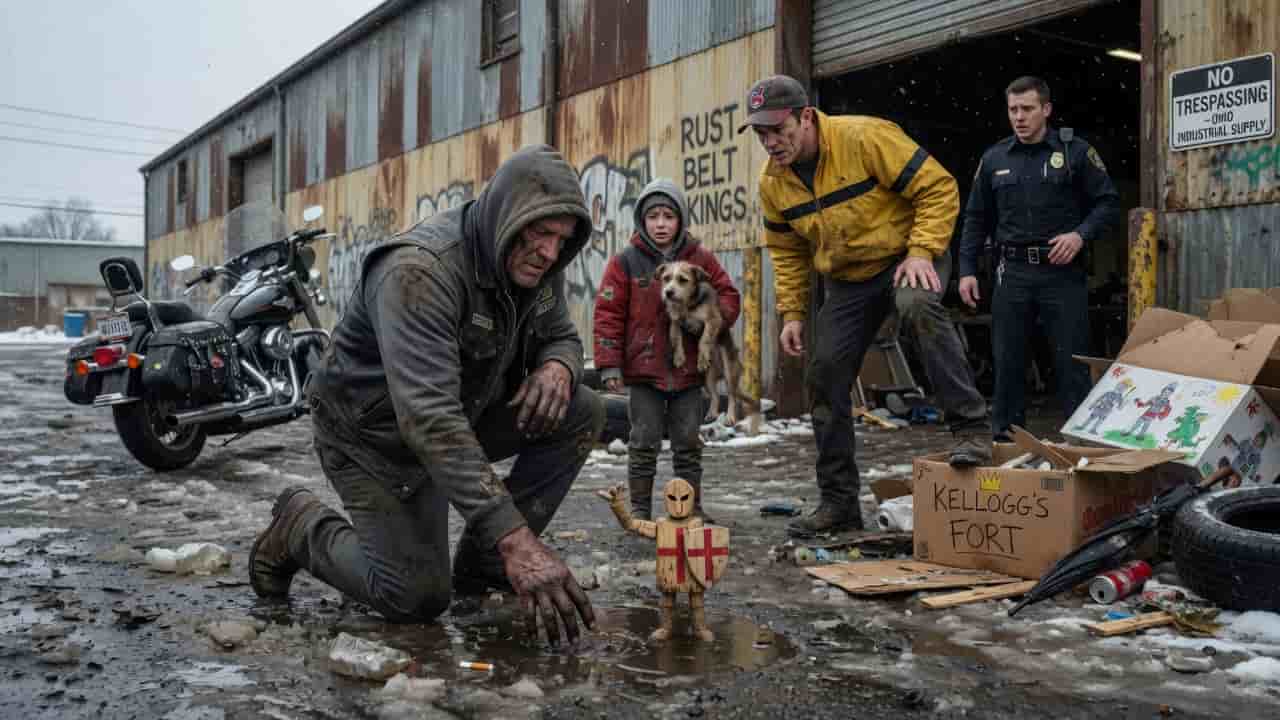
“It’s just garbage, kid. Just like the people who left you here.”
I watched from the seat of my bike as Gage kicked the cardboard walls in. He’s one of Russo’s collectors, a man who thinks a yellow windbreaker and a clip-on badge makes him king of the county. He wasn’t just taking the boy’s fort; he was taking the last bit of dignity the kid had left.
Toby stood there in the Ohio slush, clutching that mangy terrier of his, his face white with a kind of shame no eight-year-old should ever know. When Gage saw the little wooden knight I’d spent three nights carving in the back of the shop, he didn’t just take it. He dropped it in the mud and ground his boot into it while the local deputy stood in the warehouse doorway and looked at his fingernails.
“Say it again,” I said, stepping off the bike.
The whole alley went quiet. Even the wind seemed to hold its breath. Gage looked at me, then at the deputy, trying to find his courage in the silence. He didn’t know about the fire. He didn’t know about the nights I spent in the bar while my own life turned to ash.
But he was about to find out what happens when a man who has nothing left to lose decides to stand up for a boy who has nothing left to give.
I reached into the mud and picked up the knight. I saw the “D” I’d carved on the bottom—the same mark I used to put on the toys I made for a son who never got to grow up.
“Look at the mark,” I told him. “Then tell me if you still think this is garbage.”
Chapter 1: The Weight of Grain
The wood rasp made a sound like a heavy breath against the cedar. It was the only sound in the back of the shop, other than the rhythmic tick-ping of the furnace cooling down in the corner. Dutch sat on a three-legged stool, his knees flared out to accommodate his frame. He was a big man, the kind of big that made doors seem too small and chairs seem like they were built for children. His hands, thick-fingered and mapped with scars from thirty years of welding and engine work, moved with a delicacy that didn’t belong to the rest of his body.
He was carving a horse. Or at least, the idea of a horse. It was small, no bigger than a pack of cigarettes. He focused on the curve of the neck, where the muscle would bunch if the animal were real. He didn’t use a power tool. He used a small, carbon-steel whittling knife he’d sharpened until the edge was invisible.
The shop was in Elyria, Ohio, a town where the sky was the color of a wet sidewalk for six months of the year. Outside, the slush was turning to ice as the sun dipped behind the jagged silhouette of the old steel mills. This part of town didn’t get much light, even at noon. It was a place of brick, rust, and people who had learned to talk without moving their lips too much.
A soft scratching came from the side door—the one that led to the alley.
Dutch didn’t look up. He didn’t have to. He knew the rhythm of that scratch. It wasn’t a stray cat, and it wasn’t the wind. It was Toby.
“Door’s open,” Dutch said. His voice was a low rumble, like a truck idling in the distance.
The heavy steel door creaked open just enough for a small, shivering figure to slip through. Toby was eight, but he had the eyes of a man who had already seen his best days and was waiting for the bill to arrive. He was wearing a red puffer jacket that had lost most of its loft, the fabric torn at the elbow and patched with silver duct tape. Behind him, a terrier mix with more wire-hair than sense trotted in, shaking the freezing rain off its coat.
The dog, a mutt Toby called ‘Buster,’ headed straight for the space under the workbench. Toby stayed by the door, his hands shoved deep into his pockets. He smelled like woodsmoke and damp cardboard.
“He’s cold,” Toby said, nodding toward the dog.
“The dog is always cold, Toby. It’s February in Ohio.” Dutch blew a spray of cedar shavings off the workbench. He didn’t look at the boy, but he shifted his weight on the stool, clearing a space on the edge of the bench. “There’s a space heater by the drill press. Don’t put your coat on it. It’ll melt.”
Toby moved into the warmth, his movements jerky and uncertain. He watched Dutch’s hands for a long minute. “What is it?”
“A horse.”
“Why?”
“Because the wood wanted to be a horse.”
Toby frowned, stepping closer. “Wood can’t want things. It’s dead.”
Dutch finally looked up. His eyes were a pale, washed-out blue, set deep into a face that looked like it had been carved from the same cedar he was holding. There was a jagged white scar that ran from his temple down into his beard, a remnant of a night he tried to forget every time he closed his eyes.
“Everything wants something, Toby,” Dutch said. “Even the dead things. You just have to listen to the grain.”
Toby didn’t answer. He reached into his pocket and pulled out a crumpled piece of paper. He laid it on the workbench, smoothing it out with a dirty palm. It was a drawing—clumsy, crayon-sketched lines of a castle. But it wasn’t a fairytale castle. It had towers made of tires and a drawbridge that looked suspiciously like a wooden pallet.
“They’re coming tomorrow,” Toby whispered.
Dutch stopped rasping. “Who?”
“The guys from the city. Or Russo’s guys. I don’t know. The man in the yellow jacket said the alley has to be clear. He said the ‘fort’ is a fire hazard.” Toby’s voice hitched on the last word. Fire.
The word hit Dutch like a physical blow to the solar plexus. He felt the phantom heat against the back of his neck. He smelled the acrid scent of burning shingles and the sweet, terrible smell of melting plastic. For a second, the shop vanished. He wasn’t in Elyria. He was back in that house in Akron, staring at the orange glow in the window, holding a grocery bag of beer and realized he was too late. He’d been at the bar for ‘just one more,’ and the world had ended without him.
He forced his lungs to expand. He forced his fingers to stay steady on the cedar.
“A fire hazard,” Dutch repeated. He looked at the boy’s drawing. The ‘fort’ was a sprawling mess of refrigerator boxes and scrap wood Toby had scavenged from the dumpsters behind the shop. It was where the boy went when the foster home got too loud, or when the woman who ran it started drinking the ‘special juice’ that made her hands heavy and her voice mean.
“I have to move it,” Toby said. “But Buster likes it there. He thinks he’s a king.”
“You can’t move a fort, kid. You can only defend it or leave it.”
“I can’t defend it,” Toby said, looking down at his sneakers. They were wet, the canvas soaked through. “I’m just me.”
Dutch looked at the small boy, then at the scarred, massive hands he possessed. He thought about the biker vest hanging on the hook by the door. The ‘Iron Knights’ patch on the back was a symbol of a brotherhood he’d mostly walked away from, but the weight of it still sat in his bones. He led that club once. He’d led men into fights that made the local news. Now, he spent his time fixing engines and carving toys he usually threw into the furnace before anyone could see them.
“You need a knight,” Dutch said.
Toby looked confused. “For the fort?”
Dutch didn’t answer. He picked up the cedar horse and set it aside. He reached into a scrap bin and pulled out a piece of kiln-dried oak. It was harder than the cedar. It would take more work. It would hurt his hands more.
“Go home, Toby,” Dutch said, his voice turning gruff. “The sun’s down. The woman will be looking for you.”
“She doesn’t look,” Toby said quietly. “She just locks the door at eight. If I’m not there, I sleep in the fort.”
Dutch felt a slow, cold anger beginning to coil in his gut. It wasn’t a sudden flare; it was a steady, rising heat. He knew the foster system in this county. It was a business. Vic Russo ran the logistics for half the city’s ‘unauthorized’ services, and the foster placements were just another way to milk state checks while keeping the kids as leverage or labor.
“Wait,” Dutch said.
He reached into a drawer and pulled out a pair of thick wool socks. They were clean, though they had a slight scent of motor oil. He tossed them to the boy.
“Put those on. And take the dog. If I hear him scratching tonight, I’m turning him into a rug.”
Toby caught the socks, a tiny flicker of a smile touching the corners of his mouth. “Thanks, Dutch.”
The boy whistled for Buster and slipped back out into the cold. Dutch watched the door for a long time after it closed. He looked at the oak in his hand. He looked at the drawing of the fort.
He picked up his knife. He didn’t start with the head. He started with the base. He carved a small, perfect “D” into the bottom of the wood. It was a mark he hadn’t used in seven years.
He began to carve a knight. A man in armor. A man who looked like he could stand against a fire.
He worked until his fingers cramped into claws. He worked until the furnace died and the shop grew so cold he could see his own breath. He didn’t go to the bar. He didn’t reach for the bottle of rye he kept under the sink for the bad nights.
He just carved. He listened to the grain. And for the first time in a long time, the grain didn’t sound like screaming. It sounded like a promise.
Chapter 2: The Shadow of the Yellow Jacket
The next morning, the Ohio sky was the color of a bruised plum. A thin layer of freezing rain had glazed the town in a treacherous shimmer. Dutch stood in the doorway of his shop, a mug of black coffee in one hand and the oak knight in the other.
The knight was finished. It wasn’t pretty. It didn’t have the polished shine of a store-bought toy. It was rugged, with visible tool marks and a heavy, grounded stance. The knight held a shield that looked too big for him and a sword that was buried halfway into the base. It looked like he wasn’t just standing; he was anchoring the world down.
Across the alley, Toby was already at work. He was trying to reinforce the walls of his fort with pieces of frozen plywood he’d dragged from the construction site three blocks over. Buster was running in circles, barking at the ice falling from the gutters.
“Morning, Dutch!” Toby called out, his breath puffing in the air. He looked exhausted, but there was a frantic energy in his movements.
Dutch nodded once. He didn’t see the kid’s foster mother. He didn’t see anyone watching the boy except for a black sedan idling at the end of the alley. The exhaust curled up from the tailpipe like a ghost. Dutch recognized the car. It belonged to Gage, one of Russo’s “compliance officers.” That was the polite term for a man who broke fingers when the protection money was late.
Dutch walked across the alley, his boots crunching on the ice. He didn’t like being out in the open. He liked the shadows of his shop, the safety of the machines. But he saw the way Gage was watching the boy. It was the look a hawk gives a field mouse.
“Toby,” Dutch said.
The boy stopped, wiping sweat from his forehead despite the cold. “Yeah?”
Dutch held out the wooden knight. Toby’s eyes went wide. He dropped the piece of plywood and took the toy with both hands, as if it were made of glass.
“He’s heavy,” Toby whispered.
“Oak is heavy. It doesn’t break easy. And it doesn’t burn fast,” Dutch said. He felt the weight of his own words. “Keep it in your pocket. If the man in the yellow jacket comes, you show him the knight.”
Toby looked at the toy, then up at Dutch. “Will he be scared of a piece of wood?”
“It’s not just wood, kid. It’s a message.”
The black sedan’s door opened. Gage stepped out. He was wearing a bright yellow windbreaker that looked like a neon sign against the grey brick of the alley. He was thin and wiry, with a face that looked like it had been sharpened on a whetstone. He had a clipboard in one hand and a look of amused malice on his face.
“Well, well,” Gage said, his voice cutting through the quiet morning. “If it isn’t the neighborhood architect. And his bodyguard.”
Dutch didn’t move. He stood like a mountain between the boy and the man. “You’re early, Gage.”
“City’s on a schedule, Dutch. This alley is a public thoroughfare. We got complaints about the… what do you call this, kid? A castle? Looks like a pile of damp tinder to me.” Gage tapped his clipboard. “The ‘Iron Knights’ don’t run this zip code anymore. I thought you knew that.”
“I don’t run anything,” Dutch said. “I just fix bikes. But the boy isn’t bothering anyone.”
“The boy is a ward of the state, Dutch. And the state—via Mr. Russo—decided this ‘fort’ is a liability. It’s coming down. Today. Right now.”
Gage stepped forward, his eyes fixed on the fort. Toby scrambled back, clutching the wooden knight to his chest. Buster began to growl, a low, vibrating sound from deep in his throat.
“Leave it alone, Gage,” Dutch said. His voice hadn’t changed volume, but the frequency had dropped. It was the sound of a storm about to break.
Gage stopped. He looked at Dutch, really looked at him. He saw the scars. He saw the way Dutch’s hands weren’t shaking. Gage was a bully, and bullies are experts at measuring risk. He knew he couldn’t take Dutch in a fair fight, but Gage never fought fair.
“You’re getting soft in your old age, Van Owen,” Gage sneered. “Protecting trash? That’s a new look for you. I’ll be back in an hour with the city truck. If this mess is still here, I’m taking the boy back to the intake center. Russo says the woman at the foster house is tired of him anyway.”
Gage turned and walked back to his car. He didn’t look back, but he slammed the door hard enough to make the ice crack on the pavement.
Toby was trembling. “He’s going to take me back, Dutch? To the big building?”
Dutch looked at the boy. He saw the terror in his eyes, the same terror he’d seen in the mirror every morning for seven years. The fear of being alone. The fear of having nowhere to go.
“No,” Dutch said. He didn’t know how he was going to keep that promise, but he knew he had to. “He’s not taking you anywhere.”
“But he said—”
“I don’t care what he said.” Dutch turned and looked at the warehouse doorway. Officer Miller was standing there, his hands in his pockets, looking at the ground. Miller was a local kid, barely twenty-four. He’d joined the force to help people, but he’d quickly learned that in this town, the police were just another department of Russo’s empire.
“Miller!” Dutch barked.
The young officer flinched and looked up. “Yeah, Dutch?”
“You seeing this?”
“I… I got orders, Dutch. It’s a code violation. I’m just here to make sure there’s no trouble.”
“There’s already trouble, Miller. Look at the kid.”
Miller looked at Toby, then looked away. He looked ashamed, but shame doesn’t stop a city truck. “I can’t do anything, Dutch. You know how it is.”
Dutch didn’t answer. He walked back into his shop and picked up his phone. He hadn’t called the number in years. He didn’t even know if it still worked.
“Hammer?” Dutch said when the line picked up.
“Who’s this?” a gravelly voice asked.
“It’s Dutch.”
There was a long silence on the other end. “I thought you were dead, Dutch. Or worse.”
“I need the brothers. I need fifty bikes in the alley behind the old mill in an hour. We’re defending a fort.”
“A what?”
“A fort, Hammer. Bring your tools.”
Dutch hung up. He looked at the wooden knight on his workbench—the one he’d carved for his son. No, this was the horse. The knight was in Toby’s pocket.
He grabbed his leather vest. He felt the weight of the patches. He felt the ghost of the man he used to be. He wasn’t sure if he liked that man, but he knew that man was the only one who could save the boy.
Chapter 3: The Destruction of the Kingdom
The city truck arrived at exactly 10:00 AM. It was a grimy orange flatbed with a hydraulic claw, driven by two men who looked like they’d rather be anywhere else. Gage was right behind them in his black sedan, his yellow windbreaker vibrant against the falling sleet.
Toby was standing inside his fort, his small hands gripping the cardboard edges. Buster was beside him, barking frantically at the approaching engine noise. The boy looked tiny, a splash of red against the grey debris.
“Move it, kid!” Gage shouted, leaning out of his car window. “Last warning!”
Toby didn’t move. He reached into his pocket and pulled out the wooden knight, holding it up like a talisman.
Gage laughed. It was a sharp, ugly sound. He stepped out of the car and signaled to the driver of the truck. “Clear the trash! If he doesn’t move, pick him up with it!”
The hydraulic arm groaned, the metal claw opening like the maw of a beast. Officer Miller stood by his cruiser, his hand hovering over his radio, but he didn’t move. He looked like he wanted to vomit.
“Stop!” Toby screamed, but his voice was drowned out by the roar of the truck.
The claw descended. It didn’t hit Toby, but it slammed into the refrigerator box next to him, crushing it into a pulp of wet paper. Toby fell back, the dog yelping as they were showered with debris.
“That’s it!” Gage cheered, walking toward the fort. “Tear it all down!”
Gage reached the edge of the fort and grabbed a piece of scrap wood, ripping it away. He looked down at Toby, who was curled in a ball on the wet ground.
“I told you, kid. You’re nothing. Your toys are nothing.”
Gage saw the wooden knight in Toby’s hand. He snatched it away with a cruel jerk.
“What’s this? A little doll?” Gage sneered. He held the knight up, looking at it with mock curiosity. “Did the big biker make this for you? It’s pathetic.”
Gage dropped the knight into a puddle of grey slush and ground his boot into it. “Just like you, Toby. Mud and garbage.”
Toby let out a sound—a high, broken wail that cut through the mechanical noise of the truck. It was the sound of a heart breaking, pure and unadorned.
“Pick it up,” a voice rumbled.
Gage froze. The truck driver killed the engine. The sudden silence was heavier than the noise had been.
Dutch was standing at the mouth of the alley. He wasn’t alone.
Behind him, the low, rhythmic throb of fifty heavy engines began to fill the air. It wasn’t a roar yet; it was a growl. A sea of black leather and chrome began to pour into the narrow space. Men with names like Hammer, Snake, and Bear—men Dutch hadn’t seen in a decade—were pulling their bikes into a semi-circle, cutting off the city truck and Gage’s sedan.
Dutch walked forward. He didn’t run. He walked with the slow, inevitable pace of a tide. He was wearing his vest, the ‘Iron Knights’ logo clear and bold.
Gage looked at the bikers, then at Dutch. His face went from arrogant to pale in three seconds. “Van Owen… what is this? This is city business. You can’t interfere.”
Dutch didn’t look at Gage. He looked at Toby. He saw the boy on the ground, the dog licking his face. He saw the wooden knight buried in the mud under Gage’s boot.
“I said pick it up,” Dutch repeated. He was five feet away now.
Gage looked at Officer Miller. “Officer! Do something! This is an illegal assembly!”
Miller looked at the fifty bikers, then at Dutch, then at the crying boy. He slowly took his hand off his belt and folded his arms. “I don’t see any assembly, Gage. I just see some guys looking at a bike shop. Looks like a routine maintenance meet-up to me.”
Gage’s mouth hung open. He looked back at Dutch. “You’re crazy. Russo will kill you for this.”
“Russo isn’t here,” Dutch said. He reached out and grabbed Gage by the collar of his yellow windbreaker. He didn’t hit him. He just lifted him until Gage was on his tiptoes. “The boy asked you nicely to stop. I’m not going to ask you again.”
“Okay! Okay!” Gage squeaked, his bravado vanishing.
“Pick up the toy. Clean the mud off it.”
Dutch let go. Gage stumbled, nearly falling into the slush. He reached down, his fingers trembling, and retrieved the wooden knight. He wiped it on his yellow jacket, the mud leaving a long, dark streak across the bright fabric.
“Give it to the boy,” Dutch commanded.
Gage handed the knight to Toby. The boy took it, his eyes wide with shock. He looked at the toy, then at the fifty bikers behind Dutch. He looked at Dutch like he was seeing a god.
“Now get out of here,” Dutch said to Gage. “Take the truck with you. If I see a city worker in this alley again, I’m going to assume they’re here to fix the potholes. And if they aren’t fixing potholes, they’re going to have a very bad day.”
Gage didn’t wait. He scrambled into his car and peeled out, nearly hitting the city truck as it backed away in a hurry.
The alley was quiet again, except for the idling of the bikes.
Hammer, a man with a beard down to his chest and arms the size of Dutch’s thighs, hopped off his motorcycle and walked over. He looked at the crushed cardboard of the fort, then at Toby.
“This the king of the castle?” Hammer asked, his voice like grinding stones.
Toby nodded tentatively.
“Well,” Hammer said, looking at Dutch. “The castle looks like shit, Dutch. We’re gonna need some real lumber.”
“We are,” Dutch said. He felt a strange sensation in his chest. It wasn’t the heat of the fire. It was something else. A flicker of something he thought had died in Akron.
He looked at Toby. The boy was holding the knight tight. He wasn’t crying anymore. He looked… safe.
“Come on, Toby,” Dutch said. “We’re going into the shop. It’s too cold out here for a king.”
Chapter 4: The Residue of the Storm
The back of the shop was crowded. It was filled with the smell of wet leather, stale cigarettes, and the heavy, metallic scent of the bikers. Hammer and three other men were huddled over a workbench, sketching out plans on the back of a pizza box. They weren’t talking about engines. They were talking about structural integrity, weather-proofing, and where to put the “lookout tower.”
Toby was sitting on Dutch’s carving stool, wrapped in a giant wool blanket Lu had brought over from the bar. Lu was a woman who had survived three husbands and two recessions; she didn’t take crap from anyone, and she currently had a plate of grilled cheese sandwiches in front of the boy.
“Eat, kid,” Lu said. “You’re nothing but skin and bone. How are you supposed to defend a castle if you’re fainting from hunger?”
Toby took a bite, his eyes darting around the room. He looked overwhelmed, but the terror had been replaced by a quiet, vibrating wonder. Buster was curled up at his feet, gnawing on a piece of beef jerky Snake had given him.
Dutch stood by the back door, watching them. He felt like an outsider in his own shop. He’d spent seven years building a wall of silence, and in one hour, these men had torn it down.
“You did a good thing, Dutch,” Lu said, walking over to him. She didn’t look at him; she looked at the boy. “But you know Russo won’t let this go. He can’t. Not in front of the town.”
“I know,” Dutch said.
“He’ll come for the kid’s foster placement. He’ll find a way to make it legal. Or he’ll just make the kid disappear into the system in another county.”
Dutch tightened his grip on the doorframe. He knew she was right. Today was a victory, but it was a small one. He’d poked the hornets’ nest.
“I’m not letting him take him,” Dutch said.
“And how are you gonna stop him? You’re a welder with a record and a club that’s half-retired. You’re not his father, Dutch.”
The words hit the wound. You’re not his father. Dutch looked at the boy. Toby had pulled the wooden knight out of his pocket and set it on the table next to his sandwich. He was talking to the knight, whispering something Dutch couldn’t hear.
“I have the proof,” Dutch whispered.
“Proof of what?”
“The ‘D’ on the bottom of the toy.”
Lu frowned. “What does a carving mark prove? Other than you’re a decent whittler?”
Dutch turned to her. His eyes were hard, but there was a crack in the ice. “In Akron… before the fire… I worked for a guy who did private security. High-end stuff. I saw things I wasn’t supposed to see. Documents. Names. Russo wasn’t always a mobster. He was a clerk for the state’s social services. He’s the one who set up the shell companies that handle the foster checks.”
Lu’s eyes went wide. “Dutch… if you have that…”
“I don’t have the papers. They burned. But I have the memory. And I have the knight.”
“The knight isn’t a ledger, Dutch.”
“No. But the knight is why he’s afraid. He knows who I am. He knows I’m the only one left who remembers what he did before he had the yellow jackets and the black sedans.”
Dutch walked over to the boy. Toby looked up, his mouth full of grilled cheese.
“Toby,” Dutch said. “I need to tell you something. About the knight.”
Toby swallowed. “Is he okay? Gage got him all muddy.”
“He’s fine. Oak can handle a little mud. But listen to me. That knight… he’s not just a toy. He’s a guardian. As long as you have him, you’re part of the club. Do you understand?”
Toby nodded solemnly. “Like the ‘Iron Knights’?”
“Exactly like that.” Dutch reached out and put a hand on the boy’s shoulder. His hand covered almost the entire span of the boy’s back. “But being in a club means you have to be brave. Even when I’m not standing right next to you.”
“I’m trying, Dutch.”
“I know you are.”
A heavy knock came at the front door of the shop. The room went silent. Hammer reached for a heavy pipe wrench on the bench. Snake moved toward the door, his hand disappearing into the small of his back.
“It’s the law,” a voice called out. “Miller.”
Dutch signaled for the men to stand down. He walked to the front and opened the door. Officer Miller was standing there alone. He wasn’t wearing his hat. He looked exhausted.
“Russo’s at the station,” Miller said, his voice barely a whisper. “He’s filing kidnapping charges against you, Dutch. He says you used the club to intimidate a city official and took the boy by force.”
“The boy is right there,” Dutch said, gesturing to the back. “He’s eating a sandwich.”
“It doesn’t matter. He has the paperwork. He’s coming with the Sheriff and a state worker in an hour. They aren’t coming for the fort this time, Dutch. They’re coming for you. And they’re taking the boy to a high-security facility in Columbus.”
Dutch felt the cold settle back into his bones. He looked at Miller. “Why are you telling me this?”
Miller looked at the floor. “Because my dad used to talk about you. He said you were the only man in this town who ever stood up for someone who couldn’t pay you back. I don’t want to be the guy who cuffs you, Dutch.”
“Then don’t be,” Dutch said.
He turned back to the room. The bikers were all watching him. They knew the stakes now. This wasn’t a playground fight anymore. This was a war with the state.
“Hammer,” Dutch said.
“Yeah, boss?”
“Get the trucks. We’re moving the boy. And Lu, get your car. We need a decoy.”
“Where are we going?” Toby asked, standing up from the stool. He was clutching the wooden knight so hard his knuckles were white.
Dutch looked at the boy. He looked at the “D” on the bottom of the knight. He thought about the bar in Akron. He thought about the fire. He thought about the son he couldn’t save.
“We’re going to finish the fort, Toby,” Dutch said. “But we’re building it somewhere they can’t find it.”
As the bikes began to roar to life in the alley, Dutch felt the residue of the day clinging to him like soot. He wasn’t a welder anymore. He wasn’t a ghost. He was a man with a boy to protect, and for the first time in seven years, he wasn’t afraid of the heat.
He picked up his carving knife and slipped it into his boot.
“Let’s move,” he said.
Chapter 5: The Geography of Ash
The convoy didn’t move with the thunderous roar of a parade. They moved with a disciplined, low-frequency hum that seemed to vibrate through the very asphalt of the Ohio backroads. Fifty bikes, split into staggered formations, cutting through the slushy grey veins of the Rust Belt. Dutch rode at the head, his massive frame catching the brunt of the freezing wind. In his rearview mirror, he could see the headlights of Lu’s old Buick, where Toby was tucked into the backseat, hidden behind tinted glass and the protective bulk of Hammer’s younger brother, a silent giant named Silas.
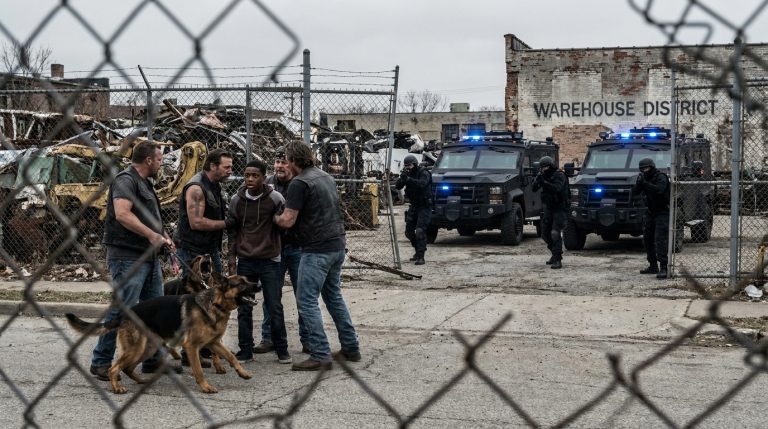
They weren’t heading for the highway. The highway was where the state troopers lived, and right now, Dutch was a man who had technically abducted a ward of the state. He knew the terminology. He knew how the paperwork would look. Kidnapping. Interference with a government official. Reckless endangerment. The words felt heavy, like wet wool against his skin, but they didn’t feel as heavy as the memory of Toby’s face when Gage had ground that wooden knight into the mud.
The “fort” they were heading to was an old limestone quarry on the edge of Lorain County. It was a jagged scar in the earth, surrounded by rusted machinery and abandoned gravel crushers that looked like skeletal prehistoric beasts. The Iron Knights had owned a small strip of land there since the seventies—a cinderblock clubhouse that didn’t appear on most modern maps. It was a place where the world ended, and the rules of the city faded into the sound of the wind rattling through the dead pines.
When they arrived, the sun was nothing more than a pale, sickly bruise on the horizon. The bikers fanned out, their boots crunching on the frozen gravel. Dutch didn’t get off his bike immediately. He sat there, the engine idling beneath him, feeling the heat of the block against his shins. He looked at his hands. They were steady, but the skin around the knuckles was white.
“He’s asleep,” Lu said, walking up to his bike. She looked tired. The neon lights of the bars she’d spent her life in seemed to have followed her out here, etched into the lines around her eyes. “Poor kid was out before we hit the county line. I think the adrenaline just ran out of him.”
“Good,” Dutch said. He killed the engine. The silence that followed was absolute, save for the ticking of cooling metal. “Let him sleep as long as he can. The air is going to get thin soon.”
“Russo is going to put out an Amber Alert, Dutch. You know that. He’ll frame this as a biker gang snatching a kid for leverage.”
“Let him,” Dutch said, swinging his leg over the seat. He stood up, his joints popping. “The more noise he makes, the more people start looking at why a sixty-year-old welder decided to start a war over a cardboard fort. Russo likes the dark. He’s spent twenty years in the shadows of the social services budget. He doesn’t want the light.”
Dutch walked toward the clubhouse. Inside, the air smelled of woodsmoke, old beer, and the cold, metallic scent of stored motorcycles. Hammer was already there, throwing logs into a massive cast-iron stove. The man looked at Dutch, his eyes reflecting the orange glow of the growing fire.
“We got guards on the access road,” Hammer said. “But we can’t stay here forever, Dutch. The Sheriff in this county isn’t like Miller. He’s on Russo’s payroll, and he’s got a SWAT team that likes to play soldier.”
“I’m not looking for a standoff, Hammer,” Dutch said, pulling out a chair. It groaned under his weight. “I’m looking for a conversation.”
“With Russo? The man doesn’t converse. He dictates.”
“He dictates because he thinks nobody has the alphabet,” Dutch said. He reached into his vest and pulled out his carving knife, absentmindedly tracing the edge with his thumb. “But I remember the names. Before the fire in Akron, when I was working for Miller’s old man doing ‘off-the-books’ security, I spent a month in a records room in Columbus. Russo was the lead auditor. I saw the D-files.”
Hammer paused, a log halfway to the stove. “The D-files?”
“Dependent Diversion,” Dutch said. “It was a program meant to find private placement for high-risk kids. But Russo found a way to divert the funds into shell companies. The ‘D’ wasn’t for Dependent. It was for ‘Discretionary.’ His discretionary slush fund. He’s been building his empire on the backs of kids like Toby for two decades. Every ‘fort’ he tears down is just a way to make sure there are no witnesses to the neglect.”
“You have proof?”
“The proof is in the system. But the key… the key is the mark. When I was in that room, I saw how he signed off on the ‘unrecoverable’ cases. He didn’t use his name. He used a stamp. A small, stylized ‘D’ with a cross-bar through it. He thought it was clever. A private joke.”
Dutch reached into his pocket and pulled out the wooden horse he’d been carving before Toby arrived. He looked at the base. “The mark I put on the toys… it’s not his mark. But it’s close enough to make him sweat. When he saw that knight in Toby’s hand today, he didn’t see a toy. He saw a ghost. He thinks I have the original audit stamps.”
“Do you?”
Dutch looked at the fire. The orange flames licked at the wood, turning the grain to ash. He remembered the smell of his own home burning. He remembered the way the heat had felt like a solid wall, keeping him back, punishing him for the beer he’d had at the bar. He remembered the silence of the morgue.
“No,” Dutch whispered. “The stamps burned with everything else. But he doesn’t know that. He’s a man built on secrets, and men like that assume everyone else is hiding something even worse.”
The door to the clubhouse opened, and Silas carried Toby in, the boy still wrapped in the wool blanket. Toby’s eyes were half-open, glazed with sleep and confusion. He looked around the rough, dimly lit room, his gaze finally settling on Dutch.
“Dutch?” Toby’s voice was small, barely audible over the crackle of the stove. “Are we in the new castle?”
Dutch stood up and walked over, his shadow looming large on the cinderblock walls. He knelt down so he was eye-level with the boy. He felt a sudden, sharp pang of grief—the kind that usually only hit him at 3:00 AM when the world was quiet. Toby looked so much like his son, Daniel, would have looked if the smoke hadn’t gotten to him first.
“We’re in the staging area, kid,” Dutch said, his voice softer than he’d ever heard it. “The castle is being built. But first, we have to make sure the dragons stay in their caves.”
Toby reached out a small, trembling hand and touched the ‘Iron Knights’ patch on Dutch’s chest. “Are you a king, Dutch?”
“No, Toby,” Dutch said, closing his massive hand over the boy’s small one. “I’m just the guy who sharpens the swords.”
“I still have him,” Toby said, digging into the folds of the blanket and pulling out the wooden knight. The oak was stained with the grey mud of the alley, but it was still solid. “He’s still guarding me.”
“He’ll always guard you,” Dutch said. “But tomorrow, Toby, I need you to be the knight. I need you to stand up and tell the truth to the people in the suits. Can you do that?”
Toby looked at the wooden figure, then back at Dutch. He saw the scars on Dutch’s face. He saw the grey in the man’s beard. He saw the way the other giant men in the room were looking at Dutch with a kind of fierce, quiet loyalty.
“Will you be there?” Toby asked.
Dutch felt the weight of seven years of failure pressing down on him. He thought about the bar. He thought about the ‘one more drink.’ He thought about the fire he hadn’t put out.
“I won’t leave the room, Toby,” Dutch said. “Not for a second. That’s a promise on the wood.”
Toby nodded, satisfied, and closed his eyes again, his head sinking into Silas’s shoulder.
Dutch stood up, his face hardening. He turned to Hammer. “Call the Sheriff’s office. Tell them I’m coming in tomorrow morning. At the county courthouse. Not the station. I want witnesses. I want the press. And tell them if Russo isn’t there, the ‘D-files’ go live on the internet by noon.”
“You’re bluffing, Dutch,” Hammer said, a grim smile touching his lips.
“I’ve spent seven years living in a ghost story, Hammer,” Dutch said, looking at the wood rasp on the table. “I’m done being the ghost. It’s time to start the fire.”
The rest of the night was a slow, agonizing crawl. Dutch didn’t sleep. He sat by the stove, his whittling knife moving rhythmically against a fresh piece of oak. He wasn’t carving a toy this time. He was carving a grip for a heavy iron pry-bar he’d found in the corner. He worked the wood until it was smooth, perfectly fitted to his hand.
He thought about the geography of his life. Akron, Elyria, Lorain. It was a map of loss. Every town had a story of something he’d broken or someone he’d failed. But Toby wasn’t a story yet. Toby was a living, breathing boy who still believed that a piece of oak could protect him from the world.
As the first light of dawn began to creep over the edge of the quarry, turning the limestone into a cold, pale white, Dutch stood up. He felt old. His back ached, and his lungs felt heavy with the dust of the shop. But when he looked at Toby, sleeping peacefully on a cot in the corner, he felt a clarity he hadn’t known since before the fire.
He didn’t need to save the world. He just needed to save this one room.
“Load up,” Dutch said as the other bikers began to stir. “We have a court date.”
The ride back into the city was different. The staggering formation was tighter, the bikes closer together. They didn’t avoid the main roads this time. They rode straight down the center of the boulevard, a black river of defiance flowing toward the courthouse. People stopped on the sidewalks to watch them pass. Shopkeepers stood in their doorways.
Dutch could see the police cruisers waiting at the perimeter of the courthouse square. He could see the flash of red and blue lights. He could see the news vans with their satellite stalks reaching for the grey sky.
He felt the weight of the wooden knight in Toby’s pocket from across the distance between the bike and the car. He felt the weight of the “D” carved into his own soul.
He didn’t slow down. He accelerated.
Chapter 6: The Verdict of the Grain
The Lorain County Courthouse was a grand, imposing structure of granite and marble, built during a time when people still believed that architecture could impose morality. Today, it felt like a fortress. A line of deputies stood at the top of the stairs, their faces set in masks of professional indifference. Behind them, through the heavy glass doors, the lobby was packed with reporters and city officials.
In the center of the storm stood Vic Russo. He was wearing a charcoal suit that probably cost more than Dutch’s shop, his hair perfectly coiffed, a look of concerned paternalism on his face. Beside him was the County Sheriff, a man named Miller—no relation to the young officer, though they shared the same badge. This Miller was older, thicker, and his eyes were the color of cold coins.
The roar of the fifty bikes as they pulled into the square was like a physical blow. The engines died in unison, leaving a ringing silence that was even more aggressive.
Dutch dismounted first. He didn’t take off his helmet until he was standing at the base of the stairs. He looked up at Russo. The man didn’t flinch, but Dutch saw the way his fingers twitched against his silk tie.
“Mr. Van Owen,” Russo said, his voice projecting easily for the microphones. “I’m glad you’ve decided to do the right thing. Kidnapping is a very serious charge, especially for a man with your… history.”
Dutch didn’t answer. He walked to the back of Lu’s Buick and opened the door. Toby stepped out, clutching Buster. The boy looked small in the shadow of the courthouse, but he held his head up. He was wearing the wool socks Dutch had given him, and his red puffer jacket was zipped to the chin.
“Toby,” Russo said, stepping forward with a practiced smile. “Come here, son. You’re safe now. These men won’t hurt you anymore.”
Toby didn’t move toward Russo. He moved toward Dutch, grabbing the big man’s hand.
“I’m not a son,” Toby said, his voice clear and sharp in the cold air. “I’m a knight. And Dutch says you’re the dragon.”
A ripple of laughter and murmurs went through the crowd. Russo’s smile didn’t slip, but his eyes turned into chips of ice. “The boy is obviously traumatized. Sheriff, take him into custody. Mr. Van Owen, you’re under arrest.”
Sheriff Miller stepped forward, his hand on his handcuffs. “Turn around, Dutch. Don’t make this harder than it has to be.”
“I’m not making it hard, Sheriff,” Dutch said, his voice like grinding tectonic plates. “I’m making it public. You want the boy? You take him in front of the cameras. But before you do, maybe you should ask Mr. Russo about the ‘D-files.’ Specifically the ones from the 2019 fiscal audit of the Lorain County Foster Care Fund.”
Russo’s face went pale—not the pale of fear, but the grey of a man who realized he’d stepped into a trap he thought he’d dismantled years ago. “I have no idea what you’re talking about. This is a desperate attempt by a criminal to deflect—”
“I have the mark, Vic,” Dutch interrupted. He reached into his pocket and pulled out the small wooden knight he’d retrieved from the mud the day before. He held it up, but he didn’t show the face. He showed the base. “You remember the stamp? The one you used to sign off on the ‘lost’ kids? The ones whose checks kept coming even after they were ‘moved’ to other counties?”
The cameras zoomed in on the wooden figure. To the reporters, it just looked like a carving. But to Russo, it was a death warrant. He knew Dutch had been in that records room. He knew Dutch was the only person alive who could connect the dots between the old state bureaucracy and the current mob-run foster system.
“That proves nothing,” Russo hissed, his voice dropping so only those on the stairs could hear. “It’s a piece of wood, Van Owen. My word against a biker’s.”
“It’s not just his word,” a new voice said.
Officer Miller stepped out from behind the line of deputies. He wasn’t wearing his hat, and his badge was pinned crookedly to his chest. He looked terrified, but he didn’t back down.
“I went back to the warehouse this morning,” Miller said, looking at the Sheriff. “I found the records Gage was trying to burn in the incinerator. He didn’t get them all. There are names, Sheriff. Kids who were listed as ‘relocated’ but were actually just dumped in uncertified homes while the state checks were rerouted to a holding company called ‘Iron Gate Logistics.’ Russo’s name is all over the incorporation papers.”
The silence that followed was absolute. Even the news cameras seemed to stop whirring.
Sheriff Miller looked at Russo, then at his own deputy. He saw the crowd. He saw the fifty bikers behind Dutch, their faces grim and expectant. He knew which way the wind was blowing. A Sheriff who protects a mobster is a Sheriff who loses an election—or ends up in a cell next to him.
“Vic,” the Sheriff said, his voice heavy. “Step back.”
“You can’t be serious!” Russo shouted. “This is a setup! That boy belongs to the state!”
“The boy belongs to himself,” Dutch said. He looked down at Toby. “Tell them, Toby. Tell them about the fort. Tell them why you were sleeping in an alley.”
Toby looked at the microphones, then at the crowd. He looked at the wooden knight in Dutch’s hand. He took a deep breath.
“He told me I was garbage,” Toby said, pointing at Russo. “He said the fort was just tinder. But it wasn’t. It was where I looked after Buster. And Dutch carved me a guardian so the fire wouldn’t get me.”
The word fire hung in the air like a ghost. Dutch felt it—the heat, the shame, the memory. But for the first time, the memory didn’t burn him. It fueled him.
“Take him,” the Sheriff said to his deputies, nodding toward Russo.
As the deputies moved in to cuff Russo, the man began to scream—about lawyers, about power, about the people he owned. But nobody was listening. The story had already moved past him. The story was now about the big man in the leather vest and the small boy in the red jacket.
The kidnapping charges were dropped within the hour, replaced by a temporary emergency guardianship granted by a judge who was more than happy to distance himself from the Russo scandal.
Later that afternoon, the sun finally broke through the Ohio clouds, casting a long, golden light over the alley behind the bike shop. The city truck was gone. Gage was in a holding cell. And the “Iron Knights” were back, but they weren’t riding.
They were building.
Hammer was running a circular saw, the scream of the blade cutting through the quiet. Silas and Snake were hauling 4×4 cedar posts. Lu was presiding over a cooler of soda and a mountain of pizza.
Dutch sat on his three-legged stool in the doorway of the shop, watching them. He was carving again. A small dog, this time. A terrier with wire-hair.
Toby was in the center of the alley, where a new structure was rising. It wasn’t made of cardboard. It was made of solid cedar and oak, with a shingled roof and a real door that locked from the inside. It was a fort that could withstand a storm. It was a fort that wouldn’t burn.
“Dutch!” Toby called out, running over. He was holding a piece of sandpaper. “Hammer says I have to sand the edges so the king doesn’t get a splinter.”
“Hammer’s right,” Dutch said. “Detail work is what makes the structure hold.”
Toby stopped, looking at Dutch. “Are you coming to see the inside? We put a chair in there for you. A big one.”
Dutch looked at the boy, then at the shop behind him. He looked at the scars on his hands. He thought about the house in Akron. He knew the pain wouldn’t ever truly go away. He knew the residue of the fire would be with him until the day they put him in the ground.
But as he looked at the “D” on the bottom of the wooden knight sitting on his workbench, he realized that the mark didn’t have to mean Death or Debt. It could mean Defend.
“In a minute, kid,” Dutch said, standing up. He felt the weight of his years, but he also felt the strength of the wood. “I just have to finish the dog.”
Toby smiled—a real, bright smile that reached his eyes—and ran back to his new castle.
Dutch picked up his knife. He listened to the grain. It was quiet now. It was peaceful. He made a single, precise cut, shaping the ear of the wooden dog.
He wasn’t a ghost anymore. He was a man with a shop, a club, and a boy who needed a chair.
He put the knife in his pocket and walked out into the light. The alley was full of the sound of building, the scent of fresh cedar, and the low, steady hum of a life that had finally found its way home.
The fort was finished. And for the first time in seven years, Dutch Van Owen wasn’t afraid to step inside.