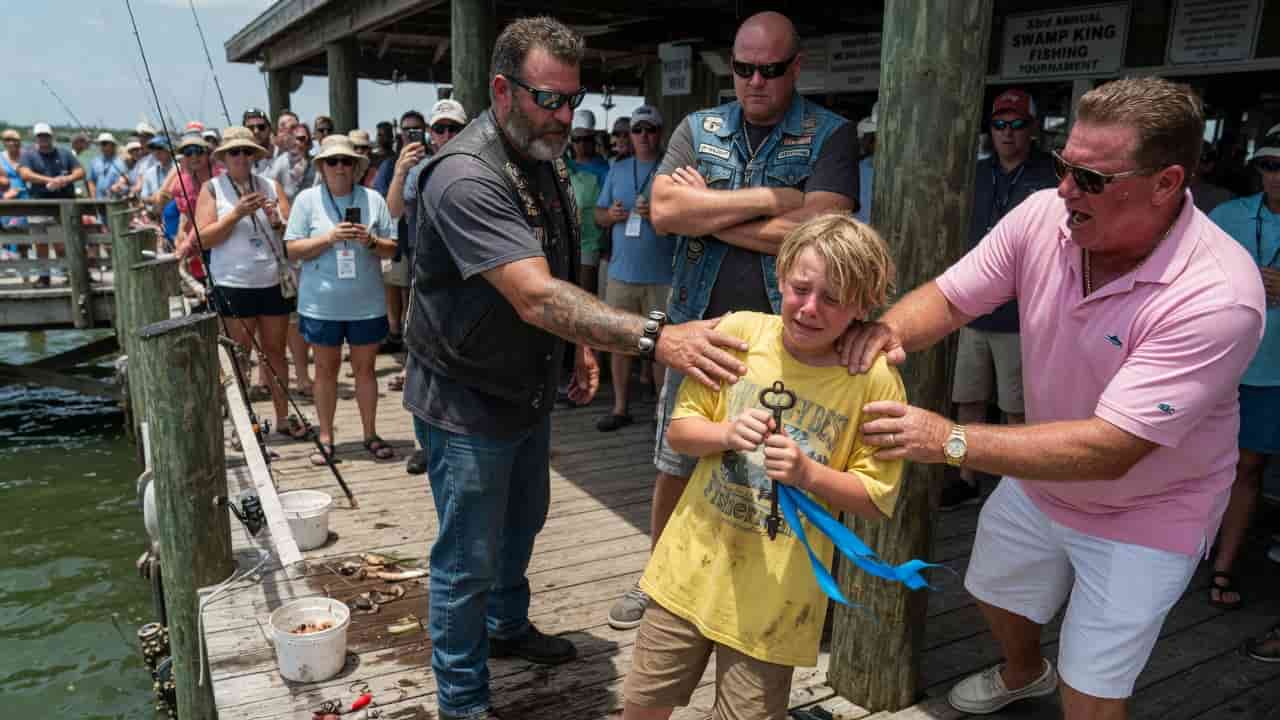
“Empty your pockets, you little rat!” the man in the pink polo screamed, his face turning a dangerous shade of purple as he cornered the trembling ten-year-old against the pier railing. The crowd at the fishing tournament just watched, a wall of tourists and locals who didn’t want to get involved with a rich man’s rage and a kid who looked like he lived in the weeds.
I didn’t care about the man’s missing watch. I didn’t even care about the boy’s fear until I saw the man’s hand go up to strike.
When I caught his wrist, the world went quiet. The rich man sputtered, looking up at my vest, my scars, and the look in my eyes that usually makes men run. He pointed a shaking finger at the boy’s clenched fist. “Look at what he’s hiding! That’s a thief’s prize right there!”
The boy’s hand slipped. The object didn’t fall, it just swung. It was an old iron key, heavy and rusted, tied with a piece of frayed silk ribbon so blue it looked like a piece of the Florida sky.
My heart stopped beating.
I knew that ribbon. I had bought a spool of it ten years ago. I’d used a piece of it to tie a key exactly like that one to my wife’s hand before they closed the lid on a casket we all knew was empty. Her body had never been found in the swamp after the accident, but we’d buried the box anyway.
The key was supposed to be six feet under the Georgia clay. Instead, it was here, dangling from the hand of a boy who had the same defiant, terrified eyes as the woman I’d lost.
I looked at the boy, my voice barely a whisper. “Where did you get that, kid?”
He didn’t answer. He just looked at me like he recognized a ghost.
I realized then that the casket wasn’t the only thing that had been empty for a decade.
Chapter 1: The Empty Weight of Georgia Clay
The heat in the Everglades isn’t just a temperature; it’s a physical weight, a wet wool blanket that smells of rotting vegetation and stagnant water. It clings to your skin and works its way into your lungs until every breath feels like an effort. I sat on the rusted bumper of my Shovelhead, the metal hot enough to sting through my jeans, and watched the dragonflies dart over the black-water canal.
Behind me, the Iron Skulls were making enough noise to wake the gators. Specs was hunched over a map spread across a grease-stained crate, his reading glasses sliding down his nose as he traced the narrow service roads that cut through the sawgrass. Deacon was leaning against a cypress tree, methodically cleaning the dirt from under his fingernails with a buck knife. They were waiting for me to say something, but I’d been quiet since we crossed the Florida line.
Ten years is a long time to carry a secret that feels like a lead pipe in your gut.
“Ghost,” Specs said, his voice scratching through the hum of the swamp. “The contact says the drop is at the Sugar Mill ruins. Another twenty miles of gravel. We move now, we beat the rain.”
I didn’t look at him. I was looking at my own hands. The tattoos were faded, the ink blurred into the tanned, scarred skin of a man who had spent his life gripping handlebars and breaking things that didn’t want to stay broken. My real name is Elias Walker, but nobody had called me that since the night the boat went down in the Savannah River. In the MC, I was Ghost. It was a name I’d earned because I was the only one who came back from that water, and because most of the time, I wasn’t really there anyway.
“Twenty miles,” I repeated. The words felt heavy, like I was dragging them up from a well.
“You alright, brother?” Deacon asked. He didn’t look up from his knife, but I could feel his eyes on the side of my head. Deacon was the enforcer, the man who handled the mess when the world got ugly, but he’d been with me the night we buried Sarah. He’d been the one who helped me lower the casket into the ground while the rain turned the Georgia red clay into a slurping, hungry mouth.
He was also the only one who knew the casket was empty.
The search teams had looked for three weeks. They found the wreckage of the skiff, the shattered motor, and Sarah’s sun hat snagged on a cypress knee, but they never found her. After twenty-one days, the sheriff told me the river didn’t give up its dead once they hit the deep channels. So we had a service. We put her favorite dress and a handful of photos into a mahogany box.
Right before they closed it, I’d taken the key to our first apartment—a skeleton key we’d found in the door of that drafty place in Savannah—and I’d tied a bright blue silk ribbon to it. I’d placed it where her hand should have been. I told myself it was so she could find her way home if she ever got out of the dark.
But I knew she wasn’t coming home. Sarah hated the MC. She hated the noise, the smells, the constant hum of violence that followed us like a stray dog. She’d begged me to leave, to take the payout and disappear into the mountains. I’d told her one more run. Always one more.
The night of the accident, she’d been crying. We were on the boat because I was trying to talk her down, trying to make her understand why I couldn’t just walk away. Then the log hit us. The world flipped. I remember the cold, the blackness, and the way her hand slipped out of mine.
Or maybe she let go. That was the thought that had rotted in my mind for a decade. Did she slip, or did she see the water as the only way out?
“Ghost,” Specs said again, louder this time. “We’re burning daylight.”
I stood up, my knees popping. The leather of my vest creaked. I reached up and felt the cold bite of the chain around my neck, tucked under my t-shirt. On that chain hung a matching skeleton key. I’d kept it as a penance, a reminder of the man I used to be and the woman I’d failed to protect.
“Let’s go,” I said.
We kicked the bikes to life. The roar of the engines shattered the silence of the glades, a violent intrusion into the ancient stillness of the swamp. As we pulled onto the gravel, a hawk circled overhead, its cry thin and lonely.
I didn’t care about the drop. I didn’t care about the money or the Skulls’ business in Florida. I was here because of a letter I’d received three weeks ago. No return address, just a postmark from Florida City and a single sentence written in a hand I would have recognized in a blackout.
The key still fits the lock.
If it was a trap, I didn’t care. If it was a prank, I’d kill the man who sent it. But if it was her—if Sarah was alive and had been hiding in this humid hell for ten years while I sat by an empty grave—I didn’t know what I was going to do.
We rode hard through the afternoon, the sky turning the color of a bruised plum. By the time we hit the outskirts of the town near the tournament grounds, the humidity had broken into a fine, stinging mist. We pulled into a roadside bar called The Gator’s Tooth, a low-slung building with a gravel parking lot full of pickup trucks and boat trailers.
“We hole up here,” Deacon said, killing his engine. “The tournament starts tomorrow. Half the county’s going to be on that pier. Best place to blend in is a crowd.”
I dismounted, my back aching from the ride. I grabbed my gear bag and headed toward the entrance. Inside, the air was thick with the smell of fried fish and stale beer. A neon sign flickered over the bar, casting a sickly green light over the faces of the men drinking away the day’s heat.
I took a stool at the far end of the bar, away from the TV and the jukebox. The bartender, a woman with tired eyes and hair the color of nicotine, slid a napkin toward me.
“Draft,” I said.
She nodded and moved away. I looked around the room. It was a typical Florida dive. Stuffed fish on the walls, local news on the screen, and the low roar of men talking about bait and engines. But then I saw him.
In a booth near the back, a boy was sitting by himself. He couldn’t have been more than ten. He was thin, with sun-bleached hair that looked like it hadn’t seen a comb in a week. He was wearing a yellow t-shirt that was two sizes too big for him. Beside him, under the table, was a dog—a big, rangy hunting hound with a notched ear.
The dog looked exactly like Blue, the hound I’d lost two years before Sarah disappeared.
My heart hammered against my ribs. It was a coincidence. It had to be. There were a thousand hounds in the South, and a million boys with messy hair.
The boy was looking at something in his hand. He was holding it tight, his knuckles white. Every few seconds, he’d glance toward the door, his eyes wide and panicked, like he was waiting for a blow to land.
Then a man walked in. He wasn’t local. He was wearing a pink polo shirt and white shorts, his face flushed and sweating. He looked like money and entitlement, the kind of man who had never been told ‘no’ in his life. He scanned the room until his eyes landed on the boy.
The boy saw him and froze. He tried to slide further into the booth, his small frame trembling.
“There you are,” the man barked, his voice cutting through the bar’s chatter.
I felt Deacon move behind me, his hand resting on the back of my chair. “Trouble?” he whispered.
“Not ours,” I said, but I didn’t look away.
The man in the pink polo reached the booth and slammed his hand down on the table. “I know you have it, Leo. Don’t make me call the sheriff. Give it here.”
The boy, Leo, shook his head. He tucked his hand under the table, but I could see the glint of metal between his fingers. The dog stood up, a low growl vibrating in its chest, but the man didn’t seem to notice.
“It’s mine,” the boy whispered, his voice cracking. “My mom gave it to me.”
“Your mom is a liar and a thief,” the man sneered, leaning over the table. “And you’re just like her. Now, give me the key before I lose my patience.”
At the word key, the air seemed to leave my lungs.
The man reached out and grabbed the boy’s arm, yanking him out of the booth. The dog lunged, barking fiercely, but the man kicked out, catching the hound in the ribs. The dog yelped and retreated.
The boy was crying now, his small feet dangling as the man held him by the bicep. “Let go! You’re hurting me!”
Nobody in the bar moved. The bartender looked away, wiping a glass. The men at the bar stared into their beers. This was a small town, and the man in the pink polo looked like he owned a significant portion of it.
I felt the old familiar heat rising in my chest. It wasn’t just about the boy. It was about the word key. It was about the way that man had said thief. It was about the ten years of silence that were suddenly screaming in my ears.
I stood up. My stool screeched against the floor, a sound like a dying bird.
“Ghost,” Deacon warned, his voice low. “Don’t.”
I ignored him. I walked across the room, my boots heavy on the floorboards. The man in the pink polo didn’t see me until I was five feet away. He turned, his face twisting into a sneer.
“This doesn’t concern you, Biker,” he said, the word dripping with contempt. “The kid stole something valuable from my house.”
I looked at the boy. His eyes were huge, filled with a desperate, hopeless terror. Tears were carving tracks through the dust on his cheeks. He was clutching his right hand shut, protecting whatever was inside it like it was his own heart.
“The kid says it’s his,” I said. My voice was quiet, but the room went dead silent.
“He’s a liar,” the man snapped. “And I’m Mr. Sterling. I suggest you go back to your drink before I have the deputies run you out of the county.”
I didn’t move. I looked at Sterling’s hand, still clamped on the boy’s arm. I could see the skin turning white under the pressure.
“Let go of the kid,” I said.
Sterling laughed, a sharp, ugly sound. “Or what? You’re going to start something in front of twenty witnesses?” He looked around the room, seeking validation from the locals. They looked away, but they were watching. “This brat’s mother is a drifter. She’s been living in a shack on my property for three years, and now her kid thinks he can just walk off with whatever he finds.”
He turned back to Leo and shook him. “The key, Leo. Now.”
The boy’s hand slipped. For a second, just a second, a piece of ribbon dangled between his fingers. It was frayed, dirty, and faded by the sun, but the color was unmistakable.
It was bright, brilliant blue.
The room tilted. I felt like I was back in the Savannah River, the black water rushing into my mouth, the weight of the world pulling me down. I reached out and grabbed Sterling’s wrist. I didn’t just hold it; I crushed it.
Sterling let out a yelp of pain and released the boy. Leo stumbled back, hitting the edge of the table.
“I said let go,” I hissed.
Sterling was staring at me, his eyes wide with shock and agony. “You… you’re breaking my arm!”
“Maybe,” I said. “But you’re the one who’s going to walk out of here. Right now.”
Deacon was suddenly beside me, his massive frame casting a shadow over the entire booth. He didn’t say anything. He just looked at Sterling.
Sterling looked from me to Deacon, then at the silent bar. He realized he was alone. He stepped back, rubbing his wrist, his face a mask of humiliated rage.
“You’ll regret this,” he spat, backing toward the door. “Both of you. And you, Leo—I’m going to your mother’s place tonight. Tell her to have her things packed.”
He turned and practically ran out of the bar, the screen door slamming behind him.
The silence that followed was heavy. I looked down at the boy. He was shaking, his breath coming in jagged sobs. The dog had returned to his side, licking his hand.
I knelt down in the sawdust. I was a big man, covered in leather and the smell of the road, and I knew I looked like a nightmare to a kid like him. I kept my hands visible, resting on my knees.
“You okay?” I asked.
Leo nodded slowly, wiping his eyes with the back of his hand. He looked at me with a strange intensity, his gaze shifting from my face to the vest I wore.
“Thank you,” he whispered.
“That’s a nice dog,” I said, nodding at the hound. “What’s his name?”
“Beau,” the boy said.
“Beau,” I repeated. It wasn’t Blue. It was just a dog. I told myself to breathe. “What was that man talking about, Leo? What did you have that he wanted?”
The boy looked around the bar, his eyes darting to the curious faces of the patrons. He leaned in, his voice so low I could barely hear it.
“He wants my mom’s secret,” he said. “He thinks there’s money. But it’s just this.”
He slowly opened his hand.
Lying in his palm was an old iron skeleton key. It was rusted, the teeth worn smooth by time. And tied to the bow of the key, knotted in a clumsy, childish double-hitch, was a strip of blue silk ribbon.
I reached out, my fingers trembling. I touched the ribbon. It was the exact shade of Sarah’s favorite dress. The exact shade of the ribbon I’d bought in Savannah ten years ago.
“Where did your mom get this?” I asked. My voice sounded like it belonged to someone else, someone far away.
“She always had it,” Leo said. “She told me it opens the door to the life we lost.”
I looked at the key, then back at the boy. He had Sarah’s chin. He had the same small mole just below his left ear.
I looked at Deacon. He was staring at the key, his face pale under his tan. He remembered. He’d been there.
“Ghost,” he whispered. “We need to go.”
“I know,” I said.
I looked at Leo. “Where do you live, kid? Where’s your mom?”
The boy hesitated, his eyes narrowing. He was young, but he’d clearly been taught to be careful. “Why?”
“Because that man is going there,” I said, standing up. “And I don’t think he’s going there to talk.”
Leo stood up, the dog following him. “She’s at the old fishing camp. Past the bridge. The one with the blue mailbox.”
“Go,” I said. “Get on your bike if you have one. We’ll be right behind you.”
The boy didn’t wait. He bolted out the door, the hound running at his heels.
I turned to Specs and Deacon. Specs was already folding his map. He didn’t ask questions. He’d seen the ribbon.
“The drop can wait,” Specs said.
“Yeah,” I said, my hand going to the chain around my neck. “It’s waited ten years. It can wait one more night.”
As we walked out to the bikes, the rain finally started. It wasn’t a mist anymore; it was a downpour, a thick, silver curtain that blurred the world. I kicked my Shovelhead to life, the vibrations rattling through my bones.
I wasn’t a ghost anymore. I was a man with a destination.
And for the first time in a decade, I was terrified of what I was going to find at the end of the road.
Chapter 2: The Social Geometry of Humiliation
The pier at Florida City was a sprawling skeletal structure of pressure-treated wood and rusted iron, extending like a long, accusing finger into the brackish water. On a normal Tuesday, it was the domain of retirees and seagulls. Today, it was the center of the Big Glades Classic.
White tents lined the shore, their canopies snapping in the humid breeze. The air was a thick soup of diesel fumes from the idling outboard motors, the briny tang of bait buckets, and the expensive scent of coconut sunscreen. It was a clash of worlds. On one side, the locals—men with skin like cured leather and hands scarred by fish hooks—and on the other, the “Winter Birds” and tournament tourists in their crisp, moisture-wicking gear.
I stood at the edge of the parking lot, leaning against a weathered piling. I’d followed the boy, Leo, from the bar the night before, but I’d lost him in the maze of service roads near the swamp. Now, the tournament felt like the only place he’d resurface. A kid with a dog like that and a key like this… he was a creature of the water.
“Crowd’s getting thick,” Deacon said, stepping up beside me. He was wearing a plain black t-shirt today, his MC vest tucked away in the saddlebags. We didn’t want to draw the wrong kind of attention yet. “Specs is down by the weigh-in station. He says he saw the kid’s dog near the bait shop.”
“And the man in the pink polo?” I asked.
“Sterling? He’s the lead sponsor,” Deacon spat the word like it was a piece of gristle. “Owns the marina, the hardware store, and half the sugarcane north of here. People say he’s looking to clear out the old fishing camps to build a resort. High-end eco-tourism, they call it. The locals call it a land grab.”
I looked out at the pier. It was a stage. Every person out there was a witness to a social hierarchy that didn’t need a map to be understood. You could see it in the way the tournament officials bowed their heads when Sterling walked by, and the way the local fishermen moved their gear to make room for the big-money boats.
I started walking toward the pier, my boots thudding on the heavy planks. The sound was rhythmic, a heartbeat under the chaos.
As I moved through the crowd, I felt the stares. I didn’t fit. I was a shadow in a room full of neon. I could hear the whispers—biker, trouble, drifter—but they didn’t land. I’d been insulted by better people in worse places.
I found Specs near the middle of the pier, leaning against the railing with a bag of boiled peanuts. He nodded toward a small boat tied to the lower dock. It was a beat-up aluminum skiff, the paint peeling in long, jagged strips.
“The kid’s down there,” Specs whispered. “With the dog. He’s been trying to sell bait to the tourists, but the officials keep chasing him off.”
I looked down. Leo was there, sitting on a rusted cooler. He looked smaller today, overwhelmed by the sheer scale of the event. The dog, Beau, was curled at his feet, his ears twitching at every loud laugh or engine rev.
But Leo wasn’t selling bait. He was looking at the crowd on the pier, his eyes searching, desperate. He was looking for someone.
Suddenly, the crowd near the weigh-in station parted. Sterling was there, surrounded by a group of men in matching tournament shirts. He was holding a microphone, his voice booming over the speakers.
“Welcome to the Big Glades Classic!” Sterling shouted, his face beaming with the fake-sincerity of a politician. “This tournament is about tradition. It’s about the spirit of the Florida waters. And it’s about protecting our community.”
He paused, his eyes scanning the crowd until they landed on the lower dock. I saw his smile falter, replaced by a cold, sharp-edged satisfaction.
“Of course,” Sterling continued, his voice dropping into a tone of mock-concern that carried perfectly over the PA system, “protecting our community means dealing with the elements that don’t belong. The squatters. The thieves. The people who think they can live off the land without respecting the laws of the men who own it.”
He pointed a finger directly at the lower dock. “Like that boy down there. Leo. Tell me, Leo, did you bring back what you stole yesterday? Or did your mother send you here to find something else to lift?”
The crowd went silent. Hundreds of heads turned toward the aluminum skiff. I could see the shame wash over Leo’s face, a deep, burning red that made him pull his shoulders up toward his ears.
“I didn’t steal nothing!” Leo yelled back, but his voice was thin, easily swallowed by the wind.
“Is that so?” Sterling stepped toward the edge of the pier, looking down at the boy like he was an insect. “Then why were you hiding in the bar yesterday with those thugs? Why were you clutching that key like it was gold?”
One of the women in the crowd, a tourist in an expensive sun hat, tittered. “A key? What would a boy like that want with a key?”
“Probably to someone’s back door,” a man beside her added, his voice loud enough for the whole pier to hear. “They look for the empty houses during the season. It’s a known problem.”
The social pressure began to solidify, a palpable force pushing down on the boy. It wasn’t just Sterling now; it was the whole room. The collective judgment of the ‘respectable’ people against the ‘drifter’ kid.
Sterling saw his opening. He climbed down the wooden stairs to the lower dock, his followers trailing behind him like a wake.
“Let’s see it, Leo,” Sterling said, his voice dropping the microphone-theatrics but keeping the venom. “Show everyone the key. Show them the ribbon. Tell them where your mother really got it.”
Leo backed away, his feet tangling in a coil of rope. He was trapped against the side of the skiff. The dog, Beau, stood up and growled, but one of Sterling’s men stepped forward and brandished a heavy gaff hook. The dog retreated, whining.
“Leave him alone,” I said.
I hadn’t meant to speak. The words just came out, low and jagged.
Sterling turned, looking up at the pier. He saw me standing by the railing. His face twisted into a grin. “Ah, the protector. You’re a long way from the highway, Biker.”
“I’m exactly where I need to be,” I said.
I didn’t use the stairs. I vaulted over the railing, my boots hitting the lower dock with a heavy, echoing thwack. The impact vibrated through the wood and into my teeth. Deacon and Specs stayed on the pier, their presence a silent threat from above.
I walked toward Sterling. The space between us felt electric, the air thick with the smell of salt and impending violence.
“You’re making a scene, Sterling,” I said. “In front of all your big-money sponsors. Is this the ‘tradition’ you were talking about? Harassing a kid over a rusted piece of iron?”
Sterling laughed, but his eyes were darting toward the crowd on the pier. He knew he was being watched. He had to win this, not just get the key, but maintain his status as the man in charge.
“The key is mine,” Sterling hissed, leaning in so the crowd couldn’t hear. “It belongs to the old plantation house. My family’s house. His mother stole it when she worked as a maid before she ‘disappeared’ the first time. It’s not about the iron. It’s about the principle.”
He turned back to Leo. “Give it to me, boy. Or I’ll have the sheriff take your mother into custody for trespassing and theft before the sun sets.”
Leo was shaking so hard the boat was rocking. He looked at me, his eyes pleading. He reached into his pocket and pulled out the key. The blue ribbon fluttered in the breeze, a bright, tragic spark of color against the gray wood of the dock.
“It’s not his,” Leo whispered to me. “She said it’s the only thing that’s real.”
“I believe you,” I said.
Sterling lunged. He was faster than he looked, his hand clamping onto Leo’s wrist. He twisted, hard, trying to force the boy’s fingers open.
“Open it!” Sterling screamed. “Open your hand, you little rat!”
Leo let out a sharp cry of pain.
I didn’t think. I acted. I stepped forward and grabbed Sterling by the throat. It wasn’t a punch; it was a shut-down. My hand wrapped around his neck, my thumb pressing into the soft tissue just below his jaw. I lifted him, just enough to put him on his toes.
The crowd on the pier gasped. Someone screamed. I could hear the frantic clicking of cell phone cameras.
“I told you,” I said, my voice vibrating against his skin. “Let. Go.”
Sterling’s eyes bulged. His hands went to my wrist, scratching at the leather of my vest, but it was like trying to claw through stone. He released Leo, who scrambled back into the boat.
I held him for a heartbeat longer than necessary. I wanted him to feel the exact moment his power evaporated. I wanted him to realize that all the money and all the ‘respectable’ friends in the world couldn’t save him from a man who had nothing left to lose.
I shoved him back. He hit the piling and slumped down, gasping for air, his pink polo shirt stained with sweat and dock-grime.
“You’re… you’re dead,” Sterling wheezed, clutching his throat. “I’ll have you hunted down. I’ll have that woman put in a hole she’ll never crawl out of.”
“Try it,” I said.
I turned to Leo. He was staring at me, the key clutched to his chest. He wasn’t crying anymore. He looked older, his face set in a grim, hollow expression that I knew all too well. It was the face of someone who had just realized the world was a predatory place.
“Get in the boat, Leo,” I said. “Go home. Now.”
“But—”
“Go!” I barked.
The boy didn’t hesitate. He grabbed the pull-cord of the old motor and yanked. It sputtered, coughed a cloud of blue smoke, and roared to life. He shoved off, the skiff cutting a jagged line through the water as he headed into the mouth of the mangroves.
I stood on the dock and watched him disappear.
I could feel the weight of the crowd above me. The silence was absolute now, a heavy, suffocating blanket. I’d crossed a line. I’d assaulted a local titan in front of his entire world. The residue of the confrontation was everywhere—in the red marks on Sterling’s neck, in the shocked faces of the tourists, and in the sudden, sharp realization that the secret of the blue ribbon was no longer just a memory.
It was a target.
I looked up at Deacon and Specs. Deacon gave a single, sharp nod. He knew. The hunt was on.
I walked toward the stairs, my boots heavy. As I passed Sterling, I didn’t look at him. I didn’t need to. I could feel his hatred like a physical heat on my back.
“Ghost,” Specs said as I reached the pier. “The deputies are already coming. We need to move.”
“Yeah,” I said. “But we’re not leaving.”
“Where are we going?”
I looked toward the mangroves where Leo had vanished. “We’re going to find the woman who owns that key. And I’m going to find out why she’s been dead for ten years while her son is alive in the swamp.”
As we walked toward the bikes, the first drops of the afternoon rain began to fall, hot and heavy, washing the salt from the air but doing nothing to cool the fire in my blood.
Chapter 3: The Residue of a Shattered Name
The ride into the deep glades was a descent into a world that time had forgotten. The paved roads gave way to gravel, then to packed dirt, then to narrow tracks where the sawgrass brushed against our chrome pipes like dry fingers. The rain had turned the dust into a slick, grey slurry, and the bikes fishtailed as we pushed deeper into the humidity.
My mind was a chaotic loop of images. Sarah’s face in the moonlight. The empty casket. The boy’s eyes. The blue ribbon.
It didn’t make sense. If Sarah had survived the accident, why hadn’t she come back? Why hadn’t she called? We had a life. It wasn’t perfect, God knows, but it was ours. Unless the MC was the reason. Unless the accident hadn’t been an accident at all.
“Ghost, slow down!” Specs yelled over the comms. “You’re going to dump the bike in a wash-out!”
I eased back on the throttle, my heart hammering. He was right. I was riding like a man trying to outrun his own shadow.
We reached the bridge Leo had described—a rusted steel structure that looked like it was being slowly consumed by the vines. On the other side sat a row of dilapidated fishing shacks, built on stilts over the black water. Most looked abandoned, their windows broken like hollow eyes.
But at the end of the line, sitting slightly apart from the rest, was a small cabin. It had been patched with mismatched wood and corrugated tin, but it was clean. A small garden of herbs grew in pots on the porch. And there, nailed to a cypress post, was a mailbox painted a faded, peeling blue.
My breath hitched.
We killed the engines. The silence that rushed in was deafening, broken only by the drip of rain from the leaves and the distant, rhythmic thrum of cicadas.
“Stay back,” I said to Deacon and Specs.
“Like hell,” Deacon grunted, dismounting. “Sterling’s people are probably already on their way. You want to do this alone, you do it quick. We’ll pull security by the bridge.”
I didn’t argue. I walked toward the cabin. My boots creaked on the wooden ramp leading to the porch. Every step felt like a mile. I reached the door and stopped. My hand hovered over the rough wood.
What was I going to say? ‘Hey, I’m the husband who buried you ten years ago. Nice kid you’ve got.’
The door opened before I could knock.
Leo stood there. He was still wearing the yellow t-shirt, but he was holding a heavy iron skillet in both hands, his face set in a mask of desperate defiance. The dog, Beau, was at his side, his hackles raised.
“I told you not to follow me,” Leo said, his voice trembling.
“I’m not here to hurt you, Leo,” I said, keeping my voice low and steady. “I’m here to talk to your mom.”
“She’s sick. She can’t talk to nobody.”
“Leo, please. I know about the key. I know about the ribbon.” I reached into my collar and pulled out the chain. I let the matching skeleton key dangle in the dim light of the porch. “I have the other one.”
The boy’s eyes went wide. He lowered the skillet an inch. He looked from my key to my face, his mouth falling open.
“You’re… you’re him,” he whispered. “The man from the picture.”
“What picture?”
A voice came from inside the cabin. It was a soft voice, raspy and thin, like dry leaves skittering across a floor. “Leo? Who is it?”
The boy looked back into the shadows of the room, then at me. He stepped aside, his defensive posture collapsing into a strange, hopeful vulnerability.
I walked into the cabin.
The interior was dim, lit only by a single kerosene lamp on a small table. The air smelled of eucalyptus and woodsmoke. In the corner, on a narrow bed covered in a patchwork quilt, a woman was propped up against the pillows.
She was thin—painfully thin. Her hair, once a deep, rich brown, was streaked with grey and pulled back in a loose braid. Her skin was pale, almost translucent, stretched tight over her cheekbones. She looked twenty years older than she should have been.
But the eyes were the same. Large, dark, and filled with a haunted intelligence.
“Elias?” she whispered.
The name hit me like a physical blow. Nobody had called me Elias in a decade. It was a name that belonged to a man who didn’t exist anymore.
“Sarah,” I said. My voice broke on the second syllable.
I walked toward the bed, my legs feeling like they were made of lead. I sank onto a wooden chair beside her. I didn’t reach for her. I didn’t know if I was allowed to.
“You’re alive,” I said. It was a stupid, obvious thing to say, but it was all I had.
She let out a small, jagged laugh that turned into a cough. She pressed a handkerchief to her mouth. When she pulled it away, I saw a fleck of blood.
“In a way,” she said, her voice regaining its strength. “I’ve been a ghost for a long time, Elias. Just like you.”
“Why?” I asked. The word was a demand and a plea all at once. “The boat… I thought I lost you. I searched for weeks. We had a service, Sarah. I put a key in a casket and buried it.”
“I know,” she said. She reached out a thin, trembling hand and touched the key around my neck. “I was there. At the back of the cemetery, under the oaks. I saw you cry.”
“Then why didn’t you come to me?” I was standing now, the chair scraping back. The anger was finally starting to push through the shock. “Ten years! I lived in a bottle for three of them. I joined the Skulls because I didn’t care if I lived or died. I’ve been mourning a woman who was watching me bury her?”
Sarah looked up at me, her eyes filling with tears. “Because they were going to kill you, Elias. Not the river. The club.”
I froze. “What are you talking about?”
“The ‘one last run’ you were so proud of? The one that was going to pay for our house in the mountains?” She shook her head. “It wasn’t a run. It was a setup. The Skulls were cleaning house. They wanted you gone because you knew too much about the Savannah docks. The boat didn’t hit a log. Someone shot out the engine.”
I remembered the sound. A sharp crack just before the world flipped. I’d told myself it was the hull snapping.
“I didn’t let go of your hand, Elias,” she whispered. “I was pulled. A fisherman found me two miles downstream. He was a good man. He hid me. And when I found out I was pregnant… I knew I couldn’t come back. If they knew I was alive, they’d know you were a liability they hadn’t finished. I stayed dead to keep you alive.”
I sank back into the chair. The room felt like it was spinning. Everything I’d built my life on for the last ten years—the guilt, the grief, the loyalty to the MC—was a lie. A beautiful, tragic, bloody lie.
“And Sterling?” I asked. “How does he fit into this?”
“He’s the one who’s been buying up the land for the Skulls’ new distribution routes,” Sarah said. “He found out who I was six months ago. He’s been using it as leverage. He wants the key because it opens a lockbox my father left me—one filled with the titles to these shacks. If he gets it, he can bulldoze this whole place and the Skulls get their port.”
I looked at Leo, who was standing in the doorway, watching us with wide, uncertain eyes. He was the son I never knew I had. The son I’d been ready to let Sterling strike.
“He’s mine,” I said. It wasn’t a question.
“He’s yours,” Sarah said. “He has your temper. And your heart.”
The silence that followed was thick with the weight of lost years. There was no way to fix this. No way to get back the decade we’d lost. There was only the present, and the present was a man named Sterling and an MC that had tried to kill us.
Suddenly, a whistle drifted through the trees—two short, sharp notes.
Deacon.
I stood up and went to the window. In the distance, at the far end of the bridge, I saw the flash of headlights. Not bikes. Trucks. Blacked-out SUVs.
“They’re here,” I said.
I turned to Sarah. She was trying to sit up, her face pale with exhaustion. “Take him, Elias. Take Leo and the key. Go through the back mangroves. There’s a skiff tied to the cypress.”
“I’m not leaving you,” I said.
“I’m dying, Elias,” she said, her voice flat and honest. “The swamp took my lungs years ago. I don’t have weeks. I have days. But Leo… he has a whole life. Don’t let them take it from him.”
I looked at the boy. He was clutching the key with the blue ribbon, his knuckles white.
“Leo,” I said. “Come here.”
He walked over to me. I put my hand on his shoulder. He didn’t flinch this time.
“We’re going to get your mom out of here,” I said.
“Elias, no—” Sarah started.
“Shut up, Sarah,” I said, and for the first time in ten years, I felt like a man who was truly alive. “I buried an empty box once. I’m not doing it again.”
I picked her up. She weighed nothing, like a bundle of dry sticks. I tucked her against my chest, her head resting on the leather of my vest.
“Leo, get the dog. Get in the boat,” I commanded.
We moved through the back door just as the first SUV hit the bridge. The rain was coming down in sheets now, a silver wall that hid us from the road. We reached the skiff. I laid Sarah down on a pile of old nets in the bow and helped Leo inside.
I looked back at the cabin. My brothers, Deacon and Specs, were moving into position near the bridge, their silhouettes dark against the rain. They weren’t just my club anymore. They were my shield.
“Ghost!” Deacon yelled over the roar of the water. “Go! We’ll hold them!”
“Don’t die for a ghost, Deacon!” I shouted back.
Deacon looked at me, his bald head gleaming in the rain. He gave a grim smile. “Better than dying for nothing. Go find your life, brother.”
I yanked the cord on the motor. It roared to life. I shoved off, the skiff cutting through the black water and into the heart of the mangroves.
As the cabin disappeared into the mist, I looked down at Sarah. She was looking up at the canopy of trees, her hand resting on Leo’s head.
The key was in my pocket. The ribbon was wet and cold. But for the first time in a decade, the weight in my chest didn’t feel like lead. It felt like a heartbeat.
And the swamp was wide, and the night was long, but we were moving.
Chapter 4: The Social Cost of Survival
The interior of the Everglades at night is a labyrinth of shifting shadows and the predatory sounds of the wild. Every splash in the water could be a gator; every rustle in the sawgrass could be a panther. But the real predators were behind us, and they had night vision and high-caliber rifles.
I steered the skiff through a narrow “gator hole,” a passage barely wider than the boat. The mangroves arched overhead like the ribs of a cathedral, their tangled roots dripping with black water. Sarah was unconscious now, her breathing shallow and ragged. Leo sat beside her, his hand never leaving her shoulder. Beau, the hound, sat in the middle of the boat, his nose tilted up, tracking the scents of the night.
“Are they still coming?” Leo whispered.
I looked back. I couldn’t see lights anymore, but I could feel them. The Skulls didn’t give up. If they knew I had Sarah—and more importantly, if they knew I knew the truth—they’d burn the whole swamp to find us.
“We have a head start,” I said. “And the rain is covering our wake. We’re okay for now.”
But I knew we weren’t. We were in a 14-foot aluminum boat with a dying woman and a child. My bike was at the bridge. My brothers were likely in a gunfight. And I had no plan beyond moving away from the noise.
After two hours of threading through the mangroves, we reached a small hammock—an island of higher ground dominated by a massive, ancient oak tree. Tucked under its branches was a small, stilted shack. It looked like a poacher’s hut, half-collapsed and covered in moss.
“We stop here,” I said. “I need to check on your mom.”
I killed the motor. The silence that followed was heavy, filled with the dripping of the trees. I lifted Sarah from the boat and carried her into the shack. It was dry inside, the floorboards dusty but solid. I laid her on an old cot and covered her with my leather vest.
Leo followed, clutching his small bag. He looked at the shack, then at me.
“Is she going to die?” he asked.
The question was direct, stripped of the usual adult padding. I looked at him. He deserved the truth.
“She’s very sick, Leo. She’s been fighting for a long time.”
He nodded, his chin trembling. He reached into his pocket and pulled out the key. The blue ribbon was soaked, the silk clinging to the iron.
“My mom said this key is for a box in Savannah,” he said. “She said it has the names of the men who tried to kill you. She said if anything happened to her, I had to find a way to get it to the police.”
I took the key from him. It felt heavy—heavier than it should have. It wasn’t just a key to a house or a life. It was a key to a war.
“She kept this all this time?” I asked.
“She said it was her insurance,” Leo said. “She said as long as she had it, she could keep us hidden. But then Mr. Sterling found the other key in the old house… the one his family bought. He realized there was a set.”
I looked at the key. Sarah had been living in a state of constant, low-level terror for ten years, holding onto a piece of evidence that could destroy the Skulls, just to keep this boy safe. And I’d spent those same ten years riding with the very men she was hiding from.
The residue of my own choices felt like ash in my mouth. I had been a pawn. A loyal, grieving pawn.
Suddenly, Beau stood up and let out a sharp bark. He ran to the door of the shack, his hackles raised.
“Stay here,” I whispered to Leo.
I stepped out onto the porch. The rain had stopped, leaving the air thick and shimmering with mist. I reached for the sidearm I’d tucked into my waistband—a Colt .45 I’d carried since my days in the service.
A figure emerged from the mist.
It wasn’t a Skull. It wasn’t one of Sterling’s men.
It was Specs.
He was limping, his shirt torn and soaked with blood. He wasn’t wearing his glasses, and his eyes looked small and tired.
“Ghost,” he wheezed, collapsing against the stairs.
I ran to him, catching him before he hit the ground. “Specs? Where’s Deacon?”
“He… he held the bridge,” Specs said, his voice wet. “There were too many of them, Ghost. Sterling didn’t just bring his goons. He brought the Skulls’ South Florida chapter. They knew you were there. They’ve been waiting for you to surface.”
I felt a coldness settle in my gut. “Deacon?”
Specs shook his head. “He went down swinging. He told me to find you. Said to tell you the debt is paid.”
I closed my eyes for a second. Deacon. The man who had helped me bury the empty box. The man who had stayed by my side when I was a drunk, broken mess. He was gone because of a lie I’d been too blind to see.
“They’re coming, Ghost,” Specs said, clutching my arm. “They found the skiff’s track. They’ve got airboats.”
As if on cue, a low, rhythmic thrumming started in the distance. The sound of an airboat engine—a high-pitched whine that cut through the swamp like a saw.
I looked back at the shack. Sarah was in there, her life slipping away. Leo was there, a boy who had just found his father only to be hunted by his father’s ‘brothers.’
“Can you move?” I asked Specs.
“I can shoot,” he said, pulling a Glock from his belt. “That’s about it.”
“Help me get Sarah to the boat. We have to move deeper.”
“There is no deeper, Ghost,” Specs said. “The tide’s coming in. The back-channels are flooded. We’re boxed in.”
I looked at the key in my hand. The blue ribbon. The symbol of everything I’d lost and everything I’d just found.
“Then we stop running,” I said.
I went back into the shack. Leo was sitting by his mother, his face pale but set.
“Leo,” I said. “I need you to be brave for a little longer.”
“I know,” he said.
I picked Sarah up again. She felt even lighter now, as if she were already turning into the mist she’d lived in for so long. We made our way back to the boat. I positioned Specs in the middle with his rifle. Leo sat in the bow with the dog.
I steered the skiff toward a small, narrow inlet hidden by a curtain of Spanish moss. It was a natural blind. If we stayed quiet, they might pass us.
We waited.
The sound of the airboats grew louder. The light of their searchlights swept across the trees, turning the mangroves into twisted, skeletal monsters. I could hear the shouts of the men—voices I recognized. Men I’d shared beer with. Men I’d called brothers.
“Ghost! Come out, Ghost!” a voice yelled. It was Miller, the president of the Florida chapter. “Give us the woman and the kid, and maybe you get to walk away! You know how this works!”
I felt Sarah stir in my arms. Her eyes opened, focusing on me with a sudden, sharp clarity.
“Elias,” she whispered.
“I’m here, Sarah.”
“The key… it’s not for a box.”
I frowned. “What?”
“It’s for the old light station… at the point,” she gasped, her hand clutching my vest. “Under the floorboards. The records… everything they did. The dock deals… the names… I didn’t just have names, Elias. I had the ledger.”
The ledger. The Holy Grail of the MC’s illegal operations. If that existed, it didn’t just destroy the Skulls; it destroyed the entire distribution network from Miami to Savannah.
“Why didn’t you tell me?”
“I was… waiting… for you to be ready,” she said. Her voice was fading, a thin thread of sound. “I didn’t want you to be a ghost anymore. I wanted you to be a father.”
She looked at Leo, a small, sad smile touching her lips. Then she looked back at me. Her eyes remained open, but the light behind them simply… went out.
It wasn’t like the movies. There was no last gasp, no dramatic final word. She was just gone. One second she was a woman I loved, and the next she was the body I should have buried ten years ago.
Leo let out a low, whimpering sound. He knew. He buried his face in the dog’s neck.
I didn’t cry. I didn’t have time.
The searchlights were getting closer. The airboats were circling the hammock, their engines deafening.
“Ghost,” Specs whispered, his finger on the trigger. “They’re here.”
I looked down at Sarah. I kissed her forehead. It was cold, smelling of rain and the swamp.
I took the key with the blue ribbon and handed it to Leo.
“Keep this safe,” I said. “No matter what happens, you don’t let them have it.”
“What are you going to do?” Leo asked, his voice shaking.
I stood up in the boat. I checked the magazine on my Colt. I looked out through the moss at the lights dancing on the water.
“I’m going to finish the run,” I said.
The first airboat burst through the moss twenty yards away. Miller was standing in the front, his face lit by the glare of the searchlight. He saw us and raised his shotgun.
“Found you, you son of a—”
I didn’t let him finish. I raised the Colt and fired.
The world exploded into noise and light. The residue of the past ten years—the lies, the grief, the empty casket—it all burned away in the flash of the muzzle.
I wasn’t a ghost anymore. I was a man protecting his son.
And for the first time in my life, I knew exactly who I was supposed to be.
Chapter 5: The Geography of a Final Stand
The muzzle flash of the Colt was a white-hot strobe light in the dark, searing the image of Miller’s shocked face into my retinas. The bullet didn’t hit him—the airboat was bucking like a wild horse in the wake of our skiff—but it shattered the high-intensity searchlight mounted on his bow. The world plunged into a chaotic, strobing darkness, lit only by the secondary lights of the following boats and the occasional orange spit of gunfire.
“Get down!” I roared at Leo, shoving his head toward the floorboards.
The airboat’s engine screamed, a mechanical banshee as Miller’s pilot tried to over-correct. They clipped a cypress knee, the metal hull grinding against the wood with a sound like a giant’s teeth breaking. I didn’t wait to see if they capsized. I yanked the pull-cord of our outboard, the small engine coughing twice before catching. We were slower, but we were lower to the water, and I knew these narrow cuts better than the men from the Florida chapter.
Beside me, Specs was slumped against the gunwale, his face a ghostly grey in the dim light. He’d managed to fire a few rounds from his Glock, but his hands were shaking. The blood on his shirt was a dark, spreading stain.
“Ghost,” he coughed, the sound wet and jagged. “They’re… they’re splitting up. They’ll try to head us off at the main channel.”
“We’re not going to the channel,” I said. I adjusted the tiller, steering us into a tunnel of mangroves so thick the branches scraped against my shoulders. “We’re going to the point. The light station.”
Sarah’s body lay between us, a heavy, silent presence. I couldn’t look at her. If I looked at her, if I let the reality of her death settle into my bones, I’d stop. I’d sit there in the black water and let them take us. But I could feel Leo’s eyes on me—huge, terrified, and expectant. He wasn’t crying anymore. He was past crying. He was in that hollow space where survival becomes a series of mechanical tasks.
“Is the light station far?” Leo whispered. He was clutching Beau’s collar, the dog shivering against his legs.
“Not far, kid. Just keep your head down.”
The mangroves thinned as we reached the coastal edge of the glades. The air changed, the stagnant smell of rot replaced by the sharp, metallic tang of the Gulf. Ahead, rising out of the mist like a bleached bone, was the light station. It was an old iron-screw pile structure, abandoned since the seventies, sitting on a patch of coral rock and sand that barely qualified as an island.
It was a lonely, desolate place—the kind of place where a woman would hide a secret she hoped would never be found.
I killed the motor a hundred yards out, letting the tide carry us toward the rickety wooden dock. The silence was absolute now, the pursuing airboats still lost in the maze of the inner swamp. I jumped onto the dock, the wood groaning under my weight, and tied the skiff off.
“Specs, can you make it to the stairs?”
“I’ll make it,” Specs grunted, though his face told a different story. “Just… give me a minute.”
I turned to the boat. I looked at Sarah. The rain had washed the dust from her face, leaving her looking peaceful, almost young again. I picked her up. She was even colder now, the heat of the night doing nothing to warm her. I carried her across the dock and up the winding iron stairs of the light station. Leo followed close behind, his small hands gripping the railing, the dog scrambling up the steps beside him.
The interior of the lantern room was a circular space filled with the skeletal remains of the old lens and the smell of rusted iron. I laid Sarah down on a bench.
“Leo, stay with your mom,” I said.
I turned to Specs, who had collapsed by the door, his breath coming in shallow gasps. “Where’s the floorboard? She said under the floorboards.”
Specs looked around the room, his eyes glazed. “The platform… the base of the lens. It’s the only wood in this whole iron bucket.”
I knelt by the central pedestal. It was surrounded by a circular wooden platform, the mahogany weathered grey. I pulled out my knife and started prying at the boards. They were swollen with humidity, resisting me, but I didn’t care. I shoved the blade into the gap and heaved. The wood splintered, a sharp crack echoing through the room.
I pulled back the board. Tucked into a shallow cavity lined with plastic was a leather-bound ledger, thick and heavy, and a small, rusted metal box.
I pulled them out. I didn’t need to open the ledger to know what it was. I could feel the weight of it. This was the paper trail. The shipments. The bribe payments to the Savannah dock authorities. The names of the silent partners in the development deals. It was the entire architecture of the Skulls’ empire, written in the meticulous, cramped hand of a man who hadn’t trusted technology.
“You found it,” Specs whispered. He tried to smile, but it looked like a grimace. “That’s… that’s the end of them, Ghost. You get that to the feds, and there isn’t a patch left in three states.”
“I don’t care about the patches, Specs,” I said, my voice sounding hollow in the small room.
I looked at the metal box. I used the key—the one with the blue ribbon—and slid it into the lock. It turned with a smooth, oiled click. Inside weren’t more records.
There was a stack of old photos. Sarah and me, sitting on the porch of that first apartment. Sarah, laughing in the rain. A small, crumpled ultrasound of Leo. And at the bottom, a folded piece of paper.
I opened it. It was a letter, addressed to me.
Elias,
If you’re reading this, it means the water finally caught up to me, or I finally stopped running. I never wanted you to find this place. I wanted to stay dead so you could live. But I realized that a man who lives as a ghost isn’t really living at all. This ledger is your way out. Not just out of the club, but out of the shadow. Take Leo. Go to the cabin in Blue Ridge I told you about. Use the money in the Savannah account—the numbers are on the last page. Give him a life that doesn’t smell like grease and blood. Don’t look back, Elias. There’s nothing left in the rearview mirror but smoke.
The paper trembled in my hand. I looked at Sarah’s body. She had spent ten years in a swamp, dying slowly, just to give me a chance to be the man I’d promised her I would be.
The roar of an airboat shattered the moment.
It was close—right at the dock. I looked out the narrow windows. Two airboats were tied up, and I could see the flash of flashlights moving up the stairs.
“They’re here,” Leo whispered, his voice small and tight. He crawled over to me, clutching the dog.
I stood up, tucking the ledger into the back of my waistband and sliding the Colt from my holster. “Specs. Can you hold the door?”
Specs looked at his Glock, then at the iron door leading to the stairs. He gave a sharp, determined nod. “Go out the gallery door, Ghost. There’s a maintenance ladder on the north side. It leads down to the rock shelf. If you can get to the skiff…”
“I’m not leaving you, Specs.”
“Yes, you are,” Specs said. He looked at me, his eyes clear for the first time since the bridge. “You’ve got the kid. You’ve got the ledger. I’m a dead man walking anyway, Elias. Let me do one thing that matters.”
He dragged himself over to the door, propping his back against the iron frame. He checked his magazine and looked up at me. “Go. Before they get to the top.”
I hesitated for a heartbeat, the weight of another sacrifice pressing down on me. Deacon. Now Specs. My brothers were falling like leaves in a storm, all to protect a man who hadn’t even known he had a son.
“Thank you, Specs,” I said.
“Don’t thank me,” he grunted. “Just make sure the kid grows up to be a better man than we were.”
I grabbed Leo’s hand. “Come on.”
We slipped out the small door onto the narrow gallery walkway. The wind was howling now, the salt spray stinging my eyes. The maintenance ladder was a series of rusted iron rungs bolted to the side of the structure.
“I can’t go down that,” Leo said, staring at the drop to the jagged coral below.
“You have to, Leo. Hold onto my neck. Close your eyes.”
I strapped him to my back using my leather belt, his arms locked around my throat. I swung over the railing, my boots searching for the first rung. The iron was slick and cold, vibrating with every gust of wind. I climbed down, my muscles screaming, the weight of the boy and the ledger pulling me away from the wall.
Halfway down, a volley of gunfire erupted from the lantern room. The sharp crack-crack-crack of the Glock, answered by the heavy boom of shotguns.
“Specs!” Leo cried out.
“Don’t look, Leo! Just hold on!”
I reached the bottom, my feet hitting the sharp coral rock. I unstrapped Leo and we scrambled across the shelf toward the dock. But as we reached the shadows of the pilings, I saw him.
Mr. Sterling.
He was standing on the dock, a sleek silver handgun in his hand. He wasn’t wearing the pink polo anymore; he was in a dark windbreaker, his face a mask of cold, calculating fury. Behind him, two of Miller’s men were untying our skiff.
“I knew you’d come here,” Sterling said, his voice carrying over the wind. “The light station was always her favorite place to hide. She used to come here when she worked for my father. She thought she was so clever.”
He pointed the gun at me, his finger tightening on the trigger. “Give me the ledger, Walker. And the boy. I might let you die quickly.”
I stepped in front of Leo, my hand going to the Colt. But I was out in the open, and he had the high ground of the dock.
“The ledger is gone, Sterling,” I said. “I dropped it in the channel.”
“Liar,” Sterling spat. “You’re a man of burdens, Walker. You wouldn’t drop the only thing that justifies your existence.”
He stepped closer, his eyes darting to the ladder behind me. “Miller’s men are at the top. Your friend is dead. There’s nowhere left to go.”
“There’s always somewhere to go,” I said.
I looked at the water. It was churning, the tide coming in fast.
Suddenly, a loud explosion rocked the light station. A fireball erupted from the lantern room, showering the dock with sparks and burning debris. Specs had found the old kerosene drums.
In the confusion, I lunged.
I didn’t fire the gun. I tackled Sterling, my weight slamming into his chest. We both went over the edge of the dock and into the dark, churning water.
The cold was absolute. I felt the salt water rush into my nose and throat, the weight of my leather vest dragging me down. Sterling was clawing at my face, his hands frantic, but I held on. I wrapped my arms around him, pulling him deeper into the current.
I remembered the Savannah River. I remembered Sarah’s hand slipping away. I remembered the ten years of silence.
I wasn’t going to let go this time.
But then, through the green-black haze of the water, I saw a light. A flash of yellow.
Leo.
He was at the edge of the dock, his hand outstretched, screaming my name into the wind.
I realized then that if I stayed down here, if I took Sterling with me into the dark, I was leaving Leo alone. I was leaving him to the Skulls. I was leaving him to the same cycle that had swallowed me.
I shoved Sterling away. I kicked, my lungs burning, my heart hammering against my ribs. I broke the surface, gasping for air, the salt stinging my throat.
Sterling surfaced ten feet away, spluttering and screaming, but the current was already pulling him toward the jagged coral of the reef.
I grabbed the piling and hauled myself up onto the dock. Leo was there, his face streaked with soot and tears. He threw his arms around my neck, sobbing.
“You’re okay,” I whispered, holding him tight. “You’re okay.”
I looked up at the light station. The lantern room was a blackened husk, the fire dying down in the damp air. Specs was gone. Sarah was gone.
But the ledger was still in my waistband. And the boy was in my arms.
“Come on,” I said, leading him toward the second airboat, the one Miller’s men had left idling. “We have a long ride ahead of us.”
We climbed into the boat. I pulled the lever, the massive propeller behind us roarng to life. As we pulled away from the light station, I looked back one last time.
The sun was just beginning to peek over the horizon, a thin line of pale gold that touched the top of the iron tower. It looked peaceful.
I turned the boat toward the north. Away from the swamp. Away from the MC. Toward the mountains Sarah had dreamed of.
The residue of the night was still on me—the smell of smoke, the sting of salt, the ache of loss. But as Leo sat beside me, his hand resting on the dog’s head, I felt the weight in my chest shift.
It wasn’t a ghost anymore. It was a life.
And for the first time in ten years, the road ahead didn’t look like a dead end.
Chapter 6: The Residue of the Blue Ribbon
The cabin in Blue Ridge sat on a ridge overlooking a valley that filled with silver mist every morning. It was built of heavy cedar logs and local stone, with a wide porch that caught the afternoon sun. It was quiet here—a different kind of quiet than the swamp. Here, the silence was filled with the rustle of pine needles and the distant chime of a mountain stream.
It had been six months since we left Florida.
I sat on the porch steps, a cup of coffee cooling in my hands. I was wearing a plain flannel shirt and work boots, my leather vest buried in a chest in the cellar. My beard was trimmed, the grey in it more pronounced now, but the hard lines around my eyes had softened, just a little.
Inside, I could hear the sound of the radio and the clatter of plates. Leo was making breakfast. He’d grown two inches since the summer, his face filling out, the haunted look in his eyes replaced by a quiet, steady curiosity. He went to the local school now. He had friends. He had a life that didn’t involve hiding in the mangroves.
Beau was curled at my feet, his notched ear twitching as he watched a squirrel dart across the yard.
I reached into my pocket and pulled out the small object I carried everywhere. It wasn’t the key anymore. It was just the ribbon. The blue silk was frayed and faded, the color of a winter sky, but it still felt like a piece of her.
The ledger was gone. I’d spent a month in a safe house in Atlanta, talking to men in suits who didn’t care about my tattoos or my past. They wanted the names. They wanted the numbers. And I gave them everything.
The fall of the Iron Skulls had been swift and brutal. The headlines had lasted for weeks—federal raids, arrests from Savannah to Miami, the collapse of a multi-state distribution network. Miller was in a federal penitentiary. Sterling’s assets had been frozen, his ‘eco-tourism’ empire revealed as a front for money laundering.
The debt was paid. But the cost… the cost was something I felt every time I looked at the empty chair at the table.
“Dad? Breakfast is ready.”
The word still caught me off guard. Dad. It was a title I hadn’t earned, a role I was still learning to play. I stood up, my knees popping, and walked into the kitchen.
Leo had set the table for two. He’d made eggs and toast, the smell of butter and burnt bread filling the room. He looked up at me and smiled—a real smile, the kind that reached his eyes.
“You okay?” he asked.
“I’m fine, Leo. Just thinking.”
“About Mom?”
“Always,” I said.
I sat down and we ate in silence for a few minutes. It wasn’t a heavy silence. It was the silence of two people who had survived a war and were finally figuring out what to do with the peace.
“I saw a bluebird yesterday,” Leo said, poking at his eggs. “Down by the creek. It was the exact same color as the ribbon.”
I looked at him. He was holding his hand out, showing me the small iron key. He’d kept it, though there were no more locks for it to open.
“She’d like it here,” Leo said. “She always liked the mountains. She told me about them when the swamp got too loud.”
“She did, didn’t she?” I reached out and ruffed his hair. “She’d be proud of you, Leo. Every day.”
After breakfast, I walked out to the small garden behind the house. I’d planted a row of blue hydrangeas along the stone wall, the flowers just beginning to bloom. In the center of the garden, under a young oak tree, was a simple granite marker.
Sarah Walker. Beloved Mother. Never Lost.
I stood there for a long time, the mountain air cool on my face. I thought about Deacon and Specs. I thought about the men I’d called brothers and the life I’d wasted in the shadows. I thought about the empty casket in Georgia and the way the river had almost taken me twice.
I pulled the blue ribbon from my pocket and tied it to a branch of the oak tree. It fluttered in the breeze, a small, bright spark of memory against the green leaves.
“The key still fits the lock,” I whispered.
The lock wasn’t a box or a ledger or a light station. It was the life I’d been running from. And the key was the boy standing in the doorway, waiting for me to come back inside.
I turned away from the grave and walked back toward the house.
I wasn’t a ghost anymore. I was a man with a son and a mountain and a future that didn’t have to be written in blood. The residue of the past would always be there—in the scars on my hands and the memories in my head—but it wasn’t the whole story.
I reached the porch and looked out over the valley. The mist was lifting, revealing the world in all its messy, beautiful, complicated glory.
“You coming, Dad?” Leo called out.
“I’m coming, Leo,” I said.
I stepped into the house and closed the door, leaving the ghosts to the wind.