“What’s the matter, kid? You lost your voice along with this piece of junk?”
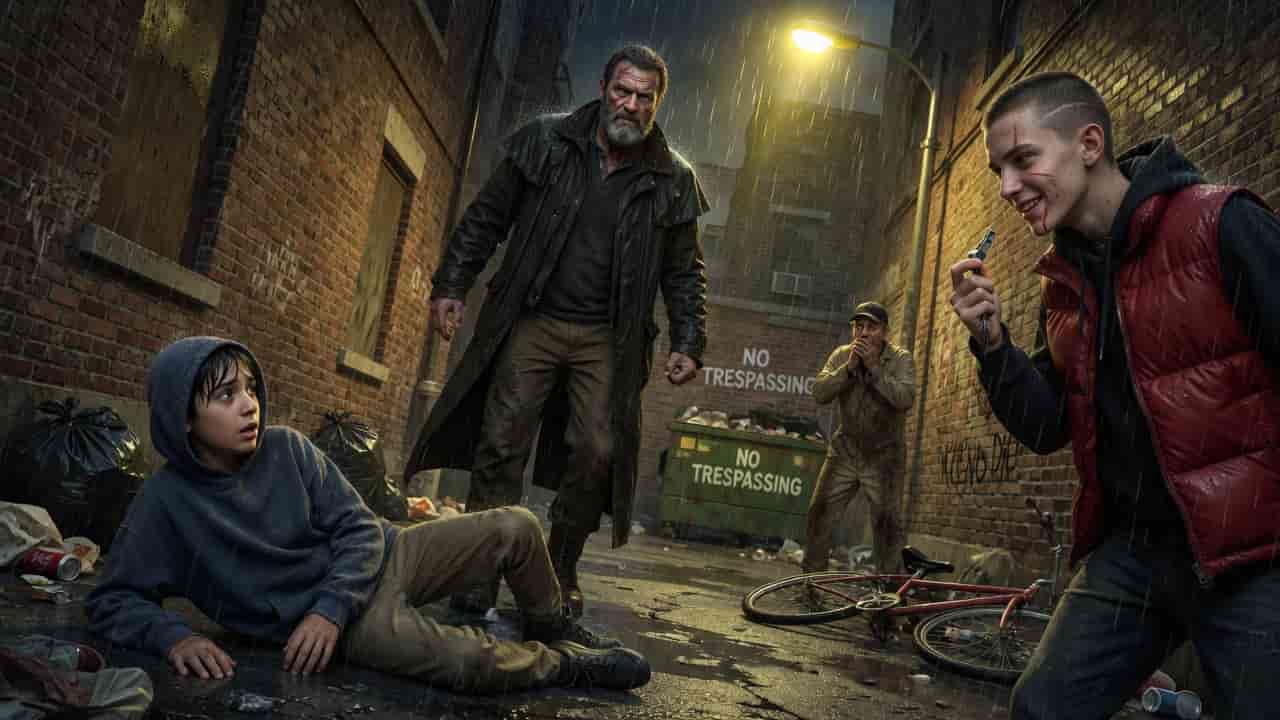
Jax stood over the boy, dangling the dented silver whistle just out of reach. He knew Mateo couldn’t fight back. He knew the kid barely had enough English to beg, let alone stand up for himself. In this part of Chicago, silence was just an invitation for people like Jax to take whatever wasn’t nailed down.
Mateo was on his knees in the cold mud of the alley, his eyes fixed on that whistle. It wasn’t just metal to him. It was the only thing he had left of the life he’d lost before he ended up in this crumbling city.
The rest of the street kids were watching from the mouth of the alley, laughing as Jax mocked the boy’s desperate, silent reaches. Nobody was going to help. In this neighborhood, you looked the other way if you wanted to keep your own teeth.
But then the laughter stopped.
A shadow, massive and heavy, fell over the brick wall. Gunnar Steele, a man people usually crossed the street to avoid, stepped into the flickering light of the streetlamp. He didn’t look like a hero. He looked like a storm that had finally decided to break.
“Drop the whistle, Jax,” Gunnar said. His voice wasn’t loud, but it sounded like grinding stones.
Jax tried to keep his sneer, but his hand started to shake. “This ain’t your business, old man. The kid’s a nobody.”
Gunnar took one step closer, and the air in the alley seemed to vanish. He knew exactly what that whistle was. He knew the secret it held—a secret that went back twenty years to a night of blood and betrayal.
The truth about why that whistle was in this boy’s hands was about to change everything.
Chapter 1
The air in the back of Steele’s Small Engine Repair didn’t circulate; it just sat there, heavy with the scent of 10W-30 and the metallic tang of shaved iron. Gunnar Steele liked it that way. He liked things that stayed where he put them. He sat at his workbench, a massive man who made the heavy-duty stool look like a child’s toy, his hands—thick-fingered and scarred across the knuckles—delicately picking at the carburetor of a John Deere mower that had seen better decades.
Outside the frosted glass of the garage door, Chicago was doing what it did best: being loud. The ‘L’ train shrieked as it rounded the bend three blocks over, a sound that usually vibrated right through Gunnar’s molars. But inside the shop, he had his own defense. A small, battered cassette player sat at the end of the bench, its plastic casing yellowed by years of shop grime.
The tape hissed, a soft, rhythmic white noise that preceded the music. Then, a woman’s voice drifted out, thin and haunting, recorded in a kitchen somewhere a lifetime ago. She wasn’t singing words, just humming a melody that didn’t quite go where you expected it to. Elena.
Gunnar didn’t look up. He didn’t let his expression change. If he did, the ghost would win. He just tightened a screw until the metal groaned.
“Gunnar? You in there?”
The voice came with a tentative knock on the side door. It was Fingers. Nobody called him by his real name anymore, mostly because his real name didn’t fit a man whose hands were always twitching, always looking for a lock to pick or a pocket to dip. Fingers was sixty going on eighty, a spindly man who survived on the periphery of the neighborhood’s bad intentions.
Gunnar didn’t answer. He waited for the tape to reach a specific bridge in the humming, a part where Elena’s voice caught, just for a second, like she was about to laugh.
“I know you’re in there, big man,” Fingers said, pushing the door open just enough to let a sliver of gray Chicago light hit the floor. “I got Tiny with me. We need a word.”
Gunnar reached out and clicked the tape player off. The silence that followed wasn’t peaceful; it was a vacuum. He turned the stool slowly.
Fingers stood in the doorway, his eyes darting around the shop as if looking for something he could pawn. Behind him loomed Tiny. Tiny was 350 pounds of soft-tissue and bad decisions, a man whose name was the only joke he’d ever been a part of. Tiny didn’t talk much, mostly because thinking took up too much of his bandwidth.
“What?” Gunnar said. His voice was a low rumble, the sound of a truck idling on a cold morning.
“The Spiders,” Fingers said, stepping inside and wiping his nose with the back of a greasy hand. “They’re making a move on the park again. Jax is leading them. They’re taxing the kids, Gunnar. Even the ones who don’t have a nickel to their name.”
Gunnar picked up a rag and began wiping grease from his palms. “Not my problem. I fix engines. I don’t fix the street.”
“They’re messing with the boy,” Tiny rumbled from the doorway. His voice was like gravel falling down a chute. “The quiet one. Mateo.”
Gunnar’s hands stopped moving for a heartbeat. Just one. Mateo was a kid who lived in the basement apartment across the alley. He didn’t speak much English, and he didn’t speak at all when he was scared. He spent his afternoons sitting on an overturned milk crate near Gunnar’s garage, playing with a small, dented silver whistle. He never blew it. He just polished it with the hem of his hoodie until it shone.
Gunnar had seen the kid every day for three months. He’d never spoken a word to him. He’d never given him a reason to think they were friends. But he’d noticed the kid. You couldn’t help but notice something that stayed so still in a city that was always moving.
“He’s got that whistle,” Fingers said, his voice dropping an octave. “You seen it? Jax wants it. Says it looks like real silver. He’s gonna take it off him today, Gunnar. I saw them cornering him by the dumpster ten minutes ago.”
Gunnar looked at the cassette player. The tape was still inside, the thin brown ribbon holding Elena’s voice. He hated that he knew exactly why the whistle mattered. He hated that the kid reminded him of the very things he’d spent twenty years trying to bury under layers of grease and silence.
“I said it’s not my problem,” Gunnar said, his voice harder now.
“Right,” Fingers muttered, backing away. “Sure. Just thought you’d want to know. Since you’re the only one Jax is actually afraid of. But hey, keep fixing your mowers, Gunnar. Don’t mind us.”
Fingers and Tiny vanished back into the gray afternoon. Gunnar sat there for a long time. The shop felt smaller than it had five minutes ago. The smell of the oil was cloying.
He thought about Mateo. The boy’s eyes were too large for his face, the kind of eyes that had seen things no eleven-year-old should understand. The kid didn’t cry when the older boys pushed him. He didn’t shout. He just tucked that whistle into his pocket and waited for them to get bored.
Gunnar stood up. His knees popped, a sound like a small-caliber pistol. He didn’t grab a coat. He didn’t grab a tool. He just walked to the side door and stepped out into the alley.
The wind was coming off the lake, sharp and smelling of wet concrete. He walked toward the end of the block, where the brick buildings leaned toward each other like tired old men. He heard the laughter before he saw them. It was a sharp, jagged sound, the kind of laughter that only happens when someone is enjoying a power they didn’t earn.
“Come on, doggy,” a voice sneered. Jax. “Whistle for me. Let’s see if it works.”
Gunnar stopped at the edge of the brick wall. He could see them now. Jax was leaning against a rusted dumpster, his red puffer vest bright against the grime of the alley. Two other teenagers stood behind him, smirking.
On the ground, in a puddle of muddy water, was Mateo. His bicycle, a salvaged piece of junk with one missing handlebar grip, lay twisted beside him. Jax was holding the silver whistle, dangling it by its thin cord.
“You like this, don’t you?” Jax said, leaning down so his face was inches from Mateo’s. “My brother says this is antique. Worth a lot of money. More than a little mute like you is worth, anyway.”
Mateo didn’t move. He was staring at the whistle, his lips pressed together so hard they were white. He reached up, a slow, tentative movement, his fingers trembling.
Jax snatched it back, laughing. “Nah. You want it? You gotta beg. Use your words, kid. Say ‘please, Mr. Jax, give me back my shiny toy.'”
The other kids cracked up. One of them reached out and kicked Mateo’s shoulder, not hard, but enough to make the boy lose his balance and fall back into the mud.
Gunnar felt something in his chest. It wasn’t anger—anger was hot and messy. This was something cold and heavy, a familiar weight he hadn’t felt in a long time. It was the feeling of a man who had already lost everything and realized he didn’t have to be afraid of losing anything else.
He stepped into the light.
“Jax,” Gunnar said.
The laughter died instantly. It didn’t fade; it just stopped. Jax looked up, his sneer faltering for a split second before he tried to paste it back on. He was nineteen, all lean muscle and bravado, but he wasn’t stupid. He knew Gunnar Steele was the man who had once cleared out a bar with nothing but a heavy-duty stapler and a bad attitude.
“Steele,” Jax said, standing up straight. He tucked the whistle into his palm. “Just having some fun with the kid. No harm done.”
“Drop the whistle,” Gunnar said. He didn’t move. He just stood there, his massive shadow stretching all the way to Jax’s boots.
“Look, I found this,” Jax said, his voice rising in pitch. “Finders keepers, right? That’s the law of the street.”
“I’m the law of this alley,” Gunnar said. He took a step forward. “And I don’t like thieves.”
Jax looked at his two friends. They were already backing away, looking for an exit. They weren’t paid enough to tangle with a man like Gunnar.
“He’s just a kid,” Jax muttered, though he didn’t let go of the whistle. “He can’t even tell on me. What do you care?”
“I care because I’m tired of the noise you make,” Gunnar lied.
The truth was, he cared because that whistle had a dent on the side of it, a specific mark made by Elena’s teeth twenty years ago when she’d dropped it during a rehearsal. He knew it was the same one. He’d seen it from his garage a dozen times, but he’d forced himself to look away. He’d told himself it was a coincidence.
But seeing it in Jax’s greasy hand, seeing the way it glinted in the dying light, he knew. It was hers. And the fact that this boy had it meant the past wasn’t buried. It was just waiting for someone to dig it up.
“Give it to him,” Gunnar said, his voice dropping to a whisper that was scarier than a shout.
Jax hesitated. His pride was warring with his survival instinct. He looked at Mateo, then back at Gunnar.
“Fine,” Jax spat. He didn’t hand it over. He tossed it into the mud a few feet away from Mateo. “Keep your trash.”
Jax and his crew turned and ran, their sneakers slapping against the wet pavement. Gunnar didn’t watch them go. He looked down at Mateo.
The boy was already crawling toward the whistle. He picked it up, wiped the mud off on his hoodie, and clutched it to his chest. He looked up at Gunnar, his eyes wide and unblinking. He didn’t say thank you. He didn’t smile.
“Get up,” Gunnar said, his voice gruff. “Go home.”
Mateo stood up, grabbing his bike. He paused for a second, looking at Gunnar as if he wanted to say something, but the words wouldn’t come. Then he turned and hurried down the alley, the silver whistle disappearng into his pocket.
Gunnar stood in the silence for a long time. The ‘L’ train shrieked again, but he didn’t hear it. He just felt the cold rain starting to fall, and the sudden, heavy realization that his quiet life was over.
Chapter 2
Gunnar didn’t sleep that night. The silence in his apartment above the shop was too loud, filled with the ghosts of things he’d tried to forget. He sat in his armchair, the only piece of furniture he’d kept from the old house, and stared at the dark.
The silver whistle. He’d bought it for Elena back when they were young and full of the kind of hope that only people who don’t know any better possess. She was a singer, a girl with a voice that could make a room full of hard men go quiet, but she had a strange obsession with dogs. She’d wanted a Border Collie, said she wanted something that would listen to her when the rest of the world wouldn’t.
She’d used that whistle to train the dog, a big, clumsy thing named Blue. She’d keep it on a silver chain around her neck, even when she was on stage. It was her lucky charm, she said.
Then came the heist.
Gunnar closed his eyes, and he could still hear the sound of the tires screaming on the asphalt. He’d been the driver. It was supposed to be a simple job—a jewelry exchange in a parking garage. But things went sideways. The cops showed up before the bags were even in the trunk.
Elena had been in the car. He’d told her to stay home, but she’d insisted. She’d been humming that same melody, the one on the tape. He’d been distracted, looking at her in the rearview mirror, watching the way her hand went to the whistle around her neck.
He’d missed the turn. The car had spun out, hitting a concrete pillar. Gunnar had walked away with a few broken ribs and a scar that ran from his temple to his jaw. Elena hadn’t walked away at all.
He’d blamed her for years. Blamed her for being there, for distracting him, for leaving him alone in a world that didn’t make sense without her voice. He’d sold everything, moved to the city, and buried himself in engines. Engines were simple. They didn’t have feelings. They didn’t hum melodies that broke your heart.
But now, that whistle was back. And it was in the hands of a boy who couldn’t speak.
The next morning, the sun was a pale, watery disk behind the clouds. Gunnar opened the shop at 7:00 AM, the same as always. He was halfway through a fuel pump replacement when he saw a shadow in the doorway.
Mateo was standing there. He was wearing the same navy hoodie, the hood pulled low. He was holding his bicycle, which looked even worse than it had the day before. The chain was hanging limp, and the front tire was flat.
Gunnar didn’t look up. “Shop’s not open for bikes.”
Mateo didn’t move. He just stood there, the silence stretching between them.
Gunnar sighed, tossing his wrench onto the bench with a loud clack. “What do you want, kid?”
Mateo walked forward, his footsteps silent on the concrete. He reached into his pocket and pulled out the silver whistle. He held it out to Gunnar, his palm open.
“I told you,” Gunnar said, his voice harsh. “It’s yours. Keep it.”
Mateo shook his head. He pointed to the whistle, then to Gunnar’s chest. Then he made a whistling motion with his lips, but no sound came out.
“You can’t make it work?” Gunnar asked.
Mateo nodded. He looked frustrated, his small brow furrowed.
Gunnar took the whistle. It felt cold in his hand, heavier than it looked. He looked at the dent. He remembered the night it happened—Elena had dropped it in the middle of a set at a dive bar in Cicero. He’d picked it up for her, and she’d kissed him, her breath smelling of peppermint and cheap gin.
He blew into the whistle. No sound came out.
“It’s a dog whistle, kid,” Gunnar said, handing it back. “Humans can’t hear it. Only dogs.”
Mateo’s face fell. He looked at the whistle, then at the empty street outside. He looked like he’d just been told the world was flat.
“Why do you want to blow it anyway?” Gunnar asked. “You got a dog?”
Mateo shook his head. He pointed to his throat, then to the whistle. He made the whistling motion again, his eyes pleading.
He didn’t want to call a dog. He wanted a voice.
Gunnar felt a sharp pang in his chest, a sensation he hadn’t felt in two decades. He looked at the boy—really looked at him. Mateo wasn’t just a quiet kid. He was a kid who was trapped inside himself, searching for a way to be heard in a neighborhood that didn’t listen to anyone.
“Listen,” Gunnar said, his voice softening just a fraction. “I can’t make that thing make noise you can hear. It’s not built that way. But I can fix your bike.”
Mateo’s eyes lit up. He nodded vigorously, pushing the bike toward Gunnar.
Gunnar spent the next hour working on the junker. He replaced the chain with a used one that still had some life in it, patched the tire, and straightened the handlebars. Mateo watched every move, his eyes tracking Gunnar’s hands with an intensity that was almost unnerving.
“There,” Gunnar said, wiping his hands on a rag. “Good as new. Or as good as it’s gonna get.”
Mateo took the handlebars. He looked at the bike, then at Gunnar. He reached into his pocket and pulled out a crumpled five-dollar bill, holding it out.
“Keep your money,” Gunnar said. “Just stay out of the alley. Jax won’t be happy about yesterday.”
Mateo pocketed the money. He paused, then reached out and touched Gunnar’s arm. It was a light touch, gone in a second, but it felt like an electric shock. Then the boy hopped on his bike and pedaled away.
“You’re getting soft, Steele,” a voice said from the shadows of the back room.
Fingers stepped out, leaning against a stack of tires. He’d been watching the whole time.
“Shut up, Fingers,” Gunnar said.
“The kid’s got a way about him,” Fingers said, ignoring him. “Reminds me of someone. That look in his eyes… like he’s waiting for the floor to drop out from under him.”
“He’s just a kid,” Gunnar said.
“He’s a kid with a silver whistle that belongs to a dead woman,” Fingers said, his voice suddenly sharp. “I saw it, Gunnar. I remember that whistle. I remember Elena.”
Gunnar froze. He turned slowly, his eyes narrowing. “What did you say?”
“I was at that bar in Cicero,” Fingers said, stepping closer. “I saw her drop it. I saw you pick it up. You think I forget things like that? You think I don’t know why you moved here and started fixing lawnmowers?”
Gunnar took two long strides and grabbed Fingers by the collar of his jumpsuit, lifting him off his feet. Tiny, who had been lurking near the door, moved forward, but Gunnar didn’t even look at him.
“You don’t talk about her,” Gunnar hissed. “You don’t ever say her name in this shop.”
“I’m just saying,” Fingers wheezed, his face turning red. “That kid didn’t just find that whistle in a gutter. Someone gave it to him. Or someone left it for him. You ever think about that?”
Gunnar stared at him for a long beat, his heart hammering against his ribs. Then he shoved Fingers back against the tires.
“Get out,” Gunnar said.
“Gunnar—”
“Get out!”
Fingers and Tiny didn’t argue. They vanished into the afternoon.
Gunnar sat back down at his bench, but he didn’t pick up his tools. He looked at the cassette player. He thought about Mateo’s throat, the way the boy had pointed to it.
He thought about the night Elena died. He’d seen the cops take her away. He’d seen them bagging her things. He’d never seen the whistle again. He’d assumed it was lost, crushed in the wreckage or taken by some cop as a souvenir.
But if it was here… if it was with Mateo…
He stood up and walked to the back of the shop, to a heavy floor safe hidden under a pile of old tarps. He dialed the combination, his fingers sure despite the tremor in his hands.
Inside the safe were the tapes. Dozens of them. And at the very back, a small, leather-bound notebook. Elena’s journal.
He hadn’t opened it in twenty years. He’d been afraid of what he’d find. But now, he didn’t have a choice. He opened it to the last page.
There was a date, two days before the heist. And a single sentence, written in her loopy, elegant script:
I have to tell him. About the baby. About the life we’re supposed to have.
Gunnar felt the world tilt. He gripped the edge of the safe, the cold metal biting into his palms.
Baby?
Elena had never told him. She’d died with that secret. Or so he thought.
He looked out the window toward the basement apartment across the alley. He saw Mateo sitting on his milk crate, polishing the silver whistle.
Gunnar’s breath hitched. He wasn’t just looking at a neighborhood kid anymore. He was looking at a ghost.
Chapter 3
The realization didn’t come as a lightning bolt; it was more like a slow, freezing tide. Gunnar watched Mateo through the grime-streaked window of the shop for the rest of the afternoon. He watched the way the boy tilted his head when he heard a siren, the way he tucked his hair behind his ears—a gesture so familiar it made Gunnar’s vision blur.
Elena used to do that. Every time she was nervous. Every time she was about to go on stage.
He calculated the years in his head. Elena had died twenty years ago. Mateo was eleven. The math didn’t work for him to be Gunnar’s son. But it worked for a grandson. Or a nephew.
But Elena didn’t have family. She’d been a runaway from a foster home in Ohio. Gunnar was all she had.
He stayed in the shop until the sun went down, the shadows lengthening across the concrete floor like accusing fingers. He didn’t turn on the lights. He just sat there in the dark, the smell of grease and regret filling his lungs.
If Elena had a child… if she’d survived the crash just long enough to give birth… no, the doctors had told him she was gone. Dead on arrival.
But what if they’d lied? What if she’d lived for an hour? A day? What if someone had taken the baby and left Gunnar to rot in his own guilt?
He stood up, his movements heavy and stiff. He had to know. He had to talk to someone who knew the truth about that night. But the only people who were there were either dead, in prison, or hiding.
He walked out of the shop and across the alley. He didn’t knock on the basement door. He just stood there, looking at the flickering blue light of a television through the small, high window.
Mateo lived there with a woman named Sofia. She was old, her face a map of hard years and cheap cigarettes. She worked two jobs, cleaning offices at night and a laundromat during the day. She was the one who had brought Mateo to the neighborhood three months ago.
Gunnar took a breath and knocked.
The door opened a few inches, held by a sturdy chain. Sofia peered out, her eyes narrowing as she recognized him.
“Mr. Steele,” she said. Her English was better than Mateo’s, but heavily accented. “Is too late for repairs.”
“I’m not here for repairs,” Gunnar said. “I want to talk about the boy.”
Sofia’s expression shifted from annoyance to fear. She started to close the door. “He do nothing wrong. He is good boy.”
“I know he’s a good boy,” Gunnar said, putting his hand on the door to keep it from closing. “I want to know where he came from. I want to know about the whistle.”
Sofia froze. She looked past him into the dark alley, then back at his face. She saw the scar, the beard, the desperation he couldn’t hide.
“Is not your business,” she whispered.
“He’s wearing my wife’s whistle, Sofia,” Gunnar said, his voice cracking. “That makes it my business.”
Sofia’s eyes filled with tears. She let out a long, shaky breath and unhooked the chain. “Come in. But be quiet. He is sleep.”
The apartment was tiny, smelling of Fabuloso and stale cooking oil. Mateo was asleep on a narrow cot in the corner, his small chest rising and falling in a rhythmic, peaceful cadence. The silver whistle was on the milk crate next to his bed, glinting in the light from the kitchen.
Gunnar sat at the small formica table. Sofia sat across from him, her hands trembling as she lit a cigarette.
“I find him in the hospital,” Sofia said, her voice a low rasp. “Ten years ago. I was cleaning. He was in the ward for the children who have no one. The ‘ghost babies,’ they call them.”
Gunnar felt a cold shiver run down his spine.
“They say his mother was a woman who died in a car crash,” Sofia continued. “She live for three days after. Just long enough. But she have no name. No ID. They call her Jane Doe.”
Gunnar closed his eyes. Three days. Elena had lived for three days while he was sitting in a police precinct, being grilled by detectives who didn’t care about anything but the jewelry.
“How did he get the whistle?” Gunnar asked.
“It was with her things,” Sofia said. “The nurses, they feel sorry for the baby. They put it in his blanket when they send him to the foster home. I follow him, Mr. Steele. I see how they treat him. He don’t speak, so they think he is stupid. They hit him. They lock him in the closet.”
She leaned forward, her eyes fierce. “So I take him. Five years ago, I just take him and we run. We move from city to city. We hide. I give him my name. I give him everything I have.”
Gunnar looked at Mateo. The boy’s hair was messy, his face pale. He looked so much like Elena it hurt to breathe.
“Why didn’t you find me?” Gunnar asked.
“I don’t know who you are,” Sofia said. “There was no name in the journal. Only ‘G.’ She write about ‘G’ every day. She say ‘G’ is a good man with a dark heart. She say she love him, but she is afraid of the life he choose.”
Gunnar lowered his head, his tears finally falling, hot and stinging against his scars. A good man with a dark heart. She’d seen right through him.
“He is yours?” Sofia asked softly.
“He’s her son,” Gunnar said. “That’s all that matters.”
“The Spiders,” Sofia said, her voice turning urgent. “They are coming back, Mr. Steele. Jax, he tell everyone in the park that the kid has silver. He say he’s going to take it tomorrow. He say he’s going to make the kid scream so we can finally hear his voice.”
Gunnar looked up. The grief in his eyes was replaced by something else. Something older. Something more dangerous.
“No,” Gunnar said. “He won’t.”
“You cannot stop them all,” Sofia said. “They are many. You are one.”
“I’m not just one,” Gunnar said.
He stood up and walked out of the apartment. He didn’t go back to his shop. He walked to the park, a dark, desolate patch of grass and broken playground equipment three blocks away.
It was a staging ground for the neighborhood’s misery. Homeless men huddling over trash fires, drug dealers moving in the shadows, and the street kids—The Spiders—sitting on the stone benches near the fountain.
Jax was there, center stage. He was holding a beer, bragging to a group of twenty people about how he’d stood up to Gunnar Steele in the alley.
“The old man is washed up,” Jax was saying, his voice echoing in the quiet park. “He’s a ghost. Tomorrow, we go back. We take the whistle, and we take whatever else the kid has. Maybe we take the old lady’s TV, too.”
The crowd laughed. It was a cruel, opportunistic sound.
Gunnar didn’t hide. He walked right into the center of the circle, his heavy boots thudding on the pavement.
The laughter died. Jax stood up, his face pale in the orange glow of the trash fires.
“Steele,” Jax said, his voice shaking slightly. “You lost? The shop’s that way.”
“I’m not lost,” Gunnar said. He looked around the circle at the faces—the witnesses, the people who lived on the misery of others. “I’m here to tell you how it’s going to be.”
“Oh yeah?” Jax said, trying to regain his swagger. He looked at his crew. There were a dozen of them now, all armed with chains or knives. “And how’s it gonna be, old man?”
Gunnar reached into his pocket and pulled out his own whistle—not a silver one, but a heavy, brass boatswain’s pipe he used for signaling Tiny in the shop. He blew it.
The sound was piercing, a high, metallic shriek that made everyone in the park flinch.
From the shadows of the trees, figures began to emerge. Tiny was first, looking like a mountain in a denim jacket. Then Fingers, his eyes bright and manic. Then others—men Gunnar had fixed engines for, men who owed him favors, men who had been waiting for someone to give them a reason to stand up.
There were twenty of them. Thirty. A quiet army of the neighborhood’s working class, the people Jax usually ignored.
“The boy is mine,” Gunnar said, his voice carrying through the park like a death sentence. “The whistle is mine. If any of you touch him, if any of you even look at him, you’re not dealing with a ghost. You’re dealing with me.”
Jax looked around, his bravado finally shattering. He saw the size of the men standing behind Gunnar. He saw the way the homeless men were watching, their eyes cold and hungry for a change in the power structure.
“This is a joke,” Jax muttered, but he was already backing away. “Come on, let’s go. This place is dead anyway.”
The Spiders melted into the night, disappearing like smoke in the wind. The crowd in the park dispersed, whispering, their eyes lingering on Gunnar.
Gunnar didn’t feel like a victor. He felt exhausted. He felt like a man who had finally stopped running and realized he had nowhere left to go.
“Gunnar,” Fingers said, stepping up beside him. “You okay?”
“I’m fine,” Gunnar said.
“What now?”
Gunnar looked toward the basement apartment. He could see Sofia standing in the doorway, watching him.
“Now,” Gunnar said, “I have to find a way to tell him who I am.”
Chapter 4
The aftermath of the park confrontation didn’t feel like peace. It felt like a held breath. The neighborhood was quiet the next morning, but it was the kind of quiet that precedes a storm. Gunnar opened the shop, but he didn’t work. He sat on his stool and watched the alley.
He was waiting for the residue. In this city, you didn’t humiliate a kid like Jax without paying for it. Jax was a symptom of a larger disease, a small-time enforcer for a crew that didn’t like losing face.
Around noon, Mateo appeared. He didn’t have his bike. He walked slowly, his hands tucked deep into his hoodie pockets. He stopped at the entrance to the shop, his eyes searching Gunnar’s face.
He’d heard. In a neighborhood like this, news traveled faster than the ‘L’ train. He knew the big man had stood up for him in front of everyone.
“Come in, kid,” Gunnar said.
Mateo stepped inside, the smell of the shop seeming to calm him. He walked over to the workbench and sat on the small stool Gunnar had set out for him.
Gunnar reached into his safe and pulled out the journal. He laid it on the bench between them.
“I knew the woman who owned that whistle,” Gunnar said. He didn’t know if the boy understood him, but he had to say it. “Her name was Elena. She was… she was everything to me.”
Mateo looked at the journal, his small hand reaching out to touch the leather. He looked up at Gunnar, a question in his eyes.
“She’s gone,” Gunnar said. “But she left something behind. Something she didn’t get to see.”
He opened the journal to the last page and pointed to the word ‘G.’
“That’s me,” Gunnar said. “I’m G. I’m Gunnar.”
Mateo stared at the letter. He traced it with his finger, then looked at Gunnar. He reached into his pocket and pulled out the silver whistle, laying it on top of the journal.
The two pieces of the past, finally together.
“She used to hum this,” Gunnar said. He reached over and clicked the cassette player.
The tape hissed, then Elena’s voice filled the shop. Mmm-mmm-mmm…
Mateo froze. His eyes went wide, and his whole body began to tremble. He didn’t look scared; he looked like he was hearing a voice from a dream. He leaned closer to the speakers, his breath hitching.
He recognized it. Somehow, in the deep, lizard-brain memory of a child who had lived for three days inside his mother’s body, he recognized the melody.
He looked at Gunnar, and for the first time, he didn’t look like a stranger. He looked like a son.
“She loved you, Mateo,” Gunnar said, the words feeling like glass in his throat. “I didn’t know you existed. I’m sorry. I’m so sorry.”
Mateo didn’t cry. He just reached out and took Gunnar’s hand. His fingers were small and cold, but his grip was surprisingly strong.
They sat there for a long time, listening to the tape play over and over again. The ghosts were still there, but they weren’t screaming anymore. They were just part of the room.
But the peace was broken by the sound of a heavy engine idling in the alley.
Gunnar stood up, his instincts screaming. He looked out the window. It wasn’t Jax. It was a black SUV with tinted windows. The kind of car that belonged to people who didn’t fix engines.
The door opened, and a man stepped out. He was tall, dressed in a sharp charcoal suit that looked out of place against the brick and grime. He didn’t look like a thug. He looked like a lawyer. Or a predator.
“Stay here,” Gunnar said to Mateo.
He stepped out into the alley, his hand reflexively going to the heavy wrench he’d tucked into his belt.
“Gunnar Steele?” the man asked. His voice was smooth, educated.
“Who’s asking?”
“My name is Silas Vane,” the man said. “I represent the estate of the woman who died in that crash twenty years ago.”
Gunnar felt his blood run cold. “She didn’t have an estate. She was a runaway.”
“That’s what she wanted you to think,” Silas said, stepping closer. “But Elena wasn’t just a singer, Gunnar. She was the daughter of a man who owns half of the real estate in this city. A man who has been looking for his grandson for a very long time.”
Gunnar looked back at the shop, where Mateo was watching through the glass.
“He’s not a grandson,” Gunnar said. “He’s a kid.”
“He’s the heir to a fortune, Gunnar,” Silas said, his voice dropping. “And we’ve been tracking that whistle for years. We knew it would turn up eventually. Now, you can give him to us the easy way, or we can involve the police. And I don’t think you want your history with the jewelry heist coming up in a courtroom.”
Gunnar looked at the man, then at the black car. He saw two more men sitting inside, their eyes fixed on him.
The bullying wasn’t over. It had just changed clothes.
“He’s not going anywhere with you,” Gunnar said.
“We have the paperwork, Gunnar,” Silas said, reaching into his jacket and pulling out a thick envelope. “We have the DNA results from the hospital. We have the legal right. You? You’re just a felon who’s been hiding in a garage.”
Silas stepped forward, his eyes cold and triumphant. He reached for the door of the shop.
Gunnar didn’t think. He didn’t plan. He just moved.
He grabbed Silas by the wrist, his grip like a vise. The man’s face went pale, his eyes wide with shock.
“Listen to me, you suit-wearing piece of trash,” Gunnar hissed. “You tell your boss that if he wants the boy, he has to come through me. And I’m not just a felon. I’m the man who’s been keeping his secret for twenty years.”
“You’re making a mistake,” Silas gasped, trying to pull away.
“The mistake was coming here,” Gunnar said.
He shoved Silas back toward the car. The two men inside started to open their doors, but Gunnar reached into the shop and pulled out his heavy brass pipe. He blew it, the shriek echoing through the alley.
Within seconds, the alley was filled. Tiny, Fingers, and a dozen other men appeared from the shadows, their faces grim. They didn’t have to say anything. They just stood there, a wall of flesh and bone.
Silas looked at the crowd, then at Gunnar. He saw the fire in the big man’s eyes, the kind of fire that doesn’t go out until everything is burned to the ground.
“This isn’t over,” Silas said, scrambling back into the SUV.
“I know,” Gunnar said.
The car sped away, leaving a cloud of exhaust in the damp air.
Gunnar turned back to the shop. Mateo was standing in the doorway, the silver whistle in his hand. He looked scared, but he also looked like he was waiting for Gunnar to tell him what to do.
Gunnar walked over and knelt down so he was eye-level with the boy.
“They’re coming for us, Mateo,” Gunnar said. “They have money, and they have the law. But they don’t have you.”
Mateo looked at the whistle, then at Gunnar. He did something then that he’d never done before. He opened his mouth, his throat working as he tried to find a sound.
It wasn’t a word. It was a whistle. A soft, low sound that mimicked the melody on the tape.
Gunnar felt his heart shatter and rebuild itself in the same second. He reached out and pulled the boy into a hug, his massive arms wrapping around the child’s small frame.
“I won’t let them take you,” Gunnar whispered into the boy’s hair. “I promise.”
The residue of the confrontation hung in the air, thick and bitter. Gunnar knew he’d just started a war he couldn’t win. He knew the police would be there by morning. He knew his quiet life was truly, finally dead.
But as he looked at Mateo, he realized he didn’t care. For the first time in twenty years, he wasn’t just fixing engines.
He was fixing a family.
Chapter 5
The dawn didn’t break over Chicago; it just bled a bruised purple into the gray fog that clung to the brickwork. Gunnar Steele sat in his shop, the lights off, watching the alley through the gap in the heavy steel shutters. He hadn’t slept since the black SUV had pulled away. His hands, usually so steady with a wrench, were resting on his knees, heavy as lead.
Behind him, the shop was a graveyard of silent machines. The ‘L’ train rumbled in the distance, a low, tectonic growl that vibrated through the floor. He was waiting for the other shoe to drop. People like Silas Vane didn’t go away; they gathered their strength and returned with the law in their pocket and a smile that didn’t reach their eyes.
A soft knock came at the side door—three short raps, then a long one. Sofia’s signal.
Gunnar stood up, his joints protesting with a series of sharp cracks. He opened the door, and Sofia slipped inside, her face pale and her eyes red-rimmed. She was carrying a small duffel bag, the canvas worn and stained.
“He is awake,” Sofia whispered, her voice tight with a fear she hadn’t shown before. “He ask for you, Mr. Steele. Not with words, but he look at the window of the shop all morning.”
“Is he okay?” Gunnar asked, his own voice sounding like it had been dragged over gravel.
“He is scared. He hear the cars. He see the men in the suits.” Sofia gripped the handle of her bag. “We have to go, Gunnar. I have a sister in Gary. We can hide there.”
Gunnar looked at the shop, at the workbench where Mateo had sat just yesterday, listening to the ghost of his mother’s voice. He looked at the cassette player, the brown tape still visible through the plastic window.
“We can’t outrun them, Sofia,” Gunnar said. “They have names. They have money. If we run, we’re just proving them right. We’re just ‘the felon’ and ‘the kidnapper’ then.”
“And what are we if we stay?” Sofia asked, her voice rising. “We are targets. That man, Vane… he look at me like I am dirt under his shoe. He don’t care about Mateo. He care about the ‘heir.'”
“I know,” Gunnar said. He walked over to the workbench and picked up the heavy wrench he’d used to scare Vane. He felt the weight of it, the cold familiarity of it. “But this neighborhood is the only place we have a floor under our feet. Everywhere else, we’re just falling.”
The sound of car doors slamming echoed through the alley. Not one car this time. Three.
Gunnar stepped to the window. Two police cruisers were idling at the mouth of the alley, their lights off but their presence unmistakable. Between them was the black SUV. Silas Vane stepped out, accompanied by an older man—tall, white-haired, wearing a coat that probably cost more than Gunnar’s shop was worth.
“Marcus Sterling,” Gunnar muttered.
“The grandfather?” Sofia asked, moving to the window.
“The man who let his daughter run away to a foster home in Ohio because she didn’t fit the brand,” Gunnar said.
He felt a cold, jagged anger rising in his chest. It wasn’t just about Mateo anymore. It was about the twenty years of silence. It was about the way Elena had looked when she talked about ‘the life she chose’—a life that was an escape from the man now standing in the mud of an alley in the South Side.
“Stay back,” Gunnar said to Sofia. “Get Mateo. Keep him in the back room. Don’t let him see the cops.”
Gunnar opened the main garage door. The screech of the rollers sounded like a challenge. He stepped out onto the concrete apron, his massive frame silhouetted against the dim interior of the shop.
The police officers didn’t move. They stayed by their cars, hands near their belts, their faces neutral. They were there for authority, not for the fight. This was Sterling’s show.
Marcus Sterling walked forward alone. He stopped ten feet from Gunnar. Up close, his face was a mask of high-society grief—perfectly groomed, eyes bright with a manufactured sorrow.
“Mr. Steele,” Sterling said. His voice was rich, cultured, the kind of voice that spoke in boardrooms and at charity galas. “I believe we have much to discuss.”
“I don’t think so,” Gunnar said. “I think you should get off my property before I decide you’re trespassing.”
“Property,” Sterling said, glancing around at the rusted parts and the oil-stained pavement. “A generous term. My daughter, Elena… she lived in places like this because of you. She died because of you.”
Gunnar didn’t flinch. “She lived in places like this because she’d rather be poor and free than rich and owned. And she died because I made a mistake. I carry that every day. Do you carry the fact that she didn’t even want you to know she was pregnant?”
Sterling’s composure slipped for a fraction of a second. A muscle jumped in his jaw. “She was young. She was confused. But the boy… Mateo… he is a Sterling. He belongs in a world where he will be cared for. Not in a garage with a man who spends his days listening to old tapes.”
Silas Vane stepped up beside Sterling, holding a thick sheaf of legal documents. “We have a court-ordered emergency custody warrant, Mr. Steele. Issued two hours ago. The police are here to ensure the boy is transferred to his legal guardian—Mr. Sterling—immediately.”
“The boy has a guardian,” Gunnar said. “Sofia. She’s raised him for five years. She’s the one who pulled him out of the ‘ghost ward’ while you were busy buying up the city.”
“A woman with no legal standing who essentially kidnapped a ward of the state,” Vane said, his voice oily. “If you want to protect her, Steele, you’ll hand the boy over now. Otherwise, she goes to prison, and you go back to Joliet for the jewelry heist. We have the statements from your old crew. They’re very eager to talk if it means a shorter sentence for themselves.”
Gunnar felt the trap close. It was a clean, efficient kill. They weren’t just taking Mateo; they were dismantling the only world the boy knew. If Gunnar fought, Sofia went down. If Sofia went down, Mateo was alone again.
“Let me talk to him,” Gunnar said.
“No,” Sterling snapped. “He’s been through enough trauma.”
“He doesn’t even know who you are,” Gunnar said, his voice rising. “He thinks you’re the men who come to take his whistle. You want him to start his new ‘privileged’ life in the back of a police car, screaming?”
One of the police officers, an older man with a tired face, stepped forward. “Give him ten minutes, Mr. Vane. It’ll be easier on the kid.”
Vane looked at Sterling. Sterling checked his watch, a gold Patek Philippe that glinted in the gray light.
“Ten minutes, Steele,” Sterling said. “Then he comes out. With or without you.”
Gunnar turned and walked back into the shop. He closed the door, the latch clicking with a finality that made his stomach turn.
Sofia was standing by the back room, Mateo clutched to her side. The boy was holding the silver whistle so tight his knuckles were white. He looked at Gunnar, his eyes searching, terrified.
“They’re here for me, aren’t they?” Mateo didn’t say it, but the question was written in the way he shrunk back into the shadows.
Gunnar knelt down. He didn’t know how to do this. He had spent twenty years avoiding feelings, and now he had to explain the end of the world to an eleven-year-old who couldn’t hear his own voice.
“Listen to me, Mateo,” Gunnar said. “The man out there… he’s your grandfather. He’s Elena’s father.”
Mateo shook his head violently. He pointed to the whistle, then to Gunnar.
“I know,” Gunnar said, his voice breaking. “I know. But he has papers. He has the law. If I don’t let you go, they’ll take Sofia away. They’ll put her in a bad place.”
Mateo looked at Sofia. She was crying silently, her hand over her mouth. He looked back at Gunnar, his expression shifting from terror to a strange, heartbreaking resolve.
He reached into his pocket and pulled out the silver whistle. He held it out to Gunnar.
“No,” Gunnar said, pushing the boy’s hand back. “You keep it. It’s yours. It’s her voice. You don’t ever let them take that from you.”
Mateo gripped the whistle. He stepped forward and hugged Gunnar, his small head buried in the rough oilskin of the duster coat. Gunnar held him, feeling the boy’s heart beating like a trapped bird.
“I’m going to find a way,” Gunnar whispered. “I’m going to come for you. I don’t care about the money. I don’t care about the prison. You’re a Steele, Mateo. Don’t you forget that.”
He stood up and took Mateo’s hand. He led the boy to the door.
When they stepped out into the alley, the silence was absolute. Marcus Sterling stood waiting, his hands in his pockets. Silas Vane had a smug, satisfied look on his face.
Gunnar walked Mateo to the SUV. He didn’t look at the cops. He didn’t look at Vane. He only looked at Sterling.
“If you ever raise a hand to him,” Gunnar said, his voice a low, vibrating threat, “I don’t care how many lawyers you have. I don’t care how many cops you own. I will find you.”
Sterling didn’t blink. “He’s a Sterling now, Mr. Steele. He will be beyond your reach.”
Mateo climbed into the back of the SUV. He didn’t look back. He just stared straight ahead, his fingers curled around the whistle. The door closed with a heavy, expensive thud.
The cars pulled away, the blue lights finally flickering out as they reached the end of the alley.
Gunnar stood in the mud long after the sound of the engines had faded. Sofia was standing in the doorway of the shop, her duffel bag at her feet.
“What now, Gunnar?” she asked.
Gunnar looked at his hands. They were covered in grease, the grime of twenty years of hiding. He thought about Elena’s journal. He thought about the ‘G’ who was a good man with a dark heart.
“Now,” Gunnar said, his voice hard and cold as iron, “I stop being a mechanic. And I start being the man Elena was afraid of.”
He turned and walked back into the shop. He went to the floor safe and pulled out the heavy, black-market burner phone he hadn’t touched since the night of the heist. He dialed a number he’d memorized two decades ago.
“Tiny? Fingers?” Gunnar said when the call connected. “Get the word out. We’re going to the Gold Coast. And tell everyone to bring whatever they’ve got. The Silver Whistle is calling.”
Chapter 6
The Sterling estate was a fortress of limestone and wrought iron overlooking the lake, a monument to a century of stolen land and leveraged buyouts. It was three miles and a world away from the South Side. Gunnar Steele sat in the back of Tiny’s rusted Chevy truck, parked two blocks over, watching the gate.
He wasn’t alone. Along the curb were half a dozen vehicles that didn’t belong in the Gold Coast—battered pickups, a primer-gray van, and a few motorcycles that roared with a defiant, unmuffled growl. Fingers was in the passenger seat, his eyes darting toward the security cameras mounted on the streetlamps.
“You sure about this, Gunnar?” Fingers asked. “This ain’t a jewelry exchange. This is a kidnapping charge waiting to happen.”
“It’s not kidnapping if you’re taking back what’s yours,” Gunnar said.
He checked the heavy, lead-lined pipe he’d brought from the shop. He wasn’t planning on a firefight. He was planning on a confrontation. Sterling thought he was protected by his walls and his pedigree. He didn’t realize that Gunnar had nothing left to lose, and a man with nothing is the most dangerous thing in the world.
“The kid’s in the library,” Tiny rumbled, looking at a grainy image on his phone. He’d hacked into the home’s basic Wi-Fi security ten minutes ago—a trick he’d learned in the joint. “He hasn’t moved for three hours. Just sitting there. Vane is with him.”
“And Sterling?”
“In the study. Probably counting his money.”
Gunnar climbed out of the truck. “Wait for the signal. If the cops show up, you scatter. This is my play.”
“We’re staying, Gunnar,” Fingers said, his voice uncharacteristically steady. “The neighborhood’s watching. You don’t do this alone.”
Gunnar nodded once, a sharp, tight movement. He walked toward the iron gates. He didn’t try to pick the lock. He didn’t try to climb over. He simply walked up to the intercom and pressed the button.
“Steele,” he said.
There was a long pause. Then, the gate clicked and swung open. Sterling was inviting him in. He wanted to finish this.
Gunnar walked up the long, gravel driveway, his heavy boots crunching in the silence. The house loomed over him, a white specter of a life he could never understand. The front door opened before he reached the steps. Silas Vane stood there, looking triumphant.
“Come to sign the final relinquishment papers, Mr. Steele?” Vane asked. “It’s for the best. We’ve already arranged for the boy to start at a private academy in Switzerland. He leaves tonight.”
Gunnar didn’t answer. He walked past Vane, his shoulder catching the lawyer and sending him stumbling back against a marble bust of some long-dead Sterling.
“Hey!” Vane shouted. “You can’t go in there!”
Gunnar ignored him. He followed the sound of a television—the same flickering blue light he’d seen through the basement window in the alley. He found the library.
Mateo was sitting in a high-backed leather chair that swallowed him whole. He looked smaller than he had in the shop. He was dressed in a suit that didn’t fit right, his navy hoodie gone, replaced by cashmere and silk. He looked like a doll.
But he was still holding the silver whistle.
When he saw Gunnar, Mateo’s face transformed. He didn’t jump up; he just stared, his eyes filling with a sudden, desperate hope.
“Steele,” a voice said from the balcony above the library.
Marcus Sterling stood there, looking down, a glass of scotch in his hand. He looked tired, the mask of the grieving grandfather beginning to fray at the edges.
“I told you he was beyond your reach,” Sterling said. “What did you think you would accomplish by coming here? You’re a common criminal. You think a court will listen to you over me?”
“I don’t care about the court,” Gunnar said, his voice echoing in the high-ceilinged room. “I care about the truth. I care about why Elena ran.”
“She was rebellious,” Sterling said, his voice tight.
“She wasn’t rebellious,” Gunnar said, stepping toward the center of the room. “She was terrified. I found her journal, Sterling. I read the parts about you. About how you tried to control her. About how you told her that if she ever had a child out of wedlock, you’d make sure the baby ‘disappeared’ so the family name wouldn’t be tarnished.”
Sterling’s hand shook, just a fraction. A splash of scotch hit the oriental rug.
“That’s a lie,” Sterling hissed.
“Is it?” Gunnar asked. “Then why did she live as a Jane Doe for three days? Why didn’t she call you? She knew. She knew that if you found out about Mateo, you’d treat him like an asset, not a grandson. And that’s exactly what you’re doing now. You’re shipping him off to Switzerland because he’s a ‘mute’ who’s an embarrassment to your brand.”
Mateo looked from Gunnar to Sterling. He stood up, the silver whistle clutched in his hand. He walked toward the center of the room, standing between the two men.
“Give me the boy, Marcus,” Gunnar said. “Let him go back to the alley. Let him have a life where he’s heard.”
“Never,” Sterling said. He looked over the balcony railing at Vane, who was hovering in the doorway. “Call the police, Silas. Tell them Steele is armed and threatening us.”
“Go ahead,” Gunnar said, his eyes fixed on Sterling. “Call them. I’ve got Fingers outside with the journal. And I’ve got Tiny with the security footage of you dragging this boy out of his home yesterday. You want to see the Sterling name on the front page of the Tribune tomorrow? ‘Chicago Mogul Kidnaps Grandson He Abandoned For A Decade’?”
Vane hesitated, the phone halfway to his ear. He knew a PR disaster when he saw one. And he knew Gunnar Steele wasn’t bluffing.
“Silas,” Sterling warned.
“Sir,” Vane whispered. “He… he might have a point. The optics are… problematic.”
Sterling looked at Gunnar. He saw the scars, the beard, the massive, violent capability of the man. He saw a man who had already survived the worst thing that could happen and was still standing.
“He’s nothing without the name,” Sterling said, his voice losing its strength.
“He’s everything without the name,” Gunnar countered. “He’s his mother’s son. And he’s my boy.”
Mateo did it then. He didn’t look at Sterling. He didn’t look at Vane. He looked at Gunnar.
He raised the silver whistle to his lips.
He didn’t blow into it. He just held it there. And then, he spoke.
It wasn’t a full sentence. It wasn’t even a word. It was a sound—a sharp, guttural, rhythmic imitation of the melody from the tape. Mmm… mmm… mmm…
The sound was small, but in the silence of the library, it sounded like a thunderclap. It was the first time Mateo had used his own voice to reach for the world.
Gunnar felt the last of the ice around his heart shatter. He walked forward and picked Mateo up, the boy’s small arms wrapping around his neck.
“Let’s go home, Mateo,” Gunnar said.
He walked out of the library. He walked past Vane, who stepped aside. He walked through the front door and down the limestone steps.
Sterling didn’t follow. He stayed on his balcony, a lonely old man in a big white house, watching the only thing that mattered walk away into the dark.
When Gunnar reached the gate, the neighborhood was waiting. Tiny honked the horn of the truck. Fingers was cheering, his cap thrown into the air. The motorcycles roared, a symphony of grease and steel.
They drove back to the South Side in a slow, triumphant procession. The ‘L’ train shrieked overhead, but for once, it didn’t sound like a threat. It sounded like a welcome.
An hour later, Gunnar was back in his shop. The lights were on, the smell of 10W-30 filling the air. Sofia was there, making coffee, her face glowing with a relief that words couldn’t describe.
Mateo was sitting on his milk crate near the workbench. He’d changed back into his navy hoodie. He was polishing the silver whistle, the light reflecting off the dent that Elena had made twenty years ago.
Gunnar sat on his stool, the heavy duster coat draped over the back of it. He looked at the cassette player. He reached out and clicked it on.
The tape hissed. Elena’s voice drifted out. Mmm-mmm-mmm…
Mateo looked up. He hummed along, his voice stronger this time, matching the melody perfectly.
Gunnar didn’t try to hide his tears. He didn’t try to be the man Elena was afraid of. He just leaned back, closed his eyes, and listened to the music.
The shop was full of ghosts, but they weren’t haunting him anymore. They were just part of the family. And as the city roared outside, Gunnar Steele finally felt something he hadn’t felt in a very long time.
He felt quiet.