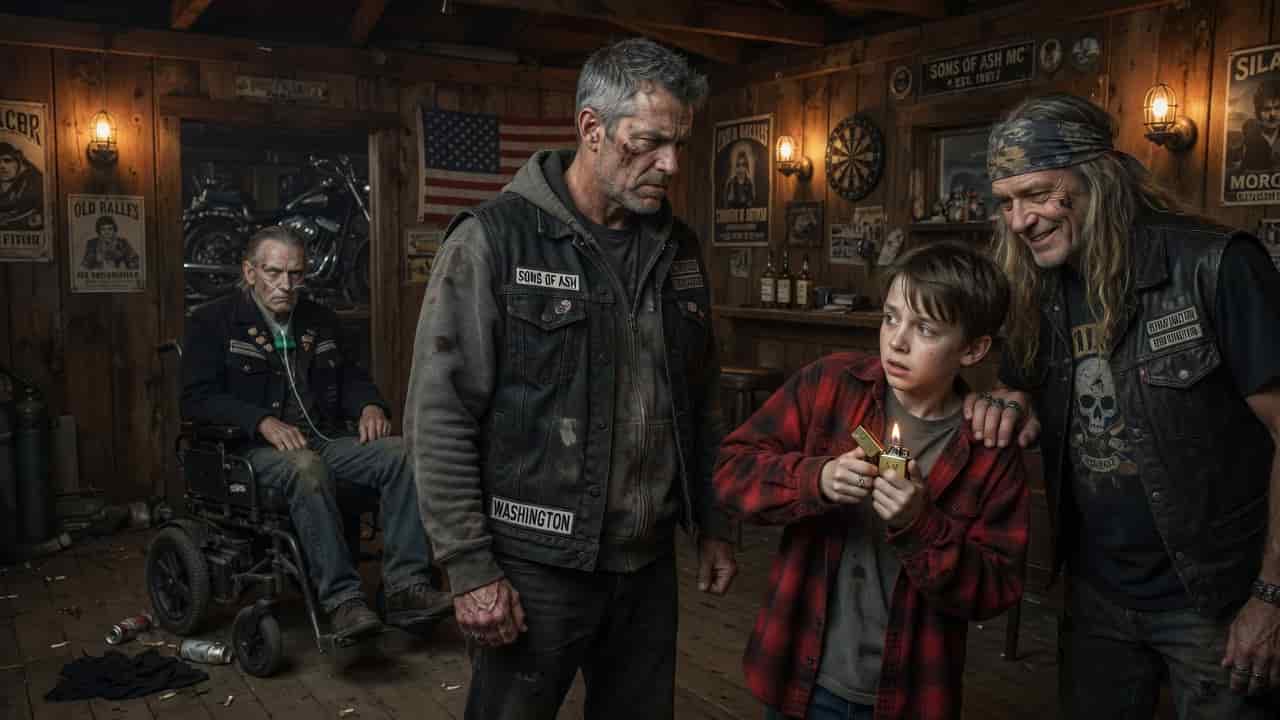
Gutter’s voice was a jagged blade, cutting through the thick smoke of the Sons of Ash clubhouse. He leaned over eleven-year-old Leo, his breath smelling of cheap whiskey and old tobacco. The boy was shaking so hard the gold Zippo rattled in his grip. Around the room, the Old Guard sat on worn leather benches, watching the initiation with the kind of bored cruelty that only comes from men who have forgotten what it’s like to feel fear.
Caleb stood in the shadows of the doorway, his own hands—mapped with the shiny, puckered skin of old third-degree burns—cramped into fists. He had spent ten years trying to forget the night his wife was gone, the night the world turned into an orange roar. He had been told it was an accident. He had been paid to believe it.
“Look at me when I’m talking to you,” Gutter sneered, reaching out to shove the boy’s shoulder.
Leo’s eyes darted toward the background, toward the man in the wheelchair who ruled this mountain with a cold, silent fist. Silas didn’t move. He just watched his grandson crumble.
But Caleb was already moving. He didn’t just stop the shove; he caught Gutter’s wrist in a grip that made the older man’s bones creak.
“Drop the lighter, Leo,” Caleb said, his voice a low vibration that stopped the room.
The gold Zippo slipped from the boy’s fingers. Caleb caught it. He didn’t need to see the engraving to know what it was. He felt the weight of it—the weight of a ten-year-old lie.
“Where did he get this, Gutter?” Caleb asked.
The room went deathly silent. The truth was finally out, and the fire was just beginning.
Chapter 1: The Ash in the Air
The air in the Washington Cascades doesn’t just smell like pine; it smells like damp earth and the slow, heavy decay of things that have been wet for too long. Caleb Morgan, known to the Sons of Ash as “Matches,” sat on the rear bumper of his 1998 Ford F-150, watching the fog roll off the peaks and settle into the valley like a cold, wet blanket. He took a drag of his cigarette, the ember glowing bright orange against the gray morning.
He hated the smell of fire, but he was better at understanding it than any man alive. He’d spent twelve years as an arson investigator for the county before the world fell apart. Now, he spent his days fixing the wiring in a clubhouse that was held together by spit, prayer, and illegal diesel.
“Matches,” a voice called out. It was dry and raspy, like sandpaper on a rough board.
Caleb didn’t turn around. He knew the sound of his father’s wheelchair on the gravel. Silas Morgan rolled into view, the electric hum of his chair a constant, irritating drone. Silas was seventy-four, but his eyes still looked like they were made of flint. He wore a navy wool coat that smelled of mothballs and the sharp, medicinal tang of the oxygen he pumped into his lungs twenty-four hours a day.
“The boy’s inside,” Silas said.
Caleb flicked his ash onto the gravel. “He shouldn’t be here, Silas. He’s eleven. This isn’t a place for a kid.”
“He’s a Morgan,” Silas countered, his voice wheezing through the plastic tube beneath his nose. “And he’s an orphan. That makes him club property until he’s old enough to hold his own. You know the rules. You helped write them before you got all sensitive about smoke.”
Caleb finally looked at him. The burn scars on his hands felt tight, the way they always did when he was around his father. The skin was a landscape of ridges and valleys, a permanent map of the night he’d tried to pull Sarah out of the bedroom. The night he’d failed.
“I didn’t get sensitive, Silas. I got honest. There’s a difference.”
“Honesty didn’t pay the mortgage on that house you lost,” Silas spat. “Honesty didn’t keep you out of the bottle. The club did. I did. Now go inside. Gutter is teaching the boy some respect. You might want to watch. Might remind you of what it looks like.”
Caleb stood up, his boots crunching on the wet stone. He walked past his father without another word, headed for the heavy oak doors of the clubhouse.
The interior of the “Sons of Ash” headquarters was a cavernous space, a converted sawmill that felt more like a tomb than a social club. The walls were lined with old photographs—men on Harleys from the seventies, blurred shots of parties that ended in police raids, and the central crest: a phoenix rising from a pile of blackened bones.
At the center of the room, under a single hanging industrial light, Leo sat on a wooden stool. He looked tiny in the space, his oversized red flannel shirt hanging off his narrow shoulders. He was the son of a club member who’d gone off a cliff on Highway 20 three months ago. The mother had been gone long before that. Now, Leo was the mascot, the errand boy, the target.
Gutter stood over him. Gutter was a man who looked like he’d been carved out of a piece of old, rotten driftwood. He was fifty-five, with a belly that hung over a massive pewter belt buckle and eyes that were always searching for a weakness to exploit.
“I said pick it up,” Gutter growled.
Leo reached for a heavy iron poker that lay on the floor. His hand was shaking. Caleb stopped at the edge of the light, his heart hammering a slow, heavy rhythm against his ribs.
“What are we doing, Gutter?” Caleb asked, his voice steady but carrying a serrated edge.
Gutter looked up, a yellow-toothed grin spreading across his face. “Just teaching the pup how to stoke the hearth, Matches. He’s a bit twitchy. Thinks the fire’s gonna jump out and bite him.”
“He’s a kid,” Caleb said, stepping into the light. “He’s twitchy because you’re breathing down his neck like a wolf.”
“He needs to learn,” Gutter said, his voice rising for the benefit of the other men sitting in the shadows. “We don’t have room for cowards in the Sons. Especially not ones carrying the Morgan name. Ain’t that right, Silas?”
Silas had rolled into the back of the room, his oxygen tank clinking against the frame of his chair. “The boy needs to prove he’s got the stomach for it,” the old man said from the dark.
Leo looked up at Caleb, his eyes glassy with unshed tears. There was a look in the boy’s face that Caleb recognized—the look of a person who had seen the world end and was just waiting for the leftovers to be swept away.
“Give me the poker, Leo,” Caleb said softly.
“No,” Gutter stepped between them, his massive frame blocking the boy. “He does it himself. Or he spends the night in the crawlspace under the floorboards. His choice.”
Caleb felt the familiar heat rising in his chest. It wasn’t anger; it was a memory of the roar. The way the fire had sounded like a freight train coming through the hallway. He looked at Gutter’s smug, cruel face and then at his father, who sat like a king on a throne of chrome and rubber.
“He’s not going in the crawlspace,” Caleb said.
“You gonna stop me?” Gutter asked, stepping closer. He was taller than Caleb, and heavier, but Caleb knew exactly where the soft spots were on a man like Gutter. He’d spent years studying how things break—buildings, cars, people.
“I’m going to tell you that the chimney’s blocked,” Caleb lied, his voice flat. “If you start a fire in that hearth right now, the whole room’s going to fill with smoke in under three minutes. And Silas can’t breathe smoke, can he, Gutter?”
Gutter hesitated, his eyes darting toward Silas. The old man’s dependency on the oxygen was the only thing that kept the peace in the club. If Silas choked, the hierarchy would collapse into a bloody mess within the hour.
“Check it then,” Gutter muttered, stepping back. “But the boy stays. We ain’t done with him.”
Caleb walked over to the hearth, his boots loud on the boards. He felt Leo’s eyes on him—desperate, searching. He wanted to tell the boy to run. He wanted to tell him that this place was nothing but a slow-motion fire, waiting for a spark to finish the job. But he couldn’t. He was a Morgan. And Morgans didn’t run. They just burned until there was nothing left but the black.
He reached into the chimney flue, feeling the cold, soot-covered iron. There was no blockage. He knew that. But he stayed there for a long time, his hand covered in the black residue of old fires, listening to the wheeze of his father’s breath and the terrified silence of the boy.
The residue stayed on his skin long after he left the room. It was a stain that wouldn’t wash off, no matter how much soap he used. It was the same stain that had been on his soul since the night he’d taken the money. The money his father had handed him in a brown paper bag three days after Sarah’s funeral.
“Keep your mouth shut, Caleb,” Silas had said then. “It was an old house. Faulty wiring. That’s the story. Anything else ruins the club. Anything else ruins me.”
Caleb had taken the bag. He’d used it to pay for the booze that had drowned the screams he still heard every time he closed his eyes.
Now, the boy was here. And the fire was coming back. Caleb could feel it in the air, a dry, electric tension that made the hair on his arms stand up. He looked at his scarred hands in the dim light of the hallway and realized that the “accidental” fire ten years ago was just the beginning.
The Sons of Ash were finally going to live up to their name.
Chapter 2: The Trial of the Flame
Three days later, the tension in the clubhouse had reached a boiling point. It wasn’t just the usual friction of men trapped in a small town with too much time and too many secrets; it was something specific. A series of brush fires had started along the northern ridge of the valley—small, controlled, but clearly intentional.
The Fire Chief, a man named Miller who had known Caleb since they were in diapers, had stopped by the clubhouse twice. He didn’t come with a warrant, but he came with a warning.
“People are talkin’, Caleb,” Miller had said, standing on the porch, his eyes shielded by the brim of his hat. “They see the Sons riding up that ridge road. They see the smoke an hour later. If one of those fires hits a house, I won’t be able to stop the Sheriff from coming in here with a sledgehammer.”
Caleb had looked at the ridge, where a thin finger of gray smoke was poking at the blue sky. “It’s not us, Miller. We’ve got enough trouble keeping the lights on.”
“Tell that to Gutter,” Miller replied. “He’s been bragging down at the Silver Dollar about how the valley needs a ‘cleansing.’ Keep your people on a leash, Caleb. Before I have to put ’em down.”
Now, inside the clubhouse, the “cleansing” was taking a different form.
The room was packed. Nearly thirty members of the Sons of Ash were lined up along the walls, the air thick with the smell of cheap beer and the metallic tang of sweat. At the center of the room, a small folding table had been set up.
Gutter stood at the head of the table, his thumbs hooked into his belt. He looked like he was enjoying himself. Beside him, Leo stood trembling, his face white, his eyes fixed on the floor.
“Every Morgan man has to prove his worth,” Gutter announced, his voice booming off the rafters. “Silas did it. Caleb did it. Even if he did go soft and join the government for a while. Now, it’s the pup’s turn.”
Caleb pushed through the crowd, his heart sinking. He saw his father, Silas, parked in the corner. The old man was watching with a terrifying, blank intensity. He wasn’t stopping this. He was presiding over it.
“What is this, Gutter?” Caleb demanded, stepping into the circle.
“It’s a tradition, Matches,” Gutter sneered. “The Trial of the Flame. We want to see if the boy has the Morgan fire in him, or if he’s just another piece of wet wood.”
Gutter reached into his pocket and pulled out an object that made the air vanish from Caleb’s lungs. It was a gold Zippo lighter. It caught the light, gleaming with a cruel, polished brilliance.
Caleb felt a physical jolt, like he’d been hit in the solar plexus. He knew that lighter. He hadn’t seen it in ten years, but he knew the weight of it, the specific way the hinge clicked. It had been a gift to Sarah on their fifth anniversary. He’d had it engraved. He’d thought it was lost in the rubble of their bedroom.
“Where did you get that?” Caleb’s voice was a whisper, but it cut through the room like a gunshot.
Gutter didn’t answer. He just held the lighter out to Leo. “Take it, boy.”
Leo hesitated, his hand hovering in the air. He looked at Caleb, a silent plea for help in his eyes.
“Gutter, put that away,” Caleb said, stepping forward.
“Back off, Matches!” Gutter roared, his face turning a dark, mottled red. “This is club business. The boy has to light the flame. He has to hold his hand over it for ten seconds. If he flinches, he ain’t a Morgan. If he flinches, he’s just another piece of trash we’re hauling around.”
The room erupted in a low, rhythmic chant. “Light it. Light it. Light it.”
The sound was a blunt instrument, hammering at Caleb’s sanity. He looked at his father. “Silas, stop this. You know what that lighter is.”
Silas didn’t blink. “The boy needs to learn that fire doesn’t care who you are, Caleb. It only cares what you’re made of. Let him hold the flame.”
Leo’s hand closed around the gold Zippo. He was shaking so hard the metal rattled.
“Light it!” Gutter screamed, leaning over the boy, his face inches from Leo’s. “Do it now, you little coward! Prove you belong!”
Leo flicked the wheel. A spark flew, but no flame. He tried again. Nothing. The crowd began to laugh—a cruel, mocking sound that filled the room like rising water.
“Look at him,” one of the bikers laughed. “Kid can’t even start a spark. Just like his old man. Died in a ditch because he couldn’t handle a simple curve.”
Leo’s face crumpled. The shame was a physical thing, a weight that bowed his head and made his shoulders shake. He was being publicly dismantled, his dignity stripped away in front of thirty men who smelled of his father’s failures.
“Again!” Gutter commanded, grabbing Leo’s wrist and forcing his thumb back onto the wheel. “Light it, or I’ll shove your hand into the hearth myself!”
“Stop!” Caleb lunged forward.
Gutter saw him coming and swung a heavy forearm, catching Caleb in the chest and sending him stumbling back. The crowd roared. Gutter turned back to Leo, his hand tightening on the boy’s wrist until Leo let out a small, sharp cry of pain.
“You’re going to light this, and you’re going to watch it burn,” Gutter hissed.
Leo flicked the wheel a third time. This time, the flame took. A steady, blue-and-orange tongue of fire licked at the air.
“Now,” Gutter grinned, “Hold your other hand over it. Ten seconds. Count ’em out, boys!”
The room began to count. “One… two… three…”
Leo’s hand hovered over the flame. His eyes were wide with a primal, bone-deep terror. Caleb could see the boy’s skin starting to redden, the heat rising.
“Four… five…”
“Let him go!” Caleb scrambled to his feet, but two of the larger bikers stepped in his path, their arms crossed over their chests.
“Six… seven…”
Leo’s face was a mask of agony and shame. He didn’t pull away. He was so desperate to belong, so desperate to stop the laughter, that he was letting himself be burned.
“Eight… nine…”
“DROP IT!” Caleb screamed.
He didn’t wait for the tenth second. He threw himself into the two bikers, using his shoulder to drive one into the wall and spinning past the other. He reached the table just as the count hit ten.
He didn’t hit Gutter. He didn’t waste the time. He reached out and snatched the gold Zippo from Leo’s hand, his own scarred fingers closing around the hot metal without a flinch.
The flame went out. The room went silent.
Leo collapsed off the stool, clutching his red, blistered hand to his chest, sobbing silently.
Caleb stood there, the gold lighter gripped in his fist, his breath coming in ragged, shallow gasps. He looked down at the object in his hand. He didn’t need to look at the bottom to know what was there, but he did it anyway.
There, engraved in delicate, flowing script that was now scratched and tarnished, were the words: To my eternal flame. Love, C.
“Where,” Caleb said, his voice a low, vibrating growl that seemed to come from the floorboards themselves, “did you get this, Gutter?”
Gutter stepped back, his smirk faltering for the first time. He looked toward Silas, searching for backup, but the old man remained silent, his eyes fixed on the gold lighter in Caleb’s hand.
“I found it,” Gutter muttered. “In the old storage lockers. Thought it was club property.”
“You’re lying,” Caleb said. He stepped closer, the heat from the lighter still radiating through his palm. “This was in my bedroom. Under six feet of ash. The only way you found this is if you were there. The night it happened.”
The implication hung in the air like a thick, poisonous gas. The room, which had been full of noise and laughter moments ago, was now deathly still. Every man in the room knew the story of Caleb’s wife. They knew the tragedy that had sent him into a bottle for five years.
“I don’t know what you’re talking about, Matches,” Gutter said, his voice cracking. “It’s just a lighter.”
“It’s not just a lighter,” Caleb said. He turned the Zippo over, his thumb tracing the engraving. “It’s proof. And if you had it, Gutter, then you were in that house before the fire department arrived. Which means you saw her. You saw her, and you didn’t help.”
“Caleb,” Silas’s voice cut through the tension. “Give me the lighter.”
Caleb turned to his father. The old man’s face was unreadable, but his hand was trembling on the armrest of his wheelchair.
“No,” Caleb said. “I’m not giving you anything ever again, Silas.”
He looked at Leo, who was still on the floor, his face buried in his flannel shirt. Caleb reached down and put a hand on the boy’s shoulder. The boy flinched, then leaned into him, his small body racking with tremors.
“We’re leaving,” Caleb said.
“You leave this room,” Silas wheezed, “and you’re out of the club. You lose the truck. You lose the cabin. You lose everything.”
Caleb looked at the men around him—the men who had just laughed at an eleven-year-old boy being burned. He looked at the gold lighter, the symbol of the life he’d lost and the lie he’d bought.
“I already lost everything, Silas,” Caleb said. “Ten years ago. I’m just now realizing it.”
He picked Leo up in his arms and walked toward the door. Nobody moved to stop him. Not even Gutter. They just watched him go, the gold lighter held tight in his hand, a small, cold piece of proof that the past was finally ready to burn.
Chapter 3: The Residue of Truth
The cabin was a three-room shack five miles up the mountain, tucked into a grove of hemlocks that stayed dark even in the middle of the day. It was the only place Caleb felt safe, mostly because it was the only place Silas’s wheelchair couldn’t reach.
He sat Leo down on the kitchen counter and took the boy’s hand. The burn was shallow—red and angry, but no blisters yet. He ran it under cool water from the hand pump, the rhythmic clack-clack-clack of the metal handle the only sound in the room.
Leo didn’t cry. He just stared at the wall, his eyes vacant.
“I’m sorry, Leo,” Caleb said. “I should have stopped them sooner.”
“They said I was a coward,” Leo whispered. His voice was so small it barely carried over the sound of the water.
“They’re the cowards,” Caleb replied. “Thirty grown men watching a kid get hurt isn’t brave. It’s pathetic. Don’t ever let them tell you who you are.”
Caleb wrapped the boy’s hand in a clean cloth and handed him a glass of water. “Stay here. Don’t go outside. I have to look at something.”
He walked into the small living area and sat at the scarred oak table. He pulled the gold Zippo from his pocket and set it down. In the sunlight filtering through the grimy window, the lighter looked different. It didn’t look like a treasure anymore; it looked like a weapon.
As an arson investigator, Caleb knew that fire was a storyteller. It left clues in the way wood charred, in the direction the smoke stained the walls, in the melted remnants of glass and metal. The “accidental” fire at his house had been ruled a faulty wiring issue because the insurance investigator hadn’t looked hard enough, and because Caleb—blinded by grief and his father’s “advice”—hadn’t pushed.
But he was pushing now.
He took a magnifying glass from his tool kit and inspected the lighter. He wasn’t looking at the engraving. He was looking at the bottom, near the hinge.
There, tucked into the tiny crevice where the lid met the body, was a smear of something dark and waxy.
Caleb’s heart skipped a beat. He took a needle and scraped a tiny portion of the substance onto a white piece of paper. He smelled it.
It wasn’t soot. It wasn’t motor oil.
It was paraffin wax mixed with a specific brand of industrial accelerant—the kind used by the logging companies to clear brush. The kind the Sons of Ash kept in fifty-gallon drums in the garage.
The lighter hadn’t been “found” in a locker. It had been used to start the fire.
The realization hit him like a physical blow. Sarah hadn’t died in an accident. She’d been murdered. And his own club—his own family—had used his wife’s own anniversary gift to burn her alive.
He felt a wave of nausea so intense he had to lean over and put his head between his knees. The room seemed to tilt, the shadows of the hemlocks outside stretching like long, black fingers across the floor.
He’d taken the money. He’d taken twenty thousand dollars in a brown paper bag and used it to buy the very truck he’d used to drive Leo away. He had been an accessory to his wife’s death, paid off by the man who had raised him.
“Caleb?”
He looked up. Leo was standing in the doorway, his bandaged hand tucked into his chest.
“Is that the lighter from the fire?” Leo asked.
Caleb looked at the boy. “What do you know about the fire, Leo?”
“My dad used to talk about it,” the boy said softly. “When he was drunk. He said the ‘Old Man’ ordered a ‘heat-up’ to get the insurance money because the club was going under. He said they didn’t know your wife was home. He said it was a mistake.”
Caleb felt the air turn to ice in his lungs. “A mistake.”
“He said they felt bad about it,” Leo continued, his voice trembling. “That’s why they gave you the money. To make it right.”
Caleb stood up, his chair clattering to the floor. He walked over to the window and looked out at the valley. The smoke from the ridge fires was thicker now, a dark smudge against the horizon.
It wasn’t a “cleansing.” It was a pattern. Silas was doing it again. He was burning things down to stay afloat, and he was using the club to do his dirty work.
And now he was using Leo.
Caleb turned back to the boy. “Leo, I need you to listen to me. I’m going to go back there. I’m going to finish this. But I need you to stay here. If I’m not back by dark, you walk down the mountain to Chief Miller’s house. Do you understand?”
“Don’t go,” Leo said, his eyes filling with tears. “They’ll hurt you. Gutter has a gun. I saw it.”
“Gutter is a bully, Leo. And bullies are only dangerous as long as you’re afraid of them.”
Caleb reached into his cabinet and pulled out a heavy steel flashlight and a roll of duct tape. He taped the gold Zippo to the side of the flashlight, making it one unified object.
He wasn’t going back as a biker. He was going back as an investigator.
The residue of the past was finally coming to the surface, and Caleb was going to make sure it burned everything it touched. He looked at his scarred hands one last time, the puckered skin a reminder of the cost of his silence.
He wasn’t going to be silent anymore.
Chapter 4: The Founder’s Debt
The sun was dipping behind the jagged teeth of the Cascades when Caleb pulled his truck into the gravel lot of the clubhouse. He didn’t park in his usual spot. He parked right in front of the main doors, blocking the exit.
He stepped out, the steel flashlight heavy in his hand. The air was still, the usual sounds of music and shouting from inside replaced by a heavy, expectant silence. They were waiting for him.
He pushed open the oak doors.
The room was lit by a dozen candles now, the industrial light turned off. Silas sat in the center of the room, his wheelchair positioned like a judge’s bench. Gutter stood to his right, a snub-nosed revolver tucked into his belt, his hand resting on the grip.
“You came back,” Silas said, his voice a wheeze that sounded like dry leaves skittering on a sidewalk. “I knew you would. You’re a Morgan. You can’t stay away from the heat.”
Caleb walked into the center of the room, his boots echoing on the boards. He didn’t look at Gutter. He kept his eyes on his father.
“I didn’t come back for the club, Silas,” Caleb said. “I came back for the truth.”
“The truth is whatever I say it is,” Silas replied. “It’s been that way for forty years. It’s not going to change now just because you found an old lighter.”
Caleb held up the flashlight, the gold Zippo glinting in the candlelight. “This isn’t just a lighter, Silas. It’s a confession. There’s paraffin and accelerant in the hinge. The same stuff Gutter used to start the fires on the ridge this morning.”
Gutter shifted his weight, his eyes darting toward Silas. “He’s bluffing, Silas. He don’t know nothing.”
“I know everything,” Caleb said, his voice rising. “I know you ordered the ‘heat-up’ on my house. I know you didn’t care if Sarah was inside because she was the only one telling me to leave the club. She was an obstacle, wasn’t she, Silas? A problem that needed to be ‘cleansed.'”
Silas leaned forward, his oxygen tube pulling taut. “She was taking you away from your legacy, Caleb. A man without his family is nothing. I did what I had to do to keep you here.”
“You killed her!” Caleb roared, the sound echoing off the high rafters.
“I saved you!” Silas screamed back, his face turning a terrifying shade of purple. “Look at you! You were going to be a paper-pusher! A nobody! Here, you’re a king! You’re the next Founder!”
“I don’t want it,” Caleb said, his voice suddenly cold and flat. “I want you to admit it. In front of all of them.”
He looked around the room. The other bikers were leaning forward now, their faces pale in the candlelight. They were seeing the cracks in the foundation, the rot that had been hidden under the patches and the chrome.
“Admit what?” Silas sneered. “That I paid you to keep your mouth shut? That you took the money and spent it on whiskey while your wife’s memory turned to ash? You’re just as guilty as I am, Caleb. You’re the one who let her stay in that house. You’re the one who signed the papers.”
The words hit Caleb like a physical weight, pinning him to the spot. It was the truth he had been running from for ten years. He was the one who had taken the bag. He was the one who had chosen the club over the justice she deserved.
“He’s right, Matches,” Gutter laughed, his confidence returning. “You ain’t no hero. You’re just a traitor who got a better price than the rest of us.”
Gutter pulled the revolver from his belt and leveled it at Caleb’s chest. “Now, give us the lighter. And maybe we’ll let you walk back to that shack of yours.”
Caleb looked at the gun, then at his father, and finally at the gold Zippo. He felt the weight of the lie, the crushing pressure of the Morgan name.
“No,” Caleb said.
“Give it to him, Caleb!” Silas commanded. “Don’t be a fool! You can’t win this!”
“I’m not trying to win,” Caleb said.
He thumbed the switch on the flashlight, but instead of the beam, he flicked the wheel of the Zippo. The flame took instantly.
“What are you doing?” Gutter shouted, his finger tightening on the trigger.
Caleb didn’t answer. He looked at the floorboards—the old, oil-soaked cedar that hadn’t been cleaned in decades. He looked at the stack of old newspapers and rags in the corner, the tinder that had been waiting for a spark for forty years.
“You love the fire so much, Silas?” Caleb asked, his voice a low, terrifying whisper. “Let’s see how much you love it when it’s your house on the line.”
He dropped the lighter.
It didn’t fall to the floor. He threw it.
The gold Zippo arched through the air, a small, spinning star, and landed directly in the stack of oil-soaked rags.
The explosion wasn’t loud, but it was immediate. A wall of blue flame shot up toward the rafters, the accelerant in the rags catching with a hungry roar.
“You crazy bastard!” Gutter screamed, firing a shot.
The bullet whizzed past Caleb’s ear, shattering a bottle of whiskey on the bar behind him. The alcohol ignited instantly, a second wall of flame erupting behind Caleb.
The room turned into a furnace. The bikers scrambled for the doors, their tough-guy personas vanishing in the face of the one thing they couldn’t intimidate.
Silas sat frozen in his chair, the fire reflecting in his glasses. “Caleb! Get me out of here!”
Caleb looked at his father. The man who had sold his soul for a patch. The man who had burned his daughter-in-law for insurance money.
The smoke was already thick, filling the upper reaches of the sawmill. Caleb felt the heat on his face, the familiar, terrifying pull of the roar.
He looked at the exit, then at his father.
“The truth is finally out, Silas,” Caleb said over the sound of the burning wood. “And it’s beautiful.”
He turned and ran, not for the doors, but for the kitchen—the only other way out. He had to get to Leo. He had to make sure the only part of the Morgan name worth saving was safe.
Behind him, the Sons of Ash clubhouse turned into a giant, orange beacon against the Washington night, the gold lighter finally finishing the job it had started ten years ago.
Chapter 5: The Weight of the Oxygen
The kitchen was a choke point of grease and ancient sawdust. Caleb moved through the thickening haze, the air already tasting like a mouth full of pennies. Behind him, the clubhouse was screaming—not the men, but the building itself. The old cedar beams, dried by decades of mountain summers and interior smoke, were groaning as the heat expanded the wood until it buckled. He heard the pop-pop-pop of glass bottles exploding behind the bar, a rhythmic percussion to the low-frequency thrum of the fire taking hold of the floorboards.
He reached the back door, his hand hovering over the iron latch. It would be easy. One push, a breath of cold mountain air, and he’d be in the gravel lot, heading for the truck. He could leave the Sons of Ash to the fire they’d spent forty years stoking.
But then he heard the sound. It wasn’t a scream. It was a rhythmic, mechanical hiss-click.
Silas.
Caleb stopped, his forehead pressed against the cool wood of the door. The smoke was dropping now, a heavy gray curtain that obscured the floor. He could smell the melting plastic of the oxygen tubing. He knew that sound—the regulator on his father’s tank trying to compensate for the thinning air.
“Damn it,” Caleb whispered.
He turned back. The kitchen was already a tunnel of orange light. He stayed low, crawling on his hands and knees, his scarred palms finding the heat through the floorboards. He pushed back into the main room. The scene was a chaotic tableau of panic. Most of the bikers had scrambled through the front doors, but the fire had moved faster than they expected, cutting off the main path for the stragglers.
He found Silas exactly where he’d left him. The old man was slumped in his chair, his head lolling back, eyes wide and fixed on the ceiling. The oxygen tank was whistling, a high-pitched alarm that cut through the roar. Silas was clawing at the plastic tube around his neck, his fingers blue-tipped and trembling.
“Caleb…” the word was barely a vibration.
Caleb grabbed the handles of the wheelchair. The rubber tires were already soft, starting to smell like burning chemical. He jerked the chair back, spinning it toward the kitchen.
“Stay still, Silas,” Caleb grunted, his lungs beginning to burn. Every breath felt like inhaling a handful of needles.
He didn’t go back the way he came. He knew the kitchen would be a chimney by now. Instead, he angled the chair toward the side loading dock—a heavy sliding door used for bringing in kegs and lumber. It was bolted from the inside.
He shoved the chair through the smoke, his boots slipping on spilled beer and melted wax. He reached the door and slammed his shoulder into the iron bolt. It didn’t budge. He hit it again, the impact jarring his collarbone.
“Caleb, leave… leave me,” Silas wheezed.
“Shut up, Silas. I didn’t save you ten years ago just to watch you turn into a cinder now. We’re leaving.”
He grabbed a heavy iron bar used as a doorstop and hammered at the bolt. The metal screamed against metal, then finally gave way. He slid the door open, and the night air hit him like a physical blow—cold, sharp, and smelling of wet hemlock.
He rolled the wheelchair down the ramp and into the gravel. He didn’t stop until they were fifty yards away, near the edge of the tree line. Only then did he collapse onto his knees, retching, the black phlegm of the fire coating the back of his throat.
Behind them, the Sons of Ash clubhouse was a god. A towering pillar of orange and red, the flames licking forty feet into the night sky. The roof was already starting to sag, the weight of the old shingles finally giving way to the heat.
Silas was gasping, the oxygen tank hissed one last time and then went silent. Empty.
Caleb crawled over to him, his hands shaking. He ripped the plastic tube from his father’s face. Silas’s skin was the color of a bruised plum.
“Look at it, Silas,” Caleb said, his voice a jagged wreck. “Look at your legacy.”
Silas turned his head slowly. The fire reflected in his thick glasses, two small infernos dancing in the frames. He didn’t look angry. He looked small. For the first time in Caleb’s life, the man who had ruled the mountain looked like nothing more than a collection of brittle bones and regrets.
“It’s… it’s all gone,” Silas whispered.
“It was gone a long time ago,” Caleb said. “We just didn’t have the guts to admit it.”
Caleb stood up, his legs feeling like they were made of water. He scanned the gravel lot. Most of the bikes were gone, the dust still settling from the panicked exit. But Gutter’s truck—the rusted black Chevy with the “No Mercy” sticker on the tailgate—was missing.
A cold dread settled in Caleb’s stomach, deeper and sharper than the pain in his lungs.
Gutter wasn’t a man who ran for the sake of running. He was a man who looked for leverage. And Caleb had left the only leverage that mattered at the cabin.
“Silas,” Caleb said, grabbing the old man’s shoulders. “Where did Gutter go? Did he say anything?”
Silas blinked, his focus drifting. “He said… he said the boy was the last of the line. He said a Morgan shouldn’t be left in a shack with a traitor.”
Caleb didn’t wait. He didn’t say goodbye. He didn’t ask if Silas would be okay. He ran for his F-150, the engine roaring to life with a desperate, mechanical scream. He threw it into gear, the gravel spraying from under his tires as he tore out of the lot.
The drive up the mountain was a blur of shadows and sharp turns. The smoke from the ridge fires was drifting down into the valley, mixing with the fog to create a wall of gray that made the headlights useless. Caleb drove by memory, his hands gripping the steering wheel so hard the old burn scars felt like they were going to split.
He thought about the night Sarah died. He thought about the smell of the paraffin on the lighter. He’d lived a decade in a house built of lies, and he’d paid for the foundation with her blood. He wasn’t going to let Leo be the next payment.
He reached the turn-off for the cabin and saw the tail lights. Gutter’s Chevy was parked crookedly across the dirt track, the driver’s side door standing open.
Caleb slammed on his brakes, sliding to a halt inches from Gutter’s bumper. He grabbed the heavy steel flashlight from the passenger seat—the one with the gold Zippo still taped to the side.
The cabin was dark. The hemlocks stood silent, their branches dripping with the evening mist. There was no sound of a struggle. No shouting. Just the rhythmic tick-tick-tick of Gutter’s cooling engine.
Caleb stepped out of the truck. His heart was a drum, beating out a rhythm of pure, unadulterated terror. He walked toward the porch, the wood groaning under his weight.
“Leo?” he called out, his voice barely a whisper.
No answer.
He pushed the door open. The cabin was empty. The glass of water he’d given Leo was still on the counter, the condensation having pooled at the base. But the boy was gone.
Caleb walked back outside, his eyes searching the mud. There, near the edge of the clearing, were two sets of tracks. One small—Leo’s sneakers. One large—Gutter’s heavy engineer boots. They led into the deep woods, toward the old logging flumes.
“Gutter!” Caleb roared, the sound echoing off the mountain peaks. “I’m here! Leave the boy alone!”
A voice drifted back through the trees—mocking, thin, and full of the kind of malice that only thrives in the dark.
“He’s a Morgan, Caleb! He belongs with the club! Even if there ain’t no clubhouse left, he’s going to learn what happens to people who turn their backs on their own!”
Caleb didn’t hesitate. He plunged into the woods, the branches clawing at his face, the flashlight beam cutting a jagged path through the hemlocks. He didn’t care about the heat anymore. He didn’t care about the smoke. He only cared about the boy.
The residue of the past was finally catching up to him, and it was wearing Gutter’s boots. Caleb ran, his breath coming in ragged gasps, the gold Zippo on the flashlight glinting like a promise of things to come.
He was an arson investigator. He knew how fires started. And he knew exactly how to put them out.
Chapter 6: The Final Burn
The old logging flumes were a skeletal remain of the valley’s industrial past—massive wooden troughs, some twenty feet high, that had once carried timber down the mountain. Most of them had rotted away, but a few sections near the creek remained, towering over the ravine like the ribs of a dead giant.
Caleb found them there.
Gutter was standing on the narrow walkway of the flume, ten feet above the rushing water of the creek. He had Leo by the collar of his red flannel shirt, holding the boy over the edge. Leo wasn’t screaming. He was frozen, his eyes fixed on Gutter’s face with a look of absolute, soul-crushing betrayal.
“Stay back, Matches!” Gutter yelled, his voice cracking with desperation. He held his revolver in his other hand, the barrel shaking as he pointed it at Caleb. “I’ll do it! I’ll drop him! See how well a Morgan swims in the dark!”
Caleb stopped at the base of the flume. He turned off his flashlight, letting the moonlight filter through the canopy. The world was silver and black, cold and sharp.
“He’s a child, Gutter,” Caleb said, his voice reaching for a level of calm he didn’t feel. “He hasn’t done anything to you. This is between me and you. And Silas.”
“Silas is a corpse in a chair!” Gutter spat. “He’s been dead for years, he just forgot to stop breathing! You’re the one who burned the only thing I ever had! That clubhouse was my home!”
“It was a cage, Gutter. You just liked the bars.”
Caleb started to climb the ladder, his movements slow and deliberate. He didn’t look at the gun. He only looked at Leo.
“Stop right there!” Gutter screamed, the revolver clicking as he cocked the hammer.
“You’re not going to shoot me, Gutter. Because if you shoot me, you have to deal with what comes next. And you don’t have the stomach for it.”
Caleb reached the top of the walkway. He was six feet away from them. He could see the sweat on Gutter’s brow, the way the man’s eyes were darting around, looking for an exit that didn’t exist.
“I have the lighter, Gutter,” Caleb said, holding up the flashlight. “I have the proof. I know you started the fire ten years ago. I know you used Sarah’s gift to do it.”
“It was an order!” Gutter’s voice was a plea now. “Silas said she was a risk! He said he’d take care of us if we took care of her! I didn’t want to do it, Caleb! I liked Sarah!”
“You liked her so much you watched her burn,” Caleb said, stepping closer.
Gutter’s face twisted into a mask of pure rage. He lowered the gun from Caleb’s chest and pointed it at Leo’s head. “One more step and the kid gets it! I mean it!”
Leo looked at Caleb. In that moment, the boy’s eyes weren’t full of fear. They were full of knowledge. He’d seen the truth of the men who claimed to be his family, and he’d seen the cost of their “brotherhood.”
“Do it then,” Caleb said, his voice a low, terrifying vibration.
Gutter blinked. “What?”
“Do it,” Caleb repeated, taking another step. “Kill the last Morgan. Finish what Silas started. Burn the whole line down. But know this, Gutter—if you pull that trigger, you’re not going to jail. You’re not going to see a judge. I’m going to take you back to that clubhouse, and I’m going to make sure you feel every degree of the heat Sarah felt.”
The silence that followed was absolute. Even the creek seemed to go quiet, the mountain holding its breath.
Gutter looked at the boy, then at Caleb, then at the dark woods surrounding them. The bravado, the cruelty, the decades of being the “tough guy” for a dying club—it all evaporated in the face of Caleb’s cold, absolute certainty.
Gutter’s hand began to shake violently. He looked down at the creek, the water churning over the rocks below.
“I can’t,” he whispered.
He let go of Leo’s collar.
Leo stumbled back, tripping on the rotted wood of the walkway. Caleb lunged forward, catching the boy before he could fall. He pulled Leo into his chest, the boy’s small frame shaking with a sudden, violent sob.
Gutter dropped the revolver. It hit the wood with a dull thud, then slid through a gap in the boards and vanished into the creek.
He sank to his knees, his face buried in his hands. “I just wanted to belong,” he sobbed. “I just wanted to be someone.”
Caleb didn’t look at him. He didn’t offer a hand. He just held Leo, his own eyes closed, the first real breath of air in ten years finally reaching his lungs.
“It’s over, Leo,” Caleb whispered into the boy’s hair. “It’s finally over.”
The sun was beginning to touch the peaks of the Cascades when Chief Miller’s SUV pulled into the clearing by the cabin. The light was pale and watery, the kind of light that doesn’t hide anything.
Caleb was sitting on the porch steps, Leo asleep with his head in Caleb’s lap. The gold Zippo sat on the wood between them, the engraving clear in the morning light.
Miller stepped out of the vehicle, his boots loud on the gravel. He looked at Caleb, then at the boy, and then at the smoke still rising from the valley below.
“Silas is at the hospital,” Miller said, leaning against the hood of his car. “He’s stable, but the doctors say his lungs are shot. He won’t be coming back to the mountain.”
Caleb nodded. “And Gutter?”
“We found him wandering the ridge road. He didn’t put up a fight. He’s been talking, Caleb. A lot. About the clubhouse. About the ridge fires. And about ten years ago.”
Miller walked over and looked at the lighter. “Is that it?”
“That’s it,” Caleb said. “The paraffin is still in the hinge. It’ll match the drums in the garage.”
Miller picked up the lighter, turning it over in his hand. “This is going to destroy the club, Caleb. Every man who was there that night. Every man who took the money. Including you.”
“I know,” Caleb said.
“You’re going to lose the truck. The cabin. You’re looking at five to ten for accessory after the fact, even with a plea.”
“I know,” Caleb repeated.
He looked down at Leo. The boy’s hand was still bandaged, the red flannel shirt stained with soot and forest floor.
“What happens to the boy?” Caleb asked.
Miller sighed, looking toward the mountains. “He’s got an aunt in Spokane. Seems like a decent woman. She’s already on her way. He’ll be safe, Caleb. I’ll make sure of it.”
Caleb reached down and gently brushed the hair from Leo’s forehead. The boy stirred but didn’t wake.
“Tell him…” Caleb stopped, his voice catching. “Tell him he doesn’t have to be a Morgan. Tell him he can just be Leo.”
Miller nodded, his expression softening for the first time. “I’ll tell him.”
Caleb stood up, moving carefully so as not to wake the boy. He handed the keys to his truck to Miller.
“The truth is a fire, Miller,” Caleb said, looking out at the valley. “It burns everything down. But it leaves the ground clean for whatever comes next.”
He walked toward the SUV, his steps heavy but sure. He didn’t look back at the cabin. He didn’t look back at the gold lighter. He looked toward the horizon, where the sun was finally breaking over the ridge, the light turning the smoke-filled air into something that looked, for the first time in a decade, like a new day.
The residue was gone. The debt was paid. And for Caleb Morgan, the man once known as “Matches,” the fire was finally out.