“Whose watch is that?”
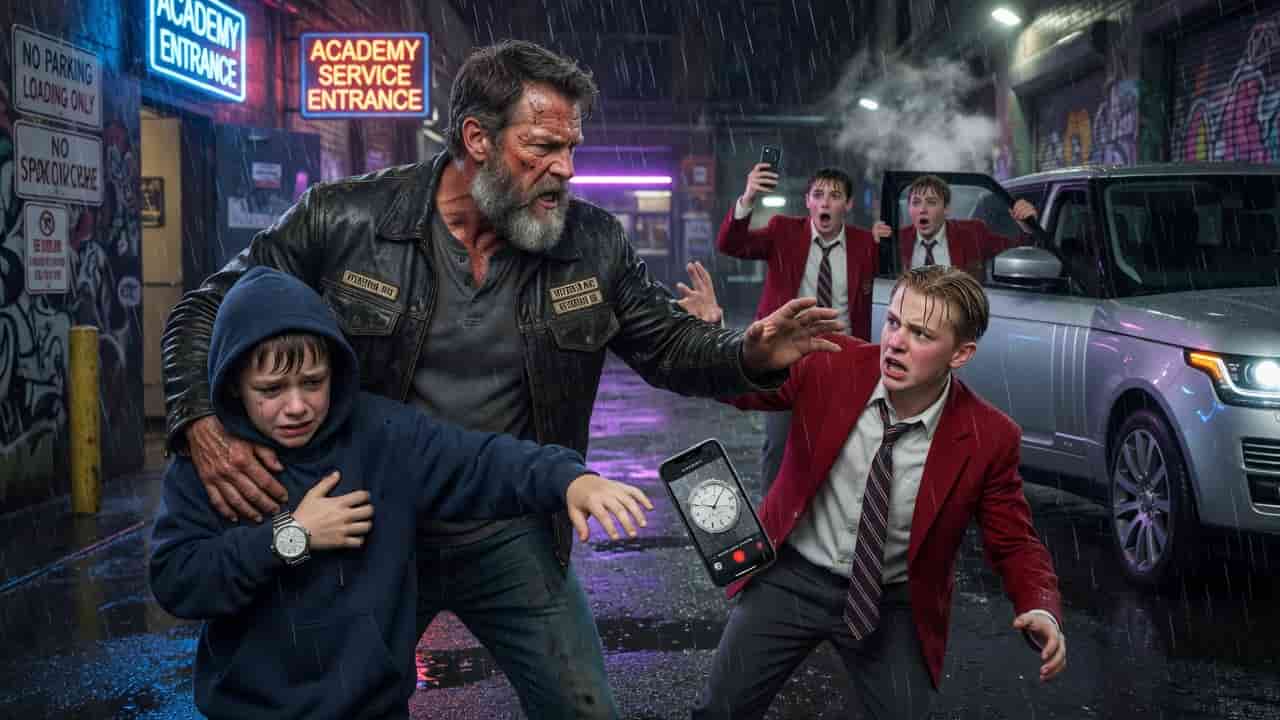
Silas didn’t mean to get involved. He was just trying to get through the rain and the memories that usually drowned him this time of year. But when he saw three private school kids cornering a boy no older than eight behind the academy, something in him snapped. They were laughing while the kid hyperventilated, holding a phone in his face like he was a spectacle instead of a person.
One of them said something cruel about the boy’s mother—the kind of lie that stays buried until it rots.
Silas didn’t think. He moved. He sent the expensive phone skittering across the wet asphalt and watched the entitled look on the bully’s face turn to pure, unadulterated shock. But the anger vanished the second Silas reached out to steady the boy.
On the child’s thin wrist sat a silver watch. The crystal was cracked, and the hands were frozen at exactly 12:04.
Silas knew that time. He had lived inside that minute for a decade. It was the exact moment his wife was taken from him in a pharmacy parking lot while he sat in the car, too high to move, watching a man with a scarred face walk away into the dark.
Now, that watch was on this boy’s wrist. And the people who had been lying to Silas for years were about to find out what happens when a man who has lost everything finally finds a reason to fight back.
The truth wasn’t just hidden; it was being protected by the most powerful family in the city. And Silas was just getting started.
Chapter 1: The Weight of 12:04
The rain in Seattle doesn’t just fall; it colonizes. It gets into the seams of your jacket, the cracks in the sidewalk, and the spaces between the things you’re trying to forget. Silas Hendrix sat on his 1998 Fat Boy, the engine idling with a rhythmic, heavy thrum that he felt in his teeth. He was parked across from “The Midnight Watch,” a tiny, sliver-of-a-shop wedged between a high-end bistro and a closed-down laundromat.
Silas didn’t look like he belonged in this part of the city. He was a man made of rough edges—leather, oil, and a beard that had more grey in it than he cared to admit. He was fifty-two, but his joints felt seventy when the humidity spiked. He stared at the neon sign in the shop window: a flickering blue clock that pulsed like a dying heart.
He checked his own wrist. He wasn’t wearing a watch. He hadn’t worn one in ten years. He didn’t need a dial to tell him what time it was. It was always 12:04 in his head.
“You’re late, Stone,” a voice croaked from the doorway.
Silas looked up. Tic-Toc stood there, a man so thin he looked like he was made of coat hangers, wearing an apron stained with jeweler’s oil. His real name was Arthur, but no one had called him that since the eighties. He was the club’s resident miracle worker for anything with a gear or a spring.
“Bike’s running slow,” Silas lied. He kicked the kickstand down and dismounted, his boots splashing into a puddle that reflected the sickly yellow of the streetlights.
“The bike’s fine. It’s the rider,” Tic-Toc said, stepping back to let Silas into the cramped, ticking warmth of the shop.
The air inside smelled of ozone, old paper, and the metallic tang of brass. Thousands of clocks lined the walls—cuckoos, grandfathers, sleek modern chronometers, and pocket watches hanging from velvet boards. The sound was a deafening, multilayered carpet of tick-tick-tick, a cacophony of seconds being devoured.
Silas hated it. It reminded him that everything was moving forward except him.
“I need that gear for the primary drive,” Silas said, leaning against a glass counter. He kept his hands in his pockets. They were shaking again. They always shook when he was too close to a clock.
Tic-Toc didn’t move toward the back room. He just looked at Silas, his eyes magnified behind thick spectacles. “You look like hell, Silas. When was the last time you slept? Truly slept?”
“I sleep fine. I just don’t like the dreams.”
“The dreams haven’t changed in a decade. Maybe it’s time you changed the channel.” Tic-Toc reached under the counter and pulled out a small, wrapped parcel. “Here’s your gear. Hardened steel. Should last longer than you will at this rate.”
Silas took the parcel. “What do I owe you?”
“Nothing. Consider it a tax on your misery.” Tic-Toc leaned forward, his voice dropping. “The club’s worried, Silas. The younger guys—they see you sitting out there in the rain, staring at nothing. They think you’re a ghost. And ghosts are bad for business.”
Silas felt a familiar, hot needle of resentment. The “younger guys” were kids who liked the patches and the noise but didn’t know a thing about the weight of the road. They saw his silence as weakness. They didn’t understand that he stayed silent because if he started talking, he might never stop screaming.
“I do my job,” Silas said, his voice flat.
“You do your shifts. You ride the perimeter. But you aren’t there,” Tic-Toc countered. “You’re still in that pharmacy parking lot, Silas. You’re still waiting for Sarah to come out with those aspirin.”
The mention of her name hit Silas like a physical blow to the solar plexus. He felt the air leave his lungs. For a second, the ticking of the clocks became a roar. 12:00. 12:01. 12:02. He could see the neon ‘Pharmacy’ sign flickering. He could see the man in the dark hoodie walking toward the car. He could see the gun.
And he could see himself, slumped in the passenger seat, his head back, eyes pinned, drifting in a morphine haze that made the world feel like it was made of warm honey. He had seen the killer’s face. He had seen the way the man hesitated. But Silas hadn’t moved. He hadn’t reached for the door. He hadn’t reached for the iron under the seat. He had just watched.
“Don’t say her name,” Silas whispered.
“Someone has to,” Tic-Toc said sadly. “Before you follow her into the dark.”
Silas turned and walked out. The bell above the door chimed—a bright, cheerful sound that felt like an insult. He stood on the sidewalk, the rain hitting his face, trying to ground himself. He needed a drink, or a ride, or a fight. Anything to drown out the sound of those clocks.
He climbed onto the Fat Boy and kicked it over. He didn’t head back to the clubhouse. He just rode. He let the city blur into a smudge of grey and neon. He ended up in the North End, near the private academies where the grass was too green and the gates were too high. It was a world that had never touched him, and he usually avoided it, but tonight, he just wanted to be somewhere he didn’t belong.
He turned down an alleyway behind the Saint Jude’s Academy, looking for a place to light a cigarette out of the wind. That’s when he heard it.
Laughter. Not the good kind. The sharp, jagged laughter of someone enjoying a kill.
Silas slowed the bike, the engine a low growl. In the shadows of a loading dock, three teenagers in bright red blazers were gathered in a semi-circle. They were tall, well-fed, and radiating an easy, inherited arrogance. One of them, a blonde kid with a face that looked like it had been carved out of ivory, was holding a smartphone up, filming something on the ground.
“Come on, Leo,” the blonde kid sneered. “Tell the camera. Tell everyone why you’re such a freak.”
Silas stopped the bike. He shouldn’t have cared. Rich kids being jerks wasn’t his business. But then he saw the target.
A small boy, maybe eight years old, was backed against the brick wall. He was wearing an oversized hoodie that swallowed his frame. He wasn’t crying—not yet—but his chest was heaving in a way Silas recognized. A panic attack. The kid was drowning on dry land.
“He’s gonna barf,” one of the other boys laughed, leaning in. “Look at his eyes. He’s glitching out.”
“It’s because of his mom,” the blonde one said, his voice dripping with casual cruelty. “My dad says her brain just broke. He says Leo’s gonna end up just like her—in a room with padded walls, ticking away.”
Ticking.
The word triggered something in Silas. He saw the boy flinch at the word, his hands flying to his ears. The kid was hyperventilating so hard he was starting to sway.
“Say it, Leo,” the blonde kid commanded, shoving the phone closer. “Say: ‘I’m a crazy person like my mom.'”
Silas didn’t consciously decide to move. He was off the bike before the kickstand was even down. He walked toward them, his boots heavy on the pavement. He was a shadow emerging from the rain, and for a few seconds, the teenagers didn’t even notice him. They were too busy enjoying the degradation.
“Hey,” Silas said.
The three boys spun around. The blonde one, Julian, didn’t look scared. He looked annoyed. He looked at Silas’s worn leather jacket and the grease under his fingernails and he saw a person who didn’t exist in his social tax bracket.
“This is private property, old man,” Julian said, not lowering the phone. “Keep moving.”
“Put the phone down,” Silas said. His voice was low, vibrating with a frequency that usually made grown men step back.
“Or what? You’re going to call your biker friends? My dad is on the board of this school. He owns half this block. You’re trespassing.” Julian turned back to the boy, grinning for the camera. “Anyway, as I was saying—”
Silas didn’t give him the chance. He reached out, his hand a blur, and swiped at the phone. He didn’t just take it; he launched it. The device hit the wall across the alley and shattered, the screen flickering once before going dark.
Julian froze. His mouth fell open. He looked at his empty hand, then at the wreckage of his thousand-dollar toy, then at Silas.
“You… you crazy piece of trash!” Julian yelled, stepping forward, his face turning a blotchy red. “Do you have any idea who I am?”
Silas stepped into his space. He didn’t touch him, but he let his presence fill the air. He was a wall of cold, wet leather and repressed violence. Julian’s bravado didn’t just crack; it evaporated. He took a stumbling step back, his heel catching on an uneven stone.
“I know who you are,” Silas said, his voice a gravelly rasp. “You’re the kind of coward who needs an audience to feel tall. Get out of here. Now. Before I decide that the phone wasn’t the only thing that needed breaking.”
Julian’s friends were already backing away toward a silver SUV parked further down the alley. Julian looked like he wanted to say something else, some final entitled jab, but Silas took one more step, and the boy turned and bolted.
The alley went quiet, save for the rain and the distant hum of the city. Silas stood there for a moment, his heart hammering against his ribs. He felt the residue of the anger—a hot, metallic taste in his mouth. He hadn’t felt that alive in years.
Then he remembered the boy.
He turned around. The kid, Leo, was still against the wall, but he had slid down to the ground. He was curled into a ball, his forehead resting on his knees. He was shaking violently.
“Hey,” Silas said, trying to soften his voice. He realized he probably looked terrifying to a child. “They’re gone, kid. It’s okay.”
The boy didn’t look up. He was making a small, soft sound—a rhythmic clicking with his tongue. Click. Click. Click.
“Leo, right?” Silas asked. He slowly dropped to one knee, keeping a respectful distance. “I’m Silas. I’m not going to hurt you.”
He reached out, intending to just put a steadying hand on the boy’s shoulder. As he did, Leo’s arm shifted, the sleeve of his oversized hoodie riding up.
Silas stopped mid-motion. His hand stayed frozen in the air.
On the boy’s thin, pale wrist sat a silver watch. It was a high-end vintage piece, the kind that cost more than Silas’s bike. But the silver was tarnished, and the crystal was spiderwebbed with a deep, ugly crack.
Silas stared at the face of the watch. The hands were fixed. They didn’t move. They were pointed at twelve and four.
12:04.
The world seemed to tilt. The rain stopped making noise. Silas felt a coldness spread from his chest to his fingertips. He knew that watch. He had seen it a thousand times in his memories, glinting under the fluorescent lights of the pharmacy as Sarah reached for the door.
“Where did you get that?” Silas whispered, his voice cracking.
Leo looked up then. His eyes were huge, dark, and filled with a haunted intelligence that no eight-year-old should possess. He looked at the watch, then back at Silas.
“It stopped,” Leo said, his voice tiny. “When the loud noise happened. It stopped and it won’t go again.”
Silas reached out, his fingers trembling uncontrollably now. He gently took the boy’s wrist, his eyes locked on the watch. He turned it over. On the back, nearly worn away by time and skin, were three engraved initials.
S.M.H.
Sarah Marie Hendrix.
Silas felt the alleyway vanish. He wasn’t in the rain anymore. He was back in the car. He could smell the stale coffee. He could feel the heavy, lethargic weight of the pills in his blood. He could see the man with the scarred face ripping the watch from Sarah’s wrist after she fell.
“Whose watch is this, Leo?” Silas asked, his voice a desperate, broken thing. “Tell me where you got this.”
Leo shrank back, fear returning to his eyes. “It was my dad’s,” he whispered. “He told me never to show anyone. He says it’s a secret.”
Silas stared at the boy—this child of the elite, this boy who was being bullied for being “crazy” like his mother. And as he looked into Leo’s eyes, he saw a reflection of his own grief, a shared trauma that bridged the gap between the clubhouse and the academy.
He looked at the watch again. 12:04. The time his life ended. And now, ten years later, it was ticking again in the pulse of a child.
Chapter 2: The Sound of Ticking
The rain hadn’t let up by the time Silas pulled the Fat Boy into the driveway of a modest, slightly overgrown bungalow in a neighborhood that had seen better days but was trying to keep up appearances. He had Leo tucked in front of him on the bike, the boy’s small hands gripping the handlebars with a white-knuckled intensity. Silas had watched him the whole ride, his mind a whirlpool of impossible connections.
“Is this where you live?” Silas asked as he killed the engine.
Leo nodded, sliding off the bike. He looked smaller now, standing on the cracked pavement, the oversized hoodie soaked through. He kept his left hand tucked deep into his pocket, hiding the watch.
“My aunt Martha is home,” Leo said. “She’s a nurse. She works the late shift at the hospital, but she’s always awake when I get back from tutoring.”
Silas stayed on the bike. He didn’t know what he was doing here. He was a biker with a record and a past that could poison a room, and he was dropping off a kid from a world he didn’t understand. But the watch—the watch was a tether he couldn’t cut.
The front door opened, throwing a rectangle of warm, yellow light onto the wet grass. A woman stepped out, her face etched with a weary kind of strength. She was in her late thirties, wearing faded scrubs, her hair pulled back in a messy bun.
“Leo? You’re late, honey. I was about to—” She stopped, her eyes landing on Silas. Her posture immediately shifted. It wasn’t fear, exactly; it was the practiced alertness of someone used to dealing with trauma in an ER. “Who are you?”
“He helped me, Martha,” Leo said, running toward her. “Some kids were… they were being mean. He made them go away.”
Martha caught Leo, her eyes never leaving Silas. She took in the leather, the beard, the heavy bike. She saw the tremor in Silas’s hands, even though he tried to hide it by gripping the grips.
“Is that right?” she asked, her voice guarded.
“They were cornering him in the alley behind the school,” Silas said. “Filming him. I just… I stopped it.”
Martha’s expression softened, but only by a fraction. She looked down at Leo, checking him for injuries. When she saw his red-rimmed eyes and the way he was still shaking, she pulled him closer.
“Thank you,” she said to Silas. “I’ve told the school about those boys. Julian Vane and his friends. They think because their parents donate the library, they can treat the other kids like dirt.”
Vane. The name hit Silas like a low-frequency hum. Arthur Vane was a name you saw on campaign posters and the sides of buildings. He was a “pillar of the community,” a man who spoke about law and order while his son spent his afternoons humiliating children in alleys.
“He needs to get inside. Get dry,” Silas said. He started to kick the bike over, but his eyes drifted to Leo’s pocket.
“Wait,” Martha said. She walked to the edge of the porch. “You’re soaking wet. And you look like you’ve seen a ghost. Do you want a cup of coffee? It’s the least I can do.”
Silas wanted to say no. He wanted to ride back to the clubhouse and drink until the 12:04 in his head went silent. But he couldn’t leave. Not yet.
“Just for a minute,” he said.
The inside of the house was cramped but clean. It smelled of lavender and lemon pledge, a stark contrast to the oil and smoke of Silas’s life. Leo was sent to change, and Silas found himself sitting at a small kitchen table while Martha moved with efficient grace, pouring two mugs of thick, dark coffee.
“I’m Martha,” she said, sitting across from him. “And you’re…?”
“Silas. Most people call me Stone.”
“Well, Silas, you picked a powerful enemy today. Julian Vane doesn’t take ‘no’ for an answer, and his father is even worse.” She sighed, leaning back. “Leo’s been a target ever since he started at Saint Jude’s. He’s there on a legacy scholarship. His father… his father was a different man before he died.”
Silas felt his pulse jump. “Leo’s father. What happened to him?”
Martha’s face clouded. She looked toward the hallway to make sure Leo was out of earshot. “They say it was an accident. A hit-and-run six years ago. But Elias—that was my brother—he was a troubled man. He worked as a driver for some high-up people. He saw things he wasn’t supposed to see. After Leo’s mother passed away, Elias just… he wasn’t the same. He became paranoid. Obsessive.”
“About what?”
“Clocks,” Martha said, a sad smile touching her lips. “He started collecting them. Repairing them. He said he was trying to find a specific minute. He’d sit in the dark for hours, just listening to them tick. He left everything to Leo. The house, the debt, and that box of old watches.”
Silas gripped his mug so hard the ceramic groaned. “The watch Leo is wearing. The silver one with the cracked face. Was that his father’s?”
Martha nodded. “Elias’s favorite. He told Leo it was a ‘truth-teller.’ He said as long as the hands didn’t move, the lie couldn’t grow. I know it sounds crazy, Silas. But Leo clings to it. He has these… episodes. Panic attacks. The only thing that calms him down is the sound of a clock. But not just any clock. He needs to hear the one that’s broken.”
“12:04,” Silas whispered.
Martha froze. Her eyes narrowed, searching his face. “How did you know the time?”
Silas looked down at his coffee. He couldn’t tell her. He couldn’t tell this woman that her brother might have been the man who stood over his wife’s body. He couldn’t tell her that he was an addict who had watched his own world burn and was now looking for someone to blame.
“I saw it in the alley,” Silas lied. “When I helped him up.”
Martha didn’t look convinced, but before she could press him, Leo walked back into the room. He had changed into dry pajamas, but he was still wearing the watch. He walked straight to Silas and stood beside him.
“Do you know how to fix it?” Leo asked.
Silas looked at the boy. He saw the desperation there—the need for something in his broken world to finally start working again.
“I know a man,” Silas said. “A man who specializes in things that have stopped.”
“Will you take me?” Leo asked.
“Leo, no,” Martha interrupted. “Silas has done enough. We can’t ask him—”
“I’ll take him,” Silas said, surprised by the firmness in his own voice. “Tomorrow. After school. I’ll pick him up.”
Martha looked between the weathered biker and her nephew. She saw the way Leo was looking at Silas—with a trust that he didn’t give to anyone. She saw the way Silas was looking at the watch—with a hunger that was almost frightening.
“Okay,” she said softly. “But if I see a single scratch on him, Silas, I don’t care how big you are. I’ll come for you.”
Silas nodded. He stood up, his body feeling heavy and old. He walked to the door, but before he left, he turned back to Leo.
“Keep it hidden, kid,” Silas said. “The watch. Don’t let anyone else see it. Especially not kids like Julian.”
Leo nodded solemnly. “Because of the secret?”
“Because of the truth,” Silas said.
He rode back to the clubhouse in a daze. The rain had turned into a fine mist that clung to everything. When he walked into the main room, the air was thick with the smell of cheap beer and stale tobacco. A group of the younger members—guys with names like Snake and Joker—were huddled around a pool table.
“Look who it is,” Snake sneered. He was twenty-four, with a neck tattoo of a coiled viper and a mouth that never knew when to shut. “The Ghost of Seattle. Where you been, Stone? We had a run to the docks. You weren’t there.”
“I had business,” Silas said, walking past them toward the bar.
“Business? What kind of business? You looking for another fix?” Snake laughed, and the others joined in. It was an old joke, a cruel one. Everyone knew Silas had been clean for years, but the stain of the addiction was like a permanent grease mark on his reputation.
Silas stopped. He turned slowly, his eyes locking onto Snake’s. The room went quiet. The laughter died in the throats of the other bikers. There was something in Silas’s gaze tonight—something cold and sharp that hadn’t been there in a long time.
“Say that again,” Silas said.
Snake’s smirk flickered. He gripped his pool cue a little tighter. “I was just joking, man. Take it easy.”
“I don’t feel like taking it easy,” Silas said, stepping into Snake’s personal space. He could smell the arrogance on the kid, the unearned confidence of someone who hadn’t seen a real war. “I’ve been riding this road since before you were a glint in your old man’s eye. If you want to talk about my business, you do it to my face. Not behind my back like a coward.”
Snake backed up against the pool table. He looked around for support, but the others were looking at the floor. Silas was a legend in the club, even if he was a faded one.
“My bad, Stone,” Snake muttered. “Won’t happen again.”
Silas stared at him for a few more seconds, letting the silence settle like ash. Then he turned and walked to his room—a small, windowless box at the back of the clubhouse. He sat on the edge of his bed, the gear parcel from Tic-Toc sitting on the nightstand.
He reached into his pocket and pulled out a crumpled photo. It was Sarah. She was laughing, her hair caught in a breeze, her eyes bright with a future they were supposed to have together.
He looked at her wrist in the photo. There it was. The silver watch. 12:04.
He closed his eyes and listened. He didn’t hear the bikes outside. He didn’t hear the music from the bar. He heard the ticking. A thousand clocks, all out of sync, all screaming the same thing.
He was a ghost. He was a coward. He was the man who let her die.
But as he drifted off to sleep, he didn’t see the pharmacy parking lot. He saw a boy in a navy-blue hoodie, holding a secret on his wrist. And for the first time in ten years, Silas felt like he wasn’t just waiting for the end. He was waiting for the morning.
Chapter 3: The Broken Gear
The next afternoon, the sun made a brief, mocking appearance through the clouds, lighting up the glass and steel of the city. Silas was waiting at the gates of Saint Jude’s twenty minutes early. He sat on his bike, a dark blotch on the pristine sidewalk, watching the sea of red blazers pour out of the school.
He saw Julian Vane almost immediately. The boy was surrounded by his clique, laughing as they walked toward a line of waiting town cars and SUVs. Julian spotted Silas and stopped. For a moment, the entitled rage from the alley flickered in his eyes, but then he saw the way Silas was looking at him—flat, unblinking, and entirely unimpressed. Julian looked away, whispering something to his friends as they hurried into a black Cadillac.
Then came Leo. He was walking alone, his head down, his oversized hoodie pulled low. He looked up when he saw the Fat Boy, and a small, tentative smile broke across his face.
“You came,” Leo said, reaching the bike.
“I said I would,” Silas replied. “Get on. We’re going to see the clock man.”
They rode through the city, away from the manicured lawns and toward the industrial heart of the docks. The air turned salty and heavy with the smell of diesel. When they reached Tic-Toc’s shop, the neon sign was pulsing a steady, rhythmic blue.
“Wait here a second,” Silas said to Leo, leaving him by the bike. He walked into the shop, the bell chiming his arrival.
Tic-Toc was at his workbench, a loupe pressed to his eye as he manipulated a tiny hairspring. He didn’t look up. “Back so soon, Stone? Did the gear break already?”
“The gear’s fine. I have something else. Something… unique.”
Tic-Toc set down his tweezers and looked up. He saw the expression on Silas’s face and his own eyes widened behind his glasses. “You look like you’ve seen the Second Coming, Silas. What is it?”
Silas stepped back to the door and waved Leo inside. The boy walked in hesitantly, his eyes darting around at the thousands of ticking clocks. He seemed overwhelmed, his hands flying to his ears for a moment before he settled.
“This is Leo,” Silas said. “And he has a watch that needs looking at.”
Leo walked to the counter and slowly pulled his left hand out of his pocket. He unbuckled the silver watch and laid it on the velvet pad.
Tic-Toc leaned in. He didn’t touch it at first. He just stared. Then, very slowly, he picked up the watch, turning it over in his long, spindly fingers. He saw the initials on the back. He saw the crack in the crystal. He saw the hands at 12:04.
The shop went unnaturally quiet. Even the ticking seemed to soften.
“Where did you find this, Silas?” Tic-Toc whispered.
“It belongs to the kid. His father left it to him.”
Tic-Toc put the loupe back to his eye and began to examine the watch with a feverish intensity. He unscrewed the back casing, his movements precise and practiced. He let out a soft, sharp breath.
“This isn’t just a watch, Silas,” Tic-Toc said, his voice trembling. “This is a Patek Philippe Ref. 1518. One of the rarest chronographs in the world. But that’s not the point. Look at the movement.”
He turned the watch so Silas could see the tiny, intricate gears. One of them was shattered—not just broken, but crushed, as if something had been jammed into the mechanism with incredible force.
“The gear didn’t fail,” Tic-Toc said. “It was murdered. And look here.” He pointed to a small, hand-stamped serial number on the inner plate. “This isn’t a factory number. This is a tracking mark. Used by private couriers for high-value assets.”
Silas felt a cold sweat break out on his neck. “What are you saying?”
“I’m saying this watch wasn’t bought in a store. It was part of a shipment. A shipment that went missing ten years ago.” Tic-Toc looked at Leo, then back at Silas. “This is the ‘Midnight Watch,’ Silas. The one the Vane family was looking for after the pharmacy heist. They didn’t want the drugs. They wanted the contents of the courier bag Sarah was carrying.”
The room spun. Silas grabbed the edge of the counter to keep from falling. Sarah hadn’t been there for aspirin. She had been working. She had been a courier—a job she’d taken to help pay for his rehab, a job he hadn’t even known the details of.
“My dad said it was a secret,” Leo said, his voice small but clear. “He said if the hands ever started moving, the bad men would come back.”
“Your father,” Silas said, turning to Leo. “What was his name?”
“Elias Thorne,” the boy replied.
Thorne. Silas remembered the name. He had seen it in the old police reports. Elias Thorne had been the lead investigator on the pharmacy robbery. He had been the one who interviewed Silas in the hospital while Silas was still coming down from the high. Thorne had been disgraced a year later—accused of stealing evidence and fired from the force.
He hadn’t been a thief. He had been a whistleblower who had been silenced. He had taken the watch to protect the truth.
“Can you fix it?” Silas asked Tic-Toc.
“I can,” Tic-Toc said. “But Silas… if I fix this, if those hands move past 12:04, you’re opening a door you can’t close. The Vane family… they built an empire on what was in that courier bag. They won’t let a ghost and a child take it away.”
“Fix it,” Silas said. His voice was a low growl, the sound of a man who had finally found his way out of the dark.
“It’ll take a few days,” Tic-Toc said, his face grim. “I have to hand-forge the replacement gear. And Silas… stay safe. People are going to start noticing you’re not a ghost anymore.”
Silas took Leo back to Martha’s house. The ride was silent, both of them lost in the weight of what they had discovered. When they arrived, Martha was waiting on the porch, her face pale. She held a phone in her hand.
“Silas,” she said as he killed the engine. “I just got a call. From the school. They’ve expelled Leo.”
“What?” Silas said, dismounting. “On what grounds?”
“Assault,” Martha said, her voice shaking with anger and fear. “Julian Vane’s father filed a report. He says a ‘dangerous biker’ attacked his son and that Leo was the one who orchestrated it. They’re saying Leo is a danger to the other students. They’ve also filed a restraining order against you.”
Silas felt the old, familiar rage bubbling up, but this time it was different. It wasn’t the aimless anger of a man who hated himself. It was the focused, lethal fury of a protector.
“They’re trying to isolate him,” Silas said. “They know about the watch, or they suspect. They want him away from any witnesses.”
“What do we do?” Martha asked, looking at Leo, who had retreated into the shadows of the porch.
“We wait,” Silas said. “I have people. The club might think I’m a ghost, but they still owe me. I’m going to find out exactly what Elias Thorne was looking for.”
He spent the next forty-eight hours in a fever of activity. He reached out to old contacts—men he hadn’t spoken to in a decade. He dug through the club’s archives, looking for any mention of the Vane family and their connections to the underworld.
He found it in the basement of a condemned bar—a ledger from ten years ago. It showed payments made by Arthur Vane to a local gang for “security services” on the night of the pharmacy robbery. The gang was the one Silas’s own club had been at war with.
The robbery hadn’t been a random act of violence. it had been a targeted hit. They had killed Sarah to get the watch, but Elias Thorne had gotten there first. He had taken the proof and disappeared into the shadows of his own grief.
On the third night, Silas was sitting in the clubhouse bar, a map of the city spread out before him. Snake walked up, his eyes narrow and suspicious.
“You’re making a lot of noise, Stone,” Snake said. “People are asking questions. The Vane family… they have friends in high places. Friends we don’t want to piss off.”
“I don’t give a damn who they’re friends with,” Silas said, not looking up.
“Well, maybe you should. Because a black SUV has been sitting outside the gate for the last hour. And they aren’t here to buy t-shirts.”
Silas looked toward the window. Sure enough, a sleek, black SUV with tinted windows was idling at the entrance to the clubhouse lot.
“Tell the guys to stay inside,” Silas said, standing up.
“What are you going to do?”
“I’m going to finish the conversation I started in the alley.”
Silas walked out into the cool night air. The SUV’s door opened, and a man stepped out. He was tall, impeccably dressed in a charcoal suit, with silver hair and a face that radiated power. Arthur Vane.
“Mr. Hendrix,” Vane said, his voice smooth and cultured. “I believe you have something that belongs to my family.”
“I don’t have anything of yours, Vane,” Silas said, stopping ten feet away.
“Let’s not play games. My son tells me you were quite heroic in that alley. But heroes often have a short shelf life in this city. The watch, Silas. Give it to me, and I’ll make sure the boy and his aunt are taken care of. Permanent scholarships. A new house. A life far away from here.”
“And if I don’t?”
Vane’s smile didn’t reach his eyes. “Then things will get very difficult. For everyone. The boy is already out of school. It wouldn’t take much to have social services take a look at that household. A single woman working double shifts, a child with documented psychological issues, and a violent biker as their only protector? It won’t end well for them.”
Silas felt the air grow cold. He saw the cold, calculating cruelty in Vane’s eyes—the same look Julian had used on Leo.
“The watch is being fixed,” Silas said. “And when those hands move, everyone is going to see exactly what you did ten years ago.”
Vane’s expression didn’t change, but his jaw tightened. “You’re a drug addict, Silas. A ghost. No one will believe you.”
“They don’t have to believe me,” Silas said. “They just have to listen to the ticking.”
Vane turned and got back into the SUV without another word. As the vehicle pulled away, Silas stood in the dark, his hands finally, for the first time in a decade, perfectly still.
Chapter 4: The Midnight Reveal
The pressure began to build like a storm front over the Sound. Within twenty-four hours of Vane’s visit, the clubhouse was being patrolled by “unmarked” security vehicles. Martha called Silas, her voice trembling—someone had been following her home from the hospital, and a man in a suit had been seen talking to her neighbors, asking questions about Leo’s safety.
“They’re closing in, Silas,” Martha whispered over the phone. “I don’t know how much longer I can keep Leo calm. He keeps asking when the watch will be back. He says he can’t hear the ‘truth’ anymore.”
“I’m coming to get you,” Silas said. “Pack a bag. We’re moving you to the clubhouse. It’s the only place I can guarantee security.”
“The clubhouse? Silas, I’m a nurse. I can’t take a child into a—”
“It’s either that or Vane takes him. Choose.”
There was a long silence, then a soft sob. “Okay. Just hurry.”
Silas didn’t go alone. He walked into the main room of the clubhouse and stood on a table. The room went silent. Even the music was cut.
“I need ten riders,” Silas shouted. “Full patches. No rookies. We’re doing a recovery run.”
“Who are we recovering, Stone?” Joker asked, leaning against his bike.
“A boy and his aunt. And the soul of this club.” Silas looked around, his gaze landing on the younger guys who had mocked him. “For ten years, I’ve been a ghost. I’ve let you think I was weak because I was drowning in my own shame. But the people who killed my wife—the people who built this city on the blood of our families—they’re coming for a child. And I’m not going to let it happen. Who’s with me?”
For a heartbeat, no one moved. Then, Tic-Toc stepped out from the back room, holding a small, silver object wrapped in silk. He walked to the table and handed it to Silas.
“The gear is forged, Silas,” Tic-Toc said, his voice ringing in the quiet room. “The hands are moving.”
Silas took the watch. He held it to his ear.
Tick. Tick. Tick.
The sound was steady, relentless, and beautiful. 12:05. The time after the end.
Snake was the first to step forward. He looked at Silas, then at the watch. “If the Vanes want a war, they can have one. I’m in.”
One by one, the riders stood up. Within ten minutes, the roar of ten engines shook the walls of the clubhouse. They rode out in a tight formation, a thunderous wall of steel and leather that carved through the evening traffic.
They reached Martha’s house just as a black sedan was pulling into her driveway. Two men in suits were stepping out, but they stopped when the bikes surrounded them, the engines growling like hungry wolves.
“Change of plans, fellas,” Silas said, dismounting. He walked past the suit-clad men as if they were invisible.
Martha and Leo were waiting at the door, bags in hand. Leo saw Silas and ran to him, his eyes landing on the watch in Silas’s hand.
“It’s fixed?” Leo asked, his voice filled with awe.
“It’s fixed, kid,” Silas said. He knelt down and buckled the watch back onto Leo’s wrist.
The moment the strap was secured, Leo’s whole body seemed to relax. He closed his eyes, listening to the steady rhythm. The panic that had been hovering around him for days seemed to dissipate.
“We need to go,” Silas said to Martha. “Now.”
They loaded Martha and Leo into a club van, flanked by the riders. As they pulled away, Silas saw Julian Vane standing on the sidewalk across the street, his face pale and twisted with a mixture of fear and realization. The boy wasn’t filming this time. He was just watching his world crumble.
Back at the clubhouse, Silas set up Martha and Leo in the most secure room—the old armory, which had been converted into a comfortable living space. He then gathered the senior members of the club in the briefing room.
“This watch contains a micro-film strip,” Tic-Toc explained, pointing to the internal mechanism he had uncovered. “Elias Thorne didn’t just hide the watch. He used it as a storage device. It contains the real ledgers of the Vane family’s shipping business. Every bribe, every illegal shipment, every murder they paid for to keep their secrets.”
“How do we get it out?” Joker asked.
“I need a high-resolution scanner and a specific chemical developer,” Tic-Toc said. “It’ll take a few hours to extract the data without damaging it.”
“We don’t have a few hours,” Silas said, looking at the security monitors.
Outside, the perimeter was being swarmed. Not just by black SUVs, but by the city police. Arthur Vane had pulled his final lever. He had branded the club as a kidnapping ring, using the “disappearance” of Leo and Martha as the catalyst.
“They’re going to breach,” Silas said. “They’ll come in with everything they’ve got.”
“Then we give them a show,” Snake said, checking his sidearm.
“No,” Silas said. “No shooting. Not yet. If we start a war with the cops, we lose the truth. We need to hold them off long enough for Tic-Toc to finish. And we need a witness.”
Silas walked to the room where Leo was sitting. The boy was staring at the watch, his face calm.
“Leo,” Silas said. “I need you to do something for me. Something brave.”
“What is it?”
“I need you to tell the story. The real one. The one your father wanted you to tell.”
Silas took Leo to the clubhouse bar and sat him in front of a laptop with a high-speed satellite uplink. He looked at Martha, who was standing by her nephew, her hand on his shoulder.
“We’re going live,” Silas said. “To every news station in the city. To every social media platform. We’re going to show them the watch, and we’re going to show them the boy the Vanes tried to silence.”
As the first flash-bangs detonated at the gate, Silas hit the ‘record’ button.
“My name is Leo Thorne,” the boy said, his voice clear and steady. “And I have a secret.”
Outside, the chaos was erupting. Tires screeched, shouting filled the air, and the heavy thud of tactical boots hit the pavement. But inside the clubhouse, the only sound that mattered was the steady tick-tick-tick of the silver watch on the boy’s wrist.
Silas stood behind the camera, his hand on Leo’s chair. He looked at the monitor as the viewer count began to climb—ten, a hundred, a thousand, ten thousand. The city was watching. The lie was being dismantled in real time.
He felt a hand on his arm. It was Martha. She was looking at him with an expression of profound gratitude and something else—a shared understanding of the cost of the truth.
“You’re not a ghost anymore, Silas,” she whispered.
Silas looked at the screen, then at the watch on Leo’s wrist. 12:06. The time was moving forward. For the first time in ten years, he wasn’t waiting for the end. He was standing in the middle of a new beginning, and he was ready for whatever came next.
The door to the clubhouse was kicked open. Smoke filled the room. Figures in tactical gear rushed in, their weapons raised. But Silas didn’t flinch. He just looked into the lens of the camera and smiled—a cold, hard smile that promised a reckoning.
“Say it again, Leo,” Silas whispered. “Tell them everything.”
Chapter 5: The Siege of Silence
The first flash-bang didn’t just light up the room; it rewrote the physics of the clubhouse. One moment, Silas was standing in the dim, amber glow of the bar, watching a small boy tell a story that could topple an empire. The next, the world was a screaming white void. The sound wasn’t a noise so much as a physical weight that pressed into his eardrums, rattling his molars.
Silas didn’t fall. He’d spent too many years leaning into the wind on a highway to let a little pressure knock him over. He lunged for Leo, his large hand shielding the boy’s head as he pulled him down behind the heavy mahogany of the bar.
“Stay down!” Silas roared, though he couldn’t even hear his own voice.
The smoke followed the light—thick, acrid, chemical-smelling grey that tasted like burnt plastic and old copper. Figures in tactical black surged through the shattered front doors, their weapon-mounted lights cutting through the haze like searchlights in a shipwreck.
“Police! Get on the ground! Now!”
The commands were a barked chorus, overlapping and jagged. Silas looked over the top of the bar. Snake was on one knee, his hand hovering near his holster, his face a mask of twitching adrenaline. Across the room, Joker had a pool cue in one hand, his knuckles white, staring down the barrel of an AR-15.
“Don’t do it!” Silas screamed, his hearing starting to whistle back into existence. “Snake! Joker! Keep your hands where they can see them! If we shoot, they win! Nobody fires!”
It was the hardest thing he’d ever asked of them. These were men whose entire identity was built on the refusal to be intimidated, men who lived in the friction between society’s rules and their own codes. To stand down while their home was invaded was a kind of spiritual amputation.
Snake looked at Silas, his eyes wild. He saw the way Silas was holding Leo, the way the boy was clutching the silver watch to his chest as if it were a shield. Something in the kid’s terror seemed to anchor the younger biker. Snake slowly raised his hands, palms open, and sank to his shins.
“Clear!” one of the tactical officers shouted.
The room was a chaos of motion. Officers moved in pairs, zip-tying the club members who were scattered across the floor. They weren’t being gentle. Silas felt a heavy boot land on the small of his back, shoving him further against the bar. A gloved hand gripped the back of his neck, forcing his face toward the floor.
“Hands behind your back, Hendrix!”
“The kid,” Silas grunted, his cheek pressed into the beer-stained wood. “He’s just a kid. He hasn’t done anything.”
“Shut up.”
They yanked Silas’s arms back. The plastic ties bit into his wrists, sharp and cold. He watched as two officers pulled Leo away. The boy didn’t scream. He didn’t fight. He just looked at Silas with those vast, haunted eyes, his mouth moving in that silent click-click-click rhythm.
“Martha!” Silas called out, looking for her in the haze.
He saw her being led out from the back hallway, her hands bound. She looked pale, her nurse’s scrubs wrinkled and stained with smoke, but she kept her head up. She looked at Silas, and for a fleeting second, he saw the residue of the woman who had spent a decade holding a broken family together. It wasn’t defeat; it was a cold, clinical assessment of the damage.
The tactical teams began to pull back, replaced by men in suits. They didn’t have the urgency of the breach; they had the slow, methodical confidence of people who knew they owned the room. And in the center of them, walking through the wreckage of the front door with the air of a king visiting a conquered province, was Arthur Vane.
Vane didn’t look like a man who had just seen his secrets aired on a livestream. He looked immaculate. His charcoal suit was uncreased, his silver hair perfectly in place. He stopped in the middle of the room, looking around at the cracked pool table, the torn leather booths, and the men on the floor.
“You really should have taken the deal, Silas,” Vane said, his voice quiet enough to carry in the sudden, ringing silence.
Vane walked toward the bar. He reached out and picked up the laptop Silas had used for the stream. He looked at the screen, which was still flickering with a ‘Connection Lost’ message, and then closed it with a sharp, final snap.
“Where is the watch?” Vane asked.
Silas looked up at him, his jaw tight. “It’s gone, Vane. The truth is already out there. You can’t un-ring a bell.”
Vane smiled. It was a thin, predatory expression. “You’ve lived in the dirt so long you’ve forgotten how the world actually works. A livestream from a clubhouse? A story told by a child with a history of psychological trauma and a man with a record as long as a highway? My PR team has already framed this as a hostage situation. By tomorrow morning, the narrative will be that you coerced that boy into reading a script. The ‘proof’ you think you have? It’s just pixels. Without the physical object, it’s nothing but noise.”
He turned to one of the officers. “Check the boy. Thoroughly.”
“No!” Martha screamed, struggling against her captors. “Don’t you touch him!”
Silas felt the old, dark heat rising in his chest. It wasn’t the aimless fire of his addiction; it was something older, something that felt like the heavy thrum of his Fat Boy’s engine. He looked at Vane, and for the first time, he saw the fear behind the polish. Vane wasn’t here to arrest them. He was here to erase them.
“The watch isn’t on the kid,” Silas said, the lie tasting like iron in his mouth.
Vane paused. He looked at Silas, his eyes narrowing. “Then where is it?”
“Tic-Toc,” Silas said, nodding toward the back room. “He’s got it. He was taking it apart to get the film. He’s probably flushed the evidence by now.”
Vane’s face hardened. He gestured to two of his security men. “Find the old man. Bring me the watch.”
As the men headed toward the back, Silas felt a flicker of hope. Tic-Toc wasn’t just a clockmaker; he was a man who understood the architecture of time. He knew how to hide things in plain sight. He knew that the most important parts of a machine are often the ones you don’t see.
The minutes that followed felt like hours. Silas watched as the police began to move the club members toward the waiting vans outside. The neighborhood was a sea of blue and red lights, the sirens a distant, wailing chorus. He saw the ‘unmarked’ SUVs—Vane’s private security—mixed in with the official vehicles. The line between the law and the family was a smudge.
Julian Vane appeared in the doorway then. He looked different than he had in the alley. The arrogance was gone, replaced by a jittery, wide-eyed panic. He walked over to his father, looking at the men on the floor with a mixture of disgust and terror.
“Dad, we need to go,” Julian whispered. “People are outside. They’re filming with their phones. It’s… it’s all over the internet.”
“I told you to stay in the car,” Vane said, not looking at his son. His voice was cold, a whip-crack that made Julian flinch.
“But the people—”
“The ‘people’ are a distraction. The watch is the reality.” Vane turned back to Silas. “Last chance, Hendrix. Tell me where it is, and I might be able to keep the boy out of the system. If you keep playing this game, he’ll be in a state facility before sunrise, and I’ll make sure his ‘treatment’ is very, very long.”
Silas looked at Leo. The boy was being held by a female officer near the door. He wasn’t looking at Vane. He was looking at his own wrist, where the watch sat beneath the sleeve of his hoodie. He caught Silas’s eye, and he did something he hadn’t done the entire time Silas had known him.
He winked.
It was a small, quick gesture, but it hit Silas with the force of a revelation. The boy wasn’t a victim. He was a Thorne. He was the son of the man who had outplayed the Vanes ten years ago.
“You want the truth, Vane?” Silas said, his voice rising, carrying over the noise of the room. “The truth is that you’re a coward. You’re a man who hides behind suits and lawyers and tactical teams because you’re terrified of a little ticking sound. You killed my wife for a secret you couldn’t even keep.”
Vane stepped forward and kicked Silas in the ribs. It wasn’t a tactical strike; it was a clumsy, emotional outburst of a man losing control. Silas grunted, the air leaving his lungs, but he didn’t look away.
“You think you’re so powerful,” Silas gasped, a bloody smile touching his lips. “But you’re just a man who’s about to be very, very late.”
One of Vane’s security men came running back from the shop area. He looked pale. “Sir… the old man. He’s gone.”
“Gone? What do you mean gone?” Vane roared.
“There’s a tunnel. Behind the lathe. He’s been gone for at least ten minutes. And the shop… he set some kind of delay. The whole place is wired.”
The realization hit the room at the same time the first alarm went off. It wasn’t a police siren. It was the sound of a thousand clocks in Tic-Toc’s shop, all hitting the hour at once. Chime. Gong. Whistle. Ring. The noise was a tidal wave of sound that flooded the clubhouse, drowning out the voices of the officers and the orders of the commanders.
In the confusion, Silas felt the pressure on his back lift. The officer holding him had turned toward the noise. Silas used the moment of distraction to lunge upward, his bound hands catching Vane’s legs. He didn’t need to hurt him; he just needed to destabilize him.
Vane went down, his head hitting the edge of the pool table with a sickening crack.
“Move!” Silas shouted to Martha and Leo.
The room devolved into a blur. The tactical teams, confused by the sudden noise and the lack of clear orders, hesitated. The club members, seeing their opening, began to resist. It wasn’t a shootout; it was a chaotic, physical scramble.
Silas felt someone grabbing his arm. It was Snake. The kid had somehow slipped his ties. He had a knife in his hand, and with two quick movements, Silas’s wrists were free.
“Go, Stone!” Snake yelled, shoving a leather vest into Silas’s hands. “Take the kid and the nurse. There’s a bike hidden in the alley behind the kitchen. A scout bike. Get them out of here!”
“What about the rest of you?”
“We’re the club,” Snake said, his eyes hard and bright. “We stay with the ship. Go!”
Silas grabbed Martha and Leo. They moved through the kitchen, the smell of grease and old beer a comfort compared to the chemical smoke in the bar. They reached the back door and burst into the cool night air.
The scout bike was there—a stripped-down, matte-black Sportster that looked like a shadow. Silas didn’t have a helmet for all of them, but he didn’t care. He threw Leo in the middle and had Martha climb on the back.
“Hold on,” Silas said.
He kicked the bike over. It roared to life, a high-pitched scream compared to the heavy thrum of his Fat Boy. He didn’t turn on the lights. He knew these alleys. He knew the way the city breathed at night.
As he pulled out of the alley, he looked back. The clubhouse was a silhouette of chaos, but above it, he saw something else. He saw a swarm of drones—not police drones, but the small, consumer-level ones used by the local news and the curious. The city was indeed watching. The ‘hostage’ narrative was already dying under the weight of ten thousand cameras.
Silas rode hard, weaving through the industrial district, heading for the one place he knew Vane’s influence couldn’t reach. Not a palace, not a fort, but a place of transition.
He pulled up to the loading dock of the city’s main postal hub. It was 11:45 PM. The late-night trucks were lined up, a fleet of white and blue ready to carry the city’s secrets across the country.
“Why are we here?” Martha asked, sliding off the bike, her face streaked with soot and tears.
“Because of the watch,” Silas said, breathing hard. He looked at Leo. “Give it to me, kid.”
Leo hesitated, then unbuckled the silver watch. He handed it to Silas. The ticking was still there—steady, relentless, a heartbeat in the palm of his hand.
Silas looked at the watch. He didn’t see the gears or the silver. He saw Sarah. He saw the life he should have had. He saw the ten years he’d spent in a grey fog, waiting for a time that never came.
He walked to the ‘Priority Express’ drop box. He pulled a pre-paid envelope from his vest—one Tic-Toc had given him before the breach. He slipped the watch inside and sealed it. The address was to the State Attorney General, with a copy of the digital encryption key written on the inside of the flap.
“What are you doing?” Martha asked.
“I’m putting the truth in the mail,” Silas said. “Once it’s in the system, Vane can’t touch it. Even he can’t stop the US Postal Service.”
He dropped the envelope into the slot. He heard the soft thud as it landed at the bottom of the bin.
12:04 was over.
Silas stood there for a moment, the rain starting to fall again, a gentle, cleansing mist. He felt a weight lifting from his shoulders—not the weight of the police or the Vanes, but the weight of his own silence. He looked at Martha, and then at Leo.
“Is it over?” Leo asked, his voice tiny.
“No,” Silas said, pulling the boy into a hug. “But the clocks are finally in sync.”
He looked toward the horizon, where the first hint of a new day was starting to bleed into the grey sky. The reckoning was coming, and for the first time in a decade, Silas Hendrix was ready to face the light.
Chapter 6: The Residue of Justice
The next forty-eight hours were a blur of flash-bulbs, cold coffee, and the sterile, white-walled interrogation rooms of the FBI. Silas had turned himself in at the downtown field office shortly after dropping the watch in the mail. He knew that if he stayed on the run, he’d just be giving Vane another excuse to hunt them down. By walking into a federal building, he moved the game onto a board where the local police and the Vane family’s payroll couldn’t reach.
He sat in a small room, his hands cuffed to a steel bar on the table. He looked tired. The grey in his beard seemed more pronounced, and the lines around his eyes were etched deep by a decade of regret and a night of war. But his hands weren’t shaking.
The door opened, and a woman in a sharp navy suit walked in. She wasn’t carrying a weapon; she was carrying a folder. She sat across from him and laid a silver object on the table.
The watch.
“Mr. Hendrix,” she said. “I’m Special Agent Miller. We received your… package.”
Silas didn’t look at the folder. He looked at the watch. It looked smaller in the fluorescent light of the FBI office, less like a myth and more like a piece of machinery.
“The data was there?” Silas asked.
“Everything,” Miller said, her voice professional but not unkind. “The microfilm was remarkably well-preserved. We’ve recovered the ledgers, the offshore account numbers, and the communications between Arthur Vane and the crew that hit that pharmacy ten years ago. It turns out Vane wasn’t just shipping stolen goods; he was moving a prototype for a new pharmaceutical compound. Your wife was the courier.”
Silas felt a sharp, cold pang in his chest. “She didn’t know.”
“No,” Miller confirmed. “She thought she was moving legal documents. Elias Thorne found the truth during his investigation. When he realized Vane owned the department, he took the only piece of physical evidence he could find—the watch that contained the shipment’s tracking and the internal records. He spent the rest of his life waiting for someone he could trust to come looking for it.”
She leaned forward. “Arthur Vane was arrested four hours ago. He was trying to board a private jet at Boeing Field. His son, Julian, is in custody as well. We’re looking into the intimidation of Leo Thorne and the abuse of power at Saint Jude’s. It’s going to be a long process, Silas. A very long one.”
“And the club?”
Miller sighed. “Most of them are being processed. There will be charges—trespassing, resisting arrest, some old warrants. But given the circumstances, and the role you all played in exposing a multi-million dollar criminal conspiracy, the US Attorney is looking at a deal. They won’t be in for long.”
Silas nodded. He didn’t care about the deals. He cared about the kid.
“Where are Leo and Martha?”
“They’re in a safe house. Martha has already been reinstated at the hospital—it turns out the ‘complaints’ against her were also fabricated by Vane’s people. And Leo…” she paused, a small smile touching her lips. “He’s doing well. He’s asking for you.”
Silas felt a lump in his throat that he couldn’t swallow. He looked away, staring at the blank white wall. He thought about Sarah. He thought about the man he had been in that pharmacy parking lot—a man so lost in a chemical haze that he had watched his world be destroyed. He had spent ten years trying to earn his way back to that moment, trying to find a way to fix a clock that had stopped.
He realized now that you don’t fix time. You just live in it.
“Can I see them?” Silas asked.
“Soon. We need your final statement. And Silas… thank you.”
A week later, Silas was standing on the porch of the bungalow. The rain had finally stopped, replaced by a pale, watery Seattle sun that made the wet grass sparkle. The Fat Boy was parked in the driveway, its chrome polished and shining. He’d spent three days working on it, cleaning off the smoke and the grime of the siege.
The front door opened, and Leo walked out. He wasn’t wearing the oversized hoodie today. He had on a t-shirt and jeans, and he looked… younger. The weight that had been pressing down on him seemed to have shifted. He walked over to Silas and stood by the bike.
“Are you going away?” Leo asked.
Silas looked at the boy. He saw the intelligence there, the shared trauma, but also the potential for something else. A future that wasn’t defined by a secret.
“For a little while,” Silas said. “The club needs some work. We’ve got a lot of cleaning up to do. And I’ve got some things of my own to settle.”
“Will you come back?”
Silas reached into his pocket and pulled out a small, velvet bag. He handed it to Leo.
“Open it.”
Leo opened the bag. Inside was a watch. Not the silver Patek Philippe—that was in a federal evidence locker—but a simple, rugged watch with a leather strap. It was new, and the hands were moving with a steady, quiet tick.
“It’s for you,” Silas said. “So you always know what time it is. Not the old time. The now time.”
Leo buckled the watch onto his wrist. He looked at the face, watching the second hand sweep across the dial. He looked up at Silas and smiled—a real, bright smile that reached his eyes.
“Thank you, Silas.”
Martha stepped onto the porch then. She looked at Silas, and there was a quiet, comfortable understanding between them. They were people who had been broken by the same man, and who had found a way to stand up together.
“The coffee’s on,” she said. “If you have a minute.”
“I have all the time in the world,” Silas said.
He walked into the house, the sound of the bike’s cooling engine a fading rhythm in the afternoon air. As he sat at the kitchen table, he looked at his own wrist. He still wasn’t wearing a watch. He didn’t need one. He could feel the time moving through him—not as a burden, but as a path.
He thought about the “Midnight Watch.” It had been a symbol of death and secrets for ten years. But now, it was just a piece of history. The real watch wasn’t made of silver or gears. It was the way people looked after each other in the dark. It was the refusal to stay silent when the truth was being buried. It was the miles you rode to make things right.
That night, Silas rode back to the clubhouse. It was quiet. Most of the guys were still in processing, and the building was a shell of its former self. He walked into the bar, the smell of smoke still lingering in the rafters. He sat on a stool and looked at the empty room.
Tic-Toc was there, sitting in his usual spot at the end of the bar. He had a glass of water in front of him and was staring at a small clock on the shelf.
“You made it back, Stone,” Tic-Toc said, his voice a dry rasp.
“Yeah. I made it back.”
“The Vanes are finished. The city’s a different place tonight.”
“Is it?” Silas asked.
“For some. For the ones who were waiting.” Tic-Toc looked at Silas. “And for you?”
Silas thought about the pharmacy. He thought about the 12:04 that had been etched into his soul. He realized he couldn’t see the man with the scarred face anymore. He couldn’t feel the lethargy of the morphine. He just felt the cool night air and the solid ground beneath his boots.
“I think I’m done with the ghosts,” Silas said.
He stood up and walked to the wall where the club’s history was displayed—the photos of the founders, the old runs, the fallen brothers. He found a small, empty space near the bottom. He reached into his pocket and pulled out a photo. It was Sarah, laughing in the breeze.
He pinned the photo to the wall. He stood back and looked at it for a long time.
“Goodnight, Sarah,” he whispered.
He walked out of the clubhouse and climbed onto his bike. He didn’t head for the industrial district or the academies. He headed for the coast. He wanted to see the ocean. He wanted to see the horizon. He wanted to see the sun come up over a world that was no longer stopped.
As the Fat Boy roared down the highway, the sound of the engine was a steady, powerful heartbeat. Silas Hendrix wasn’t a ghost. He wasn’t a victim. He was a man on a road, and for the first time in ten years, he knew exactly where he was going.
The rain began to fall again, but Silas didn’t pull over. He leaned into the wind, the water hitting his face like a blessing. He rode through the 12:04, through the midnight, and into the morning.
The clocks were all ticking now. And Silas was finally keeping time.