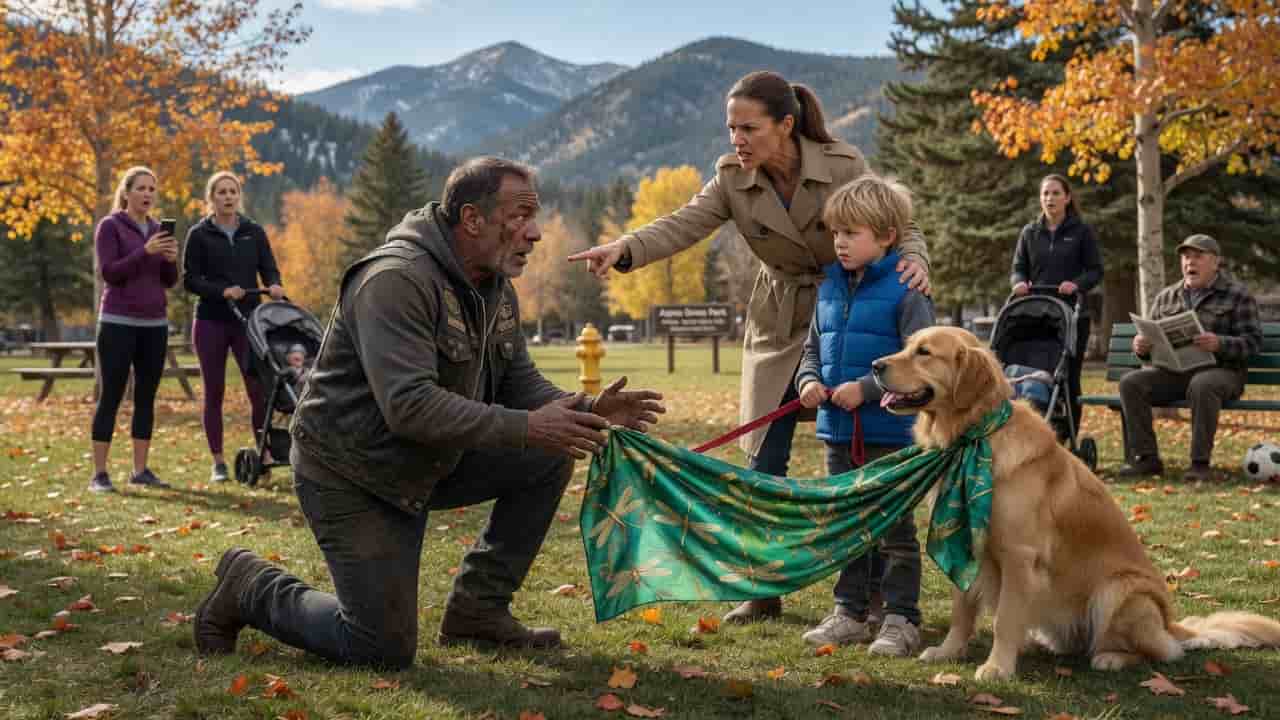
“Where did you get that scarf, kid?”
Duke didn’t mean for his voice to sound like gravel grinding under a boot, but he couldn’t help it. He was on his knees in the middle of the grass, the engine of his Harley still ticking hot in the parking lot behind him. He wasn’t looking at the boy’s face. He was looking at the emerald silk tied around the neck of a scruffy Golden Retriever.
It was a dragonfly pattern. Hand-dyed. There wasn’t another one like it in the world because Elena had spent three weeks mixing the inks in their kitchen before she disappeared ten years ago.
“Leave him alone!”
The shove came from the side, sharp and hard enough to knock Duke off balance. It was Beth, Elena’s sister. She stood over him in front of half the town, her face twisted with a decade of rehearsed hatred.
“Don’t you ever speak to my nephew,” she hissed, her voice carrying across the playground. “You think because you wear that leather vest, you can just corner a child? You’re a joke, Duke. Everyone knows why she really left you. They know what kind of man you are when the lights go out.”
Duke didn’t move. He stayed on the ground, the big, “scary” president of the Iron Nest MC, while the mothers at the picnic tables whispered and pointed. He could smell it—the faint, lingering scent of lavender and dye still clinging to the silk.
He had a choice: tell the truth about that final night and destroy the boy’s memory of his aunt, or stay the monster the town wanted him to be.
Chapter 1: The Weight of the Garage
The air in the garage always smelled like a slow-motion funeral. It was a thick, stagnant cocktail of 10W-40, stale Pall Malls, and the metallic tang of grinding discs. To anyone else, it was just the scent of the Iron Nest MC clubhouse, the place where bikes came to get reborn and men came to rot in peace. To Duke Sterling, it was the smell of a holding cell.
He was currently elbow-deep in the guts of a ’94 Softail, his knuckles barked and bleeding where a wrench had slipped an hour ago. He didn’t wipe the blood. He liked the sting. It was a localized, manageable pain that focused his mind on the mechanical instead of the haunting.
“You’re over-torquing that, Boss,” a voice rasped from the shadows.
Duke didn’t look up. He knew the cadence of the limp. Thimble was the only man in the club allowed to call Duke ‘Boss’ with that particular hint of pity. Thimble was seventy, with skin like a discarded leather saddle and eyes that had seen the club go from a group of Vietnam vets looking for a home to a commercialized brotherhood of middle-aged men clinging to a myth. Thimble was also the club’s tailor, the man who stitched the patches onto the vests with a surgical precision that didn’t match his shaky hands.
“It’s fine,” Duke said, his voice a low rumble that vibrated in his own chest.
“It ain’t fine. You’re gonna snap the stud, and then you’ll be in here until three in the morning drilling it out just so you don’t have to go home to that empty house on the ridge.”
Duke finally dropped the wrench. It hit the concrete with a loud, final clang that echoed off the corrugated tin walls. He wiped his hands on a rag that was already more grease than fabric. He looked at Thimble. The old man was leaning against a tool chest, a needle and a spool of heavy black thread in his pocket.
“The house isn’t empty,” Duke said. “I got the dog.”
“Buster is a good dog, but he don’t talk back, and he don’t dye silk.”
The mention of the silk was like a physical blow. Duke felt the familiar tightening in his throat, the one he’d spent ten years trying to swallow. He turned back to the bike, his back a broad, impenetrable wall of leather.
“Elena’s been gone a long time, Thim. Move on.”
“I moved on,” Thimble said softly. “I’m just wondering when you’re gonna stop holding your breath.”
Duke didn’t answer. He couldn’t.
His life was a series of carefully constructed silences. As the President of the Iron Nest, he was expected to be a pillar of stoic aggression. He was the man who negotiated territory with the Denver crews, the man who stood at the front of the pack during the mountain runs, the man who didn’t flinch when a bar fight broke out in a roadside dive. But every night, when the garage doors rolled down and the other guys went home to wives who complained about the grease on the carpet, Duke went home to a house that felt like a museum of a crime scene.
Elena had been a textile artist. She’d turned their spare bedroom into a studio filled with vats of indigo, madder root, and jars of silk cocoons. She’d been a creature of color and light, a jarring contrast to Duke’s world of chrome and shadows. For five years, it had worked. They were the beauty and the beast of Clear Creek County. And then, it wasn’t.
He remembered the final night with a clarity that made his heart stutter. The heat in the kitchen. The smell of boiling dye. The way the humidity made her hair curl at the temples. They had been fighting—something stupid, something about him being out too late, about the club taking more than it gave. He had been tired, stressed from a looming debt the club couldn’t pay, and she had been relentless.
He had raised his hand. Just once.
He hadn’t even meant to hit her. He’d meant to gesture, to tell her to shut up, to give him a minute of peace. But his hand had connected with her cheek, a heavy, meaty sound that ended the world.
She hadn’t cried. She’d just looked at him with an expression of profound, quiet realization. She’d walked out of the kitchen, and a week later, she was gone. No note. No trace. Just a half-finished silk scarf on the loom, a dragonfly pattern she’d been obsessing over for months.
The police had questioned him, of course. Sheriff Roy was a friend, but even friendship only goes so far when a woman vanishes. They’d searched the woods, the river, the old mine shafts. Nothing. The town had made up its mind: Duke Sterling was a man with a temper, and Elena was a woman who’d finally been broken by it.
“Duke?” Thimble’s voice broke through the fog.
“Yeah.”
“You got a ride scheduled for the toy run tomorrow. Don’t forget. The town’s watching. We need to look like the good guys for at least four hours.”
“I’ll be there,” Duke said.
He picked up the wrench again, but his hands were shaking. He hated the toy runs. He hated the way the parents in town clutched their children’s hands when the bikes rolled through the park. He hated the way they looked at him—with a mixture of fear and fascination, as if he were a caged tiger that might snap the bars at any moment.
But he would go. He would put on the vest. He would ride the mountain pass. He would be the President. It was the only identity he had left that wasn’t covered in the dust of a missing woman.
He worked for another three hours, until the cold mountain air began to seep under the garage door. He finally cleared his tools, locked the clubhouse, and mounted his own bike. The ride up to the ridge was a blur of pine trees and moonlight.
When he walked into the house, Buster, the scruffy Golden Retriever he’d found as a stray a year after Elena left, greeted him with a lazy wag of his tail. Duke sat on the edge of the bed, the silence of the house pressing in on his eardrums. He looked at the closed door of the spare bedroom. He hadn’t opened it in three years.
He didn’t need to. He knew exactly what was inside. The jars of dye. The loom. The ghost of a woman who had been too bright for a man who lived in the dark.
He laid back on the bed, still in his boots, and closed his eyes. He dreamt of dragonflies. They were emerald and gold, and they were always flying just out of reach, their wings making the sound of a motorcycle engine echoing in a canyon.
Chapter 2: The Park and the Ghost
The Clear Creek public park was a postcard of Colorado autumn. The aspens were turning a violent, shimmering gold, and the air had a crisp edge that made everyone move a little faster. It was the day of the annual “Bikers for Kids” toy run, an event Duke tolerated solely because it kept the local council from hassling the clubhouse about zoning permits.
There were thirty bikes lined up near the gazebo, a sea of polished chrome and black leather that looked entirely out of place next to the brightly colored plastic of the playground. Duke stood by his Harley, his arms crossed over his chest. He felt the weight of the stares.
“Look at ’em,” whispered Jinx, a female rider who’d joined the Nest two years ago. She was lean, covered in tattoos of thorns and wire, and had a cynical streak that rivaled Duke’s. “They think we’re gonna start a riot over the bouncy castle.”
“Let ’em think,” Duke said. “Just keep the guys away from the beer tent until after the hand-off.”
Duke scanned the crowd, his eyes moving with the practiced alertness of a man who was always looking for a threat. But he wasn’t seeing threats today. He was seeing families. Fathers pushing swings. Mothers sharing thermoses of coffee. It was a world he’d been exiled from a decade ago.
And then he saw it.
About fifty yards away, near the edge of the duck pond, a young boy was playing with a dog. The boy couldn’t have been more than seven or eight—blonde, messy hair, a blue puffer vest that looked a size too big. The dog was a large, shaggy Golden Retriever that looked remarkably like Buster.
But it wasn’t the boy or the dog that stopped Duke’s heart. It was the leash.
It wasn’t a leash. It was a long, shimmering strip of silk.
Duke’s vision tunneled. The sounds of the park—the shrieking children, the thrumming bike engines, the wind in the trees—all faded into a dull hum. He began to move. He didn’t realize he was walking until Jinx called out his name, her voice sounding like it was underwater.
He pushed through the crowd, his heavy boots thudding on the grass. People stepped out of his way, their faces flickering with alarm as the massive, leather-clad man charged toward the pond. He didn’t care. He couldn’t see anything but that green. That specific, impossible emerald green.
He reached the edge of the pond and stopped. The boy was laughing, tugging on the silk as the dog tried to chase a squirrel. Duke dropped to one knee, his breath coming in ragged, shallow bursts.
“Hey,” Duke rasped.
The boy stopped. He looked at Duke, his blue eyes wide with the natural caution of a child confronted by a giant. He clutched the silk tighter.
“Where did you get that?” Duke asked, his voice trembling. He reached out a hand, his fingers twitching toward the fabric. “That scarf. Where did it come from?”
The boy took a step back, his lip beginning to quiver. “It’s my dog’s lead. My auntie gave it to me.”
“Your auntie?” Duke’s heart hammered against his ribs. He could see it now, up close. The pattern. It wasn’t just green; it was a series of interlocking dragonflies, their wings outlined in a faint, shimmering gold thread. It was Elena’s masterpiece. The one she’d been working on the night she left. The one that had disappeared with her.
“Let me see it,” Duke said, his voice a desperate whisper. “Please. Just let me touch it.”
He reached out, his grease-stained thumb grazing the edge of the silk. It was cool and incredibly soft, exactly as he remembered. And then he smelled it. Beneath the scent of dog and wet grass, there was a faint, lingering note of lavender and something metallic.
The scent of her studio.
“Get your filthy hands off him!”
The voice was a whip-crack. Before Duke could react, a sharp shoulder slammed into him, knocking him sideways. He stumbled, his knee digging into the mud. He looked up.
Beth stood there, her face a mask of incandescent rage. She was Elena’s younger sister, the one who had led the charge to have Duke arrested ten years ago. She’d stayed in town, moved into their parents’ old house, and made it her life’s mission to ensure nobody ever forgot that Duke Sterling was a murderer who just hadn’t been caught yet.
“Beth,” Duke said, his voice sounding hollow.
“Don’t you say my name,” she hissed. She pulled the boy behind her, her hand gripping his shoulder so hard her knuckles were white. “And don’t you dare touch my nephew. You think because you’re wearing that pathetic costume, you can corner a child in broad daylight?”
“The scarf, Beth,” Duke said, pointing a shaking finger. “That’s Elena’s. That’s the dragonfly scarf. Where did you get it?”
Beth’s eyes flickered, a momentary shadow of something that wasn’t anger—something that looked like panic—passing over her face. Then it was gone, replaced by a sneer of pure contempt.
“It’s a rag, Duke. A piece of junk I found in the back of a closet. Leo needed a leash, and I wasn’t going to spend money on one when I had this piece of trash lying around.”
“It’s not trash,” Duke growled, rising to his feet. He felt the heat rising in his neck, the old, dangerous pressure building in his chest. “She was making that for the gallery in Denver. It disappeared the night she—”
“The night you killed her?” Beth finished, her voice rising so the entire park could hear.
The crowd had gone silent. The mothers at the picnic tables were standing up, their phones already out. The other bikers had gathered at the edge of the grass, watching with grim faces.
“You’re pathetic, Duke,” Beth said, her voice dripping with venom. “You’ve spent ten years playing the grieving widower while everyone in this town knows the truth. You broke her. You chased her into the woods or you buried her under the floorboards, and now you’re upset because a child is using her ‘art’ to walk a dog?”
She leaned in, her face inches from his. “Look around you. Nobody wants you here. Go back to your garage and rot with the rest of your trash. Stay away from my family.”
She turned, yanking the boy and the dog with her. Leo looked back at Duke, his eyes filled with a terrifying mixture of confusion and fear. Duke watched them walk away, the emerald silk dragging in the dirt, catching on twigs and dead leaves.
He didn’t move. He couldn’t. He felt the weight of the town’s collective gaze, a physical pressure that made it hard to breathe. He was the monster again. The man who had destroyed something beautiful and was now being punished by seeing it used as garbage.
“Duke,” Jinx said, stepping up beside him. Her voice was uncharacteristically soft. “We gotta go. The cops are already circling the lot.”
Duke looked down at his hands. They were covered in grease and Colorado mud. He felt a sudden, violent urge to scream, to tear the leather vest off his back, to run until his lungs gave out. Instead, he just nodded.
“Yeah,” he said. “We’re done here.”
He walked back to his bike, his head down. He didn’t look at the crowd. He didn’t look at the mountains. He just focused on the rhythmic, heavy thud of his own heart, and the phantom scent of lavender that refused to leave his nostrils.
Chapter 3: The Iron Nest
The clubhouse was quiet when they returned, the kind of quiet that follows a funeral. The men didn’t joke or brag about their bikes. They moved around the bar and the pool tables with a heavy, awkward energy, avoiding Duke’s eyes.
Duke sat in his “office”—a wood-paneled corner of the loft that overlooked the garage floor. He had a bottle of cheap bourbon on the desk, but he hadn’t opened it. He was staring at his own hands, the image of that emerald silk burned into his retinas.
There was a knock on the doorframe. Jinx stood there, her helmet tucked under her arm.
“Thimble’s in the back,” she said. “He’s pretty worked up. He heard what happened.”
“Everyone heard,” Duke said.
“Beth’s a bitch, Duke. She’s always been a bitch. She’s been looking for a reason to put a boot in your ribs since 2016.”
“She had the scarf, Jinx.” Duke looked up, his eyes bloodshot. “The dragonfly silk. Elena didn’t take it with her. It wasn’t in her bag. It wasn’t in the car. It was on the loom.”
Jinx frowned, stepping into the room. She pulled up a chair and sat across from him. “Maybe the cops gave it to her? Evidence return?”
“Roy would have told me. And they never took it as evidence. They said it wasn’t relevant.” Duke leaned forward, his voice a low hiss. “Beth said she found it in a closet. But I searched that house. I searched every inch of it every night for a year. That scarf wasn’t there.”
“So she’s lying,” Jinx said. “Big surprise.”
“It’s not just the lie. It’s the dog. Why would she let a kid use a handmade silk scarf as a dog leash? Unless she wanted me to see it. Unless she wanted to show me that she has what’s left of Elena, and I don’t.”
Jinx stayed silent for a long moment. She reached out, her gloved hand briefly touching Duke’s forearm. It was a rare gesture of comfort from a woman who usually expressed affection through insults.
“You think she knows where Elena went?”
“I think she knows something,” Duke said. “But she’d rather see me hang than tell me the truth.”
“Well, you didn’t help yourself today, Boss. Shoving a woman in a park? The Facebook groups are already calling for the club to be evicted from the county.”
“I didn’t shove her,” Duke snapped. “She shoved me.”
“Doesn’t matter. You’re six-two and look like you eat nails for breakfast. She’s a local schoolteacher who’s raising her ‘tragically abandoned’ nephew. In the court of public opinion, you just assaulted a saint.”
Duke stood up, his chair scraping violently against the floor. He walked to the window, looking out at the rows of bikes below. He saw Thimble sitting on a stool near the sewing machine, his head in his hands.
The pressure was mounting. It wasn’t just the memory of Elena anymore; it was the survival of the club. If the town turned on them now, they’d lose the lease. They’d lose the garage. They’d lose the only place where men like Duke felt they belonged.
“I need to talk to Roy,” Duke said.
“The Sheriff? He’s probably the one who’s gonna have to serve the restraining order Beth is undoubtedly filing right now.”
“He’s the only one who knows what the original case file looked like. I need to know if that scarf was ever logged. If it wasn’t, then Beth stole it. And if she stole it from my house, I want to know when.”
Duke grabbed his vest and headed for the stairs. He didn’t stop to talk to the guys. He didn’t stop to check on Thimble. He just wanted to be moving.
He rode down to the county station, the wind whipping his face. He felt a strange, cold clarity. For ten years, he’d been passive. He’d accepted the guilt, the shame, and the silence because he felt he deserved it. He’d hit her. He’d broken the one thing that mattered.
But seeing that silk in the dirt had changed something. It was an insult to her memory that he couldn’t stomach. If she was gone, she deserved better than to have her work dragged through the mud by a woman who hated her husband more than she loved her sister.
The station was a small, brick building next to the courthouse. Sheriff Roy was behind the glass, looking at a stack of paperwork with the weary expression of a man who was counting the days to retirement. When he saw Duke, he sighed and leaned back in his chair.
“I was wondering how long it would take you to get here,” Roy said, his voice a gravelly drawl.
“I didn’t hit her, Roy.”
“I know you didn’t. I saw the video Beth’s friend posted. You looked like a man who’d seen a ghost.”
“The scarf, Roy. The emerald one with the dragonflies. Was it ever in the evidence room?”
Roy frowned, rubbing his jaw. “The silk? No. I remember the loom was empty when we did the second sweep, but we assumed she’d packed her projects when she left. Why?”
“It wasn’t empty the night she left,” Duke said, his voice tight. “It was right there. I looked at it before I went to bed. I thought about cutting it up because I was so angry. But I didn’t. The next morning, it was gone.”
“And you’re telling me this now? Ten years later?”
“I didn’t care then, Roy! I just wanted her back! But Beth had it today. She said she found it in a closet. But it wasn’t in my closets.”
Roy’s expression shifted from weary to professional. He stood up and beckoned Duke into his inner office, closing the door behind them.
“Duke, listen to me. I like you. I’ve always liked you. But you’re a biker with a reputation, and Beth is a pillar of this community. If you start accusing her of theft—or worse—without proof, this town will burn you to the ground.”
“I don’t care about the town,” Duke said. “I want to know how she got that scarf.”
“Maybe Elena gave it to her?” Roy suggested. “Before she left?”
“They weren’t speaking, Roy. You know that. Beth hated us. She hated that Elena married ‘out of her class.’ She wouldn’t have given Beth a stick of gum, let alone that scarf.”
Roy sighed, looking out the window at the quiet street. “I can’t reopen a missing persons case based on a scarf, Duke. But I can look at the old photos. See if that loom was actually empty in the first sweep.”
“Do it,” Duke said. “Please.”
“Go home, Duke. Stay away from the park. Stay away from the boy. If I see one more report about you confronting that family, I’m gonna have to lock you up for your own safety.”
Duke walked out of the station, the cold air hitting him like a physical weight. He didn’t feel relieved. He felt like the walls were closing in.
He rode back to the ridge, but he didn’t go inside. He sat on the porch with Buster, the dog’s head resting on his boot. He looked at the trees, the dark shadows of the mountains.
He thought about the boy, Leo. He thought about the way the kid had looked at him—not with hatred, but with a strange, wide-eyed curiosity. He looked like Elena. He had her nose, her stubborn chin.
Duke realized then that he didn’t just want the scarf back. He wanted to know the boy. He wanted to know if Elena’s blood was still in that house, even if she wasn’t.
But as long as he was Duke Sterling, the monster of the Nest, he would never get close. He was trapped in the identity he’d built, a man of leather and grease, forever separated from the world of silk and light.
Chapter 4: The Diner Confrontation
The next morning, Duke found himself at ‘The Rusty Spoon,’ a local diner where the coffee was strong enough to peel paint and the gossip was even stronger. He knew he shouldn’t be there. He knew he was a lightning rod for trouble. But he couldn’t sit in that empty house anymore.
He was sitting at the counter, his back to the room, when the bell above the door chimed. The room went silent. Duke didn’t need to look in the mirror to know who had walked in.
“Two coffees and a hot chocolate, please,” Beth’s voice said, sharp and demanding.
Duke closed his eyes, his grip tightening on his mug. He heard the footsteps approaching. He didn’t move.
“Still here, Duke?” Beth said, her voice dripping with mock surprise. “I figured you’d be halfway to Denver by now, given the reception you got yesterday.”
Duke turned slowly on his stool. Beth was standing there, Leo at her side. The boy was holding a comic book, his eyes darting toward Duke and then away. The Golden Retriever, Buster’s twin, was tied to a table leg nearby. The emerald scarf was still there, now knotted haphazardly into the dog’s nylon collar. It looked frayed at the edges.
“I live here, Beth,” Duke said quietly.
“Not for long, if the petition goes through,” she replied. She looked at the other patrons, her voice rising. “Can you believe this? After what he did yesterday, he still has the nerve to sit here like he’s one of us.”
“I didn’t do anything, Beth. I asked a question.”
“You terrified a child!” she shouted. “Leo, tell him. Tell him how scared you were.”
The boy looked up, his face pale. He looked at his aunt, then at Duke. He didn’t say anything. He just gripped his comic book tighter.
“He’s a child, Beth. Don’t use him as a prop,” Duke said, his voice low and dangerous.
“I’m using him as a witness!” she yelled. “A witness to the kind of man you are! You think you can just come back into our lives? You think because you’ve got a fancy club and a loud bike, we’ve forgotten what you did to my sister?”
Duke stood up. He was a head taller than anyone in the room, and his presence seemed to suck the air out of the diner.
“I want the scarf, Beth,” Duke said. “It doesn’t belong to you. It belongs to Elena’s estate. Which means it belongs to me.”
“It belongs in the trash!” Beth screamed. She reached down, unknotting the silk from the dog’s collar with a violent yank. She held it up, the emerald fabric fluttering in the stale air of the diner. “You want it? You want this reminder of how much she hated you?”
“Beth, stop,” Duke said, stepping forward.
“She gave it to me, Duke! The night she left! She came to my house, crying, her face bruised because of you! She gave me this and told me to sell it, to use the money to get away from you if I ever needed to. She said you were a monster!”
The room was deathly quiet. Duke felt the blood drain from his face.
She went to Beth’s house? That wasn’t in the police report. Beth had told the police she hadn’t seen Elena in a month before the disappearance. She’d sworn under oath.
“You’re lying,” Duke said, his voice a whisper. “You told Roy you hadn’t seen her.”
Beth froze. The realization of what she’d just said seemed to hit her, her eyes widening in a brief flash of panic. She clutched the scarf to her chest, her knuckles white.
“I… I was protecting her,” she stammered, her voice losing its edge. “I didn’t want you finding her. I didn’t want you following her.”
“Where did she go, Beth?” Duke took another step, his shadow falling over her. “If she came to your house that night, where did she go next?”
“I don’t know!” Beth screamed, her composure shattering. “She just left! She walked out into the rain and I never saw her again! And it’s your fault! It’s all your fault!”
She threw the scarf at him. It hit Duke in the chest, the soft silk sliding down his leather vest and pooling on the floor.
“Keep it!” she sobbed. “Keep your cursed rag! Come on, Leo. We’re leaving.”
She grabbed the boy’s arm and practically dragged him out of the diner. The bell chimed violently behind them.
Duke stood in the center of the room, the emerald silk at his feet. He felt the eyes of the town on him—no longer just with hatred, but with a new, sharp curiosity. The lie had been exposed. Beth had seen her. Beth had been the last one to see her.
He reached down and picked up the scarf. It was stained with coffee and dirt, a far cry from the masterpiece it had once been. He pressed it to his face, inhaling deeply.
The lavender was gone. Now, it just smelled like the diner—fried fat and old smoke.
He walked out of the diner, ignoring the whispers. He mounted his bike, the scarf tucked securely into the pocket of his vest, right over his heart.
He knew what he had to do now. He didn’t care about the club’s lease. He didn’t care about the town’s opinion. He had the first thread of the truth in ten years, and he was going to pull on it until the whole world unraveled.
He rode straight to the clubhouse, his mind racing. He needed Thimble. He needed Jinx. But mostly, he needed to find out what else Beth was hiding. Because if she’d lied about that night, she’d lied about everything.
And for the first time in a decade, Duke Sterling didn’t feel like a monster. He felt like a hunter.
Chapter 5: The Stitch in Time
The Iron Nest clubhouse felt less like a sanctuary and more like a besieged fortress by the time Duke pulled into the gravel lot. The news of the diner confrontation had traveled through the small mountain town like a brushfire, fueled by the dry timber of decade-old resentment. Two patrol cars from the county sheriff’s office were parked at the entrance, their light bars dark but their presence unmistakable.
Duke didn’t look at the deputies. He climbed the stairs to the loft, the emerald silk scarf clutched in his hand like a captured flag. His boots felt heavier with every step, the leather of his vest suddenly too tight, as if the shame of the town was physically shrinking the garment.
In the loft, Thimble was waiting. He was sitting at his heavy industrial sewing machine, the one he used to repair the thickest cowhide and the most stubborn denim. He didn’t have any work in front of him. He was just staring at the wall, his hands resting on his knees.
“You brought it back,” Thimble said, his voice barely audible over the hum of the garage’s ventilation fan.
“She threw it at me,” Duke said. He laid the silk on Thimble’s workbench, smoothing it out with fingers that wouldn’t stop twitching. “She lied, Thim. She told the town she hadn’t seen Elena, but she admitted in the Spoon that Elena came to her house that night. She said she was protecting her.”
Thimble leaned forward, his old eyes narrowing as he looked at the fabric. He reached out a gnarled hand, his touch infinitely more delicate than Duke’s. He didn’t look at the dragonfly pattern; he looked at the edges, the seams, the way the gold thread integrated with the emerald silk.
“This ain’t just art, Duke,” Thimble whispered. “This is a letter.”
“What are you talking about?”
“Look here.” Thimble pointed to the underside of the scarf, where the gold thread looped back into the emerald field. “Elena was a master, but she was also a bit of a traditionalist. She used a French knot for the eyes of the dragonflies, but look at the count. One knot, two knots, three… then a gap. Then four.”
Duke leaned in, his breath hitching. He knew nothing of textiles, but he knew the woman who had made this. He remembered her sitting by the window for hours, her lips moving in a silent count as she worked the needle. He’d always thought she was just keeping track of the pattern.
“It’s Morse? No, that’s too simple,” Duke muttered.
“It’s a coordinate stitch,” Thimble said, his voice gaining a sudden, sharp clarity. “I seen it once in the old country, before I came over. Lacemakers used it to mark their work without ruinous labels. It’s a series of intentional ‘mistakes’ that correspond to a map. Elena wasn’t just making a scarf that night. She was leaving a trail.”
Duke felt a cold shiver race down his spine. The night they had fought, the night he had hit her—she hadn’t just been angry. She had been prepared. She had known the end was coming, one way or another, and she had spent her final hours in that house stitching a secret into the silk.
“Can you read it?” Duke asked.
“I need a magnifying glass and a bottle of something stronger than coffee,” Thimble said. “And I need you to keep the world away from me for an hour. Jinx says there’s a crowd forming at the gate.”
Duke nodded and walked to the window. Thimble was right. At the edge of the clubhouse property, a dozen people had gathered. They weren’t the usual suspects—not the angry teenagers or the bored locals. These were the town’s “respectable” citizens. He saw the hardware store owner, a couple of teachers from the middle school, and several members of the church board. They weren’t shouting yet, but they were holding signs. EXPOSE THE TRUTH. JUSTICE FOR ELENA. NO MORE NESTS.
“Stay with the scarf,” Duke told Thimble. “I’ll handle the gate.”
He went downstairs, his heart a dull, rhythmic thrum in his ears. Jinx was in the garage, checking the load on a shotgun she kept behind the bar.
“Put that away,” Duke said.
“They’re throwing rocks, Duke. One of ’em chipped the paint on Miller’s Road King.”
“I said put it away. If we draw a weapon, we lose everything. We’re the Iron Nest, not a street gang. We’re neighbors, even if they don’t want us to be.”
Duke walked out the front door, alone. The sun was dipping behind the peaks, casting long, jagged shadows across the gravel. As he approached the gate, the murmuring of the crowd died down, replaced by a thick, suffocating silence.
“Duke Sterling!” a man yelled. It was Miller, the hardware store owner. He was a small man who usually overcompensated with a loud truck and a louder voice. “We want you out of this county! We’re tired of the secrets and we’re tired of the fear! Beth told us what happened at the diner!”
Duke stopped ten feet from the gate. He didn’t cross his arms. He didn’t puff out his chest. He stood there, his hands open at his sides, looking at the people he’d bought groceries alongside for a decade.
“Beth lied to you,” Duke said, his voice carrying clearly in the crisp air. “She lied to all of us. She was the last person to see Elena alive, and she’s known it for ten years.”
“You’re a murderer!” a woman screamed from the back. “You’re just trying to shift the blame because you got caught cornering a kid!”
“I wasn’t cornering him,” Duke said, his voice dropping an octave. “I was looking at my wife’s work. A piece of silk that was supposed to be in a evidence locker but ended up as a dog leash in Beth’s backyard. Ask yourselves why a woman who claims to love her sister’s memory would treat her final masterpiece like trash.”
The crowd wavered. He saw a few of them look at each other, the certainty in their eyes flickering. They knew Beth. They knew she was sharp-tongued and bitter. They also knew that Duke, for all his rough edges, had never once raised a hand to anyone in town.
“Go home,” Duke said. “I’m not leaving, and neither is the Nest. But the truth is coming out, and when it does, some of you are going to realize you’ve been shouting at the wrong man for ten years.”
He turned his back on them—a calculated risk—and walked back toward the clubhouse. A few more insults were hurled his way, but no rocks followed. He entered the garage and saw Jinx watching him from the shadows, the shotgun leaning harmlessly against the wall.
“You got a set on you, Boss,” she said, her voice lacking its usual sarcasm.
“I’m tired, Jinx. I’m just so damn tired of being the villain.”
He went back up to the loft. Thimble had the scarf spread out under a jeweler’s lamp, a notebook filled with frantic, shaky scribbles beside him. The old man looked up, his face pale and etched with a new kind of grief.
“It ain’t a map to a place, Duke,” Thimble said, his voice cracking. “It’s a map to a person.”
“What does it say?”
Thimble pointed to the golden dragonflies. “The stitches… they’re numbers. Dates and amounts. It’s a ledger, Duke. Elena wasn’t just an artist. She was the one keeping the books for the club’s old president, back before you took over.”
Duke froze. The club’s previous president, ‘Big Sal’ Moretti, had died of a heart attack two months after Elena disappeared. Everyone had assumed the club’s financial troubles were just bad management, but Duke had spent the last eight years digging them out of a hole he’d never fully understood.
“She wasn’t leaving because of the fight,” Duke whispered, the realization hitting him like a physical weight. “She was leaving because she’d found out Sal was skimming from the retirement fund. She was leaving to go to the authorities.”
“And Beth knew,” Thimble added. “Look at the final stitch. It’s a signature. Not Elena’s. It’s a transfer mark. The silk was finished by someone else. Someone who didn’t know how to hide the knots.”
Duke looked at the scarf. He saw the subtle shift in the gold thread toward the end of the pattern. The dragonflies were slightly skewed, the wings less graceful.
“Beth finished it,” Duke said. “Elena didn’t walk out into the rain. She never left Beth’s house.”
The silence that followed was absolute. The hum of the garage fan seemed to grow to a roar in Duke’s ears. All the years of guilt, the nights spent staring at the ceiling wondering if that one slap had truly been the catalyst for her disappearance—it was all based on a lie. But it was a lie he’d helped build by being the man the town expected him to be.
“I need to find Roy,” Duke said, grabbing his keys.
“Duke, wait,” Thimble called out. “If Beth did this… if she’s been holding onto this secret while watching you rot… she won’t go quietly. She’s got that boy, Leo. He’s her shield.”
“He’s not her shield,” Duke said, his eyes turning to flint. “He’s the reason I’m coming for her. He deserves to know who his mother really was. And he deserves to know he isn’t being raised by a saint.”
Duke ran down the stairs, his boots thunderous on the wood. He didn’t take the bike this time. He took the club’s old flatbed truck, something heavy and anonymous. He needed to be able to move without the roar of the Harley announcing his arrival.
As he drove through the darkened streets of Clear Creek, he felt a strange sense of detachment. The town looked the same—the glowing windows of the suburban homes, the flickering neon of the bars—but the world had shifted on its axis. He thought about the bruise he’d given Elena. He would never forgive himself for that, regardless of what Beth had done. That was his sin to carry. But the disappearance? The ten years of silence? That belonged to Beth.
He pulled up to the Sheriff’s station, but the lights were dim. Roy was gone for the night. Duke sat in the truck, the engine ticking as it cooled. He looked at the scarf on the passenger seat.
He realized he couldn’t wait for the law. Roy was a good man, but he was a man of procedure and paperwork. Procedure would give Beth time to hide, to burn the scarf, to disappear with the boy.
Duke put the truck in gear and headed toward the old house on the ridge—the one where Beth lived, the one that had belonged to Elena’s parents. The house where the silk had been hidden for a decade.
He wasn’t going as the President of the Iron Nest. He wasn’t going as the monster. He was going as a man who finally had the truth in his hands, and he was going to make sure the dragonflies finally had a place to land.
Chapter 6: The Dragonfly Falls
The climb up to the ridge was steep, the road a series of treacherous switchbacks that hugged the side of the mountain. Duke kept the truck’s lights off, relying on the pale wash of the moon and his own intimate knowledge of the terrain. He parked a quarter-mile from the house, the silence of the forest pressing in on him as he stepped out into the cold night air.
The house was a sprawling, two-story Victorian, its white paint peeling like dead skin. It sat alone on a plateau overlooking the valley, a grand, lonely monument to a family that had been hollowed out by secrets. A single light was burning in the kitchen window.
Duke approached the house from the rear, moving through the overgrown garden where Elena used to plant lavender and mint. He could still smell the ghosts of those herbs, a faint, bitter sweetness in the frost. He reached the back porch and peered through the window.
Beth was sitting at the kitchen table. She was alone. A bottle of wine stood open in front of her, and she was holding a pair of heavy sewing shears. She wasn’t cutting anything. She was just staring at the blades, her face pale and drawn in the harsh light of the overhead bulb.
Duke didn’t knock. He turned the handle, found it unlocked, and stepped inside.
The click of the door latch made Beth jump, the shears clattering onto the linoleum. She looked at Duke, her eyes wide with a terror that looked like it had been living in her bones for years.
“Where is the boy, Beth?” Duke asked, his voice low and steady.
“He’s asleep,” she whispered. “Duke, you shouldn’t be here. I called the police. They’re coming.”
“No, they aren’t. Roy’s home, and the deputies are at my gate. It’s just us, Beth. Just like it should have been ten years ago.”
Duke walked to the table and laid the emerald scarf down between them. He didn’t throw it. He laid it with a reverence that seemed to make Beth flinch.
“Thimble read the stitches,” Duke said. “He found the ledger. He found the signature.”
Beth’s gaze dropped to the silk. Her hands began to shake, her fingers curling into claws on the tabletop. “You don’t understand. You were never supposed to see it. It was supposed to be gone.”
“Why did you keep it, Beth? If you hated me so much, if you wanted her forgotten, why keep the one thing that could destroy you?”
“Because it was her!” Beth suddenly screamed, her voice breaking. “It was the only thing she had left! She came to me that night, Duke. She had that bruise on her face, and she was shaking. She told me everything. About Sal, about the money, about how she was going to the FBI. She said she couldn’t stay with you because you were part of it, whether you knew it or not.”
Beth stood up, her chair screeching against the floor. She began to pace the small kitchen, her movements frantic and bird-like.
“I told her to stay. I told her we’d hide her. But she wanted to go back. She wanted to get her journals, the ones she’d hidden in the garage. We fought. She tried to leave, and I… I grabbed her. We fell. On the stairs, Duke. The old wooden stairs.”
Beth stopped, her back to him. Her shoulders were heaving. “She didn’t wake up. I sat with her for six hours, waiting for her to wake up. But she didn’t.”
Duke felt a wave of nausea roll over him. He gripped the edge of the table, his knuckles white. “And then what, Beth? You just… erased her?”
“I couldn’t lose everything!” Beth turned, her face a mask of desperate rationalization. “If I called the police, they’d see the bruise you gave her. They’d think you did it. Or they’d think I did it on purpose. I had to protect the family. I had to protect her memory from the scandal.”
“You didn’t protect her memory,” Duke growled, his voice thick with rage. “You used her death to torture me for a decade. You let this town believe I was a killer while you sat in her parents’ house and raised her child like he was yours.”
“He is mine!” Beth shrieked. “I’ve been his mother for seven years! You were just the man who hit his mother! What would you have given him, Duke? A life in a garage? A leather vest and a bike?”
“I would have given him the truth,” Duke said. “I would have given him a father who wasn’t a lie.”
A soft sound from the doorway made them both freeze.
Leo was standing there, his blue pajamas rumpled, his eyes wide and wet. He was holding Buster—the dog’s twin—by the collar. He had heard everything.
“Is it true?” the boy whispered, his voice small and fragile in the large kitchen. “Did my mommy die on the stairs?”
Beth collapsed. She fell to her knees, her hands reaching out toward the boy, but he stepped back, a look of profound, adult clarity crossing his face. He didn’t look at her with fear; he looked at her with a quiet, devastating judgment.
“Leo, honey, I was trying to save us,” Beth sobbed.
The boy didn’t answer. He looked at Duke. The big man in the leather vest, the monster from the park, stood there with tears streaming down his weathered face.
“The dragonflies,” Leo said, pointing to the scarf on the table. “She made those for me?”
“She made them for the world, Leo,” Duke said, his voice cracking. “But I think she kept the best parts for you.”
The sound of sirens began to wail in the distance, growing louder as they climbed the ridge. Roy had found the truck. Or maybe Beth’s friend had finally called it in. It didn’t matter.
Duke walked over to the boy and knelt on one knee, just as he had in the park. This time, there was no one to shove him away. He didn’t reach for the boy. He just stayed there, a grounded, broken man.
“I’m sorry, Leo,” Duke said. “I’m sorry for all of it.”
The boy took a tentative step forward. He reached out a small, trembling hand and touched the leather of Duke’s vest. He didn’t pull away.
The police burst through the door minutes later, Roy leading the way with his service weapon drawn. He saw the scene—Beth on the floor, the scarf on the table, and the biker and the boy staring at each other in the center of the room. He slowly lowered his gun.
“Duke,” Roy said, his voice heavy.
“She’s ready to talk, Roy,” Duke said, not looking away from the boy. “She’s been waiting ten years to say it.”
As the deputies led Beth away, she didn’t scream or fight. She looked like a woman who had finally run out of breath. The house, once so full of her sharp, defensive energy, suddenly felt hollow and cold.
Roy stood by the table, looking at the emerald silk. “What happens now, Duke?”
“Now we find her,” Duke said. “We find where she is, and we give her back to the light.”
The aftermath didn’t happen in a single day. It happened in the weeks of excavations in the old cellar, in the quiet depositions in the county courthouse, and in the slow, painful process of a town realizing it had been wrong.
The Iron Nest didn’t get evicted. In fact, the hardware store owner, Miller, showed up at the garage two weeks later with a case of beer and a mumbled apology that Duke accepted with a silent nod. The “Bikers for Kids” run became a permanent fixture, but with a new name: The Elena Sterling Memorial Ride.
Duke didn’t move Leo into the clubhouse. That wasn’t a life for a boy. Instead, he worked with the state and a team of lawyers to ensure the boy stayed in the family house, with Jinx and Thimble acting as a strange, tattooed support system. Duke moved back into the house on the ridge, but he didn’t close the door to the spare bedroom anymore.
He spent his evenings in that room, surrounded by the vats of indigo and the jars of silk. He didn’t learn to weave, but he learned to sit in the silence without it feeling like a cage.
A month after the arrest, Duke took Leo down to the creek—the place where the water tumbled over the rocks in a series of small, shimmering falls. It was a place Elena had loved, a place where the dragonflies gathered in the summer.
Duke held the emerald scarf in his hands. It was clean now, the stains of the diner and the dirt of the park washed away by Thimble’s expert care. The gold thread shimmered in the afternoon sun.
“You sure about this?” Duke asked the boy.
Leo nodded. He was wearing a new puffer vest, this one a deep, solid green. He looked at the water, then at the man beside him.
“She doesn’t need it anymore,” Leo said. “She has us.”
Duke let go of the silk. It caught the breeze, hovering for a moment like a living thing, the dragonflies appearing to take flight as the fabric unfurled. Then it settled onto the surface of the water, a vibrant streak of emerald against the grey stone. It drifted over the falls, dancing in the spray, before disappearing into the deep, clear pool below.
Duke felt a weight lift from his shoulders—not the weight of the leather, but the weight of the silence. He reached down and took the boy’s hand.
“Come on,” Duke said. “Let’s go home.”
As they walked back up the trail toward the ridge, a single dragonfly, emerald and gold, buzzed past them, circling once before disappearing into the trees. Duke didn’t say anything. He just squeezed the boy’s hand and kept walking, the sound of the motorcycle engines in the distance finally sounding like music instead of a ghost.
The monster was gone. The hunter was at rest. And for the first time in a decade, the man in the leather vest was just a father, walking his son home in the light of a Colorado afternoon.