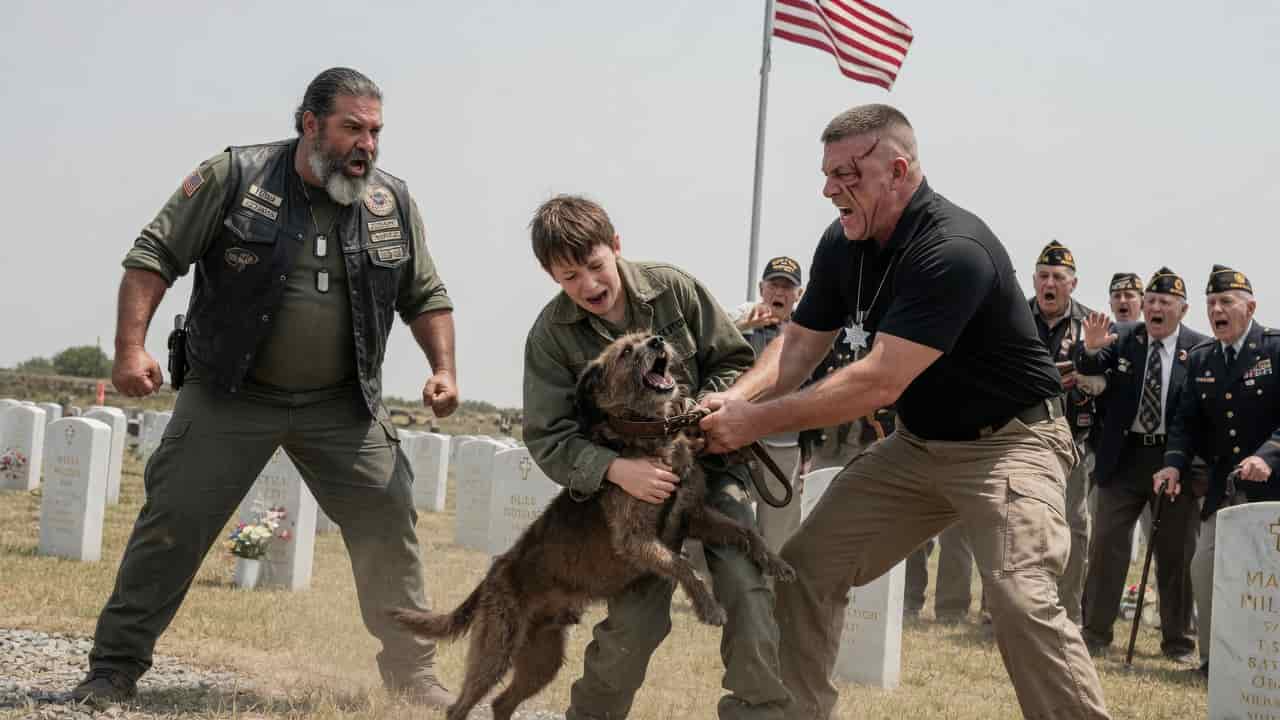
“Hand over the dog, kid. You’re nothing but a street rat who found something that doesn’t belong to you.”
Vance didn’t care that he was standing on hallowed ground. He didn’t care that dozens of decorated veterans were watching him treat a ten-year-old boy like garbage. He just wanted the ‘asset’ back, and he was willing to snap a dog’s neck to get it.
I saw the way Leo’s hands shook. I saw the way he looked at the ground, waiting for the blow to land because that’s all the world had ever given him.
But then I saw the collar rip.
When that Silver Star hit the red dirt, the world stopped moving. I knew that scratch on the back of the medal. I’d carved it there myself twenty years ago, on the night I thought I lost everything in an embassy fire half a world away.
Vance thought he was bullying a nobody. He didn’t realize he was touching my son.
The men in my club don’t take kindly to people disrespecting our own, and they definitely don’t like seeing a child humiliated in front of our fallen brothers. Vance wanted a fight? He just found one he can’t win.
Chapter 1
The humidity in Oconee County didn’t just sit on you; it owned you. It was 09:00, and the Georgia air was already thick enough to chew, smelling of damp earth and the faint, metallic tang of the nearby interstate. “Sarge” Miller stood at the edge of the Pine Grove Veteran’s Cemetery, his boots settled into the red clay like he was trying to take root. He didn’t like being here, but he didn’t like being anywhere else more.
Sarge was a big man, the kind of big that came from decades of lifting heavy things and carrying heavier burdens. His leather vest, the “cut” of the Iron Bastion MC, was stiff with salt and road grime. He wasn’t the President of a biker club because he liked the noise; he was the President because he knew how to maintain an engine and a man’s loyalty, and in his world, those were the only two things that kept you from ending up under one of these marble slabs.
He watched a small figure moving through the rows of headstones. It was the boy, Leo. The kid had been hovering around the edges of the cemetery for three days now, a skinny scrap of a thing in an oversized army jacket that looked like it had been salvaged from a dumpster. He was maybe ten, but he walked with the hunched shoulders of a man who’d spent fifty years in the mines. Following him was a scruffy terrier mix that looked like it was held together by hope and flea powder.
Sarge adjusted his sunglasses. He’d seen plenty of “street rats” in his time—kids the system had chewed up and spat out into the rural cracks of Georgia. But Leo was different. Every time the kid passed the flagpole near the entrance, he stopped. He didn’t just look at it. He stood at attention. Heels together, back straight, chin up. It was a perfect, crisp military posture that didn’t belong on a kid who looked like he hadn’t seen a hot meal in a week.
“You’re gonna burn a hole in the dirt if you keep standing there, Sarge,” a voice rasped from behind him.
Sarge didn’t turn. He knew the sound of Medic’s boots. Medic was the club’s road captain, a man who’d seen enough trauma in a Humvee to last three lifetimes and now spent his days fixing up old Harleys and stitching up the brothers when they got too rowdy at the clubhouse.
“Kid’s back,” Sarge said, his voice a low rumble.
Medic stepped up beside him, lighting a cigarette. He squinted through the smoke. “Yeah. Weird little shadow. Where’s he staying? The old cannery?”
“Probably,” Sarge replied. He felt a familiar, dull ache in his chest—the one he’d carried since the embassy bombing in ‘06. He’d been a Sergeant First Class then, a man with a pregnant wife and a future that didn’t involve leather vests and illegal scrap yards. Then the fire happened. A security clearance he’d personally signed off on had been compromised. A gate had been left unlocked. His wife, Elena, had been in the annex. They told him there were no survivors. They told him the heat had been so intense there was nothing left to bury.
He’d spent twenty years trying to outrun that gate.
“He’s got eyes on him,” Medic said, his tone shifting. He pointed toward a black Suburban idling on the access road just outside the cemetery gates. The windows were tinted dark enough to hide a sin. “That truck’s been there since I rolled in. Didn’t look like locals.”
Sarge felt the hair on the back of his neck prickle. In Oconee, you knew every truck. You knew the rust patterns on the fenders and the way the mufflers rattled. A clean, late-model Suburban with government-grade tint was a neon sign in a dark room.
“Keep an eye on the kid,” Sarge said. “I’m gonna go talk to him.”
“Sarge, don’t,” Medic warned. “The funeral for Old Man Miller—the other Miller—starts in twenty minutes. The VFW guys are already pulling in. You don’t want to be making a scene with some stray kid when the brass is here.”
“I’m just talking, Medic. Relax.”
Sarge started walking. The heat radiated off the headstones, shimmering in the air. As he approached, the dog noticed him first. It let out a weak, raspy bark and stood its ground between Sarge and the boy. Leo turned, his eyes wide and hollow. He didn’t run, which surprised Sarge. Most kids in his position had the flight reflex of a startled deer. Leo just watched him, his small hands buried deep in the pockets of that massive jacket.
“You lost, son?” Sarge asked, stopping six feet away. He kept his hands visible, palms open. It was the universal language of I’m not a threat.
Leo looked at Sarge’s vest, his eyes lingering on the military patches Sarge still wore alongside his club colors. “No, sir,” the boy whispered. His voice was thin, but steady.
“Cemetery’s a strange place to play,” Sarge said.
“I’m not playing,” Leo said. He looked toward the flagpole. “I’m waiting.”
“For who?”
The boy didn’t answer. He looked down at the dog, reaching out to scratch it behind the ears. Sarge noticed the dog’s collar then. It was an old, thick piece of leather, far too heavy for a dog that size. It looked like a piece of military tack, something used for a working dog, but it had been cut down and stitched back together with clumsy, uneven loops of fishing line.
“That’s a lot of collar for a little dog,” Sarge remarked.
Leo’s grip tightened on the dog’s neck. “It’s his. It’s important.”
Sarge felt a strange, cold vibration in his stomach. He’d spent his life trusting his gut, and right now, his gut was screaming that he was looking at something he wasn’t supposed to see. Before he could ask another question, the sound of heavy doors slamming echoed through the quiet of the graves.
The Suburban had emptied.
Three men were walking toward them. They weren’t wearing suits, but they weren’t wearing civilian clothes either. They had the look of private military contractors—tactical pants, moisture-wicking polos, and the unmistakable silhouette of concealed carry at their hips. The man in the lead was Vance. Sarge recognized the way he walked—the arrogant, chest-out strut of a man who thought his paycheck gave him jurisdiction over the world.
“Stay behind me, kid,” Sarge said, his voice dropping an octave.
“Sir?” Leo asked, his voice trembling now.
“Get behind me. Now.”
Sarge stepped into the gap. He was a wall of leather and muscle, and he felt the familiar rush of adrenaline—the “combat hum” he’d lived with for years. He didn’t know these men, but he knew their type. They were the ones who cleaned up messes for companies that didn’t exist, the ones who treated people like assets and assets like trash.
Vance stopped ten feet away. He looked at Sarge’s MC colors and gave a short, mocking huff of laughter. “You’re Miller, right? The President of the local noise-makers?”
“Sarge will do,” Sarge said. “You’re trespassing. This is a private funeral today.”
“We’re not here for the funeral,” Vance said. He looked past Sarge at the boy, his eyes narrowing. “We’re here for the property he’s holding. Why don’t you step aside, Sarge? This doesn’t have anything to do with your club.”
“Kid doesn’t look like property to me,” Sarge said.
“The kid isn’t the asset,” Vance said, stepping closer. The two men behind him fanned out, their hands hovering near their waistbands. “The dog is. Or rather, what the dog is wearing. We’ve been tracking it for two states. The boy stole something he shouldn’t have, and we’re here to collect.”
Leo let out a small, choked sob and clutched the dog to his chest. “I didn’t steal it! It’s mine! My mom gave it to me!”
My mom.
The words hit Sarge like a physical blow. He thought about the gate. He thought about the fire. He thought about the twenty years of silence.
“You heard the boy,” Sarge said, his voice like grinding stones. “He says it’s his. And in Oconee, we take a man at his word. Even the little ones.”
Vance’s expression shifted from mocking to dangerous. “You’re making a mistake, Miller. You’ve got a nice little setup here. A clubhouse, a few legal businesses, a reputation. You really want to throw that all away for a street rat and a stray?”
“I think you need to leave,” Sarge said.
Behind him, the first of the VFW cars began to pull into the circle. Old men in blazers, many with canes or walkers, began to spill out. They were the witnesses—the men who had served, who believed in the code Sarge lived by. Vance looked at the arriving crowd and then back at Sarge. A slow, cruel smile spread across his face.
“Fine,” Vance said. “We’ll wait. But we’re not going far. That asset belongs to a very powerful group of people, Sarge. People who don’t care about your little biker gang or your sense of nostalgia.”
Vance turned and signaled his men back to the Suburban. Sarge stood there, his heart hammering against his ribs, watching them go. He felt a small, cold hand touch the back of his vest.
“Thank you, sir,” Leo whispered.
Sarge turned around. He looked at the boy, really looked at him this time. The shape of his jaw, the intensity in his eyes—it was like looking into a mirror that reached back two decades. He looked at the dog’s collar again, at the clumsy stitching.
“We need to get you out of here, Leo,” Sarge said. “But first, we’re going to bury a soldier. You stand at attention, you hear me? You show them who you are.”
Leo nodded, wiping a tear away with the sleeve of his oversized jacket. Sarge looked up at the half-mast flag, the fabric snapping in the wind. He’d spent twenty years thinking he was a ghost, a man whose life had ended in a ball of fire in a country he couldn’t even name on a map. But as he looked at the boy, he felt a spark of something he hadn’t felt in a long time.
It wasn’t hope. It was rage. And it was just beginning to burn.
Chapter 2
The “Iron Bastion” clubhouse was a converted textile warehouse on the edge of town, tucked behind a screen of weeping willows and rusted chain-link fence. It smelled of motor oil, stale beer, and the heavy, sweet scent of the Georgia pines that hemmed it in. For Sarge, it was the only place where the world made sense. Inside these walls, there were rules. There was a hierarchy. There was a brotherhood that didn’t ask questions about the scars you brought home.
Sarge sat at the long, scarred oak table in the center of the common room, a glass of lukewarm water in front of him. He didn’t drink when his head needed to be clear, and right now, his head felt like it was full of static.
Across the room, Leo was sitting on a vinyl sofa that had seen better decades. He was feeding bits of a ham sandwich to the dog, Buster. The boy ate like he expected someone to snatch the plate away at any second—small, quick bites, his eyes constantly darting toward the door. The club’s “Medic,” a man named Elias who had a permanent scowl and the gentlest hands Sarge had ever seen, was sitting in a folding chair nearby, watching the boy with a clinical, detached interest.
“He’s dehydrated,” Medic said, not looking away from Leo. “And malnourished. But he’s got a solid frame. Somebody looked after him once.”
Sarge leaned back, the leather of his chair creaking. “Those guys at the cemetery. They weren’t cops, Medic. And they weren’t just bounty hunters.”
“PMCs,” Medic grunted. “I saw the ink on the driver’s forearm. Aegis Logistics. They’re a private security firm out of Virginia. They do the dirty work the government doesn’t want to put a letterhead on. If they’re looking for a dog collar, it ain’t because they’re animal lovers.”
“They called the kid a ‘street rat,’” Sarge said, his voice low. “Right in front of the VFW guys. Like he wasn’t even human.”
The memory of it made Sarge’s hands clench into fists. He’d seen a lot of things in the service, but he’d never had much patience for bullies, especially the ones who wore tactical gear and thought a high-limit corporate credit card made them gods.
Suddenly, the heavy steel door of the clubhouse swung open. Gunner, the club’s Sergeant-at-Arms, walked in. He was a massive man with a shaved head and a long, braided beard, his arms covered in tattoos of spent shell casings and Norse runes. He looked agitated.
“Sarge, we got a problem,” Gunner said, ignoring the boy. “That black Suburban? It’s parked at the end of the driveway. They aren’t moving. And I just got a call from Radio down at the shop. Someone’s been asking questions about the club’s charter. They’re looking for leverage.”
Sarge stood up, the weight of his leadership settling on his shoulders. “They want the kid. They think we’re just a bunch of bikers who’ll roll over if they show us a badge or a bank statement.”
“Are we?” Gunner asked. It wasn’t a challenge; it was a question of policy.
Sarge looked at Leo. The boy had stopped eating. He was clutching Buster, his knuckles white. He looked small, fragile, and utterly alone in a room full of giants.
“No,” Sarge said. “We aren’t.”
He walked over to the sofa and knelt in front of Leo. The boy flinched, but he didn’t pull away. Sarge looked at the dog’s collar—the thick, oddly weighted piece of leather.
“Leo,” Sarge said softly. “I need to see the collar. I’m not going to take it, but I need to know why those men are so scared of a dog.”
Leo looked at Buster, then back at Sarge. He saw the Silver Star patch on Sarge’s vest, the one from his old unit. Slowly, the boy reached out and began to unbuckle the heavy leather strap. It was awkward; the leather was stiff and the buckle was rusted. As it came away, Sarge felt the weight of it. It was far too heavy for a simple collar.
He took it over to the workbench under the fluorescent lights. Gunner and Medic crowded around him. Sarge ran his thumb along the stitching—the messy, fishing-line repairs Leo had mentioned.
“Look at this,” Sarge whispered.
He took a pocketknife and carefully nipped the threads. As the leather flap pulled back, something metallic glinted in the light. It wasn’t a tracking device or a microchip.
It was a Silver Star medal.
Sarge froze. His breath hitched in his throat. He picked up the medal, his fingers trembling. It was worn, the silver tarnished, but the design was unmistakable. He flipped it over.
On the back, near the bottom of the star, there was a deep, jagged scratch in the shape of a ‘V’.
Sarge’s world tilted. He felt the oxygen leave the room. He knew that scratch. He’d made it with a screwdriver in a humid tent in Kuwait, twenty-one years ago. He’d done it because he wanted a way to identify his medal if it ever got lost or stolen. He’d given that medal to Elena the night before he deployed to the embassy.
“Sarge?” Medic asked, his voice sounding far away. “You okay?”
Sarge didn’t answer. He turned the medal over and over in his hand. If this was his medal… if this was the one he’d given to his wife…
He turned back to Leo. The boy was watching him, his eyes filled with a terrifying hope.
“Leo,” Sarge said, his voice cracking. “Where did you get this?”
“My mom,” Leo said. “She told me it was my dad’s. She told me it would keep me safe. She said if I ever got lost, I should find the men who wore the same star.”
“Where is she, Leo? Where’s your mom?”
Leo’s face crumpled. “The men in the black trucks… they came to our house. They were looking for papers. Mom told me to run. She told me to take Buster and the collar and never stop. I saw the fire, Sarge. Just like the one she used to tell me about.”
Sarge felt a cold, hard knot form in his stomach. Aegis Logistics. The embassy bombing. The “missing” security clearance. It was all connected. They hadn’t just lost Elena in that bombing; they’d taken her. Or she’d escaped. And for twenty years, they’d been hunting her to keep the secret of what really happened that day.
“Gunner,” Sarge said, his voice now a low, lethal growl. “Get the brothers. Lock the gates. Tell Radio to get the bikes ready.”
“What are we doing, Sarge?” Gunner asked, his eyes brightening with the prospect of a fight.
“We’re protecting our own,” Sarge said. He looked at the medal, then at the boy who had his eyes. “And we’re going to find out who decided my family was an ‘asset’ they could just delete.”
The sound of a motorcycle engine roared to life outside, followed by another. The Iron Bastion was waking up. But Sarge knew this wasn’t just a club matter anymore. This was a war that had been twenty years in the making.
He walked over to Leo and put a heavy hand on the boy’s shoulder. “You’re not waiting anymore, Leo. You found us.”
The boy looked up, and for the first time, he didn’t look like a street rat. He looked like a Miller.
Outside, the first rain of the afternoon began to fall, drumming against the metal roof of the warehouse. The storm was here.
Chapter 3
The morning of Old Man Miller’s funeral—no relation to Sarge, just a coincidence of name that felt like an omen—the air was so heavy you could taste the salt from the distant coast. The Pine Grove Veteran’s Cemetery was a sea of white marble and manicured green, but today it felt like a battlefield.
Sarge stood at the back of the crowd, his arms crossed over his chest. He’d brought Leo and the dog, despite Medic’s warnings. He couldn’t leave them at the clubhouse. Not with Aegis circling like vultures. The boy was dressed in a clean shirt Gunner had scrounged from a local thrift store, though he still wore the oversized army jacket like armor. He stood perfectly still, his hand resting on Buster’s head.
The ceremony was standard military honors. The crisp snap of the flag being folded. The lonely, haunting notes of Taps. The veterans stood in a line, their backs straighter than they’d been in years, paying their last respects to a brother.
But the peace was a lie.
Sarge could see the black Suburban parked on the rise overlooking the cemetery. He could see the flash of binoculars from the driver’s side window. They were waiting for the crowd to thin. They were waiting for the witnesses to leave.
As the chaplain finished the final prayer and the veterans began to disperse toward their cars, the Suburban roared to life. It didn’t drive away. It accelerated down the hill, tires churning up the gravel as it screeched to a halt just yards from where Sarge and Leo stood.
Vance stepped out, flanked by four men this time. They were all geared up—visible holsters, tactical vests, earpieces. They didn’t care about the funeral anymore. They didn’t care about the elderly men in VFW caps who were turning to look, their faces filled with confusion and mounting outrage.
“End of the line, Miller,” Vance shouted, his voice cutting through the quiet of the graves. “Give us the kid and the dog, and maybe we don’t burn your clubhouse to the ground tonight.”
Sarge didn’t move. He felt the weight of the club brothers behind him—Gunner, Medic, and five others who had arrived on their bikes, their engines idling in a low, menacing thrum.
“You’re on holy ground, Vance,” Sarge said, his voice echoing. “You really want to do this here? In front of these men?”
Vance looked at the veterans. He let out a short, bark of a laugh. “These fossils? What are they going to do? Hit me with their canes? They’re yesterday’s news. We’re the ones who run things now.”
He stepped forward, his eyes locked on Leo. The boy shrank back, clutching Buster. The dog began to growl, a low, vibrato sound that came from deep in its chest.
“Come here, kid,” Vance commanded. “Don’t make this harder than it has to be. You’re a street rat. Nobody cares what happens to you. You’re just a clerical error we’re here to fix.”
One of the veterans, an eighty-year-old Korean War vet named Mr. Henderson, stepped forward, his hand trembling on his walker. “Now you listen here, young man. This is a place of respect. You have no right to speak to a child that way.”
Vance didn’t even look at him. He reached out and shoved the old man’s shoulder, sending him stumbling back. “Stay out of it, Gramps. This is business.”
That was the spark.
Sarge moved faster than a man his size should. He was across the grass in three strides, his hand shooting out to grab Vance’s wrist just as the mercenary reached for the dog’s collar.
“I told you once,” Sarge growled, his face inches from Vance’s. “Take your hands off him.”
Vance sneered, his eyes flashing with a mix of surprise and adrenaline. “Or what? You’re a washed-up sergeant with a biker patch. I’m backed by the biggest security firm in the hemisphere.”
“I don’t care if you’re backed by the Pope,” Sarge said. “In this county, I’m the law you need to worry about.”
Vance tried to yank his arm back, but Sarge’s grip was like an iron vice. The mercenary’s other hand moved toward his holster.
“Don’t,” Gunner warned, stepping up behind Sarge, his hand resting on the heavy chain he wore as a belt. The other club members moved in a synchronized arc, forming a wall between the Aegis team and the veterans.
Vance looked around, realizing he was suddenly outnumbered and surrounded by men who didn’t fear the tactical gear he wore. His face twisted in a mask of frustrated rage. He looked at Leo, then at the dog. With a sudden, violent jerk, he lunged, his fingers catching the edge of Buster’s collar.
The dog yelped, its small body being lifted off the ground. Leo let out a piercing scream. “No! Let him go!”
Sarge didn’t hesitate. He slammed his elbow into Vance’s chest, the force of the blow audible. At the same time, he grabbed the other side of the leather collar, trying to twist it out of Vance’s hand.
The leather groaned under the pressure. It was old, weakened by the hidden compartment and the clumsy fishing-line stitches. With a sharp, dry snap, the collar gave way.
Vance stumbled back, holding a fragment of the strap. Sarge stood his ground, the main body of the collar clutched in his hand.
And then, time seemed to slow down.
From the torn seam of the leather, a piece of metal tumbled out. It hit the red clay with a dull thud and rolled a few inches before coming to a stop near Mr. Henderson’s walker.
It was the Silver Star.
The afternoon sun hit the silver, making it gleam with a sudden, blinding intensity. The veterans went silent. They knew that shape. They knew what it represented.
Mr. Henderson leaned down, his shaky fingers picking up the medal. He turned it over, his eyes widening as he saw the name engraved on the back—a name that Aegis had tried to bury for twenty years.
“This belongs to a Miller,” the old man whispered, his voice cracking. “But not the one we just put in the ground. This is a Gallantry award. From the ’06 embassy fire.”
He looked up at Sarge, then at the boy. The realization rippled through the crowd of veterans. This wasn’t a street rat. This was the son of a hero they all remembered.
Vance froze, his face pale. He knew he’d lost the room. He knew he’d just exposed the very thing he was sent to hide.
“Give it to me,” Vance demanded, but his voice lacked the previous bravado. He reached for his gun.
“Try it,” Sarge said, his hand already moving to the heavy wrench he kept in his vest pocket. “Try it in front of all these witnesses. Tell them why you’re trying to steal a dead woman’s medal from her son.”
The veterans stepped forward as one—a phalanx of grey hair and hard eyes. They might have been old, but they were a brotherhood that Aegis couldn’t buy.
Vance looked at the wall of men, then at the Suburban. He knew the mission was blown. He pointed a shaking finger at Sarge.
“This isn’t over, Miller. You have no idea what you’ve just started. That medal… that kid… they’re a death sentence for everyone in this cemetery.”
He turned and signaled his men. They retreated to the truck, the tires spitting gravel as they sped away, leaving a cloud of red dust in the air.
Sarge stood there, his chest heaving. He felt a small weight against his leg. It was Leo. The boy was holding Buster, both of them shaking.
Mr. Henderson walked over and pressed the Silver Star into Sarge’s palm. “I think this belongs to your family, Sergeant Miller.”
Sarge looked down at the medal—at the scratch he’d made two decades ago. The secret was out. The war was no longer in the shadows.
“Thank you, sir,” Sarge said to the old man.
He looked at Leo. The boy’s eyes were filled with tears, but for the first time, they weren’t the tears of a victim. They were the tears of a son who had finally been seen.
“We’re going, Leo,” Sarge said. “We’re going to find your mother. And then we’re going to finish this.”
As they walked toward the bikes, the veterans stood at attention, saluting the boy and the man who was leading him home. The humiliation was over. The rescue had begun. But Sarge knew that Vance was right about one thing.
The real fight was just beginning.
Chapter 4
The fallout from the cemetery hit the clubhouse like a physical shockwave. By the time Sarge roared through the gates with Leo tucked behind him on the bike, the Iron Bastion was already in full “lockdown” mode. The chain-link gates were padlocked, and Radio—the club’s tech specialist—was perched on the roof with a pair of long-range binoculars and a radio that was crackling with police scanner chatter.
Sarge dismounted, his boots hitting the gravel with a heavy, purposeful thud. He didn’t say a word as he led Leo and Buster inside. The common room was crowded. Every patch-holding member of the Oconee chapter was there, their faces etched with the kind of grim focus that only came when the club’s survival was on the line.
“Talk to me, Radio,” Sarge barked, heading straight for the “War Room”—a small, windowless office off the main hall.
Radio’s voice came over the intercom, tinny and urgent. “Sarge, I’ve got three different ‘service vehicles’ circling the perimeter. They’re running plates through a private server in DC. They’ve already flagged our charter. Legal’s gonna be on our backs by morning with a dozen injunctions if we don’t move.”
Sarge sat at the desk and slammed the Silver Star down on the blotter. The silver caught the light of the desk lamp, the ‘V’ scratch looking like a scar on the metal.
“They aren’t going to wait for morning,” Sarge said. He looked at Medic and Gunner, who had followed him in. “Vance is a cornered dog. He failed the ‘quiet’ part of his mission. Now he’s going to go for the ‘clean’ part.”
“You mean he’s gonna try to wipe us out,” Gunner said, his hand subconsciously going to the knife at his belt.
“He’s going to try to erase the evidence,” Sarge corrected. “And the evidence is that boy in the other room.”
Medic leaned against the doorframe, his arms crossed. “Sarge, we need to talk about the ‘why.’ Why is Aegis hunting a ten-year-old? Why was that medal hidden in a dog collar? And how the hell did your wife’s medal end up in Georgia twenty years after she was supposed to be dead?”
Sarge closed his eyes for a moment. He could still see the embassy fire in his dreams—the orange glow against the night sky, the sound of the secondary explosions. He’d lived with the guilt of that gate for two decades.
“They didn’t kill everyone,” Sarge whispered. “The bombing… it was a cover. A distraction. Aegis—or whoever they were back then—needed a way to extract certain people without a paper trail. Elena was a translator. She knew things about the local insurgent leaders that the contractors were using as double agents. If she talked, their whole operation in that sector would have been exposed as a war crime.”
“So they took her,” Medic said, the horror of the realization settling into his voice.
“They took her,” Sarge confirmed. “But she was smart. She must have escaped. She went underground, changed her name, and lived like a ghost for twenty years. And she kept that medal. She kept it as a way to find me if she ever could.”
“And now they found her,” Gunner said. “And they found the kid.”
Sarge stood up, his resolve hardening into something cold and sharp. “Leo said they came to their house. He saw a fire. That means Elena… she’s either gone, or she’s running. But Aegis thinks she gave the kid something else. Something more than just a medal.”
He walked out into the common room. Leo was sitting at the table, Buster curled at his feet. The boy looked up as Sarge approached.
“Leo,” Sarge said, sitting across from him. “I need you to think. Before the men came to your house, did your mom give you anything else? A piece of paper? A flash drive? Anything?”
Leo shook his head, his lower lip trembling. “No. Just the collar. She said the collar was everything. She told me to never take it off Buster.”
Sarge frowned. He’d examined the collar. There was nothing in it but the medal. But then he remembered the weight. It had been heavy. Too heavy for just leather and silver.
“Gunner, get me the collar,” Sarge commanded.
Gunner brought the torn leather strap from the workbench. Sarge took it and began to peel back the inner lining—the part that sat against the dog’s neck. He ran his fingers along the leather, feeling for inconsistencies. Near the buckle, there was a slight, hard ridge. It wasn’t metal. It felt like… plastic.
He took his knife and carefully sliced into the leather. From a hidden, waterproof sleeve, he pulled out a small, micro-SD card.
The room went silent.
“There it is,” Medic whispered. “The insurance policy.”
“Radio!” Sarge yelled. “Get in here!”
Radio scrambled down from the roof and hurried into the office. He took the card with trembling hands and slotted it into a shielded laptop. The screen flickered to life, columns of data and encrypted files scrolling past.
“It’s a ledger,” Radio said, his eyes wide. “Payroll records for Aegis Logistics from 2005 to 2010. It lists every ‘black site’ payment, every bribe to local officials, and… oh god.”
“What?” Sarge asked.
“The passenger manifest for the embassy evacuation,” Radio said. “The official record says twelve people died. This manifest shows fourteen people were loaded onto a private Aegis transport twenty minutes before the bomb went off. Your wife’s name is at the top of the list, Sarge.”
Sarge felt a surge of emotion so powerful he had to grip the edge of the table to keep from collapsing. She was alive. Or she had been. The lie was laid bare, documented in the very data Aegis had been trying to reclaim.
“Sarge, we have to go,” Radio said suddenly. “I just picked up a high-frequency ping. They’ve bypassed the clubhouse’s local jammer. They know exactly where this laptop is.”
“How long?” Sarge asked.
“Three minutes. Maybe less.”
Sarge turned to the room. “Gunner, get the van. Medic, you and the others take the bikes. We’re moving the boy to the safe house in the mountains. We’re not fighting them here. We’re going to draw them out onto the highway, where we have the advantage.”
“Sarge, that’s a suicide run,” Medic said. “They’ll have air support. They’ll have tech we can’t even dream of.”
“They have tech,” Sarge said, looking at the Silver Star. “But we have the road. And we have the truth. They want a war? Let’s give them one they can’t hide from.”
He walked over to Leo and picked him up, dog and all. The boy clutched Sarge’s neck, his small heart hammering against Sarge’s chest.
“Hold on tight, son,” Sarge whispered. “We’re going to find your mom.”
As they ran for the garage, the first of the Aegis flash-bangs erupted at the front gate, the white light illuminating the Georgia woods like a jagged bolt of lightning. The battle for the Iron Bastion had begun, but Sarge was already focused on the road ahead.
He wasn’t just a biker anymore. He wasn’t just a veteran. He was a father. And God help anyone who stood between him and his family.
At the end of the driveway, Sarge kicked his Harley into gear, the roar of the engine drowning out the sound of the approaching sirens. He looked back one last time at the clubhouse, then turned his gaze toward the dark ribbon of the highway.
“Let’s go,” he growled.
The chase was on.
Chapter 5
The Georgia night was a wall of black heat, broken only by the rhythmic strobe of emergency lights and the searing white beams of the Aegis Suburbans. Sarge leaned his Harley into a sharp, sweeping curve on Highway 129, the floorboards scraping against the asphalt with a shower of sparks that looked like dying stars in his rearview mirror. Behind him, Leo was a small, rigid weight, his arms wrapped so tightly around Sarge’s waist that the leather of the vest bunched up. Buster was tucked into the custom chest-pouch Sarge had rigged, the dog’s head poking out, ears pinned back by the hundred-mile-an-hour wind.
The roar of the engines was a physical force, a wall of sound that kept the world at bay. To Sarge’s left, Gunner was a shadow on a matte-black Road Glide, his hand occasionally dropping to the side-mount holster where he kept his signal flares. To the right, Medic and two other brothers, Gears and Slim, formed a protective wedge. They were the “Iron Bastion” in motion, a moving fortress of chrome and steel.
“Radio, give me an exit!” Sarge shouted into the helmet comms, his voice competing with the mechanical scream of the V-twin.
“Two miles, Sarge!” Radio’s voice was distorted by the hum of the encrypted channel. “Look for the logging road near Mile Marker 14. It’s overgrown, but the bikes can handle the brush. Those armored trucks are too heavy for the mud after this rain. You gotta split them up.”
“Copy that,” Sarge growled. He checked his mirror. The three Suburbans were still there, their LED light bars blindingly bright. They weren’t using sirens. They didn’t want the local deputies involved. They wanted a quiet execution in the woods.
As they hit the fourteen-mile marker, Sarge didn’t signal. He simply swerved, his front tire catching the edge of the gravel shoulder. He felt the bike skip, the suspension bottoming out as he plunged into a tunnel of kudzu and loblolly pines. The brothers followed, their engines barking as they downshifted into the dirt.
The world went from the smooth hum of the highway to a chaotic, jarring nightmare of mud and branches. Sarge gripped the handlebars with everything he had, his forearms burning. He could feel Leo shaking against his back, a rhythmic tremor that felt like a heartbeat.
“Stay with me, son!” Sarge yelled over his shoulder. “Keep your eyes on my back!”
They pushed deep into the hollow, the path narrowing until the handlebars were clipping the brush. Behind them, the sounds of the Suburbans faded, replaced by the heavy, wet crunch of tires struggling against the Georgia clay. The logging road was a trap for anything with four wheels and a heavy frame.
After three miles of punishing terrain, they broke into a clearing. It was an old hunting camp, a cluster of rotting plywood shacks centered around a rusted-out bus. Sarge killed the engine, the silence that followed so heavy it made his ears ring.
He dismounted and immediately reached for Leo. The boy’s face was pale, his hair matted with sweat and dust, but his eyes were clear. He was holding Buster like the dog was his only anchor to the earth.
“You okay?” Sarge asked, his voice rough.
Leo nodded once. “We lost them?”
“For now,” Sarge said. He looked at Gunner, who was already pulling a scout rifle from his saddlebag. “Gunner, take Slim and head back to the ridge. I want eyes on that road. If they start winching those trucks through, I want to know five minutes before they get here.”
“On it, Sarge,” Gunner said, disappearing into the dark.
Sarge led Leo and Medic into the old bus. It was a ruin of torn upholstery and shattered glass, but it offered a roof and a line of sight. Medic pulled a small tactical light from his pocket, the red beam illuminating the interior without ruining their night vision.
“Let’s see that card again,” Sarge said.
Radio, who had been riding pillion with Slim, produced the micro-SD. He popped it into a ruggedized tablet. The data flickered to life. Sarge leaned in, his eyes scanning the manifests, the names, the dates.
“There,” Sarge said, pointing to a file labeled Project Nightingale / Extraction 06-Alpha.
Radio opened it. It wasn’t just a list of names. It was a series of incident reports. One of them was dated three years after the embassy bombing. It described a “non-compliant asset” being relocated from a facility in South Carolina to a private medical wing in Savannah.
Asset: E. Miller. Status: Relocated for neurological stabilization following repeated escape attempts.
Sarge felt a cold, sharp pain in his chest. Neurological stabilization. The corporate-speak for breaking someone’s mind. They’d kept her for years. They’d kept her alive not because they were merciful, but because she was a witness they couldn’t figure out how to kill without leaving a trace.
“She’s in Savannah,” Sarge whispered. “Or she was.”
“Sarge, look at the date on the last log,” Radio said. “It’s from six months ago. Asset transferred to Aegis Logistics Regional HQ – Atlanta. Terminal status pending.”
“Terminal status,” Medic muttered, his face hardening. “They’re done with her. They’re cleaning the slate.”
Sarge stood up, the metal floor of the bus groaning under his weight. He looked out the window toward the ridge. He’d spent twenty years thinking he was a man who had lost his soul in a fire. He’d spent twenty years building a club that was essentially a waiting room for the end of the world. But looking at that data, he realized he’d been wrong. He hadn’t lost her to a bomb. He’d lost her to his own silence, to the security clearance he’d signed, to the system he’d trusted.
“We’re not going to the safe house,” Sarge said.
“Sarge?” Medic asked. “The mountain cabin is the only place we can hold them off.”
“We’re not holding them off,” Sarge said. “We’re going to Atlanta. We’re taking the fight to their front door. If Elena is still in that facility, I’m bringing her out. And if she isn’t…” He didn’t finish the sentence, but the look in his eyes was enough to make Medic take a step back.
“They’ll be expecting that,” Medic warned. “They’ll have the highway blocked. Every entrance to that city will be a kill zone.”
“Then we don’t use the highway,” Sarge said. He turned to Leo. “Son, I need you to listen to me. I’m going to send you with Medic. He’s going to take you to a place where they can’t find you. You’ll have the dog, and you’ll have the brothers to watch your back.”
“No,” Leo said, his voice surprisingly loud in the cramped bus. “I’m not going without you.”
“Leo, it’s dangerous—”
“You’re my dad,” the boy said, the words landing with the force of a hammer. “I waited for you. I stood at that flag every day because Mom told me you were a soldier. She said soldiers don’t leave people behind.”
Sarge froze. He looked at the boy—the messy hair, the oversized jacket, the eyes that held the weight of twenty years of hiding. He felt a lump in his throat that no amount of grit could swallow.
“She said that?” Sarge asked.
Leo nodded. “She said you’d come. Even if it took forever.”
Sarge reached out and pulled the boy into a brief, crushing hug. He could smell the Georgia dirt and the faint scent of woodsmoke on the kid’s jacket. He felt the small, rapid thud of Leo’s heart against his own.
“Okay,” Sarge whispered. “Okay. We stay together. But you do exactly what I say. No questions. No hesitation.”
“Yes, sir,” Leo said, standing at attention.
Suddenly, the radio on Sarge’s belt crackled. It was Gunner. “Sarge! We got a problem. They aren’t winching the trucks. They’ve abandoned them at the trailhead. They’re coming in on foot. And they’ve got a tail-man I recognize.”
“Who is it?” Sarge asked.
“Rickard,” Gunner said.
Sarge felt the world go still. Rickard. His best friend from the service. The man who had been his Best Man at his wedding. The man who had been his commanding officer on the day of the bombing.
“He’s with them?” Sarge asked, his voice hollow.
“He’s leading them,” Gunner said. “He’s wearing an Aegis patch, Sarge. And he’s carrying a suppressed SPR. He’s hunting us like we’re back in the Valley.”
Sarge looked at the Silver Star on the table. Rickard had been the one who signed the final report. Rickard had been the one who told Sarge there were no survivors. He hadn’t just been a witness to the lie; he’d been the architect.
The “Mirror” of everything Sarge had once been was now the man coming through the woods to kill his son.
“Gunner, fall back,” Sarge commanded. “Don’t engage. Let them get into the clearing. We’re going to give them exactly what they want.”
“What’s the plan, Sarge?”
“We’re going to show Rickard what happens when you lie to a brother,” Sarge said. He looked at the brothers in the bus. “Ready the bikes. We’re going to use the bus as a shield. When the shooting starts, I want everyone moving. Don’t stay in one place.”
He turned to Leo. “Get under the back seat. Don’t move. Don’t make a sound. No matter what you hear.”
Leo scrambled under the rusted metal bench, pulling Buster with him. Sarge watched him go, a fierce, protective fire burning in his chest. He picked up his heavy leather vest and pulled it on, the weight of the patches and the history feeling lighter than it ever had before.
He walked out of the bus and into the clearing. The air was silent again, but it was a different kind of silence. It was the silence before the first shot.
Sarge stood in the center of the clearing, his hands hanging loose at his sides. He could feel the eyes on him from the darkness of the trees. He could feel the laser sights tracking across his chest.
“Rickard!” Sarge yelled, his voice echoing off the pines. “I know you’re out there! Stop hiding behind the corporate payroll and face me like a man!”
For a long moment, there was no answer. Then, a figure stepped out from the shadows of the logging road. It was a man in his fifties, grey-haired and lean, wearing high-end tactical gear that looked like it had never seen a speck of dirt. He was holding a precision rifle, the barrel pointed toward the ground.
“Sarge,” Rickard said, his voice sounding tired. “You should have just stayed in the cemetery. You should have let the boy go.”
“You told me she was dead, Rick,” Sarge said. “You looked me in the eye at the memorial and told me there was nothing left.”
“It was for the best,” Rickard said, stepping closer. “She was compromised. The whole mission was compromised. If I hadn’t turned her over, they would have killed both of you. I saved your life, Sarge.”
“You didn’t save my life,” Sarge said, taking a step forward. “You stole it. You took my wife and my son and you turned them into ‘assets’ for a paycheck.”
“It wasn’t about the money,” Rickard said, though his eyes shifted toward the mercenary team moving through the brush behind him. “It was about the stability of the region. You were always too emotional, Sarge. You couldn’t see the big picture.”
“The big picture is right here,” Sarge said, gesturing to the bus. “My son is in there. And he’s got the proof of what you did. He’s got the manifest. He’s got the names.”
Rickard’s face hardened. “Then you know why I can’t let you leave this clearing. I’m sorry, Sarge. I really am.”
He began to lift the rifle.
“Don’t do it, Rick,” Sarge warned.
“I have to.”
Before Rickard could level the barrel, a flash of red light erupted from the roof of the bus. Gunner had fired a signal flare directly into the canopy of the pines above the Aegis team. The dry needles ignited instantly, a wall of fire illuminating the mercenaries like deer in headlights.
“Now!” Sarge yelled.
The clearing exploded into motion. The Iron Bastion brothers opened fire from the shadows of the shacks, their shots disciplined and precise. The mercenaries scrambled for cover, but the fire above them was raining down sparks and smoke, blinding their thermal optics.
Sarge lunged for the bus, the bullets whistling past his ears. He grabbed his own sidearm and began to lay down suppressive fire, his eyes locked on Rickard. The two men moved through the chaos like they were back in the service, using every scrap of cover, every angle.
Rickard was good, but he was fighting for a lie. Sarge was fighting for his son.
In the middle of the firefight, the back door of the bus flew open. Leo hadn’t stayed under the seat. He had climbed out the emergency exit and was running toward the woods, Buster yapping at his heels.
“Leo! No!” Sarge screamed.
Vance, who had been circling the perimeter, saw the boy. He broke cover, his handgun raised. “I got him!”
Sarge didn’t think. He threw himself across the open ground, his body a shield. He felt the impact of a bullet in his shoulder, a hot, searing flash of pain that spun him around. He hit the ground hard, the red clay filling his mouth.
Vance stood over him, a cruel smile on his face. “Told you, old man. Street rats don’t survive the night.”
Vance leveled the gun at Leo, who had frozen ten feet away.
Crack.
The sound wasn’t from Vance’s gun. It was a sharp, high-powered report from the ridge. Vance’s head snapped back, his body collapsing into the mud like a string-cut puppet.
Sarge looked up, gasping for breath. On the ridge, Rickard was standing with his rifle lowered. He had made his choice. He had looked at the boy—the son of the man he’d once called brother—and he couldn’t do it.
Rickard looked at Sarge for a long second, a ghost of a salute flickering in his posture. Then, he turned and vanished into the smoke of the burning trees.
Sarge crawled toward Leo, his arm hanging limp at his side. The boy ran to him, throwing his arms around Sarge’s neck, crying into the leather of the vest.
“I got you,” Sarge whispered, his vision blurring. “I got you, son.”
Medic was there a second later, his hands moving over Sarge’s shoulder with practiced efficiency. “Entry wound is clean, Sarge. Hit the meat, missed the bone. You’re gonna live to regret this.”
“I already regret everything,” Sarge said, looking at the fire. “Except this.”
He looked at the tablet, which Slim had salvaged from the bus. The data was still there. The evidence was still alive. And somewhere in Atlanta, a woman named Elena was waiting for the men who didn’t leave people behind.
“Mount up,” Sarge growled, pulling himself to his feet with Leo’s help. “We have a long ride ahead of us.”
The Iron Bastion didn’t argue. They gathered their bikes, their faces grim and soot-stained. They were no longer running. They were a strike force. And the Georgia night was finally beginning to break into the grey light of dawn.
Chapter 6
The Aegis Logistics regional headquarters wasn’t a fortress; it was a glass-and-steel monument to corporate indifference in the heart of Atlanta’s Buckhead district. It sat behind a row of manicured hedges and a security gate that looked more like a valet stand than a military checkpoint. They relied on the illusion of legitimacy to hide the rot inside.
Sarge sat on his Harley at the end of the block, the morning sun reflecting off the polished windows of the skyscrapers. His shoulder was bandaged and stiff, but the adrenaline was doing the work that the painkillers couldn’t. He looked at the brothers lined up behind him. There were twelve of them now—the Oconee chapter and a few reinforcements from the Atlanta charter who had answered the call at 4:00 AM.
“This ain’t a cemetery, Sarge,” Gunner said, checking the action on his shotgun. “There’s gonna be cameras. Cops. News crews.”
“Good,” Sarge said. “I want the world to see what’s behind those windows. Radio, you ready?”
Radio sat in a van a block away, his fingers flying across three different laptops. “I’ve got the bypass ready. The moment you hit the gate, I’m dumping the manifest to every news outlet in the state. And I’m locking their internal elevators. They won’t be able to move the ‘assets’ once the alarm goes off.”
“Do it,” Sarge commanded.
He kicked the bike into gear and twisted the throttle. The roar of the twelve engines was a physical assault on the quiet suburban morning. They didn’t slow down for the gate. Gunner, on his heavy Road Glide, simply lowered his shoulder and rammed the plastic arm, shattering it into a dozen pieces.
They swarmed the circular driveway like a plague. Security guards in white shirts and black slacks stumbled out, their hands going to their radios in a panic. Sarge ignored them. He rode the Harley right up the marble stairs and onto the plaza, the tires screaming against the stone.
He dismounted before the bike had even stopped moving. He walked toward the glass doors, the Silver Star clutched in his hand like a weapon.
“Miller!” a voice yelled.
It was Rickard. He was standing in the lobby, but he wasn’t wearing his tactical gear anymore. He was in a suit, looking like the corporate executive he had become. Behind him, two Aegis security teams were forming a line, their weapons drawn.
“It’s over, Rick,” Sarge said, his voice carrying through the lobby. “The manifest is out. The news is already scrolling the names. You can’t hide her anymore.”
Rickard looked at the tablet in his hand. His face went pale as he realized the data was live. He looked at the security teams, then at Sarge.
“You’re going to jail for this, Sarge,” Rickard said. “You can’t just storm a corporate office like it’s a trench.”
“I’m already in jail, Rick,” Sarge said, stepping into the lobby. “I’ve been in a cell for twenty years. I’m just here to pick up my wife.”
The security teams hesitated. They were mercenaries, but they weren’t stupid. They knew the optics of shooting an unarmed, decorated veteran in a glass lobby in front of a dozen witnesses.
“Where is she?” Sarge demanded.
Rickard sighed, a long, defeated sound. He pointed toward the service elevator. “Level 4. Room 402. But Sarge… she’s not the woman you remember. They… they did a lot of work on her.”
Sarge didn’t wait. He shoved past Rickard and headed for the elevator. Gunner and Medic followed, their heavy boots echoing on the marble.
The fourth floor smelled of bleach and ozone. It was a medical wing, clean and sterile and utterly terrifying. Sarge walked down the hall, his heart hammering against his ribs. He stopped in front of door 402. He reached for the handle, his hand trembling so violently he had to use both hands to turn the knob.
The room was small, lit by a single window overlooking the city. A woman was sitting in a chair by the bed. She was thin—painfully thin—and her hair was white, though she couldn’t have been much older than fifty. She was looking out the window, her hands folded in her lap.
“Elena?” Sarge whispered.
The woman didn’t turn. She continued to stare at the skyline.
Sarge walked into the room and knelt beside her. He took her hand. It was cold, the skin like parchment.
“Elena, it’s me. It’s Miller. It’s Sarge.”
Slowly, she turned her head. Her eyes were vacant, a clouded grey that seemed to see right through him. She looked at him for a long time, her brow furrowing as if she were trying to solve a complex puzzle.
“The gate,” she whispered. Her voice was a dry rasp. “You forgot to lock the gate.”
Sarge felt a sob catch in his throat. Even after twenty years of whatever they had done to her, the guilt was the only thing she had left.
“I’m here now, Elena. I’m here. And I brought someone.”
He signaled to the door. Leo walked in, holding Buster. The boy stopped at the foot of the bed, his eyes wide with a mix of fear and recognition.
The woman looked at the boy. For a second, the vacancy in her eyes vanished. A spark of something—life, memory, love—flickered in the grey.
“Leo?” she asked, her voice trembling.
The boy ran to her, burying his face in her lap. The woman’s hands moved slowly, tentatively, as if she were afraid he would dissolve if she touched him. She began to stroke his hair, her fingers tracing the line of his jaw.
“My son,” she whispered. “You found the star.”
Sarge sat on the floor and leaned his head against her knee. He felt her other hand rest on his shoulder. It wasn’t the reunion he’d dreamed of—there was no grand speech, no sudden healing—but it was real. They were in the same room. They were a family.
Outside, the sound of sirens was growing louder. The police were arriving, and the Aegis legal team would be right behind them. Sarge knew the next few years would be a nightmare of courtrooms, depositions, and medical treatments. He knew the Iron Bastion would likely lose its charter, and he might spend time in a different kind of cell for the stunt they’d just pulled.
But as he looked at Leo and Elena, he didn’t care.
“We’re going home,” Sarge said, even though he knew “home” was a place that didn’t exist anymore.
“Home,” Elena repeated, the word sounding like a prayer.
Two hours later, Sarge sat on the back of his Harley in the parking lot of a quiet diner on the outskirts of Atlanta. The police had taken his statement and, seeing the media circus surrounding the Aegis documents, had decided not to arrest him—yet. Elena was in an ambulance, being transported to a veterans’ hospital under the protection of the VFW guys Sarge had called.
Leo was sitting on the curb next to the bike, feeding the last of a burger to Buster. He looked up at Sarge, his face smeared with grease and red clay.
“What happens now?” Leo asked.
Sarge looked at the Silver Star, which he’d pinned back onto his vest. It was scratched, tarnished, and had been hidden in a dog’s collar for years, but it was finally where it belonged.
“Now we fix things,” Sarge said. “We get your mom better. We find a place with a big yard for that dog. And I teach you how to ride a bike.”
Leo smiled—a real, genuine smile that reached his eyes. “Can I have my own jacket?”
Sarge laughed, a sound that felt strange and new in his chest. “We’ll see, kid. We’ll see.”
He looked back toward the city. The sun was high now, burning away the last of the Georgia humidity. The residue of the last forty-eight hours—the violence, the fear, the shame—was still there, but it was being overwritten by something else.
He felt the weight of his leadership, the loyalty of his brothers, and the love of a family he’d thought was lost to the fire. He was a man with a lot of scars, but for the first time in twenty years, he wasn’t a ghost.
Sarge kicked the Harley to life. He looked at Leo and nodded toward the passenger seat.
“Mount up, Miller,” Sarge growled. “We’ve got a long ride ahead.”
The boy scrambled onto the bike, and as they pulled out onto the highway, the roar of the engine felt less like a scream and more like a song. They rode toward the horizon, two soldiers and a scruffy dog, leaving the lies behind in the dust.