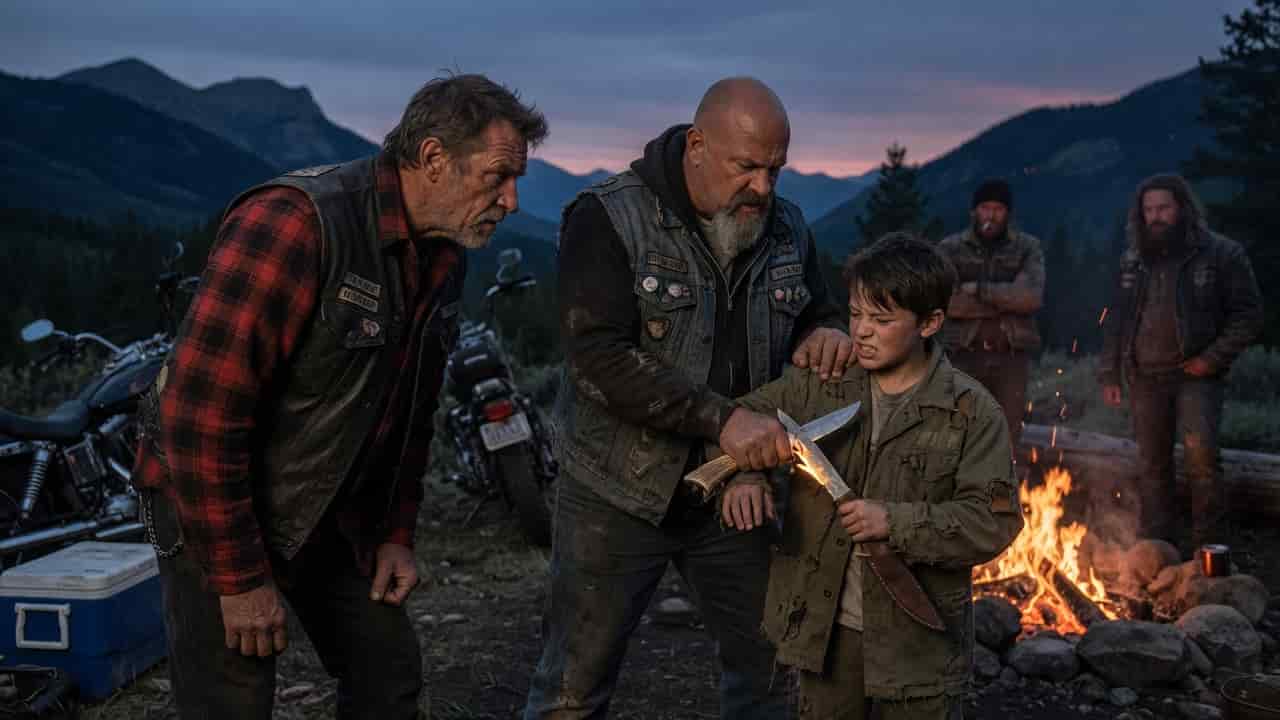
“Give it here, pup. You’re too small for steel.”
Bear’s voice was a low rumble, the kind of sound that usually meant someone was about to get hurt. He had the boy by the collar of that oversized army jacket, lifting him just enough so his toes barely scraped the frozen Montana dirt. The kid didn’t cry, though. He just gripped the leather sheath tighter, his knuckles white against the deer-antler handle.
The rest of the pack just watched. In the North, we don’t step in for strangers, especially not trespassers caught scouting the perimeter of the camp. But then the firelight hit the blade as Bear tried to wrench it away.
I saw the curve of the antler. I saw the specific, jagged notch in the brass guard. My breath hitched, a sharp, cold burn in my lungs that had nothing to do with the mountain air. That knife hadn’t been seen in a decade. Not since the night Elara disappeared into the treeline and never came back.
“Bear,” I said, my voice cutting through the laughter like a cold wind. “Let him go.”
Bear froze. He knew that tone. He dropped the kid, who crumpled into the dirt but kept his eyes locked on me. The boy looked feral—hungry, tired, and carrying a piece of my life I thought was gone forever.
“Where did you get that knife, kid?” I asked.
The boy didn’t answer. He just looked at the sheath, where I knew—without even seeing it—that her name was burned into the leather.
Chapter 1
The cold in Montana doesn’t just sit on your skin; it hunts. It finds the gaps in your flannel, the cracks in your boots, and the places in your mind where you keep the old regrets. We were camped high up near Bitterroot, the kind of place where the trees grow so thick they choke out the sun by four in the afternoon.
I was sitting on a plastic milk crate, staring into a fire that wasn’t doing nearly enough work. My hands were grease-stained, the black oil from a primary drive fix etched into the calluses of my palms. I’m Hunter Boone, but most people just call me Hunter. I lead this pack because I’m the only one who knows how to survive up here without a GPS or a grocery store. We aren’t just a club; we’re a collection of men who decided the world down in the valleys was too loud and too soft.
“Got a live one, Hunter,” Tracker called out.
I didn’t look up immediately. I let the smoke from the pine needles sting my eyes for a second longer. Tracker was coming in from the north perimeter, his boots crunching on the frost-hardened needles. Beside him, Woods was hauling something—or someone—by the arm.
They dragged a boy into the light of the campfire. He couldn’t have been more than twelve, though he had the kind of eyes that looked like they’d seen fifty years of bad winters. He was thin, wrapped in an old olive drab M65 field jacket that was three sizes too big for him. His face was a map of dirt and dried sap.
“Caught him near the fuel cache,” Woods said, giving the boy a shove that sent him stumbling toward the center of the ring. “Kid’s got hands like a raccoon. Was trying to get into the jerky stash.”
The boy didn’t make a sound. He didn’t plead. He just stood there, his chest heaving under the heavy canvas of the jacket. He looked at us—at the heavy leather vests, the bearded faces, the bikes lined up like iron sentinels in the shadows—and he didn’t blink.
“Who do you belong to, pup?” I asked. My voice was raspy from the cold.
The boy’s gaze shifted to me. He didn’t answer. He reached slowly toward his hip, and Bear, who had been leaning against a nearby pine, moved faster than a man his size should. He lunged forward and grabbed the boy’s wrist.
“Whoa there, Billy the Kid,” Bear growled. “No need for that.”
Bear twisted the boy’s arm, forcing him to drop whatever he was reaching for. It hit the dirt with a soft thud. It was a knife. But it wasn’t some cheap, store-bought folder.
I leaned forward. The orange glow of the fire licked at the object on the ground. It was a fixed-blade hunting knife. The handle was carved from a single piece of deer antler, polished smooth by years of use, but with a distinctive dark grain near the pommel. The sheath was heavy, dark-tanned leather, well-oiled and worn.
My heart didn’t skip a beat—I’m not the kind of man for poetic reactions—but my stomach turned into a cold stone. I knew that antler. I’d spent three nights in a garage in Missoula carving it. I’d shaped that brass guard with a file until my fingers bled.
“Check it out,” Bear said, picking up the knife and holding it up for the others to see. “Nice steel. Probably worth a few cases of whiskey.”
“Give it here,” the boy hissed. It was the first time he’d spoken. His voice was sharp, a jagged edge of a sound.
Bear laughed, a wet, rattling sound in his chest. “You hear that? Pup’s got a bite. You too small for steel this heavy, kid. You’ll just cut your own fingers off.”
Bear started to unsheathe the blade, mocking the boy’s height, holding the knife just out of reach. The boy lunged, snapping his teeth near Bear’s forearm, but Bear just shoved him back with a massive palm. The boy went down in the dirt, hard.
“That’s enough,” I said.
The camp went quiet. When I speak, the air usually gets a little thinner. Bear stopped laughing, the knife held mid-air. He looked at me, then back at the boy, confused.
“It’s just a trespasser, Hunter,” Bear said, though he lowered his arm. “Just having a bit of fun.”
“Give me the knife,” I said.
Bear hesitated for a heartbeat—pride is a hell of a thing in this MC—but then he stepped over and handed it to me. The leather was cold. I turned it over in my hands. I didn’t need to look at the back of the sheath, but I did anyway. There, burned into the hide in shaky, amateurish letters, was the name: Elara.
Ten years. Ten years since I’d watched her walk toward the creek to wash a tin plate. Ten years since I’d heard her scream, a sound I’d ignored because I was too busy tracking a prize buck, thinking the scream was just a hawk or the wind. By the time I’d reached the water, there was nothing but a turned-over plate and a muddy boot print that didn’t belong to her.
I’d told the pack she was “taken by the woods.” It was a clean story. It made me a tragic figure, a man of the mountains who lost his heart to the wild. But the truth was a rot in my bones. I’d chosen the hunt. I’d heard the danger and I’d stayed on the trail of the kill, convinced my ego was more important than her safety.
I looked at the boy. He was staring at me now, his eyes fixed on the knife in my hand.
“Where did you get this?” I asked. My voice felt like it was coming from a mile away.
The boy wiped a smudge of dirt from his nose with the back of a filthy hand. He looked at the knife, then at me, and his expression shifted. It wasn’t fear anymore. It was a strange, haunting recognition.
“From my father,” the boy said.
The silence that followed was heavier than the Montana snow.
Chapter 2
The word father hung in the air like woodsmoke that wouldn’t clear. Bear spat a glob of tobacco juice into the fire, the hiss the only sound in the clearing. Tracker and Woods exchanged a look. They knew about Elara—or the version of her I’d allowed them to know. They knew I’d never had a son.
I stood up, the milk crate scraping against the frozen ground. I was a head taller than Bear and twice as mean when I wanted to be, but right now, I felt like a man made of glass. I walked toward the boy. He didn’t flinch as I approached. He just watched the knife in my hand.
“Your father,” I repeated. I felt the name Elara burning into my palm through the leather. “Who is he?”
“The man in the cabin,” the boy said. He stood up slowly, brushing the pine needles from his tattered jacket. He had a strange, upright dignity that didn’t match his ragged appearance. “He told me if I ever got lost, I should show the knife to the men on the iron horses. He said you’d know it.”
My hands started to shake, just a fine tremor, so I clenched them into fists. I looked at the knife again. This wasn’t a coincidence. You don’t find a custom-made blade in the middle of three million acres of wilderness by accident.
“What’s your name, kid?” Tracker asked, stepping closer.
“Caleb,” the boy said.
“And this ‘man in the cabin,'” I said, stepping into Caleb’s personal space. I could smell him now—smoke, pine, and the metallic tang of dried blood. “Does he have a name?”
Caleb narrowed his eyes. “Silas.”
The name hit me like a physical blow. Silas. Silas Vance. The man I’d been hunting ten years ago. The man who’d stolen three of our bikes and a cache of high-grade hunting rifles. I’d tracked him into these very mountains, obsessed with the “respect” he’d taken from me. I’d been so close to his trail that afternoon. I’d seen his campfire smoke. And when Elara screamed, I told myself Silas wouldn’t be near the camp. I told myself she was safe.
I was wrong. He hadn’t just taken the bikes. He’d taken her.
“Hunter?” Bear’s voice was cautious. “You okay, man? You look like you’ve seen a ghost.”
“I have,” I muttered. I looked at the boy—Caleb. He had Elara’s chin. The same slight cleft that she used to hate. And he had eyes that looked exactly like mine—dark, restless, and full of a quiet, brewing storm.
I turned to the pack. “Tie him up. Not tight, but don’t let him wander. Put him in the tool shed. Bear, you’re on guard.”
“Tie him up?” Bear grunted. “He’s just a kid, Hunter. And if he’s Silas’s boy—”
“He’s staying,” I snapped. “And nobody touches him. If he loses a hair, I’ll take it out of your hide, Bear. You understand?”
Bear nodded quickly, his eyes wide. He’d seen me kill a grizzly with nothing but a short-spear, but he’d never seen me look like I was about to break.
They led Caleb away. He didn’t fight them. He just kept his eyes on me until the shadows of the tool shed swallowed him. I stood by the fire, the knife still in my hand.
“Hunter,” Tracker said, stepping up beside me. He was the oldest of us, the one who’d been with me since the beginning. He remembered the night Elara disappeared. He’d been the one to help me search the creek bed until our flashlights died. “That’s her knife. I know the work.”
“Yeah,” I said.
“If that kid is twelve… and she went missing ten years ago…” Tracker trailed off. He didn’t need to finish the math.
“He says Silas is his father,” I said, the name tasting like poison.
“Silas was a dead man,” Tracker whispered. “We looked for him for six months after she went. We found his burnt-out camp. We thought he’d froze to death or the wolves got him.”
“Apparently, he’s a better survivalist than we gave him credit for,” I said. I looked up at the black peaks silhouetted against the stars. “He’s been out there. This whole time. With her.”
The thought of it was a jagged blade in my gut. Ten years. Elara living in a cabin with the man I’d failed to protect her from. Raising a son. My son? Or his?
“What are we going to do?” Tracker asked.
“We’re going to wait for morning,” I said. “And then I’m going to have a talk with my guest.”
I walked away from the fire, heading toward my own tent, but I didn’t sleep. I sat on my bedroll, unsheathed the knife, and ran my thumb along the edge. It was still sharp enough to shave with. Elara had always been meticulous about her tools. She used to say that in the woods, a dull knife was a death sentence.
I thought about the night she left. I remembered the way the sun had hit the water, the way the dragonflies had skimmed the surface. I remembered the feeling of the rifle in my hand, the weight of the ego that told me I was the master of these mountains. I’d been so sure I was the hunter.
I looked at the knife and realized I’d been the prey all along. Silas had been watching. He’d waited for the moment I turned my back, the moment I chose my pride over my heart. He hadn’t just taken her; he’d allowed me to live with the knowledge of what I’d done. And now, he’d sent the boy.
He wasn’t just returning a knife. He was opening an old wound and pouring salt into it.
Chapter 3
The morning light in Montana is grey and unforgiving. It doesn’t warm you; it just exposes everything the night managed to hide. I woke up with my muscles locked tight and my head pounding. I hadn’t slept more than an hour.
I walked out to the tool shed. Bear was slumped against the door, a half-empty thermos of coffee between his boots. He looked up as I approached, rubbing his eyes.
“Kid didn’t make a peep,” Bear said. “Scary quiet, if you ask me. Most kids would be crying for their mama by now.”
“He isn’t most kids,” I said.
I opened the door. The shed smelled of rusted iron, gasoline, and old burlap. Caleb was sitting on a stack of tires in the corner. He’d taken off the army jacket, revealing a thin, grey t-shirt underneath. His arms were corded with muscle that shouldn’t belong to a twelve-year-old. He was staring at a spiderweb in the rafters.
“Hungry?” I asked.
Caleb looked at me. His eyes were even more striking in the daylight—a deep, stormy grey. “My father says hunger is just a feeling. It doesn’t mean you have to eat.”
“Your father says a lot of things, it seems,” I said. I sat down on a workbench opposite him. I’d brought the knife with me. I held it out, handle-first.
Caleb reached for it, but I pulled it back just an inch.
“First, we talk,” I said. “Where is the cabin?”
Caleb’s expression didn’t change. “North. Past the Devil’s Slide. Near the hidden spring.”
“That’s deep in the interior,” I said. “No roads. No trails.”
“We don’t need roads,” Caleb said.
I leaned in closer. “The woman. The one who used this knife. Is she still there?”
Caleb looked down at his boots. For the first time, I saw a flicker of something human in his face—a shadow of grief, maybe, or just the weight of a secret too big for a boy to carry.
“She went away,” he said softly.
“Away where?” My heart hammered against my ribs. “Did she leave? Did she… die?”
“She went into the ground,” Caleb said. His voice was flat, devoid of the emotion a son should have for his mother. “Two winters ago. The cough took her. Silas said the mountains wanted her back.”
I closed my eyes. The ground seemed to tilt beneath me. Elara was gone. I’d spent ten years imagining her alive, imagining the day I’d find her and beg for her forgiveness. I’d imagined the anger she’d have, the way she’d look at me with that disappointed tilt of her head. I’d even imagined her being happy with someone else, just so she wasn’t dead.
But she was in the ground. And she’d died with a “cough,” probably something simple that a ten-dollar bottle of antibiotics could have fixed if she’d been anywhere but a hole in the mountains with a madman.
“He told me to come find you when I was ready,” Caleb said.
I opened my eyes. “Ready for what?”
“To see if you were as big as he said you were,” Caleb said. He looked me up and down, his gaze clinical. “He said you were a king of the road. But he said you were a king who forgot his crown in the dirt.”
I felt a surge of rage, a hot, liquid fire in my chest. Silas. Even from his cabin in the middle of nowhere, he was still mocking me. He’d kept her until she died, and then he’d sent the living proof of my failure to my doorstep.
“Is he alone out there?” I asked, my voice low and dangerous.
“He’s never alone,” Caleb said. “The woods speak to him. And he has the dog.”
“The dog?”
“Ghost,” Caleb said. “He’s bigger than a wolf. He doesn’t like strangers.”
I stood up, the anger finally overriding the grief. I couldn’t do anything for Elara now. But I could finish the hunt I’d started ten years ago. I could take back what was left of my life.
I stepped out of the shed. The rest of the pack was gathered near the bikes, watching. They could see it on my face. The “Pack Leader” was back, and he was looking for blood.
“Tracker! Woods!” I shouted. “Get the gear. We’re going north.”
“Hunter, wait,” Tracker said, stepping forward. “You’re going into the interior? This late in the season? The snows are going to hit the passes by tomorrow.”
“I don’t care,” I said.
“What about the kid?” Bear asked, gesturing toward the shed.
“He’s coming with us,” I said. I looked back at Caleb, who had followed me to the doorway. “He’s going to show us the way.”
“I don’t have to show you anything,” Caleb said, his jaw set.
I walked over to him, leaning down until our faces were inches apart. “You want your knife back, Caleb? You want to see if I’m the man your father said I was? Then you lead us to that cabin. Otherwise, I’m going to melt this steel down and throw it in the creek.”
Caleb didn’t flinch. He just nodded once. “I’ll take you there. But you won’t like what you find.”
“I haven’t liked anything I’ve found in ten years,” I said. “One more thing won’t kill me.”
Chapter 4
We rode hard. The engines of the Harleys screamed against the incline, the heavy tires churning through the mud and the patches of old, grey ice. Caleb was strapped to the back of my bike, his small hands gripped tight around my waist. He didn’t complain about the cold or the noise. He just sat there, a silent weight against my back.
The further we went, the more the world seemed to narrow. The pines grew closer together, their branches intertwining like skeletal fingers. The air turned thin and sharp, tasting of ozone and impending snow.
By mid-afternoon, we had to leave the bikes. The trail had disappeared into a steep, rocky ravine that no machine could navigate. We cached the Harleys under a cedar-branch lean-to and started the climb on foot.
“How much further?” Bear grunted. He was struggling with the altitude, his face a bright, alarming shade of red.
“Two miles,” Caleb said. He was moving through the woods with an ease that made me feel clumsy. He didn’t look for footing; he just knew where the ground was solid.
I watched him. He moved like Elara. She’d always been light on her feet, a girl from the city who’d taken to the mountains like she’d been born in a cave. Every time Caleb hopped over a fallen log or ducked under a low branch, it was like watching a ghost move through the trees.
“Hunter,” Tracker whispered, pulling me back a few paces. “Look at the kid. He’s not leading us to a cabin. He’s leading us to a kill box.”
“I know,” I said. I patted the holster at my hip. I wasn’t an idiot. I knew Silas wasn’t just sitting by a fireplace waiting for a reunion.
“We should send a scout ahead,” Tracker suggested.
“No,” I said. “He wants me. If we start playing tactical games, he’ll just vanish into the brush. We go in loud and we go in together.”
We reached the crest of a ridge, and the world opened up. Below us sat a small valley, hidden from the rest of the world by sheer granite walls. In the center, near a small, steaming spring, was a cabin. It was built from unpeeled logs, the roof covered in thick green moss. It looked like it had grown out of the earth itself.
Smoke curled from the chimney, a thin, white ribbon against the darkening sky.
“That’s it,” Caleb said. He stood at the edge of the ridge, his hair blowing in the wind.
Suddenly, a sound echoed through the valley. It wasn’t a wolf howl, and it wasn’t a dog’s bark. It was something in between—a long, mournful cry that made the hair on my arms stand up.
“Ghost,” Caleb whispered.
A massive shape emerged from the shadow of the cabin. It was white—pure, blinding white—and it was the size of a mountain lion. It stood on the porch, its head cocked toward the ridge. It knew we were there.
“Stay here,” I told the pack.
“Like hell,” Bear said, pulling a short-barreled shotgun from his pack. “We didn’t come this far to watch you get eaten by a dog.”
“I said stay here,” I repeated, my voice dropping into that low, dangerous register. “This is my hunt. If things go sideways, you do what you have to. But until then, nobody moves.”
I started down the slope. Caleb followed me, unbidden. I didn’t stop him.
As we approached the cabin, the front door creaked open. A man stepped out onto the porch. He was tall, his hair a wild mane of white, his beard reaching his chest. He was wearing buckskins that looked like they’d been repaired a thousand times. He looked like a man who had forgotten what a mirror was.
He looked at me, and a slow, crooked smile spread across his face.
“Hunter Boone,” the man called out. His voice was surprisingly clear, echoing off the granite walls. “You’re late. I expected you three winters ago.”
I stopped twenty feet from the porch. My hand was on the grip of my revolver, but I didn’t draw it. Not yet.
“Silas,” I said.
“And you brought the boy back,” Silas said, looking at Caleb. “Good. A son should be with his father when the work is finished.”
“He isn’t your son, Silas,” I said, the words feeling like they were carved out of ice.
Silas laughed, a dry, hollow sound. “Does it matter? He’s the one who lived in the woods. He’s the one who watched her die. He’s the one who carries the knife. He’s more mine than yours will ever be, Hunter. Because I stayed. And you ran.”
“I didn’t run,” I growled. “I was hunting you.”
“No,” Silas said, stepping off the porch. The massive white dog followed him, its eyes fixed on my throat. “You were hunting an idea of yourself. You were hunting the man you thought you were. But you weren’t that man. You were just a coward with a shiny bike and a loud voice.”
Silas reached into his belt and pulled out a knife. It was the twin to the one I’d given Elara. I’d made two that year. One for her, and one for me. He’d taken mine, too.
“You want to finish it, Hunter?” Silas asked. “No guns. Just the steel you’re so proud of. In front of the boy. Let him see who the real man is.”
I felt the weight of the pack behind me on the ridge. I felt the weight of the ten years of guilt and the cold, empty bed. I looked at Caleb, who was standing between us, his face unreadable.
I reached behind me and pulled the antler-handled knife from my belt. I tossed the sheath into the snow.
“No guns,” I said.
I stepped forward, but before I could reach him, Caleb moved. He didn’t go to Silas, and he didn’t stay with me. He stepped between us and held out his hand.
“Wait,” Caleb said.
“Out of the way, pup,” Silas said, his voice sharpening.
“No,” Caleb said. He looked at Silas, then at me. “She didn’t die of a cough.”
The world went perfectly still. The wind stopped. Even the massive dog went quiet.
“What are you saying, kid?” I asked.
Caleb looked at Silas. “She was leaving. She had her pack ready. She said she was going back to the man with the iron horses. And then the man in the cabin got angry.”
I looked at Silas. His smile had vanished. His eyes were wide, darting toward the dog, then back to the boy.
“She didn’t die of a cough,” Caleb repeated, his voice trembling for the first time. “He hit her. And then he didn’t stop hitting her.”
The rage that hit me then wasn’t fire. It was a cold, absolute vacuum. It sucked the air out of the valley. I didn’t say a word. I didn’t scream. I just started walking.
Silas whistled, a sharp, piercing sound. “Ghost! Kill!”
The white dog lunged.
Chapter 5
The white shape didn’t move like a dog. It moved like a collapsing mountain. Ghost was a hundred and thirty pounds of lean, desperate muscle, and when he hit me, the world didn’t just go sideways—it went black for a heartbeat. I felt the air leave my lungs in a wet whistle, my back slamming into the frozen, root-gnarled earth. The cold was a secondary concern; the primary one was the snap of jaws inches from my carotid.
I jammed my left forearm up, the thick leather of my vest and the heavy flannel of my sleeve taking the brunt of the first strike. I heard the fabric tear, a sound like a scream, followed by the sickening pressure of teeth finding the meat of my arm. I didn’t feel the pain yet—adrenaline is a liar that tells you you’re invincible right until you start to leak—but I felt the weight. The dog was trying to pin me, its hind legs churning the snow into a grey slush.
“Hunter!” Bear’s voice roared from the ridge, followed by the metallic clack-clack of a shotgun being racked.
“No!” I managed to wheeze out. “Stay back!”
If they fired, they’d hit me. Or worse, they’d hit Caleb, who was still standing five feet away, his face a mask of paralyzed shock. This was the moment the boy’s world fractured. Everything he knew—the man who raised him and the legend he’d been sent to find—was currently trying to tear each other apart in the dirt.
I reached for the antler-handled knife. My fingers were numb, fumbling against the snow, but then I felt it. The cold brass guard, the rough grain of the horn. It felt balanced. It felt like it had been waiting for this. I didn’t want to kill the animal. The dog was just a tool, a living extension of Silas’s malice. But as Ghost’s teeth crunched deeper into my arm, the survival instinct—the same one that had kept me alive on the road for twenty years—took over.
I didn’t stab. I sliced upward, a short, controlled burst of movement aimed at the dog’s shoulder. I felt the resistance of the hide, then the warm, copper-smelling spray of blood. Ghost let out a high-pitched yelp, a sound that was too human for comfort, and recoiled.
I rolled to my feet, my breath coming in ragged, steaming gasps. My left arm was a mess of shredded plaid and red, the cold finally starting to bite into the open wounds. I stood my ground, the knife held low, the way Tracker had taught me when we were both too young to know better.
Silas was laughing. He wasn’t even looking at the dog. He was looking at me, his eyes wide and bright with a feverish, manic light. He held my old knife—the twin to the one in my hand—with a casual, practiced ease.
“Look at you,” Silas mocked. “Bleeding in the dirt for a woman who didn’t even want you at the end. She used to talk about you, Hunter. In the beginning. She’d cry and say you were coming. And I’d just sit there and sharpen the steel, and I’d tell her, ‘He isn’t coming, Elara. He’s too busy being a king.'”
“Shut up, Silas,” I said. My voice was steady, which surprised me. The rage had moved past the point of heat; it was a frozen, crystalline thing now.
“Then she stopped talking about you,” Silas continued, stepping around the bleeding dog, which was now whimpering in the snow. “She started looking at the trees. She started realizing that the mountains don’t care about MC patches or ‘respect.’ They just care about who stays. And I stayed.”
I looked at Caleb. The boy was staring at Silas, his eyes filled with a dawning, horrific clarity. “She tried to leave,” Caleb said, his voice small but piercing. “You said she fell. You said the mountain took her. But I saw the pack. I saw her boots.”
Silas didn’t even turn to the boy. “The boy has a vivid imagination, Hunter. Comes from living in the dark. You know how it is.”
“I know how it is,” I said. I stepped forward, the snow crunching under my boots. Every movement sent a flare of agony through my arm, but I welcomed it. It kept me focused. “I know you’re a man who steals what he can’t build. You stole my bikes. You stole my rifles. And when you realized you couldn’t be me, you stole the only thing that made me human.”
Silas’s face contorted. The “mountain man” persona slipped for a second, revealing the petty, bitter thief underneath. He lunged.
He was fast for an old man, but he was clumsy. He’d spent ten years fighting trees and elk; he’d forgotten how to fight a man who had nothing left to lose. He swung the knife in a wide, desperate arc. I stepped inside his reach, the way I’d done a thousand times in barroom brawls from Missoula to Billings. I grabbed his wrist with my good hand, the impact jarring my shoulder.
We slammed into the side of the cabin, the unpeeled logs groaning under our weight. Silas smelled of rancid fat and unwashed hair. He was strong—the kind of wiry, deceptive strength that comes from a decade of hard labor—but I had the weight of ten years of guilt behind my shoulder.
“She… loved… me,” Silas hissed, his face inches from mine.
“She was a prisoner,” I spat back.
I twisted his wrist, the bone popping with a sound like a dry twig. Silas screamed, his fingers nervelessly releasing the knife. It fell into the snow, the blade disappearing into the white. I didn’t stop. I slammed my forehead into his nose, felt the cartilage break, and then I threw him.
He hit the porch steps and rolled into the dirt, coughing up a mixture of snow and blood. I stood over him, the antler-handled knife trembling in my hand. Behind me, I heard the sound of boots. The pack was descending the ridge. Bear, Tracker, and Woods were moving in a grim, silent line, their weapons drawn.
“Hunter, move aside,” Bear growled, leveling the shotgun at Silas’s chest. “Let’s end this circus.”
Silas looked up, his face a mask of red and grey. He looked at the shotgun, then at me. He wasn’t smiling anymore. He looked small. He looked like the pathetic thief he’d always been.
“Wait,” I said.
I looked at Caleb. The boy was standing by the edge of the porch, looking at the man who had raised him. There was no love in the boy’s eyes, but there was a terrible, haunting debt. Silas was the only father he’d ever known, even if the man was a monster.
“Caleb,” I said, my voice rough. “Come here.”
The boy hesitated, then walked slowly toward me. He looked at the knife in my hand—the one with his mother’s name on it.
“He killed her,” Caleb whispered, looking at Silas. “He said she was sick. But she wasn’t. She was just… brave.”
I looked down at Silas. I could feel the eyes of my men on me. They wanted a kill. They wanted the “Hunter” they knew to deliver justice in the old way, the way of the North. And a part of me—the part that had lived in the dark for a decade—wanted it too. I wanted to feel the steel go home. I wanted to erase the man who had erased my life.
But then I looked at the boy’s hands. They were shaking. Not from the cold, but from the sudden, violent vacuum of his entire reality. If I killed Silas here, in front of him, I wasn’t saving him. I was just giving him a different kind of monster to remember.
“Tracker,” I said, not taking my eyes off Silas. “Get the zip-ties. We’re taking him back.”
“Back?” Bear barked. “Hunter, the man is a murderer. He’s a thief. We don’t have enough gas to haul him down the mountain, let alone deal with the legal mess.”
“We’re taking him back,” I repeated. “He’s going to tell the sheriff exactly where she is. He’s going to say it on the record. And then he’s going to rot in a cell in Deer Lodge until the mountains forget his name.”
Silas started to laugh again, a wet, bubbling sound. “You think… you think you’re better than me? You left her. You’re just as guilty, Hunter. You’re just as—”
I kicked him. Not hard enough to kill him, but hard enough to silence the lie. He slumped into the dirt, unconscious.
The silence that followed was absolute. The white dog, Ghost, had crawled into the shadows under the porch, leaving a trail of red in the snow. The wind picked up, whistling through the gaps in the cabin logs.
I looked at the antler-handled knife. There was blood on the brass guard. I wiped it off on my jeans, the movement slow and deliberate.
“Bear, get the dog,” I said. “See if you can patch him up. He’s just an animal.”
“And the cabin?” Woods asked, looking at the moss-covered roof.
“Leave it,” I said. “The woods can have it back.”
I turned to Caleb. He was looking at me, his stormy grey eyes searching for something—a sign, a promise, a reason to trust the man who had just broken his world. I reached out and put my hand on his shoulder. My palm was still stained with grease and blood, but I didn’t pull away.
“Let’s go find your mother, Caleb,” I said. “Let’s find her for real this time.”
Chapter 6
We found her just as the first real snow of the season began to fall.
It wasn’t a “mountain taking her back” kind of place. It was a small clearing a hundred yards behind the cabin, tucked under the sheltering arms of a massive, ancient hemlock. There was no headstone, just a circle of smooth river stones and a small, hand-carved wooden bird perched on a branch above.
Caleb led us there. He didn’t speak the whole way. He just walked with his head down, his oversized jacket flapping in the wind. When we reached the clearing, he stopped and pointed.
“Here,” he said.
I knelt in the snow. My left arm was bandaged now, the throbbing pain a constant reminder of the price of the truth. Tracker and Bear stood a respectful distance back, their hats in their hands. Even the mountain seemed to hold its breath.
I cleared the snow from the stones. I thought I would feel an explosion of grief, something that would finally break the dam I’d built inside myself. But all I felt was a profound, heavy exhaustion. It was the feeling of a hunt finally coming to an end. The trail had run out. There was nowhere left to track.
“She used to sing,” Caleb said suddenly. He was standing beside me, looking at the stones. “Not loud. Just to herself. When she was skinning the rabbits or mending the clothes. She’d sing about a city with lights that never went out.”
“Missoula,” I whispered. “She loved the neon on Front Street.”
“She told me that the lights were stars that people caught and put in glass jars,” Caleb said. A small, sad smile touched his lips. “I didn’t believe her. I thought stars were too hot.”
“She was always a dreamer,” I said. I reached into my vest and pulled out the hunting knife. I looked at the name Elara one last time. I didn’t want to keep it anymore. It didn’t belong in a leather sheath on my hip. It belonged here.
I dug a small hole near the center of the stone circle. The ground was hard, but I worked at it with a folding spade until I reached the dark, rich earth. I placed the knife inside, the antler handle facing up toward the branches.
“Rest now, Elara,” I said. “I’m sorry it took me ten years to hear you.”
I covered the knife and replaced the stones. I stood up, my knees cracking, and looked at Caleb. He was the only thing left of her. The only thing that wasn’t a memory or a grave.
“We need to go, Caleb,” I said. “The passes are closing.”
“What happens now?” he asked. He looked at the cabin, where Silas was currently tied to the back of a pack mule Woods had managed to find in the small stable.
“We go down,” I said. “We find you a place. A real place. With lights in jars.”
“With you?”
I looked at the boy. I looked at the way he stood—the same stubborn set of the shoulders I saw every time I looked in a mirror. I thought about the MC, about the noise and the grease and the hard, uncompromising life we led. It was no place for a boy. But then I realized that the “civilized” world was the place where a woman could disappear for ten years and no one would notice as long as the story was clean.
“Yeah,” I said. “With me. For as long as you want.”
The descent was a blur of cold and fatigue. We reached the cached bikes by dusk, the snow already several inches deep on the seats. We lashed Silas and the gear down. Bear had managed to staple the dog’s shoulder; the animal was slumped in a sidecar Tracker had rigged from a trailer, its white eyes watching us with a wary, dulled intelligence.
When I kicked my Harley over, the roar of the engine felt different. It didn’t sound like power anymore. It just sounded like a machine.
Caleb climbed on behind me. He wrapped his arms around my waist, and for the first time, he didn’t just grip for safety. He leaned his head against my back. I felt the warmth of him through the leather and the flannel, a small, beating heart against the cold void of my spine.
We rode out of the valley as the moon rose, a silver sliver over the peaks.
The ride back to the main camp was silent. The pack didn’t celebrate. There was no “victory” to be had. We were hauling a murderer and a broken boy out of a grave we’d all helped dig with our silence.
When we rolled into the campsite near Bitterroot, the fire was low. The men who had stayed behind stood up, their faces illuminated by the dying embers. They looked at Silas, then at the boy, then at me.
“It’s done,” Tracker said, stepping off his bike.
I didn’t say anything. I helped Caleb down. He was stiff from the ride, his face pale. I led him toward the fire and handed him a tin cup of lukewarm coffee.
“Drink it,” I said. “It’ll help the chill.”
I walked over to Silas. He was awake now, staring at the stars with a vacant, shattered expression. He looked like a man who had finally realized that the mountains don’t keep secrets; they just store them until the thaw.
“Tracker, Bear,” I said. “First thing tomorrow, you take him to the county seat. Give the sheriff the coordinates of the cabin. Tell them everything.”
“What about you, Hunter?” Bear asked.
“I’m taking a leave,” I said.
The word leave hung in the air. In the MC, you don’t take leaves. You’re either in or you’re out. You’re either part of the pack or you’re a ghost.
“How long?” Woods asked.
I looked at Caleb. He was sitting on the milk crate I’d occupied the night before, staring into the fire. He looked small, but he looked grounded. He looked like he was finally starting to realize that he didn’t have to be feral anymore.
“As long as it takes,” I said.
I walked over to the boy and sat down in the dirt beside him. I didn’t need a crate. I didn’t need to be a king. I just needed to be a man who could answer a question.
“Hunter?” Caleb asked, not looking away from the flames.
“Yeah, Caleb?”
“Do the lights in the jars… do they really stay on all night?”
I reached out and squeezed the back of his neck, the way my father had done once, a lifetime ago, before the road and the bikes and the ego took over.
“Yeah, kid,” I said, my voice thick. “They stay on. I’ll make sure of it.”
The fire popped, a shower of sparks rising into the black Montana sky. We sat there together, the biker and the boy, two pieces of a broken story trying to find a way to fit together. The hunt was over, and the winter was coming, but for the first time in ten years, the air didn’t feel like it was trying to kill me. It just felt like air.
I closed my eyes and for a second, just a second, I thought I could hear a woman singing about a city with lights that never went out. And then there was only the wind in the pines, and the steady, quiet breathing of the boy beside me.
The residue was there—the blood on the snow, the scarred arm, the memory of the hemlock tree—but as the snow covered the camp, it felt like a beginning. Not a clean one, and certainly not an easy one. But a beginning nonetheless.
I leaned back against the tire of my Harley and watched the stars. They were hot, Caleb was right about that. But sometimes, if you look at them long enough, they look exactly like a way home.