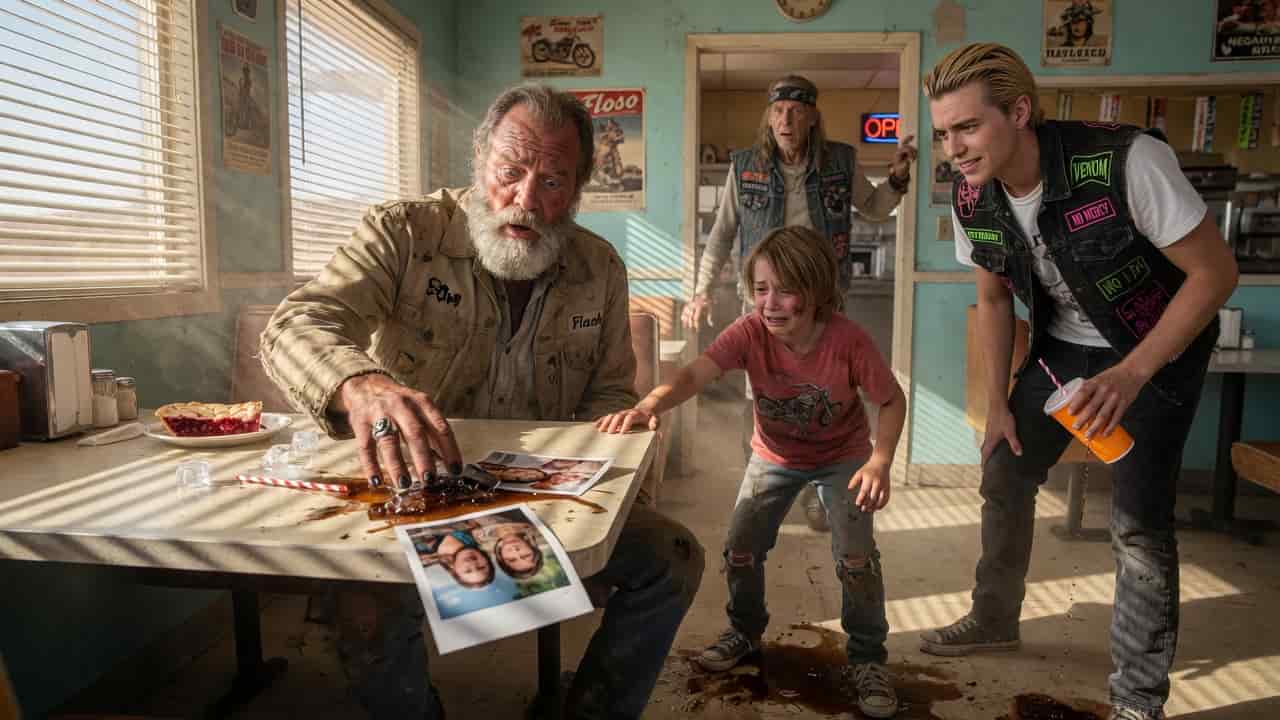
“Look at this piece of trash,” Jax sneered, his voice carrying across the quiet diner. He tilted his cup, watching the dark liquid soak into the edges of the only thing 10-year-old Leo had left in this world.
The boy was on his knees, his hands hovering over the wet floor, his face a mask of pure, helpless heartbreak. He didn’t fight back. He didn’t scream. He just looked like his whole world had been erased in front of a room full of strangers.
“Please,” Leo whispered, his voice cracking. “Please give it back.”
Jax just laughed, kicking the wet Polaroid further into the puddle. The diner regulars looked away, nobody wanting to cross the man with the newest patch and the loudest bike. They thought it was just a mean joke. They thought the boy was just a drifter’s kid with a piece of paper.
But Silas “Flash” Miller wasn’t looking at Jax. He was looking at the woman in the photo—the woman laughing in front of a bar that burned down fifteen years ago. The woman the authorities have been hunting since the night the sky turned orange.
Silas hadn’t touched a camera in a decade. He’d spent years making sure there were no records, no evidence, and no way back. Now, the past was lying in a puddle of soda, and the man who burned it all down has to decide if he’s going to save the boy or keep the secret that could ruin them both.
Chapter 1: The Heat of the Frame
The Arizona sun didn’t just shine; it leaned on you like a debt collector. It was ten in the morning, and the asphalt outside the Rusty Hub was already soft enough to swallow a kickstand. Silas Miller, known to exactly four people as “Flash” and to everyone else as the guy who didn’t want to talk to you, sat at the end of the counter. He kept his back to the door and his eyes on the steam rising from a cup of coffee that tasted like burnt rubber and regret.
Silas didn’t like cameras. He didn’t like smartphones, he didn’t like the way the younger riders at the Hub spent more time framing shots for their “followers” than they did checking their oil. To Silas, a lens was just a witness you couldn’t bribe.
“Check the lighting on that, Negative,” a voice barked from the booths.
Silas didn’t look. He knew the voice. Jax. Twenty-four years old, wearing a leather vest that still smelled like the factory, and carrying enough ego to sink a barge. Jax was the “Mirror” of everything Silas had spent thirty years trying to outrun. The kid wanted to be a legend before he’d even hit a thousand miles of open road.
“Light’s fine, kid,” Negative grunted. Negative was Silas’s contemporary, a man so thin he looked like he was made of piano wire and cigarette ash. He got his name because he used to develop film in a bathtub back when that was a thing people did. Now, he just sat in the back of the Hub, watching the world go digital and hating every second of it.
The screen door creaked—a high, whining protest that set Silas’s teeth on edge.
A boy walked in. He couldn’t have been more than ten. He was covered in the fine, red silt of the high desert, his t-shirt three sizes too big and his eyes too wide for his face. He didn’t look like he belonged to any of the tourists or the bikers. He looked like he’d been dropped out of a passing truck.
“We’re not a bus stop, kid,” Sarah, the waitress, said without looking up from the grill. “And the bathroom is for paying customers.”
The boy didn’t answer. He walked toward the booths, his movements stiff, like he was carrying something fragile inside his chest. He sat down three booths away from Jax, clutching a small, rectangular object against his ribs.
Silas watched him through the mirror behind the bar. The boy looked exhausted. Not just ‘missed-a-nap’ tired, but ‘lived-a-lifetime’ tired.
Jax noticed him too. Jax noticed everything that might make for a good “moment.” He leaned over the back of his booth, his expensive black leather creaking. “Hey, kid. You lost? Or did your mom leave you here to find a real man?”
The boy flinched. He didn’t look at Jax. He just stared at the table, his small hands tightening around the object.
“I asked you a question,” Jax said, his voice dropping an octave. He liked the audience. He liked the way the other two young riders at his table started snickering.
“Waiting for someone,” the boy whispered.
“Waiting for who? The tooth fairy? You look like you haven’t seen a dentist or a shower in a month.” Jax reached out, his hand lightning-fast, and snatched the object from the boy’s grip.
“Hey!” The boy lunged, but Jax was already standing, holding the item high above his head.
It was a Polaroid. Old. The edges were white and peeling, the chemistry of the film beginning to yellow and crack.
“What’s this?” Jax mocked, squinting at it. “A picture of your girlfriend? Oh, wait. It’s just some lady. She looks like she’s had a few too many at the cantina.”
“Give it back,” the boy said. He wasn’t crying yet, but his voice was shaking so hard it sounded like it was coming apart. “It’s my mom. It’s the only one I have.”
Silas felt a cold ripple move down his spine. He hated that phrase. The only one. He knew what it meant to have ‘the only one’ of something. He’d had the only one of a lot of things once. Then he’d struck a match and watched them turn into black flakes that drifted into the Arizona night.
“The only one, huh?” Jax turned the photo around, showing it to his friends. “It’s trash, kid. Look at the quality. It’s blurry, it’s old, and honestly? She looks like trouble.”
“Jax, leave the kid alone,” Negative said from his corner. It wasn’t a command; it was a tired suggestion. Negative knew how Jax worked. The more you pushed, the more he performed.
“I’m just educating him on photography, Neg,” Jax said, his eyes glinting. He looked at the boy, then at the half-full cup of Dr. Pepper on the table. “You know what happens to old trash? It gets recycled.”
Jax didn’t just drop the photo. He placed it carefully on the checkered linoleum floor, right in front of the boy’s feet. Then, with a slow, deliberate motion, he tilted his cup.
The dark soda glugged out. It splashed onto the white border of the Polaroid. It began to seep into the layers of the film, turning the bright, laughing woman in the photo into a distorted, brown ghost.
The boy let out a sound—not a scream, but a soft, broken whimper—and dropped to his knees. He reached for the photo, but he was too afraid of Jax’s heavy, polished boots to pull it away.
“Look at this piece of trash,” Jax sneered.
Silas stood up. He didn’t think about it. He didn’t plan it. His body just moved, a habit of violence and protection that he thought he’d buried under fifteen years of desert sand.
He didn’t walk; he closed the distance in two heavy strides. He grabbed Jax’s wrist mid-pour.
Jax’s eyes went wide. He tried to yank his arm back, but Silas’s grip was like a vice forged in a shipyard. He twisted Jax’s arm, forcing the cup to fall and shatter on the floor.
“Pick it up,” Silas said. His voice was a low rumble, the sound of a storm moving over a mountain range.
“Let go of me, old man!” Jax hissed, his face turning red. “You don’t know who you’re—”
“I know exactly who you are,” Silas interrupted. He leaned in close, the smell of old tobacco and cold grease radiating off his jacket. “You’re a boy in a costume. And you just ruined something you can’t replace. Pick it up. Now.”
The diner went dead silent. Even the sizzle of the grill seemed to die down.
Leo was sobbing now, his hands hovering over the wet floor, his eyes fixed on the ruined image of his mother. Silas looked down, intending to help the boy, but his breath hitched.
Through the brown stain of the soda, he saw the woman’s face. She was laughing. She was wearing a leather vest with colors Silas recognized—colors he had once worn, colors that belonged to a club that hadn’t existed since the fire.
And there, in the blurry background, standing by a bike with a custom chrome fender, was a younger man. A man with a dark beard and a look of fierce, arrogant love in his eyes.
It was Silas.
The woman in the photo was Elena. His wife. The woman he’d told everyone was lost in the fire. The woman he’d spent fifteen years trying to erase from the world to keep her from a cage.
And the boy on the floor, clutching her ruined image, was looking up at him with eyes that were a perfect, haunting match for hers.
Chapter 2: The Residue of the Room
The silence in the Rusty Hub was heavy, the kind of silence that follows a gunshot. Jax was still struggling, his face a mottled purple, but Silas didn’t feel the weight of the man’s arm. He felt the weight of the ten years he’d been dead and the fifteen years he’d been lying.
“I said pick it up,” Silas repeated, his voice even lower. He shoved Jax toward the floor.
Jax stumbled, his expensive boots slipping in the spilled soda. He scrambled to his feet, looking around the diner for support. His friends were staring at their plates. The regulars were looking at the floor. In a small town like this, power was a fragile thing, and Silas had just shattered Jax’s version of it.
“You’re crazy,” Jax spat, wiping his wrist. “It’s just a damn picture. Kid shouldn’t have been in here anyway.”
“Get out,” Silas said. He didn’t raise his voice. He didn’t have to.
Jax opened his mouth to retort, saw the look in Silas’s eyes—the look of a man who had already lost everything and had nothing left to fear—and shut it. He turned and stormed out, the screen door slamming behind him with a final, pathetic bang.
Silas stood over the boy. Leo was still on his knees, his shoulders shaking. He’d managed to scoop the Polaroid out of the puddle, but the damage was done. The soda had reached the internal chemicals, and the colors were bleeding into each other like a watercolor left in the rain.
“Let me see it, son,” Silas said. His voice felt like it was breaking through a layer of rust.
Leo looked up at him, wary. He clutched the photo to his chest. “You’re him,” he whispered.
Silas froze. “I’m who?”
“The man in the back,” Leo said. “The one my mom said would know what to do if the shadows got too long.”
Silas felt the air leave the room. If the shadows got too long. That was Elena’s phrase. She used it when the feds were circling, when the deals went sour, when the world felt like it was closing in.
He reached down, his hand trembling slightly, and helped the boy to his feet. “Come on. Let’s get you in the back. Sarah, get the kid a burger and a real Coke. On my tab.”
Sarah nodded, her eyes wide. She’d known Silas for five years and had never heard him speak more than three words at a time. She moved to the grill with uncharacteristic speed.
Silas led Leo to a small office in the back of the diner, a cramped space filled with old ledgers and the smell of stale coffee. Negative followed them, his thin face etched with a concern that went deeper than curiosity.
“Silas,” Negative said as he closed the door. “That photo. That bar. That was the ‘Blind Pig,’ wasn’t it?”
Silas sat on the edge of a desk, his eyes on the boy, who was now sitting in a rickety wooden chair, staring at the ruined Polaroid. “Yeah. Before the fire.”
“And that girl…” Negative trailed off. He knew. He’d been there when Silas walked out of the flames, alone, covered in soot and blood, telling the sheriff that Elena didn’t make it out.
Silas ignored him. He leaned toward Leo. “Where is she, Leo? Where’s your mom?”
Leo’s lower lip trembled. “She… she had to go. Two days ago. She said some men were coming. Men in suits.”
“The feds,” Silas whispered.
“She gave me the photo and a bus ticket,” Leo said, a tear finally escaping and carving a path through the dust on his cheek. “She told me to find the Hub. She told me to find Flash. She said he was the only one who could keep me safe because he’s already a ghost.”
Silas closed his eyes. Elena. She was alive. All these years, he’d lived in this self-imposed exile, believing he was protecting her memory, believing his lie had given her a chance to start over. He’d burned their house, their records, their life—everything—to make the FBI believe the mastermind behind the interstate heist ring had perished in the blaze.
He’d done it for her. And she had spent those fifteen years running, raising a son he never knew he had.
“Why didn’t she come herself?” Silas asked.
“She said if they caught her, they’d take me to a place with no names,” Leo said. “She said you’d know how to hide me. Because you’re the best at it.”
Negative stepped forward, his eyes sharp. “Silas, if she’s on the move, and the feds are on her, they aren’t far behind this kid. A bus ticket? That’s a paper trail a mile wide.”
“I know,” Silas said. He looked at the photo. Elena’s face was almost gone now, dissolved into a brownish blur. The younger Silas in the background was just a dark shape.
“He’s right, Silas,” a new voice said.
The door to the office opened. It wasn’t Sarah with a burger.
It was a man in a charcoal suit that looked entirely too expensive for a roadside diner in the middle of a desert. He was in his late fifties, his hair a salt-and-pepper buzz cut, his eyes the color of a winter lake. He held a leather badge wallet in one hand and a smartphone in the other.
“Agent Vance,” Silas said, his voice flat.
“Silas Miller,” Vance replied, stepping into the room. He didn’t look at Silas first. He looked at Leo. Then he looked at the wet Polaroid on the desk. “Or should I say, Flash? I’ve spent fifteen years looking for that woman. I’ve looked in morgues, in hospitals, in every trailer park from Maine to Mexico.”
Vance walked to the desk and picked up the photo with two fingers. He didn’t seem to care that it was dripping soda. He looked at the blurred face of Elena.
“You did a hell of a job with that fire, Silas,” Vance said. “The forensic tech back then was… well, it wasn’t what it is now. We found bone fragments. We assumed. But I never liked assumptions. They’re messy.”
“She’s dead, Vance,” Silas said, though the lie felt thin and hollow in the presence of the boy.
“Is she?” Vance pointed the phone at the photo and snapped a picture. “The boy says otherwise. The boy has her eyes. And he has your jaw. It’s a compelling piece of evidence.”
Vance leaned over Leo, his shadow swallowing the boy. “Tell me, Leo. Where did Mom go? Was it the silver van? Or did she take the bike?”
Leo shrank back into the chair, his face pale. He looked at Silas, his eyes pleading.
“Leave the boy alone, Vance,” Silas said, standing up. He felt the old rage simmering, a heat that had nothing to do with the sun. “He’s a kid. He doesn’t know anything.”
“He knows enough to lead me here,” Vance said, turning back to Silas. “And you know enough to finish the story. I’ve got fifteen years of my life wrapped up in your wife’s ‘unsolved’ file. I’m not leaving this desert without her.”
Vance tapped the phone screen. “I just sent that photo to the lab. They’ll digitalize it, clean it up. In an hour, I’ll have a clear image of her face. And I’ll have a clear image of yours, Silas. The one you’ve been trying to hide.”
The agent smiled, but there was no warmth in it. It was the smile of a hunter who had finally smelled blood.
“I’m going to wait in the diner, Silas. I’m going to have a cup of that terrible coffee. You have one hour to decide if you’re going to help me find her, or if I’m going to take the boy into custody as a material witness in a federal fugitive investigation.”
Vance turned and walked out, leaving the door open.
Silas looked at the Polaroid. The image was gone. Completely. It was just a square of wet, brown cardboard.
He looked at Leo. The boy was crying silently, his small hand reaching out for the empty frame.
Silas realized then that he hadn’t just burned his past fifteen years ago. He’d built a cage for himself, and now, the bars were closing in on his son.
Chapter 3: The Ghost of the Garage
The air in the office was suffocating. Silas could hear the low murmur of the diner outside, the clink of silverware, the occasional burst of laughter from a trucker who didn’t know the world was ending three rooms away.
“Silas,” Negative whispered, his voice cracking. “What are you going to do? Vance isn’t joking. He’ll take that kid.”
Silas didn’t answer. He walked over to Leo and put a heavy hand on the boy’s shoulder. “Leo, I need you to listen to me. Did your mom give you anything else? Anything at all? A key? A piece of paper?”
Leo shook his head, wiping his eyes with the back of his hand. “Just the photo. And she told me to tell you… she told me to tell you that the ‘Chrome Wing’ is still waiting.”
Silas felt a jolt of electricity hit his heart. The Chrome Wing. It wasn’t a bike. It was the name of a roadside motel they’d stayed at the night before the heist. But it was more than that. It was the name of the garage Silas had owned before everything went to hell—the place where he’d hidden the take from the heist.
He’d told her he’d burned the money. He’d told her it was gone, that there was nothing left to tie them to the job.
He’d lied to her, too.
“Negative,” Silas said, turning to his old friend. “I need you to take the boy. Take him out the back way, through the grease pit. Get him to your place. Don’t use the main road.”
“Silas, Vance has deputies watching the perimeter,” Negative said, his eyes darting to the window.
“Then go through the scrub. You know the trails. If you get caught, tell them you were just taking him for a ride. But don’t let them take him.”
Negative nodded, his face grim. He reached out and took Leo’s hand. “Come on, kid. We’re going on an adventure. It’s going to be dusty, and it’s going to be loud, but we’re going.”
Leo looked at Silas, his eyes wide. “Are you coming?”
“In a minute,” Silas said. He tried to make his voice sound steady, but it felt like he was lying to a mirror. “I have to talk to the man in the suit.”
He watched them disappear through the back door, the small boy and the wire-thin man vanishing into the shimmering heat of the desert.
Silas waited until he heard the low thrum of Negative’s old Shovelhead fading into the distance. Then he walked out into the diner.
Agent Vance was sitting at the counter, exactly where Silas had been an hour ago. He was sipping his coffee, his eyes fixed on the front door.
“The boy’s gone, Silas,” Vance said without turning around. “My men followed the bike. They’ll let them get a few miles out, then they’ll pick them up. It’s easier that way. Less of a scene.”
Silas sat down next to him. “You’re not picking them up, Vance. Because you don’t want the boy. You want Elena. And you know if you touch that kid, I’ll never tell you where she is.”
Vance turned his head, his gaze cold. “I already have the photo, Silas. My tech is good. I don’t need you anymore.”
“Your tech is digital,” Silas said, leaning in. “It can reconstruct a face, but it can’t reconstruct a memory. You want to know why she’s running? You want to know who else was on that job?”
Vance paused, the coffee cup halfway to his lips. “The ‘Blind Pig’ job? It was you and her. That’s what the file says.”
“The file is a lie,” Silas said. “I wrote it. I gave the feds exactly what they wanted to hear so they’d stop looking. There were three other men. Men who aren’t in any file. Men who would kill her—and you—if they thought she was talking.”
Silas saw the flicker of doubt in Vance’s eyes. It was the first time in fifteen years he’d seen the man hesitate.
“You’re lying,” Vance said, but his voice lacked conviction.
“Am I? Ask yourself why a woman as smart as Elena would stay in the shadows for fifteen years if she was the one in charge. She was the witness, Vance. I was the muscle. And the guys in the suits? They weren’t feds. They were the ones who financed the whole thing.”
Silas felt the weight of the secret pressing against his ribs. He was digging a hole, and he wasn’t sure if he was burying Vance or himself.
“Why tell me this now?” Vance asked.
“Because the boy is her son,” Silas said. “And if those men find out he’s here, he’s as good as dead. I’m giving you a choice, Vance. You can keep chasing a ghost, or you can help me protect a living boy.”
Vance stared at him for a long time. Outside, the wind picked up, swirling the dust against the windows.
“Where is she, Silas?”
“I don’t know,” Silas said, and for the first time that day, it was the truth. “But I know where she’s going. The Chrome Wing. It’s an old garage two hundred miles south of here. She’ll be there tonight. If we leave now, we can get there before they do.”
Vance set his cup down. “You’re coming with me. In my car.”
“No,” Silas said. “I’m taking my bike. If I show up in a government sedan, she’ll be gone before we hit the gravel. I go first. You follow at a distance. If I see a single siren, the deal is off.”
Vance looked at Silas, then at the empty seat where Leo had been sitting. He stood up and adjusted his suit jacket. “Two hundred miles, Silas. If this is a setup, I’ll make sure you never see the sun again.”
“I haven’t seen the sun in fifteen years, Vance,” Silas said. “A few more years of darkness won’t make much difference.”
Silas walked out to his bike, an old, matte-black Harley that looked like it had been carved out of the desert itself. He kicked it over, the engine roaring to life with a sound like a heartbeat.
As he pulled out of the Hub’s parking lot, he didn’t look back. He didn’t look at the diner, or the feds, or the dust. He looked ahead, at the shimmering horizon where the road met the sky.
He had a son. He had a wife who was alive. And he had a garage full of stolen money that was about to become the most dangerous thing he’d ever owned.
The residue of the diner—the spilled soda, the broken cup, the ruined photo—stayed behind, but the shame of it followed him like a shadow. He could still see Leo’s face, the way the boy had looked at him, recognizing a father he’d never known in the background of a blurred memory.
Silas twisted the throttle, the wind tearing at his face. He wasn’t a ghost anymore. He was a man with a target on his back, riding toward a past he’d tried to burn.
Chapter 4: The Chrome Wing
The ride south was a blur of red rock and heat haze. Silas kept his speed steady, his eyes constantly checking the mirror for Vance’s charcoal sedan. The agent was there, a dark speck in the distance, a reminder of the leash Silas was currently wearing.
But his mind was elsewhere. It was back in the garage, fifteen years ago.
The Chrome Wing had been his pride. A six-bay shop on the edge of a forgotten town, where he’d spent his days fixing engines and his nights planning the kind of scores that could buy a man a new life. Elena had been the brains. She was brilliant, a woman who could see the gaps in a security system the way a mechanic sees a leak in a gasket.
They were going to do one last job. The Blind Pig. A high-stakes card game run by the kind of men who didn’t use banks. It was supposed to be their ticket out.
But someone had tipped them off. The heist turned into a bloodbath. Silas had barely gotten Elena out, her side soaked in red, her eyes glazed with shock. He’d taken her to the garage, hidden her in the crawlspace, and then he’d done the only thing he could think of to save her.
He’d set the place on fire.
He’d put a body he’d found in the morgue two days prior—a drifter who’d died of an overdose—in the office, dressed in her clothes. Then he’d opened the gas lines and struck a match.
He’d watched his life go up in smoke, believing that if the world thought she was dead, she could finally be free.
He hadn’t seen her since. He’d sent her away with a bag of cash and a promise that he’d find her when the dust settled. But the dust never settled. The feds stayed, the questions stayed, and Silas became Flash—the man who lived in the shadow of a tragedy he’d manufactured.
The sun was dipping below the horizon when the silhouette of the Chrome Wing finally appeared. It sat off a dirt track, a skeletal structure of rusted steel and scorched timber, surrounded by a fence that had long since surrendered to the weeds.
Silas pulled up to the gate, the engine of his bike ticking as it cooled. The silence of the desert was absolute, broken only by the dry rasp of the wind through the sagebrush.
He dismounted and walked toward the remains of the office. His boots crunched on the charred gravel. Everything looked the same, yet smaller. The fire had taken the roof, leaving the interior open to the stars.
“Elena?” he whispered.
There was no answer. Just the creak of a swinging door.
He walked into the garage bays. The smell of old oil and woodsmoke still lingered, a ghost of the life he’d destroyed. He moved toward the back, toward the corner where the crawlspace had been.
The floorboards were gone, replaced by a slab of cracked concrete. Silas knelt down, his fingers tracing the outline of a hidden panel he’d installed himself.
He pulled it back.
The space was empty. The money was gone.
“Looking for something, Silas?”
He spun around.
Vance was standing in the doorway, his silhouette framed by the purple twilight. He wasn’t alone. Two other men were with him—men who weren’t wearing suits. They were wearing tactical vests and carrying short-barreled rifles.
“Where is she, Silas?” Vance asked, his voice cold.
“She’s not here,” Silas said, standing up. He felt a cold dread pooling in his stomach. This wasn’t a search. It was an ambush. “You lied to me, Vance. You didn’t follow me to find her. You followed me to find the money.”
Vance stepped into the light. His face was different now—harder, hungrier. “The money? Silas, I don’t care about the money. I care about the people who want it back. And they’ve been very patient.”
The two men moved into the room, their weapons leveled at Silas’s chest.
“You see, Silas,” Vance said, walking toward him. “Fifteen years is a long time to keep a secret. But a secret like yours? It has a shelf life. And yours just expired.”
Vance reached into his pocket and pulled out a phone. He held it up, the screen glowing. It was a video feed.
In the grainy footage, Silas saw a small room. A motel room.
Negative was there, slumped in a chair, his face bruised.
And Leo was sitting on the bed, his eyes wide with terror, clutching the ruined Polaroid to his chest.
“The boy is a very effective motivator,” Vance said. “Now, I’m going to ask you one more time. Where is Elena?”
Silas felt the world tilting. He’d tried to protect the boy by sending him away, but he’d walked him right into the trap. He’d tried to protect Elena by burning their life, but he’d only succeeded in making her a target.
“I don’t know,” Silas said, his voice a jagged edge. “I haven’t seen her in fifteen years. I thought she was gone.”
Vance sighed, a sound of genuine disappointment. “I believed you, Silas. I really did. I thought you were the romantic hero, the man who sacrificed everything for love. But it turns out you’re just a liar who forgot where he buried the truth.”
Vance nodded to the men. One of them stepped forward and slammed the butt of his rifle into Silas’s ribs.
Silas went down, the air exploding from his lungs. He tasted copper. He felt the rough concrete against his cheek.
“Search him,” Vance commanded.
They tore through his jacket, his pockets, his boots. They found nothing but a few crumpled bills and a spare spark plug.
“He doesn’t have it,” one of the men said.
“Then he’s useless,” Vance said. He looked down at Silas, his eyes devoid of pity. “But the boy… the boy might know something his father doesn’t. Or maybe his mother will come out of the woodwork when she hears her son is in the hands of the people she robbed.”
Vance turned to leave. “Kill him. Make it look like a bike accident. The desert is full of them.”
“Wait,” Silas gasped, struggling to sit up. “The photo.”
Vance paused. “The photo is trash, Silas. We already discussed this.”
“The photo isn’t trash,” Silas said, his voice thick with blood. “Look at the back. Under the chemical layer. I put the coordinates there. In the ink. You can’t see it with a digital camera. You need a blacklight. The kind Negative has in his shop.”
Vance stopped. He looked at Silas, his eyes narrowing. “Coordinates to what?”
“To the rest of the take,” Silas lied. “The stuff I didn’t burn. The stuff that will buy you a new life, Vance. A life where you don’t have to chase ghosts anymore.”
Vance walked back to him, kneeling down so they were eye-to-eye. “You’re lying again, aren’t you?”
“Maybe,” Silas said, a grim smile touching his lips. “But can you afford to take that chance? If you kill me, you’ll never know. And the boy? He’s just a kid. He doesn’t know about the ink.”
Vance stared at him for a long, agonizing minute. The wind howled through the ruined garage, a mournful sound that seemed to echo Silas’s own soul.
“Fine,” Vance said, standing up. “We’re going back to the Hub. We’re going to find that blacklight. And if you’re lying, Silas… I’ll let you watch what I do to the boy before I finish you.”
They hauled Silas to his feet and shoved him toward the sedan.
As they drove away from the Chrome Wing, Silas looked back at the ruins of his life. He’d spent fifteen years trying to be a ghost. But ghosts couldn’t save their sons.
He had to become something else. He had to become the man in the background of the photo—the man who would do anything to protect the woman he loved.
Even if it meant walking back into the fire.
Chapter 5: The Chemical Ghost
The interior of Agent Vance’s charcoal sedan smelled like new leather and cold, calculated ambition. Silas sat in the back, his hands zip-tied behind him, the plastic biting into his wrists with every jolt of the suspension. To his right sat one of the men in tactical gear—a guy with a neck like a bull and eyes that stayed fixed on the side of Silas’s head. Silas didn’t mind the stare. He was used to being watched by men who wanted to see him break.
In the front, Vance drove with a terrifying, rhythmic precision. He didn’t use a GPS; he knew these desert roads by heart, a map etched into his mind by fifteen years of failure.
“You’re quiet, Silas,” Vance said, his eyes meeting Silas’s in the rearview mirror. “Usually, men in your position are bargaining. They’re telling me about their childhoods, their regrets, how they just wanted a better life for their families.”
“I don’t have a better life,” Silas said, his voice grating against his throat. “I have the one I built. And I’m not bargaining. I’m waiting.”
“Waiting for what? A miracle? Or the woman in the photo to drop from the sky?” Vance turned onto the gravel road that led to Negative’s workshop. “You lied about the coordinates, Silas. We both know it. But I’m going to play along. I’m going to let you walk into that shop, and I’m going to watch you realize that you’ve run out of road.”
The sedan pulled up to Negative’s place—a corrugated metal shack tucked behind a graveyard of rusted-out trucks and skeletal bike frames. It was a place where things went to be forgotten, which made it the perfect home for a man like Negative.
The mercenaries hauled Silas out of the car. The evening air had turned sharp and cold, the kind of desert chill that gets under your skin and stays there. They shoved him toward the door, which was hanging off one hinge.
Inside, the shop was lit by a single, flickering fluorescent tube. The air was thick with the scent of developer chemicals, stale tobacco, and fear.
Negative was slumped in a wooden chair in the center of the room, his hands taped to the armrests. His face was a map of bruises—dark purple blossoms under his eyes and a split lip that was still weeping. Across from him, on a narrow cot usually reserved for Negative’s afternoon naps, sat Leo.
The boy wasn’t crying anymore. He was sitting perfectly still, his small shoulders squared, his eyes fixed on the door. He was still clutching the Polaroid, or what was left of it—a damp, shapeless square of cardstock. When he saw Silas, his expression didn’t change, but his grip on the photo tightened until his knuckles went white.
“Leo,” Silas said, his voice breaking.
“Don’t,” Vance said, stepping between them. He looked at Negative. “Did he talk?”
“He’s a vault, sir,” the other mercenary said, stepping out from behind a stack of old tires. “Doesn’t know a thing about the woman. Just keeps saying he’s a photographer.”
Vance walked over to Negative and gripped the old man’s chin, forcing him to look up. “A photographer. That’s a noble profession. Tell me, photographer, do you have a blacklight in this dump? Something for checking the authenticity of film?”
Negative spat a glob of blood onto the floor. “Under the sink. Third drawer. But it won’t show you what you’re looking for.”
Vance nodded to one of his men, who retrieved a handheld UV lamp. It looked like a heavy flashlight with a dark, violet lens.
“Alright, Silas,” Vance said, turning back to him. “The stage is yours. Show me the ink.”
One of the mercenaries cut Silas’s zip-ties. Silas rubbed his wrists, the blood returning in a painful, stinging rush. He felt the eyes of everyone in the room on him. He felt the weight of the lie he’d told in the garage, a lie that was now the only thing keeping them all alive.
He walked toward the workbench, his movements slow and deliberate. He could feel Leo watching him. The boy’s silence was heavier than any scream. It was the silence of a child who had seen the world for what it was and had stopped expecting it to be kind.
Silas picked up the Polaroid from the cot. It felt cold and slimy in his hand. He placed it on the workbench, under the flickering fluorescent light.
“The ink is sensitive,” Silas said, his voice steady. “It reacts to the silver halides in the film. If you just blast it with the lamp, you’ll wash it out. You have to be precise.”
He wasn’t a photographer, but he’d spent enough time in this shop to know how Negative worked. He knew the chemistry of the old film, the way the layers were bonded. He wasn’t looking for coordinates. He was looking for time.
“Move,” Vance commanded, taking the lamp from his man. He clicked it on.
The violet light spilled across the ruined photo. The brown stains of the soda turned a murky, glowing green. The blurred edges of the image seemed to vibrate under the UV rays.
“I don’t see anything,” Vance hissed.
“Wait,” Silas said. “Give it a second. The heat from the bulb has to activate the trace.”
He leaned over the photo, his face inches from Vance’s. He could smell the agent’s expensive aftershave, a scent that felt like an insult in this room full of grease and failure.
“There,” Silas whispered, pointing to a corner of the photo where the paper had begun to peel.
Vance leaned in closer, his eyes narrowing.
In that moment, Silas didn’t look at the photo. He looked at Leo.
The boy was staring at the wall behind the workbench—a wall covered in old, framed photographs Negative had taken over forty years. Most of them were landscape shots, desert sunrises and lonely highways. But there was one, tucked in the corner, that Silas hadn’t noticed before.
It was a shot of the Hub, taken from across the road. It was night, and the neon sign was glowing a sickly green. In the window of the diner, you could see the silhouette of a woman. She wasn’t laughing. She was looking out at the road, her hand pressed against the glass.
It was Elena. And the photo wasn’t forty years old. The date stamp in the corner said it was taken three months ago.
Silas felt a surge of adrenaline that nearly made him gasp. She hadn’t been running for fifteen years. She’d been here. She’d been watching him, just as he’d been hiding from her. They were two ghosts haunting the same stretch of highway, both of them too afraid of the light to reach out.
“There’s nothing here, Silas,” Vance growled, pulling back. He slammed the lamp onto the workbench. “You’re stalling. You don’t have coordinates. You don’t have the money. You’re just an old man trying to play a game you lost a decade ago.”
Vance turned to his men. “Take the boy to the car. We’re done here.”
“No!” Leo screamed, finally breaking. He lunged for the photo, but one of the mercenaries caught him by the arm, lifting him off the ground.
“Let him go!” Silas roared. He swung a heavy, grease-stained fist at the man holding Leo, but the other mercenary was faster. He stepped into Silas’s path and drove a knee into his stomach.
Silas collapsed to the floor, gasping for air. The world turned into a swirl of violet light and grey concrete.
“You had your chance, Silas,” Vance said, standing over him. “I gave you every opportunity to be the hero. But you chose to be a liar. And now, the boy is going to pay the price for your pride.”
Vance looked at the mercenary holding Leo. “Get him out of here. And as for the photographer… burn the shop. Let’s finish what Silas started fifteen years ago.”
The mercenary started toward the door with Leo, the boy kicking and screaming. The other man reached for a canister of kerosene sitting on Negative’s shelf.
“Vance, wait!” Negative shouted, his voice cracking with desperation. “Look at the wall! Look at the photo in the corner!”
Vance paused, his hand on the doorknob. He turned and looked at the wall of photographs. His eyes scanned the frames, landing on the shot of the Hub.
He walked over to it, his expression shifting from anger to a cold, predatory curiosity. He pulled the frame off the wall and held it up to the light.
“Three months ago,” Vance whispered. He looked at Silas, then back at the photo. “She was right under your nose. All this time.”
Vance turned to Silas, a slow, terrible smile spreading across his face. “You didn’t know, did you? You really thought she was gone.”
Silas didn’t answer. He couldn’t. The realization that she had been so close—that he could have seen her, touched her, if he’d only looked up from his coffee—was a physical weight that made it impossible to breathe.
“This changes things,” Vance said, his voice dropping to a low, dangerous purr. “She’s not a ghost. She’s a local. And locals have habits. They have places they go. People they talk to.”
Vance looked at his men. “Keep the boy here. And keep Silas alive. I’m going to find the woman in this photo. And when I do, I’m going to make sure the three of you have a very long, very painful reunion.”
Vance walked out of the shop, the framed photo tucked under his arm.
The room went quiet again, but the silence was different now. It was no longer the silence of the dead. It was the silence of the trapped.
Silas lay on the floor, his ribs screaming, his heart hammering against his chest. He looked up at Leo, who was being shoved back onto the cot. The boy’s eyes were wide, filled with a mixture of terror and a strange, flickering hope.
“She’s here, Leo,” Silas whispered, the words tasting like copper and salt. “Your mom. She’s here.”
Leo nodded, a single tear tracking through the dirt on his face. “I know. She said the shadows were getting long. But she didn’t say the light was coming back.”
Silas closed his eyes. He had one hour. One hour before Vance realized that the woman in the photo was the one who had been hunting him.
He had to get out of those zip-ties. He had to save Negative and the boy. And he had to find the woman who had been watching him from the darkness for fifteen years.
The residue of the room—the smell of kerosene, the violet glow of the lamp, the bruised face of his friend—was a reminder of everything he had to lose. But the image of Elena in the window was the only thing he needed to remember why he was still breathing.
Chapter 6: The Residue of the Sun
The first thing Silas Miller did when the door closed was stop breathing. He needed the stillness. He needed to hear the exact rhythm of the men outside. There were two of them—the mercenaries. Vance had taken the sedan, likely heading back toward the Hub or the local sheriff’s office to start shaking trees. That left the muscle.
One was pacing the perimeter of the shack, his boots crunching on the dry scrub. The other was standing just outside the door, the glow of a cigarette visible through the gap in the hinges.
“Negative,” Silas hissed.
The old man shifted in his chair. “Still here, Flash. Mostly.”
“The third drawer. Behind the developer tanks. Is the serrated blade still there?”
Negative let out a wet, raspy cough. “Always. For cutting the film headers. But Silas… they’ve got rifles. You’ve got a bad heart and a pair of hands that haven’t thrown a punch in a decade.”
“I’ve got a son,” Silas said.
He rolled onto his side, the movement sending a jolt of white-hot pain through his ribs. He crawled toward the workbench, his breath coming in shallow, ragged hitches. He could see Leo watching him from the cot. The boy’s face was a mask of concentration, as if he were trying to memorize Silas’s every move.
“Leo,” Silas whispered. “I need you to be loud. Can you do that?”
Leo nodded once. “How loud?”
“Like the world is ending.”
Silas reached the base of the workbench. He found the drawer, his fingers fumbling with the handle. It was stuck—years of spilled chemicals had fused the wood. He braced his feet against the floor and pulled with everything he had. The drawer groaned, then slid open with a sharp, metallic screech.
“Hey! What’s going on in there?” The man at the door barked. The cigarette glow disappeared.
“The boy!” Negative shouted, picking up the cue. “He’s having a fit! He’s choking!”
Leo let out a scream that curdled the blood. It wasn’t the scream of a frightened child; it was a raw, visceral sound of pure distress. He began to thrash on the cot, his boots drumming against the metal frame.
The door kicked open. The mercenary stepped in, his rifle held low, his eyes scanning the room. He saw Negative tied to the chair and Leo convulsing on the cot. He didn’t see Silas, who was pressed against the side of the workbench, the small, serrated film blade gripped in his hand.
The man moved toward the cot. “Shut up, kid! Shut the hell up!”
As he passed the workbench, Silas lunged. He didn’t aim for a kill; he didn’t have the strength or the angle. He drove the blade into the man’s calf and twisted.
The mercenary roared, his leg buckling. He swung the butt of the rifle toward Silas’s head, but Silas was already under him, grabbing the man’s tactical vest and pulling him down. They hit the floor in a heap of nylon and bone.
“Run, Leo!” Silas gasped, his fingers clawing at the man’s throat.
Leo didn’t run. He jumped off the cot and grabbed a heavy glass gallon of fixer from the shelf. With a grunt of effort, he swung it, the bottle shattering against the mercenary’s temple. The man went limp, a mixture of blood and acrid chemicals pooling around his head.
Silas scrambled to his feet, gasping. He grabbed the mercenary’s rifle and turned toward the door just as the second man appeared.
The second mercenary didn’t hesitate. He raised his weapon.
A shot rang out.
But it didn’t come from the mercenary’s rifle. It came from the darkness of the scrub.
The man in the doorway jerked backward, his chest exploding in a spray of red. He fell into the dirt without a sound.
Silas froze, the rifle trembling in his hands. He looked out into the night, the desert air suddenly cold and still.
A figure emerged from the shadows of the rusted trucks. She was wearing a dark duster, her hair pulled back into a tight, silvering braid. She carried a long-barreled hunting rifle with the ease of someone who had spent a lifetime holding one.
She walked toward the shack, her boots silent on the gravel. She stopped in the doorway, the light from the fluorescent tube catching the sharp, familiar line of her jaw.
“Elena,” Silas whispered.
She didn’t look at him first. She looked at Leo. The boy was standing by the workbench, his hands covered in chemicals and blood, his eyes wide.
“Mom?” Leo asked, his voice a tiny, broken thing.
Elena dropped the rifle and crossed the room in three strides. She gathered the boy into her arms, pulling him so tight it looked like she was trying to fuse him to her skin. She buried her face in his neck, her shoulders shaking with a silent, devastating grief.
Silas watched them, a ghost in his own life. He felt a profound sense of displacement, as if he were a character in a story that had moved on without him.
After a long minute, Elena looked up. Her eyes met Silas’s. They weren’t the eyes of the laughing girl in the Polaroid. They were the eyes of a survivor—hard, weary, and filled with a fierce, protective light.
“You burned the house, Silas,” she said. Her voice was like a low-frequency hum, the sound of a desert wind.
“I had to,” Silas replied. “They were going to take you.”
“They took me anyway,” she said, standing up, her hand still resting on Leo’s head. “I spent five years in a facility in Nevada. Five years of no name, no sun, no life. They wanted the money, Silas. They didn’t care about the heist. They cared about the people who paid for it.”
Silas felt the ground shifting beneath him. “I thought you were free. I thought my lie gave you a chance.”
“Your lie gave them a target,” Elena said. She walked over to Silas and touched his cheek. Her hand was cold, but her touch was like a brand. “I escaped when Leo was three. I’ve been moving ever since. But I always stayed close to the Hub. I needed to know if you were still waiting.”
“I was always waiting,” Silas said.
“Vance is coming back,” Negative said from his chair. “And he’s not coming alone. He’s got the whole regional office behind him now.”
Elena turned toward Negative, a ghost of a smile touching her lips. “He’s not coming back, Neg. Not for a long time.”
She reached into her pocket and pulled out a digital recorder. She pressed play.
Vance’s voice filled the room—cold, arrogant, and perfectly clear. “I don’t care about the money, Silas. I care about the people who want it back. And they’ve been very patient… Kill him. Make it look like a bike accident.”
“I’ve been recording him for months,” Elena said. “Every conversation, every threat, every illegal deal he’s made to stay on this case. I sent the file to the Internal Affairs division an hour ago. And I sent a copy to the local news.”
Silas looked at her, a slow, grudging admiration blooming in his chest. She hadn’t been running. She’d been building a cage of her own.
“We have to go,” Elena said, picking up her rifle. “The feds will be here soon, and they won’t be happy. But they won’t be looking for us. They’ll be looking for Vance.”
She looked at Leo. “You ready, son?”
Leo nodded, his face solemn. He looked at Silas. “Are you coming this time?”
Silas looked around the shop. He looked at Negative, who was finally untying his own hands. He looked at the ruined Polaroid on the floor, the image of his past finally dissolved into nothing.
“Yeah,” Silas said. “I’m coming.”
They walked out into the Arizona night. The sky was a vast, glittering expanse of stars, the desert breathing a cool, sage-scented sigh. Silas’s bike was still there, leaning against the fence like a loyal dog.
He kicked it over, the engine’s roar a defiant shout against the silence. Elena and Leo climbed into an old, beat-up 4×4 parked in the scrub.
As they pulled onto the highway, Silas looked in his mirror. He didn’t see Vance. He didn’t see the feds. He saw the first hints of dawn breaking over the horizon—a pale, dusty gold that turned the asphalt into a ribbon of light.
They drove for hours, leaving the Hub, the Chrome Wing, and the lies behind. They stopped at a small roadside overlook just as the sun fully crested the mountains.
Silas dismounted and walked to the edge of the road. Elena joined him, Leo standing between them.
“Where now?” Silas asked.
“Somewhere with no names,” Elena said. “And no cameras.”
She reached into her pocket and pulled out a small, silver object. It was a thumb drive. “The rest of the take, Silas. The part you didn’t burn. It was never in the garage. It was in the accounts I set up before the job.”
Silas looked at her, the irony of it all finally hitting him. He’d lived in poverty and shame for fifteen years to protect a secret that didn’t exist, while the woman he loved had been the one holding the keys to their future all along.
“I’m sorry,” Silas said.
“Don’t be,” Elena replied, leaning her head against his shoulder. “The residue is gone, Silas. The fire finally went out.”
They stood there for a long time, three ghosts becoming people again in the light of a new day. The Arizona sun was no longer leaning on them; it was simply shining.
The road ahead was long, dusty, and uncertain. But for the first time in fifteen years, Silas “Flash” Miller wasn’t looking in the rearview mirror. He was looking at the woman beside him, the boy at his feet, and the wide, open world that was finally, truly, theirs.
The only thing left of the past was a small, empty frame on a workshop floor, and a memory of a woman laughing in a place that no longer existed. But that was enough. It was more than enough.
“Come on,” Silas said, his voice finally clear of the rust. “We’ve got a lot of miles to make up.”
And together, they rode into the dust.