
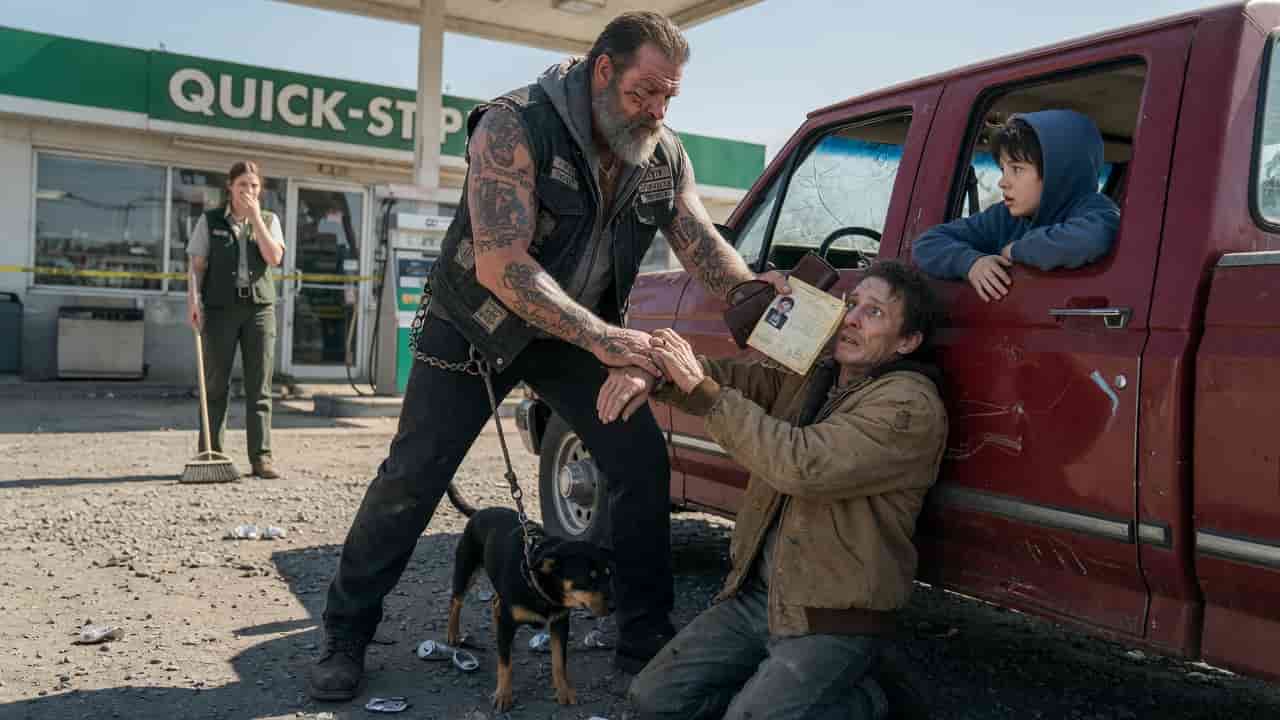
“You hit that dog one more time, and I’m going to show you what a real leash feels like.”
I wasn’t looking for trouble when I pulled the Harley into the Wawa. I was just trying to outrun the ghost of my wife, Sarah, on the tenth anniversary of the night the hospital told me she—and our boy—didn’t make it.
But then I saw him. A wiry man in a tan jacket, screaming at a terrified ten-year-old boy sitting in the cab of a rusted Ford. The man kicked at a small dog cowering on the gravel, and something in me snapped. I didn’t just step in; I dismantled him.
“He’s just a foster kid!” the man shrieked, backed against his truck while the clerk watched in horror. “He’s mine to handle!”
I grabbed his wallet, intending to take a ‘fine’ for the animal he’d just bruised. I wasn’t looking for money. I was looking to humiliate him the way he was humiliating that kid. But tucked behind his ID, hidden in a flap no one was supposed to check, was a piece of paper that stopped my heart.
An unofficial birth record.
A hospital stamp from 2016.
My wife’s thumbprint.
And my name—my real name—listed as the father.
I looked at the boy in the truck. He had Sarah’s eyes. He had my chin. And for ten years, he’d been sold through a system that told me he was in the ground.
The man started to beg. “Give it back, Mike. You don’t know who you’re messing with.”
He was right. I didn’t know yet. But by the time the Iron Reapers roll into the city center tonight, the judge who signed this paper is going to wish I’d stayed in that prison cell forever.
Chapter 1: The Weight of the Ghost
The air in the Iron Reapers’ clubhouse always smelled the same: stale beer, WD-40, and the heavy, metallic scent of primary drive oil. It was a smell that usually settled Mike’s nerves, a reminder that he was the king of a very specific, very hard-earned hill. But today, the smell was making him nauseous.
He sat at the head of the heavy oak table in the “Church” room, the inner sanctum where the patches that mattered made the decisions that kept them out of the ground. On the wall behind him, the Reapers’ crest—a skeletal hand clutching a rusted gear—loomed over the room. To his left sat “Lawyer,” a man who actually had a degree but preferred the company of felons. To his right was “Jury,” six-foot-six of pure muscle and bad intentions, the MC’s primary enforcer.
“The bridge contract is soft, Mike,” Lawyer was saying, tapping a pen against a legal pad. “The guys in Scranton are encroaching. They think because you’ve been quiet since you got out, you’ve lost the appetite for the street. We need a show of force. Something loud.”
Mike didn’t answer. He was staring at his own hands. They were huge, the knuckles scarred from a decade of prison yard logic. There was a faded tattoo on his left ring finger—a simple band of ink that had survived the SHU, the fights, and the long, freezing nights in Camp Hill.
Ten years.
Ten years ago today, he’d been sitting in a processing cell, waiting for a bail hearing that was never going to happen, when a chaplain with bad breath and a limp had walked up to the bars. The man hadn’t even looked him in the eye. He’d just read from a clipboard. Complications during delivery. Your wife, Sarah Miller, passed at 2:14 AM. The infant followed shortly after. Deepest sympathies.
Mike had shattered his hand against the cinderblock wall before the chaplain could finish the sentence. He’d spent the funeral in a suicide watch gown, staring at a white wall while the two people who were supposed to be his entire world were lowered into the dirt of a Potter’s Field. Or so they told him.
“Mike?” Jury’s voice was a low rumble. “You with us, Boss?”
“I’m with you,” Mike said, his voice like gravel being crushed. He stood up, the legs of his heavy chair screaming against the concrete floor. “Lawyer, handle the Scranton thing. Tell them if I see one of their patches south of the Lehigh Valley, I’ll burn their clubhouse with them inside. Jury, keep the boys on a short leash. I’m going for a ride.”
“It’s the day, isn’t it?” Jury asked, his eyes softening just a fraction.
Mike didn’t answer. He grabbed his cut from the back of the chair, the heavy leather settling onto his shoulders like a suit of armor. He walked out of the Church, through the main bar where a few prospects were scrubbing the floors, and out into the biting Pennsylvania air.
His bike, a customized 1998 Heritage Softail, waited for him like a loyal hound. He kicked it over, the roar of the V-twin engine vibrating through his boots, up his spine, and into his skull. It was the only thing that could drown out the sound of that chaplain’s voice.
He rode north, away from the city, away from the business, toward the cemetery that sat on a hill overlooking the river. It was a cheap place, the grass overgrown and the headstones leaning like drunken soldiers. He didn’t go to the main gate. He parked on the shoulder of the road and walked through a gap in the chain-link fence.
The grave was small. A flat marker he’d paid for with his first haul after getting out. Sarah Miller. 1992–2016. Beloved Wife. There was no marker for the boy. They’d told him the baby had been cremated with the mother to “save costs.” At the time, Mike had been too broken to question it. Now, it felt like a hole in his chest that never quite closed.
“Ten years, Sarah,” he whispered. He knelt in the damp grass, his fingers tracing the cold granite. “I’m still here. I don’t know why, but I’m still here.”
He stayed there for an hour, the wind whipping his beard, the silence of the dead pressing in on him. He felt like a ghost himself—a man with a title and a kingdom, but no blood to pass it to. No legacy. Just a patch and a pile of money that didn’t buy anything he actually wanted.
On the ride back, the sky turned a bruised purple, the kind of weather that promised a storm. He was twenty miles from the clubhouse when his fuel light flickered. He pulled into a run-down gas station, the kind with flickering fluorescent lights and a gravel lot that hadn’t seen a steamroller in twenty years.
He didn’t notice the red Ford F-150 at first. He was too busy staring at the pump, watching the numbers climb. But then he heard the sound.
A sharp, wet thwack. Then a yelp.
Mike turned his head.
A man in a tan work jacket was standing by the open passenger door of the truck. He was wiry, his face flushed with a mean kind of heat. He was holding a frayed rope leash, and at his feet, a small black-and-tan mutt was cowering, its ears flat against its head.
“You stupid mutt!” the man screamed. He kicked out with a heavy work boot, catching the dog in the ribs. The animal slid across the gravel, whimpering.
Inside the truck, a boy’s face appeared in the window. He was small, maybe ten years old, with skin the color of milk and eyes that looked like they’d seen the end of the world. He was crying, his hands pressed against the glass.
“Shut up!” the man yelled at the boy, pointing a finger. “You want what the dog got? I’ll give it to you. You’re lucky I even took you in. Most foster kids end up in the trash where they belong.”
The boy flinched, pulling back into the shadows of the cab.
Mike felt a cold, familiar pressure rising in his throat. It wasn’t the “business” rage he used on the Scranton guys. It was something older. Something deeper. It was the rage of a man who had lost his own son, watching a man who didn’t deserve a son treat a child like garbage.
He hung the pump back on the rack. He didn’t check his change. He just started walking.
His boots crunched on the gravel, a steady, rhythmic sound that the man in the tan jacket didn’t notice until Mike was five feet away.
“Hey!” Mike’s voice was low, but it carried the weight of a falling hammer.
The man spun around, his hand still gripped tight on the leash. He looked at Mike’s vest, his eyes widening as he saw the “Iron Reapers” rocker and the “President” patch.
“This ain’t your business, biker,” the man said, though his voice wavered. “Just a dog and a kid who don’t know how to listen.”
Mike didn’t say a word. He just kept coming.
The man tried to step back, but he was already pinned against the rusted metal of his truck. The boy in the cab stared at Mike, his mouth hanging open.
“The dog,” Mike said, pointing a massive, tattooed finger at the shivering animal. “Let go of the rope.”
“Look, I don’t want no trouble—”
“Let. Go.”
The man dropped the rope. The dog immediately scurried under the truck, its tail tucked tight.
“Now,” Mike said, stepping into the man’s personal space until their chests were inches apart. “The kid. Why is he crying?”
“He’s… he’s sensitive,” the man stammered, his bravado evaporating. “He’s a foster. They’re all messed up. I’m just trying to teach him some discipline. The state pays me to take care of him, not to coddle him.”
Mike looked at the boy again. The kid was watching them, his small frame shaking. There was something about the shape of the boy’s eyes, the way his jaw set even while he was terrified. It was a needle of recognition that Mike couldn’t quite place.
“What’s his name?” Mike asked.
“Leo,” the man said. “Look, Mr. Reaper, or whatever you are. I’m Gary. I’m a taxpayer. I’m just doing my job. You got no right to—”
Mike’s hand moved faster than Gary could blink. He seized Gary’s wrist, twisting it just enough to make the man’s knees buckle.
“You think because the state pays you, you own him?” Mike hissed. “You think because he doesn’t have a father to protect him, you can kick his dog and scream in his face?”
“He’s nobody’s kid!” Gary yelped, trying to pull away. “Nobody wants him! That’s why he’s with me!”
The words hit Mike like a physical blow. Nobody’s kid. He reached out with his free hand and shoved Gary hard against the truck. The red metal groaned. From the corner of his eye, Mike saw the gas station clerk standing in the doorway, her hand frozen on a broom handle.
“I’m taking a fine for the dog, Gary,” Mike said.
He reached into Gary’s back pocket and ripped out a battered brown leather wallet.
“Hey! That’s theft!” Gary screamed, though he made no move to reclaim it. “I’ll call the cops! I’ll tell them you assaulted me!”
“Go ahead,” Mike said, flipping the wallet open. He wasn’t looking for the fifty bucks in the front sleeve. He was looking for an ID, something he could use to find this man later if the boy turned up with more bruises.
But as he pulled out Gary’s driver’s license, a folded piece of yellowed paper fell out from behind the plastic window. It was old, the creases worn white, and it looked like it had been handled a thousand times.
Mike picked it up. He expected a receipt or a phone number.
Instead, he saw a header: St. Jude’s Maternal Ward – Unofficial Birth Record.
His heart didn’t just skip a beat; it seemed to stop entirely. He felt the blood drain from his face, leaving him cold in the humid evening air.
He unfolded the paper.
Date: April 9th, 2016.
Mother: Sarah Miller.
Status: Deceased.
Infant: Male. Weight: 7lbs 4oz.
Status: Healthy.
And there, at the bottom, under the line for Paternal Information, was his own name. His real name. The one he’d buried under a decade of iron and ink.
Michael Joseph Vance.
Mike’s hand began to shake. The paper rattled in his grip. He looked at the date again. The night the chaplain told him they were both gone. The night his life ended.
This paper said his son had lived.
He looked up, his eyes burning with a sudden, violent clarity. He looked at Gary, who was now deathly silent, his face turning a sickly shade of grey. Then Mike looked at the boy in the truck.
Leo. Ten years old.
The boy wasn’t a stranger. He was the ghost Mike had been mourning for ten years, sitting in a rusted truck, being kicked by a man who shouldn’t have been allowed to hold a leash, let alone a life.
“Where did you get this?” Mike’s voice was a whisper, but it was more terrifying than the shout had been.
“I… I don’t know what you’re talking about,” Gary stammered, his eyes darting toward the road.
Mike grabbed Gary by the throat, lifting him until the man’s toes barely touched the gravel.
“This paper,” Mike growled, shoving the record into Gary’s face. “This is my wife’s name. This is my name. Why do you have this in your wallet? Why is that boy in your truck?”
“It was just paperwork!” Gary choked out. “The judge… Judge Miller… he said it was a closed case! He said the father was a lifer who’d never get out! I was just supposed to keep him in the system! Keep the checks coming!”
Mike felt the world shift on its axis. The cemetery, the headstone, the ten years of grief—it was all a lie. A manufactured tragedy.
He dropped Gary, who collapsed into a heap on the gravel, gasping for air.
Mike didn’t look at him. He walked to the passenger door of the truck. He reached out, his hand trembling, and opened the door.
The boy, Leo, shrank back into the seat, his eyes wide with terror.
“Don’t hurt me,” the boy whispered.
Mike looked at him—really looked at him. He saw Sarah’s nose. He saw the way the boy’s hair curled at the temples, just like his own used to. He saw ten years of lost birthdays, lost Christmases, and a decade of pain that didn’t have to happen.
“I’m not going to hurt you, Leo,” Mike said, his voice breaking. He reached into the cab and held out his hand. Not a fist. Not a weapon. Just a hand. “I’m your father.”
The silence that followed was broken only by the sound of the wind through the power lines and the distant, low rumble of a storm finally breaking over the hills.
Mike Vance was no longer just the President of the Iron Reapers. He was a man who had just found his soul in a gas station parking lot, and God help anyone who tried to take it from him again.
Chapter 2: The Parking Lot
The gas station clerk, a girl who looked like she’d rather be anywhere else on earth, finally stepped out onto the concrete apron. She was holding her broom like a spear, but her eyes were glued to Mike.
“Do I need to call the police?” she asked, her voice thin.
Mike didn’t look back. He was still staring at the boy. Leo was huddled against the far door of the truck, his small hands gripping the edge of the seat. He looked like a trapped animal, waiting for the killing blow.
“Call them,” Mike said, his voice cold and flat. “Tell them Michael Vance is at the Quick-Stop on Route 32. Tell them to send the Sheriff. Not a deputy. The Sheriff.”
Gary, still on the ground, scrambled backward on his hands and knees. “You can’t just take him! He’s a ward of the state! I have the placement papers!”
Mike turned slowly. The movement was deliberate, the way a predator turns when it’s decided which part of the prey to eat first. He walked over to where Gary was shivering in the gravel.
“You have placement papers,” Mike said, his voice dropping an octave. “But I have his birth certificate. And I have ten years of back-pay for the lie you’ve been living on.”
He reached down, grabbed Gary by the collar of his tan jacket, and hauled him to his feet. He didn’t hit him. He didn’t have to. The sheer mass of Mike’s presence was enough to make Gary’s knees go soft.
“Who gave him to you?” Mike asked. “And don’t lie. I’ve spent ten years in a cage with men who lie for a living. I can smell it on your breath.”
“It… it was a private placement,” Gary stammered, his eyes darting toward the boy in the truck. “Judge Miller. He handles the ‘difficult’ cases. Kids with… with backgrounds. He told me the father was a violent felon who’d died in prison. He said the kid needed a firm hand. I was doing him a favor!”
“A favor?” Mike’s grip tightened. “You were kicking his dog. You were calling him trash.”
“He is trash!” Gary screamed, a sudden, desperate flash of mean-spirited courage sparking in his eyes. “Look at him! He’s just like you! A mistake that should’ve been wiped out ten years ago! The Judge knew it, the hospital knew it, and the world’s better off for it!”
The red mist that descended over Mike’s vision was total. He didn’t think. He didn’t plan. He slammed Gary back against the red Ford with enough force to crack the side mirror. He pinned the man there with one hand, his thumb pressing into the soft tissue under Gary’s jaw.
“Say it again,” Mike whispered. “Tell me one more time how my son is a mistake.”
Gary’s face turned a mottled purple. He clawed at Mike’s forearm, but it was like trying to move a steel bridge beam.
In the truck, the boy let out a small, choked sob.
That sound—more than the anger, more than the revelation—stopped Mike. He looked over his shoulder. Leo was watching him, his face pale, his eyes filled with a terror that Mike realized was directed at him. To the boy, Mike wasn’t a savior yet. He was just a bigger, more violent version of the man who had been hurting him.
Mike exhaled, a long, slow breath that tasted like iron and rain. He loosened his grip. Gary slumped against the truck, gasping for air, clutching his throat.
“Get your things,” Mike said to Gary, his voice dangerously quiet.
“What?”
“Get out of the truck. Take your wallet. Take your miserable life. But leave the kid. And leave the dog.”
“You can’t do that! That truck is mine!”
“It was yours,” Mike said. He reached into his vest pocket and pulled out a roll of hundreds, thick enough to choke a horse. He peeled off five bills and threw them into the gravel at Gary’s feet. “Now it’s a down payment on the ten years you stole. If I see you on this road again, if I even hear your name spoken in this county, I will find you. And I won’t be looking for a birth certificate next time.”
Gary looked at the money, then at Mike’s face. He saw the “Iron Reapers” patch, the “President” rocker, and the absolute, unwavering promise of violence in Mike’s eyes. He scrambled to grab the bills, didn’t even look back at the boy, and started running down the shoulder of the highway, his boots kicking up dust in the fading light.
Mike stood there for a moment, the silence of the parking lot rushing back in. The gas station clerk had disappeared inside, presumably to lock the door. The only sounds were the ticking of the cooling truck engine and the soft whimpering of the dog under the chassis.
Mike walked to the passenger side of the truck. He moved slowly this time, keeping his hands visible. He leaned against the doorframe, trying to make his 250-pound frame look as small as possible.
“He’s gone, Leo,” Mike said gently.
The boy didn’t move. He was staring at the floorboards. “He’s going to come back. He always comes back when he’s mad.”
“Not this time,” Mike said. “I promise you. Not ever again.”
He reached under the truck and whistled softly. The mutt crept out, belly-low to the ground, sniffing at Mike’s boot. Mike reached down and rubbed the dog’s ears. His hands, which had been ready to snap a man’s neck seconds ago, were now steady and soft.
“You okay, buddy?” Mike asked the dog. The animal licked his thumb and then sat, looking up at the truck.
Mike looked back at Leo. “What’s the dog’s name?”
“Bones,” the boy whispered. “Because he was skinny when I found him.”
“Well, Bones looks like he could use a steak. And you look like you could use a burger. You ever been to the clubhouse in Oley?”
Leo shook his head. “I’m not supposed to talk to bikers. Gary says they’re monsters.”
Mike felt a sharp, bitter pang in his chest. He looked down at his vest, at the ink on his arms, at the life he’d built out of necessity and rage. To the world, he was a monster. He was the man you called when you wanted someone broken. He was the man the law couldn’t touch.
But he was also the man who had spent ten years mourning a child he never got to hold.
“Some of us are,” Mike said, his voice thick. “But some of us just had to grow claws to keep the world from eating us alive. I’m not going to hurt you, Leo. I knew your mom. She was… she was the best thing that ever happened to me.”
Leo’s head snapped up. “You knew her? Gary said she was a junkie who didn’t want me.”
Mike’s jaw tightened so hard his teeth ached. The lies this man had told… the poison he’d poured into this boy’s head.
“She wasn’t a junkie,” Mike said, his voice trembling with restrained fury. “She was a teacher. She loved books, and she loved the way the river looked in the morning. And she wanted you more than anything in this world. She died because she was trying to bring you into it.”
Leo stared at him, a single tear tracking through the dirt on his cheek. “Then why weren’t you there? Why did I have to live with Gary?”
Mike looked away, out toward the dark line of the trees. “Because I was a fool. I made a mistake, and I was in a place where I couldn’t get to you. And when I asked where you were, people who were supposed to tell the truth told me a lie instead. They told me you were gone, Leo. They told me both of you were gone.”
He reached into his pocket and pulled out the yellowed birth record. He held it out so the boy could see the names.
“I’ve been looking for you for ten years,” Mike lied, but it felt like the truth. “I just didn’t know you were still here.”
Leo looked at the paper, then at Mike’s face. Slowly, tentatively, he reached out and touched the edge of the document. His small fingers brushed against Mike’s calloused hand.
“Are you really my dad?”
“I am,” Mike said. “And I’m sorry it took me so long to find the right gas station.”
The boy didn’t say anything for a long time. He just watched Mike, his eyes searching for a lie, for a catch, for the inevitable moment when the kindness would turn into a kick. But Mike didn’t move. He just stood there in the gravel, the wind blowing his hair, waiting.
Finally, Leo climbed down from the truck. He was clutching a small, dirty backpack. He whistled, and Bones hopped into the cab of the truck, then down to the ground.
“Can Bones come too?”
“Bones is part of the family now,” Mike said.
He helped the boy into the passenger seat of the truck—it was his truck now, legally or not. Mike walked around to the driver’s side, climbed in, and adjusted the seat. The interior smelled like stale cigarettes and cheap air freshener, but as he looked over at the boy, it felt like the most important place in the world.
He pulled out his cell phone and hit a speed dial.
“Lawyer,” Mike said when the call connected.
“Mike? Where are you? The Scranton guys just—”
“Forget Scranton,” Mike interrupted. “I need you at the clubhouse in twenty minutes. Bring the Judge. Not the one on our payroll, the enforcer. And tell Jury to get the guest room ready. The one with the window.”
“Mike, what’s going on? You sound… different.”
Mike looked at Leo, who was staring out the window at the passing trees.
“I found him, Lawyer,” Mike said, his voice cracking. “I found the boy.”
There was a long silence on the other end of the line. Lawyer knew the history. Everyone in the inner circle knew the ghost that Mike carried.
“You’re sure?”
“I have the record. And I have the kid. He’s got Sarah’s eyes, Lawyer. I’m coming home.”
Mike hung up and put the truck in gear. As they pulled out of the parking lot, leaving the Quick-Stop behind, he saw the gas station clerk watching them from the window. She didn’t look scared anymore. She looked like she’d just seen a dead man come back to life.
As they hit the highway, the first drops of rain began to hit the windshield. Mike turned on the wipers, the steady shuck-shuck rhythmic and grounding.
“Where are we going?” Leo asked.
“To a place where nobody’s ever going to kick your dog again,” Mike said. “To a place where you’re going to learn what it means to be a Vance.”
He reached over and patted the boy’s knee. Leo didn’t flinch. It was a small victory, but to Mike, it felt like winning a war.
The residue of the parking lot was still there—the adrenaline, the lingering scent of Gary’s fear, the weight of the paper in his pocket. But as the lights of the city began to glow on the horizon, Mike felt something he hadn’t felt in a decade.
He felt like he had a reason to wake up tomorrow. And he felt like the people who had stolen ten years of his life were about to find out exactly what kind of monster they had created.
Chapter 3: The Paper Trail
The Iron Reapers’ clubhouse was a fortress. Situated at the end of a long, private road in the woods outside of Oley, it was surrounded by a ten-foot chain-link fence topped with concertina wire. To most people, it was a den of iniquity. To Mike, it was the only place he felt safe.
As the red Ford F-150 pulled through the gate, the rumble of the engine alerted the sentries. Two men in leather vests stepped out of the shadows of the porch, their hands resting near their hips. When they saw Mike behind the wheel of a beat-up truck instead of his Harley, they tensed.
Mike killed the engine and sat for a moment. He looked at Leo. The boy was staring at the clubhouse—the rows of motorcycles, the flickering neon “Open” sign, the rough-looking men.
“It looks like a prison,” Leo whispered.
“It’s a clubhouse,” Mike corrected, though he understood the boy’s perspective. “It’s where my friends live. They’re going to be a little loud, and they look like they’ve been through a dryer with a bag of rocks, but they won’t hurt you. You stay close to me, okay?”
Leo nodded, clutching his backpack. Bones, the dog, was already standing on the bench seat, tail wagging tentatively.
Mike stepped out of the truck and walked around to open Leo’s door. As he helped the boy down, Jury stepped off the porch. The big man stopped dead in his tracks, his eyes darting from Mike to the kid, then back to Mike.
“Holy mother of…” Jury breathed.
“Not a word, Jury,” Mike said, his voice a warning. “Where’s Lawyer?”
“In the Church. He’s been pacing since you called. Mike, is that… is that him?”
“This is Leo,” Mike said. “Leo, this is Jury. He’s the loudest man I know, but he’s harmless unless you’re a Scranton biker.”
Jury looked down at the boy. He was a terrifying sight—three hundred pounds of muscle, a shaved head, and a tattoo of a coiled cobra on his neck. But as he looked at Leo, the big man’s face softened into something approaching awe.
“Hey there, little man,” Jury said, his voice uncharacteristically soft. “Nice dog you got there.”
“His name is Bones,” Leo said, his voice small.
“Bones. I like it. Strong name.” Jury looked at Mike. “The room’s ready. I put fresh sheets on the bed and cleaned out the fridge. Got some of that chocolate milk you like, too.”
“Thanks, Jury.”
Mike led Leo inside. The clubhouse was quieter than usual. Word had clearly spread that something was happening. The men at the bar—hard-eyed bikers who had seen everything—stood in silence as Mike walked by with the boy. There were no jokes, no loud talk. They just watched, their hats off, acknowledging the return of a ghost.
Mike took Leo up the back stairs to a small, clean room. It was sparse—a bed, a dresser, a small desk—but it was a palace compared to whatever hole Gary had kept him in.
“You stay here for a bit, Leo,” Mike said. “Bones can stay with you. I need to talk to my friends down the hall. There’s a TV in the cabinet, and the fridge in the corner is full of whatever you want.”
“Are you coming back?” Leo asked.
The question caught Mike in the throat. He realized then that for this boy, every adult was a temporary fixture, a person who eventually left or turned mean.
“I’m coming back,” Mike said, leaning down so he was eye-level with the boy. “I’m not going anywhere. I’m just twenty feet away. If you need me, you just yell. You hear me?”
Leo nodded. Mike waited until the boy sat on the edge of the bed before closing the door.
He walked down the hall to the Church. Lawyer was already there, the yellowed birth record spread out on the oak table under a desk lamp. He was looking at it through a magnifying glass.
“Sit down, Mike,” Lawyer said without looking up.
Mike sat. He felt the weight of the day crashing down on him. His muscles ached, and his brain felt like it was spinning in a centrifuge.
“Tell me it’s real,” Mike said.
Lawyer straightened up. He looked tired. “The stamp is from St. Jude’s. The signature on the bottom is a nurse named Evelyn Graves. She’s been retired for five years, but I remember her name from some of the hospital’s legal filings back in the day.”
“And the record?”
“It’s an unofficial copy,” Lawyer said, tapping the paper. “It’s the kind of thing a clerk keeps under the desk when they know something’s being erased from the official books. It’s insurance, Mike. Someone wanted to make sure there was a paper trail if things ever went south.”
“Gary said a judge gave it to him,” Mike said. “Judge Miller.”
Lawyer’s face went grim. “Miller. He’s the presiding judge for the family court in this district. He’s been there for twenty years. He’s got a reputation for ‘streamlining’ adoptions for foster kids. High success rate, very little red tape.”
“He sold my son,” Mike said. The words were flat, devoid of emotion, which made them ten times more dangerous.
“It looks like more than that,” Lawyer said. “I did some quick digging after you called. In 2016, the county received a federal grant for foster care placement. They got a bonus for every kid they moved out of the system and into permanent homes. If a kid was ‘orphaned’ and had no living relatives, the process was even faster.”
“But I was alive,” Mike growled. “They knew where I was. I was in a state cell four hours away.”
“On paper, you were a ghost,” Lawyer said. “I checked your prison records from that year. There’s a discrepancy. For three months—the three months surrounding Leo’s birth and Sarah’s death—your status was listed as ‘Under Investigation – Communication Restricted.’ That’s why the chaplain was the only one who spoke to you. That’s why your mail was being returned. Someone flagged your file to keep you in the dark.”
Mike slammed his fist into the table. The wood groaned. “Who? Who has that kind of power?”
“A judge does,” Lawyer said. “A judge can issue a stay of communication. They can seal a file. If Miller wanted that kid in the system, and he wanted you out of the picture, he had all the tools he needed.”
Mike stood up and began to pace the small room. He felt like he was back in the SHU, the walls closing in, the air getting thin. “Sarah died. They told me she died of complications. Was that a lie too?”
Lawyer looked down at the table. “I don’t know yet, Mike. I’ve requested the medical examiner’s report from that night. It’s sealed, but I have a contact at the morgue who owes me. We’ll know by morning.”
The door to the Church opened, and Jury stepped in. He looked at Mike, then at the paper on the table.
“The boys are ready,” Jury said. “Just give the word. We’ll go to Miller’s house right now. We’ll pull the truth out of him.”
“No,” Mike said. “Not yet.”
“Mike, he sold your kid!” Jury shouted. “He told you your wife was dead and your son was a pile of ash! How are we not at his door with a gas can?”
“Because he’s a judge,” Mike said, turning to face his enforcer. “You go to his house and hurt him, the state police will be here in an hour. They’ll take the boy back. They’ll put me in a hole I’ll never crawl out of. And Leo will end up with another Gary.”
He walked over to Jury and put a hand on his shoulder. “I’m not going to just kill him, Jury. I’m going to ruin him. I’m going to take everything he’s ever built and burn it to the ground in front of the whole town. I want him to feel what it’s like to lose a life while you’re still breathing.”
Jury nodded, his jaw tight. “What do we do first?”
“We find the nurse,” Mike said. “Evelyn Graves. If she signed this, she knows what happened in that room. Lawyer, find her. Jury, get the bikes ready. We’re not going as the Reapers. Not yet. We’re going as shadows.”
Lawyer nodded and went back to his phone. Jury left to talk to the men. Mike was left alone in the Church. He looked at the birth record one more time.
Michael Joseph Vance.
He remembered the day he’d told Sarah he was going to prison. He’d been a different man then—a low-level enforcer, a man who thought he was invincible. Sarah had cried, not because he was going away, but because she was pregnant and she was scared of the world he was leaving her in.
“I’ll be back, Sarah,” he’d told her. “It’s only three years. By the time he’s walking, I’ll be home. I’ll be a father.”
He had failed her. He had let the world take her, and he had let a corrupt system steal his son. He couldn’t fix the past, but as he looked at the door leading to the room where Leo was sleeping, he knew he was going to build a future out of the wreckage.
He walked back to Leo’s room and opened the door a crack.
The boy was asleep, curled up on the small bed with Bones tucked against his chest. The TV was still on, the flickering blue light casting long shadows across the room.
Mike stepped inside and turned off the TV. He stood there for a long time, watching the rise and fall of the boy’s chest. He noticed a small bruise on Leo’s arm, a purple mark where Gary must have grabbed him.
The residue of the day was heavy. The shock was starting to wear off, replaced by a cold, surgical precision. Mike reached out and gently pulled the blanket up over the boy’s shoulders.
“I’m here, Leo,” he whispered.
As he stepped back into the hallway, he saw Elena, the MC’s social worker—a woman they kept on retainer to handle the fallout of their more complicated lives. She was standing by the stairs, looking at him with a mix of pity and fear.
“Mike,” she said. “Lawyer told me.”
“He’s staying here, Elena,” Mike said, his voice hard. “Don’t tell me about the law. Don’t tell me about CPS.”
“I’m not,” Elena said, stepping closer. “I’ve been looking into Miller for a long time, Mike. There have been whispers for years. Disappeared files, parents who were told their kids were dead when they were just… misplaced. But nobody ever had proof. Nobody ever had a father like you.”
“You help me,” Mike said. “You find the cracks in his system. You find every kid he’s ever ‘processed.’ We’re going to open the books, Elena.”
“It’s dangerous, Mike. He’s got the police, the county council, the whole machine behind him.”
Mike looked at the door to Leo’s room. “I’ve got five hundred bikers who haven’t had a real fight in three years. I think I like my odds.”
He walked past her, his boots heavy on the floorboards. The hunt was beginning. The paper trail was thin, but it was enough. By the time the sun came up, the Iron Reapers wouldn’t just be a motorcycle club. They would be a reckoning.
And at the center of it was a man who had finally found the one thing worth more than his life.
Chapter 4: The Judge’s Shadow
The morning arrived with a grey, oppressive dampness that clung to the Pennsylvania hills. Mike hadn’t slept. He’d spent the night in the Church, drinking cold coffee and staring at the maps Lawyer had spread across the table.
Leo was still asleep when Mike checked on him at dawn. The boy was tangled in the sheets, his breathing shallow but steady. Bones looked up at Mike, let out a soft ‘woof,’ and went back to sleep. For the first time in ten years, Mike felt like the clubhouse wasn’t just a place to hide; it was a home.
At 7:00 AM, the phone in the Church rang. Lawyer picked it up, listened for a minute, and then looked at Mike.
“We found the nurse,” Lawyer said. “Evelyn Graves. She’s living in a retirement community in West Chester. It’s a gated place, high-security.”
“Jury,” Mike called out.
Jury appeared in the doorway, already wearing his vest. “Ready.”
“Take a clean car. No patches, no bikes. I want to talk to her before Miller finds out we’re looking.”
“I’m coming too,” Mike said.
“Mike, you stay here,” Lawyer argued. “If you’re spotted near her, the alarm goes off. Let Jury and me handle the first contact.”
“No,” Mike said, his voice final. “I’m the one she’s going to remember. I’m the one who was supposed to be dead.”
They took a nondescript black SUV, leaving the motorcycles behind. Mike sat in the back, staring out the window as they drove through the rolling hills of Chester County. It was a wealthy area, a world away from the rust and grease of the Reapers’ territory. This was where the people who ran the system lived.
The retirement community was called “The Gables.” It looked like a Five-Star hotel, with manicured lawns and fountains. Lawyer used his credentials to get them past the gate, claiming they were there for a legal deposition.
They found Evelyn Graves in a sunroom at the back of the facility. She was an elderly woman, her skin like parchment, her eyes clouded with cataracts. She was sitting in a wheelchair, a quilt over her lap, staring out at the garden.
Mike stepped forward. He felt out of place in his leather vest and heavy boots, a wolf in a room full of porcelain.
“Mrs. Graves?” Mike said softly.
The woman turned her head slowly. She looked at Mike, then at Lawyer and Jury. A flicker of something—fear, or maybe just memory—crossed her face.
“I’m not supposed to have visitors,” she said, her voice a thin reed.
“My name is Michael Vance,” Mike said. He knelt beside her chair so he wasn’t looming. “Ten years ago, you signed a birth record for a boy born to Sarah Miller. You kept a copy of it.”
The woman’s breath hitched. She looked at Mike’s face, searching his features. “The biker,” she whispered. “The one they said was going to die in the SHU.”
“I didn’t die,” Mike said. “And neither did my son.”
Evelyn closed her eyes. A tear escaped and ran down the deep wrinkles of her cheek. “I told them it was wrong. I told the Judge he couldn’t just take him. But he said it was for the best. He said the mother was gone and the father was a monster.”
“What happened that night, Evelyn?” Mike asked, his heart hammering against his ribs. “Tell me the truth.”
“She was so tired,” Evelyn said, her voice drifting back in time. “Sarah. She fought so hard. The baby was healthy, Mike. He was beautiful. He had your hair. But there were complications… she started to bleed, and the doctor… the doctor wasn’t there.”
“What do you mean he wasn’t there?” Jury growled from the doorway.
“Judge Miller,” Evelyn said. “He was in the room. Not the doctor. He was talking to the hospital administrator. I heard them. They said it was a ‘clean slate.’ They said if the mother didn’t make it, the child could be placed immediately. They didn’t even try to stop the bleeding, Mike. They just… they watched her go.”
Mike felt a cold, sharp pain in his chest. He looked at his hands, the knuckles white. They hadn’t just stolen his son. They had let his wife die so they could have the child.
“Why?” Mike asked, his voice breaking. “Why my kid?”
“Because he was perfect,” Evelyn said. “And because you were nobody. You were a felon with no family. You were the perfect person to steal from, because nobody would ever believe you.”
She reached under her quilt and pulled out a small, tarnished key. “I kept the records, Mike. Not just yours. All of them. There’s a locker at the Greyhound station in Allentown. Number 412. The key is for the box inside. It has the names of every kid Miller sold. Every parent he lied to.”
Mike took the key. It felt heavy in his palm, like a weapon. “Why are you giving this to me now?”
“Because I’m dying,” Evelyn said, looking him in the eye. “And I don’t want to meet Sarah on the other side with this on my soul. Run, Mike. Run as fast as you can. Because once Miller knows you have that key, he won’t just send the police. He’ll send the devils.”
They left the facility in silence. The ride back to Allentown was a blur of speed and adrenaline. Mike clutched the key in his hand, his mind racing.
They reached the Greyhound station an hour later. Jury stayed in the car, his hand on his piece, while Mike and Lawyer went inside. The station was a dismal place, smelling of floor wax and desperation. They found locker 412 in a dark corner near the restrooms.
Mike inserted the key. It turned with a satisfying click.
Inside was a metal lockbox. They took it back to the SUV and broke the seal.
Lawyer opened the lid and gasped. It was filled with files, hundreds of them. Each one contained a birth certificate, a death certificate, and a placement order signed by Judge Miller.
“It’s a factory,” Lawyer whispered, flipping through the pages. “He wasn’t just ‘streamlining’ adoptions. He was running a market. These kids weren’t being foster-placed. They were being sold to the highest bidder. Corporate executives, politicians, wealthy families who didn’t want to wait for the state system.”
“And Leo?” Mike asked.
Lawyer found the file for Leo. “He was supposed to go to a family in Connecticut. A wealthy couple. But something happened. The placement fell through at the last minute because the kid ‘showed signs of trauma.’ So Miller dumped him with Gary. He was keeping him on ice until he could find another buyer.”
Mike felt a wave of nausea. His son had been a commodity. A piece of inventory.
“We have enough,” Lawyer said, looking at the box. “We take this to the Attorney General. We take it to the FBI.”
“No,” Mike said. “The system is what let him do this. The system is what told me my wife was dead. I’m not giving this to a suit in a building.”
“Mike, what are you going to do?”
Mike looked out the window. They were passing a billboard for a local political rally. Judge Miller – Fairness for Our Families.
“I’m going to have a rally of my own,” Mike said. “Lawyer, I want you to make copies of every one of these files. Every single one. I want them delivered to every news station in the state by midnight. But don’t send the originals.”
“And the originals?”
“Those are for the protest,” Mike said.
They arrived back at the clubhouse to find the yard filled with motorcycles. Word had gone out. The Iron Reapers weren’t just the Pennsylvania chapter anymore; bikers from Jersey, Maryland, and Ohio had started to arrive. The sound of five hundred engines was a low, constant vibration that shook the earth.
Mike walked through the crowd, the men parting for him like a sea. He didn’t say a word until he reached the porch. He looked out at the sea of leather and chrome, at the men who had been his only family for a decade.
“Ten years ago,” Mike shouted, his voice carrying over the roar of the engines. “A man in a black robe told me my life was over. He told me my wife was dead and my son was gone. He lied!”
A roar went up from the crowd.
“He didn’t just lie to me!” Mike continued, holding up the lockbox. “He lied to hundreds of families! He stole children from mothers and sold them like cattle! He thinks he’s the law! He thinks he’s untouchable!”
Mike stepped to the edge of the porch, his eyes burning. “Tomorrow morning, Judge Miller is holding a press conference at the County Courthouse. He thinks he’s going to announce his run for the State Supreme Court. He thinks it’s his big day.”
Mike paused, the silence in the yard absolute.
“We’re going to be there,” Mike said. “Five hundred bikes. Five hundred Reapers. We’re going to show him what happens when you steal from a man who has nothing left to lose. We’re not going there to fight. We’re going there to witness. We’re going to hand every one of these files to the families he ruined. And then, we’re going to watch him fall.”
The cheer that followed was deafening. It was the sound of a storm finally breaking.
Mike walked back into the clubhouse, his heart heavy but his mind clear. He went to Leo’s room.
The boy was sitting at the desk, drawing a picture of Bones. He looked up as Mike entered, his eyes searching.
“Are we going somewhere?” Leo asked.
“We’re going to finish it, Leo,” Mike said, sitting on the edge of the bed. “Tomorrow, everybody’s going to know who you are. And nobody’s ever going to lie about your mother again.”
“Will I have to go back to Gary?”
Mike reached out and took the boy’s hand. “Not as long as I’m breathing, son. Not as long as I’m breathing.”
As Mike left the room, he saw the residue of his decision. The clubhouse was no longer a place of business. It was a war room. The men were cleaning their bikes, checking their gear, their faces grim. They knew what was coming. A confrontation with the state, with the law, with the very fabric of the world they lived in.
But as Mike looked at the key in his hand, he didn’t feel afraid. He felt a strange, terrifying peace. He had been a ghost for ten years. Tomorrow, he was going to be a man again.
And Judge Miller was about to find out that some ghosts don’t stay buried. They come back with five hundred friends and a thirst for the truth.
Chapter 5: The Gathering Storm
The night before the courthouse was a low-frequency hum that vibrated through the floorboards of the Iron Reapers’ clubhouse. Outside, the gravel lot was gone, replaced by a sea of leather, chrome, and denim. Five hundred men don’t gather in silence, even when they’re trying to. There was the clinking of wrenches, the low murmur of voices planning routes, and the occasional sharp crack of a kickstand hitting the earth.
Mike stood on the second-floor balcony, watching the flicker of small campfires. He felt like an ancient general on the eve of a siege, but his armor was just a worn leather vest and his army was a collection of outcasts who had finally found a cause that didn’t involve a territory dispute or a shipment of black-market parts.
“They’re ready, Mike,” a voice said behind him.
Mike didn’t turn. He knew the cadence of Elena’s footsteps. The social worker had stayed at the clubhouse, working through the night with Lawyer to categorize the names in the ledger. Her eyes were rimmed with red, and her blouse was wrinkled, but she had a look of fierce, academic rage that Mike respected.
“How many?” Mike asked.
“Two hundred and fourteen,” Elena said, leaning against the railing. “Two hundred and fourteen children documented in Graves’s ledger over the last eight years alone. We’ve already made contact with twelve families in the immediate area. Three mothers were told their babies died of SIDS. Two fathers were told their parental rights were terminated while they were serving ninety days for petty theft. It’s a massacre of the poor, Mike. A systematic harvest.”
Mike gripped the railing, his knuckles white. “And the police?”
“The local PD is staying clear,” Elena said. “They know the Reapers. They know if they push tonight, Oley burns. But the State Police… they’re setting up a perimeter three miles out. They think you’re planning a riot.”
“Let them think it,” Mike said. “As long as they don’t move until after the cameras start rolling tomorrow morning, I don’t care what they think.”
He left her on the balcony and walked back inside, heading toward the guest room. He needed to see the boy. He needed to remind himself why he was risking the fragile peace he’d built since his release.
He found Leo sitting on the floor with Bones. The boy had found an old set of Mike’s tools and was meticulously cleaning a pair of heavy pliers with a rag. He looked up as Mike entered, his expression guarded but no longer terrified.
“Bones had a tick,” Leo said, pointing to a small glass jar on the nightstand. “I got it off him. I didn’t even make him bleed.”
“Good work, Leo,” Mike said, sitting on the edge of the bed. “You got a steady hand. That’s important.”
Leo stopped rubbing the pliers and looked at Mike. “Jury said there’s going to be a lot of bikes tomorrow. He said you’re going to be the boss of all of them.”
“I’m the President,” Mike said. “It means I have to make sure everyone stays in line. It’s a big job.”
“Are you going to hurt the Judge?”
Mike looked at the boy’s hands. They were small, the fingernails still stained with the dirt from Gary’s yard. “I’m going to tell the truth about him, Leo. In the world I live in, the truth hurts more than a punch. He tried to tell the world you didn’t exist. Tomorrow, I’m going to make sure nobody ever forgets your name.”
“Will I have to talk?”
“Only if you want to,” Mike said. “You’ll be with Elena and Lawyer. You’ll be safe. But I want you there. I want you to see that the world isn’t just men like Gary. I want you to see that you have people who will ride through fire for you.”
Leo was quiet for a long time. He looked down at the dog, who had rested his head on the boy’s knee. “Gary said I was a burden. He said I owed him for the food I ate.”
Mike felt a sharp, stabbing heat in his gut. He reached out and placed a hand on Leo’s shoulder. “Gary was a liar, Leo. He’s the one who owes. He owes you ten years of birthdays. He owes you every night you went to bed scared. And the Judge… he’s the one who wrote the bill. Tomorrow, we’re going to collect.”
The door to the room creaked open, and Lawyer stepped in. His face was grim. “Mike. We have a problem. There’s a car at the gate. It’s not the cops.”
Mike stood up, his posture shifting instantly into combat mode. “Who is it?”
“It’s Miller’s clerk. A guy named Henderson. He says he has a ‘personal message’ for the President of the Iron Reapers.”
“Jury’s with him?”
“Jury’s got him pinned against the fence,” Lawyer said with a thin smile. “But the guy isn’t folding. He says if you don’t talk to him, you won’t make it to the courthouse tomorrow.”
Mike looked at Leo. “Stay here with Bones. Don’t open the door for anyone but me or Jury.”
Mike walked down the stairs and out into the yard. The bikers parted like a black sea, their eyes following him. At the gate, a man in a sharp grey suit was indeed pinned against the chain-link by Jury’s massive forearm. The man was sweating, his glasses sliding down his nose, but he held a leather briefcase like a shield.
“Let him up, Jury,” Mike said.
Jury stepped back, though he kept his hand on his belt. The clerk straightened his jacket, gasping for air. He looked around at the five hundred bikers, his face a mask of high-class disdain masking a core of pure terror.
“Mr. Vance,” Henderson said, his voice trembling. “I am here as a representative of Judge Miller’s office. He is aware of the… situation at the gas station. He is also aware that you have come into possession of certain sensitive documents.”
“Sensitive is one word for it,” Mike said, stepping into the man’s space. “I prefer ‘criminal.’”
“Let’s not be dramatic,” Henderson said, trying to regain his composure. “The Judge is a reasonable man. He understands that there was a… clerical error ten years ago. A tragedy of the system. He is prepared to offer a settlement.”
“A settlement?” Lawyer asked, stepping up beside Mike.
“A trust fund for the boy,” Henderson said, opening his briefcase. “Five hundred thousand dollars. Immediate placement with a high-end private academy. All records of the previous foster placement will be expunged. In exchange, the documents in your possession are to be returned tonight, and the… gathering scheduled for tomorrow is to be cancelled.”
The yard went deathly silent. Mike could hear the crackle of a fire nearby. He looked at the briefcase, filled with the kind of money that could buy a lot of silence in a town like Oley.
“Half a million,” Mike mused. “That’s a lot of money for a ‘clerical error.’”
“It’s a generous offer,” Henderson said, gaining confidence. “It ensures the boy’s future. If you go through with this… protest… you will be arrested. The boy will be taken back into state custody. You’ll spend another ten years in a cell, and this time, there won’t be a ledger to save you. Is that what you want for him?”
Mike looked at the man. He saw the arrogance of a system that thought everything had a price. He saw the contempt for people like him—men with tattoos and loud bikes who were supposed to be too stupid or too greedy to say no.
“You tell the Judge something for me,” Mike said.
He reached out and snatched the briefcase from Henderson’s hand. He turned it over, dumping the stacks of cash onto the dirt and gravel of the parking lot. The bikers watched as the hundreds fluttered in the wind like dead leaves.
“The boy isn’t for sale,” Mike said, his voice a low, terrifying growl. “He was sold once. It’s not happening again. You tell Miller that I’m not coming for his money. I’m coming for his chair. I’m coming for his name. And tell him to wear his best robe tomorrow. I want him to look real good when the handcuffs go on.”
Henderson stared at the money in the dirt. He looked at Mike’s eyes and finally saw the truth: there was no deal to be made. He turned and scrambled back to his car, tires screeching as he sped away.
“Jury,” Mike said.
“Yeah, Boss?”
“Pick up the money. Give it to Elena. Tell her it’s the start of the legal fund for the other two hundred families. I want every one of them to have the best lawyer money can buy.”
Jury grinned, a savage, joyful expression. “You got it, Mike.”
Mike turned back toward the clubhouse. The residue of the encounter was a cold, hard knot in his chest. They were going to play dirty. They were going to try to use Leo as leverage. He had to move faster, hit harder, and make sure the truth was out before they could bury it.
He spent the rest of the night in the Church with Lawyer and Elena. They mapped out the courthouse—the entrances, the press area, the Judge’s private chambers. They coordinated with the families, arranging for them to arrive in a separate convoy.
Around 3:00 AM, Mike found himself back in the bar area. The fire in the hearth was dying down. He sat on a stool, his head in his hands. He felt the weight of the five hundred men outside, the weight of the two hundred families, and most of all, the weight of the boy upstairs.
“You’re doing the right thing, Mike,” a voice said.
It was Lawyer. He was holding two glasses of whiskey. He set one down in front of Mike.
“Is there a right thing in a world this broken, Lawyer?” Mike asked, taking a sip. The liquid burned, grounding him.
“There’s the truth,” Lawyer said. “And there’s the people we love. Everything else is just noise. You’re not just fighting for Leo. You’re fighting for Sarah. You’re finally giving her the ending she deserved.”
Mike looked at the faded tattoo on his finger. “I just want it to be over. I want to take him to a park. I want to teach him how to ride a bike without five hundred guards watching us.”
“Tomorrow,” Lawyer promised. “Tomorrow we break the world. And the day after, you can be a father.”
Mike nodded. He finished his drink and stood up. He walked to the window and looked out at the horizon. The first hint of blue was touching the sky. The storm was here.
He went back up to Leo’s room one last time. The boy was awake, sitting by the window, watching the bikers prepare. He looked up as Mike entered.
“It’s time?” Leo asked.
“It’s time,” Mike said.
He helped the boy put on his jacket. He checked Bones’s collar. Then, he led them down the stairs and out into the yard.
As Mike stepped onto the porch, the five hundred engines roared to life simultaneously. The sound was a physical force, a wall of thunder that shook the trees and silenced the birds. Mike swung his leg over his Heritage Softail, the familiar vibration of the frame meeting his grip.
Leo climbed into the sidecar Mike had spent the last four hours attaching—a heavy, steel-framed beast Jury had pulled from the back of the garage.
Mike looked at his men. He raised a fist.
“To the courthouse!” he roared.
The convoy pulled out of the gate, a mile-long snake of black leather and chrome, heading into the heart of the system that had tried to erase them. The sun was rising, hitting the chrome and turning the highway into a river of fire. Mike felt the wind in his face, and for the first time in ten years, he didn’t feel like a ghost. He felt like a storm. And the storm was heading straight for Judge Miller.
Chapter 6: The Reckoning
The Allentown County Courthouse was a massive, neo-classical monument to authority, its white marble pillars standing like sentinels against the morning sky. By 9:00 AM, a small army of reporters, cameramen, and local dignitaries had gathered on the front steps. A podium had been set up, draped in the state flag. This was supposed to be Judge Miller’s coronation—the announcement of his bid for the State Supreme Court.
Miller stood in the foyer behind the glass doors, adjusting his silk tie. He was a man who projected stability, a silver-haired pillar of the community. But today, his hands were trembling slightly. He had heard the reports. A convoy of motorcycles was moving south on Route 32, a force larger than anything the county had seen in decades.
“Where are the State Police?” Miller hissed at Henderson, his clerk.
“They’re at the perimeter, sir,” Henderson whispered, his face pale. “They say they can’t intervene unless there’s a direct threat of violence. It’s a ‘First Amendment gathering,’ apparently.”
“Gathering?” Miller spat. “It’s an invasion!”
The sound reached them then. It started as a low, rhythmic throb in the distance, a sound that felt like it was coming from the earth itself. The reporters turned their heads. The cameras swung around.
The first line of bikes rounded the corner of 5th Street.
It was a wall of black. Five hundred motorcycles, riding four abreast, their engines synchronized in a deafening, guttural roar. At the head of the formation was Mike, his leather vest fluttering in the wind, his face a mask of iron. Beside him, in the sidecar, Leo sat with his jaw set, clutching Bones the dog.
The convoy didn’t stop. They didn’t slow down. They rode right up onto the sidewalk and the plaza, circling the courthouse steps in a massive, swirling formation of chrome and smoke. The reporters scrambled back, their faces filled with a mix of shock and professional hunger. This wasn’t a protest. This was an occupation.
Mike killed his engine. Behind him, four hundred and ninety-nine engines went silent at the exact same moment. The sudden quiet was more terrifying than the noise had been.
Mike dismounted. He reached into the sidecar and helped Leo out. He didn’t look at the cameras. He didn’t look at the police. He looked straight at the glass doors of the courthouse.
“Judge Miller!” Mike’s voice echoed off the marble pillars, amplified by the natural acoustics of the plaza. “Come out! The people you sold are here to see you!”
The doors remained closed. Mike signaled to Jury and a dozen other Reapers. They stepped forward, each carrying a stack of papers. They began to move through the crowd of reporters and onlookers, handing out copies of the ledger—the birth records, the placement orders, the names of the children.
“Check the names!” Jury shouted. “Check the dates! See what happens to the kids in this county when nobody’s watching!”
A reporter from the Morning Call looked down at the sheet in her hand. Her eyes went wide. “This is a birth record… it says the child was deceased. But there’s a placement order signed by Miller two weeks later.”
The murmur in the crowd turned into a roar of realization. The cameras were no longer focused on the podium; they were focused on the papers.
Inside, Miller saw the crowd turning. He saw the flashes of the cameras as they photographed the evidence. He knew the game was up, but a man like Miller doesn’t go down without trying to burn the room.
He pushed open the doors and stepped out onto the steps. He looked down at Mike, his face contorted with a desperate, high-court rage.
“This is an illegal assembly!” Miller shouted, his voice cracking. “Security! Arrest this man! He is a convicted felon in possession of stolen government property!”
Two bailiffs moved forward, but they stopped when they saw the wall of bikers standing behind Mike. Jury stepped up, his arms crossed over his massive chest, a silent wall of muscle.
“The only thing stolen here, Miller,” Mike said, walking slowly up the steps, “was ten years of my son’s life.”
He reached the top of the stairs and stood eye-to-eye with the man who had ruined him. Mike reached into his vest and pulled out the original yellowed birth record—the one with Sarah’s thumbprint.
“You told me she was dead,” Mike said, his voice dropping to a whisper that only Miller could hear. “You told me the boy died with her. You let her bleed out in that room because you had a buyer lined up for the infant. You aren’t a judge. You’re a gravedigger.”
“You have no proof,” Miller hissed, though his eyes were darting toward the cameras. “Those papers are forgeries. You’re a biker, Vance. Nobody believes a man with a patch over a man with a robe.”
“That’s where you’re wrong,” Mike said.
He stepped aside and pointed down the steps.
A line of cars had pulled up behind the bikes. From the cars emerged the families—the mothers who had been told their babies were gone, the fathers who had been erased. They walked up the steps, a silent, grieving procession. In the center was Evelyn Graves, pushed in her wheelchair by Elena.
The nurse looked up at Miller. She didn’t say a word, but the look of pure, unadulterated judgment in her eyes was enough to make Miller stumble back.
“I’m not the one you have to answer to, Miller,” Mike said, loud enough for the microphones to catch it. “You have to answer to them. And you have to answer to him.”
Mike looked down at Leo. The boy was standing at the bottom of the steps, holding the dog. He looked small against the backdrop of the massive courthouse, but he looked back at the Judge with a steady, quiet dignity that Miller couldn’t replicate.
“That’s my son,” Mike said, his voice thick with pride. “His name is Leo Vance. And he’s the reason your world ends today.”
The Sheriff of Allentown, a man who had known Mike for twenty years and Miller for thirty, stepped out from the crowd. He wasn’t wearing his hat. He walked up the steps, his face grim. He didn’t look at Mike. He looked at Miller.
“Judge,” the Sheriff said. “I’ve just had a call from the District Attorney. They’ve seen the copies. They’re issuing a search warrant for your private chambers and your home. Until then… I’m going to need you to step away from the podium.”
“You can’t do this!” Miller shrieked, his composure finally shattering. “I am the law in this county!”
“The law doesn’t sell kids, Miller,” the Sheriff said. He reached for his handcuffs.
As the metal clicked over Miller’s wrists, a cheer went up from the plaza that was louder than the bikes had been. It was a sound of release, of a decade of hidden pain finally being acknowledged.
Mike didn’t stay to watch them lead Miller away. He didn’t stay for the interviews or the flashbulbs. He walked down the steps, through the crowd of families who were weeping and hugging each other, and went straight to Leo.
He knelt in front of the boy. The residue of the battle was there—the adrenaline, the lingering anger—but as he looked at Leo, it all faded away.
“Is it over?” Leo asked.
“It’s over,” Mike said. “He’s never going to hurt anyone again.”
“Can we go now?”
“Yeah,” Mike said. “We can go.”
He helped Leo back into the sidecar. He signaled to Jury, who nodded and began to coordinate the departure. The Reapers didn’t leave in a roar this time. They pulled out slowly, a somber, respectful exit.
Mike didn’t head back to the clubhouse. He rode north, back toward the small cemetery on the hill.
The sun was high in the sky now, the clouds breaking to reveal a brilliant, piercing blue. He parked the bike at the gap in the fence and walked through the grass, Leo following close behind with Bones.
They stopped at Sarah’s grave.
Mike knelt and placed the yellowed birth record on the granite marker. He weighed it down with a small, smooth stone he’d picked up from the courthouse plaza.
“We’re here, Sarah,” Mike whispered. “I found him. I brought him home.”
Leo stood beside him, looking at the name on the stone. He didn’t cry. He just reached out and touched the letters of his mother’s name.
“She was pretty,” Leo said.
“She was the best,” Mike said.
They stayed there for a long time, the three of them—the man who had been a ghost, the boy who had been a secret, and the dog who had been a victim. The wind blew through the trees, a soft, clean sound that seemed to wash away the scent of grease and stale air.
Mike looked at the horizon. The future was still uncertain. There would be legal battles, there would be the challenge of learning how to be a father to a ten-year-old, and there would be the ghosts that never truly left. But for the first time in his life, Mike didn’t feel like he was fighting a war. He felt like he was starting a life.
He stood up and took Leo’s hand.
“Come on, son,” Mike said. “Let’s go home.”
As they walked back toward the bike, Bones trotting happily between them, Mike felt the weight of the last ten years lift from his shoulders. He wasn’t just the President of the Iron Reapers. He wasn’t just a felon. He was a father. And as the engine of the Heritage Softail roared to life, it didn’t sound like a warning anymore.
It sounded like a song.
The road ahead was long, but as Mike pulled onto the highway with his son beside him, he knew they were going exactly where they were supposed to be.
The truth had been told. The debt had been paid. And the boy who was never supposed to exist was finally, finally free.



