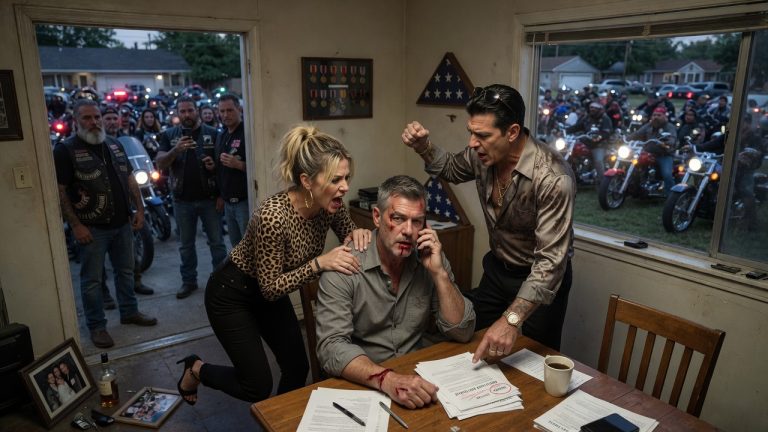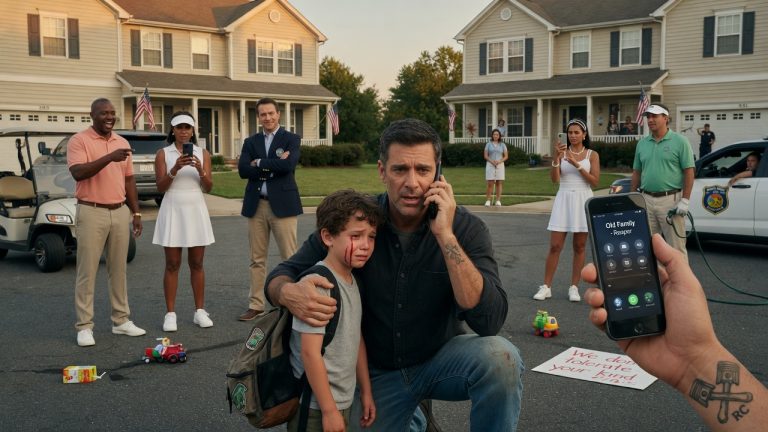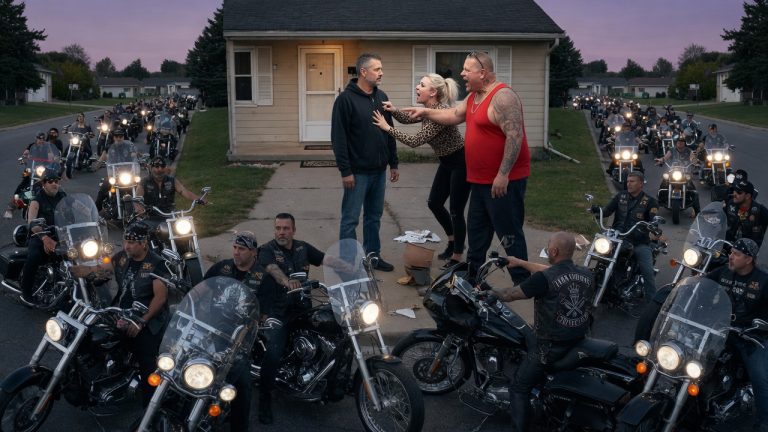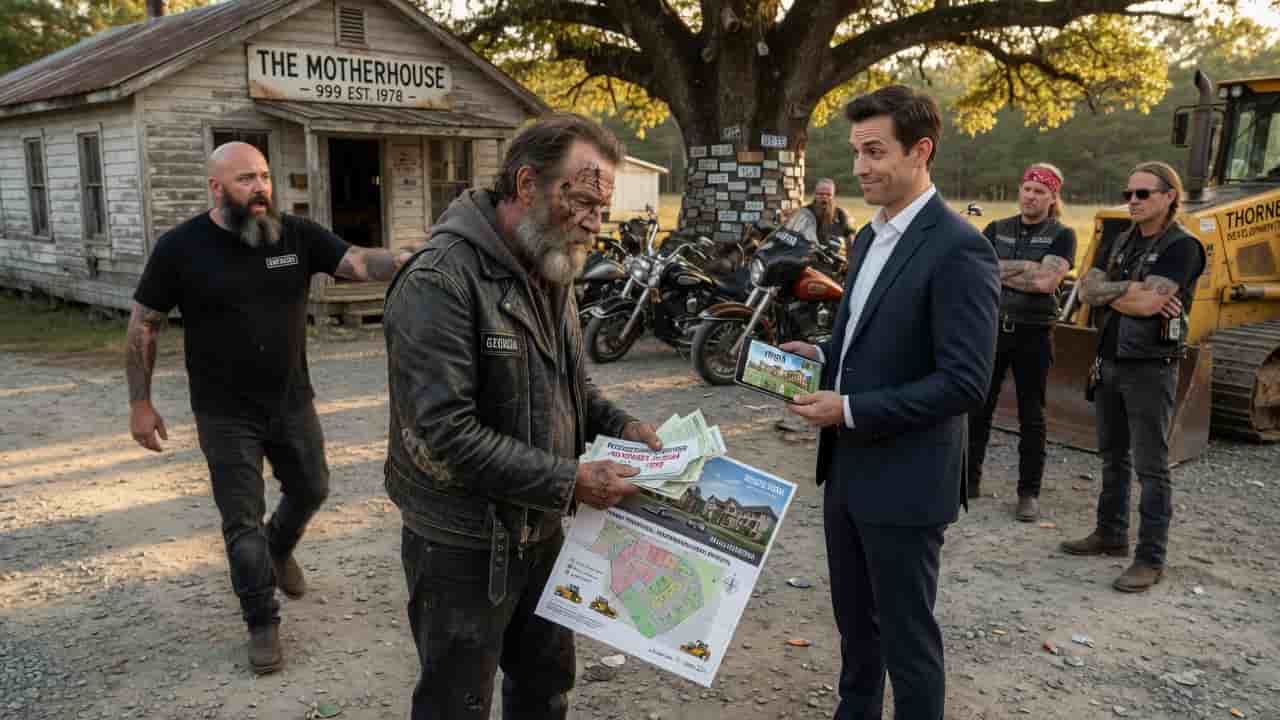
“Look at them, Dutch. Tell your ‘brothers’ what your legacy is actually worth.”
I stood there, the gravel of the Motherhouse grinding under my boots, feeling every bit of my sixty-five years. Julian Thorne didn’t belong here. His three-thousand-dollar suit was a neon sign of disrespect against the grease-stained walls of our garage. But he held the one thing that could keep my grandson, Leo, in that hospital bed.
The stack of papers in my hand felt heavier than my bike. It wasn’t just a map of the land we’d owned for forty years; it was a list of every brother we’d buried under the old oak tree.
“Julian, please… not here,” I whispered. My voice sounded thin, like a ghost’s.
Behind me, I could hear the engines of the 999 idling. Iron, my sergeant-at-arms, was watching. He knew something was wrong. He’d seen the yellow machines parked at the gate. He didn’t know I’d already signed the contract. He didn’t know the ‘King’ of the 999 was flat broke and trading our history for a chance at a kid’s life.
Julian didn’t care about our codes. He snatched the bills from my hand, waving them at the men who would follow me into a fire. “It’s not a clubhouse anymore, boys!” he shouted, his voice cutting through the Georgia heat. “It’s a down payment for a hospital bed.”
The silence that followed was worse than any fight I’ve ever been in. I couldn’t look up. I couldn’t tell them the truth.
Chapter 1: The Cost of the Crown
The air in the pediatric oncology ward didn’t move. It just sat there, smelling of industrial-grade bleach and the kind of synthetic citrus they used to hide the scent of things failing. Dutch Miller sat in a chair that was too small for his frame, his knees nearly hitting his chin. He looked like a mountain forced into a shoebox. His leather vest, the “cut” that bore the three nines on the back, creaked every time he took a breath.
Across from him, tucked into a nest of white linens and plastic tubing, was Leo.
Leo was six. He should have been scraping his knees on the pavement outside the Motherhouse or trying to convince Dutch to let him sit on the tank of his Harley. Instead, he was translucent. You could see the blue map of his veins beneath skin that looked like wet tissue paper. His breathing was a ragged, whistling thing, the sound of a small engine struggling against a clogged fuel line.
“He’s stable for the afternoon, Dutch,” Cora said, her voice soft but practiced. She was the nurse who didn’t flinch at the patches or the scars. She’d seen enough of both in this town.
“Stable isn’t better,” Dutch rasped. His voice was a low rumble, the sound of tires on gravel.
“Better costs money we don’t have,” Cora replied. She wasn’t being cruel; she was being Georgia-real. “The new trial starts Monday. If the insurance doesn’t clear—and it won’t, Dutch, we both know that—the deposit is forty thousand. Just to get him in the door.”
Dutch looked down at his hands. They were huge, calloused, and stained with forty years of motor oil that no amount of Gojo could ever truly remove. These were hands that had built an empire from a single garage in the North Georgia hills. They were hands that had held his son, Danny, while he choked on the very poison the 999 had been “escorting” across state lines ten years ago.
He had failed the father. He would not fail the son.
“I’ll get it,” Dutch said.
“How? Whiskey says the club’s account is dry. The taxes on the Motherhouse are three months behind.”
Dutch didn’t answer. He stood up, his joints popping like small-caliber fire. He leaned over the bed and pressed his forehead against Leo’s. The boy’s skin was hot, feverish.
“Sleep, little man,” Dutch whispered. “The King’s got it handled.”
He walked out of the hospital, the automatic doors huffing behind him. The Georgia heat hit him like a physical blow, thick and humid, smelling of pine and asphalt. He climbed onto his 1998 Heritage Softail, the chrome pitted but the engine tuned to a perfect, rhythmic lope.
He didn’t head back to the Motherhouse. Not yet. Instead, he rode three miles East to a glass-and-steel building that looked like a jagged tooth rising out of the red clay.
The lobby of The Apex Group was air-conditioned to the point of hostility. The girl behind the desk looked at Dutch’s worn leather, his grey beard, and the “999” on his chest like he was a stray dog that had wandered into a cathedral.
“I’m here for Thorne,” Dutch said.
“Do you have an appointment, Mr…?”
“Miller. And he’s expecting me.”
Three minutes later, he was ushered into an office that overlooked the valley. Julian Thorne didn’t get up from his desk. He was young, his hair perfectly coiffed, wearing a suit that cost more than Dutch’s entire bike. He was holding a fountain pen like a scepter.
“The King of the Hill,” Thorne said, his voice smooth and devoid of any real warmth. “I honestly didn’t think you’d show.”
“Let’s not do the talk, Julian,” Dutch said, sitting in a leather chair that felt too soft, too vulnerable. “You want the land. You want the Motherhouse.”
“I want the access point,” Thorne corrected. “The Motherhouse just happens to be sitting right where the new bypass hits the commercial district. It’s an eyesore, Dutch. A monument to a time that Georgia is trying to forget. Bikers, brawls, and ‘private business.’ The county wants you gone. I just happen to be the one willing to pay for the privilege of moving you.”
Dutch felt a cold knot tighten in his stomach. The Motherhouse wasn’t just a building. It was where his father had started the club in ’74. It was where the ashes of twenty-two brothers were buried under the Great Oak in the back lot. It was their church. Their fortress.
“The price,” Dutch said.
Thorne slid a folder across the desk. “The first installment is fifty thousand. Cashier’s check. It clears tomorrow morning. The rest—the half-million—comes when the wrecking crews finish the demo.”
Fifty thousand. It was exactly what Leo needed for the trial and the back bills. It was a life for a legacy.
“If I sign this,” Dutch said, his voice trembling just enough for Thorne to notice, “no one finds out until the check clears. I need time to… talk to my boys.”
“Your ‘boys’ aren’t the ones on the deed, Dutch. You are. Because your father was smart enough to keep the title in the family name,” Thorne smirked. “You sign, I pay. But I’m sending a surveyor out today. And a bulldozer. Just to mark the perimeter. It’s a formality.”
“No bulldozers,” Dutch growled. “Not until I’m ready.”
“Monday, Dutch. Monday the machines start. If you want the money for that kid, you sign now.”
Dutch looked at the pen. It was heavy, silver. He thought of Leo’s whistling breath. He thought of the Great Oak. He thought of the brothers who looked at him as if he were a god.
He picked up the pen and wrote his name. Every stroke felt like he was carving a hole in his own chest.
“Pleasure doing business, Mr. Miller,” Thorne said, not looking up as he tucked the paper into a drawer. “Enjoy your weekend. It’s your last one as King.”
Dutch walked out, the check already heavy in his pocket, feeling like a man who had just traded his soul for a handful of silver, wondering if the kid would ever forgive him for what he’d just destroyed.
Chapter 2: The Cracks in the Brotherhood
The ride back to the Motherhouse felt longer than usual. The wind didn’t cool Dutch off; it just felt like it was trying to peel the skin from his face. By the time he pulled into the gravel lot, the sun was beginning its slow, bloody descent behind the treeline.
The Motherhouse was a sprawling, two-story structure of corrugated metal and reclaimed timber. It looked like a beast that had been patched up too many times, but to Dutch, it was beautiful. Six bikes were lined up out front, their chrome catching the dying light.
As Dutch kicked his stand down, the heavy double doors of the garage swung open. Whiskey stepped out, a cigarette dangling from the corner of his mouth and a grease-stained ledger tucked under his arm. Whiskey had been the club’s accountant for thirty years. He was a man who saw the world in red and black ink, and lately, the red was winning.
“You’re late, Dutch,” Whiskey said, squinting through the smoke. “The brewery called again. They’re cutting off the tap unless we settle the June invoice. And Iron’s been pacing the floor like a caged wolf. He wants to know why you were at the hospital for six hours.”
Dutch pulled his helmet off, his grey hair matted to his forehead. “Leo had a rough night.”
“We all have rough nights, Dutch,” Whiskey said, his voice lowering as he stepped closer. “But the club is a business. We got thirty-two patches counting on that rent being paid. I looked at the books this morning. We’re short. Five grand short for the property taxes alone.”
Dutch walked past him, his boots heavy on the wooden porch. “I’ll handle the taxes, Whiskey. Don’t worry about it.”
“With what? You don’t have the scratch, and the club’s ‘escort’ fees have dried up since the state troopers started camping on I-75. Unless you got a pot of gold buried under that oak tree, we’re headed for a sheriff’s sale.”
Dutch stopped. He didn’t turn around. “I said I’ll handle it.”
Inside, the Motherhouse was cool and smelled of stale beer, sawdust, and old leather. Iron was at the bar, his massive arms resting on the scarred wood. He was cleaning a chrome manifold with a rag, but he stopped the moment Dutch walked in.
Iron was the Sergeant-at-Arms. He was the club’s muscle, but more than that, he was Dutch’s conscience. He’d been the one to find Danny in that motel room ten years ago. He’d been the one to hold the family together while Dutch drowned his grief in a bottle of bourbon.
“Hospital call?” Iron asked.
“Yeah,” Dutch said, heading behind the bar to splash some water on his face.
“How’s the kid?”
“Fighting.”
Iron nodded, but his eyes didn’t leave Dutch. “You look like hell, Dutch. Even for you. You’re vibrating.”
“Just tired, Iron. It’s the heat.”
“It ain’t just the heat,” Iron said, tossing the rag onto the bar. “There was a guy here today. Driving a white BMW. Said he was a surveyor. Said he was checking the lot lines for a ‘future development.’ I almost broke his jaw before he cleared out.”
Dutch froze, the water dripping from his beard into the sink. Thorne, you son of a bitch.
“What did you tell him?” Dutch asked, his voice steady by sheer force of will.
“I told him the only thing being developed on this lot was a funeral for anyone who stepped onto it without a patch,” Iron said. “But he had paperwork, Dutch. He had a map with the 999 logo on it. Where would a suit get our logo?”
Dutch turned around, drying his face with a paper towel. He could feel the weight of the check in his pocket, a fifty-thousand-dollar lie pressing against his thigh.
“Probably some old city planning garbage,” Dutch said. “Don’t sweat the suits, Iron. They’ve been trying to eminent domain us since the nineties. They can’t touch us as long as I hold the deed.”
“Then why did he look so smug?” Iron asked, his voice dropping into a dangerous register. “He looked at the Motherhouse like it was already a pile of toothpicks.”
“Because he’s a suit,” Dutch snapped. “That’s what they do. Now, quit riding my back and go check the perimeter. I want the gates locked tonight.”
Iron stared at him for a long beat. The loyalty in his eyes was a physical weight, a debt Dutch knew he could never repay. Iron lived for the club. He had no wife, no kids, no life outside the 999. To him, the Motherhouse was the only thing that made sense in a world that had moved on.
“Fine,” Iron said, sliding off his stool. “But Whiskey’s right about one thing. We need a win, Dutch. The boys are getting restless. They see you spending all your time at the hospital, they see the bills piling up… they’re starting to wonder if the King is still on the throne.”
“I’m still here,” Dutch said.
“Are you?” Iron asked softly as he walked toward the door. “Because it feels like you’re already gone.”
Dutch waited until the door swung shut before he leaned his head against the cool surface of the back bar. He pulled the check out. It was a slip of paper that meant Leo lived, but it was also the fuse to a bomb that would destroy everything else.
He thought about the Great Oak. He thought about his father’s ashes mixed into the Georgia dirt beneath its roots. He thought about the twenty-two names carved into the bark.
He was the King. And he had just sold the kingdom to save the last prince.
He tucked the check back into his pocket and headed up the stairs to his small apartment above the garage. He didn’t turn on the lights. He just sat in the dark, listening to the sound of the bikes outside, the brotherhood laughing over cold beers, and the slow, steady ticking of a clock that was running out of time.
Chapter 3: The Humiliation
The sun wasn’t even fully over the horizon when the sound started. It wasn’t the roar of a Harley or the chirp of Georgia cicadas. It was the low, industrial thrum of a diesel engine, accompanied by the high-pitched beep-beep-beep of a vehicle in reverse.
Dutch was awake before his brain could process the noise. He’d spent the night in a chair, his boots still on, the fifty-thousand-dollar check sitting on the bedside table like a poisonous insect.
He lunged for the window.
Down in the gravel lot, a yellow flatbed truck was idling. On the back sat a medium-sized bulldozer, its blade glinting in the pale morning light. Standing next to the truck, looking entirely too clean for the hour, was Julian Thorne.
“No,” Dutch whispered. “Not yet.”
He scrambled down the stairs, nearly tripping over a stack of old tires in the dark. By the time he hit the porch, the front doors of the Motherhouse were already bursting open. Iron, Whiskey, and four other bikers—all in various states of undress but all armed with heavy glares—were spilling out onto the gravel.
“What the hell is this?” Iron roared, his bare chest tattooed with the club’s history.
Thorne didn’t look at Iron. He was looking at the porch, waiting for Dutch. He held a silver tablet in his hand, tapping the screen with a manicured thumb.
“Mr. Miller!” Thorne called out, his voice cutting through the diesel fumes. “I told you we’d be starting the perimeter marking today. My crew needs access to the back lot. The oak tree has to be surveyed for removal.”
The lot went silent. It was a heavy, dangerous silence.
Whiskey stepped forward, his eyes darting between Thorne and the bulldozer. “Removal? That tree is the heart of this club, you little shit. Nobody touches that tree.”
Thorne finally looked at Whiskey, his expression one of bored amusement. “Actually, anyone with a legal permit can touch it. And since this land is officially under redevelopment contract as of yesterday afternoon…” He turned his gaze back to Dutch, who was standing on the bottom step, his face ashen.
“Dutch?” Iron asked, his voice low and vibrating with a dawning, terrible suspicion. “What is he talking about?”
Dutch felt his throat close up. He looked at the Brotherhood. He saw the trust in their eyes, the loyalty that had sustained him through the death of his son and the slow rot of his life. And then he looked at Thorne, who was smiling—a sharp, predator’s smile.
“Dutch signed the Motherhouse over to The Apex Group yesterday,” Thorne said, his voice loud enough for the guys at the back of the lot to hear. “The check for the first installment was issued at 4:30 PM. Isn’t that right, Dutch?”
Iron turned slowly. He looked at Dutch like he was seeing a stranger. “Tell me he’s lying, Dutch. Tell me this suit is just talking out his ass.”
Dutch tried to speak, but the words were dry husks. “Iron… listen to me…”
“Did you sign it?” Iron’s voice was a growl now, a sound of pure, unadulterated pain.
“Look at him,” Thorne mocked, stepping closer to Dutch, invading his personal space. Thorne smelled like expensive cologne and arrogance. He reached out and flicked the “999” patch on Dutch’s chest with a contemptuous finger. “The great King of the Hill. The legend. You know what he is? He’s a man who couldn’t even pay his own electricity bill last month.”
“Shut up,” Dutch rasped.
“Why? They should know,” Thorne said, turning to the bikers. “Your leader didn’t sell this place to help the club. He didn’t sell it to get you a new clubhouse. He sold it because he’s broke. He’s a failure. He’s trading your ‘sacred ground’ for a few more weeks of life for a kid who’s probably going to die anyway.”
The world exploded.
Iron lunged, his massive hand closing around Thorne’s throat, slamming him back against the side of the flatbed truck. The tablet fell to the gravel with a plastic clack.
“Say that again,” Iron hissed, his face inches from Thorne’s. “Say one more word about that kid.”
Thorne gasped, his face turning a mottled purple, but he didn’t look scared. He looked triumphant. “Hit me… go on,” he choked out. “Assaulting a developer… with a signed contract… will get this place seized by the county… by noon. Dutch… tell him.”
Dutch stepped into the gravel, his legs feeling like lead. “Iron! Let him go!”
“He insulted Leo, Dutch! He’s trying to take our home!”
“I said let him go!” Dutch roared.
Iron froze. He slowly released his grip. Thorne slumped against the truck, coughing, straightening his suit jacket with trembling hands.
“You’re a smart man, Dutch,” Thorne panted. “Cowardly, but smart.” He reached into his pocket and pulled out a stack of papers—the medical bills Dutch had left at the hospital the week before, which Thorne must have intercepted or acquired through his connections. He shoved them into Dutch’s chest.
“Here,” Thorne sneered. “Since you like collecting debt so much. Tell your ‘brothers’ what your legacy is actually worth. It’s not a clubhouse anymore. It’s a down payment for a hospital bed.”
Thorne looked at the bikers, his eyes full of cold contempt. “He sold you out for a dying kid. He’s not a King. He’s a janitor for a graveyard, and he just sold the graves.”
Thorne climbed into the cab of the truck, signaling the driver. The diesel engine roared, and the truck began to back up toward the gates.
Dutch stood in the center of the lot, the medical bills scattered at his feet like autumn leaves. He didn’t look up. He couldn’t. He could feel the eyes of the 999 on him—thirty-two men who had called him father, brother, leader.
“Dutch?” Whiskey asked, his voice cracking. “Is it true? Is the Motherhouse gone?”
Dutch didn’t answer. He just watched the bulldozer idling at the gate, its yellow blade reflecting the sun, waiting to tear down everything his father had built. He had saved Leo. But as he stood in the silence of his own ruin, he realized he had no home left to take the boy back to.
Chapter 4: The Proof
The silence after the truck pulled away was heavier than the noise of the engine. It was a physical thing, thick and suffocating. The bikers didn’t move. They stood like statues in the Georgia morning, their shadows long and jagged on the red clay.
Iron was the first to break. He walked over to where the papers had fallen, his heavy boots crunching on the gravel. He knelt, his massive frame casting a shadow over the scattered medical bills. He picked one up. Then another.
“St. Jude’s,” Iron whispered, his voice sounding small for the first time in Dutch’s memory. “Forty thousand for the trial. Twelve thousand for the PICC line and the meds. Six grand for the room.”
He looked up at Dutch, his eyes red-rimmed. “You didn’t say it was this bad, Dutch. You said the insurance was covering it.”
“There is no insurance, Iron,” Dutch said, his voice flat. “There never was. Danny’s ‘benefits’ died with him, and I haven’t been able to afford the club’s group policy for two years. I’ve been paying out of pocket since Leo got sick.”
Whiskey stepped forward, his face a mask of disbelief. “Two years? Dutch, where has the money been coming from? We’ve been scraping by, sure, but the escort fees, the garage work… that should have covered something.”
“I spent it,” Dutch said, finally looking Whiskey in the eye. “Every dime. I took the tax money. I took the maintenance fund. I even sold the spare parts from the back shed three months ago.”
A murmur went through the crowd. These were men who lived by a code where the club’s money was sacred. It was the “Common Pot,” the lifeblood that kept them all fed and their bikes on the road.
“You stole from the club?” a younger biker named Jax spat, stepping forward. “We’ve been riding on bald tires and skipping meals so you could play savior?”
Iron was on his feet in a second, his hand on Jax’s chest, shoving him back. “Watch your mouth, kid. He’s the King.”
“He’s a thief!” Jax shouted. “He sold the Motherhouse! My father’s name is on that oak tree! What happens to him when the bulldozers come? Does he just get tossed in a dumpster so Dutch can pay for a kid who isn’t even a patch?”
The word thief hung in the air like a gunshot.
Dutch felt the residue of Thorne’s humiliation starting to fester. He wasn’t just a man who had made a hard choice; he was now the villain in his own story. The shame was a cold, oily slick in his gut.
“Jax is right,” Dutch said softly.
The lot went quiet again.
“I sold you out,” Dutch continued, his voice gaining a ragged strength. “I watched my son die because of what we do. I watched him choke on the very life we lead. And when Leo got sick, I told myself I wouldn’t let the 999 take another Miller. I thought I could fix it. I thought I could find a way to pay it back before anyone noticed.”
He looked at the Motherhouse, the peeling paint, the sagging porch. “But the world got faster than I was. Thorne came to me with a way out. He offered me fifty grand just to sign the deed. I took it.”
Iron grabbed the front of Dutch’s cut, his knuckles white. He didn’t shake him. He just held him, his face inches away. “You should have told us, Dutch. We’re brothers. We would have held a rally. We would have sold our bikes. We would have robbed a damn bank if that’s what it took.”
“And then what, Iron?” Dutch asked, tears finally spilling over. “The club is dying. Look at us. We’re dinosaurs in a world of glass buildings and BMWs. If I asked you to sell your bikes, the 999 would be over anyway. This way… this way Leo has a chance.”
Iron’s grip loosened. He looked at the medical bills still in his other hand. The proof of Dutch’s betrayal was also the proof of his love, and the contradiction was tearing the big man apart.
“The Brotherhood is more than a kid, Dutch,” Whiskey said, his voice cold. “It’s a covenant. You broke it. You sold the ground we stand on without asking the men who bled for it.”
Whiskey turned to the rest of the club. “The contract is signed. Thorne’s check is in his pocket. By Monday, this place is gone. And Dutch Miller isn’t our King anymore. He’s just another guy who couldn’t handle the weight of the crown.”
One by one, the bikers turned away. They didn’t shout. They didn’t fight. They just walked back toward their bikes or into the garage, their silence a more brutal condemnation than any insult Thorne could have hurled.
Iron was the last to move. He stayed standing in the gravel, looking at Dutch.
“I’ll stay until the machines come,” Iron said, his voice thick with gravel. “But not for you, Dutch. For the tree. I won’t let them dig up the brothers while I’m still breathing.”
“Iron—”
“Don’t,” Iron said, holding up a hand. “Just go to the hospital, Dutch. Go be a grandfather. Because as of right now, you don’t have anything else.”
Iron turned and walked toward the Great Oak in the back, leaving Dutch alone in the center of the lot.
Dutch stood there for a long time, the Georgia sun now hot and punishing on his neck. He looked at the medical bills at his feet. He looked at the Motherhouse. He had the money. He had the fifty thousand dollars that would give Leo a future.
But as he looked at the empty porch and the brothers who wouldn’t look back, he realized the cost was higher than he’d ever imagined. He had saved his blood. But he had murdered his life.
He knelt in the dirt, slowly picking up the bills, his hands still trembling. The King was broke, the kingdom was lost, and the only thing left was the whistling breath of a boy in a hospital bed who would grow up never knowing the names of the men his grandfather had betrayed.
Chapter 5: The Weight of the Blood
The fluorescent lights of the hospital’s business office were a special kind of cruel. They didn’t just illuminate; they stripped. They made the grease under Dutch’s fingernails look like rot and the salt-and-pepper of his beard look like ash. He stood at the waist-high counter, his large frame blocking the view of the waiting room behind him. Across from him sat a woman named Mrs. Gable, who wore a floral blouse and a headset that looked like a silver spider clinging to her ear.
“It’s all here,” Dutch said. His voice was a low, tired rasp.
He slid the cashier’s check across the granite. Fifty thousand dollars. It looked like nothing—just a rectangular slip of paper with Julian Thorne’s corporate watermark. It didn’t look like forty years of history. It didn’t look like the roof over thirty-two men’s heads. It didn’t look like the Great Oak.
Mrs. Gable picked it up with two fingers, her eyes scanning the numbers. She typed something into her computer, the rhythmic clack-clack-clack of the keys sounding like a countdown.
“The Apex Group,” she read aloud, her brow furrowing. “This is a third-party corporate disbursement, Mr. Miller. We usually require personal funds or direct insurance wire for the trial deposits.”
“The money is good,” Dutch said, his hand tightening on the edge of the counter. “Check the routing. Check the signature. It’s for Leo Miller. The oncology trial. Dr. Aris said Monday was the deadline.”
“I see the deadline,” she said, her voice softening just a fraction. She looked at him—really looked at him—and for a second, Dutch saw pity in her eyes. It was worse than the contempt Thorne had shown him. Pity meant she knew he was desperate. Pity meant she could smell the defeat on him. “I’ll process this as a private grant. It’ll take about an hour for the hospital’s legal department to verify the funds. You can wait in the room.”
“I’ll wait with him,” Dutch said.
He walked down the long, sanitized hallway toward the pediatric wing. The sound of his boots on the linoleum was too loud, a heavy, rhythmic thud that felt like a heartbeat in an empty chest. He passed a vending machine, a janitor mopping a spill, a young couple crying quietly in a corner alcove. This was a world of quiet tragedies, a place where the air was filtered and the stakes were measured in white blood cell counts and heart rates.
It was the opposite of the Motherhouse. At the Motherhouse, everything was loud. The bikes, the music, the laughter, the fights—it was all a way to prove you were still alive. Here, life was something you clung to with both hands while someone else watched the monitor.
When he pushed open the door to Leo’s room, the air was cold. Leo was asleep, his small chest rising and falling in that jagged, whistling rhythm. Cora was there, adjusting an IV bag. She looked up as Dutch entered, her eyes landing on the empty space where his confidence used to be.
“You did it?” she whispered.
“The check is downstairs,” Dutch said. He sat in the small chair by the bed, the one that made him feel like a giant in a dollhouse.
Cora stopped what she was doing. She walked over and put a hand on his shoulder. Her hand was warm, and for a moment, Dutch wanted to lean into it, to let the weight of the last forty-eight hours crush him completely.
“How, Dutch? Whiskey called me. He said the club was in trouble. He said things were… falling apart.”
Dutch looked at Leo’s pale face. “The club is gone, Cora. I sold the Motherhouse to Thorne.”
Cora’s hand went still. She lived in this town. She knew what that meant. She knew that the Miller name and the 999 were the same thing in the red clay of Georgia. To sell the land was to erase the family.
“The Great Oak?” she asked softly.
“He’s bringing the machines on Monday.”
“Oh, Dutch.” She pulled her hand back, her expression a mix of horror and understanding. “The boys… Iron… they won’t forgive this.”
“I didn’t do it for them,” Dutch said, his voice hardening. “I did it for him. My son died because I put the club first. I let the ‘business’ come into my house, and it took Danny away. I’m not letting it take the only piece of him I have left. If the Motherhouse has to burn so he can breathe, let it burn.”
“It’s not just a building, Dutch,” Cora said, her voice trembling. “It’s where your father is. It’s where the history is. You’re cutting off your own roots to save a branch.”
“Then the branch better grow,” Dutch snapped.
He spent the next three hours in that room, watching the sun move across the wall. He thought about the residue of his life. He thought about the way Iron had looked at him in the gravel lot—the betrayal that was deeper than any wound he’d ever taken in a bar fight. He thought about the brothers who were likely packing their bags right now, leaving the home he’d sold out from under them.
Around 4:00 PM, a different woman from the business office came to the door. She handed Dutch a receipt.
“The funds have cleared, Mr. Miller. Leo is officially enrolled in the trial. The first treatment begins Monday morning at 8:00.”
“Thank you,” Dutch said.
He stood up and kissed Leo’s forehead. The boy didn’t wake up, but he shifted slightly, his small hand curling into a fist.
“I’ll be back,” Dutch whispered. “I have to go finish it.”
The ride back to the Motherhouse was a blur of highway and pine trees. He didn’t feel the wind anymore. He felt like he was floating in a dark, cold sea. When he pulled into the lot, the bikes were gone.
The row of heavy cruisers that usually lined the front of the garage was missing. The gravel was empty, save for the deep ruts left by the flatbed truck that morning. The double doors were closed, the padlock hanging loose.
Dutch walked onto the porch. The silence was heavy, smelling of old grease and abandonment. He went inside. The bar was dark. The neon Budweiser sign was turned off. The smell of stale beer was still there, but the life had been sucked out of the room.
He walked through the common area, his boots echoing on the floorboards. On the bar, he found a single object: Iron’s sergeant-at-arms patch. It had been ripped from his vest, the threads frayed and silver. Next to it was a half-empty bottle of cheap bourbon.
Dutch didn’t touch the patch. He walked through the kitchen and out the back door.
The Great Oak stood in the center of the back lot, its massive branches reaching up toward the darkening sky like the fingers of a buried giant. The memorial plaques—twenty-two of them—glinted in the twilight.
Iron was there.
He was sitting on the ground, leaning his back against the rough bark of the tree. A shovel was leaning against the trunk beside him. He looked up as Dutch approached, his eyes sunken and tired.
“They’re all gone, Dutch,” Iron said. his voice was a ghost of itself. “Whiskey took the ledger. Jax and the others… they went to the clubhouse in Macon. They stripped the place. The trophies, the photos… they even took the dartboard.”
“I figured they would,” Dutch said.
“I told them to leave the beer,” Iron said, gesturing to the bottle in the dirt. “Seemed like a waste to let the suits have it.”
Dutch sat down on a rusted metal bench a few feet away. “The money cleared, Iron. Leo starts Monday.”
Iron nodded, but there was no joy in it. “Good. I’m glad. But that kid’s gonna have a hell of a time growing up without a name. Because ‘Miller’ doesn’t mean anything in this county anymore.”
“It means he’s alive,” Dutch said.
“Is he? Or is he just another ghost? Like us?” Iron stood up, his joints popping. He picked up the shovel. “I’ve been digging, Dutch. I’m moving the ashes. I’m not letting Thorne’s machines grind your father into the dirt to build a bypass.”
“Iron, you can’t move twenty-two sets of remains by yourself.”
“I’m not by myself,” Iron said, looking toward the gate.
Two sets of headlights cut through the darkness. Two trucks—old, battered F-150s—pulled into the back lot. Whiskey climbed out of one. Two of the older patches, men who had been with Dutch’s father, climbed out of the other. They didn’t look at Dutch. They didn’t say a word. They just walked over to the back of the trucks and started pulling out shovels and plastic containers.
They walked to the tree and began to dig.
Dutch stood up, his heart Hammering against his ribs. “What are you doing? I told you to leave.”
Whiskey stopped, his shovel poised over the red clay. He looked at Dutch with a cold, clinical detachment. “We’re leaving, Dutch. But we’re taking the 999 with us. You sold the wood and the metal. You didn’t sell the brothers.”
They worked in silence for hours. The only sounds were the scrape of metal on dirt and the heavy breathing of aging men. Dutch tried to help, but when he reached for a shovel, Iron stepped in front of him.
“No,” Iron said. “You’re the one who sold the ground. You don’t get to touch the dirt.”
Dutch stood back, a stranger in his own kingdom. He watched as they carefully unearthed the small urns and the jars of ash buried beneath the roots. He watched as they removed the plaques from the bark, one by one.
When the last one was gone, the tree looked naked. It looked like just a tree—a big, old oak that was about to be cut down. The magic was gone. The residue of forty years had been packed into the back of a Ford.
“Where will you take them?” Dutch asked as Whiskey climbed back into his truck.
Whiskey looked out the window, the glow of the dashboard lights making his face look like a skull. “Somewhere you won’t find us, Dutch. You got your money. You got your kid. Stay in the hospital. Stay in the clean rooms. Because if you ever show your face near a 999 patch again, I won’t be able to stop Iron from doing what he should have done this morning.”
The trucks pulled away, their taillights disappearing into the Georgia night.
Dutch was left alone under the tree. The lot was empty. The Motherhouse was a hollow shell. He looked down at his hands, the ones that had built the empire, and saw only the dirt he wasn’t allowed to touch.
He walked back inside and lay down on the floor of the bar. He didn’t go up to his bed. He didn’t want to be in a room that had a door he could lock. He wanted to feel the coldness of the floorboards. He wanted to feel the weight of the silence.
He closed his eyes, and all he could see was Julian Thorne’s smirk and the yellow blade of a bulldozer. He had won. Leo was saved.
But as the first light of Sunday morning began to creep under the door, Dutch Miller realized he was the only ghost left in the house.
Chapter 6: The King of Nothing
Monday morning arrived with a sky the color of a bruised plum. The Georgia humidity was so thick it felt like breathing through a wet wool blanket. Dutch stood on the front porch of the Motherhouse, a cup of lukewarm coffee in his hand. He hadn’t slept. His eyes were bloodshot, the skin beneath them hanging in dark, heavy bags.
The 1998 Heritage Softail was parked at the bottom of the steps, the chrome dull under a layer of morning dew. It was the only thing he had left. Everything else—the tools, the furniture, the history—belonged to The Apex Group now.
At exactly 7:00 AM, the first of the white SUVs appeared at the gate.
Julian Thorne climbed out of the back seat, looking as though he’d been vacuum-sealed into his navy suit. He held a clipboard and a coffee cup from a place that didn’t exist in this county. Behind him, two massive yellow excavators and a wrecking ball crane rumbled into the lot, their engines vibrating the very boards Dutch stood on.
Thorne walked up the gravel, his shoes crunching with an annoying, rhythmic precision. He stopped at the bottom of the porch steps and looked up.
“You’re still here, Dutch,” Thorne said, checking his watch. “I expected you to be at the hospital. The trial starts in an hour, doesn’t it?”
“I’m going,” Dutch said. “I just wanted to see you start.”
Thorne smirked. He looked around the empty lot, his eyes landing on the closed garage doors. “Where’s your circus? Where’s the muscle and the grease monkeys? I brought two extra security guards just in case your ‘brothers’ decided to get sentimental.”
“They’re gone, Julian,” Dutch said, tossing the rest of his coffee into the dirt. “You didn’t buy a club. You bought a pile of scrap metal and some bad memories. They took the rest with them.”
Thorne’s smile faltered for a fraction of a second, his eyes darting toward the back lot. “And the tree? The ‘sacred’ oak?”
“It’s just wood now,” Dutch said.
Thorne recovered quickly, his arrogance reasserting itself like a reflex. “Good. Makes the demo easier. My foreman says we can have the main structure down by noon. The bypass survey crew will be here at one.”
He stepped up onto the first stair, invading Dutch’s space one last time. He smelled like success and cold metal. “You made the right choice, Dutch. In twenty years, no one will remember this place. But that kid might actually live to see his twenty-first birthday. That’s a fair trade in my book.”
“Your book doesn’t have a soul, Julian,” Dutch said, his voice low and steady.
“Souls don’t pay the property taxes,” Thorne countered. He turned to the foreman and gave a sharp, downward motion with his hand. “Level it.”
Dutch walked down the steps, his boots heavy. He climbed onto his bike and kicked the engine over. The roar of the Softail felt small against the industrial scream of the excavators. He didn’t look back as he pulled out of the gate. He didn’t want to hear the sound of the wood splintering. He didn’t want to see the dust of his father’s dream rising into the Georgia sky.
He rode straight to the hospital.
The pediatric oncology ward was already buzzing. He found Leo’s room, but the bed was empty. For a heart-stopping second, panic flared in Dutch’s chest, a cold, sharp blade of fear.
“He’s in Pre-Op, Dutch,” Cora said, appearing behind him. She looked exhausted, her scrubs wrinkled. “They’re placing the central line for the trial meds. He’ll be back in an hour.”
Dutch sank into the chair in the hallway. He felt like a clock that had finally run out of tension. The main spring had snapped, and all the gears were just spinning uselessly in the dark.
“They started the demo,” Dutch said.
Cora sat next to him. She didn’t say anything. She just took his hand, her fingers interlaced with his rough, oil-stained ones.
An hour later, they wheeled Leo back in. He was groggy from the sedation, his eyes half-open and unfocused. A new, complex-looking pump was attached to his IV pole, a bag of clear fluid slowly dripping into his vein.
The fifty-thousand-dollar miracle.
Dutch leaned over the bed, his shadow falling across the boy. Leo blinked, his gaze slowly finding Dutch’s face.
“Grandpa?” the boy whispered, his voice a tiny, fragile thread.
“I’m here, Leo,” Dutch said.
“Where’s Iron? He said… he said he was gonna show me how to fix the chain.”
Dutch felt a lump form in his throat, a hard, jagged stone of grief. “Iron’s… Iron’s on a long ride, Leo. He had some business to take care of.”
“Is he coming back?”
Dutch looked at the monitor, the steady beep… beep… beep of Leo’s heart. “I don’t know, kiddo. I don’t know.”
Leo drifted back to sleep, his hand gripping Dutch’s thumb with a strength that surprised him. Dutch stayed there for the rest of the day. He watched the bag of medicine empty and be replaced by another. He watched the doctors come in with their clipboards and their cautious optimism.
Around 6:00 PM, his phone buzzed in his pocket. It was a text from an unknown number. Just a photo.
Dutch opened it. It was a picture of the Great Oak, lying on its side in the red Georgia clay. The Motherhouse was gone, reduced to a pile of twisted metal and shattered timber. The site was a scar on the earth, a flat, grey wasteland where a kingdom used to be.
Dutch deleted the photo.
Two weeks later, Dutch was sitting in the hospital cafeteria, eating a piece of dry toast and drinking scorched coffee. He looked different. He’d shaved his beard, leaving only a short, grey stubble. He wasn’t wearing his cut. He was wearing a plain flannel shirt and work pants. He looked like any other grandfather in the valley, just another man waiting for a miracle.
A shadow fell across the table.
Dutch looked up. It was Iron.
He wasn’t wearing his patches either. He looked older, his face lined with a weariness that went deeper than bone. He sat down across from Dutch, his massive arms resting on the plastic table.
“How is he?” Iron asked.
“The first round worked,” Dutch said, his voice cautious. “The markers are down. The doctors say he might be able to come home in a month.”
“Home where?” Iron asked.
“I got an apartment,” Dutch said. “Small place in Canton. Near the clinic. I’m working at a shop over there. Fixing tractors, mostly. It pays the rent.”
Iron nodded. He looked at the coffee cup in front of him, his fingers tracing the rim. “We moved the brothers to a plot in North Carolina. Near the Blue Ridge. It’s quiet there. No suits. No bypasses.”
“That’s good, Iron. Thank you for doing that.”
“I didn’t do it for you,” Iron said, but the venom was gone. It had been replaced by a hollow, echoing sadness. “The club is finished, Dutch. Whiskey went back to Florida. Jax joined a support crew out of Savannah. There’s no 999 anymore.”
“I know.”
Iron looked out the window at the parking lot. “I’m heading out West. Always wanted to see the desert. Thought I’d ride until the bike gives out.”
He stood up and reached into his pocket. He pulled out a small, heavy object and set it on the table. It was the silver “999” ring Dutch’s father had given him when he took the presidency. Dutch had lost it in the gravel lot during the demo.
“Found it in the dirt,” Iron said. “Before the cranes finished.”
Dutch looked at the ring. It was scratched, the silver dull, but the three nines were still visible, a testament to a loyalty that had been traded for a life.
“Keep it,” Dutch said. “I don’t have a throne to sit on anymore.”
Iron looked at the ring, then back at Dutch. He didn’t smile. He didn’t offer a hand. He just picked up the ring and tucked it back into his pocket.
“Goodbye, Dutch,” Iron said.
“Safe ride, Iron.”
Dutch watched him walk away, his heavy stride echoing through the cafeteria. He watched him go out the glass doors and disappear into the bright Georgia sun.
Dutch sat there for a long time, the cold coffee forgotten. He thought about the Motherhouse. He thought about the roar of thirty bikes moving in unison down a winding county road. He thought about the smell of woodsmoke and the sound of his father’s voice under the Great Oak.
It was all gone. The history, the brotherhood, the respect. He was sixty-five years old, and he was starting over with nothing but a flannel shirt and an apartment in a town where no one knew his name.
He got up and walked back to the pediatric wing.
When he entered the room, Leo was awake. He was sitting up, a coloring book in his lap. He looked better. There was a faint tint of color in his cheeks, a spark of life in his eyes that hadn’t been there a month ago.
“Grandpa!” Leo chirped. “Look! I colored the motorcycle!”
Dutch walked over and looked at the page. Leo had colored a bike bright red, with yellow flames licking the tank. It didn’t look like a Harley. It looked like a toy.
“It’s beautiful, Leo,” Dutch said.
“Can we go for a ride when I get out?”
Dutch looked at the boy—at the life he had bought with the ruins of his own. He thought about the empty gravel lot and the fallen tree. He thought about the twenty-two ghosts he’d abandoned.
He leaned down and hugged the boy, burying his face in Leo’s hair. It didn’t smell like hospital bleach anymore. It smelled like soap and childhood. It smelled like the future.
“Yeah, kiddo,” Dutch whispered, his voice breaking. “We’ll go for a ride. Wherever you want.”
The King was gone. The Motherhouse was dust. But as Dutch Miller held the only thing he had left, he realized that the crown had always been too heavy. He was just a man now, with empty pockets and a grandson who was breathing.
And for the first time in ten years, the silence didn’t feel like a grave. It just felt like a beginning.