When Sarah Vance walked into the 999 MC’s anniversary party, the music didn’t stop because she was a cop. It stopped because she was holding the one piece of evidence that was supposed to be buried six feet under the warehouse floor. She didn’t come for an arrest; she came to humiliate the man the whole town called a king, and she did it in front of the only family he had left.
“Why is my father’s wedding ring around your neck, Raven?”
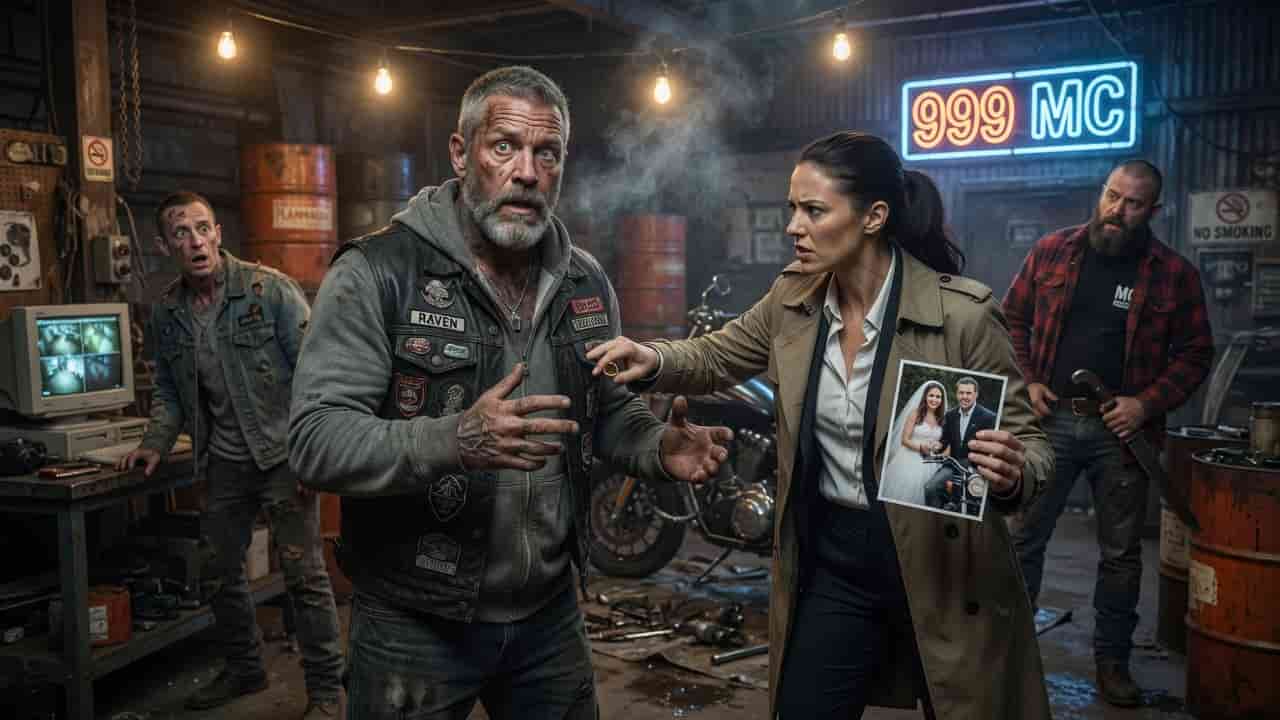
Sarah’s voice was like a razor blade cutting through the humid air of the warehouse. She didn’t wait for an answer. She lunged forward, her fingers catching the silver chain hidden under Cole’s leather vest. She yanked it hard, forcing the leader of the 999 to stumble, his boots scraping against the very floorboards that held his darkest secret.
The room went cold. Shotgun and Mute, the men who would take a bullet for Cole, didn’t move. They just watched as their “Vị vua công chính” turned ashen. They saw the gold band Sarah held up—the matching ring to the one Cole had been hiding for ten years.
Ten years of lies. Ten years of pretending his mentor had simply vanished into the Louisiana swamp. Now, the mentor’s daughter was standing in his house, exposing the truth one inch of silver chain at a time.
“Tell them where you found it, Cole,” she hissed. “Tell them why it was in the mud behind the river house.”
Cole Stone had built an empire on loyalty, but as Sarah stared him down in front of his brothers, he realized that loyalty only works if you aren’t the one who broke it first.
Chapter 1: The Weight of the Chain
The humidity in the bayou didn’t just hang in the air; it owned it. It sat on your shoulders like a wet wool coat, smelling of diesel, river silt, and the slow, sweet rot of the cypress swamps. Inside the warehouse of the 999 Motorcycle Club, the heat was even worse. It was the club’s tenth anniversary—a decade of “Raven” Stone’s rule—and the air was thick with the scent of roasted hog, cheap beer, and the hot metal of fifty idling Harleys.
Cole “Raven” Stone stood on the makeshift wooden stage at the far end of the warehouse, looking out over his kingdom. He was a big man, built like a brick oven, with shoulders that had only gotten broader as the years piled up. His leather vest, the “cut,” was heavy with patches, but the heaviest thing he wore was the thin silver chain tucked beneath his grey hoodie. It felt like a cold wire against his skin, a constant reminder of the gold band it carried—the ring that was never supposed to see the light of day again.
“To ten years,” Cole growled into the microphone. His voice was a low rumble that could be heard over the hum of the crowd. He raised a plastic cup of lukewarm Miller Lite. “To the brothers we’ve kept, and the ones we’ve lost to the road.”
A roar went up from the floor. Men in denim and leather toasted the air. Women in tight jeans and club shirts leaned against the steel beams. It was a scene of triumph. To anyone else, the 999 were just a bunch of aging outlaws in a rusted-out shed on the edge of the Atchafalaya. To Cole, they were the only thing keeping him from drifting away into the mud.
He stepped off the stage, his heavy boots thumping against the plywood. He was immediately flanked by Shotgun, a man whose neck was wider than his head, and Mute, the club’s tech genius who hadn’t spoken a word since a botched deal in New Orleans five years back.
“Good speech, Boss,” Shotgun said, slapping Cole’s shoulder. “Mayor’s in the back. He’s looking for his envelope.”
Cole nodded, but his eyes were on the main bay door. The heavy corrugated steel was rolled up, letting in the swamp air and the occasional mosquito. A pair of headlights cut through the fog outside, turning the mist into two blinding white tunnels. A car was approaching—too fast for a guest, too quiet for a bike.
A silver Crown Vic pulled into the gravel lot, the engine cutting out with a sharp metallic click.
“Who’s the suit?” Shotgun asked, his hand drifting toward the small of his back where he kept a Glock 19 tucked into his waistband.
Cole didn’t answer. He felt a sudden, sharp chill that had nothing to do with the night air. He knew that car. He’d seen it parked outside the sheriff’s station for weeks. And he knew the woman who stepped out of it.
Sarah Vance didn’t look like a detective. She looked like the ghost of the man who had taught Cole everything he knew. She had the same sharp, hawk-like nose as her father, the same way of tilting her head as if she was listening for a lie. She was wearing a tan trench coat that looked out of place among the grease and leather, but the way she walked—shoulders square, eyes locked on the target—made the room go quiet as she entered the warehouse.
She didn’t stop until she was five feet from Cole. The music, a muddy blues track playing from a set of blown-out speakers, hissed into silence as Mute reached over and killed the power.
“Detective Vance,” Cole said. He tried to keep his voice steady, but the ring on the chain seemed to pulse against his chest. “You’re a long way from the precinct. This is a private party.”
“I’m not here as a cop, Cole,” Sarah said. Her voice was thin but carried like a gunshot. “Though I’m sure the Mayor would love to know why I found his campaign stickers in the trash out back.”
She looked around the room, her gaze lingering on the hardened faces of the bikers. There was no fear in her. Only a cold, shimmering contempt.
“I’m here because I found something,” she continued. She reached into her coat pocket and pulled out a small, clear evidence bag. Inside was a gold wedding band, scratched and dull, but unmistakable. “I found it at the old river house. Under the porch. In the mud where the cypress roots grow thick.”
Cole felt the air leave his lungs. He reached up, his hand reflexively going to his throat, clutching the silver chain through the fabric of his hoodie.
“My father disappeared ten years ago,” Sarah said, stepping closer. The light from a hanging bulb caught the gold in the bag. “Everyone in this town says he just walked away. They say Silas Vance got tired of being a cop and tired of being a father and just headed West. But you and I both know Silas never went West.”
She thrust the bag toward Cole’s face. Shotgun stepped forward, a low growl starting in his throat, but Cole held up a hand to stop him.
“This is my mother’s ring,” Sarah hissed, her eyes welling with a rage so pure it made the warehouse feel small. “The one he wore every day. The one he was wearing the night he came here to see you.”
“I don’t know what you’re talking about, Sarah,” Cole said. His voice sounded hollow, even to his own ears. “Silas left. We all saw the truck drive out of town.”
“You saw a truck,” she snapped. “But you didn’t see him in it. And you certainly didn’t see this.”
She reached out with her other hand—lightning fast, the way Silas used to move—and grabbed the silver chain at Cole’s neck. Before he could react, she yanked it upward. The clasp didn’t break; it held, dragging Cole’s head down toward hers. The gold ring he wore around his neck popped out from under his shirt, dangling in the air between them.
A collective gasp went through the warehouse. The men of the 999 looked at each other, then at the two rings. They were identical. Same width, same dull gold, same inscription on the inside that only the two of them knew.
“Why is my father’s wedding ring around your neck, Raven?” Sarah whispered. The silence in the room was absolute. Even the crickets in the swamp seemed to have stopped. “Explain it to me. Explain it to your brothers. Tell them why you’re wearing the jewelry of a man who’s been ‘missing’ for a decade.”
Cole’s heart hammered against his ribs like a trapped bird. He looked at Shotgun, whose face had gone from protective to deeply confused. He looked at Mute, who was slowly backing away from the computer desk. The authority he had spent ten years building was dissolving into the humid air, one second at a time.
“It’s not what you think,” Cole managed to say, but the weight of the chain felt like a noose.
Chapter 2: The Cracks in the Chrome
The warehouse felt like it was tilting. Cole could feel the eyes of forty men—men who called him “President,” men who had followed him into bar fights and legal battles—boring into the back of his head. The social structure of a biker club is built on a single, fragile foundation: the belief that the man at the top is the strongest and the most honest of the bunch.
Sarah Vance didn’t let go of the chain. She held him there, leaning over his own workbench, forcing him to look at the two rings side-by-side. The public humiliation was surgical. She wasn’t just accusing him of a crime; she was stripping him of his dignity in his own house.
“Answer her, Boss,” Shotgun said. His voice wasn’t a threat yet, but the “Boss” sounded heavier than usual. “Where’d you get the gold?”
Cole grabbed Sarah’s wrist. His hand was twice the size of hers, his skin calloused and scarred from years of wrenching on engines, but he didn’t squeeze. He couldn’t. “Sarah, let go. We’ll talk in the office.”
“No,” she said, her voice rising so it echoed off the corrugated steel ceiling. “We aren’t talking in the office. We’re talking right here. In front of the men you’ve been lying to. You told me Silas was your mentor. You told me he was the only man in this county with a lick of sense. You sat at my mother’s funeral and told her you’d find him.”
She yanked the chain again, forcing Cole to stumble forward. “You found him, didn’t you? You found him and you kept a trophy.”
“It’s not a trophy,” Cole growled, his own temper finally beginning to flare through the shame. He shoved her back, not hard, but enough to break her grip. The silver chain snapped back against his chest, the ring clinking against his sternum. “It was a debt. Silas owed me.”
“A debt?” Sarah laughed, a sharp, bitter sound. “My father didn’t owe you anything but a jail cell, Cole. He was coming here to shut you down. He told me that night. He said, ‘Sarah, I’m going to go talk some sense into Raven. And if he won’t listen, I’m bringing the state police in.'”
The room shifted again. The “999” stood for a specific code—a code of independence from the law. The idea that their founder had been in deep with a cop—even a “good” one—was poison. Cole saw the Mayor, a small man in a sweating seersucker suit, slipping out the back door. The rats were already starting to run.
“Silas was one of us,” Cole said, looking around at his men, trying to reclaim the room. “Before he put on the badge, he was a member. You all know that. He founded this club before most of you were out of diapers.”
“He founded it to be a brotherhood,” Sarah shouted. “Not a front for the Mayor’s kickbacks and whatever you’ve got buried in those drums out back! He was coming to take the patch back, wasn’t he? He was going to strip you of that vest.”
Cole felt a bead of sweat roll down his spine. She was too close to the truth. Silas had come that night. He had stood right where Sarah was standing now, his badge glinting in the moonlight, telling Cole that the 999 had become a cancer on the parish. He had told Cole to step down, to burn the ledger, or he’d personally lead the raid.
Cole remembered the smell of the swamp that night. He remembered the way the shovel felt in his hands, the weight of the damp earth, and the way Silas’s eyes had looked—not surprised, but disappointed—as the light left them.
“I didn’t kill him, Sarah,” Cole lied. The lie felt oily in his mouth. “He gave me that ring. He said if he didn’t come back from where he was going, I was to keep it. To remember the code.”
“Where he was going?” Sarah stepped into his space again, her face inches from his. She was trembling now, the adrenaline finally starting to give way to the raw grief she’d been carrying for a decade. “He was going home, Cole. He had a steak in the fridge and a daughter waiting for him to help with her pre-calc. He didn’t ‘go’ anywhere.”
She turned to the room, raising the evidence bag high. “If any of you have a shred of the loyalty you brag about, you’ll tell me what happened that night. Because I’m not leaving this parish until I dig him up. And I’m starting with this floor.”
She pointed at the concrete beneath their feet.
Cole felt the world go white for a second. The floor. The concrete was only five years old. Before that, it had been packed dirt and old wood. He had personally overseen the pouring of the slab. He had told the men it was to modernize the shop, but he knew exactly what lay three feet under the oil-stained surface, directly beneath the heavy lift where his own bike sat.
“You’re hysterical, Sarah,” Cole said, his voice dropping to a dangerous, low vibrato. “Get out of my warehouse. Now. Before I have Shotgun put you in your car.”
Shotgun didn’t move. He stood there, his arms crossed over his massive chest, looking at the floorboards, then back at Cole.
“She’s a cop, Raven,” Shotgun said softly. “But she’s Silas’s kid. Maybe we should let her look. If there’s nothing there, there’s nothing there. Right?”
The challenge was out in the open. Cole was being cornered by his own Enforcer. The silence that followed was the loudest thing he had ever heard.
Chapter 4: The Ghost in the Machine
The office of the 999 warehouse was a small, wood-paneled box that smelled of stale cigarettes and motor oil. On the wall hung a framed photo of the original five members. Silas Vance was in the center, younger, grinning, with his arm draped over a teenage Cole Stone.
Cole sat behind his desk, his head in his hands. The party was over. The warehouse was mostly empty, save for a few die-hards cleaning up the trash and the low, constant hum of the swamp outside. Sarah had left, but her threat hung in the air like the humidity. She was coming back with a warrant. He knew it. And he knew the Mayor wouldn’t protect him—not after seeing Sarah pull that chain.
There was a soft knock on the door. Mute slid inside, his denim jacket covered in a fine layer of dust. He didn’t say anything, but he held out a small, old-fashioned USB drive.
“What is it, Leo?” Cole asked, using Mute’s real name.
Mute pointed toward the computer on the desk. He made a gesture like a flickering screen, then pointed toward the back of the warehouse, where the old security system had been housed before the fire five years ago.
Cole felt a cold lump form in his stomach. “I thought those tapes were gone. The fire took the whole server room.”
Mute shook his head. He pointed to his own chest, then to the drive. He had saved something.
Cole plugged the drive into his laptop. The screen flickered to life, showing a graining, black-and-white feed from a decade ago. It was the back loading dock of the warehouse. The timestamp in the corner read: October 14, 2016. 02:14 AM.
On the screen, two figures appeared. One was unmistakably Silas Vance, his badge catching the dim light. The other was Cole, younger, leaner, his face contorted in an argument. They were standing near the edge of the swamp, where the old wood pilings met the mud.
In the video, Silas reached out and handed Cole something. It was small. A flash of gold. He said something—the audio was a mess of static and wind—but his lips moved clearly. Keep it safe.
Then, Silas turned to walk away. He didn’t get five steps before a third figure emerged from the shadows of the warehouse. This person was holding a heavy iron pipe. The strike was quick, brutal, and final. Silas went down in the mud without a sound.
The younger Cole on the screen didn’t move. He stood there, frozen, as the third figure—the man who had actually swung the pipe—stepped into the light.
It was the Mayor. Only back then, he was just a desperate councilman with a debt to the wrong people.
The video showed Cole finally moving. He didn’t call the police. He didn’t scream. He looked at the body, then at the Councilman, then at the club. He picked up a shovel.
The screen went black.
Cole sat in the silence of the office, the blue light of the laptop reflecting in his tired eyes. He hadn’t killed Silas. But he had buried him. He had taken the ring Silas had tried to give him—a symbol of a truce that never happened—and he had worn it as a penance, a weight to keep him grounded in the lie.
“Does anyone else know?” Cole asked.
Mute shook his head. He looked at Cole with a profound, quiet pity. He had kept this secret for five years, waiting for the right moment, or perhaps just waiting for the weight of it to break Cole.
“Shotgun is talking to the guys,” Cole said, more to himself than to Mute. “They think I did it. They think I’m the one who put the pipe to Silas’s head.”
The door burst open. Shotgun didn’t knock this time. He looked like he’d been drinking, his face flushed and his eyes bloodshot. Behind him stood two other members, their faces grim.
“Cops are at the gate, Raven,” Shotgun said. “Not just Sarah. State police. They’ve got a dog. A cadaver dog.”
Cole stood up. He felt a strange sense of relief. The chain around his neck didn’t feel like a noose anymore; it felt like a tether, pulling him toward the only thing he had left—the truth.
“Let them in,” Cole said.
“What?” Shotgun stepped forward, his hand on his belt. “We can block the road. We can get you out the back. We don’t let them dig up our floor, Raven. That’s our house.”
“It’s not a house,” Cole said, stepping around the desk. He looked at the photo of Silas on the wall one last time. “It’s a graveyard. And it’s time we stopped living on top of it.”
He walked past Shotgun and out into the main warehouse. The blue and red lights of the police cruisers were already flashing through the open bay doors, reflecting off the chrome of the bikes. Sarah Vance was standing at the edge of the concrete slab, a shovel in her hand and a look of absolute, terrifying resolve on her face.
Cole walked straight to her. He didn’t stop until he was inches away. He reached up, unclipped the silver chain from his neck, and placed it in her open palm, right next to the matching ring in the evidence bag.
“I didn’t swing the pipe, Sarah,” Cole said, his voice loud enough for every man in the room to hear. “But I dug the hole. And I’m going to show you exactly where to start.”
He turned to the men of the 999, the brothers who had followed him for a decade. “Leo, play the tape. Let everyone see who really runs this parish.”
The warehouse went silent as the laptop screen was projected onto the white wall of the shop. As the image of the Councilman—the now-Mayor—swinging the pipe filled the room, the world of the 999 MC didn’t just crack. It shattered.
Chapter 3: The Mayor’s Debt
Two hours before the party, the Mayor’s office in the town of St. Jude was a sanctuary of chilled air and expensive bourbon. Mayor Harrison “Harry” Miller was a man who had built his career on the idea of “managed chaos.” He kept the 999 MC on a short leash, using them for muscle when a local developer got too loud or a strike needed breaking, and in return, he kept the sheriff’s department looking the other way.
Cole had sat in the velvet chair across from Harry’s desk, feeling the grime of the warehouse on his skin.
“You’re sweating, Cole,” Harry had said, swirling his drink. “It’s unattractive. Especially on your big day.”
“Sarah Vance is back in town,” Cole said. “She’s digging. Literally.”
Harry had laughed, but the sound didn’t reach his eyes. “She’s a girl with a grudge. Her father was a drunk who walked out on her. That’s the story, isn’t it? That’s the story we all agreed on.”
“She found a ring,” Cole said.
The ice in Harry’s glass stopped rattling. He leaned forward, the seersucker fabric of his suit bunching at his shoulders. “What ring?”
“Silas’s wedding band. She found it at the river house. If she keeps looking, she’s going to find the rest of him. And if she finds him, she finds the pipe.”
Harry set his glass down with a precise, heavy thud. “The pipe is gone, Cole. You told me you took care of it.”
“I did,” Cole said. But he hadn’t. He had kept it, wrapped in an oily rag, tucked inside the frame of Silas’s old bike—the one bike in the shop that was never for sale. It was his insurance policy, the only thing he had to keep the Mayor from selling the club out to the feds.
“Listen to me carefully,” Harry whispered, his voice like a snake in the grass. “If that girl finds anything under that warehouse, it won’t be my name on the warrant. It’ll be yours. I’m the Mayor. You’re just a biker with a record. Who do you think this town is going to believe?”
Cole had walked out of that office knowing the clock was ticking. He had spent ten years protecting a man he hated to honor a “brotherhood” that was rotting from the inside out. As he drove back to the warehouse, the silver chain had felt like it was glowing red-hot against his chest.
Now, standing in the warehouse with Sarah yanking that same chain, Cole realized he had waited too long to choose. He had tried to be a king and a servant at the same time, and all he had ended up with was a handful of gold and a floor full of ghosts.
“You’re going to lose everything tonight, Cole,” Sarah said, her voice breaking his reverie. “Your club, your patch, your ‘royalty.’ Was it worth it? Was he worth it?”
Cole looked at the men around him. He saw the doubt in Shotgun’s eyes. He saw the fear in Mute’s posture.
“No,” Cole said, his voice finally clear. “He wasn’t.”
He reached for the laptop on Mute’s desk. “Leo, show her. Show her everything.”
Chapter 5: The Breaking of the Slab
The sound of the first jackhammer was a physical blow to the chest. It wasn’t just the noise—a jagged, metallic scream that tore through the humid Louisiana night—it was the vibration. It travelled up through the soles of Cole’s boots, into his marrow, shaking the very foundation of the life he had spent ten years building.
The State Police had arrived in force, their black-and-white SUVs forming a semi-circle around the warehouse doors like sharks circling a carcass. The cadaver dog, a lean Belgian Malinois named Jax, had alerted within seconds of being led onto the concrete floor. He hadn’t barked. He’d simply sat down, his ears pinned back, staring at a specific spot beneath the heavy hydraulic lift where Cole’s customized Road King usually sat.
“Move the bike,” Sarah Vance had commanded. Her voice was flat, devoid of the heat that had fueled her earlier. Now, she was all ice and procedure.
Cole didn’t wait for Shotgun or Mute to help. He gripped the handlebars himself, the chrome cold against his palms. As he rolled the heavy machine off the slab, he felt the eyes of the remaining 999 members—men who had stayed behind even as the party-goers fled—burning into his back. They stood in the shadows of the tool benches, their leather vests looking heavy and worn under the harsh fluorescent lights.
“You really doing this, Raven?” Shotgun asked. He was standing near a stack of oil drums, his arms crossed. The confusion in his eyes had hardened into a cold, dangerous disappointment. “You’re letting them tear up the clubhouse? On our anniversary?”
Cole didn’t look up. He kicked the kickstand down with a sharp clack. “It was never our house, Shotgun. It was a tomb. I just didn’t tell you who was in it.”
The jackhammer bit into the concrete. A cloud of grey dust billowed up, coating the polished chrome of the bikes and the “999 MC” banner that hung from the rafters. The light in the room seemed to dim as the dust settled on the bulbs.
Sarah stood at the edge of the workspace, her trench coat stained with grease and grit. She didn’t look away from the hole. Every time the steel bit into the slab, she flinched, but her eyes remained locked. She was watching the death of a lie, and the birth of a nightmare.
“You knew,” she said, her voice barely audible over the roar of the equipment.
Cole stood beside her. He felt a strange, detached sense of peace. The secret was out. The pressure that had been crushing his ribs for a decade had finally shifted. “I knew he was there. I didn’t know the Mayor was the one who did it until tonight. I thought… I thought Silas had come to me for a reason. I thought I was protecting the club by burying the mess.”
“Protecting the club?” Sarah turned to him, her face a mask of weary contempt. “You buried my father under a motorcycle lift so you could keep playing king. You let my mother die wondering if he’d found someone else, if he’d just decided we weren’t worth the trouble.”
“I was twenty-two, Sarah,” Cole said, but the excuse felt like ash in his mouth. “I was a kid who wanted to belong to something. Silas was the only father I had, too. And when I saw him lying there… I panicked. I thought if I called the cops, the club was over. I thought the town would burn us down.”
“Instead, you let the town be run by a murderer in a seersucker suit,” she snapped.
The jackhammer stopped. The silence that followed was heavier than the noise. One of the forensic technicians, a man in a white Tyvek suit, knelt by the jagged hole. He used a small brush to clear away the debris.
“We’ve got something,” the tech said.
The room went cold. Even the bikers in the shadows took a step forward. Cole felt the silver chain—now in Sarah’s pocket—as if it were still around his neck, pulling him down.
Sarah stepped toward the hole, but a State Trooper held her back. “Stay back, Detective. Let them do their job.”
“That’s my father,” she whispered.
Cole watched as the technicians worked with painstaking slowness. They weren’t just digging; they were exfoliating the past. First, they found a scrap of blue fabric—the remains of a police uniform. Then, the glint of a brass button. And finally, the edge of a leather holster.
Sarah let out a sound—not a cry, but a ragged, strangled gasp. She turned away, her hand over her mouth, and walked toward the open bay doors.
Cole followed her out into the night. The humidity was thick, the smell of the swamp overwhelming the scent of the diesel and dust. They stood on the gravel lot, the red and blue lights of the cruisers pulsing against the dark wall of the cypress trees.
“He’s really there,” Sarah said, looking out into the dark. “For ten years, I’ve had these dreams where he just walks through the front door and says he was undercover. That he couldn’t call. I hated him for it. I hated him for leaving me.”
“He never would have left you,” Cole said. It was the only truth he had left to give her. “He spent that whole last night talking about you. How you were going to be a better cop than he ever was. How he wanted to get out of the life so he could watch you grow up.”
Sarah looked at him, her eyes shining with tears that refused to fall. “And you helped the man who took that away from him.”
“I did,” Cole said. “And I’ll pay for it. All of it.”
Inside the warehouse, a commotion started. Cole heard Shotgun’s voice, loud and angry. He turned to see the Enforcer being restrained by two State Troopers.
“Where’s the Mayor?” Shotgun was shouting. “If that video is real, if that bastard killed Silas, I want him! He’s been taking our money for years! He’s been using us!”
The revelation was spreading like a virus through the club. The men who had prided themselves on being “outlaws” realized they had been the janitors for a crooked politician’s sins. The loyalty that Cole had demanded was curdling into a violent, undirected rage.
“Get your men under control, Cole,” the lead State Trooper said, walking out to the lot. “We’ve got units heading to the Mayor’s estate, but we don’t need a riot here.”
Cole looked at Shotgun, who was straining against the officers’ grip. He looked at the patches on Shotgun’s vest—the symbols of a brotherhood that was now revealed as a facade.
“Let him go,” Cole said to the Troopers. Then, he walked over to Shotgun. He stood close, so only the big man could hear him. “You want to do something? You want to be a man? Help them finish the dig. Show Silas the respect I didn’t. Then, you take the patch off. The 999 is dead, Shotgun. I killed it a long time ago.”
Shotgun’s face twisted. He looked like he wanted to strike Cole, to roar at the moon, but the weight of the moment seemed to break him. He slumped, his shoulders dropping.
“You lied to us, Raven,” Shotgun whispered. “Everything we did… it was all for a lie.”
“Yeah,” Cole said, his heart heavy as a stone. “It was.”
As the sun began to peek over the edge of the bayou, casting a bruised purple light over the warehouse, the forensic team finally recovered the remains of Silas Vance. They carried the black bag out with a grim, practiced solemnity.
Sarah Vance stood straight as a ramrod as her father was carried past. She didn’t cry. She didn’t move. She just watched until the ambulance doors closed and the lights faded down the county road.
Cole Stone stood beside the empty hole in his warehouse floor. He felt the social and moral fabric of his life dissolving. He was the leader of nothing. He was a man who had buried his hero to save a club that had never been worth the cost.
The residue of the night was everywhere—in the grey dust on his hands, in the betrayal in his brothers’ eyes, and in the cold, hard reality that the truth doesn’t just set you free. It ruins you first.
Chapter 6: The Residue of Justice
The trial of Harrison Miller didn’t happen in a courtroom; it happened in the streets of St. Jude long before the first gavel fell. The video Mute had saved—the graining, black-and-white evidence of the Mayor swinging that iron pipe—had leaked to the local news within forty-eight hours. The town that had once bowed to the Mayor’s “managed chaos” turned on him with the ferocity of a cornered beast.
But for Cole Stone, the fallout was quieter and far more permanent.
Six months after the night at the warehouse, the 999 MC was a memory. The warehouse had been seized by the state, the bikes sold off at auction, and the “999” banner burned in a bonfire behind a roadside bar by men who felt like they’d been cheated out of a decade of their lives.
Cole sat in a small, windowless room in the Parish jail, wearing a bright orange jumpsuit that made his grey beard look even older. He had pleaded guilty to obstruction of justice and tampering with evidence. He hadn’t asked for a deal. He’d told the judge he wanted the maximum sentence.
The door buzzed open, and Sarah Vance walked in.
She looked different. She wasn’t wearing the trench coat or the navy suit. She was in a simple black sweater and jeans, her hair down. She looked like a woman who had finally stopped running.
“You look like hell, Cole,” she said, sitting across from him at the steel table.
“It’s an honest look,” Cole replied. His voice was raspy, the result of months of silence. “I heard about the Mayor. Fifteen years?”
“Twenty,” Sarah said. “The jury didn’t take kindly to the video. Especially the part where he helped you pour the concrete. He’s going to die in Angola.”
“Good,” Cole said. He looked at his hands, the grease finally scrubbed from beneath his fingernails, replaced by the pale, soft skin of a man who no longer worked on engines. “And you? You still a cop?”
Sarah hesitated. She looked at the small window high in the wall, where a sliver of Louisiana blue sky was visible. “I took a leave of absence. I spent a lot of time at the river house. Digging out the garden. Trying to remember the parts of my father that weren’t buried in your floor.”
“Did you find them?”
“Some of them,” she said. She reached into her purse and pulled out a small velvet box. She pushed it across the table toward him. “I thought you should have this back.”
Cole opened the box. Inside was the silver chain, cleaned and polished. But the ring was gone.
“I kept the ring,” Sarah said. “I buried it with my mother. I figured it belonged to her. But the chain… that was yours. You bought it with your own money when you were twenty, didn’t you? To carry the weight of the debt you thought you owed.”
Cole touched the cool metal of the chain. It felt lighter than he remembered. “I don’t think I should have it, Sarah. I’m the reason it took ten years to get him home.”
“You’re also the reason we found him at all,” she countered. “You could have destroyed that drive. You could have let the Mayor burn the warehouse down. But you didn’t. You stood there and let me yank that chain until the whole world fell apart.”
She stood up to leave, her chair scraping against the linoleum. “My father always said you were the best of them, Cole. Even when you were a screw-up. He said you had a sense of justice that would eventually catch up to your pride.”
“He was right about the pride,” Cole said. “I’m not so sure about the justice.”
“The justice is done,” Sarah said, her hand on the door handle. “Now there’s just the residue. The living with it.”
She looked back at him one last time. There was no forgiveness in her eyes—not exactly. There was something else: an acknowledgment. They were both survivors of a man named Silas Vance and a town named St. Jude. They were bonded by a secret that had finally been lanced like a boil.
“Goodbye, Raven,” she said.
“Goodbye, Sarah.”
After she left, Cole sat in the silence for a long time. He thought about the warehouse, the smell of the diesel, and the way the slab had looked before they broke it—smooth, grey, and perfect. A perfect lie.
He picked up the silver chain and looped it around his neck. It was just a piece of jewelry now. No ring. No weight. Just a cold wire against his skin.
He walked back to his cell, the sound of his boots echoing in the corridor. He wasn’t a king anymore. He wasn’t a brother. He was just a man named Cole who had finally stopped digging.
In the corner of his cell, a small patch of sunlight hit the floor. He watched it move, inch by inch, as the afternoon wore on. He thought about the bikes he’d never ride again, the men who would never call his name, and the mentor whose face he could finally see without flinching.
The 999 was gone. The patch was shattered. But as the sun dipped below the horizon, casting the parish into shadow, Cole Stone realized that for the first time in ten years, he could breathe. The air was still thick, still humid, and still smelled of the swamp, but it was his.
He closed his eyes and listened to the distant sound of the Louisiana night—the cicadas, the bullfrogs, and the long, low whistle of a train heading West. It wasn’t a happy ending. It was just an ending. And in the dark of the cell, that was enough.