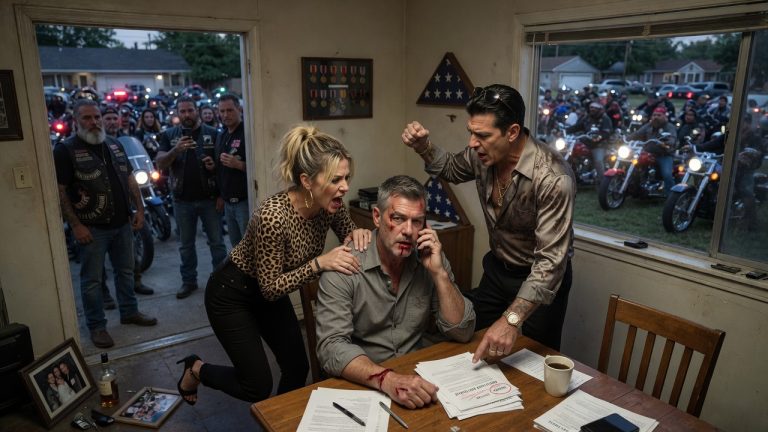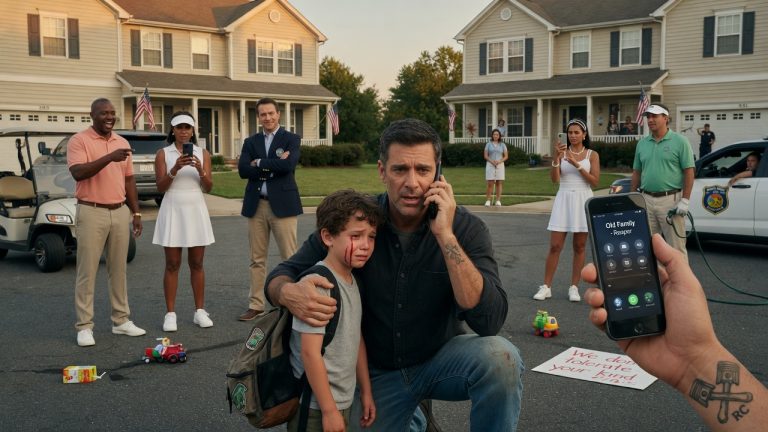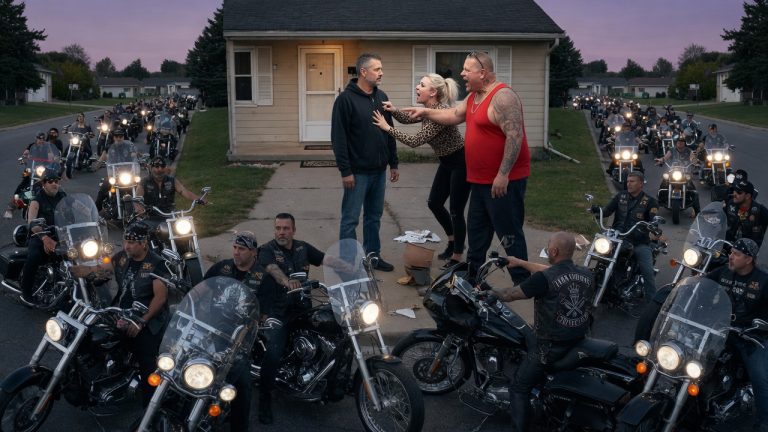
“Look at me and tell me it was worth it, Tank.”
I stood there, my boots rooted to the oil-stained concrete of the 999 garage, watching the woman who raised us all tear the heart out of our leader. Tank Malone was a giant—a man who’d lost half his legs for this country and gave the rest of his life to this club. We followed him because we thought he was the last honest man in Arizona.
But the heat does things to a man’s judgment.
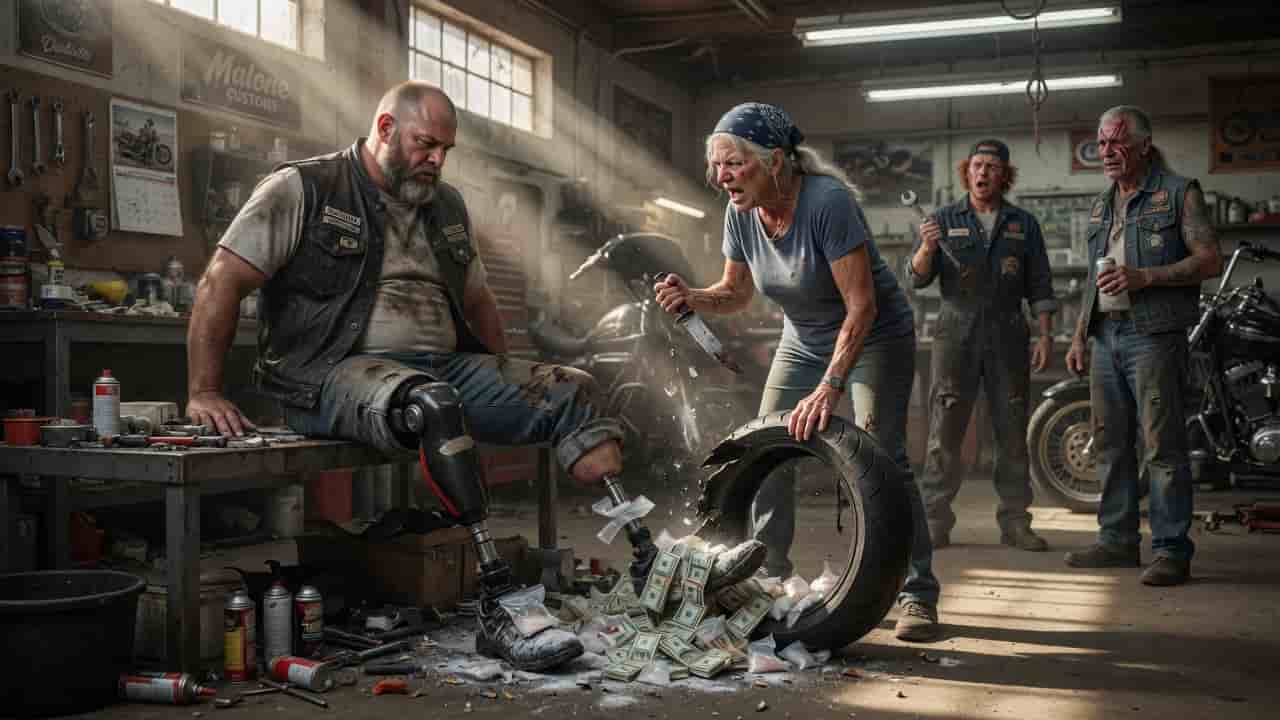
Mama Blue didn’t say a word at first. She just walked up to the custom chopper Tank had been hiding in the back stall, the one he said was for a “private client.” With one swift, jagged motion, she drove a rusted blade into the rear tire.
I expected air to hiss out. I expected a curse from Tank.
Instead, the rubber groaned and vomited a waterfall of bundled hundred-dollar bills and small, clear bags filled with that white poison that had already put three of our brothers in the ground this year.
The silence that hit the room was heavier than the desert air.
“Blue, I did it for the families,” Tank rasped, his voice cracking like dry timber. “The club was starving. I had to choose.”
Mama Blue didn’t hesitate. She stepped into his space—the space of a man twice her size—and delivered a slap that echoed off the corrugated metal walls. She didn’t care about his history. She didn’t care about his pain. She only cared about the truth he’d buried in those tires.
“You didn’t choose the families, Tank,” she hissed, kicking the spilled money against his prosthetic leg. “You chose the easy way out. And you sold our souls to the people who want us gone.”
I saw the look in Tank’s eyes then. It wasn’t anger. It was the look of a man who realized he’d become the monster he promised to protect us from.
CHAPTER 1
The heat in the Mojave doesn’t just sit on you; it burrows. It’s a physical weight that finds the cracks in your skin and the rust in your soul. Inside the 999 Garage, the air was a thick soup of spent oil, stale tobacco, and the copper tang of old blood. It was 104 degrees by noon, and the swamp cooler in the corner was doing nothing but humming a wet, rhythmic eulogy for a summer that refused to end.
Tank Malone sat on his stool, his massive frame hunched over a carburetor. His hands, thick and scarred like the roots of an old oak, moved with a precision that belied their size. But every few minutes, he’d stop. He’d feel that familiar, agonizing itch—a phantom burn in a foot that hadn’t been there since a roadside IED took it near Fallujah. He reached down, his fingers brushing the cold, unyielding carbon fiber of his prosthetic. It was a high-tech piece of gear, expensive and sleek, but in this light, covered in grease and Arizona dust, it just looked like another piece of salvaged machinery.
The garage was quiet, save for the rhythmic clink-clink of Sparky’s wrench in the back bay. Sparky was a good kid, but he talked too much and thought too little. He didn’t see the way the club’s ledger was bleeding red. He didn’t see the way the local deputies were lingering longer at the gate, eyes narrowed at the lack of chrome and the abundance of empty crates.
“Tank?”
The voice was soft, but it cut through the hum of the cooler like a razor. Tank didn’t look up. He knew the gait. He knew the smell of lavender and laundry detergent that always clung to Mama Blue, even in this den of filth.
“Not now, Blue,” Tank grunted, his voice a low rumble in his chest. “This intake is finicky. I gotta get it set before the sun drops.”
Mama Blue didn’t move. She stood at the edge of his workspace, her silver hair pulled back so tight it made her eyes look like two chips of blue flint. She was the club’s conscience, the woman who’d buried a husband and two sons in the colors of the 999. She was the one who kept the books at the clubhouse and the peace in the bar.
“The power company called the house, Tank,” she said, her voice devoid of its usual warmth. “They’re cutting us off Friday. And the grain delivery for the kitchen? It didn’t show. Driver said the check bounced harder than a rubber ball.”
Tank’s hands went still. He stared into the throat of the carburetor. The silence stretched, becoming an entity of its own. He could feel the eyes of the other men in the garage—Sparky, Lucky, even the lính đánh thuê, the merc they’d hired for ‘security’ who was leaning against the doorframe—shifting toward him. They were waiting for the King to provide.
“I’m handling it,” Tank said, finally looking up. His eyes were bloodshot, the skin beneath them bruised with exhaustion. “I got a private contract coming in tonight. A custom build for a guy down in Nogales. It’ll cover the nut, Blue. All of it.”
“Nogales?” Mama Blue stepped closer, her nose wrinkling. “We don’t do business south of the line, Tank. You made that rule yourself ten years ago. You said the cartels were a virus that would rot us from the inside out.”
“The rule was about drugs, Blue. Not bikes,” Tank snapped, the pressure finally popping his lid. “Money is money, and right now, we’re out of it. You want the lights on? You want the kids fed? Then let me do my job.”
Mama Blue flinched, a small, almost imperceptible movement that hit Tank harder than a physical blow. He’d never raised his voice to her. Not once. He watched her jaw set, her spine straightening until she looked ten feet tall despite her slight frame.
“I want us to be able to look ourselves in the mirror, Tank,” she said quietly. “Don’t lose your way trying to find a shortcut.”
She turned and walked out, her boots clicking a sharp, disapproving rhythm on the concrete. Tank watched her go, the guilt roiling in his gut like bad whiskey. He waited until the screen door slapped shut before he turned to the mercenary in the doorway.
The man, a lean, hollow-cheeked shadow named Vane, gave him a slow, mocking grin. Vane didn’t ride. He didn’t care about the club. He was there because Tank needed a man who could pull a trigger without asking about the soul of the target.
“She’s a sharp one, that old bird,” Vane said, his voice a dry rasp. “She keeps digging, she’s gonna find what you’re planting in the garden.”
“Shut up, Vane,” Tank growled. “Is the shipment ready?”
“Sitting in the shed behind the scrub. Six tires, heavy-tread, reinforced walls. Packed so tight you couldn’t fit a toothpick between the bills and the bags,” Vane said, pushing off the wall. “Your Mexican friends are coming at midnight. They want to see the ‘bikes’ they’re paying for.”
Tank looked down at his prosthetic. The carbon fiber caught a stray beam of light, mocking him with its cold efficiency. He wasn’t a king anymore. He was a smuggler. A Judas in his own garage. He’d told himself it was just this once. Just to get through the summer. Just to keep the 999 from evaporating into the heat of the desert.
But as he looked at the empty, dusty bays of the garage, he knew he was lying. You don’t just invite the devil in for a drink; you end up giving him the keys to the house.
He picked up a rag and began to wipe the grease from his hands, but no matter how hard he scrubbed, the feeling of being dirty remained. It was beneath the skin. It was in the bone. It was in the space where his real foot used to be, a hollow, aching void that no amount of cartel money could ever fill.
CHAPTER 2
The wake for “Kid” was a somber, stifling affair. Kid—real name Danny Miller—had been twenty-two, a prospect with a smile that could charm the rattlesnakes out of the brush. They found him in the back of a rusted-out Ford, blue-lipped and cold, with a needle still clutched in a hand that should have been holding a handlebar.
The clubhouse was packed, but the air felt thin. Every biker in the county was there, leather vests smelling of sweat and woodsmoke, but nobody was talking. The silence was a jagged thing. In a club that prided itself on brotherhood, an overdose was a betrayal. It was a failure of the collective.
Tank stood at the head of the room, his back to the open casket. He felt like a pillar of salt. Every time he looked at Kid’s mother, sobbing in the front row, his skin felt like it was being flayed by a desert wind. He knew where that “white ghost” had come from. He’d seen the bags in the shed. He’d felt the weight of them in the tires he’d personally mounted on the bikes being moved through their territory.
Mama Blue sat next to the grieving mother, her hand a steady, rhythmic presence on the woman’s shoulder. She didn’t look at Tank. She hadn’t looked at him for three days. Her silence was a physical weight, a judgment that didn’t need words to be understood.
“He was a good kid,” Sparky whispered, standing beside Tank. The young mechanic’s eyes were wet. “I don’t get it, Tank. Kid hated the hard stuff. He was a beer and weed guy. Why would he touch that junk?”
“Curiosity kills more than cats, Sparky,” Tank said, his voice sounding like it was being dragged over gravel. “People make mistakes when they’re looking for a way out of the heat.”
“It’s moving into the town, Tank,” Sparky continued, oblivious to the way Tank’s jaw was clenching. “Sheriff says there’s a new supply. High-grade. Coming up from the border. He says whoever is letting it through is gonna have blood on their hands.”
Tank turned away, the prosthetic leg clicking as he pivoted. He couldn’t stay in that room. He couldn’t breathe the same air as the people he was poisoning.
He walked out onto the porch, the night air offering no relief from the heat. Vane was leaning against a pillar, a cigarette dangling from his thin lips. The mercenary looked at the grieving crowd inside with a detached, clinical interest.
“Emotional lot, aren’t they?” Vane remarked, blowing a cloud of smoke into the dark. “One kid goes down and the whole world stops. Back in my day, we just called that Tuesday.”
Tank grabbed Vane by the front of his tactical vest, slamming him against the wood pillar. The sound of the impact was muffled by the wind, but the violence was sharp and immediate.
“Don’t you ever talk about my people like that,” Tank hissed, his face inches from Vane’s. “You’re here for a job, not to offer commentary. You understand?”
Vane didn’t flinch. He didn’t even drop his cigarette. He just looked at Tank with eyes that were as cold and empty as a dry well.
“I understand that you’re paying me with the same money that bought that kid’s last hit,” Vane said quietly. “You want to be a saint, Tank? Go inside and confess. You want to save this club? Then let go of my vest and tell me when the next shipment is moving. Because the guys in Nogales? They don’t care about wakes. They care about their product.”
Tank’s grip tightened, his knuckles white. He wanted to break Vane. He wanted to purge the room of the man’s presence. But he couldn’t. Vane was the bridge. Vane was the one who knew the routes, the contacts, the leverage they held over the local cops. Without Vane, the cartel would stop negotiating and start shooting.
He let go, his hands shaking. Vane straightened his vest with a smirk.
“Midnight. The north garage,” Tank said, his voice hollow. “The tires are already packed. We move them under the cover of the funeral procession tomorrow. No one stops a line of bikes headed to the cemetery.”
“Clever,” Vane said, nodding. “Using the dead to move the stuff that makes ‘em. I like the symmetry.”
Tank didn’t answer. He walked down the porch steps and into the darkness of the garage. He needed to work. He needed the mindless, repetitive motion of the wrench to drown out the sound of Kid’s mother screaming in the clubhouse.
He spent the next four hours in the back bay, his mechanical leg propped up on a milk crate. He was mounting the final set of “heavy-duty” tires onto a stripped-down Harley. Inside the rubber walls, he’d stashed a quarter-million in cash and ten kilos of the finest white powder the Sinaloa could produce.
Every time the bead of the tire seated against the rim with a loud pop, Tank flinched. It sounded like a gunshot. It sounded like the end of everything.
As he finished the last tire, he felt a presence in the room. He didn’t have to turn around. The smell of lavender told him everything.
“You’re working late,” Mama Blue said. She was standing in the shadows, her arms crossed over her chest.
“Got to get these bikes ready for the run tomorrow,” Tank said, his back still to her. “Need everything perfect for Kid’s final ride.”
“Is that what this is, Tank? A ride for Kid?” She walked forward, the light of the single overhead bulb catching the silver in her hair. She stopped by the bike, her hand reaching out to touch the tire he’d just mounted.
Tank’s heart hammered against his ribs. He watched her fingers trail over the rubber.
“It’s a tribute,” he said, his voice straining.
Mama Blue looked at him then, and for the first time, he saw something in her eyes that wasn’t just anger. It was pity.
“There’s a smell in here, Tank,” she said softly. “It’s not grease. It’s not gasoline. It’s the smell of a man who’s trying to hide a rot that’s already reached the bone.”
She leaned down, her eyes narrowing as she looked at the floor near his prosthetic. A tiny, almost invisible dusting of white powder had fallen from one of the bags during the packing process. It sat on the black carbon fiber of his ankle like a curse.
“What is that, Tank?” she asked, her voice dropping to a whisper.
Tank didn’t move. He couldn’t. The room felt like it was closing in, the heat becoming an oven.
“It’s nothing, Blue. Just some industrial sealant,” he lied. The words felt like lead in his mouth.
She didn’t look away. She reached down, her fingers brushing the powder from his leg. She rubbed it between her thumb and forefinger, her face going deathly pale.
“I know what sealant feels like, Tank,” she said, her voice trembling. “And I know what killed Danny Miller.”
She looked from the powder to the tires, and then back to Tank’s face. The realization hit her like a physical blow. She stumbled back, her hand covering her mouth.
“No,” she breathed. “Not you. Not my Tank.”
“Blue, listen to me—” Tank started, stepping toward her.
“Don’t!” she screamed, her voice echoing through the empty garage. “Don’t you dare touch me with those hands.”
She turned and ran out into the night, leaving Tank standing in the center of his kingdom of lies. He looked down at the bike, at the money, at the drugs. He was the most powerful man in the 999, and he had never felt smaller.
CHAPTER 3
The morning of the funeral was a blur of dust and false reverence. The 999 was out in force, over fifty bikes idling in the dirt lot outside the clubhouse. The sound was a low-frequency thrum that vibrated in the marrow of Tank’s teeth. He sat atop his own bike—a massive, blacked-out Road King—feeling every vibration through his prosthetic.
He was the leader. He was the one who would lead the procession. Behind him, four bikes carried the “tribute” tires. Sparky was on one, Lucky on another. They didn’t know. They thought they were honoring a fallen brother. Tank felt like he was leading his own children into a slaughterhouse.
He looked over his shoulder. Mama Blue was there, sitting on the back of a trike driven by one of the older members. She was dressed in black, her face a mask of cold, hard stone. She hadn’t spoken a word to anyone since she’d fled the garage. She hadn’t gone to the Sheriff. She hadn’t told the club. Not yet. She was waiting for the moment when the truth would hurt the most. Tank knew her well enough to know she wouldn’t just stop him; she would destroy the lie entirely.
Vane was on the perimeter, his eyes scanning the horizon. He looked like a wolf in a flock of sheep. He caught Tank’s eye and tapped his watch. It was time.
Tank kicked the Road King into gear. The procession moved out, a long, winding snake of leather and chrome snaking through the desert toward the small cemetery on the edge of town. People stood on their porches as they passed, hats over their hearts. They saw a brotherhood in mourning. They didn’t see the poison in the wheels.
The heat was already unbearable, the sun a white-hot eye staring down at them. Tank’s prosthetic felt heavy, the straps chafing against the stump of his leg. Every time he shifted gears, he felt the ghost of his foot trying to find the pedal. He focused on the road, on the shimmering heat waves, on anything but the weight of the girl sitting three bikes back who’d lost her brother to the very things he was carrying.
They reached the cemetery—a desolate patch of ground surrounded by a sagging chain-link fence. The priest was waiting, his robes fluttering in the dry wind. They gathered around the open grave, the bikers forming a circle of black leather.
As the priest spoke of dust and ashes, Tank felt a hand on his arm. It was Sparky.
“You okay, boss?” the kid whispered. “You look like you’re about to pass out.”
“I’m fine, Sparky,” Tank said, his voice tight. “Just the heat.”
“We’re gonna miss him,” Sparky said, looking down at the casket. “He was supposed to help me with the wiring on that custom bike tonight. You know, the one with the special tires?”
Tank’s stomach did a slow, sickening roll. “Yeah. I know.”
The service ended with the roar of fifty engines—the traditional “Biker’s Salute.” The sound was deafening, a wall of noise that seemed to push the heat back for a moment. But as the engines died down, a new sound emerged.
The crunch of gravel.
Two black SUVs pulled into the cemetery lot, their windows tinted dark. They didn’t belong here. They were clean, expensive, and carried the unmistakable aura of the border. Vane immediately moved toward them, his hand disappearing under his vest.
The bikers shifted, the tension in the air snapping tight. This was a funeral. A sacred space. To have the cartel show up here was an insult of the highest order.
“Who the hell is that?” Lucky growled, his hand moving toward the knife at his belt.
“Friends of mine,” Tank said, his voice loud enough to carry. “They’re here to pay their respects.”
The door of the lead SUV opened, and a man stepped out. He was dressed in a sharp, light-colored suit that looked ridiculous in the dirt of the cemetery. This was El Cuervo. The man who held the 999’s debt in one hand and their destruction in the other.
He walked toward the group, a thin smile on his face. He didn’t look at the casket. He looked at the bikes.
“A beautiful ceremony,” El Cuervo said, his English perfect and chillingly polite. “Such loyalty. Such… brotherhood. It is a rare thing these days.”
He stopped in front of Tank, his eyes flicking to the tires on the bikes parked nearby. “I see the tribute is ready for delivery. I assume there were no complications?”
The circle of bikers was silent. They looked from the man in the suit to Tank, the confusion on their faces beginning to curd into suspicion.
“We’re in the middle of a funeral, Cuervo,” Tank said, his voice a warning. “Wait at the garage.”
“I am a busy man, Malone,” Cuervo said, his smile fading. “And my associates are impatient. We will take the bikes now. It saves everyone the trouble of a second meeting.”
“The hell you will,” Lucky stepped forward, his face flushed with rage. “Nobody takes a brother’s bike on the day he’s buried. Who the hell do you think you are?”
Cuervo didn’t even look at him. He kept his eyes on Tank. “Tell your man to stand down, Malone. Before this funeral needs more than one casket.”
Vane drew his weapon—not at Cuervo, but at Lucky. The sound of the hammer cocking was like a thunderclap in the silence.
“Easy, Lucky,” Vane said, his voice flat. “Do what the man says.”
The betrayal was instantaneous. The 999 looked at Vane, then at Tank, their world tilting on its axis.
“Tank?” Sparky’s voice was small, terrified. “What’s going on? Why is Vane pointing a gun at us?”
Tank looked at his men—the men he’d led, the men he’d fed, the men he’d lied to. He saw the shock, the burgeoning realization, and the heartbreak. He looked at Mama Blue.
She was standing at the edge of the grave, her eyes fixed on him. She didn’t look surprised. She looked like she was watching a man drown and deciding whether or not to throw him a stone.
“Tell them, Tank,” she said, her voice carrying over the wind. “Tell them what’s in the tires. Tell them what you sold Kid’s life for.”
Tank opened his mouth, but no words came out. The heat was crushing him. The guilt was a physical weight on his chest, making it impossible to breathe. He was the King. He was the Leader. And he was utterly, completely alone.
CHAPTER 4
The ride back to the garage was a funeral of a different kind. The cartel SUVs followed the procession like vultures trailing a dying animal. No one spoke. The only sound was the roar of the engines and the whistling of the wind. When they arrived, the atmosphere in the garage was electric, a storm about to break.
Tank parked his bike in the center of the bay. He didn’t get off. He sat there, his hands still gripping the bars, staring at the wall. The club members gathered around, a wall of leather and silent fury. El Cuervo and his men stood by their SUVs, watching with detached amusement. Vane stood to the side, his gun visible, a silent reminder of the new order.
Mama Blue walked into the center of the circle. She looked smaller than she had at the cemetery, but her presence filled the room. She was holding something in her hand—a rusted Bowie knife she’d taken from the tool bench.
“Everyone, listen up,” she said, her voice clear and hard. “Our President has something he wants to show you. He calls it a ‘private contract.’ I call it the end of the 999.”
She walked over to the Harley Sparky had been riding—the one with the “special” tires.
“Tank, you want to do the honors?” she asked, her eyes boring into him. “Or should I?”
“Blue, stop,” Tank said, finally dismounting. His prosthetic clicked loudly on the concrete. “Not here. Not like this.”
“Why not here, Tank? This is where we work. This is where we live,” she said, her voice rising. “This is where you brought the poison.”
She didn’t wait for an answer. She knelt by the bike and drove the knife into the rear tire. The sound of the rubber tearing was sickening. She sliced a long, jagged gash in the sidewall and then reached inside.
She pulled out a bundle of cash, the rubber bands snapping. She threw it at Tank’s feet. Then she reached in again and pulled out a clear plastic bag filled with white powder.
The room erupted.
“You son of a bitch!” Lucky roared, lunging forward. Vane stepped in his way, the barrel of his gun finding Lucky’s chest.
“Stay back!” Vane shouted.
Sparky stood frozen, his eyes fixed on the bag of powder. “That… that’s what killed Kid. You brought that here?”
Tank looked at the kid’s face and felt something inside him finally snap. The weight he’d been carrying, the layers of lies and rationalizations, they all crumbled at once.
“I did it for the club!” Tank screamed, his voice raw with a decade of suppressed pain and desperation. “The bank was taking the house! The bikes were falling apart! We were dying, Sparky! I was trying to save us!”
“By killing us?” Mama Blue stood up, her face inches from his. “You thought we were worth so little that we’d trade our children for a few stacks of blood money?”
She stepped forward and delivered a slap that sounded like a gunshot. Tank’s head snapped to the side, his cheek instantly blooming with a red handprint. He didn’t fight back. He didn’t even move.
“Look at them, Tank!” she screamed, gesturing to the men surrounding them. “Look at what you brought into this house!”
“Blue, I had no choice,” Tank rasped, his eyes filling with tears.
“You always have a choice,” she hissed. She reached down and grabbed a handful of the spilled cash, throwing it at his face. The bills fluttered around him like dead leaves. “You sold our souls for dust.”
She kicked the remaining money toward his prosthetic leg, the bundles thudding against the carbon fiber.
“Look at your leg, Tank,” she said, her voice dropping to a terrifyingly calm whisper. “You lost your real one for a cause you believed in. You just lost your soul for a cause nobody wants.”
She looked around at the men of the 999. “This isn’t a club anymore. It’s a crime scene.”
El Cuervo stepped forward, clapping his hands slowly. “A very touching drama. But I believe you are damaging my property. The money, and the product, belong to me.”
“It belongs in the dirt,” Lucky shouted, but he didn’t move against Vane’s gun.
Tank looked at El Cuervo, then at Mama Blue, then at the broken tire on the floor. He saw the residue of his choices—the white powder on his leg, the money at his feet, the hatred in the eyes of his brothers.
He had tried to be a savior, and he had ended up a Judas. The silence in the garage was no longer heavy; it was hollow. Everything he had built, everything he had bled for, was gone.
Mama Blue turned her back on him and walked toward the exit. The other members followed her, one by one, leaving Tank standing in the center of the bay with the man who owned him and the man who’d betrayed him.
The heat in the garage was suddenly gone, replaced by a cold, numbing void. Tank looked down at the money at his feet and realized that for the first time in his life, he didn’t know how to stand.
CHAPTER 5
The silence that followed the club’s departure was more violent than the roar of their engines. It was a vacuum, a sudden drop in pressure that made Tank’s ears ring. He remained on the workbench, his prosthetic leg stretched out before him, the carbon fiber dusted with the white powder that had cost him everything. The garage, once the heart of his world, now felt like a tomb. The air was stagnant, smelling of hot rubber, spilled chemical, and the sharp, metallic tang of his own shame.
El Cuervo didn’t move. He stood in the center of the bay, his expensive suit looking like a shroud in the dim light. Behind him, his two enforcers remained like statues, their hands resting on the grips of their holstered weapons. Vane, the mercenary, was the only one who seemed comfortable. He had lowered his gun but kept it held loosely at his side, his eyes tracking the doorway where the 999 had vanished.
“A dramatic exit,” Cuervo said, his voice smooth and cold as a polished stone. “But ultimately, a waste of time. I did not come here for a theater performance, Malone. I came for my investment.”
Tank didn’t look up. He was staring at the pile of hundred-dollar bills at his feet. They were crumpled, stained with grease, and mocked him with their promise of security. He thought of Kid’s mother. He thought of the way Sparky’s voice had cracked. Every word he’d spoken about ‘saving the club’ felt like a handful of dry sand in his throat.
“The deal is dead, Cuervo,” Tank said, his voice a low, vibrating growl that seemed to come from his boots. “Take your money. Take your poison. Get out of my garage.”
Cuervo’s smile didn’t reach his eyes. He stepped closer, the heels of his leather loafers clicking on the concrete. “Dead? No, Malone. A deal is only dead when the debt is paid in full. You have four more bikes in the back with my property in the tires. And you have the route. The funeral was a success, despite the emotional outbursts. My people across the line are expecting the rest of the delivery by dawn.”
“I said get out,” Tank repeated. He looked up then, and the look in his eyes made even Vane shift his weight. It wasn’t the look of a leader. It was the look of a man who had nothing left to lose because he had already burned his own house down.
“You’re confused,” Cuervo said softly. “You think because your little club turned their backs on you, you are free. You are not. You belong to me until that ledger is balanced. Vane, remind our friend of his obligations.”
Vane stepped forward, the smirk on his face widening. He enjoyed this. He had spent weeks watching Tank struggle with his conscience, and now that the struggle was over, he wanted to see the man break. He walked toward the workbench, the barrel of his Glock glinting under the lone industrial bulb.
“You heard the man, Tank,” Vane said. “Stand up. We’ve got tires to mount. You’re the best wrench in the county, right? Let’s see some of that legendary efficiency.”
Tank didn’t stand. He didn’t move. He just watched Vane approach. In his mind, he was back in the desert outside Fallujah, feeling the heat of the IED before the sound even hit him. He remembered the feeling of his life changing in a heartbeat, the sudden realization that the world he knew was gone. This felt exactly like that.
“I’m not mounting another tire for you, Vane,” Tank said. “And I’m not moving another ounce of your shit.”
Vane’s expression shifted from amusement to a sharp, clinical irritation. He didn’t like being told no. He swung the pistol, the heavy slide catching Tank across the temple. The blow was sudden and brutal. Tank’s head snapped to the side, and he felt a warm trickle of blood begin to slide down his ear. He didn’t fall. He just sat there, the pain blooming like a dark flower in his skull.
“Tank, Tank, Tank,” Vane sighed, leaning in close. “Don’t be a martyr. It doesn’t suit you. You’re a smuggler. You’re a liar. You’re just another guy trying to make a buck off someone else’s misery. Accept it. It’s easier that way.”
Vane grabbed Tank by the collar of his leather vest, trying to haul him to his feet. Tank let him. He allowed the smaller man to pull him up, his prosthetic leg clicking as it locked into place. He stood a full head taller than Vane, a mountain of meat and scarred leather.
“That’s it,” Vane encouraged. “Now, move.”
Tank didn’t move toward the bikes. He moved toward Vane.
With a roar that sounded like a dying engine, Tank threw his weight forward. He didn’t use a punch; he used his entire massive frame as a battering ram. He slammed into Vane, the momentum carrying both of them across the garage floor. Vane tried to bring the gun up, but Tank’s hand—thick as a vice—clamped onto his wrist, twisting it with a sickening pop. The Glock clattered onto the concrete.
They hit the side of a tool chest with a deafening crash. Tools spilled everywhere, the air filling with the sound of clanging steel. Tank didn’t stop. He pinned Vane against the chest, his forearm pressed against the man’s throat.
“I’m a liar,” Tank hissed, his face inches from Vane’s. “I’m a smuggler. But I’m still a Biker. And this is my garage.”
Vane gasped for air, his face turning a dark, mottled purple. His hand fumbled on the top of the tool chest, his fingers closing around a heavy pipe wrench. He swung it blindly, the iron head catching Tank in the ribs. Tank felt a rib snap, the air leaving his lungs in a sharp hiss, but he didn’t let go. He drove his forehead into Vane’s nose, the crunch of cartilage echoing in the quiet bay.
Behind them, Cuervo’s enforcers drew their weapons.
“Enough!” Cuervo barked. “Kill him.”
The first shot missed, the bullet punching a hole in the vintage metal sign above Tank’s head. Tank didn’t wait for the second. He shoved Vane aside and dove behind a row of heavy tires, the rubber absorbing the impact of the next three rounds. The garage was suddenly a war zone. The smell of cordite replaced the smell of oil.
Tank crawled toward the back of the bay, his prosthetic leg dragging slightly. He needed a weapon. He didn’t keep guns in the garage—Mama Blue didn’t allow it—but he had tools. And in Tank’s hands, a tool was a weapon of mass destruction. He reached up, his fingers finding the handle of a heavy, two-foot-long pry bar.
He heard the enforcers approaching, their footsteps cautious on the oil-slick floor. They were professionals, moving in a pincer maneuver. Vane was somewhere in the shadows, probably clutching his broken wrist and looking for his gun.
“Come out, Malone!” Cuervo’s voice drifted over the stacks of tires. “Make this simple. If you die now, I’ll have to burn this place to the ground. Think of the old woman. Think of what happens to her when you’re not here to protect her.”
The mention of Mama Blue hit Tank like a physical blow. He realized then that he couldn’t just win this fight; he had to end it. He had to make sure Cuervo and his people never came back to this town. He had to pay his debt in blood.
Tank waited until he saw the shadow of the first enforcer. The man was moving slow, his gun held in a high-ready position. Tank didn’t wait for him to turn the corner. He swung the pry bar with everything he had, the heavy steel catching the man across the knees. The enforcer went down with a muffled cry, his gun skittering away into the darkness. Tank didn’t hesitate; he brought the bar down on the man’s shoulder, a sickening crack signaling the end of the fight for him.
The second enforcer opened fire, the muzzle flashes illuminating the garage in strobe-like bursts. Tank scrambled behind the lift, the sparks flying as the bullets hit the hydraulic pistons. He was trapped. He could hear Vane’s voice now, raspy and full of hate.
“I got him, Boss! He’s behind the lift!”
Tank looked around. He was surrounded by the machinery of his life. Above him, a half-restored chopper hung from a chain hoist. He looked at the release lever on the wall three feet away. It was a long shot. He’d have to expose himself to the second enforcer and Vane.
He took a deep breath, the pain in his ribs a sharp, nagging reminder of his mortality. He thought of Kid’s smile. He thought of the way the sun looked over the Mojave in the morning.
“Hey, Vane!” Tank shouted. “You want to see how a real Biker dies?”
He lunged from behind the lift, a roar on his lips. The second enforcer turned, his gun leveling at Tank’s chest. Tank didn’t stop. He threw the pry bar like a javelin, the steel spinning through the air. It didn’t hit the enforcer, but it distracted him just long enough. Tank slammed his hand onto the release lever.
The chain hoist screamed. The three-hundred-pound motorcycle fell like a stone, the front wheel catching the enforcer across the chest and pinning him to the floor. The sound of the impact was final.
Tank stood there, gasping for air, his chest heaving. He was covered in sweat, blood, and grease. He looked toward the front of the bay. Cuervo was standing by the door, his face pale. His enforcers were down. Vane was nowhere to be seen.
“It’s over, Cuervo,” Tank said, his voice a low, dangerous rumble. “Get in your car and drive. If I ever see you in this county again, I won’t use a pry bar. I’ll use the whole damn building.”
Cuervo looked at the carnage in the garage—the spilled drugs, the fallen men, the giant standing in the center of it all. He didn’t say a word. He turned and walked out, the sound of his SUV’s engine fading into the night.
Tank didn’t move for a long time. He just stood there, the adrenaline slowly draining out of him, replaced by a crushing, absolute exhaustion. He looked down at his prosthetic. It was scratched, dented, and covered in filth. It felt heavier than it ever had before.
He had won the fight, but as he looked at the empty garage, he knew he had lost the war. The 999 was gone. His reputation was gone. The only thing left was the residue of his choices, and the long, dark road ahead.
He walked over to the workbench and sat down, the metal groaning under his weight. He picked up a rag and began to wipe the blood from his temple. He didn’t look at the money on the floor. He didn’t look at the drugs. He just looked at the doorway, waiting for a shadow that he knew would never come back.
CHAPTER 6
The dawn didn’t bring light to the 999 Garage; it only brought clarity. The harsh, white sun of the Arizona morning crept across the floor, illuminating the wreckage of the night before. The spilled cash looked like trash. The bags of powder looked like salt. The blood on the concrete had turned a dark, rusty brown.
Tank hadn’t moved from his workbench. He sat there, a ghost in his own shop, watching the dust motes dance in the light. His ribs were a dull, throbbing ache, and his temple was swollen and purple. He felt like he was made of glass—one wrong move, one loud noise, and he would simply shatter.
He heard the sound of a single engine approaching. It wasn’t the thunderous roar of a pack; it was the steady, rhythmic chug of a vintage trike. He didn’t have to look to know who it was.
Mama Blue pulled up to the open bay door. She didn’t get off. She sat there for a moment, her silver hair catching the morning light, looking at the carnage. She saw the motorcycle pinned to the floor. She saw the pry bar. She saw the man sitting in the center of it all.
She finally dismounted, her boots clicking softly as she walked into the garage. She stopped a few feet from the workbench, her eyes scanning the room. She didn’t look angry anymore. She looked tired. She looked like a woman who had spent the night burying more than just a prospect.
“They’re gone, Tank,” she said, her voice quiet. “I saw them at the gas station near the highway. They were moving fast. Cuervo didn’t look like a man who was planning a return visit.”
“He won’t be back,” Tank said, his voice sounding like it was coming from a great distance. “The debt is paid. Just not the way he wanted.”
Mama Blue looked at the money on the floor. “What are you going to do with that?”
“Burn it,” Tank said. “Or give it to the church. I don’t care. It’s not mine. It never was.”
Mama Blue walked over to the workbench and sat down next to him. She didn’t touch him, but he could feel the warmth of her presence. The smell of lavender and laundry soap was the only thing in the room that felt real.
“The boys are at the clubhouse,” she said. “Most of them are packing. Lucky wants to head north. Sparky… Sparky is just sitting in the kitchen, staring at his hands. He thought you were a god, Tank. It’s hard for a kid to find out his god is just a man with a bad leg and a worse plan.”
Tank closed his eyes. The guilt was a physical weight, pressing down on his shoulders. “I thought I could save it, Blue. I thought if I could just get us through the summer, I could fix everything. I could go back to being the man they thought I was.”
“You can’t bargain with the truth, Tank,” Blue said softly. “It’s the one thing that doesn’t take installments. You either have it or you don’t. You tried to build a future on a foundation of rot. It was always going to fall.”
“What happens now?” Tank asked, finally looking at her. His eyes were hollow, the light in them extinguished.
“The club is dead, Tank. The 999 is a memory,” she said, and for the first time, her voice wavered. “We’re selling the clubhouse. The bank is taking the deed to the garage next month anyway. There’s nothing left here but the heat and the ghosts.”
Tank looked around the shop. He saw the tools he’d used for twenty years. He saw the grease stains that told the story of a thousand repairs. He saw the empty bay where Kid used to park his bike.
“I’m leaving,” Tank said. It wasn’t a decision he’d made; it was a fact that had finally surfaced. “I can’t stay here. I can’t look at these walls anymore.”
“Where will you go?”
“South. Or maybe west. Somewhere where nobody knows the name Tank Malone,” he said. He looked down at his prosthetic. “Maybe I’ll find a place where I can just be a guy who fixes tractors. No colors. No codes. No lies.”
Mama Blue stood up. She reached out then, her hand resting on his shoulder. It was a heavy, grounding touch. “You were a good man once, Tank. Don’t forget that. The mistakes you made… they’re yours to carry. But they don’t have to be the whole story.”
“They feel like the whole story right now, Blue.”
“Then start a new chapter,” she said. She leaned in and kissed his forehead, her lips cool against his battered skin. “Goodbye, Tank.”
She turned and walked out of the garage. He watched her go, her trike disappearing into the shimmering heat of the desert road. She didn’t look back. She knew, as he did, that the residue of this betrayal would never truly wash away. It would remain in the silence of the clubhouse, in the tears of Kid’s mother, and in the way the wind whistled through the empty bays of the garage.
Tank spent the next hour cleaning. He didn’t do it because he had to; he did it because it was the only thing he knew how to do. He stacked the tools. He wiped down the workbench. He dragged the fallen motorcycle out of the way. He gathered the money and the drugs into a heavy canvas bag and set it on the workbench. He’d drop it off at the Sheriff’s station on his way out of town—an anonymous gift with a heavy price tag.
He walked to the back of the garage and pulled out a dusty, black duffel bag. He packed a few changes of clothes, his basic tools, and a photo of the 999 from five years ago—a time when they were all smiling, and the only thing they had to worry about was the price of chrome.
He walked to his Road King. He checked the oil, the tires, and the fuel. He mounted the bike, the weight of it familiar and comforting. He kicked it into gear, the engine roaring to life, the sound echoing through the empty garage like a final salute.
He rode out of the bay, the sunlight hitting him with the force of a physical blow. He didn’t look at the sign above the door. He didn’t look at the clubhouse in the distance. He just looked at the road.
As he reached the edge of town, he passed the cemetery. He slowed down, his eyes finding the fresh mound of earth where Kid lay. He didn’t stop. He couldn’t. He just nodded, a silent apology to a boy who had deserved a better leader.
The road ahead was long, straight, and shimmering with heat. It was a blank canvas, a vast, indifferent expanse of sand and sky. Tank Malone, the Judas of the Garage, rode into the heart of it. He carried the weight of his sins, the ache in his ribs, and the phantom itch in a foot that wasn’t there.
He wasn’t looking for forgiveness. He was just looking for a place where the air was clean and the truth didn’t cost so much. And as the town vanished in his rearview mirror, he realized that the only thing he was truly taking with him was the one thing he couldn’t leave behind—himself.
The heat didn’t bother him anymore. He was part of it now. Just another piece of the desert, moving through the dust, looking for a way to be whole again.