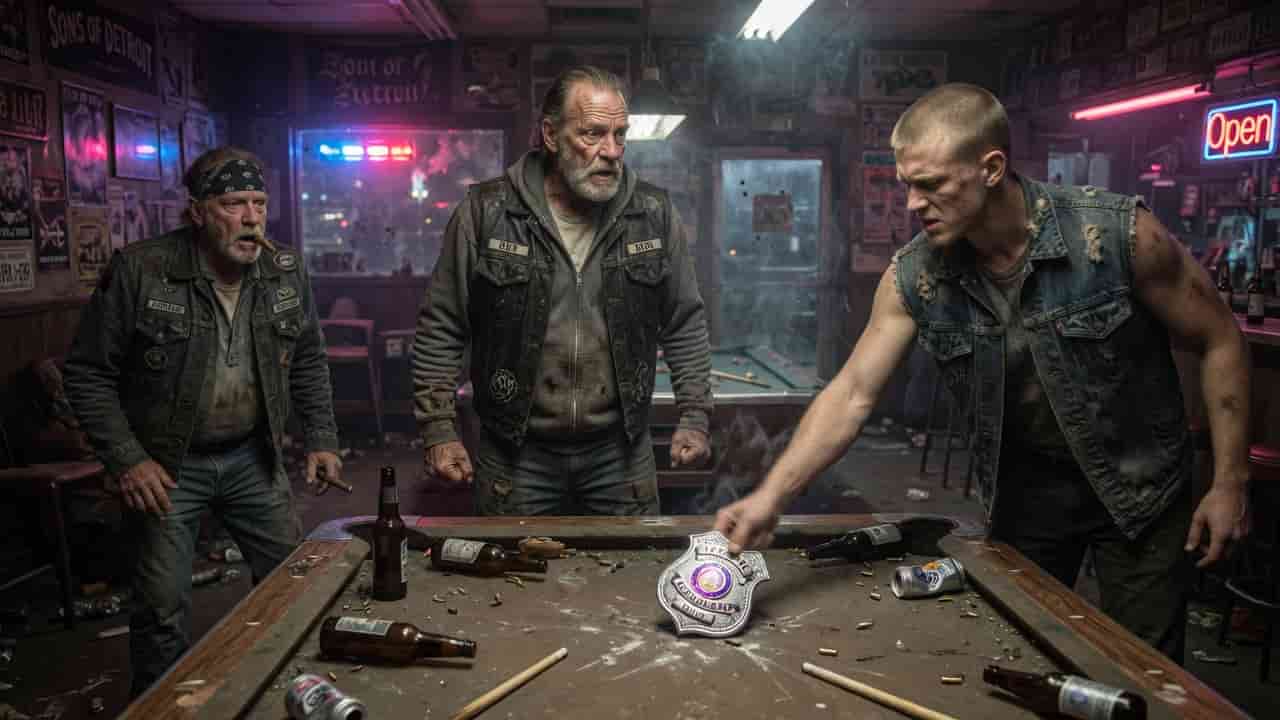
“Whose name is on this, Rick?”
The room went so quiet you could hear the oil dripping from the bikes in the garage. Rookie stood there, his knuckles white against the felt of the pool table, his eyes burning with the kind of hate that only comes from feeling like a fool. He didn’t just find a piece of metal; he found the lie that Rick Dalton had been living for twenty-five years.
Rick didn’t move. He couldn’t. Not with the flashing blue lights of the SWAT vans pulsing against the boarded-up windows, and not with fifty of his men watching him like he was a stranger. He had led the 999 Biker club through the lean years, through the wars, and through the funerals, all while carrying a secret that would make every one of them want to see him gone.
“You’re not hearing me, kid,” Rick rasped, but his voice sounded thin, like old paper.
“I’m hearing the sirens, Rick!” Rookie screamed, his voice echoing off the corrugated steel ceiling. “And I’m looking at a lawman’s patch with your name on it. Are they out there to arrest us, or are they out there to bring you home?”
Chief, the oldest man in the room and the only one Rick truly trusted, let his glass shatter on the floor. He didn’t pick it up. He just looked at Rick—really looked at him—and Rick knew the brotherhood was over before the first door was even kicked in.
Chapter 1: The Rust on the Crown
The rain in Detroit didn’t wash things clean; it just turned the city’s layers of soot into a slick, grey paste that clung to everything. Inside the 999 Biker clubhouse, the air tasted of stale Newport smoke, burnt motor oil, and the kind of sour sweat that comes from men who spend too much time looking over their shoulders.
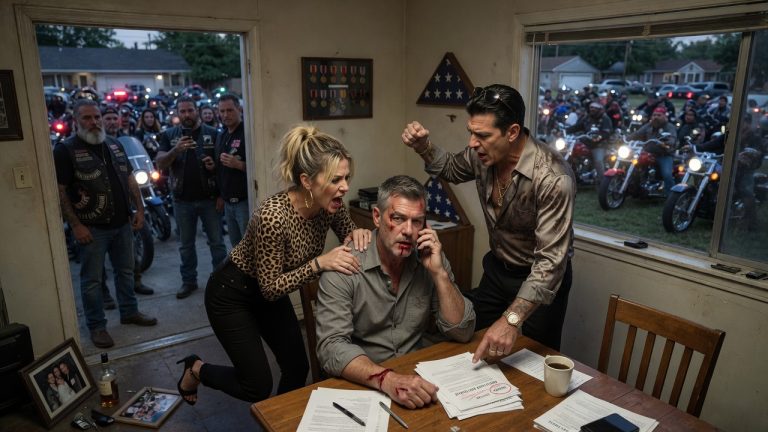
Rick “Rider” Dalton sat at the head of the heavy oak table in the “War Room,” though lately, it felt more like a cage. He was sixty-two, and his joints felt every one of those years, especially the ones he’d spent on the asphalt. He rubbed his thumb over the scarred leather of his vest, tracing the ‘999’ patch. It was a symbol of absolute defiance, or so he told the younger guys. To him, it was a heavy piece of fabric that felt more like a shroud every day.
Outside, the low hum of the city was being swallowed by something sharper. The rhythmic, electronic chirp of a police siren, distant but deliberate.
“They’re circling again, Rick,” Chief said, leaning against the doorframe.
Chief was seventy, with a beard that looked like steel wool and hands that had been broken in so many bar fights they looked like gnarled tree roots. He ran the armory and kept the bikes humming, but mostly, he kept the peace. He was the only one who didn’t call Rick ‘Rider’ when they were alone.
“Miller doesn’t circle unless he smells blood,” Rick said, not looking up. “How’s the gate?”
“Locked. Rookies are on the perimeter. But they’re twitchy. That SWAT van has been parked at the end of the block for three hours. Miller’s making a point.”
Rick stood up, his knees popping with a sound like a small-caliber pistol. He walked to the window, pulling back a sliver of the heavy plywood. The street was a graveyard of industrial skeletons—gutted factories and rusted-out shipping containers. Down at the corner of 4th and Industrial, the black-and-white SUV sat idling, its headlights cutting through the drizzle like the eyes of a predator.
Captain Miller. Rick didn’t need to see him to know he was sitting in that driver’s seat, sipping lukewarm coffee and checking his watch. Miller was the kind of cop who viewed the world as a checklist of things to break. He was younger than Rick, leaner, and fueled by a brand of ambition that didn’t allow for casualties. To Miller, the 999 weren’t just a club; they were the last obstacle between him and a deputy commissioner’s desk.
“He wants Jax,” Rick muttered.
“We all know what Jax did,” Chief said, his voice dropping an octave. “You can’t kill a civilian, Rick. Not even in Detroit. Not anymore. The code doesn’t cover that.”
“The code covers brotherhood, Chief. If I hand Jax over, the club sees it as a betrayal. If I don’t, Miller levels this place with us inside.”
Rick felt the old familiar itch at the base of his skull—the ghost of a life he’d tried to bury thirty years ago. Back when he had a different name and a different set of clothes. Back when he didn’t have to choose between a murderer and a massacre.
He turned away from the window, his eyes catching the light of a small, framed photo on the wall. It was Sarah’s husband, Tommy. Tommy had died three years ago when a bike frame snapped at seventy miles per hour. Rick had been the one to hold him while he bled out on the I-94. He’d promised Tommy he’d look after Sarah. It was the only promise he’d ever made that he intended to keep, and it was the one that made him most vulnerable.
“Get the men in the common room,” Rick said. “I need to talk to them before Miller decides to stop being patient.”
“You going to tell them about the deal?” Chief asked.
“There is no deal yet. Just pressure.”
As Chief walked away, Rick reached into his pocket and pulled out a small, encrypted burner phone. He scrolled to a single contact: Vance.
Commissioner Vance was the only person who knew Rick’s real history. He was the one who had kept Rick’s file in the deep freeze for three decades, using Rick as a back-channel to keep the biker wars from spilling into the suburbs. It was a symbiotic relationship built on mutual blackmail and a shared history of shadows.
He typed: Miller is on my doorstep. Call him off.
The reply came ten seconds later: Jax killed a mother of two. I can’t protect you from that. Give him up or lose the crown.
Rick stared at the screen until it went black. The ‘crown’ was a joke. It was a throne made of rust and broken promises. He shoved the phone back into his pocket and headed toward the common room.
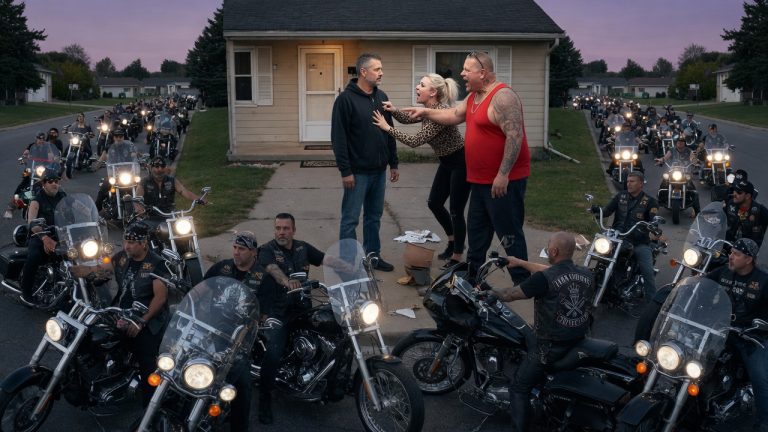
The common room was a cavernous space filled with the smell of floor wax and cheap beer. About forty men were scattered around, some playing pool, others cleaning parts on oily rags. The air was thick with a performative bravado. They were loud, cursing and laughing, but their eyes kept darting toward the boarded-up windows. They knew the score.
At the center of the room was Rookie. He was twenty-two, with a buzzed blonde head and a chip on his shoulder the size of a cinder block. He was a ‘legacy’—his father had been a founder—and he felt he was entitled to a seat at the table he hadn’t earned.
“Hey, Rider!” Rookie shouted, slamming his cue stick down. “When are we going to stop hiding? Miller’s out there mocking us. We got enough fire in the back to take out half the precinct. Let’s show ’em why we’re called the 999.”
A few of the younger guys cheered, a hollow sound that didn’t reach the rafters.
Rick walked up to Rookie, stopping until they were chest to chest. Rick was shorter, but he was dense, a wall of muscle and scar tissue.
“You want to go out there?” Rick asked quietly. “Go ahead. The door isn’t locked from the inside. Walk out that gate and see how long it takes for Miller to put a hole in that pretty blonde head of yours. You think this is a movie, kid? You think you get a respawn?”
Rookie’s face flushed red, a vein in his neck throbbing. “My old man wouldn’t have sat here like a dog in a kennel.”
“Your old man died in a ditch because he didn’t know when to shut up,” Rick snapped. The room went silent. “We’re a club, not a suicide pact. Until I say otherwise, nobody touches a weapon. Nobody goes near the gate. Understood?”
Rookie held Rick’s gaze for a second too long before looking away. “Understood, Rider.”
Rick felt the residue of the encounter—the sharp, acidic taste of disrespect. He was losing them. The younger generation didn’t value the long game; they valued the explosion. And Rookie was exactly the kind of fuse that could blow everything Rick had built.
He walked past them toward the bar, where Chief was pouring a shot of rye.
“You’re hard on him,” Chief whispered.
“I have to be. He’s looking for a reason to lead, and he’s too stupid to realize that leadership is just a fancy word for being the first one to get blamed.”
Rick took the shot, the burn of the whiskey a welcome distraction from the throbbing in his knees. He looked around the room—at the faces of men he’d bled with, men who looked to him for a future that was rapidly evaporating.
He thought about the badge in the safe in his private quarters. A tarnished piece of silver with ‘Dalton’ engraved on the back. He’d kept it as a reminder of the man he killed to become ‘Rider.’ Now, it felt like a ticking bomb.
If Miller broke down that door, he wouldn’t just find Jax. He’d find Rick’s past. And in a world built on the hatred of the law, that was a death sentence more certain than any SWAT sniper’s bullet.
Chapter 2: The Judge and the Jury
The drive to the outskirts of the city was a gauntlet of urban decay. Rick took his old Electra Glide, the vibration of the shovelhead engine rattling his teeth. He needed to see Judge Halloway. If anyone could stall Miller’s warrant, it was the man who had been on the 999’s payroll since the Reagan administration.
Halloway lived in a house that pretended the neighborhood hadn’t died thirty years ago. It was a sprawling Victorian with a manicured lawn that looked obscene against the backdrop of boarded-up liquor stores.
Rick parked the bike and walked up the path, his leather vest attracting the nervous glances of a neighbor walking a poodle. He didn’t care. He was a ghost in this part of town, a remnant of a history they wanted to forget.
Halloway met him in the study, a room lined with leather-bound books that smelled of cedar and old ego. The Judge was eighty, frail, with skin like parchment, but his eyes were still sharp—and greedy.
“You’re a difficult man to see, Richard,” Halloway said, gesturing to a velvet chair.
“The club is under siege, Arthur. Miller’s got a hard-on for a raid, and he’s using the Jax situation as leverage.”
Halloway sighed, pouring two glasses of sherry. “Jax killed a woman in front of six witnesses, Rick. He didn’t even wear a mask. He walked into that convenience store like he owned the air she breathed. I can’t fix that. The DA is already looking at the footage.”
“I don’t need you to fix Jax,” Rick said, leaning forward. “I need you to bury the warrant for the clubhouse. Miller wants to search the premises. He’s looking for the ledger.”
Halloway paused, the glass halfway to his lips. “The ledger? I thought you burned that years ago.”
“I did. But Miller doesn’t know that. He’s convinced I have proof of every payoff, every bribe, and every shipment that went through Detroit since 1995. If he gets inside, he’ll tear the walls down. He’ll find things… things that don’t just involve the club.”
The Judge’s hand trembled slightly. He knew what Rick meant. The 999 weren’t just bikers; they were the middle-men for a dozen different interests in the city, including some that wore judicial robes.
“Miller is a crusader, Rick. He doesn’t take money, and he doesn’t take orders from people like me. He’s got the backing of the Governor’s office on this one.”
“Then find a technicality. A jurisdictional overlap. Anything to buy me forty-eight hours.”
“What happens in forty-eight hours?”
“I handle Jax,” Rick said, his voice flat. “And I move the assets.”
Halloway looked at him for a long time. “You’re tired, aren’t you? I can see it in your eyes. You’ve been playing both sides for so long you’ve forgotten which one is yours.”
“I don’t have a side, Arthur. I just have a club.”
Rick left the house with a promise of a ‘procedural delay,’ but he knew it was a thin shield. Halloway was a sinking ship, and the Judge was looking for a lifeboat.
As he rode back toward the clubhouse, he took a detour through the old Polish neighborhood. He stopped in front of a small, neat bungalow with a swing set in the yard. Sarah was out front, hanging laundry. She looked younger than her forty years until you saw her eyes—they were heavy with the kind of permanent fatigue that only comes from losing the person you thought you’d grow old with.
He hopped off the bike and walked toward the fence. She didn’t smile, but her posture relaxed.
“Hey, Sarah.”
“Rick. You look like you haven’t slept in a week.”
“Occupational hazard,” he said, reaching into his pocket and pulling out an envelope of cash. It was the monthly ‘pension’ the club paid to its widows.
She took it without looking at it. “There’s talk on the news, Rick. They’re saying the club is involved in that shooting at the deli.”
“Jax is an idiot. He’s not the club.”
“People don’t see the difference. They see the patch, and they see a monster. Tommy… Tommy used to say you were the only thing keeping the monsters at bay. Is that still true?”
Rick looked at the ground, the wet asphalt reflecting the grey sky. “I’m trying, Sarah. But the walls are getting thinner.”
“If things go bad, Rick… don’t come here. I can’t have that life on my porch. Not with the kids.”
“I know,” he said, the words sticking in his throat.
The residue of the conversation followed him all the way back to the clubhouse. It was a cold, hollow feeling—the realization that the people he was trying to protect were the ones most afraid of him.
When he pulled up to the gate, Rookie was waiting. The kid looked smug.
“Chief wants you in the back,” Rookie said, his voice dripping with an unearned authority. “We got a problem.”
Rick ignored him and walked into the garage. In the center of the floor, Jax was sitting on a crate, his hands shaking as he tried to light a cigarette. He was twenty-four, covered in tattoos that he’d gotten to look tough, but right now, he just looked like a scared animal.
Chief was standing over him, his face a mask of disappointment.
“He tried to bolt,” Chief said. “Rookie caught him trying to climb the back fence.”
Rick walked up to Jax. The kid looked up, tears welling in his eyes.
“I didn’t mean to do it, Rider. She started screaming… I just wanted her to stop screaming.”
“You killed a woman for sixty dollars and a pack of smokes, Jax,” Rick said, his voice like grinding stones. “You broke the first rule. You brought the heat to the house.”
“Don’t give me to them,” Jax pleaded, reaching for Rick’s vest. “Please. I’m a brother.”
“Brotherhood ended when you pulled that trigger,” Rick said.
But he didn’t hand him over. Not yet. Because he knew the moment he gave Jax to Miller, the club’s internal pressure would hit a breaking point. Rookie was already whispering to the others, telling them that Rick was getting soft, that he was looking for an out.
“Put him in the basement,” Rick ordered. “Lock the door. Chief, you stay with him.”
As they dragged Jax away, Rookie stepped into Rick’s path.
“You’re protecting a murderer, Rider. That’s not what we do. We’re supposed to be ‘Outlaws,’ not ‘Hideouts.'”
“You want to lead, kid?” Rick asked, stepping into Rookie’s space. “Then you handle the forty SWAT guys outside. You handle the Judge who’s about to turn state’s evidence. You handle the widows who are terrified their kids are going to grow up without a father. You want the patch? Take it. But you take the weight too.”
Rookie didn’t back down this time. He just smiled—a thin, cruel line. “Maybe the weight is only heavy because you’re carrying too many secrets, Rick.”
Rick felt a jolt of ice in his chest. Rookie didn’t know. He couldn’t know. But the kid was digging, and in a place like the 999, if you dug deep enough, all you found was bones.
Chapter 3: The Ghost in the Radio
The basement of the clubhouse smelled of damp concrete and ancient sins. Rick sat at a small desk in his private office—a windowless room tucked behind the main furnace. This was where he kept the real history of the 999. Not the ledger Miller was looking for, but the things that actually mattered.
He opened a small floor safe, the tumblers clicking with a precision that calmed his nerves. Inside was a stack of old files, a few gold coins, and a heavy, outdated police radio. It was a Motorola from the late nineties, its casing scratched and faded.
He turned it on. Static filled the room, a white noise that felt like a heartbeat. He tuned it to a frequency that shouldn’t have existed.
“Vance,” he said into the mic.
A few seconds passed. “You’re taking a risk, Rick. The digital forensics team is monitoring the airwaves.”
“Miller is moving up his timeline. Halloway couldn’t stop the warrant. He’s coming in at dawn.”
“I told you,” Vance’s voice was distorted, ghostly. “Jax is a dead weight. Give him up, and I can tell Miller the clubhouse is off-limits. I’ll say it’s an ongoing federal investigation.”
“And what happens to me when Miller finds the old files in the precinct? He’s digging into the 1998 cold cases, Vance. He’s looking at the ‘Blue Biker’ operation.”
The line went silent for a long beat. “That operation was scrubbed. Your name was removed.”
“Miller is smart. He’s looking at the signatures on the evidence bags. He’s looking for ‘Detective Dalton.’ If he connects the dots, your career is over too.”
“Then do what you have to do, Rick. But do it quietly. If there’s a gunfight at that clubhouse, I can’t bury the bodies.”
Rick clicked the radio off. The residue of the conversation was a thick, greasy layer of guilt. He was a man who had betrayed everyone he’d ever known to survive, and now, the survival was the very thing killing him.
He reached back into the safe and pulled out a small velvet pouch. Inside was the badge. He held it in his palm, the cold metal biting into his skin. Detective Richard Dalton. Detroit PD.
He’d been an undercover operative, sent in to dismantle the 999 from the inside. But the department had hung him out to dry during a botched raid. They’d left him in a warehouse with two broken ribs and a dead partner. The club had been the ones to pick him up. They’d patched him up, fed him, and given him a name. He’d stayed because the ‘monsters’ were more honest than the men in the suits.
He heard a noise at the door—a soft, rhythmic thud.
He shoved the badge and the radio back into the safe and locked it just as the door pushed open. It was Sarah. She wasn’t supposed to be here.
“The front gate was open,” she said, her voice trembling. “The boys… they’re drinking, Rick. They’re talking about a war.”
“I told you to stay home, Sarah.”
“I couldn’t. I had a feeling. You have that look on your face… the one Tommy had before he didn’t come back.”
She walked over to him, her hand resting on his shoulder. Rick felt a surge of tenderness so sharp it hurt. He wanted to tell her everything. He wanted to tell her he was a lie, that her husband had died for a man who didn’t exist.
“I’m getting everyone out,” Rick said. “Tonight. I’m going to surrender Jax, and then I’m dissolving the club.”
“They won’t let you,” she whispered. “Rookie is in the garage telling everyone that you’re a sell-out. He says you’ve been talking to the cops.”
Rick’s heart hammered against his ribs. “How does he know?”
“He doesn’t. He’s guessing. But people are listening because they’re scared. They need a villain, Rick, and right now, you’re the easiest one to cast.”
“Go home, Sarah. Please. Take the back alley. Don’t let anyone see you.”
“Rick…”
“Go!”
He watched her leave, her small frame disappearing into the shadows of the basement. He felt a profound sense of isolation. He was the king of a hill that was collapsing into the sea.
He walked up the stairs, his mind racing. He needed to get the safe out of the building. He needed to destroy the evidence before Miller arrived.
In the common room, the atmosphere had shifted from tension to toxicity. The music was off. The men were gathered in a circle around Rookie, who was standing on a chair.
“He’s been gone for hours!” Rookie shouted. “Where does a ‘Biker’ go when the heat is on? He goes to see his handlers! My dad told me stories about how the club was infiltrated back in the day. How the cops sent in a rat to take us down. Maybe that rat never left. Maybe he just grew a beard and started calling himself ‘Rider.'”
Rick stepped into the light, his eyes cold. “Get off the chair, kid.”
The room went still. The men looked between Rick and Rookie, the loyalty in the room flickering like a dying candle.
“Where were you, Rick?” Rookie asked, jumping down. “Who were you talking to?”
“I was making sure you don’t all end up in a federal prison,” Rick said. “I was buying us time.”
“Or you were buying yourself a deal,” Rookie countered. He looked around at the others. “We’re the 999. We don’t buy time. We take it. If Miller wants Jax, he has to come through all of us. But Rick here… he’s ready to open the gate and hand us over on a silver platter.”
“I’m handing over a murderer,” Rick said, his voice rising. “A man who killed a mother in cold blood. If that’s what this club has become, then it deserves to burn.”
A murmur of dissent rippled through the crowd. To these men, the crime didn’t matter as much as the betrayal of the brotherhood.
“He’s hiding something,” Rookie said, his voice dropping to a dangerous whisper. “He spends all his time in that basement office. Why? What’s in that safe, Rick? Is it the names of every man in this room? Is it our lives?”
“It’s none of your business,” Rick said, but he knew he’d lost the room.
Chief stepped forward, trying to intervene. “Enough! Rider is the president. He’s earned his seat. Rookie, you’re out of line.”
“I’m the only one in line!” Rookie screamed.
The sound of a heavy engine idling outside cut through the argument. The SWAT vans were moving. The lights were no longer circling—they were focused.
“They’re at the gate,” someone yelled.
Panic erupted. Men scrambled for weapons. In the chaos, Rookie locked eyes with Rick. There was no fear in the kid’s eyes, only a predatory gleam. He knew he didn’t have to win the argument—he just had to wait for the collapse.
Rick turned and ran back toward the basement. He had to get the badge. He had to get the radio. If Miller found them, it wouldn’t matter if he gave up Jax or not. He’d be a dead man walking, hated by the law and hunted by the outlaws.
Chapter 4: The Silver Exposure
The basement was a blur of shadows and sharp breaths. Rick reached his office, his hands shaking as he spun the dial on the safe. Left 22, Right 14, Left 39. The door clicked open. He grabbed the velvet pouch and the radio, shoving them into the inner pocket of his vest. He felt the weight of them against his ribs—a physical manifestation of his double life.
As he turned to leave, the floorboards above him groaned. A heavy, rhythmic thudding—the sound of boots. Not the disciplined stomp of SWAT, but the chaotic, heavy tread of bikers.
“In here!” Rookie’s voice echoed through the hallway.
Rick tried to shove the safe door closed, but a boot wedged into the gap. Rookie burst into the room, followed by two of his lieutenants—Sully and Tiny. They were young, fueled by adrenaline and a misguided sense of purity.
“Looking for your exit strategy, Rick?” Rookie asked, his chest heaving.
“Get out of my office,” Rick said, his voice a low, dangerous growl. He reached for the heavy iron paperweight on his desk, but Sully grabbed his arm, twisting it behind his back.
“You’re done giving orders,” Rookie said. He looked at the open safe. His eyes narrowed. “What’s this? No ledger? No money?”
He reached in and pulled out a stray folder—an old report from the 1998 investigation. He flipped it open. “What the hell is ‘Operation Blue Biker’?”
“Give it to me,” Rick pleaded, struggling against Sully’s grip.
Rookie ignored him, his eyes scanning the pages. His face went pale, then bright red. “This is a surveillance report. On my father. It’s signed by a Detective Richard Dalton.”
He looked at Rick, the realization hitting him like a physical blow. “Dalton. Richard Dalton. Rick… Rider…”
“Rookie, listen to me,” Rick said, his voice cracking. “The department abandoned me. I became one of you. I protected this club for thirty years.”
“You spied on us,” Rookie whispered, the betrayal dripping from his words. “You watched my father go to prison while you sat at his table and drank his beer.”
He lunged forward, grabbing Rick by the collar of his vest. He began to tear at the pockets, his fingers searching. Rick fought, but Tiny grabbed his other arm, pinning him against the wall.
“What else are you hiding, you rat?”
Rookie’s hand dived into Rick’s inner pocket. He pulled out the velvet pouch.
“No,” Rick groaned.
Rookie ripped the pouch open. The silver badge tumbled out, clattering onto the concrete floor before Rookie scooped it up. He held it up to the dim light of the single overhead bulb.
“A lawman’s patch,” Rookie said, his voice trembling with a mixture of horror and triumph. “With your name on it.”
“It’s a trophy!” Rick shouted, a desperate lie. “I took it from the man who broke my ribs!”
“You’re a liar,” Rookie said. “And everyone is going to see it.”
He grabbed Rick by the hair and dragged him toward the stairs. “Bring him! Bring the rat!”
They emerged into the common room. The chaos of the impending raid had frozen into a weird, expectant silence. Outside, the sirens were a constant, deafening wail, and the sound of a megaphone was calling for surrender. But inside, the focus was entirely on the man being dragged across the floor.
Rookie threw Rick toward the pool table. Rick hit the edge, the breath leaving his lungs in a painful wheeze. He looked up to see Chief standing by the bar, his face etched with a deep, weary sorrow.
“Look at him!” Rookie screamed, his voice reaching a fever pitch. “Look at our ‘Leader’!”
He slammed the silver badge onto the pool table, the metal ringing out like a bell.
“Whose name is on this, Rick?” Rookie demanded, leaning over the table, his face inches from Rick’s.
The club members crowded around, their faces a gallery of shock, anger, and confusion.
“I found it in his safe,” Rookie told the room. “Along with a police radio and files on all our fathers. He’s not one of us. He never was. He’s a detective. He’s the reason the SWAT is out there right now.”
Rick looked at the badge, then at the men he’d called brothers. He saw Sully’s disgust, Tiny’s confusion, and then he looked at Chief.
“Chief,” Rick whispered. “I didn’t bring them here.”
Chief didn’t answer. He just looked at the badge on the table. He reached out, his g
Chapter 5: The Weight of the Silver
The silence in the common room was a physical weight, heavier than the leather of their vests, thicker than the exhaust fumes that usually filled the rafters. Rick stood by the pool table, the green felt a mocking backdrop to the tarnished silver badge that seemed to pulse under the flickering fluorescent lights. He could hear the rain drumming on the corrugated steel roof—a relentless, jagged sound that matched the thudding in his chest. Outside, the megaphone crackled again, Captain Miller’s voice amplified into a metallic god-complex, demanding the release of Jax and the unconditional surrender of the 999.
Inside, the gods were much more intimate, and much more vengeful.
“Is it true, Rick?” Chief asked again. His voice wasn’t loud. It was the sound of a man watching his house burn down and realizing he was the one who left the stove on.
Rick looked at Chief, seeing the decades of shared road, the nights spent over broken engines, the funerals they’d both stood through with heads bowed. “The name on the badge is mine, Chief. I can’t lie about that.”
“A detective,” Rookie spat, the word coming out like a mouthful of bile. He circled the pool table, his boots clicking on the concrete. He didn’t look like a kid anymore; he looked like a predator that had finally cornered the alpha. “Thirty years. My old man went to Jackson for five years because of a ‘confidential informant’ in the ninety-eight sweeps. You were at my house for Christmas dinner that year, Rick. You brought me a plastic motorcycle. You sat on our couch while my mother cried because she didn’t know how she was going to pay the heat bill.”
The room seemed to shrink. The forty men surrounding them were no longer a brotherhood; they were a jury. Rick saw Sully shift his grip on a heavy iron wrench. He saw Tiny’s hand drift toward the holster at his hip. These were men who lived by a single, unyielding truth: the law was the enemy, and a rat was lower than the dirt under a kickstand.
“I didn’t send your father away, Rookie,” Rick said, trying to keep his voice level despite the tremor in his hands. “I was undercover. My job was to dismantle the leadership. But the department… they didn’t care about the truth. They just wanted numbers. When the raid went south, they left me for dead. I stayed because you people were the only ones who didn’t throw me away.”
“You stayed because it was the perfect cover!” Rookie shouted, his face turning a dark, bruised purple. He grabbed the badge off the table and shoved it into Rick’s face, the sharp edges of the silver catching the light. “You want us to believe you’re one of us? You’ve been a parasite. Sucking the life out of this club, keeping us just small enough to manage, just quiet enough so your handlers could sleep at night.”
Rookie turned to the room, raising the badge high like a trophy. “He’s been playing us since before most of you were born. Every time we lost a shipment, every time a brother got pulled over with a ‘random’ warrant, it was him. He’s been the leash around our necks.”
“That’s not true,” Rick rasped. He looked around the room, searching for a single face that didn’t hold pure, unadulterated hatred. He found none. Even the men he’d personally bailed out, whose children’s hospital bills he’d paid with club funds, were looking away. The residue of thirty years of loyalty was being washed away by a single piece of metal.
“Then explain the radio, Rick,” Rookie said, his voice dropping to a low, mocking hiss. “Explain why you were talking to the Commissioner ten minutes ago while we were preparing for a goddamn war.”
“I was trying to call off the SWAT,” Rick said. “I was trying to save your lives.”
“We don’t need a lawman to save us,” Sully growled, stepping forward. He was a massive man with a scarred forehead and a permanent scowl. He’d been Rick’s enforcer for a decade. “We need a brother. And we don’t have one at the head of this table.”
Sully lunged. It wasn’t a clean punch; it was a desperate, heavy swing born of pure betrayal. Rick tried to duck, but his knees betrayed him, a sharp flare of arthritis locking his joints. The blow caught him on the temple, sending him reeling back against the pool table. The world turned into a dizzying swirl of grey and red.
He felt hands on him—heavy, calloused hands that he had shaken in friendship a thousand times. They weren’t friendly now. They dragged him upright, pinning his arms behind his back.
“Let him go!” Chief shouted, but his voice lacked its usual authority. He was an old man in a room full of young, angry blood.
Rookie stepped in front of Rick, his eyes wide and wild. He reached out and ripped the ‘999’ patch from Rick’s vest. The sound of the stitches tearing was louder than the sirens outside. It was the sound of Rick’s life being unmade.
“You don’t get to wear the colors,” Rookie said, throwing the patch onto the floor and grinding it into the grease with his heel. “You’re not ‘Rider.’ You’re just a cop in a leather jacket.”
The humiliation was a physical coldness that seeped into Rick’s bones. He looked down at the empty space on his chest, feeling a profound sense of nakedness. For thirty years, that patch had been his skin. It had been the only thing that made sense in a world of lies. Now, he was just Richard Dalton again—a man with no home, no family, and a countdown ticking in the street outside.
“What do we do with him?” Tiny asked, his hand still hovering over his gun. “Miller is going to kick the door in any minute. If they find a cop tied up in here, they’ll kill us all before we can even put our hands up.”
“Maybe that’s the point,” Rookie said, a cruel smile spreading across his face. “Maybe we give Miller what he wants. We give him Jax, and we give him his long-lost hero. We throw them both out the front gate and let the law handle its own trash.”
“No,” Rick said, his voice stronger now, fueled by a sudden, sharp desperation. “If you give me to Miller, he’ll kill me himself. He knows I have the history. He knows I know where the bodies are buried—both the ones the club dropped and the ones the precinct hid. Miller isn’t here for justice, Rookie. He’s here for a cleanup.”
“Why should we care if he kills you?” Sully asked, tightening his grip on Rick’s arm until the bone groaned. “You’re already dead to us.”
“Because if I die, the files in that safe stay hidden,” Rick lied, his mind racing. He had to keep them in the building. He had to keep them alive. “And those files are the only thing keeping Halloway and the rest of the city council from letting Miller level this neighborhood. You kill me, you kill the only leverage the 999 has left.”
Rookie looked at the safe in the corner of the office doorway, then back at Rick. He was wavering, the greed for power battling the hunger for revenge.
The sound of a window shattering in the kitchen cut through the tension. A canisters of tear gas skittered across the linoleum, hissing like a nest of snakes. White, acrid smoke began to billow into the common room.
“They’re coming!” someone screamed.
Chaos erupted. Men scrambled for masks, for weapons, for exits that didn’t exist. The bravado of the last hour vanished, replaced by the raw, animal panic of being trapped.
In the confusion, Sully let go of Rick’s arm to grab his rifle. Rick slumped to the floor, coughing as the gas hit his lungs. He crawled toward the pool table, his eyes streaming. He found the badge where Rookie had dropped it. He closed his hand around it, the metal hot against his palm.
He looked up through the haze and saw Chief standing over him. The old man was wearing a heavy industrial respirator, his eyes behind the goggles filled with a terrible, silent judgment.
“You should have told me, Rick,” Chief said, his voice muffled by the mask. “I would have helped you bury it. But you let me believe in a lie for thirty years. I loved you like a brother. And a brother doesn’t let a man build his life on a foundation of rot.”
Chief didn’t help him up. He just turned and disappeared into the smoke, heading toward the armory.
Rick was alone. He was in the center of the room he had ruled for three decades, surrounded by the men he had protected, and he was completely, utterly alone. He could hear the heavy thud of a battering ram hitting the front gate. Thump. Thump. Thump.
He pulled himself up, using the pool table for support. The gas was getting thicker, turning the room into a ghost world of shifting shadows and muffled shouts. He knew the layout of the clubhouse better than anyone—every loose floorboard, every hidden crawlspace. He could slip out the back, through the old coal chute in the basement. He could disappear into the Detroit night, leave the badge, leave the club, and try to find Sarah.
But he looked at the ‘999’ patch lying in the dirt, the one Rookie had stomped on. He thought about the men in the room—stupid, violent, loyal, and doomed. They were his fault. Every choice they had made for thirty years had been filtered through his lies.
He didn’t head for the basement. He headed for the front door.
He found Rookie near the foyer, huddled behind a heavy oak sideboard, a chrome-plated .45 in his hand. The kid was shaking, the reality of a SWAT breach finally overriding his ego.
“Give me the gun, kid,” Rick said, his voice a rasping command.
“Get away from me, rat!” Rookie screamed, leveling the pistol at Rick’s chest.
“Miller is going to come through that door with infrared and flashbangs,” Rick said, stepping toward him, ignoring the barrel of the gun. “He’s not going to ask for your name. He’s going to see a weapon and he’s going to fire. You want to die for a patch you haven’t earned? Or do you want to live long enough to actually lead these men?”
Rookie’s eyes flickered toward the door as the first flashbang detonated. The sound was a physical punch to the head, a white-hot explosion of light and noise that left Rick’s ears ringing with a high-pitched whine.
In the split second of disorientation, Rick lunged. He grabbed Rookie’s wrist, twisting the gun away with a strength born of pure adrenaline. Rookie collapsed, clutching his ears, his face contorted in a silent scream.
Rick stood over him, the .45 heavy in his hand. He looked at the door. The wood was splintering, the heavy steel bar groaning under the pressure of the ram.
He reached down and grabbed Rookie by the collar, dragging him back toward the hallway.
“Stay down!” Rick shouted over the roar of the sirens. “Stay down and don’t move!”
He turned back to the door just as it gave way. The front entrance exploded inward in a shower of splinters and dust. Through the haze, the black-clad figures of the SWAT team appeared, their laser sights cutting through the smoke like red needles.
“Police! Drop the weapon!”
Rick didn’t drop it. He held the gun at his side, his finger off the trigger. He looked at the lead figure—a man with a tactical vest that read MILLER.
“It’s over, Captain!” Rick shouted, his voice echoing in the ruined foyer. “I have the murderer! I have the evidence! Stand your men down!”
Miller stopped, his rifle leveled at Rick’s head. He tilted his head slightly, the red dot of his sight dancing across Rick’s forehead.
“Detective Dalton,” Miller said, his voice clear even through the chaos. “I heard you were dead.”
“I was,” Rick said, his grip tightening on the silver badge in his left hand. “But I decided to come back for the funeral.”
Chapter 6: The Last Ride of Richard Dalton
The air in the foyer was a toxic soup of dust, cordite, and the metallic tang of fear. The red laser dots of twenty rifles converged on Rick’s chest, a constellation of death held in check by a single man’s curiosity. Captain Miller stepped forward, his movements deliberate and predatory. He lowered his rifle slightly, but his finger remained married to the trigger.
“You’ve got a lot of nerve using that name, Rick,” Miller said. The black visor of his helmet reflected the strobe lights of the cruisers outside, making him look less like a man and more like a machine. “Richard Dalton died in a warehouse fire in ninety-nine. The city paid for the casket. They even gave his widow a folded flag.”
“The casket was empty, Miller. You know that. Vance knows that. The only thing that died in that fire was my patience for the department.”
Rick looked past Miller at the tactical team. They were young, their faces hidden behind masks, their bodies encased in ceramic plates. They were the version of himself he had been thirty years ago—convinced that the world was a map of clear borders and that they were the ones holding the compass.
“I’m not here to talk about the past,” Miller said. “I’m here for Jax. And I’m here to execute a search warrant on this den of thieves. Drop the gun, Rick. Don’t make me add ‘cop-killer’ to the list of things I have to write in the report.”
“Jax is in the basement,” Rick said, his voice steady. “Chief is with him. He won’t resist if I’m the one who goes down there. But if you send your boys in, they’ll trip the wires. Chief isn’t just an armorer, Miller. He’s a combat engineer. He’s got enough C4 under the floorboards to take out the entire block.”
It was a lie, a desperate gamble built on the reputation Chief had cultivated for years. But Miller hesitated. He knew the 999 weren’t just a street gang; they were a legacy club with resources and a deep, abiding hatred for the police.
“Why should I believe you?” Miller asked.
Rick held up his left hand, opening his palm. The silver badge sat there, tarnished and scarred, but unmistakably real. “Because I’m still on the job, Captain. Even if the payroll office forgot about me. I’ve spent thirty years doing what the department couldn’t—keeping this city from tearing itself apart. I have the ledger. I have the names. And I have the proof of every payoff you’ve taken from Halloway to keep the docks open for the shipments.”
The red dots on Rick’s chest wavered. The men behind Miller shifted, their internal loyalty to the ‘brotherhood’ of the badge suddenly conflicting with the realization that their commander might be compromised.
Miller’s jaw tightened. “You don’t have anything but a dead man’s shield and a mouth full of lies.”
“Try me,” Rick said. “Let my men walk. Every one of them except Jax. They leave through the back, no weapons, hands on their heads. You get your murderer, you get your headlines, and I give you the ledger. We walk away, and Detroit stays quiet for another twenty years.”
“And what happens to you?” Miller asked, his eyes narrowing.
“I go with the boys,” Rick said. “I finish what I started.”
From the shadows behind the sideboard, Rookie let out a choked, hysterical laugh. “He’s still doing it! Even now, he’s trying to play both sides! He’s trying to buy our freedom with his own soul!”
Rookie stood up, his face smeared with soot and tears. He looked at Miller, then at Rick. “He’s lying, Officer! He doesn’t have the ledger! He burned it years ago! The only thing he has is that badge and a basement full of secrets he’s too scared to tell!”
The balance of the room tipped. Miller saw the opening—the fracture in the enemy’s front. He raised his rifle again, the red dot settling squarely between Rick’s eyes.
“Thank you, son,” Miller said to Rookie. “You just simplified my evening.”
“Miller, don’t,” Rick warned, but it was too late.
Miller didn’t fire at Rick. He fired at the ceiling—a signal. The flashbangs went off in the kitchen and the common room simultaneously. The sound was a physical wall of force that knocked Rick to his knees.
Through the white-out, he heard the screaming of the club members as the SWAT team moved in. It wasn’t a tactical arrest; it was a purge. He heard the heavy thwack of batons hitting flesh, the zip-tie cuffs clicking, the grunts of men being slammed into the concrete.
Rick scrambled toward the hallway, his vision blurred. He had to get to the basement. He had to get to Chief.
He felt a heavy boot hit his ribs, sending a flare of agony through his side. He rolled, gasping for air, and saw Miller standing over him. The Captain had removed his helmet, revealing a face that was cold, handsome, and utterly devoid of mercy.
“You were a legend, Rick,” Miller said, looking down at him. “The ‘Blue Biker.’ The man who went so deep he forgot to come up for air. But legends are better when they’re dead. They don’t talk back, and they don’t hold onto files they shouldn’t have.”
Miller raised his pistol, his movements slow and clinical.
A shot rang out from the darkness of the hallway. Miller’s shoulder jerked back as a bullet tore through the meat of his arm. He cried out, dropping his pistol and stumbling back.
Chief stepped into the light. He was carrying a short-barreled shotgun, his face a mask of ancient, weary resolve. He didn’t look at Miller. He looked at Rick.
“Go, Richard,” Chief said. “Take the girl. Take the kids. Get out of this city.”
“Chief, no—”
“I knew,” Chief said, his voice a gravelly whisper. “I’ve known since the ninety-eight sweeps. I saw you at the precinct that night, coming out of the back entrance. I never said anything because I thought you were ours now. I thought the man you became was better than the man you were.”
Chief turned the shotgun toward the advancing SWAT team. “I’m an old man, Rick. I’ve lived a hundred years in this basement. I don’t want to see the sun anymore. But you… you still owe Tommy. You still owe Sarah. Go!”
Rick didn’t argue. He couldn’t. He saw the first tactical team members rounded the corner, their rifles rising. He turned and ran toward the basement stairs, the sound of Chief’s shotgun booming behind him—a rhythmic, defiant roar that echoed through the ruins of the clubhouse.
He hit the basement floor, his lungs burning. He didn’t go to his office. He went to the coal chute. He scrambled up the rusted metal incline, his fingers clawing at the grit, until he burst out into the alleyway behind the building.
The rain was coming down in sheets now, a cold, cleansing deluge that soaked through his leather vest in seconds. He could hear the sirens, the shouts, the sound of breaking glass. The 999 was dying. The legacy was being dismantled in a storm of blue and red lights.
He ran. He ran through the blackened streets of Detroit, past the gutted factories and the abandoned homes, until he reached the small bungalow with the swing set in the yard.
Sarah was standing on the porch, a coat thrown over her nightgown, her eyes wide with terror as she watched the distant glow of the clubhouse fire on the horizon.
Rick stopped at the gate, his breath coming in ragged gasps. He was covered in soot, blood, and the residue of a life he had failed to escape.
“Rick?” she whispered.
He reached into his pocket and pulled out the silver badge. He looked at it for a long second—the man he was, the man he pretended to be, and the man he had become. He threw it into the gutter, watching as the rainwater swept it down toward the sewer grate.
“We have to go, Sarah,” he said, his voice breaking. “We have to go right now.”
“What about the club? What about Tommy’s brothers?”
“They’re gone,” Rick said, taking her hand. His grip was tremulous, but firm. “It’s just us now.”
He looked back at the city. The smoke from the clubhouse was rising into the rainy sky, a dark, heavy pillar that looked like a scar on the horizon. He thought about Chief. He thought about Rookie, sitting in a cell, finally realizing that the ‘crown’ was made of thorns. He thought about the man called ‘Rider,’ and he realized he couldn’t even remember the sound of that man’s laugh.
He turned away from the fire and walked toward the old truck parked in the driveway. He didn’t look back again. He was sixty-two years old, his body was broken, his name was a lie, and his brothers were ghosts.
But as he pulled out onto the wet asphalt, heading toward the highway that led away from the rust and the ruin, he felt a strange, terrifying lightness in his chest. For the first time in thirty years, Rick Dalton wasn’t looking over his shoulder. He was just a man in the rain, driving toward a morning that didn’t belong to anyone but him.
The ‘Lawman’s Patch’ was gone, buried in the Detroit mud. And as the city lights faded in the rearview mirror, Rick finally understood that the only way to truly survive a secret is to let it burn until there’s nothing left to hide.