
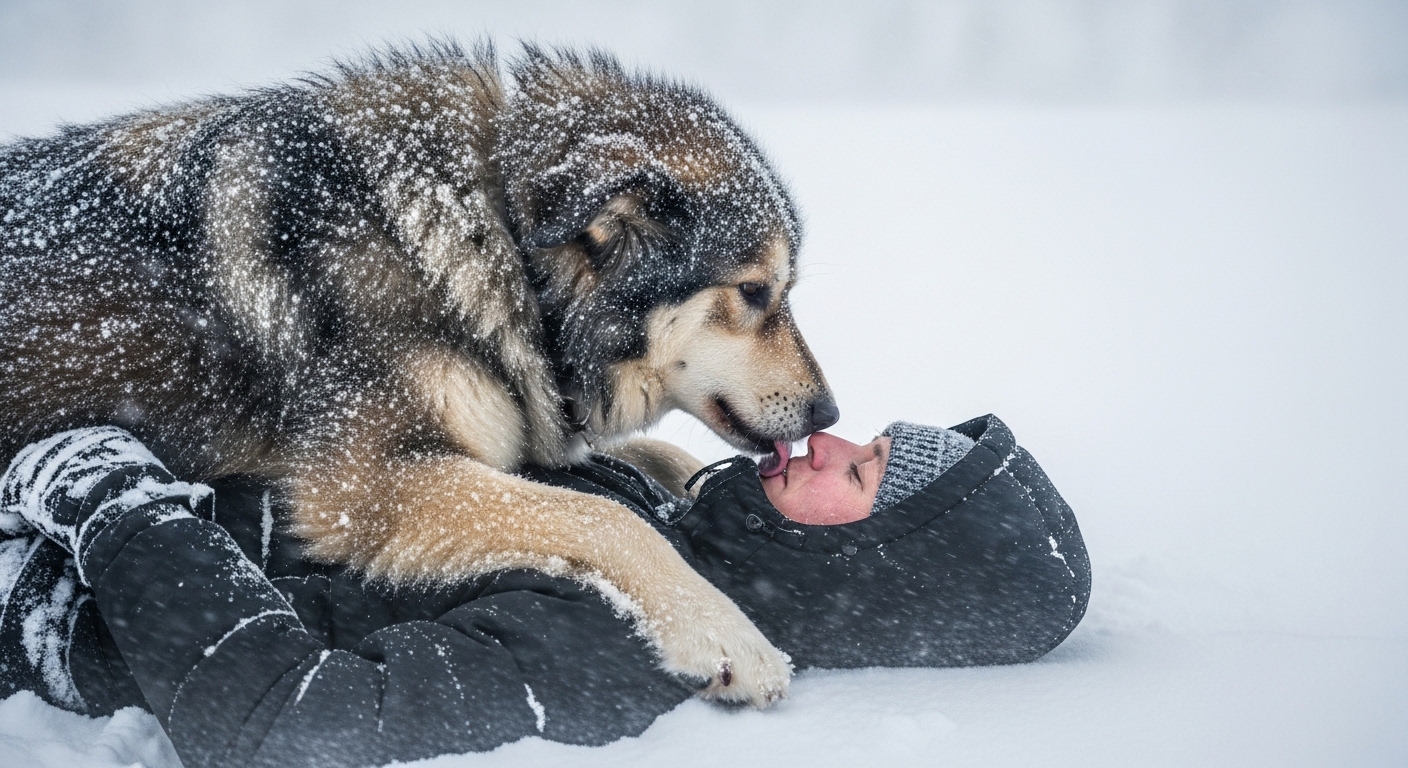
The darkness didn’t come with a scream; it came with a handful of tiny white pills and a silence so heavy I thought I’d finally found peace. I felt worthless, a shadow in my own life, ready to let go. But my dog saw a version of me I had forgotten existed—and she refused to let me disappear.
I was tired. Not the kind of tired a nap fixes, but the kind that settles into your bones until you feel like a ghost haunting your own skin.
I sat on the edge of my bed, the shadows of the room swallowing everything I once loved. In my hand was the bottle—my “exit strategy.” I told myself the world would be lighter without my weight on it. I told myself I was doing everyone a favor.
Then there was Daisy.
She didn’t know about my failures. She didn’t know about the debt, the heartbreak, or the crushing loneliness. To her, I was simply her entire world.
As I tipped the bottle back, I felt a sudden, sharp jolt. Daisy wasn’t just sitting there anymore. She lunged, her snout hitting my arm with a force that sent the bottle flying. It hit the nightstand and clattered to the floor, the remaining pills scattering like tiny, broken promises.
“Daisy, stop,” I choked out, my voice sounding like gravel.
But she wouldn’t. She began to bark—not her “squirrel at the window” bark, but a frantic, guttural sound of pure desperation. She jumped onto the bed, her seventy-pound body pinning me down, her tongue licking the salt from my cheeks as she let out a whimpering cry I’ll never forget.
She looked me right in the eyes, her golden gaze pleading, screaming at me to stay. In that moment, through the fog of my own despair, I realized that if I left, she’d be waiting at that door forever.
With shaking fingers, I reached for the phone. “I need help,” I whispered to the operator. “Please… my dog… she won’t let me go.”
Chapter 1: The Quietest War
The apartment in Seattle was too quiet. For Marcus, the silence was a predator. Six months ago, he had been a lead architect with a fiancée and a bright future. Today, he was a man in a darkened bedroom, surrounded by “Past Due” notices and the wreckage of a life dismantled by a single, tragic mistake on a construction site that wasn’t even his fault.
The legal fees had eaten his savings. The stress had eaten his relationship. And now, the depression was eating what was left of his soul.
“It’s okay, Daisy,” he whispered, patting the mattress. The Border Collie hopped up, her tail giving a tentative wag. She was the only thing Marcus hadn’t lost in the “great collapse.”
But even her love felt like a burden today. She deserves someone who can afford the good kibble, he thought. Someone who can take her to the park without having a panic attack.
He reached into the drawer and pulled out the bottle of high-strength sedatives he’d been hoarding. He didn’t leave a note. He felt like he’d already said everything he had to say, and no one had been listening anyway.
He swallowed the first three pills with a swig of warm water. The darkness felt inviting, like a heavy velvet curtain about to drop.
But Daisy was a working dog, and her “job” was Marcus. She sensed the chemical shift in the room, the sudden drop in his heart rate, and the surrender in his eyes. She didn’t just sit by. She acted. With a sharp, frantic yip, she dove at his arm, sending the bottle spinning across the room.
The clatter of plastic on wood sounded like a gunshot in the silence.
Chapter 2: The Confrontation
“Daisy, leave it!” Marcus snapped, his head already starting to swim.
But Daisy didn’t leave it. She began to howl—a haunting, melodic cry that echoed through the thin walls of the apartment complex. She began to dig at Marcus’s chest, her claws catching on his shirt, her eyes wide and panicked.
The door to the bedroom creaked open. It was Julian, Marcus’s younger brother, who had moved in three weeks ago to “help,” though mostly he just spent his time criticizing Marcus’s “lack of grit.”
“What is that dog’s problem?” Julian asked, flicking on the light. The harsh LED glare made Marcus wince. Julian saw the bottle on the floor. He saw the glass of water. His face didn’t soften; it hardened into a mask of disgust. “Are you serious, Marcus? Again with the drama?”
“It’s not drama, Julian,” Marcus whispered, the pills beginning to numb his limbs. “I’m just… done.”
“You’re selfish,” Julian spat, walking over to pick up the bottle. “Do you have any idea what this would do to Mom? You’re just looking for a way to make everyone feel sorry for you.”
Daisy growled at Julian—a low, warning vibration. She stood between Julian and Marcus, her hackles raised. She wasn’t protecting Marcus from his brother; she was protecting him from the cruelty of the world Julian represented.
“Get that dog away from me,” Julian ordered.
“She’s the only one… who knows,” Marcus murmured, his eyes fluttering shut. “She’s the only one… who stays.”
Chapter 3: The Call for Life
Julian stared at his brother, the reality finally sinking in. This wasn’t a cry for attention. Marcus’s skin was turning a grey, waxy hue. The “weakness” Julian loathed was actually a man dying right in front of him.
“Marcus? Hey, Marcus!” Julian shook him, but Marcus was slipping away.
Daisy didn’t stop. She ran to the hallway and began barking at the front door, her voice raw. She was calling for a world outside this apartment to intervene.
Julian grabbed Marcus’s phone, his hands finally beginning to shake. “911? My brother… I think he took something. He’s not responding.”
While Julian talked to the operator, Daisy returned to the bed. She nudged Marcus’s hand, her cold nose pressing into his palm. She didn’t bark anymore. She just breathed with him, a rhythmic, grounding force.
In the haze of his fading consciousness, Marcus felt that breath. It was a tether. He thought of the times they had run through the park, the way she looked at him when he came home, the absolute, unfiltered purity of her devotion.
If I go, he thought, who will tell her I love her?
That single thought was a spark in the dark. It wasn’t much, but it was enough to keep him reaching for the surface of the black water.
Chapter 4: The Recovery
The stomach pump was a nightmare. The four days in the psych ward were a blur of white walls and soft-edged furniture. But the entire time, all Marcus could think about was the look in Daisy’s eyes when she knocked that bottle over.
When he was finally discharged, Julian was the one who picked him up. The drive home was silent until Julian pulled over near a park.
“I’m sorry, Marc,” Julian said, staring at the steering wheel. “I thought… I thought you were just being difficult. I didn’t see how much pain you were actually in. I was a jerk.”
“It’s okay,” Marcus said, his voice still thin. “I didn’t see it either. I thought I was nothing.”
They got back to the apartment, and the moment the door opened, a blur of black and white fur nearly knocked Marcus over. Daisy was a whirlwind of joy, her tail thumping against the walls, her whimpers of excitement filling the space that silence used to occupy.
Marcus sat on the floor and pulled her into his lap. He buried his face in her neck, smelling the scent of cedar and home.
“She didn’t eat for two days while you were gone,” Julian said quietly. “She just sat by your bedroom door and waited.”
Chapter 5: The New Blueprint
Recovery wasn’t a straight line. There were days when the shadows tried to creep back in, when the bills felt too high and the future too short. But everything had changed.
Marcus started a small consulting firm from his dining room table. He wasn’t building skyscrapers anymore; he was designing small, sustainable homes for people who had lost everything, just like he had.
Julian stayed, too. Not as a critic, but as a brother. They started hiking together on the weekends—Marcus, Julian, and Daisy.
One afternoon, standing at the top of a trail overlooking the Puget Sound, Marcus looked down at his dog. She was older now, with a little grey around her muzzle, but her eyes were just as sharp, just as filled with that fierce, protective love.
He pulled a small, empty plastic bottle from his pocket—the one Daisy had knocked over two years ago. He had kept it as a reminder. He threw it into a trash bin at the trailhead, a final act of letting go.
“You ready to go home, Daisy?” he asked.
She let out a single, happy bark and started down the trail, her tail wagging in time with the life she had fought so hard to save.
Chapter 6: The Final Lesson
That night, Marcus sat on his balcony, the city lights twinkling below. He realized that the “worthlessness” he had felt was a lie told by a tired mind.
He wasn’t his bank account. He wasn’t his mistakes. He was the man who made Daisy’s tail wag. He was the man who deserved to see the sunrise.
He realized that sometimes, when we can’t find a reason to live for ourselves, we have to live for the ones who can’t imagine a world without us.
Daisy hopped up onto the chair beside him, resting her heavy head on his shoulder. Marcus closed his eyes, listening to the sound of the world—the cars in the distance, the wind in the trees, and the steady, beautiful heartbeat of the dog who had refused to let him die.
The darkness was still there, but it didn’t feel like a predator anymore. It was just the space between the stars.
And as he petted Daisy’s soft ears, Marcus finally understood the greatest truth of all: You are never truly alone as long as there is a soul that loves you enough to fight the dark on your behalf.


