
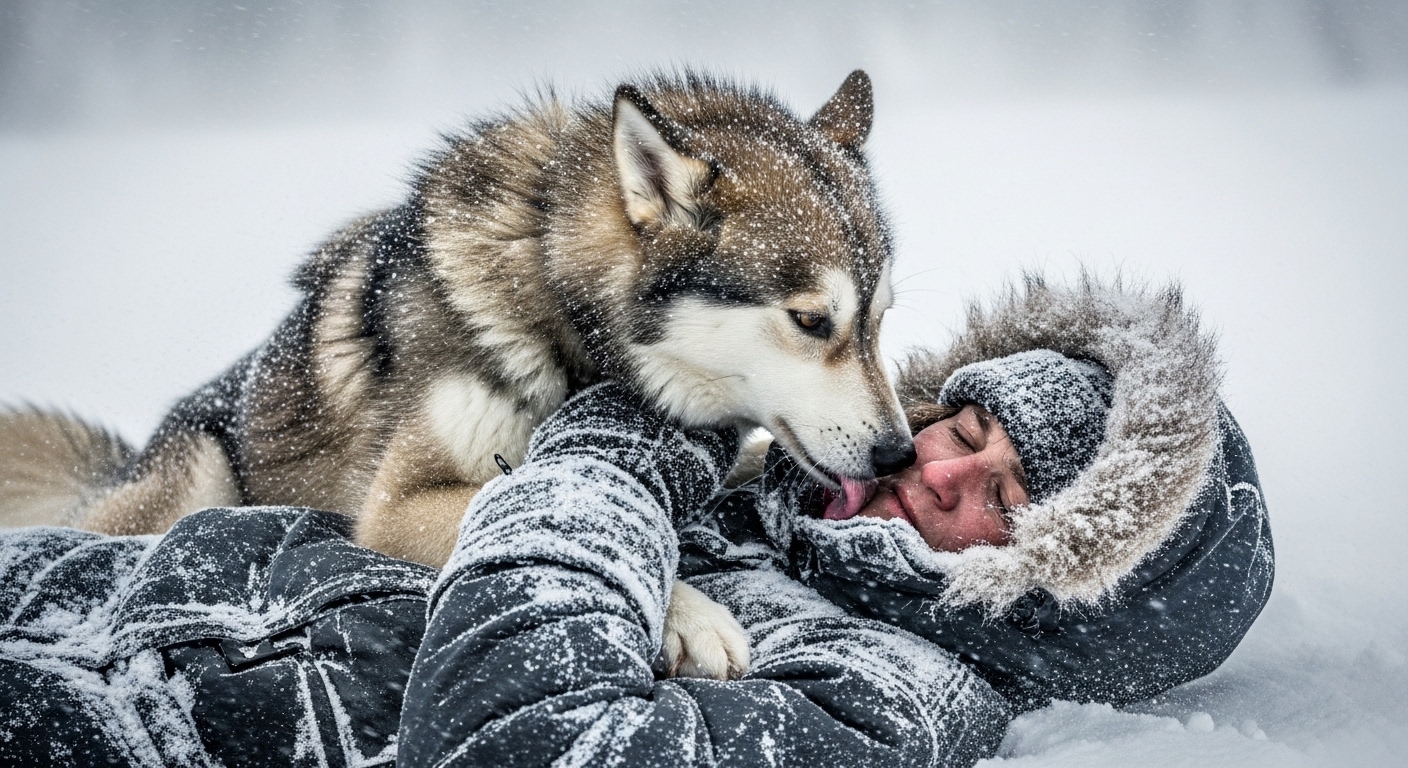
I collapsed from diabetic shock miles deep in the snowy woods. No phone, no people, just the creeping cold that felt like a heavy blanket pulling me under. My dog didn’t just sit and howl at the moon. He became my heartbeat.
Chapter 1: The White Silence
The woods in Northern Michigan don’t kill you with a scream. They kill you with a whisper.
I was three miles into the Blackwood Trail when the world started to tilt. It wasn’t the terrain; it was the familiar, terrifying hollowed-out feeling in my chest. My glucose was crashing. I reached for my pack, but my fingers were already numb, fumbling with the zipper like they belonged to someone else.
Then came the darkness. Not the night, but the grey, fuzzy veil of a diabetic coma.
I hit the snow hard. I remember the sensation of the cold biting into my cheek, and then… nothing. No sound but the wind.
Except for the huffing.
Bear, my three-year-old Akita-Shepherd mix, wasn’t a “rescue” in the traditional sense. He was a dog I’d bought from a backyard breeder who didn’t want him because he was “too clingy.” To the breeder, his loyalty was a defect. To me, it was everything.
As my body temperature began to plummet toward the point of no return, Bear didn’t panic. He didn’t run back to the trailhead. He went to work.
I felt a faint pressure against my side—the rhythmic scrape, scrape, scrape of paws against the frozen earth. He was digging. Not for a bone, but for a grave that would eventually become a womb.
He pushed me. He used his massive shoulders to shove my dead weight into the hollow he’d carved beneath a fallen hemlock. The snow piled up around us, creating a natural insulation, a fortress against the sub-zero wind.
Then, he did the only thing he could. He curled his 90-pound frame around my torso, his chin resting on my shoulder, his breath hot against my neck.
“Stay,” he seemed to say with every pulse of his heart.
Chapter 2: The Geometry of Survival
Twelve hours. That’s how long the search party said I was out.
In the medical world, they talk about the “Golden Hour,” that window of time where life can be snatched back from the brink. But in the snowy wilderness, when the sun dips below the horizon and the temperature hits negative fifteen, the window is made of ice. It shatters quickly.
Inside the snow burrow, the world was a different color. It was a dull, muffled blue. Bear’s heat was a physical presence, a radiating furnace that kept my core from freezing solid.
I drifted in and out of consciousness. In the brief moments of lucidity, I felt the rough texture of his fur against my face. I heard the steady, heavy thrum of his heart. It was the only clock I had.
Thump. Thump. Thump.
Every time my own breathing slowed too much, Bear would nudge my jaw with his nose. He’d give a sharp, authoritative lick to my ear, a jolting reminder to stay on this side of the veil.
He was fighting a war on two fronts. He was fighting the cold that tried to seep through the snow walls, and he was fighting my own body’s urge to simply stop.
I didn’t know it then, but back at the trailhead, my wife, Sarah, was hysterical. She’d called the Sheriff when I didn’t check in by 4:00 PM. She knew about my condition. She knew that without my kit, I was a ticking clock.
“He’s a hiker,” the Deputy had said, trying to calm her. “He probably just hunkered down for the night. We’ll start a sweep at first light.”
“He’s a diabetic!” Sarah had screamed. “He doesn’t have until first light! He has until the sun goes down!”
Chapter 3: The Searchers
The search party consisted of four men: Sheriff Miller, two volunteers from the local fire department, and a man named Silas.
Silas was a tracker. He didn’t use drones or infrared—not at first. He used his eyes. He’d lived in these woods for sixty years, and he knew that the snow tells stories if you know how to read the grammar.
“The wind is covering the prints,” the Sheriff shouted over the roar of the blizzard. “We’re blind out here, Silas. We need to turn back and wait for the chopper.”
Silas didn’t answer. He was kneeling by a cluster of pine saplings. He pointed to a broken branch, the inner wood still white and fresh.
“A dog did this,” Silas murmured. “Not a deer. A dog marking a path.”
He looked up into the swirling white abyss. “He’s not just lost. He’s being guarded.”
The men pushed on, their headlamps cutting pathetic, flickering holes in the darkness. They were exhausted, their own limbs heavy with the onset of hypothermia. They were minutes away from calling it off, from admitting that they would be searching for a body in the spring rather than a man in the winter.
Then, Silas stopped.
“Listen,” he whispered.
At first, there was nothing. Then, a sound that shouldn’t exist three miles deep in the timber. A low, rhythmic woof. Not a bark of fear. Not a howl of distress. It was a signal.
Chapter 4: The Shared Pulse
Inside the burrow, Bear knew they were close.
He didn’t leave me. Even as the light of the searchers’ beams filtered through the cracks in the snow, he stayed wrapped around my chest. He knew that the moment he moved, the heat would escape. He was a professional.
I woke up to the sound of shovels.
The transition from the blue silence of the burrow to the blinding white light of the lanterns was violent. I gasped, my lungs burning with the sudden intake of freezing air.
“We got him! He’s alive! Get the blankets!”
Hands grabbed at me, pulling me out of the hollow. I tried to speak, but my tongue was thick, a piece of dry leather in my mouth.
“Bear…” I croaked.
The dog didn’t move at first. He stayed in the burrow, his body shaking with a delayed reaction to the cold he had been fending off for twelve hours. He looked at the rescuers with a weary, protective suspicion.
Only when Silas knelt down and spoke in a low, vibrating hum did Bear relax. He crawled out of the hole, his legs trembling, and collapsed next to my stretcher.
“Look at his paws,” one of the volunteers whispered, holding a light to Bear’s feet.
The pads were raw, bleeding from the hours of digging through frozen crust and jagged ice to make that shelter. He had literally worn himself down to the bone to save me.
Chapter 5: The Toll of the Trail
The ride to the hospital was a blur of sirens and the smell of antiseptic. Sarah was there, her face a mask of tear-streaked relief.
But I wouldn’t let them close the ambulance doors until Bear was inside.
“Sir, we can’t—” the EMT began.
Sheriff Miller stepped forward, placing a hand on the door. “The dog goes. He’s the only reason this man is breathing. He’s part of the medical team now.”
At the hospital, they treated me for severe hypoglycemia and stage-two hypothermia. They told me my internal temperature had been 94 degrees when they found me.
“Another thirty minutes,” the doctor said, shaking his head. “If that dog hadn’t shared his heat, your heart would have gone into arrhythmia. You’d be gone.”
Bear was in the corner of the room, his paws bandaged, his belly full of the premium steak the nursing staff had “accidentally” ordered for him. He was sleeping, but even in his sleep, his ears would twitch every time I moved.
He had saved me from the woods, but the woods had left their mark on both of us.
Chapter 6: The Covenant of the Cold
A month later, the snow had started to melt, turning the Blackwood Trail into a mess of mud and hope.
I stood at the trailhead with Bear. I wasn’t hiking today. I was just standing there, looking at the trees that had almost become my headstones.
People ask me all the time if I’m afraid to go back out. They ask if I’m going to get a GPS tracker or a satellite phone. I tell them I already have the best survival gear ever made.
I looked down at Bear. He looked up at me, his tail giving that familiar, rhythmic thump against the dirt.
He wasn’t “too clingy.” He was a part of me. He was the heat in the storm, the heartbeat in the silence, and the proof that sometimes, the things we rescue end up being the only things that can rescue us.
I leaned down and hugged him, burying my face in the same thick fur that had filtered the freezing air for twelve hours.
“Thank you,” I whispered.
He didn’t bark. He just leaned his weight against my leg, a solid, warm presence that told me he’d do it all over again in a heartbeat.
We walked back to the car together, two survivors of the white silence, forever bound by a debt that could never be repaid, only lived.


