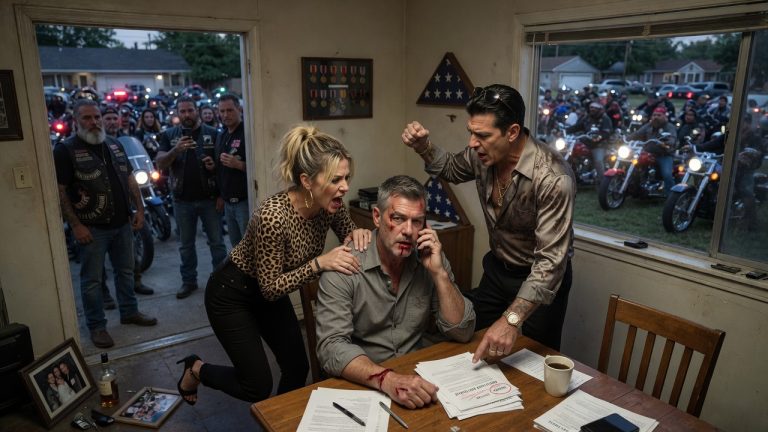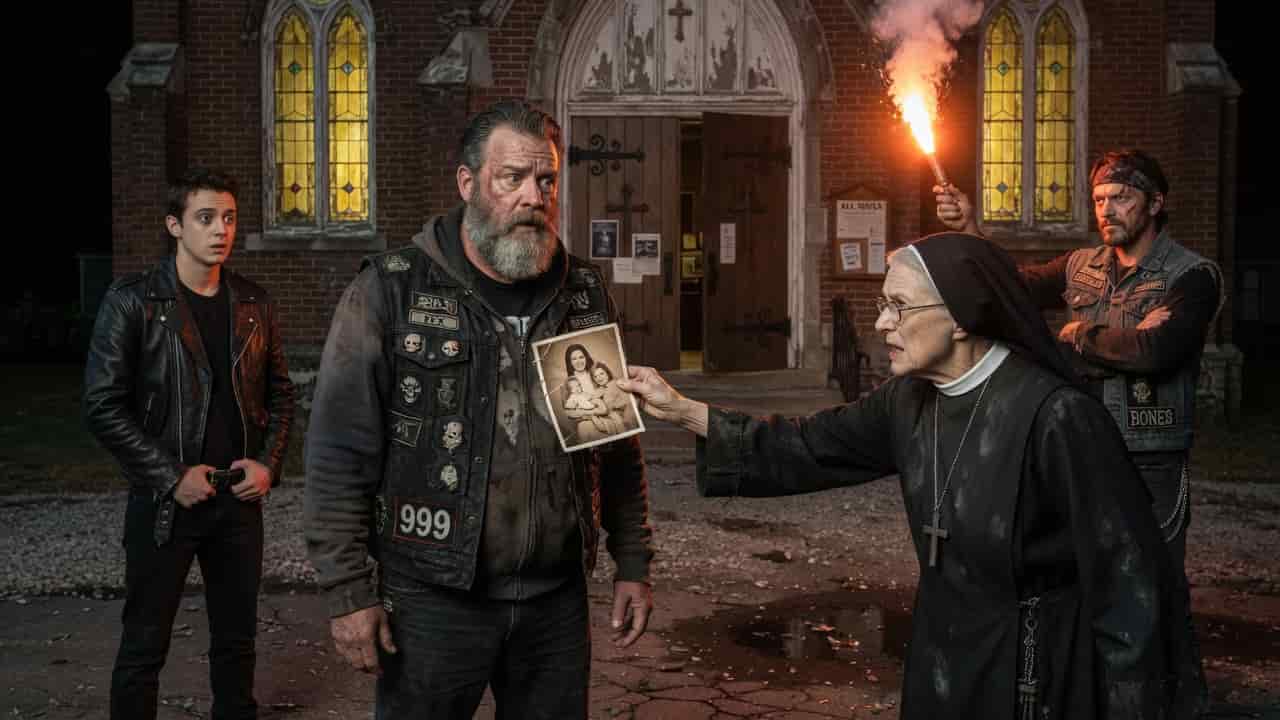
“You think those patches make you a man, Rex? You think I don’t remember the six-year-old boy who cried himself to sleep in the corner of the dormitory because his father never came back for him?”
The whole crew was standing there—twenty bikes idling, the smell of exhaust and road flares thick in the night air. Bones was already reaching for the gasoline, looking for any excuse to take Rex’s spot as President. All Rex had to do was give the word. He had to show them he was cold. He had to show them the church meant nothing.
But then Sister Mary stepped out of the shadows. She didn’t have a weapon. She just had a tiny, faded photograph from thirty years ago.
When she held it up, the room—the whole world—seemed to go silent. I saw Rex’s hand shake. I saw the look on the Prospect’s face when he realized his hero was just a terrified orphan hiding behind a biker vest.
Bones saw it too. And that’s when the night turned into a total disaster.
Chapter 1: The Weight of the Cut
The air in the 999 MC clubhouse always tasted like a mix of stale beer, burnt tobacco, and the chemical bite of chain lube. It was a thick, heavy atmosphere that settled into your pores and stayed there. For Rex Malone, it was the smell of home, or at least the closest thing he’d allowed himself to have in twenty years.
He sat at the head of the heavy timber table in the “Church”—the inner sanctum where the patched members of the mother charter met to decide who lived, who bled, and who got paid. Rex didn’t look like a man who was losing his grip. He sat with his shoulders squared, his thick arms resting on the wood, the “President” patch on his chest catching the dim light from the overhead industrial lamps.
But across from him sat Bishop.
Bishop wasn’t a biker. He was a “facilitator”—a man in a sharp, slate-gray suit that probably cost more than the three Harley-Davidsons parked in the driveway. He worked for the Greystone Group, a development firm that was currently eating up the north side of the city like a slow-moving cancer.
“We’re behind schedule, Rex,” Bishop said, his voice smooth and devoid of any real emotion. He didn’t use titles. He didn’t care about the brotherhood. He cared about the dirt. “The demolition crews were supposed to be on-site at St. Jude’s three days ago. My clients are losing fifty thousand dollars a day in interest alone. That’s not a gap I’m prepared to swallow.”
Rex shifted, the leather of his vest creaking. “St. Jude’s isn’t a vacant lot, Bishop. It’s an active parish. There are people there. Nuns. Kids in the after-school program. You don’t just kick the doors in and start swinging hammers without some pushback.”
“That’s exactly what I pay the 999 to handle,” Bishop countered. He leaned forward, tapping a manicured finger on a manila folder. “The land was sold. The deed is clear. The holdouts are trespassing. I don’t care about the optics of moving a few elderly women. I care about the ground they’re sitting on.”
From the side of the table, a low, rasping laugh broke the tension.
Bones, Rex’s Vice President, was leaning back in his chair, picking at a callus on his palm with a pocketknife. Bones was ten years younger than Rex, thinner, and possessed a brand of cruelty that was purely transactional. He didn’t have a history with the neighborhood. He just had an appetite for the top seat.
“Boss is getting soft in his old age,” Bones said, not looking up from his knife. “Maybe the stained glass is making him feel holy. Or maybe he just likes the way the Sisters bake cookies.”
The table went quiet. The other five patched members shifted their gaze from Bones to Rex, waiting for the explosion. In the 999, you didn’t question the President’s resolve without catching a fist or a bullet.
Rex felt the heat rising in his neck, a slow, thrumming pulse of rage. But beneath the rage was a cold, hollow pit of dread. He knew exactly why he was stalling. He knew the smell of the incense in that chapel. He knew the way the floorboards creaked in the upstairs hallway of the rectory.
“I’m not soft, Bones,” Rex said, his voice dropping an octave. “I’m smart. You pull a stunt like a forced eviction on a church in broad daylight, you bring the feds down on the clubhouse. You want to spend the next five years in a box because you couldn’t wait seventy-two hours for a quiet exit?”
“I think seventy-two hours has already passed,” Bones said, finally looking up. His eyes were flat, like a shark’s. “I think you’re protecting something. And the boys are starting to wonder if the 999 is a motorcycle club or a charity wing for the Vatican.”
Bishop smiled—a thin, predatory movement of the lips. “It seems your leadership is being questioned, Rex. That’s unfortunate. My offer to the club remains the same: clear the lot by Friday, and the final installment of the ‘consulting fee’ is doubled. Fail to do so, and we find another group of men who are less conflicted about their religious affiliations.”
Bishop stood up, adjusted his tie, and walked out of the room without looking back.
The silence that followed was worse than the argument. Rex could feel the eyes of his brothers on him. He saw “Deacon,” the Sergeant-at-Arms, a man who had been Rex’s primary enforcer for a decade, looking down at the table. Even Deacon wouldn’t meet his eyes.
“Friday,” Bones whispered. “That’s forty-eight hours, Rex. What’s it gonna be? Do we ride, or do I start taking votes for a new President who can actually get his boots dirty?”
Rex stood up so fast his chair clattered against the floor. He leaned over the table, his face inches from Bones’. “We ride tomorrow night. Midnight. We clear the place, we board it up, and we hand the keys to the suits. Anyone who isn’t on their bike by eleven-thirty can hand in their colors.”
He turned and stormed out of the Church, through the main bar where the prospects were scrubbing floors and the hang-arounds were nursing cheap beers.
Outside, the night air was cool, but it didn’t help. He walked over to his bike—a customized Fat Boy with a matte black finish—and leaned against the handlebars.
“Rex?”
He looked up. Standing a few feet away was “Joey,” a twenty-year-old prospect who had been with the club for six months. Joey reminded Rex of himself at that age—hungry for a family, willing to do anything to belong. He came from the same rough streets, the same broken homes.
“What is it, kid?” Rex grunted.
“The word is we’re hitting the church,” Joey said, his voice hesitant. “My mom… she used to take me there for the food pantry when the lights got turned off at home. Sister Mary, she’s… she’s good people, Rex. Is it true? We’re just tossing them out?”
Rex looked at the kid. He saw the doubt, the fracturing of the hero-worship that kept the club’s hierarchy intact. He wanted to tell the kid to shut up. He wanted to tell him that the world was a meat-grinder and the church was just another piece of gristle.
Instead, he reached into his pocket and pulled out a cigarette. His hands were steady, but his heart was hammering against his ribs.
“The world doesn’t care about ‘good people,’ Joey,” Rex said, lighting the cigarette. “It cares about who owns the dirt. You want to wear the patch? You stop thinking about the food pantry and you start thinking about the club. That’s the only family you got now.”
Joey nodded, but the light in his eyes had dimmed. He turned away to finish wiping down a bike, his movements stiff.
Rex inhaled the smoke, letting it burn in his lungs. He hated himself in that moment. He hated Bishop, he hated Bones, and he hated the crumbling brick building on 4th Street that refused to stay in the past.
He reached into the inner pocket of his vest. His fingers brushed against something—a small, stiff piece of paper he’d been carrying for a week. He didn’t pull it out. He didn’t need to. He knew the image on it by heart.
It was a legal notice, served to him by a private investigator he’d hired months ago. It wasn’t about the land deal. It was about a will. A will left by a man named Thomas Malone—a man who had spent thirty years drinking himself into a grave after dumping his six-year-old son on the steps of St. Jude’s.
Thomas Malone had died owning a small, forgotten parcel of land in the city’s industrial district. A parcel that had been folded into the church’s trust decades ago.
Rex was the sole heir.
If the club found out, they’d think he was holding out on them. If Bishop found out, he’d realize Rex had the legal power to stop the development entirely.
Rex was standing on a landmine, and the only way to keep it from exploding was to destroy the one place that had kept him alive when the rest of the world wanted him dead.
He crushed the cigarette under his boot and swung his leg over the bike. The engine roared to life, a violent, mechanical scream that drowned out the voices in his head. He didn’t go home. He rode toward the north side, toward the neighborhood where the streetlights were burned out and the crosses on the rooftops were the only things that still looked toward the sky.
He stopped a block away from St. Jude’s. The church sat like a weary giant in the middle of a wasteland of abandoned storefronts and chain-link fences. It was beautiful in a way that hurt to look at—the red brick stained by soot, the stained glass shimmering like oil on water.
He saw a light on in the rectory. A single, soft yellow glow behind a sheer curtain.
Sister Mary was still awake. She was always awake.
Rex gripped the throttle until his knuckles turned white. He had forty-eight hours to kill his past, or his brothers would kill him.
He kicked the bike into gear and sped away, the sound of the exhaust echoing like gunfire through the empty streets. He didn’t see the black SUV parked in the shadows of an alleyway two blocks back. He didn’t see Bones sitting in the driver’s seat, watching the President of the 999 stare at a church like it was a lover he couldn’t quite leave behind.
Bones smiled and tapped a cigarette against the steering wheel. “Gotcha, Rex,” he whispered. “You’re a dead man walking. You just don’t know it yet.”
Chapter 2: The Altar of Shame
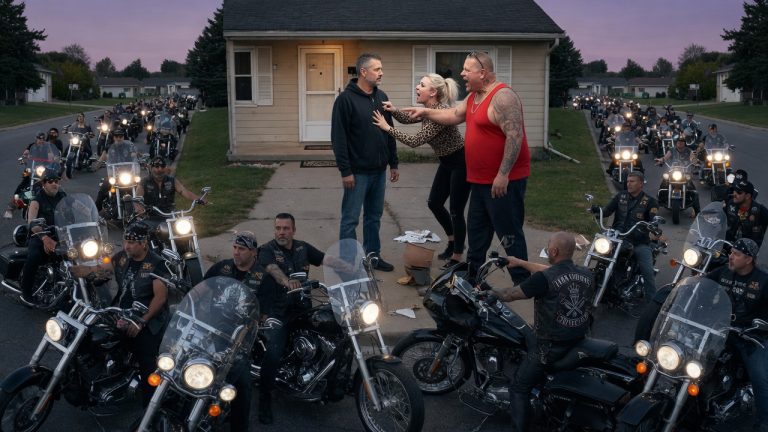
The roar of twenty engines was a physical assault on the silence of 4th Street. It was midnight, and the neighborhood was a ghost town, the residents huddling behind locked doors as the 999 MC rolled up to the iron gates of St. Jude’s.
Rex led the column. He felt the weight of the men behind him like a physical pressure against his spine. Bones was flanking him, his jaw set, his eyes darting toward the church windows with a hungry intensity. They hadn’t spoken since the meeting, but the air between them was charged with a lethal static.
Rex hopped off his bike, the kickstand crunching into the dirt. He didn’t wait for the others. He walked straight to the heavy oak doors and hammered on them with his fist. The sound boomed through the hollow interior of the church.
“Open up!” Rex shouted. “By order of the city and the Greystone Group! We have an eviction mandate!”
It was a lie. There was no mandate yet—just Bishop’s money and the club’s muscle. But Rex needed the authority of the words to keep his own soul from collapsing.
A small side door creaked open. A sliver of light spilled onto the stone steps.
Sister Mary stepped out. She looked smaller than Rex remembered, her habit worn at the cuffs, her face a map of deep-set wrinkles and unwavering resolve. She didn’t look at the twenty men in leather vests. She didn’t look at the motorcycles or the road flares being pulled from saddlebags.
She looked directly at Rex.
“It’s a late hour for a visit, Richard,” she said. Her voice was steady, thin but sharp as a needle.
The use of his real name hit Rex like a physical blow. Behind him, he heard Bones mutter, “Richard? Who the hell is Richard?”
Rex stiffened. “The name is Rex, Sister. And we’re not here for a visit. You’ve had your notices. The land is sold. You have thirty minutes to gather your personal belongings and vacate the premises. After that, we’re boarding the doors.”
Sister Mary didn’t move. She folded her hands into her sleeves. “The land was never sold, Richard. It was stolen. And you know that better than anyone. This house is a sanctuary. It sheltered you when your own father wouldn’t. It fed you when you were nothing but skin and bones.”
“I said move!” Rex barked, his voice cracking. He took a step toward her, his shadow looming over her small frame. “The world has moved on, Sister. This place is a relic. It’s over.”
Bones stepped up beside Rex, a malicious grin twisting his scarred face. He was holding a heavy pry bar in one hand. “You heard the man, Grandma. Move your beads or we move ’em for you. We got a job to do.”
Bones didn’t wait for a response. He reached out and shoved Sister Mary—not hard enough to knock her down, but enough to make her stumble back against the stone archway.
“Hey!”
It was Joey, the Prospect. He had stepped forward from the line of bikes, his face flushed with a mix of fear and indignation. “You don’t have to put hands on her, Bones. She’s just a nun.”
Bones turned, his eyes narrowing. “You got something to say, Prospect? Maybe you want to take her place in the rectory? I’m sure the sisters can find a dress that fits you.”
The other bikers laughed, a harsh, jagged sound. Rex felt a wave of nausea. He looked at Joey, then at Sister Mary. She was straightening her habit, her eyes never leaving Rex’s face. There was no fear in them—only a deep, piercing disappointment that was far more painful than a punch to the gut.
“Is this what you’ve become, Richard?” she asked softly. “A man who hides behind bullies and children?”
“Shut up,” Rex hissed. He grabbed the heavy door and shoved it open. The smell of incense and old paper rushed out to meet him. “Get the others. Get the kids out of the back. Now.”
The club swarmed past him into the church. It was a desecration in real-time. Heavy boots thudded on the polished wood of the nave. Men with “999” on their backs began ripping tapestries from the walls and knocking over wooden collection boxes.
Rex stood in the center of the aisle, his heart hammering. He saw Deacon, his most trusted enforcer, hesitating near the altar. Deacon looked at the crucifix hanging above the tabernacle, then at Rex. He didn’t move.
“Check the back rooms, Deacon!” Rex yelled, the sound echoing off the high ceiling. “Move!”
Deacon nodded slowly and headed toward the rectory.
Bones was in the front pew, laughing as he used his pry bar to splinter the wood of a kneeling rail. “This place is gonna burn real nice, Rex. Think Bishop will mind if we give him a head start on the demolition?”
“No fire,” Rex said, his voice trembling. “We board it up. That’s the deal.”
“The deal is whatever I say it is,” Bones countered, standing up. He walked over to a rack of votive candles and began knocking them onto the floor. The small flames flickered and died on the cold stone, leaving trails of black smoke.
Suddenly, a scream erupted from the back of the church.
Rex ran toward the sound, his boots sliding on the waxed floor. He burst into the small kitchen area behind the rectory. Deacon was standing there, holding a young woman by the arm. She was one of the lay workers who helped with the orphanage. She was clutching a toddler to her chest, her eyes wide with terror.
Two other sisters were huddled in the corner, their prayers a frantic, low-velocity murmur.
“They won’t leave, Boss,” Deacon said, his voice flat. “They say they got nowhere to go.”
Rex looked at the woman, then at the child. The kid couldn’t have been more than three. He was wearing a faded t-shirt with a cartoon character on it. He looked exactly like a photo Rex had seen of himself—the same hollowed-out look in the eyes, the same way he gripped the fabric of the woman’s shirt.
“Rex, don’t do this,” Sister Mary said. She had followed him into the room. She stood in the doorway, her presence like a wall of ice. “These children have no one. You are casting them onto the street in the middle of the night for the sake of a man in a gray suit who doesn’t even know your name.”
“I have a club to protect!” Rex roared, turning on her. He felt the eyes of his men on him—Bones was watching from the hallway, his phone out, recording the moment. “I have a brotherhood! If I don’t do this, we lose everything! Do you understand? Everything!”
“You’ve already lost everything, Richard,” Sister Mary said. She reached into the pocket of her habit and pulled out a small, weathered piece of paper. “You lost it the day you started believing your own lies.”
She held the paper out.
Rex froze. He knew what it was. It wasn’t the will. It was the photograph.
“Look at it,” she commanded.
Rex didn’t move.
“Look at it!” she shouted, her voice suddenly booming with the authority of a judge.
Bones stepped into the room, his eyes darting between the nun and Rex. “What’s the paper, Rex? What’s Grandma got that’s making you look like you just saw a ghost?”
He reached out to snatch the photo from Sister Mary’s hand.
Rex’s hand shot out, grabbing Bones’ wrist. The grip was bone-crushing. “Don’t touch her,” Rex growled.
Bones smirked, though his face paled slightly from the pain. “Touchy. Must be something good. Maybe it’s a picture of the President in his First Communion suit? Or maybe it’s something that proves he’s been lying to us about why we’re really here.”
Bones wrenched his arm free and stepped back, looking at the assembled men. “You all see this? Our fearless leader is protecting the target. He’s stalling. He’s keeping secrets.”
He turned back to Rex. “If you won’t clear this room, I will.”
Bones reached into his vest and pulled out a road flare. He struck it against the wall, and the room was suddenly filled with a violent, sparking red light. The smell of sulfur was overpowering.
“No!” Rex lunged for the flare, but Bones shoved him back, using the momentum to swing the flaming stick toward the wooden cabinets.
“Clear the room!” Bones shouted to the other bikers. “Burn the rats out!”
The scene devolved into chaos. The women screamed, the child began to wail, and the bikers began grabbing furniture to throw into a pile in the center of the kitchen.
Rex stood in the middle of the red-lit nightmare, paralyzed. He saw Sister Mary being pushed toward the exit by Deacon, who was trying to keep her safe while still following orders. He saw Joey standing by the sink, his face a mask of pure horror.
And then he saw the photograph.
It had fallen from Sister Mary’s hand during the scuffle. It lay on the floor, the sepia image of a small boy holding a nun’s hand, the words “Richard Malone – St. Jude’s, 1986” scrawled on the back in fading ink.
The red flare light washed over the image, making the boy’s face look like it was bleeding.
Rex looked up. Bones was standing over the pile of chairs, the flare held high, ready to drop it.
“Do it, Rex,” Bones challenged, his voice dripping with poison. “Give the order. Prove you’re one of us. Or stay here and burn with your past.”
Rex looked at the children, at the weeping sisters, and then at the face of the boy on the floor. He felt a pressure in his chest so intense he thought his ribs would snap.
“Get them out,” Rex whispered.
“What was that, Boss?” Bones mocked.
“I said get them out!” Rex screamed, his voice tearing his throat. “Everyone out! Now!”
He grabbed Bones by the throat and slammed him against the wall, the flare sparking inches from Rex’s own face. “You want to burn something, Bones? You wait until the kids are clear. If one hair on their heads is singed, I will peel the skin off your back myself. Do you hear me?”
Bones choked, his eyes bulging, but he nodded.
Rex let him go and turned to the room. “Deacon! Help them! Get them to the van! Move!”
As the room cleared, Rex knelt on the floor. He picked up the photograph, his fingers trembling so hard he nearly tore the paper. He tucked it into his vest, right next to the will he hadn’t yet destroyed.
The church was empty now, save for the men of the 999. The red light of the flare cast long, demonic shadows against the saints on the walls.
Rex stood up and walked out of the kitchen, through the nave, and onto the front steps. Sister Mary was standing by the iron gates, watching as the children were loaded into a rusted van. She didn’t look back at him.
Rex felt the residue of the shame coating him like oil. He had saved them for the moment, but the fire was already lit. Not the fire in the kitchen, but the fire in Bones’ eyes.
The ride back to the clubhouse was silent. Rex could feel the eyes of his brothers on his back. He knew what they were thinking. He knew the questions that were being whispered behind his back.
He was the President of the 999. But as he looked at the silhouette of the church in his rearview mirror, he knew that Richard Malone was the one who was truly trapped.
Chapter 3: The Ghost in the Pew
The clubhouse was a tomb. After the “eviction,” the usual post-ride celebration—the heavy drinking, the loud music, the shared stories of mayhem—simply didn’t happen. The men retreated to their corners, cleaning their bikes or nursing drinks in brooding silence.
Rex sat in his private office above the bar. It was a cramped space filled with filing cabinets, old maps, and a desk that had seen better days. He hadn’t turned on the lights. He sat in the dark, the only illumination coming from the neon sign of a liquor store across the street.
He pulled the photograph out of his vest and laid it on the desk. Next to it, he placed the will.
I, Thomas Malone, being of sound mind…
The words were a joke. His father had never been of sound mind. He had been a man of sound rage and sound addiction. But the legal document was undeniable. The land St. Jude’s sat on—or at least the three acres behind the rectory—belonged to the Malone estate. And since the church had never officially finalized the transfer from thirty years ago, Rex was effectively the landlord of his own childhood nightmare.
A soft knock at the door made him jump. He instinctively covered the documents with his hand.
“Who is it?”
“It’s Joey, Rex. Can I come in?”
Rex exhaled, a long, shaky breath. “Yeah. Come in.”
The door opened, and the young Prospect stepped inside. He didn’t sit down. He stood by the door, his helmet tucked under his arm.
“I wanted to say thanks,” Joey said quietly. “For… you know. Stopping Bones. I didn’t think he was actually gonna do it.”
“Bones is a dog on a short leash, Joey,” Rex said, his voice tired. “Sometimes you have to yank the chain so he remembers who owns him.”
“Is it true?” Joey asked. “What the nun said? About your name?”
Rex looked at the kid. He saw the genuine confusion in his eyes. To Joey, Rex was a god—a man who had clawed his way to the top of the food chain through sheer force of will. The idea that he was once a discarded child named Richard didn’t fit the myth.
“Names don’t mean much in this life, kid,” Rex said, turning his gaze back to the window. “We are what we do. Not what someone called us when we were six.”
“But you looked at that picture like it was… like it was something important.” Joey took a step forward. “My mom always said that St. Jude was the patron saint of lost causes. Is that why we’re hitting it? Because it’s a lost cause?”
Rex laughed, a dry, bitter sound. “Everything in this neighborhood is a lost cause, Joey. The church, the club, you, me. We’re just the ones fighting over the scraps.”
“I don’t believe that,” Joey said firmly. “I saw the way you looked at that kid. The one Deacon was holding. You didn’t see a scrap. You saw yourself.”
Rex slammed his hand onto the desk. “That’s enough! You’re a prospect, not a therapist. Go downstairs and help Deacon check the perimeter. We’re on high alert until the Greystone deal is signed.”
Joey flinched, nodded quickly, and retreated from the room.
Once he was gone, Rex felt the silence press in on him again. He couldn’t stay here. The walls felt like they were closing in, vibrating with the unspoken accusations of his men.
He grabbed his jacket and headed for the back stairs. He didn’t take his bike. He took the old, beat-up Ford truck the club used for hauling parts. He needed to be invisible.
He drove back to St. Jude’s.
The building was dark now, the iron gates chained shut. He parked the truck a block away and walked to the perimeter fence. He knew a loose spot in the chain-link near the old playground—the same spot he’d used to sneak out when he was ten to buy stolen cigarettes from the older boys.
The playground was a skeleton of rusted metal. The swings creaked in the wind, a rhythmic, haunting sound. Rex walked past them, his boots silent on the overgrown grass.
He didn’t go to the church. He went to the rectory.
The side door was unlocked. Sister Mary knew he would come.
The interior of the house smelled of beeswax and floor wax. It was a clean, sharp smell that cut through the city’s grime. Rex walked down the hallway, his shadow stretching long against the floral wallpaper.
He found her in the small chapel on the second floor. She was kneeling in the front pew, her head bowed.
“I wondered how long it would take you,” she said without turning around.
Rex sat in the back pew. He felt like an intruder, a wolf in a sheep’s pen. “The club is restless, Mary. Bones is telling everyone I’ve lost my nerve.”
“You never had nerve, Richard,” she said, finally standing and turning to face him. “You had fear. You spent your whole life running from the boy who was left behind. You built a cage of leather and iron around your heart and called it strength.”
“It kept me alive,” Rex snapped. “Where were you when I was sleeping under the pier in San Pedro? Where was the church when I was getting my ribs kicked in by the cops in Oakland?”
“We were here,” she said softly. “Waiting for you to come home. We never stopped looking for you, Richard. Even after your father told us you’d died in a foster home fire. He lied to us, just like he lied to you.”
Rex felt a cold chill wash over him. “What did you say?”
“Thomas Malone came here a year after you ran away,” Mary said, walking toward him. “He was sober for a week, weeping, begging for forgiveness. He told us he’d tried to find you, but that the state told him you were gone. He left a deed with the Father—a parcel of land he said was your inheritance. He wanted us to hold it for you, in case you ever came back.”
Rex pulled the will from his pocket. “This? He left this with you?”
“We didn’t know it was still in his name,” Mary said. “We thought it was part of the church’s trust. It was only when the developers started digging that the title issues surfaced.”
She stood in front of him, her eyes searching his. “You have the power to stop this, Richard. You are the legal owner of the land the rectory sits on. Bishop cannot build his luxury condos if you refuse to sell. You can save this home. You can save these children.”
Rex looked at the paper in his hand. It felt like it weighed a thousand pounds. “If I do that, the 999 will kill me. Bishop has already paid the ‘consulting fee’ to the club’s treasury. If the deal falls through because of me, Bones will have my head on a spike before sunrise.”
“Then let them,” she said, her voice hard as flint. “Is your life worth more than the souls of these children? Is your ‘brotherhood’ worth the destruction of the only place that ever loved you?”
“You don’t understand,” Rex said, standing up. He felt the old rage bubbling up, the desperate need to strike out at the truth. “It’s not just about me. It’s about the code. You don’t betray the club. You don’t hold out on the family.”
“They aren’t your family, Richard! They are your jailers!”
She reached out and grabbed his hand. Her grip was surprisingly strong. “Look at me. Look at the man you were supposed to be. Your father was a drunk and a coward, but in the end, he tried to give you a foundation. Don’t throw it away for the sake of a patch on a vest.”
Rex pulled his hand away. “I have to go.”
“Richard—”
“I said I have to go!”
He turned and ran out of the chapel, down the stairs, and into the night. He didn’t stop until he was back in the truck, his chest heaving.
He sat there for a long time, staring at the church. He thought about the toddler in the kitchen. He thought about the smell of the road flare.
And then he saw a movement in his side mirror.
A motorcycle was idling at the end of the block. A matte-black Harley.
Bones.
The Vice President didn’t move. He just sat there, his headlights dark, watching the truck. He raised a hand in a slow, mocking wave before kicking his bike into gear and disappearing into the darkness.
Rex knew then that the choice had already been made for him. Bones had seen him enter the rectory. He had seen him talking to the “target.”
The residue of his visit wasn’t peace—it was a death sentence.
He drove back to the clubhouse, his mind racing. He needed a plan. He needed a way to protect the church and survive the night. But as he pulled into the driveway and saw the line of bikers waiting for him, he realized he was out of time.
Bones was standing in the center of the yard, surrounded by the full charter. Even Deacon was there, his face unreadable.
“Well, well,” Bones said, his voice carrying over the low rumble of the idling bikes. “The President returns from his midnight prayer session. Tell us, Rex… did the Big Guy tell you what to do with that land you’re hiding from us?”
Rex stepped out of the truck. He didn’t reach for his gun. He didn’t reach for his knife. He just stood there, the weight of the will in his pocket like a stone.
“I don’t know what you’re talking about, Bones,” Rex said, his voice surprisingly calm.
“I think you do,” Bones said. He held up a manila folder—the same one Bishop had been carrying. “Bishop called. He was a little concerned about some ‘title discrepancies’ his lawyers found. Seems there’s a Malone who owns a piece of our paycheck. And since you’re the only Malone I know…”
Bones stepped forward, the club members closing the circle around Rex.
“You were gonna let us lose millions, Rex. You were gonna let the club starve so you could keep a clubhouse for the penguins.”
“It’s not like that,” Rex said.
“Then show us,” Bones challenged. He pulled a fresh road flare from his belt. “We’re going back to St. Jude’s. Right now. And you’re gonna be the one to light the first match. You burn the rectory to the ground, and we forget all about the title. You don’t… and we find a new President who’s got the stomach for the job.”
Rex looked at the faces of his brothers. He saw greed, he saw suspicion, and in Joey’s eyes, he saw a flickering hope that was about to be extinguished.
“Alright,” Rex said, his heart turning to ash. “Let’s go.”
Chapter 4: The Lit Match
The ride back to St. Jude’s felt like a funeral procession. The air was colder now, the wind whipping off the river and carrying the scent of rain. Rex rode at the front, but he felt like a prisoner being led to the gallows. Bones was right behind him, the red glow of his taillight a constant reminder of the threat.
They reached the church in less than ten minutes. The bikes swarmed the sidewalk, the headlights illuminating the brick walls like searchlights.
Bones hopped off his bike and tossed a heavy plastic jug to Rex. The slosh of gasoline inside was a sickening sound.
“Go on, Boss,” Bones said, his voice a jagged edge. “Show the boys how much you love the brotherhood. Start with the rectory stairs. That old wood’ll go up like tinder.”
Rex gripped the handle of the jug. The plastic was cold and slick. He looked at the rectory. The light in the upstairs window was still on. Mary was still there. The children were still there.
“They’re still inside, Bones,” Rex said, his voice barely a whisper.
“Then they better move fast,” Bones countered. He struck a flare, the brilliant, sparking orange light washing over the scene. “Clock’s ticking, Rex. Or maybe you want Joey to do it? He needs to earn his patch, right?”
Bones turned to the Prospect. “Hey, kid! Come here.”
Joey stepped forward, his face pale in the flare-light. He looked at Rex, his eyes pleading. “Rex… don’t make me do this.”
“Leave the kid out of it,” Rex growled.
“Then you do it!” Bones screamed, the flare sparking inches from Rex’s face. “Do it now, or I swear to God I’ll put a bullet in the nun myself!”
The club members pressed closer. The social pressure was a physical weight, a wall of leather and silent expectation. Rex saw Deacon shift his weight, his hand resting on the grip of his sidearm. Even his oldest friend was waiting for the betrayal or the compliance.
Rex walked toward the rectory steps. Every step felt like he was walking through deep mud. He reached the wooden porch and unscrewed the cap of the gasoline jug. The fumes hit him, sharp and dizzying.
He began to pour.
The liquid splashed onto the wood, dark and shimmering in the flare-light. He felt the eyes of the 999 on his back. He felt the ghost of Richard Malone screaming in his ear.
He finished the jug and turned around. Bones was standing at the bottom of the steps, his face a mask of triumphant cruelty. He held out the flare.
“Finish it.”
Rex reached for the flare. His hand was shaking.
Suddenly, the side door of the rectory flew open.
Sister Mary stepped out. She wasn’t carrying a cross this time. She was carrying the toddler—the boy with the hollow eyes. He was crying, a thin, wailing sound that cut through the rumble of the idling bikes.
“Richard, stop!” she cried out.
The club went silent. The only sound was the crackle of the flare and the wind in the trees.
Bones laughed. “Look at that. The target brought a shield. What’s the matter, Rex? Can’t light a fire with a kid watching?”
Bones stepped up onto the first step, pushing past Rex. He reached out to grab Sister Mary’s arm. “Get out of the way, old woman. This place is coming down.”
“Don’t touch her!” Joey shouted, lunging forward.
Bones spun around and backhanded the Prospect, sending him sprawling into the gravel. “Stay down, pup! This is grown-man business!”
Bones turned back to Mary, his face contorted with rage. He raised the flare, ready to thrust it into the gasoline-soaked wood right at her feet.
“I said… DON’T TOUCH HER!”
Rex didn’t think. He didn’t calculate the cost or the consequence. He swung the empty gasoline jug like a club, catching Bones across the side of the head.
Bones crumpled, the flare flying from his hand and landing in the dirt a few feet from the porch.
The 999 erupted. Guns were drawn, the metallic clicks of safeties being disengaged echoing like hailstones on a tin roof.
Rex stood on the porch, his chest heaving, his body shielding Sister Mary and the child. He looked down at the line of his brothers.
“That’s enough!” Rex roared. “This deal is dead! The land is mine, and I’m not selling! Not to Bishop, and not to the club!”
“You’re a dead man, Rex,” Deacon said, his voice heavy with sadness. He had his 9mm pointed at Rex’s chest. “You held out on the charter. You hit the VP. There’s no coming back from this.”
“Then do it, Deacon!” Rex challenged, tearing open his vest to expose his chest. “Put the bullet in me! But you better be ready to explain to the national board why you killed a President over a piece of dirt that belongs to his family!”
The mention of the national board gave them pause. The MC had rules. Killing a President was a messy business that required a trial and a consensus.
Bones scrambled to his feet, blood streaming from a cut on his temple. “He’s a traitor! Look at him! He’s protecting the church over the brothers!”
“I’m protecting my blood!” Rex screamed back. He reached into his vest and pulled out the will, waving it in the air. “My father left me this land! It’s mine! And if any of you set foot on it again, I’ll have the feds and the lawyers crawling up your asses before the sun comes up!”
It was a desperate gamble. He was threatening the club with the law—the ultimate sin.
Bones looked at the men. He saw the hesitation. He saw the doubt. He knew he was losing the room.
“Fine,” Bones spat, wiping blood from his eye. “Keep your dirty little secret, Rex. Keep your church. But you’re out. As of this second, you’re stripped of your patch. You’re ‘no-good.’ And the 999 doesn’t protect ‘no-good’ traitors.”
Bones looked at the others. “Let’s go. We’ll let the national guys handle the paperwork. But Rex… don’t think this is over. You might own the dirt, but we own the street. And you still have to sleep sometime.”
One by one, the bikers kicked their engines over. Joey stood up, looking at Rex. There was a moment of connection—a flash of respect—before the kid turned and followed the others.
The roar of the engines faded into the distance, leaving a ringing silence in the air.
Rex stood on the gasoline-soaked porch, the smell of fuel making his head swim. He felt the weight of his leather vest—the “President” patch that no longer meant anything.
He turned to Sister Mary. She was still holding the child, her face pale but her eyes steady.
“You did it, Richard,” she whispered.
“No,” Rex said, his voice cracking. He looked down at his hands, which were stained with gasoline and Bones’ blood. “I just started a war. And I don’t have an army anymore.”
He looked out at the dark street. He knew the 999 wouldn’t go to the national board. They would go to Bishop. And Bishop wouldn’t use lawyers.
He looked at the church—the sanctuary he’d just sacrificed his life to save. It looked fragile now, a pile of old bricks in a world that only valued steel.
The residue of the confrontation was a cold, hollow panic. He had the land, he had the truth, but he had lost the only family he had ever known.
“Get the kids inside, Mary,” Rex said, his voice flat. “And lock the doors. I’m staying on the porch.”
He sat down on the top step, right in the middle of the gasoline stain. He pulled the photograph from his vest and looked at it one last time.
Richard Malone was back. And he was completely alone.
Chapter 5: The Exile’s Watch
The sun didn’t so much rise as it did leak through the gray, soup-like smog of the city’s industrial edge. It was a pale, sickly light that offered no warmth, only a clearer view of the wreckage. Rex was still sitting on the top step of the rectory porch. He hadn’t slept. His back was a map of frozen muscles, and his eyes felt like they had been rubbed with sand.
The smell of gasoline had transitioned from a sharp, dizzying sting to a dull, persistent ache in the back of his throat. It had soaked into the wood of the porch, a permanent reminder of the match he hadn’t struck. He looked down at his hands. They were stained with a mixture of dirt, grease, and the dried, brownish residue of Bones’ blood. He looked at his vest. The “999” patches felt heavy, like lead weights stitched into the leather. They were no longer signs of rank; they were targets.
The side door behind him creaked open. Sister Mary stepped out, carrying two mugs of coffee. The steam rose in the cold morning air, a white ribbon against the gray sky. She didn’t say anything at first. She just sat down on the step beside him, handing him one of the mugs.
Rex took it. His fingers were stiff. The heat of the ceramic was the first thing he’d felt in hours that didn’t hurt.
“You’re still here,” she said. It wasn’t a question.
“Nowhere else to go, Mary,” Rex grunted. He took a sip of the coffee. It was black, strong, and tasted faintly of chicory. “The clubhouse is a no-go. My apartment is probably being tossed as we speak. I’m a ghost in my own zip code.”
“You’re not a ghost, Richard. Ghosts don’t bleed on the porch steps.” She looked out at the street. A lone crow landed on the rusted swing set in the playground, its caw a lonely, jagged sound. “What happens now? They won’t just let this go.”
“No,” Rex said. “Bones is a predator. He can’t afford to look weak. He’ll come back, but not for the church. He’ll come for me. And Bishop… Bishop will send the professionals. He doesn’t care about brotherhood or patches. He cares about the deed.”
Rex reached into his vest and pulled out the crumpled legal notice and the will. He laid them on the step between them. “I need you to take these. If something happens to me, you get them to a lawyer named Miller. He’s a bottom-feeder, but he hates Greystone more than he hates bikers. He’ll make sure the title stays tied up in court for the next ten years.”
Sister Mary didn’t touch the papers. She looked at him, her eyes bright with a fierce, quiet intelligence. “Why are you talking like you’re already gone?”
“Because I am, Mary. Look at me.” He gestured to the vest. “I spent twenty years building a life out of violence and loyalty to a lie. Last night, I broke the only code I had. I’m ‘no-good.’ In my world, that’s a terminal diagnosis.”
“Then leave that world behind,” she said, her voice rising. “Stay here. We have rooms. We have work. You saved these children, Richard. Do you think they care about your patches? They saw a man stand in the fire for them.”
Rex laughed, a dry, hollow sound that died in his chest. “I’m not a good man, Mary. I’m just a man who got tired of being a bad one. There’s a difference.”
He stood up, his joints popping with the effort. He walked to the edge of the porch and looked toward the iron gates. A black sedan was idling at the corner. It wasn’t a biker’s ride. It was too clean, too discreet.
“Bishop,” Rex whispered.
The sedan began to move, rolling slowly toward the church. It stopped at the gates, and the rear window slid down. Bishop’s face emerged from the shadows of the interior. He looked immaculate, his silk tie perfectly knotted, a stark contrast to the grime and gasoline of the rectory.
“Rex,” Bishop called out. He didn’t raise his voice, but it carried clearly in the morning silence. “You’ve made things very complicated.”
Rex walked down the steps, his boots crunching on the gravel. He stopped at the gate, the iron bars between him and the developer. “The deal is off, Bishop. The land isn’t for sale.”
“Everything is for sale, Rex. We just haven’t found your price yet.” Bishop leaned his arm on the door frame. “I spoke with Mr. Bones this morning. He was quite colorful in his description of your… retirement. He seems to think you’re a squatter now. A man with no friends and a very short future.”
“Bones talks a lot,” Rex said. “But he doesn’t own the dirt. I do.”
“For now,” Bishop countered. “But deeds can be challenged. Wills can be contested. And men can be removed. I’m giving you one last chance to walk away with enough money to disappear. A hundred thousand. Cash. You sign the transfer, and I’ll even tell Bones to stay clear of you for forty-eight hours. It’s a generous offer for a man in your position.”
Rex looked at the sedan, then back at the rectory. He saw Sister Mary standing on the porch, watching him. He saw a small face pressed against the glass of the downstairs window—the toddler from the kitchen.
“Keep your money, Bishop,” Rex said. “Tell your lawyers to get their suits dirty. Because the only way you’re getting this land is over my dead body.”
Bishop sighed, a sound of genuine disappointment. “That’s the problem with you people. You think your drama matters. To the city, you’re just a blight. To the law, you’re a criminal. And to me… you’re just an overhead cost I’m about to eliminate.”
The window slid up, and the sedan pulled away, the tires kicking up a cloud of dust.
Rex stood at the gate until the car disappeared. He felt a cold, clinical fear settling into his bones. Bishop wasn’t like Bones. He wouldn’t come with a flare and a loud engine. He would come with a silent, legal erasure, or a man with a long-range rifle who didn’t care about the sanctity of a church.
He turned back to the rectory. He needed to fortify the place. He spent the next three hours hauling old timber and sheets of plywood from the basement, boarding up the first-floor windows. He moved with a grim, mechanical efficiency. He wasn’t thinking about the future; he was thinking about the next hour, the next minute.
Around noon, a low rumble echoed from the street. Rex dropped a hammer and reached for the heavy wrench he’d been keeping in his belt.
It was a single motorcycle.
Rex walked to the front of the church, his heart hammering against his ribs. It was the Fat Boy—his bike. And sitting on it was Joey.
The Prospect stopped at the gate and killed the engine. He looked exhausted, his face bruised from Bones’ hit the night before.
“Rex,” Joey said, his voice shaky.
“What are you doing here, kid?” Rex asked, not moving from the shadows of the doorway. “You’re breaking the rules. You shouldn’t be within five miles of me.”
“Bones is losing it,” Joey said, leaning over the handlebars. “He’s at the clubhouse, drinking heavy. He’s telling everyone the national board gave him the green light to ‘clean up the trash.’ They’re coming back tonight, Rex. All of them. And they aren’t coming for the land. They’re coming to prove a point.”
Rex gripped the door frame. “Tonight?”
“Midnight. Just like last time.” Joey looked down at the bike. “He told me to bring your bike here. He said it would be a good ‘monument’ for your grave. I think he wanted me to set it on fire, but… I couldn’t do it.”
Joey reached into his pocket and pulled out a set of keys, tossing them through the bars of the gate. They landed in the dirt with a metallic jingle.
“Why are you telling me this?” Rex asked.
“Because you were right,” Joey said, looking up. His eyes were moist. “The club isn’t a family. It’s just a pack of dogs. And I don’t want to be a dog anymore.”
Joey reached up and unzipped his leather jacket. He pulled it off, revealing a plain t-shirt underneath. He draped the jacket over the handlebars of the bike—the jacket with the “Prospect” patch he’d worked six months to earn.
“I’m done, Rex. I’m heading out. My cousin has a place in Arizona. I’m gonna try to be a civilian for a while.”
“Go, Joey,” Rex said, his voice softening. “Don’t look back. There’s nothing here for you but ash.”
Joey nodded, turned, and started walking down the street. He didn’t have a ride, didn’t have a plan, but he walked with his head up.
Rex watched him go, then walked to the gate. He picked up the keys and unlocked the iron lock. He rolled his bike into the church courtyard, parking it under the stone archway. It looked out of place—a machine of war in a garden of peace.
He spent the rest of the afternoon in the basement of the church. He found what he was looking for in a locked crate behind the old boiler—a heavy, canvas-wrapped bundle he’d hidden there five years ago, “just in case.”
He unwrapped it, the smell of gun oil and old fabric filling the small room. It was a Remington 870 shotgun and a box of buckshot. He hadn’t wanted to use it here. He’d hoped the truth would be enough. But the truth was a fragile thing, and tonight, the world was coming to break it.
He sat on a crate and began to clean the weapon. The rhythm of it was familiar, a dark meditation. He thought about his father, Thomas Malone. He wondered if his father had ever felt this way—cornered, desperate, trying to protect a tiny piece of something that didn’t belong to him.
He thought about the will. I, Thomas Malone…
His father had been a failure in every way that mattered. But in the end, he’d left a map back to this place. He’d left a way for Richard to stop running.
Sister Mary appeared at the top of the basement stairs. She didn’t look at the gun. She looked at Rex’s face.
“The children are in the inner dormitory,” she said. “The doors are barred. They think it’s a game. We told them we’re having a ‘camp-out’ away from the windows.”
“Good,” Rex said. He stood up, the shotgun heavy in his hands. “Stay with them, Mary. No matter what you hear, don’t come out. Not for me. Not for anyone.”
“Richard—”
“I’m not Richard tonight, Mary,” Rex said, his voice a low, vibrating growl. “Tonight, I’m exactly what they made me. I’m the monster at the gate.”
He walked past her, the canvas of his vest creaking, his eyes fixed on the darkening street. The residue of his past was finally catching up to him, and as the first shadows of night began to stretch across the churchyard, Rex Malone prepared to pay the debt in full.
He took his position on the rectory porch, sitting in the same spot where the gasoline had soaked the wood. He laid the shotgun across his knees. The silence of the neighborhood was absolute, a heavy, suffocating blanket.
He waited. He was a man who had lost his name, his home, and his brothers. All he had left was a piece of paper and a promise made to a ghost. And as the clock in the church tower struck eleven, he heard it—the first, faint rumble of twenty engines, a mechanical storm rolling in to finish what the fire had started.
Chapter 6: The Last Altar
The roar didn’t stop at the gate this time. It grew louder, a violent, tooth-rattling vibration that shook the very foundation of St. Jude’s. The headlights hit the boarded-up windows of the rectory, jagged beams of light that cut through the darkness like knives.
Rex didn’t move. He sat on the porch, the shotgun a cold weight in his lap. He watched as the bikes swarmed the courtyard, the iron gates having been forced open earlier in the evening. They circled him like wolves, the exhaust fumes thick and choking.
Bones was at the center of the swarm. He wasn’t wearing his helmet. His face was a mask of jagged rage, the bandage on his temple stained with fresh blood. He stopped his bike ten feet from the porch, the engine idling with a low, predatory growl.
The other bikers—Deacon, Snake, Miller, and the rest—formed a semi-circle behind him. They didn’t look like brothers anymore. They looked like an execution squad.
Bones killed his engine. The sudden silence was worse than the noise.
“Look at you,” Bones sneered, his voice dripping with contempt. “The Great Rex Malone, sitting in the dirt with a pop-gun. You look like a hobo, Rex. You smell like one, too.”
“You’re trespassing, Bones,” Rex said. His voice was steady, coming from a place deep inside him that had already accepted the end. “This is private property. Legally recorded.”
“Legally recorded?” Bones laughed, and the others joined in—a harsh, nervous sound. “You think we give a damn about a piece of paper? You think Bishop’s lawyers are gonna help you when we’re done with you? Bishop doesn’t want the land anymore, Rex. He wants the problem gone. And you… you’re the problem.”
Bones hopped off his bike, a heavy chain wrapped around his fist. He started walking toward the steps.
Rex stood up, the shotgun rising to his shoulder in one smooth, practiced motion. The “clack-clack” of the pump echoing off the brick walls was the only warning he gave.
Bones froze. The men behind him reached for their holsters.
“One more step, Bones,” Rex said. “And I’ll see how much that chain helps when your chest is a hole the size of a dinner plate.”
“You won’t do it,” Bones challenged, though he didn’t move. “You’re too holy now, right? You’re one of the good guys. Good guys don’t shoot their brothers.”
“You aren’t my brother,” Rex said. “You’re a parasite. You’ve been waiting for a chance to take this patch since the day you walked into the clubhouse. Well, here it is. But it’s gonna cost you.”
“Deacon!” Bones shouted, not looking back. “Take him!”
Rex shifted his gaze to Deacon. His old friend was standing by his bike, his hand resting on the grip of his pistol. Their eyes met—ten years of shared roads, shared fights, and shared secrets passed between them in a second.
Deacon didn’t draw. He looked at the church, then at the boarded-up rectory, and finally at the man he’d called President.
“He’s right, Bones,” Deacon said, his voice heavy. “This isn’t club business. This is personal. You want the seat? You take it. But I’m not shooting a brother over a developer’s paycheck.”
“He’s ‘no-good’!” Bones screamed, spinning around. “He’s a traitor! He’s holding out on the treasury!”
“He’s a man defending his home,” Deacon countered. He stepped back from his bike, his hands raised. “I’m out. I’m not part of this.”
A ripple of uncertainty went through the crowd. Two other bikers followed Deacon’s lead, stepping away from the line.
Bones turned back to Rex, his face contorted with a frantic, desperate fury. He knew he was losing them. He knew that if he didn’t act now, his authority would evaporate before the sun came up.
“Fine!” Bones roared. He reached into his vest and pulled out a small, black device—a remote detonator. “You want to play hero, Rex? You want to save the church? Then watch it burn!”
Rex’s heart stopped. “What did you do?”
“Bishop’s crews were here an hour ago,” Bones smirked. “While you were playing with your shotgun in the basement, they were under the floorboards of the chapel. Gas lines are open, Rex. One spark, and this whole block becomes a crater.”
Rex looked at the church. He thought of the children in the inner dormitory. He thought of Mary.
“You’re lying,” Rex hissed.
“Try me,” Bones said, his thumb hovering over the button. “Give me the deed. Give me the will. And maybe I don’t press it. Maybe I let the kids walk out before I level the place.”
Rex felt the world tilting. He was trapped in the ultimate contradiction—to save the past, he had to give up the future. To save the children, he had to give Bishop exactly what he wanted.
But then he remembered the basement. He remembered the old boiler.
“The gas lines are shut off at the main, Bones,” Rex said, a desperate lie forming on his lips. “I did it this afternoon. Your ‘spark’ won’t do anything but make a clicking sound.”
Bones’ eyes flickered with doubt. It was the opening Rex needed.
Rex didn’t shoot. He lunged.
He tackled Bones off the porch, the two of them slamming into the gravel. The shotgun flew out of Rex’s hands as they tumbled. Bones was fast, fueled by adrenaline and spite. He swung the chain, the heavy links catching Rex across the cheek, tearing open a deep gash.
Rex didn’t feel the pain. He felt the weight of thirty years of shame. He grabbed Bones by the throat, his thumbs digging into the windpipe.
“You… don’t… own… anything!” Rex growled, his voice a guttural rasp.
They rolled through the dirt, a blur of leather and rage. The other bikers stood in a circle, watching, but no one intervened. This was the trial Bones had wanted—the old king against the pretender.
Bones managed to get a hand free and reached for a knife in his boot. He pulled it and slashed at Rex’s side, the blade slicing through the leather of the vest and into the meat of Rex’s ribs.
Rex roared, the sound more animal than human. He grabbed Bones’ wrist and slammed it against the concrete base of the gate post. The knife clattered away.
Rex pinned Bones to the ground, his knees on the younger man’s shoulders. He raised his fist, ready to end it.
“Rex! Stop!”
It was Sister Mary. She had come out onto the porch, despite his orders. She was standing there, the light from the open door silhouetting her small frame.
“Don’t do it, Richard!” she cried. “Don’t become him! If you kill him now, you lose everything you just won!”
Rex’s fist hovered in the air. He looked down at Bones. The Vice President was gasping for air, his face bruised and bloody, his eyes filled with a terrifying, pathetic fear.
Rex looked at the men around him. He saw Deacon watching him, waiting. He saw the “999” on their vests—the number that had defined his life.
He let go of Bones’ throat. He stood up, his body trembling, blood soaking through his shirt and vest.
“Get him out of here,” Rex said, his voice cracked and hollow.
Deacon stepped forward. He didn’t look at Bones. He looked at Rex. He reached out and placed a hand on Rex’s shoulder—a brief, heavy gesture of farewell.
“The patch is gone, Rex,” Deacon said softly. “But the man… the man stayed.”
Deacon and two others grabbed Bones by the arms and hauled him toward the gate. They threw him onto the back of a truck like a sack of garbage. One by one, the bikes were kicked into gear.
They rode out of the courtyard, the sound of the engines fading until it was nothing more than a distant hum in the city’s throat.
Rex stood in the center of the courtyard, the silence returning like a heavy tide. He looked down at the vest. He reached up and slowly unzipped it. He pulled it off his shoulders and let it fall into the dirt—the leather, the patches, the history of violence.
He was standing in his t-shirt, his wounds weeping, his body broken.
Sister Mary walked down the steps. She didn’t say anything. She just put her arm around his waist and helped him walk toward the rectory.
As they reached the porch, Rex stopped. He looked back at the church.
The building was still there. The bricks were still soot-stained, the glass was still shimmering, and the children were still safe inside.
He reached into his pocket and pulled out the photograph. It was ruined—stained with sweat and dirt, the corners curled. He looked at the face of the boy.
“He’s okay now, Mary,” Rex whispered. “The boy is okay.”
“Yes, Richard,” she said softly. “He is.”
They walked inside, and the heavy oak door clicked shut.
The next morning, the black sedan didn’t return. Bishop’s lawyers had found a new set of problems—a sudden, anonymous tip to the District Attorney about a series of “consulting fees” paid to a criminal organization, backed by a set of ledgers that had mysteriously appeared on the DA’s desk.
Rex Malone didn’t know about the ledgers. He didn’t care about the news.
He was in the basement of the church, helping Joey—who had returned after all—paint the walls of the new community room. He was wearing an old flannel shirt and work pants. He didn’t have a patch, and he didn’t have a crew.
But as he looked at the children playing in the yard, and the way the light hit the cross on the roof, he realized he finally knew the value of the dirt he was standing on.
It wasn’t an inheritance of money. It was an inheritance of peace.
The residue of the war remained—the scars on his face, the ache in his ribs, the knowledge of the things he’d done. But for the first time in thirty years, when someone called his name, he didn’t have to wonder which version of himself was answering.
Richard Malone was home. And that was enough.