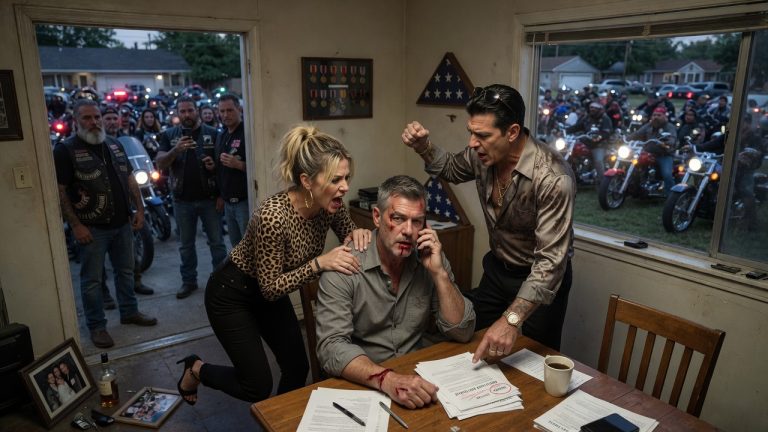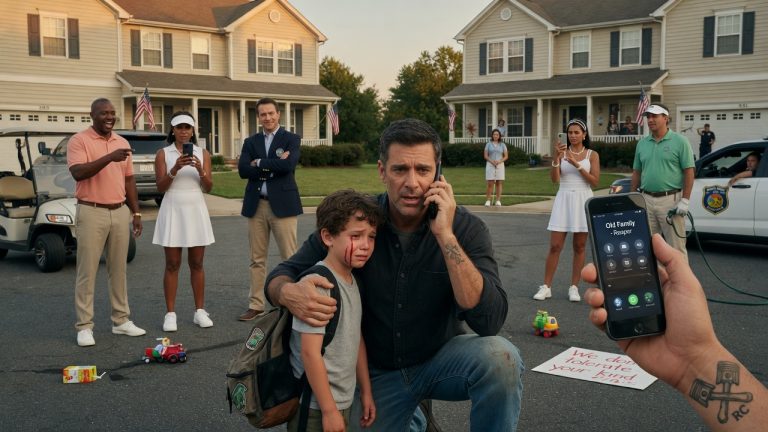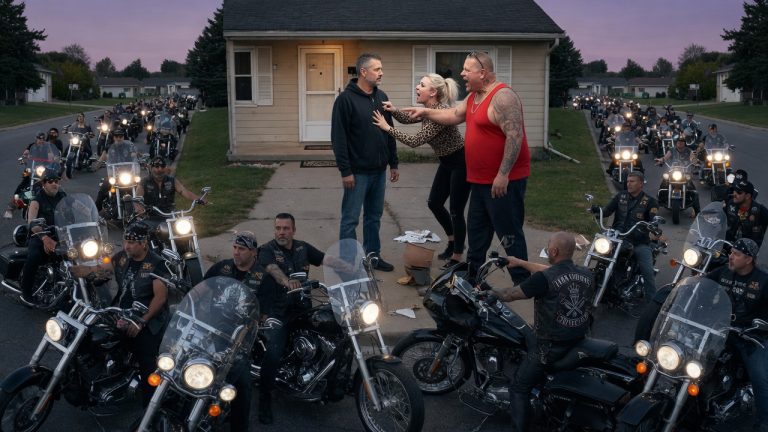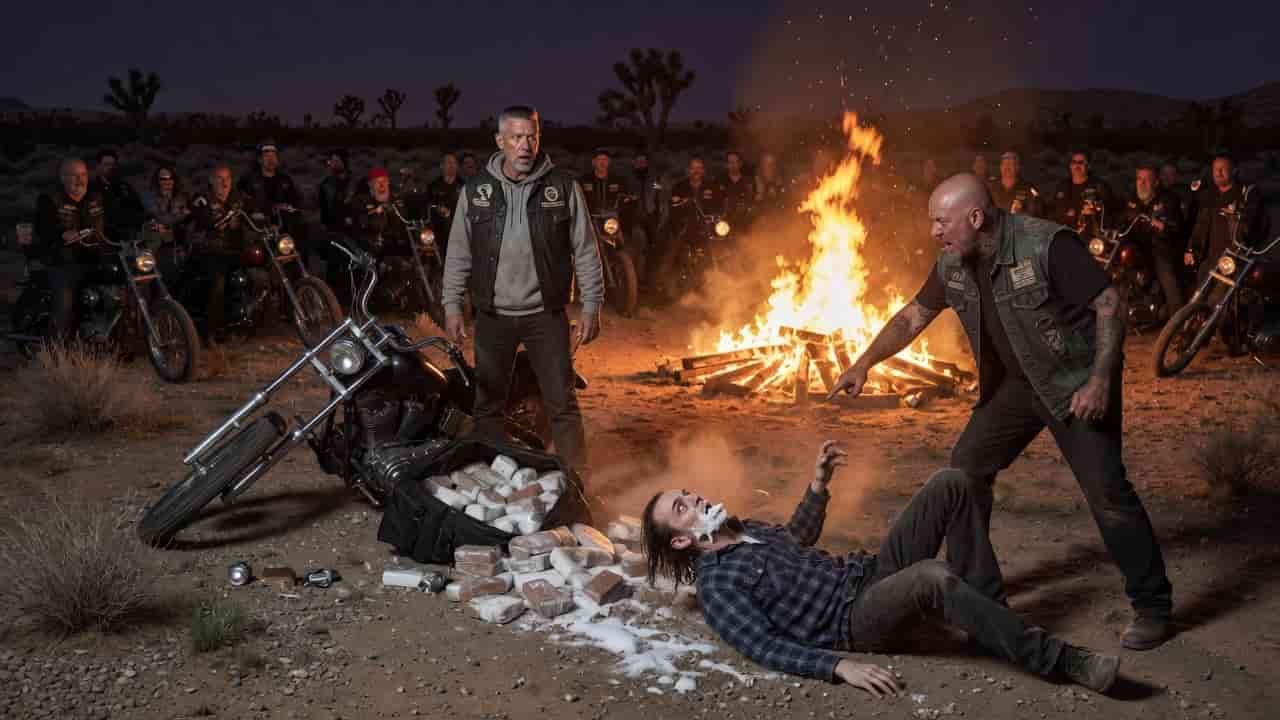
“Say it in front of the club, Cobra.”
Chef stood over the spilled bag, his heavy boot pinning a brick of white powder into the Arizona dust. The bonfire roared behind him, casting long, jagged shadows across the 900 men who had followed Cobra Vance into the desert. They were all silent now, their eyes shifting from the drugs to the man who had sworn an oath to keep them clean.
Cobra didn’t move. He couldn’t. Just a few feet away, his younger brother Leo was on the ground, his body arching in a seizure that looked like it was trying to snap his spine. The blue flannel shirt he wore was soaked in sweat, his eyes fixed on nothing.
“I did it for the club,” Cobra whispered, his voice cracking. “We were going broke. I had to feed you.”
“You didn’t feed us, you sold us out!” Chef’s roar echoed off the canyon walls. He grabbed Cobra by the collar of his leather vest, forcing him to look at his convulsing brother. “You told us this was the one thing we’d never touch. You made us swear on our lives. And all the while, you were the one driving the trucks?”
The circle of bikers tightened. The air smelled of gasoline, burnt wood, and a betrayal that was about to turn the desert floor into a trial.
Chapter 1: The Weight of the Crown
The heat in Gila Bend didn’t just sit on you; it pressed. It was a physical weight, like a heavy hand on the back of your neck, forcing you to look down at the cracked, thirsty earth. Cobra Vance sat on the porch of the MC clubhouse, a converted roadside bar that smelled of stale beer and ninety-weight gear oil. He was watching the horizon, waiting for the dust plumes that signaled the arrival of the supply trucks.
He was forty-five, but in the harsh Arizona sun, he looked fifty-five. His hands, resting on his knees, were a map of every fight he’d ever had—scarred knuckles, a missing tip on the left pinky, and the faded tattoo of a serpent coiling around his thumb. He wore the “President” patch with a weary sort of pride, a piece of leather that felt heavier with every passing year.
Beside him, a young man sat slumped in a plastic chair. This was Leo, Cobra’s younger brother by twenty-three years. Leo looked like a blurred version of Cobra—thinner, paler, with eyes that wandered and never quite landed on anything for long. He was wearing a blue flannel shirt that was far too heavy for the hundred-degree heat. He was shivering.
“You okay, kid?” Cobra asked, his voice a low rumble.
Leo didn’t look up. “Just the heat, Trace. It gets in my bones.”
Cobra frowned. He hated being called Trace—it was his birth name, a name associated with the trailer park and the smell of burnt spoons and the two bodies the deputies had carried out when he was ten years old. In this world, he was Cobra. He was the man who had built the Sons of the Serpent into a powerhouse of nine hundred and ninety-nine men. He was the man who had one absolute rule: No drugs. No sales. No use.
He had enforced it with a hammer. Three years ago, he’d personally stripped the patches off a man named “Ratty” and broken both his hands for selling pills in the back of a Tucson bar. The club believed in him because he was the man who had survived the poison and turned his back on it.
“Drink some water,” Cobra commanded, sliding a plastic bottle across the table.
Leo took a sip, but his hand shook so violently that water spilled down his chin. He wiped it away with a sleeve that was already damp. Cobra felt a cold knot of dread in his stomach. He knew that shake. He’d seen it on his mother’s hands every morning until she got her fix. But he pushed the thought away. Leo was his blood. Leo was the anchor. He’d brought the boy here to protect him, to keep him in the orbit of the club where he could be watched.
A cloud of dust appeared on the horizon. The trucks were coming.
These weren’t just any trucks. They were the lifeblood of the Serpents. Nominally, they hauled scrap metal and surplus equipment for the state. In reality, they were moving the capital that kept nearly a thousand men fed, housed, and armed.
The club was struggling. The myth of the free-wheeling biker was dying under the weight of insurance, rising gas prices, and a local economy that had collapsed a decade ago. The “legal” side of the business—the repair shops and the trucking contracts—barely covered the interest on the debts.
Cobra stood up as the first semi-truck pulled into the gravel lot, its air brakes hissing like a warning. He felt the eyes of his men on him. Chef, the club’s sergeant-at-arms, was standing by the garage doors, his massive arms crossed. Chef was a man of few words and absolute loyalty, a man who believed in Cobra’s “clean” vision with the fervor of a convert.
“Check the manifested weight, Chef,” Cobra called out.
“Already on it, Boss,” Chef replied, his voice a deep bass.
Cobra walked toward the truck, his boots crunching on the gravel. He felt the secret tucked away in the back of his mind like a shard of glass. He was the one who had negotiated the new “logistics” deal. He was the one who had told the brothers that the extra money was coming from a high-security government contract.
He was the one who had spent the last six months secretly running the largest methamphetamine pipeline in the Southwest right under their noses.
He did it for them. That was the lie he told himself every night. If the club went bankrupt, the 999 men would scatter. They’d be picked off by the cartels or the federal task forces. They’d lose their homes, their sense of belonging. He was protecting the family. And if that meant selling the very poison that had destroyed his own family, then that was the cross he had to carry.
As the driver hopped down from the cab, Cobra caught a glimpse of Leo in the periphery. The boy was staring at the truck with an intensity that made Cobra’s skin crawl. Leo wasn’t looking at the chrome or the tires. He was looking at the cargo.
“Get inside, Leo,” Cobra barked.
“I just wanted to help,” Leo murmured, his voice thin.
“Inside. Now.”
Cobra watched him go, the boy’s blue flannel flapping in the dry wind. He felt the residue of the lie sticking to his skin. He was the King of a kingdom built on a graveyard, and the first cracks were starting to show. He reached out and touched the warm metal of the truck’s fender, his fingers tracing the outline of a serpent decal.
He had to keep it together. Just a few more shipments, enough to clear the debt and set up the legal business for good. Then he’d stop. He’d be the hero they thought he was. He just needed more time.
But as the sun began to dip behind the mountains, casting the desert in blood-red light, Cobra knew that time was the one thing he couldn’t buy.
Chapter 2: The Shepherd and the Wolf
The following morning, the heat arrived before the sun was even fully over the horizon. Cobra was in his office, a cramped room at the back of the clubhouse filled with the smell of old paper and gun oil. He was staring at a ledger, the numbers refusing to balance. The cost of maintaining his “clean” image was skyrocketing.
A knock at the door startled him. He reflexively slid a folder over the secret accounts.
“Come in.”
The door creaked open, and Father Michael stepped inside. Michael wasn’t a biker, but he’d lived in Gila Bend long enough to have the desert in his skin. He was a small man with silver hair and eyes that seemed to see through the leather and the bravado. He was the only person in town who wasn’t afraid of Cobra.
“Trace,” the priest said softly.
“Father. I told you, call me Cobra.”
“I’ll call you by the name your mother gave you before the world broke her,” Michael said, sitting in the lone guest chair. “I’m here about the boy. Leo.”
Cobra felt his jaw tighten. “What about him? He’s fine. He’s with me.”
“He was at the clinic last night. Asking for clean needles. Said he was doing a favor for a friend.” Michael leaned forward, his hands clasped over his knees. “There are no friends in that life, Trace. Only ghosts.”
“He’s not using,” Cobra said, his voice dropping to a dangerous growl. “I’d know. I watch him like a hawk.”
“You see what you want to see. You always have. You wanted to see a brotherhood here, and you built one. But look at what it’s costing you.” Michael gestured toward the window, where several bikers were working on a bike in the lot. “The town is talking. They see the trucks. They see the money flowing in when the scrap yard is empty. They aren’t stupid.”
“The trucks are legal,” Cobra lied, the words tasting like ash. “State contract. High-value equipment. It’s what’s keeping the lights on in this town, Michael. You should be thanking me.”
“I’ll thank you when you stop lying to yourself,” the priest said, rising to his feet. “You’re a shepherd, Trace. But you’ve started feeding your sheep to the wolves to keep the fence standing. It won’t hold.”
After the priest left, the silence in the office was deafening. Cobra stood up and walked to the window. He saw Leo sitting on a crate near the garage, his head between his knees. The boy looked so small, so fragile.
Cobra went out to him. He didn’t say anything, just put a heavy hand on Leo’s shoulder. He felt the boy flinch.
“You were at the clinic,” Cobra said. It wasn’t a question.
Leo looked up, his eyes glassy. “I was just… I was curious, Trace. I wanted to see where it happened. Where they went.”
“They went to the dirt, Leo. Same place everyone goes who touches that shit. You stay away from there. You hear me?” Cobra’s grip tightened, his fingers digging into the boy’s thin collarbone. “I built this for you. All of this. So you wouldn’t have to live like them.”
“Is that why you do it?” Leo asked, his voice suddenly sharp. “For me?”
Cobra froze. The boy’s eyes were too clear for a moment, too perceptive.
“I do it for the Serpents,” Cobra said, stepping back.
“Right,” Leo muttered, looking back at the ground. “The Serpents.”
Cobra walked away, his heart hammering against his ribs. He needed to talk to Ghost. Ghost was the club’s best tracker and look-out, a man who lived in the shadows and saw everything. If Leo was using, Ghost would know. If the feds were watching the trucks, Ghost would know.
He found Ghost in the back of the garage, cleaning a long-range rifle with the methodical precision of a monk. Ghost didn’t look up when Cobra entered.
“The priest was here,” Ghost said.
“I know.”
“He’s right about the town. People are noticing the shift. The New Mexico crew is asking why our prices are so low. They think we’ve found a new source.” Ghost looked up, his eyes cold and flat. “Have we, Cobra?”
“We’re efficient, Ghost. That’s all.”
“Efficiency doesn’t pay for nine hundred new tires and a fresh coat of paint on the clubhouse. Something’s coming. I can feel it in the air. Like the static before a storm.”
Cobra looked at his friend, a man who had bled for him more times than he could count. He wanted to tell him. He wanted to share the burden of the secret, to explain why he was doing it. But he knew Ghost. Ghost was a purist. He believed in the code. If he knew that Cobra was the source of the rot, he’d be the first to pull the trigger.
“Just keep your eyes open,” Cobra said.
“I always do,” Ghost replied.
As Cobra left the garage, he saw Chef supervising the unloading of another truck. The massive man was laughing, clapping a younger brother on the back. It was a scene of perfect, rugged harmony. A brotherhood built on a lie.
Cobra felt a wave of nausea. He thought of his parents—the way their skin had turned a grey, translucent color in the end. He thought of the way they’d look at him, their own son, as if he were just an obstacle between them and the needle.
He was becoming the thing he hated. He was the dealer. He was the wolf in the shepherd’s clothing. And as he watched Leo stumble toward the clubhouse, he realized that the fence wasn’t just failing. It was already gone.
Chapter 3: The Mirror and the Debt
The heat wave broke on the third day, replaced by a brooding, heavy sky that threatened a monsoon. Cobra decided to ride out to the North Border, a patch of desert where a rival MC, the “Iron Saints,” held a small territory. The Saints were everything the Serpents weren’t—small, poor, and led by a man named Old Man Jack who still lived in a tent and fixed his own 1970s Shovelhead.
Cobra found Jack sitting by a small campfire, boiling coffee in a blackened tin pot. The old man looked like a piece of driftwood—twisted, sun-bleached, and indestructible.
“Vance,” Jack said, not looking up. “You look like a man who’s carrying a mountain on his back.”
“Just business, Jack,” Cobra said, dismounting. He felt out of place on his chrome-heavy, customized bike. It looked like a toy compared to Jack’s grease-stained machine.
“Business is for suits,” Jack spat into the fire. “We’re supposed to be free. But I look at you, and I don’t see a free man. I see a man who’s owned by his own success.”
“I have nine hundred and ninety-nine men to look after, Jack. I can’t afford to live in a tent.”
“Maybe that’s your problem. You think numbers mean power. But numbers just mean more mouths to feed, more secrets to keep.” Jack finally looked at him, his eyes like two polished stones. “I heard your brother’s back in town. How’s he doing?”
“He’s fine.”
“Is he? Because my boys saw him at the border two nights ago. Talking to the Sinaloa runners. He looked like a man who was looking for something he couldn’t find in your clubhouse.”
Cobra felt the world tilt. “He was where?”
“The border, Vance. Near the old mines. He was with a runner named Paco. Not a good man to owe a debt to.” Jack took a sip of his coffee. “You’ve got a rot in your house, Cobra. You can paint the walls all you want, but the foundation is soft.”
Cobra didn’t wait to hear more. He roared back toward Gila Bend, the desert wind whipping at his face. He pushed the bike to its limit, the engine screaming under him.
He found Leo in the back of the clubhouse, sitting in the dark laundry room. The boy was staring at his own reflection in the glass of a washing machine.
“Jack saw you at the border,” Cobra said, his voice a jagged edge. “With Paco.”
Leo didn’t flinch. He didn’t even turn around. “He’s a nice guy, Paco. He understands things.”
“He understands how to gut you and leave you for the coyotes! What were you doing there, Leo? Tell me the truth!” Cobra grabbed him by the shoulders and spun him around.
Leo’s face was a ruin. His nose was bleeding, a thin trail of dark red staining his blue flannel shirt. His pupils were pinned, tiny black dots in a sea of glazed blue.
“I just wanted a taste,” Leo whispered. “Just a taste of what makes you so much money, Trace. I wanted to see why it was more important than me.”
“You think I do this for the money?” Cobra shouted, shaking him. “I do this so you don’t end up in a ditch! I do this to keep the Serpents alive!”
“The Serpents are dead!” Leo yelled back, his voice cracking with a sudden, desperate energy. “They’re just addicts who don’t know it yet! They’re addicted to the life you bought them with other people’s blood! You’re just like Mom, Trace. You’re just like Dad. You just found a bigger needle.”
Cobra swung. It was an instinctive, ugly move. His fist caught Leo across the jaw, sending the boy spiraling back into the dryer.
The silence that followed was absolute. Leo lay on the floor, his hand over his mouth, looking up at Cobra with a mixture of fear and a terrible, mocking pity.
“There it is,” Leo said, his voice muffled by his hand. “The King’s justice.”
Cobra looked at his hand—the scarred knuckles, the missing pinky. He felt a wave of self-loathing so strong he thought he might vomit. He reached down to help Leo up, but the boy pulled away, crawling into the corner.
“Get out,” Leo hissed. “Go lead your brothers, Cobra. I’m fine right here.”
Cobra backed out of the room, his head spinning. He felt the residue of the blow, the physical shock of hitting his own brother. It felt like the final seal had been broken.
He walked out into the main bar area. The room was full of his men. Chef was at the bar, laughing with Ghost. The atmosphere was light, expectant. Tonight was the big bonfire, the annual celebration of the club’s founding. It was the night they renewed their vows.
“You okay, Boss?” Chef asked, noticing Cobra’s expression. “You look like you’ve seen a ghost.”
“Just the heat, Chef,” Cobra said, forcing a smile. “Just the heat.”
He went to the bar and poured himself a double shot of cheap whiskey. He drank it in one go, the burn welcome. He looked at the 999 men he had “saved.” He looked at the clean leather, the expensive bikes, the full bellies.
He had a debt to pay. To the club, to the ghosts of his parents, and now to the broken boy in the laundry room. And the only currency he had left was the lie.
Chapter 4: The Bonfire of Vanities
The bonfire was a towering structure of pallets and desert brush, situated in the middle of a dry lake bed five miles from the clubhouse. It was a tradition that went back to the club’s first year—a moment to burn away the old year’s failures and look toward the future.
Tonight, the fire was massive. The flames licked at the dark sky, casting an orange glow that could probably be seen from the interstate. Nearly a thousand motorcycles were parked in a perfect circle around the blaze, their chrome reflecting the flickering light like a sea of diamonds.
Cobra stood at the head of the circle, his bike behind him. He felt the weight of every eye in the room. This was the moment of his greatest triumph—the club was richer than ever, the brothers were united, and the Serpents were the undisputed kings of the border.
But as he looked out at the faces of his men, all he saw were the victims of his silence.
Chef stepped forward, holding a ceremonial torch. “Tonight, we remember where we came from!” he shouted, his voice carrying over the crackle of the flames. “We remember the brothers we lost to the road and the ones we lost to the needle! We thank our President for keeping us on the straight path! To Cobra!”
“TO COBRA!” the 999 men roared in unison.
Cobra felt a cold sweat breaking out on his forehead. He looked at Leo, who was standing a few yards away. The boy was wearing his blue flannel again, but he looked worse than ever. He was swaying on his feet, his face a ghostly white in the firelight.
“I have something to say,” Cobra began, stepping toward the fire. His voice felt small against the roar of the flames.
Suddenly, a loud crack echoed through the lake bed. It wasn’t the fire. It was the sound of a heavy motorcycle hitting the gravel.
Cobra turned. His bike, the crown jewel of the club, had tipped over. It had been parked on a slight incline, and the kickstand had given way.
As the bike hit the dirt, a black nylon duffel bag that had been strapped to the sissy bar—the bag Cobra had intended to hide before the ceremony—slid off and hit a sharp rock. The side of the bag split open with a sickening rip.
Dozens of plastic-wrapped bricks of white powder spilled out onto the gravel, illuminated by the fire.
The silence that followed was more violent than any scream.
Chef was the first to move. He stepped toward the bag, his face frozen in confusion. He reached down and picked up one of the bricks. He felt the weight of it, the texture. He looked at the “Sinaloa” stamp on the corner of the plastic.
He looked at Cobra.
“What is this, Boss?” Chef asked, his voice a low, dangerous rumble.
“It’s… it’s evidence,” Cobra stammered, his mind racing for a lie that would hold. “I intercepted it. I was going to burn it tonight. To show we don’t fear it.”
“Intercepted it?” Chef said, stepping closer. “From who? From your own trucks?”
“Chef, listen to me—”
“I’ve been listening to you for ten years, Vance!” Chef roared, his face contorting with a sudden, explosive fury. He dropped the brick and grabbed Cobra by the front of his leather vest. “I’ve been the one enforcing your rules! I’ve been the one who broke my own brothers’ hands because they touched this shit! And you’ve been the one bringing it in?”
The circle of bikers began to close in. The orange light of the fire made them look like a pack of wolves, their eyes gleaming with betrayal.
“Look at him!” Chef shouted, turning Cobra toward Leo.
Leo had collapsed. He was on the ground, his body arching in a violent seizure. He was clawing at the dirt, his eyes rolled back in his head so that only the whites were showing. Foam was bubbling at his lips.
“He didn’t get that at the clinic, did he?” Chef hissed. “He got it from you. Your own brother, Vance. You fed him the poison while you preached the cure.”
“I did it for the club!” Cobra screamed, his voice breaking. “We were going under! I did it to keep you fed!”
Chef shoved him back, sending Cobra stumbling into the frame of his fallen bike. “We didn’t want to be fed by a dealer! We wanted a brother! You’re not a King, Vance. You’re just a ghost. A liar who’s been selling us our own graves.”
Chef reached into his belt and pulled out a heavy folding knife. He didn’t look at Cobra; he looked at the 999 men standing in the shadows.
“What do we do with a traitor?” Chef asked the crowd.
The response was a low, guttural murmur that grew into a roar.
Cobra looked at Leo, whose body was finally going still on the cold desert floor. He looked at the white bricks spilled in the dirt, the secret that had finally come home to roost. He realized that the residue of his life wasn’t the brotherhood or the money. It was the grey, translucent color of his brother’s skin.
The bikers stepped forward, their shadows stretching long across the gravel. The bonfire roared, higher and hotter than ever, but for Cobra Vance, the world had never been colder.
Chapter 5: The Circle of Ash
The roar of the bonfire seemed to grow louder, a hungry, crackling sound that filled the void where the brotherhood used to be. Cobra Vance stood paralyzed, his boots inches away from the spilled bricks of white powder. The desert air, usually so dry and empty, now felt thick with the stench of betrayal and the sharp, metallic tang of the bike’s spilled fuel. He looked at Chef, whose massive frame was silhouetted against the flames, and for the first time in twenty years, Cobra felt small.
“Get away from him,” Chef said, his voice a low, vibrating growl. He wasn’t talking about the drugs. He was talking about Leo.
Cobra looked down. Leo was still convulsing, his heels drumming a frantic, rhythmic beat against the hard-packed gravel. His blue flannel shirt was twisted around his torso, exposing his pale, rib-thin chest. Every muscle in the boy’s body was locked in a war against itself.
“He’s my brother, Chef,” Cobra choked out, reaching toward Leo.
“You lost the right to call him that when you put his life in a duffel bag,” Chef snapped. He stepped forward, the heavy folding knife in his hand catching the orange light. He didn’t point it at Cobra; he held it down by his thigh, a promise of violence held in check only by the shock of the moment. “Ghost! Get the medic kit. Now!”
Ghost moved from the shadows of the outer circle. He didn’t look at Cobra as he passed. The silence of the other 997 men was a physical pressure, a wall of leather and judgment that hemmed Cobra in. They weren’t shouting anymore. The roar had died down into a low, terrifying hum—the sound of a hive that had just realized its queen was a parasite.
Ghost knelt by Leo, his movements efficient and cold. He turned the boy onto his side, clearing his airway, his hands steady while Cobra’s were shaking like dry leaves.
“He’s burning up,” Ghost muttered. “It’s a massive hit. Pure stuff. Your stuff, Cobra?”
Cobra couldn’t answer. The lie was a lead weight in his throat. He looked around the circle, searching for a single face that didn’t hold murder in it. He saw the younger guys, the ones he’d promised a future to, looking at the drugs with a mixture of horror and a sickening, new curiosity. He saw the old-timers, the ones who remembered the trailer parks and the morgues, looking at him with a cold, distant contempt.
“I did it for the clubhouse,” Cobra said, his voice gaining a desperate, shrill edge. “Look at the bikes you’re riding! Look at the roof over your heads! We were three months from being homeless, Chef. The bank was coming. The Saints were moving in. I saved us!”
“You killed us,” Chef said, finally looking Cobra in the eye. The big man’s eyes were wet, sparkling with a grief that he was trying to crush with anger. “We were poor, Vance. We were struggling. But we were the Sons of the Serpent. We had the one thing nobody could take—we were clean. We were the only ones who didn’t sell our souls for a chrome tailpipe.”
Chef stepped over the drugs, his heavy boots crushing one of the plastic-wrapped bricks. A puff of white powder erupted from the split seam, dusting the leather of his boots like a curse.
“You think we cared about the money?” Chef asked, his voice dropping to a whisper that somehow carried further than his shout. “We cared about you. We believed the story you told us. About the boy. About the past. We thought we were protecting a legacy. Turns out we were just security guards for a king-pin who was too chicken-shit to admit he’d turned into his father.”
Cobra felt a flash of heat in his chest—not from the fire, but from a sudden, ugly surge of pride. “Don’t you talk about my father. You don’t know what it’s like to carry the weight of a thousand men. You just follow the leader, Chef. It’s easy to be moral when you don’t have to pay the bills.”
“Is that what you tell yourself when you’re tucking the bags into the tires?” Chef stepped into Cobra’s personal space, the smell of grease and tobacco overwhelming. “That you’re the martyr? You’re just a dealer, Trace. A high-end dealer with a fancy patch.”
Behind them, Leo let out a long, ragged groan. His body went limp, the seizure finally subsiding into a terrifying, shallow-breathing stillness. Ghost looked up, his face grim.
“He needs a hospital. Now. He’s slipping into a coma.”
“I’ll take him,” Cobra said, stepping toward his bike.
“You aren’t going anywhere,” a voice called out from the circle. It was one of the younger members, a kid named Rabbit who Cobra had personally mentored. Rabbit was holding a heavy iron pipe, his knuckles white. “The trucks are still in the lot, Cobra. We checked the manifests while you were out here. There’s enough in those trailers to put the whole town in the ground.”
The mood of the circle shifted. The judgment turned into action. Men started moving toward the parked bikes, their expressions hardening. The brotherhood was fracturing in real-time. Some were looking at the drugs in the dirt with greedy eyes; others looked like they wanted to burn the whole world down.
“The trucks stay where they are!” Cobra commanded, trying to regain his authority. It was a reflex, a ghost of the man he used to be.
Nobody listened.
Chef grabbed Cobra by the shoulder and spun him around, forcing him to look at the bonfire. “You want to be a savior? Then save us from this.” Chef pointed at the spilled drugs. “Burn it. All of it. Right now. In front of the brothers.”
Cobra looked at the white bricks. There was nearly half a million dollars sitting in the dirt. It was the money that was supposed to pay off Paco. It was the money that was supposed to keep the Iron Saints from burning their clubhouse to the ground. If he burned it, he wasn’t just losing his status—he was signing a death warrant for every man in the circle.
“If I burn that, the cartel comes for us,” Cobra said, his voice trembling. “They don’t care about our codes, Chef. They want their product. They’ll kill everyone here. Your wives, your kids. They’ll wipe Gila Bend off the map.”
“Let them come,” Chef said, his jaw set. “I’d rather die fighting a wolf than live as a dog for a man like you.”
The men began to chant. It started with a few, then a dozen, then the whole circle. “Burn it! Burn it! Burn it!”
Cobra looked at Ghost, who was still cradling Leo’s head. Ghost nodded slowly. “Do it, Trace. It’s the only way you walk out of here alive. Maybe.”
Cobra reached down and picked up a brick. The plastic felt oily, cold. He looked at the bonfire, the flames dancing like demons. He thought of the twenty years he’d spent building this myth. He thought of the nights he’d spent telling Leo that they were different, that they were the survivors.
He threw the first brick into the fire.
A plume of green-tinged smoke erupted as the plastic melted and the chemicals ignited. The smell was atrocious—acrid, chemical, like burning rubber and rot. One by one, Chef and the others began to grab the bricks, hurling them into the heart of the blaze.
The air became toxic. Men began to cough, backing away from the heat, but they didn’t stop until the bag was empty and the gravel was bare.
Cobra stood in the center of the toxic smoke, his lungs burning. He felt a strange, hollow lightness. The secret was gone. The money was gone. The future was gone.
“Now,” Chef said, wiping sweat from his forehead. “Take the boy. Get him to the clinic. And don’t come back to the clubhouse.”
“Chef, listen—”
“I’m not listening anymore,” Chef said, his voice flat and final. He reached out and, with a quick, brutal motion, ripped the “President” patch off Cobra’s vest. The leather tore with a sound like a dying animal. “Go. Before I change my mind about letting you breathe.”
Cobra didn’t argue. He couldn’t. He went to Leo, picking up the boy’s limp, shivering body. Leo felt like a collection of sticks, weightless and fragile. Ghost helped him settle the boy into the sidecar of a nearby Ural—Cobra’s own bike was still lying in the dirt, its chrome stained by the very poison it had carried.
As Cobra pulled away from the lake bed, the headlights of his bike cutting a lonely path through the desert darkness, he looked back. The bonfire was still roaring, but the circle of 999 men was broken. Groups were arguing, some were fighting, and many were simply riding away into the night.
The Sons of the Serpent were dead. He had burned them himself. And as he felt Leo’s cold hand brushing against his leg, Cobra Vance realized the residue of his leadership wasn’t going to be a legend. It was going to be a body count.
Chapter 6: The Long Walk Home
The clinic in Gila Bend was a low, cinder-block building that smelled of industrial floor cleaner and desperation. Father Michael was already there when Cobra skidded into the parking lot, his tires screaming against the asphalt. The priest looked as though he hadn’t slept in a week, his face etched with a weary, knowing sadness.
“He’s in the back,” Michael said, catching Cobra as he stumbled through the doors with Leo in his arms. “The doctor is doing what she can, but his heart… it’s tired, Trace. It’s been through too much.”
Cobra sat in the plastic-molded chair of the waiting room. He still wore his leather vest, the jagged, empty space where his “President” patch had been looking like a fresh wound. His hands were stained with the soot of the bonfire and the grease of the road. He looked down at them and saw his father’s hands—trembling, desperate, and empty.
Hours bled into each other. The sun began to creep over the desert floor, a pale, sickly yellow light that didn’t bring any warmth. Every time the door to the treatment room opened, Cobra flinched. He was waiting for the final sentence, the one he knew he had earned the moment he’d signed that first manifest.
Around 5:00 AM, the doctor came out. She was a middle-aged woman named Sarah who had treated half the bikers in the county for road rash and broken bones. She didn’t look at Cobra with the usual professional detachment. She looked at him with a cold, exhausted anger.
“He’s stable for now,” she said, wiping her hands on her lab coat. “But there’s neurological damage. We won’t know the extent until he fully wakes up. If he wakes up.”
“Can I see him?” Cobra whispered.
“He’s your brother,” she said, her voice hard. “But if I were him, the last thing I’d want to see is the man who put that into my system.”
“I didn’t give it to him!” Cobra snapped, his old defensiveness flaring up.
“You brought it into his house, Vance. You made it available. You made it normal. In this town, that’s the same thing as holding the needle.” She turned and walked away, her footsteps echoing in the empty hallway.
Cobra walked into the room. Leo was hooked up to a dozen monitors, the steady beep-beep-beep of the heart rate monitor the only sound in the room. He looked even smaller under the white hospital sheets, his face stripped of the desert tan, leaving only a grey, translucent pallor.
Cobra sat by the bed and took Leo’s hand. It was cold.
“I’m sorry, kid,” Cobra whispered. “I thought I was building something. I thought I was making a place where we could be safe. I was just… I was just scared of being poor again. I was scared of being nothing.”
The door to the room creaked open. It was Ghost. He was still wearing his cuts, but the Serpent patch had been blacked out with electrical tape.
“Chef’s gone,” Ghost said, leaning against the doorframe. “He took about two hundred of the guys. They’re heading north. Said they’re done with the club life. The rest… well, the rest are waiting for the cartel.”
“And you?” Cobra asked, not looking away from his brother.
“I’m staying. Someone has to watch the border. Someone has to make sure the Saints don’t take the clubhouse and turn it into a distribution hub. It’s what you should have done, Trace.” Ghost walked over and placed a small, heavy object on the bedside table. It was Cobra’s old serpent ring, the one he’d used to seal the deals. It was bent, the silver tarnished. “Found this in the gravel. Thought you might want it as a souvenir of the empire.”
“I don’t want it,” Cobra said.
“Good. Because it doesn’t mean anything anymore.” Ghost looked at Leo. “The boy’s a fighter. He survived the trailer park. He might survive you. But don’t expect him to thank you.”
Ghost left without another word. The residue of his presence was a cold draft that seemed to settle in the room.
An hour later, Father Michael returned. He sat in the chair Ghost had vacated. He didn’t offer any platitudes. He didn’t tell Cobra that God would forgive him. He just sat in the silence, a witness to the wreckage.
“What now?” Cobra asked.
“Now you live with it,” Michael said. “The money is gone. The club is gone. Your reputation is a pile of ash in the desert. All you have left is the truth. It’s a heavy thing to carry, but it’s the only thing that won’t rot.”
Cobra looked at the monitor. The beep-beep-beep continued, steady and indifferent. He realized that for twenty years, he’d been running from the ghost of his parents, trying to build a wall of leather and chrome and men to keep the past at bay. But the past hadn’t been behind him. It had been inside him. It had been the very fuel he’d used to build his wall.
He stood up and walked to the window. In the distance, he could see the dust plumes of a few lone motorcycles heading out of town. The Sons of the Serpent were a memory now, a cautionary tale for the next generation of kids who thought a patch made them a king.
He looked at his reflection in the window. He saw a man with no title, no brothers, and no future. He saw Trace Vance, the boy from the trailer park who had finally run out of lies.
He turned back to the bed. Leo’s eyes flickered. Just a tiny movement, a flutter of the lids. Cobra held his breath.
Leo’s eyes opened. They weren’t glassy anymore. They were clear, blue, and filled with a sudden, sharp recognition. He looked at the tubes, the monitors, and then he looked at Cobra.
He didn’t speak. He didn’t have to. The look in his eyes was one of absolute, shattering disappointment. It was the look of a boy who had finally seen his hero for what he was.
Leo slowly, painfully, pulled his hand out of Cobra’s grip. He turned his head toward the wall, closing his eyes again.
Cobra stood there for a long time, his hand hanging empty in the air. He felt the cold weight of the silence, the finality of the rejection. It was the residue of his choices, the ultimate price of the crown he’d worn.
He walked out of the room, through the quiet clinic, and out into the Arizona morning. The heat was already starting to build, the sun a relentless, honest fire. He didn’t go to his bike. He didn’t go to the clubhouse. He just started walking toward the horizon, his boots kicking up the dust of a road that led nowhere.
He was a man with nothing left to hide, and in the vast, unforgiving desert, that was the most terrifying thing of all. He kept walking until the clinic was a speck in the distance, his shadow stretching out before him, long and jagged and alone.
The King was gone. Only the ghost remained.