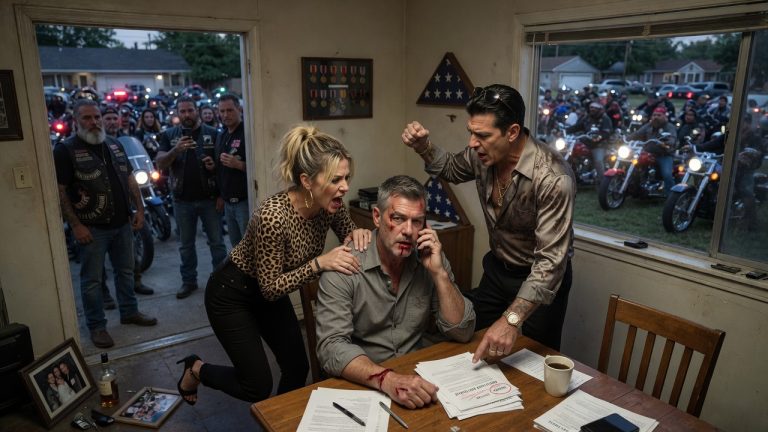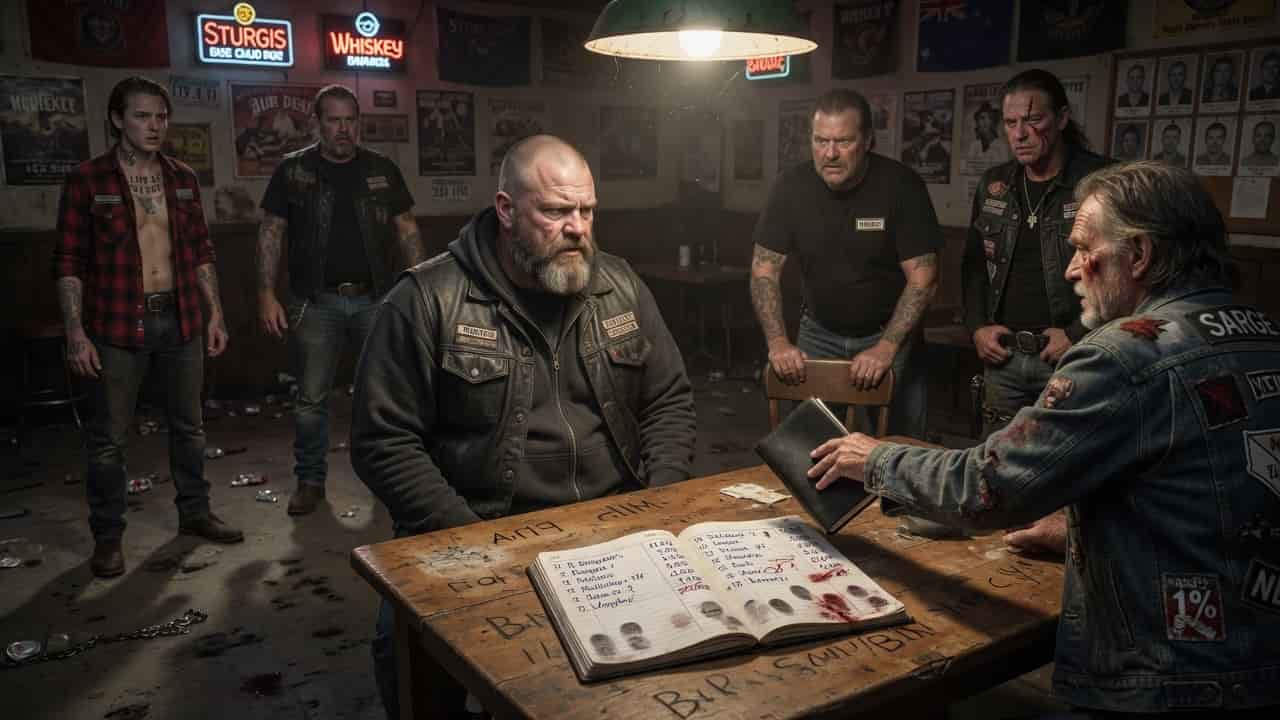
“Look at the names, Mac. Tell the room why their names are in this book.”
Sarge didn’t raise his voice, but the clubhouse went so quiet you could hear the oil dripping from the bikes in the garage. He tossed the black leather ledger onto the bar, right next to Mac’s heavy, trembling hand. The cover was stained—not with oil, but with the truth of what happened out on that desert road.
Mac didn’t look up. He couldn’t. Around him, the men he’d led for twenty years—men who called him a father, a brother, a hero—were starting to realize that the ambush wasn’t bad luck. It was a transaction.
“I did what I had to for the club,” Mac whispered, his voice cracking like dry leather.
“You did it for the cards, Mac,” Sarge snapped, stepping into the big man’s space, forcing him to look at the faces of the brothers who were still standing. “You sold the route. You told those people exactly where we’d be. Five men are gone because you couldn’t stop chasing a flush.”
The betrayal in that room is heavy enough to break the floorboards. Mac McKinley wasn’t just their leader; he was their anchor. And now, they have to decide what happens to a man who puts a price tag on his family’s lives.
Chapter 1: The Price of Iron
The desert didn’t care about brotherhood. It didn’t care about the three-piece patches on their backs or the history of the 999 MC. The Nevada heat just sat there, heavy and indifferent, pressing down on the corrugated tin roof of the clubhouse like a giant’s palm.
Inside, “Big Mac” McKinley sat at his desk, a slab of scarred oak that had seen more whiskey spills and blood-drops than a trauma ward. He was a mountain of a man, his frame still broad enough to fill a doorway even as he pushed sixty. But today, the mountain was crumbling. His hands, usually steady enough to rebuild a carburetor in the dark, were vibrating. Just a micro-tremor, visible only to him, but it felt like an earthquake.
He reached into the bottom drawer and pulled out a stack of envelopes. Not the club’s bills—those were Leo’s problem. These were personal. Most were marked with the logo of a casino three hours south, or handwritten notes on plain stationery. The numbers were staggering. Two million. It was a figure that didn’t feel real, like a distance to another planet, until you realized the people holding the debt were very much grounded on Earth.
“Mac?”
The voice was gravel and smoke. Mac shoved the envelopes back into the drawer and kicked it shut a second before Sarge walked in. Sarge was the club’s Sergeant-at-Arms, a man who looked like he’d been carved out of a hickory stump. He was Mac’s oldest friend, the man who had been riding on his left since they were twenty-year-old punks with nothing but cheap bikes and a chip on their shoulders.
“News from the hospital?” Mac asked, his voice sounding deeper, more authoritative than he felt. It was a mask he’d been wearing so long it had started to fuse to his skull.
Sarge shook his head, his grey eyes dull. “Donny didn’t make it. Code blue at 4:00 AM. His lungs just gave out. That makes five, Mac. Five kids in the ground because of one ‘random’ ambush.”
Mac felt a cold spike of nausea hit his stomach. Donny. He was twenty-two. He had a kid on the way. Mac had given him his full colors only six months ago.
“Random,” Mac repeated, the word tasting like copper.
“That’s what the cops are calling it,” Sarge said, pacing the small office. “High-road robbery gone wrong. But I don’t buy it. Those shooters knew exactly where the supply run was stopping. They were waiting in the rocks at the Mile 42 turnout. It wasn’t a robbery, Mac. It was a slaughter. They didn’t even take the bikes.”
Mac turned his chair toward the window, looking out at the dusty lot where fifty Harleys sat gleaming in the sun. He couldn’t look Sarge in the eye. If Sarge saw the flicker of shame, the house of cards would come down.
“We’ll find them, Sarge. I promise.”
“We already found something,” Sarge said. He stopped pacing and leaned against the desk. “I went back to the site this morning before the sun got too high. The cops missed a casing. Specialized stuff. Subsonic. Not the kind of ammo a highway stick-up crew uses. This was professional, Mac. Hired work.”
Mac’s heart hammered against his ribs. Vane. The name echoed in his head. Vane was the man the casino owners sent when the debt stopped being a business matter and started being a moral one. Vane had suggested the “transaction.” A tip on a high-value club movement in exchange for a half-million-dollar credit on the debt. Mac had told himself it was just a robbery. He’d told himself the boys would just give up the cargo and ride away. He hadn’t known Vane was sending executioners.
“Maybe it’s the Vipers,” Mac suggested, his voice hollow. “They’ve been pushing into our territory.”
“The Vipers are meth-heads who can barely aim a hand-gun,” Sarge snapped. “This was clean. This was a leak, Mac. Someone told them the route.”
Sarge’s gaze was a physical weight. For forty years, Mac had been the hero. He’d saved this club from bankruptcy in the 90s. He’d walked into a rival clubhouse alone to negotiate a peace treaty that had lasted a decade. He was the man who’d carried Sarge’s brother out of a burning bar in ‘88. He was a god in this town.
And his father had been a coward.
That was the wound that never healed. Mac’s father had been stripped of his colors in the 70s for skimming from the till and running when the heat showed up. Mac had spent his entire life building a wall of “honor” so high that no one would ever see the McKinley name and think of a rat. He’d become the biggest, toughest, most generous man in the state to outrun a dead man’s shadow.
But the gambling… it was the one thing he couldn’t control. It started small, a way to feel the rush of the road when he was stuck behind a desk. Then it became a way to solve the club’s money problems. And finally, it became a monster that ate everything.
“I’ll call an emergency meeting for tonight,” Mac said, his voice regaining its steel. “Every patch-holder in the room. We don’t stop until we know who did this.”
Sarge nodded, a glimmer of respect returning to his eyes. “That’s the Mac I know. The boys are hurting. They need to see their lion roar.”
Sarge walked out, closing the door behind him. Mac waited until the footsteps faded, then he opened the drawer again. He didn’t look at the envelopes. He looked at the small, black leather-bound ledger tucked into the back. It was his private record. Every debt, every payment, and the names of the five brothers who had been on that Mile 42 route.
He gripped the ledger so hard the leather groaned. He wasn’t a lion. He was a scavenger eating his own young. He had to stop. He had to find a way to pay Vane without another “transaction.” But as he looked at the balance at the bottom of the page, he knew the only thing he had left to sell was the club itself.
The residue of the conversation stayed in the room like stagnant smoke. Sarge’s trust was a jagged blade, and every time he looked at Mac with those loyal eyes, it twisted a little deeper.
Chapter 2: A Heavy Hand
The clubhouse basement was a cavern of concrete and cold air, smelling of stale beer and primary-drive fluid. Leo, the club’s accountant—a man who looked more like a high school math teacher than a biker—sat at a folding table with a laptop that looked decades too new for the room.
Mac stood over him, his shadow engulfing the table.
“Give it to me straight, Leo. No fluff.”
Leo pushed his glasses up his nose, his eyes darting toward the door. “Mac, the club’s general fund is… it’s a ghost town. We didn’t just lose the men at Mile 42. We lost the cargo. That was sixty-thousand dollars in specialty parts for the Arizona build. The insurance won’t cover it because we were off-route.”
“How are we off-route?” Mac growled. “I approved the route.”
“Exactly,” Leo whispered. “You signed off on the Mile 42 detour. You said it was to avoid the weigh station, but we don’t run heavy enough to care about weigh stations. The guys were confused, Mac. They were talking about it before they left.”
Mac leaned down, his face inches from Leo’s. “The detour was a security measure. I don’t pay you to audit my strategy. I pay you to make the numbers work.”
“They don’t work!” Leo’s voice cracked, a sudden burst of panicked bravery. “There’s a hole in the accounts, Mac. A big one. Over the last six months, small chunks have been disappearing. ‘Administrative fees.’ ‘Emergency maintenance.’ It adds up to nearly four hundred thousand. I’ve been trying to cover for you because I know what you’ve done for this club, but I can’t hide this anymore. Sarge is starting to ask for the quarterly reports.”
Mac’s hand shot out, grabbing Leo by the collar of his polo shirt. He didn’t shove him, but the threat was in the stillness. “You’ll keep hiding it, Leo. You’ll find a way to tie it to the Mile 42 loss. A ‘clerical error’ in the inventory. Do you understand?”
“Mac, please…”
“Do you understand?”
“Yes,” Leo choked out. “Yes, I’ll fix it.”
Mac let go, smoothing out the man’s collar with a terrifying gentleness. “Good. We’re a family, Leo. Family protects each other from the ugly truths.”
As Mac walked up the stairs, his phone buzzed in his pocket. He didn’t need to look at the screen to know who it was. He stepped out the back door into the alleyway, away from the prying eyes of the club members who were busy polishing their chrome for the funeral procession.
“Speak,” Mac said into the phone.
“The credit has been applied,” a voice said. It was Vane. He sounded bored, like he was discussing a grocery list. “But four-hundred-fifty thousand is a drop in the bucket, McKinley. You still owe a million-five. My employers are losing their patience. They think you’re stalling.”
“I’m not stalling. I just lost five men! The club is under a microscope. I can’t move anything right now.”
“You can move whatever I tell you to move,” Vane said, his tone sharpening. “There’s a shipment coming in from the coast on Thursday. High-end electronics. The 999 is supposed to escort it through the desert corridor. I want the GPS coordinates for the hand-off.”
“No,” Mac hissed. “I won’t do it again. Not after Donny.”
“Donny was an unfortunate variable,” Vane said. “If you don’t give me the coordinates, the next ‘variable’ will be your daughter. What’s her name? Claire? She’s a nurse at the county hospital, right? Works the night shift? Lots of dark parking lots in that neighborhood.”
The world narrowed to a pinprick of white-hot rage and paralyzing fear. Mac gripped the brick wall of the clubhouse until his knuckles turned white. He thought of Claire. She was the only thing left of his marriage, the only part of him that wasn’t covered in grease and lies.
“If you touch her, I’ll burn the world down,” Mac said, his voice a low vibration.
“Then don’t make me touch her. Thursday. Mile 88. The old quarry. Send a light crew. Two bikes max. Tell them it’s a ‘discreet’ hand-off. If there’s more than two, my people will treat it as a hostile encounter. And you know how that ends.”
The line went dead.
Mac stood in the alley, the heat of the Nevada sun feeling like a physical weight on his back. He felt the old wound in his chest—the shame of his father—throbbing like a fresh injury. He was doing exactly what his father had done. He was selling his people to save his own skin.
He walked back inside. In the main room, Sarge was sitting at the bar, staring at a photo of the club from five years ago. He looked up as Mac approached.
“You okay, brother? You look like you’ve seen a ghost.”
“Just the heat, Sarge,” Mac said, sliding onto the stool next to him. “Just the heat.”
He wanted to tell him. He wanted to confess everything, let Sarge punch him until his face was unrecognizable, and then let the club handle it. But he couldn’t. He was Big Mac McKinley. He was the king. And kings didn’t ask for mercy. They just made harder choices.
Chapter 3: The Silence in the Chrome
The funeral for the five fallen riders was a sea of black leather and muffled engines. A thousand bikers from all over the Southwest had descended on the small town, a show of force that should have made Mac feel proud. Instead, it felt like a funeral for the club itself.
Mac stood at the podium in the cemetery, the dry wind whipping his hoodie strings. He gave a speech about loyalty. He spoke about the “unbreakable bond” of the 999. Every word felt like a shard of glass in his throat. He saw Donny’s pregnant girlfriend in the front row, her face a mask of shattered grief. He saw Sarge standing behind her, his hand on her shoulder like a protective shadow.
After the service, the club gathered at “The Busted Knuckle,” a roadside bar that served as their unofficial satellite office. The atmosphere was thick with unspoken questions.
Sarge approached Mac at a corner table. He wasn’t holding a beer. He was holding a piece of paper.
“I was talking to the transport company, Mac. The one that hired us for the Mile 42 run.”
Mac felt the hair on his neck stand up. “And?”
“They said they didn’t request a detour. They said the route was supposed to be straight down the I-15. They were surprised when our guys turned off onto the county roads. They said you were the one who called and changed the manifest.”
The room seemed to tilt. Around them, the hum of conversation continued, but for Mac, the world had gone silent. He could see Blade and Ace watching them from the bar. They weren’t smiling.
“I told you, Sarge. It was a security measure. I had a tip that the Vipers were planning an I-15 hit.”
“A tip from who?” Sarge’s voice was low, dangerous. “I’m the Sergeant-at-Arms. I handle the intel. If there was a tip, it should have come through me. Why are you gatekeeping the safety of our brothers, Mac?”
“I’m the President!” Mac’s voice boomed, silencing the bar. He stood up, his massive frame towering over Sarge. “I don’t have to explain every tactical decision to you. I made a call. It turned out to be wrong. I have to live with that. Do you think I don’t feel the weight of those five caskets?”
Sarge didn’t flinch. He didn’t back down. He just stared at Mac with a look of dawning horror. It wasn’t anger yet. it was something worse. It was the moment the pedestal starts to crack.
“I know you feel it,” Sarge said quietly. “But I also know Leo has been crying in the bathroom for three days. And I know you’ve been taking ‘business trips’ to Vegas once a week for a year. I’ve been your left-hand man for forty years, Mac. Don’t lie to me. Not today.”
“Go home, Sarge,” Mac said, his voice trembling with a mix of rage and desperation. “You’re tired. We’re all tired.”
Mac turned and walked out of the bar, the silence following him like a physical presence. He didn’t go home. He drove his bike out into the desert, pushing the engine until the frame vibrated under him. He stopped at the Mile 88 quarry—the location for Thursday’s “transaction.”
It was a desolate, jagged hole in the earth. The perfect place for a betrayal.
He took out his black ledger. He looked at the names he’d already written down for Thursday’s run. Ace and Blade. Two of the best. Two of the most loyal. If he sent them here, Vane’s men would take the shipment, and if they followed the Mile 42 pattern, they would leave no witnesses.
He could change the names. He could send two guys he didn’t like as much. But there were no guys he didn’t like. That was the problem with building a family. You loved all of them, even the ones who annoyed you.
He sat on the ground, the heat of the desert cooling as the sun dipped below the horizon. He thought about his father. His father had died in a trailer, drunk and alone, still clutching a patch he hadn’t earned. Mac realized he was already there. He might still be wearing the vest, he might still have the title, but he was already alone.
He took a pen from his pocket and hovered it over the names Ace and Blade. He could cross them out. He could go to the police. He could tell Sarge.
But then he pictured Claire’s face. He pictured her walking to her car in the hospital parking lot.
The pen touched the paper. He didn’t cross the names out. He wrote a time next to them. 23:00.
He closed the book. The residue of the decision felt like lead in his veins. He had officially ceased to be a leader. He was a ghost, haunted by the living.
Chapter 4: The Judas Ledger
Thursday arrived with a sky the color of a bruised plum. The tension in the clubhouse was a living thing, a coiled snake waiting for a reason to strike.
Sarge hadn’t spoken to Mac since the bar. He had spent the morning in the garage, his eyes fixed on the floor. He was waiting. He’d seen the manifest for the “discreet” hand-off at Mile 88. He’d seen Ace and Blade prepping their bikes.
Mac was in his office, trying to keep his breathing steady. He had the ledger on the desk in front of him. It was open to the page where he’d recorded the Mile 42 “credit” and the Mile 88 “plan.” It was his confession and his death warrant.
He heard a commotion in the main room. A shout, followed by the sound of a chair scraping against the floor.
Mac stood up, but before he could reach the door, it flew open.
Sarge stood there. He wasn’t alone. Behind him were Ace, Blade, and Whiskey. Sarge’s face was unrecognizable. The hickory-stump steadiness was gone, replaced by a raw, jagged agony. In his hand, he held a blood-stained piece of clothing.
“Donny’s vest,” Sarge said, his voice a whisper that filled the room. “I went back to the impound lot. I wanted to see if there was anything of his I could give to his girl. I found this tucked inside the lining.”
Sarge stepped forward and threw a crumpled piece of paper onto the desk. It was a hand-drawn map of the Mile 42 route, with the ambush point circled in red ink. At the bottom was a signature.
M. McKinley.
Mac felt his knees go weak. He’d forgotten about that map. He’d given it to Vane’s courier weeks ago, thinking it was just for the “robbery.” He must have lost it, or Donny had found it during the struggle.
“I didn’t think it was real,” Sarge said, his voice cracking. “I told myself it was a plant. A Viper trick. But then I saw Ace and Blade getting ready for Mile 88. The same kind of detour. The same ‘discreet’ setup.”
Sarge’s eyes moved to the desk. He saw the black ledger.
Before Mac could move, Sarge lunged forward and snatched the book. Mac tried to grab it, but Whiskey and Blade were on him, their heavy hands pinning his arms to his sides.
“Let me go!” Mac roared, struggling against them. He was a giant, but he was one man against the weight of his own betrayal.
Sarge flipped through the pages. His face went from pale to a terrifying, ghostly white.
“Two million,” Sarge read aloud, his voice trembling. “Two million in gambling debts. And here… Mile 42… Five units removed. Credit: four-hundred-fifty thousand.”
Sarge looked up at Mac. The silence in the room was deafening. Ace, the youngest of them, looked like he was going to vomit. Blade’s grip on Mac’s arm tightened until the bone groaned.
“You sold them,” Sarge said. It wasn’t a question. “You sold Donny. You sold the boys. For a card game.”
“I was trying to save the club!” Mac screamed, his voice breaking into a sob. “The casino was going to take the building! They were going to kill Claire! I didn’t have a choice!”
“You always have a choice!” Sarge roared. He stepped in close, his face inches from Mac’s. He looked at the man he had loved like a brother, the man he had protected for forty years, and he saw nothing but a hollow shell.
Sarge took the ledger and slammed it into Mac’s chest.
“You’re not your father, Mac. You’re worse. He was just a coward. You’re a monster.”
Sarge turned to the room. The other bikers had gathered at the door, their faces a wall of silent judgment.
“Ace, Blade,” Sarge said, his voice regaining its command. “Put him in the chair. In the middle of the room.”
“Sarge, please,” Mac pleaded as they dragged him out into the main clubhouse. “Listen to me. I can fix this. I can talk to Vane.”
“You’re done talking,” Sarge said. He grabbed the back of a heavy wooden chair and kicked it into the center of the floor.
They forced Mac into the chair. The “999” brothers circled him, a ring of leather and rage. Sarge stood in front of him, holding the Judas Ledger like a holy text.
“You think you’re the king of the road, Mac?” Sarge said, his voice cold and sharp. “Tonight, you’re just a man with a debt. And the club is here to collect.”
Sarge looked at the clock on the wall. 22:30. “Vane is waiting at Mile 88,” Sarge said to the room. “He’s expecting a delivery. I think we should give him one. But it won’t be the one he’s expecting.”
Sarge turned back to Mac, who sat slumped in the chair, the weight of the world finally breaking him.
“You’re going to call him, Mac. You’re going to tell him the shipment is on the way. And then, you’re going to ride with us. You’re going to see exactly what four-hundred-fifty thousand dollars looks like when it’s staring down the barrel of a gun.”
The residue of the confrontation was a thick, oily film over everyone in the room. There was no going back. The anchor had been cut, and the 999 were drifting into a storm of their own making. Mac looked at the faces of his brothers, and for the first time in his life, he didn’t see loyalty. He saw the end.
Sarge tossed the ledger onto the floor at Mac’s feet. It lay there, open to the page with the names of the dead.
“Call him,” Sarge said.
Mac reached for the phone. His hand was no longer vibrating. It was as cold and still as the desert at night.
Chapter 5: The Dead Man’s Mile
The night air at eighty miles per hour felt like a physical assault, a wall of dry, desert heat that refused to cool even as the moon climbed high over the Sheep Range. Mac felt the vibrations of his Road King through the soles of his boots and the palms of his hands, but for the first time in forty years, the machine felt like a stranger between his legs. It wasn’t an escape anymore. It was a rolling cage.
Sarge rode three feet off his left fender, his headlight cutting a jagged hole in the darkness. Behind them, forty more sets of eyes burned into the back of Mac’s neck. There was no chatter on the headsets. There was no roar of brotherhood. Just the mechanical drone of the V-twins and the heavy, suffocating silence of men who had already mourned the man leading them.
Mac looked at the speedometer. They were ten miles from Mile 88. His thumb hovered over the kill switch. He could dump the bike, slide into the gravel at ninety, and let the desert take him before Sarge could get a shot off. It would be cleaner. It would be the coward’s way out—the McKinley way. But every time he looked at Sarge, he saw the image of Donny’s pregnant girlfriend. He saw the five caskets. And he remembered the phone call.
Claire.
If he didn’t deliver the “shipment,” Vane’s people would be at the hospital before the sun came up. Mac wasn’t just riding toward his own execution; he was riding to negotiate the life of the only person who didn’t know he was a monster.
Sarge pulled up closer, gesturing with a gloved hand toward the turn-off. Mac banked the heavy bike, the floorboards scraping against the asphalt with a shower of sparks that illuminated the grim faces of the front rank. They throttled down as they hit the gravel of the old quarry road, the tires crunching over the silt like dry bone.
The quarry was a jagged scar in the earth, a deep pit surrounded by high walls of limestone and discarded machinery. It was a natural amphitheater for a massacre. Mac killed his engine, and the silence that rushed in was deafening. One by one, the other forty bikes cut out, the cooling metal ticking in the dark like a countdown.
“Get off the bike,” Sarge said. His voice wasn’t loud, but it carried across the pit.
Mac swung his leg over, his joints popping. His body felt heavy, his muscles leaden with the residue of a hundred bad decisions. He stood in the center of the gravel lot, the “999” brothers forming a wide, silent semicircle behind him. They didn’t stand like a club. They stood like a firing squad.
“Call him,” Sarge commanded, stepping into the dim light of the moon. He held the black ledger in his left hand, the leather stained and warped. In his right, he held a Colt 1911, the hammer back. “Tell him the delivery is here. Tell him you’re alone with the escort.”
Mac pulled the burner phone from his vest. His fingers were numb. He hit the speed dial.
“I’m here,” Mac said when the line connected. His voice sounded like it was coming from a deep well. “I’ve got the two-bike escort. The quarry floor. Come get your property.”
“You sound tense, McKinley,” Vane’s voice crackled through the speaker. “Is there a problem? You know the rules. If I see more than three sets of headlights, my associates go for a walk at the county hospital.”
Mac looked at Sarge. Sarge nodded once.
“No problem,” Mac said, his throat tight. “Just tired of the debt. Let’s get this over with.”
“Five minutes,” Vane said and hung up.
Mac dropped the phone into the dirt. He looked at Sarge, searching for a flicker of the old friendship, a hint of the man who had shared a foxhole of a different kind with him for four decades. There was nothing. Sarge’s face was a mask of cold, professional iron.
“If this goes sideways,” Mac whispered, “if they try to leave… make sure she’s safe. Please, Sarge. She’s got nothing to do with this.”
“She’s a McKinley,” Sarge said, the words landing like a slap. “That’s her only sin. We’ve got men at the hospital, Mac. Whiskey and a few of the younger prospects are already in the parking lot. Your daughter won’t be touched. But not because of you. Because the 999 doesn’t leave family behind, even when the head of the family is a rat.”
The shame hit Mac with the force of a physical blow. He turned away, looking toward the entrance of the quarry. He could see the faint glow of headlights approaching. Two vehicles.
Sarge signaled to the brothers. With practiced, silent precision, the forty bikers melted into the shadows of the rusted cranes and the high limestone ledges. Within seconds, the quarry floor looked empty, save for Mac and two decoy bikes Sarge had positioned near the center—empty machines with their lights left on to dazzle anyone approaching.
Mac stood alone in the glare of his own headlight. He felt exposed, a target painted on a barn door. He thought about his father again. The old man had died screaming for a priest, terrified of the dark. Mac realized he wasn’t scared of the dark anymore. He was scared of the light—the light that Sarge had shone on the ledger, the light that revealed exactly what kind of man Mac was.
The two vehicles rolled into the quarry. A black SUV and a windowless delivery van. They stopped twenty yards away, their high beams blinding.
The door of the SUV opened, and Vane stepped out. He was a thin man in a tailored grey suit that looked absurd in the desert dust. He looked like a lawyer, right up until you saw the way he moved—the predatory stillness, the way his hand never strayed more than an inch from his hip. Two other men followed him, carrying short-barreled submachine guns.
“Where are the riders, McKinley?” Vane asked, squinting against the glare of the Harleys’ lights. “I only see you.”
“They’re in the shadows,” Mac said, his voice gaining a sudden, desperate strength. “They’re nervous. They don’t like the suit.”
Vane chuckled, a dry, rattling sound. “I don’t care what they like. Where’s the manifest? Where’s the shipment?”
“Right here,” a new voice boomed.
Sarge stepped out from behind a rusted excavator, twenty feet to Vane’s left. He wasn’t alone. From every corner of the quarry, the “999” brothers emerged, their leather vests absorbing the light, their weapons drawn and leveled. The semicircle closed, trapping the SUV and the van in a ring of chrome and steel.
Vane’s smile didn’t vanish; it just sharpened. He didn’t look at the forty guns pointed at him. He looked at Mac.
“You brought the whole house, McKinley? Bold. But you forgot one thing. I don’t need forty men to kill a nurse. I just need one phone call.”
Vane reached into his pocket, his fingers curling around a cell phone.
“Don’t,” Mac said, stepping forward into the space between the two forces. “The hospital is covered, Vane. Your people are already being watched. If you make that call, nobody leaves this pit. Not even you.”
Vane paused, his thumb hovering over the keypad. He looked at the faces of the bikers—men who had just buried five of their own. He saw the raw, jagged hunger for vengeance in their eyes. He realized he had miscalculated the power of a desperate man.
“You’re willing to die for this?” Vane asked.
“I’m already dead,” Mac said. He took another step, his shadow stretching out toward the hitman. “The only question is how many of you I’m taking with me.”
The tension in the quarry reached a breaking point. The air felt charged, like the moments before a lightning strike. Sarge shifted his weight, his finger tightening on the trigger.
“The ledger, Vane,” Sarge called out. “I’ve got the book. I’ve got the names. I’ve got the proof that you and McKinley have been murdering our brothers. If we die here tonight, that book is already sitting in a lockbox with a lawyer who has instructions to mail it to the D.A. and every MC in the three-state area. You won’t just be running from the law. You’ll be running from every man with a patch.”
Vane looked at the ledger in Sarge’s hand. For the first time, a flicker of doubt crossed his face. He looked at Mac, searching for a way out, a way to salvage the transaction.
But there was no transaction left. There was only the residue of betrayal and the cold, hard reality of the desert.
“Kill them,” Vane whispered.
But he wasn’t talking to his men. He was looking at Mac.
“Kill them all,” Vane screamed, and lunged for the cover of his SUV.
The quarry erupted.
Chapter 6: The Ghost of McKinley
The sound of forty-five weapons firing at once inside a limestone bowl was not a noise; it was a physical force. It shattered the eardrums and vibrated the marrow in Mac’s bones. He didn’t dive for cover. He didn’t run. He stood in the center of the crossfire, a man who had finally found the place where he belonged—the middle of a disaster.
Muzzle flashes strobed against the quarry walls, lighting up the chaos in jagged bursts. Vane’s men were professionals, but they were outnumbered and caught in the open. The SUV was shredded within seconds, the glass disintegrating into a million diamonds that caught the moonlight.
Mac saw Ace go down. The young man who had looked at Mac like a father was spun around by a burst from the van, his red flannel shirt turning dark as he hit the gravel.
“No!” Mac roared.
The rage that had been simmering under the shame finally boiled over. He didn’t feel the weight of his years or the vibration of his debt. He felt only the raw, animal need to stop the bleeding. He lunged toward the van, his heavy boots kicking up plumes of dust. He pulled a short-barreled shotgun from his back holster—a weapon he’d carried for thirty years and never intended to use on a human being.
He fired into the side of the van, the slug tearing through the thin metal. He heard a scream from inside. He fired again, and again, until the slide locked back.
To his left, Sarge was a phantom, moving with a terrifying, calculated grace. He wasn’t firing wildly. He was picking targets, his 1911 barking in a rhythmic, deadly cadence. Every time Sarge fired, a man in a suit fell.
But Vane was gone.
Mac scanned the chaos, his breath coming in ragged gasps. He saw a shadow moving toward the rear of the quarry, toward a narrow footpath that led up the limestone cliff.
Vane.
Mac didn’t call out to Sarge. He didn’t wait for backup. He ran.
He climbed the jagged path, his lungs burning in the thin desert air. He could hear the battle raging below—the screams, the roar of engines as some of the brothers tried to cut off the escape routes. He reached the top of the ledge, his hands bloody from the sharp rock.
Vane was there, standing at the edge of the cliff, looking down at the carnage. He was holding a small silver pistol, his suit torn and covered in white limestone dust. He looked at Mac, and for a second, the two men were alone above the world.
“You ruined it,” Vane hissed. “Two million dollars. You could have been a silent partner in the biggest operation in the West. We would have made you a king.”
“I was already a king,” Mac said, his voice steady. “I was just too stupid to know what the crown was made of.”
Vane raised the pistol. Mac didn’t flinch. He didn’t have a weapon; he’d dropped the empty shotgun at the bottom of the path. He just kept walking.
“One shot, Vane,” Mac said. “That’s all you get before I reach you. Make it count.”
Vane fired.
The bullet hit Mac in the shoulder, spinning him back. The pain was a white-hot iron, but it was nothing compared to the weight of the ledger. Mac didn’t stop. He lunged forward, his massive hands closing around Vane’s throat.
They went down together on the edge of the cliff, a tangle of grey wool and black leather. Vane fought like a cornered rat, clawing at Mac’s eyes, slamming the pistol into his ribs. But Mac was a mountain. He pinned Vane to the rock, his thumbs digging into the man’s windpipe.
“Tell them…” Mac choked out, blood bubbling at the corner of his mouth. “Tell them it’s over.”
Vane’s eyes bulged. He tried to speak, but there was no air left. His hands flailed, scratching at Mac’s arms, until finally, they went limp. The silver pistol clattered over the edge of the cliff, falling into the dark.
Mac let go. He rolled onto his back, staring up at the stars. He could hear the silence returning to the quarry. The shooting had stopped.
Footsteps approached. Heavy, rhythmic.
Sarge stood over him. He was covered in soot and blood, but he was standing. He looked down at Mac, then at the unconscious body of Vane.
“He’s alive,” Mac whispered. “He’s… he’s for the D.A. He’s the proof.”
Sarge knelt down. He didn’t offer a hand. He just looked at the wound in Mac’s shoulder.
“Ace?” Mac asked.
“He’ll live,” Sarge said. “Hit in the leg. Blade took some glass in the eye, but he’s standing. We lost two more, Mac. Two more because of this.”
Mac closed his eyes. The residue of the night was settling, a cold, heavy layer of finality.
“Call the police, Sarge. Tell them everything. Give them the ledger. I’m not running.”
Sarge stood up. He reached down and gripped the front of Mac’s leather vest—the one with the “President” patch and the McKinley name. With a sharp, violent motion, Sarge ripped the patch from the leather. The sound of the threads snapping was the loudest thing Mac had ever heard.
“You’re not a McKinley anymore,” Sarge said, his voice flat. “And you’re sure as hell not a 999. The club is gone, Mac. We’re dissolving. We’re going to spend the next ten years in courtrooms and funeral parlors because of what you did. There is no ‘brotherhood’ left to save.”
Sarge tossed the ripped patch onto Mac’s chest. It felt heavier than the bullet.
“We saved your daughter,” Sarge continued. “Whiskey took out the guy in the parking lot. She’s safe. She thinks you’re on a business trip. Keep it that way. If you ever speak her name to us again, I won’t need a ledger to tell me what to do.”
Sarge turned and walked away, disappearing down the path toward the quarry floor.
Mac lay there for a long time. The desert wind picked up, whistling through the limestone cracks. Below, he could see the flickering lights of the emergency vehicles approaching from the highway—the long, blue and red line of the law coming to collect what was left.
He reached down and picked up the ripped patch. He looked at the “999” and the word “President.” He thought about his father’s trailer. He thought about the five boys in the ground.
He didn’t feel like a lion. He didn’t even feel like a ghost. He just felt like a man who had finally run out of road.
He sat up, clutching the blood-stained leather to his chest. He looked out at the vast, empty Nevada horizon. The sun would be up in an hour. It would be a new day, but for Mac McKinley, the sun had set a long time ago.
He waited for the sirens. He didn’t move. He didn’t hide. He just sat in the dirt, a man with no name, no club, and a debt that could never be paid in full.
The final residue was silence—the kind of silence you only find when there’s nothing left to lose. He closed his eyes and listened to the desert breathe, waiting for the hand on his shoulder that would finally take him home.