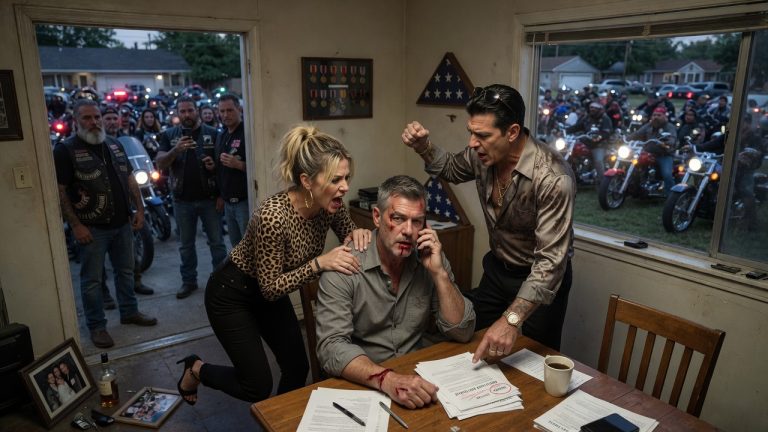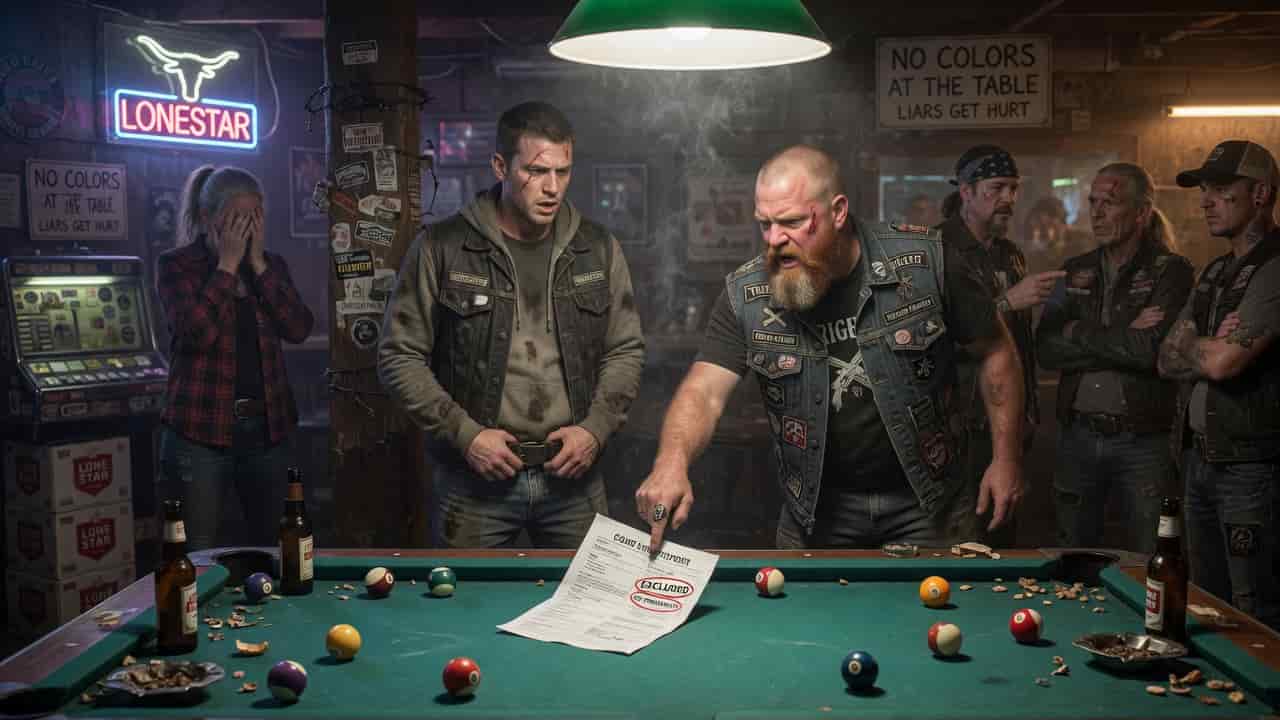
“Explain this, Rex. Right now.”
Trigger didn’t just throw a punch. He threw a piece of paper that hit harder than a lead pipe. The whole bar went silent, the kind of quiet that usually happens right before someone goes missing forever.
I looked at the lab report, then I looked at my mother. She couldn’t even meet my eyes. She just stood there by the jukebox, shaking her head, while the men I’d led for the last year started to circle like sharks.
“You told us you were the old man’s son,” Trigger sneered, leaning over the table. “You took the patch. You took the throne. But this paper says you’ve got the same DNA as the man who’s been trying to put us in cages for thirty years.”
The room felt like it was shrinking. Every eye in that place was on me, waiting for the lie I didn’t have the breath to tell. I wasn’t the heir to a kingdom. I was the son of the enemy, and I’d just been outed in the middle of my own kingdom.
The truth was out, and I knew right then—nobody was walking away from this table without paying the price.
Chapter 1: The Weight of the Crown
The air in the garage smelled like old oil, burnt rubber, and the kind of desperation that only grows in small Texas towns where the heat never breaks. Rex Malone sat on a rusted stool, watching the light from the setting sun cut through the corrugated metal walls in thin, orange ribbons. He was twenty-eight, but his hands felt eighty. He looked at them—grease under the nails, a fresh burn on the thumb from a hot exhaust pipe, and the heavy silver ring on his pinky that he hadn’t quite earned.
It was the ring his father had worn. Or the man he called father. Big Sal Malone had been the President of the 999 Biker Club for thirty years until a month ago, when his heart finally quit in the middle of a highway run. Rex had stepped into the vacuum because that’s what sons do. But every time he walked through the clubhouse, he felt the eyes.
Old Bones was the worst. The man was a relic, a sixty-year-old enforcer with skin like cured leather and eyes that seemed to see through Rex’s chest. Bones was currently leaning against the workbench, slowly sharpening a folding knife on a whetstone. Scritch. Scritch. Scritch.
“You’re quiet tonight, Rex,” Bones said without looking up.
“Just thinking about the run to El Paso,” Rex replied, his voice flat. He tried to sound like Sal. Sal had a voice like gravel shifting in a drum. Rex’s voice was smoother, more like his mother’s.
“Thinking doesn’t get the bikes moved,” Bones said. He stopped sharpening and held the blade up to the light. “Sal didn’t think much. He just moved. People followed because they knew where he stood. With you? They’re still waiting for the compass to stop spinning.”
Rex felt the familiar heat rise in his neck. It wasn’t just the temperature. It was the constant, low-grade humiliation of being managed by men who had seen him in diapers. He was the “Bastard King,” the boy who had been born out of wedlock and brought into the club as a “favor” to his mother, Maura. Sal had claimed him, eventually. But the claim always felt like a legal transaction rather than a fatherly embrace.
“The compass is fine, Bones. We move at midnight,” Rex said, standing up. He needed to get out of the garage. The smell of the oil was making him feel like he was drowning.
He walked out into the dirt lot. His bike, a modified Panhead that he’d rebuilt three times, sat near the gate. It was the only thing in his life that made sense. When the engine was screaming and the wind was trying to peel his skin off, he didn’t have to be Sal’s son or the leader of the 999. He was just a body in motion.
He kicked the engine over. It roared, a guttural, mechanical cough that vibrated through his boots. As he pulled out of the lot, he saw Trigger leaning against the fence. Trigger was younger than Bones, mid-thirties, and ambitious. He was the kind of man who smiled with his teeth but never his eyes. Trigger waved a hand, a casual gesture that felt more like a threat than a greeting.
Rex ignored him and hit the highway.
He rode for an hour, pushing the bike until the frame shook. He stopped at a roadside diner twenty miles out of town—a place where no one knew his face or his patch. He sat in a corner booth, drinking black coffee that tasted like battery acid.
His phone buzzed. A text from his mother. Come home tonight. We need to talk.
Rex sighed. Talking with Maura was always a minefield. She lived in a small house on the edge of the county, a place Sal had bought for her years ago to keep her close but not too close. She was the club’s “Anchor,” the woman who knew all the secrets but never spoke them.
He finished his coffee and rode back toward the town. The desert night was cold now, the kind of sudden chill that makes you realize how little protection leather actually provides. He pulled into his mother’s gravel driveway, the headlight sweeping over the peeling white paint of the cottage.
She was waiting on the porch, a cigarette dangling from her fingers.
“You look like him when you ride up,” she said, her voice thin. “The way you lean into the turn. It’s uncanny.”
“I look like a man who’s tired, Ma,” Rex said, dismounting. He walked up the steps and took a seat on the porch swing. It creaked in protest.
“Bones is pushing you,” she stated. It wasn’t a question.
“Bones is an old dog who misses his master. He’ll fall in line.”
“He’s not the one you should worry about, Rex. It’s Trigger. He’s been talking to the guys in the South Chapter. He thinks you’re too soft. He thinks you’re hiding something.”
Rex looked at her. Her eyes were rimmed with red, and her hand was shaking as she flicked the ash. There was a residue of fear in her expression that he hadn’t seen before.
“What would I be hiding, Ma? I’m the President. I’m Sal’s boy. That’s the story, right?”
Maura didn’t answer. She just looked out at the dark horizon, where the lights of the county jail flickered in the distance.
“Rex,” she whispered. “Sometimes stories are just things we tell ourselves to stay alive. But the truth… the truth has a way of coming home.”
“What are you talking about?”
“Nothing,” she said, standing up abruptly. “I’m just tired. Go on. Go back to your clubhouse. Just… be careful who you trust with your shadow.”
He watched her walk inside and lock the door. The sound of the deadbolt sliding home felt like a period at the end of a sentence he didn’t understand. He sat on the porch for a long time, the silence of the Texas night pressing against his ears. He thought about the ring on his finger. He thought about the way Bones looked at him. And for the first time, he wondered if the crown he was wearing was actually a target.
Chapter 2: The Enemy’s Face
The morning brought a different kind of heat—thick and humid, rolling in from the Gulf. Rex spent the early hours in the clubhouse office, staring at ledgers that made no sense. The 999 wasn’t just a club; it was a business, and the business was messy. Taxes unpaid, protection money missing, and a mounting debt to a supplier in Juarez that Sal had conveniently forgotten to mention before he died.
A knock at the door broke his concentration. It wasn’t a polite knock. It was the heavy, rhythmic thud of authority.
Rex stood up, his hand reflexively moving to the small of his back where his 9mm was tucked. He opened the door to find Sheriff Miller standing in the hallway.
Miller was a man of sixty, tall and straight-backed, with a silver star pinned to a tan shirt that looked like it had never seen a wrinkle. He was the 999’s oldest enemy. He’d spent thirty years trying to dismantle the club, and Sal had spent thirty years making sure he failed.
“Sheriff,” Rex said, leaning against the doorframe. “You’re a long way from the station.”
“I’m exactly where I need to be, Malone,” Miller said. His voice was calm, but there was a sharp edge to his gaze. He didn’t look at Rex with the contempt he usually reserved for bikers. He looked at him with something else. Curiosity? Pity?
“We don’t want any trouble today,” Rex said.
“Trouble is usually what you people export. I’m here for a conversation. Alone.”
Rex hesitated. He could feel the eyes of the other club members in the common room. Trigger was standing by the bar, watching the interaction with a dark intensity. If Rex invited the Sheriff in, it would look like he was cooperating. If he turned him away, he might miss something important.
“Five minutes,” Rex said, stepping back.
Miller walked into the small office and closed the door. He didn’t sit down. He walked over to the wall where a photo of Sal hung—Sal on his Harley, looking like a king.
“He was a hell of a thorn in my side,” Miller said, nodding at the photo. “But at least I knew what he was. He was a criminal. Pure and simple.”
“And what am I?” Rex asked.
Miller turned to face him. He stepped closer, until they were only a foot apart. Rex realized, with a jolt of discomfort, that they were the same height. They had the same square jawline. Even the way they held their shoulders was identical.
“You’re a man wearing a costume that doesn’t fit,” Miller said. “I’ve been watching you since you were a kid, Rex. When you were in high school, I saw you at the track meets. I saw you graduate. I always wondered why a kid with your brains would end up in a place like this.”
“It’s family,” Rex said, the word feeling like a lie in his mouth.
“Family isn’t always about the patch on your back,” Miller replied. He reached into his pocket and pulled out a small, yellowed photograph. He laid it on the desk.
Rex looked down. It was his mother, Maura, twenty-five years younger. She was laughing, her hair blowing in the wind. And standing next to her, with his arm around her waist, was a young man in a deputy’s uniform.
It was Miller.
Rex felt the room tilt. The air seemed to vanish. He looked at the photo, then at Miller, then back at the photo. The resemblance between the young deputy and the man Rex saw in the mirror every morning was undeniable. It was a physical strike, a blow to the gut that left him speechless.
“What is this?” Rex whispered.
“The reason Sal hated me,” Miller said softly. “And the reason he kept your mother under his thumb for three decades. He didn’t want the club to know that his ‘heir’ was the son of the man who was hunting them. He took you in to spite me, Rex. To turn you into the very thing I hate.”
“You’re lying,” Rex said, though his heart was hammering a rhythm of betrayal. “He’s my father. I have his name.”
“You have the name he gave you. But look at that photo. Look at your own face. You think Sal would have let a ‘bastard’ lead this club if he had any other choice? He was desperate. And you were the ultimate insult to me.”
Rex grabbed the photo and crumpled it in his fist. “Get out.”
“I’m leaving,” Miller said, moving toward the door. “But Trigger is already asking questions, Rex. He’s been digging into the old hospital records. He knows you were born in a county where Sal wasn’t even living at the time. If the club finds out you’re law-enforcement blood… they won’t just take your vest. You know the code.”
Miller opened the door and walked out without another word.
Rex stood in the silence of the office, his hand still clenched around the photo. He could hear the muffled sounds of the club outside—the clink of beer bottles, the raucous laughter, the heavy throb of engines. He was surrounded by men who would kill him if they knew the truth.
He walked to the small sink in the corner and splashed cold water on his face. He looked in the mirror. He didn’t see a biker. He didn’t see a Malone. He saw a stranger with the eyes of a lawman.
The psychological weight of the revelation was a physical pressure, a tightening in his chest that wouldn’t let go. Everything he had built—his status, his identity, his sense of belonging—was built on a foundation of spite. He wasn’t a king. He was a hostage to a thirty-year-old grudge.
He tucked the crumpled photo into his boot. He couldn’t let anyone see it. But as he walked back out into the common room, he saw Trigger watching him. Trigger didn’t say anything, but the look on his face told Rex that the clock was already ticking. The residue of the Sheriff’s visit hung in the air like smoke, and Rex knew that the next move wouldn’t be his.
Chapter 3: The Ghost of Old Bones
The following three days were a blur of paranoia and heat. Rex couldn’t sleep. Every time he closed his eyes, he saw the young Miller in the deputy uniform. Every time he opened them, he saw the 999 patches on the backs of men who were essentially his wardens.
He was in the garage again, trying to focus on a carburetor that refused to sync. The silence was heavy, broken only by the occasional clank of a wrench.
“You’re avoiding everyone, Rex,” a voice rasped.
Rex spun around. Old Bones was standing in the doorway, his silhouette framed by the harsh afternoon sun. He looked more like a ghost than a man—withered, gray, and eternal.
“I’m busy, Bones,” Rex said, turning back to the bike.
“Busy hiding,” Bones countered. He walked into the garage, his boots crunching on the oil-dry. “I saw Miller leave the other day. He looked satisfied. A man like that only looks satisfied when he’s planted a seed that’s going to rot someone from the inside out.”
“He was just rattling the cage. Forget about it.”
“I can’t forget about it. Because Trigger is talking. He’s telling the boys that you’re not a Malone. He’s saying Maura was seen with Miller back in the day. He’s saying the blood in your veins is blue, not black.”
Rex froze. He felt a cold sweat break out on his neck. “Trigger is a snake. You know that.”
“Maybe,” Bones said, stepping closer. He was within Rex’s personal space now, the smell of tobacco and old leather overwhelming. “But snakes usually know where the holes are. I’ve known you since you were a pup, Rex. I wanted to believe you were Sal’s. I wanted it so bad I ignored the fact that you don’t have his temper. You don’t have his greed. You’re too… careful.”
Bones reached out and grabbed Rex’s chin, forcing him to look up. The old man’s eyes were hard as flint. “Are you his, Rex? Look me in the eye and tell me you’re a Malone.”
The humiliation of being handled like a child, combined with the crushing weight of the secret, finally snapped something in Rex. He slapped Bones’s hand away.
“I’m the President of this club!” Rex shouted, his voice echoing off the metal walls. “I don’t owe you an explanation for my birth!”
“You owe the club everything!” Bones yelled back, his face turning a dark, mottled red. “We bled for this! Sal died for this! If you’re a plant—if you’re Miller’s boy—then you’re a cancer. And I’ve spent my whole life cutting out cancers.”
Bones reached for the knife at his belt. It was a slow, practiced movement, but his age showed.
Rex didn’t think. He didn’t plan. He reacted. He grabbed a heavy iron pry bar from the workbench and swung it in a wide, desperate arc.
The sound was sickening—a dull, wet thud as the iron met the side of Bones’s head.
The old man didn’t scream. He didn’t even groan. He just crumpled, his legs folding like a broken lawn chair. He hit the concrete floor with a sound that Rex would hear in his dreams for years.
Rex stood there, the pry bar still clutched in his hands. His chest was heaving. He looked down at Bones. A dark pool was already beginning to spread from under the old man’s head, staining the gray concrete.
“Bones?” Rex whispered.
There was no answer. The silence in the garage was absolute now, more deafening than any engine. Rex dropped the pry bar. It clattered loudly, a sound of finality.
He knelt beside the body, his hands shaking so violently he could barely feel for a pulse. There was nothing. Bones was gone. The man who had been the club’s memory, its enforcer, its conscience, was a heap of leather and bone on the floor.
Rex sat back on his heels, his breath coming in ragged gasps. He had just committed the ultimate sin. He had killed a brother. Not just any brother, but the one man who might have actually helped him if the truth came out.
He looked around the garage. He had to hide him. He couldn’t just leave him here. If Trigger found this… it wouldn’t matter who Rex’s father was. He’d be dead before sunset.
He spent the next hour in a trance of panicked efficiency. He dragged Bones’s body to the back of the garage, into the pit where they stored old tires and scrap metal. He covered him with a heavy tarp and stacked several tires on top. It was a temporary fix, a shallow grave in the middle of a fortress.
When he was done, he scrubbed the blood from the floor with degreaser and sawdust. He worked until his fingernails bled, until the smell of the chemicals burned his throat.
As he walked out of the garage, the sun had finally set. The air was cooling, but Rex felt like he was on fire. He walked toward the clubhouse, his heart hammering against his ribs.
Trigger was standing by the entrance, smoking a cigar. He watched Rex approach, his eyes narrowing.
“Where’s Bones?” Trigger asked. “He was looking for you.”
“I haven’t seen him,” Rex said, his voice cracking. He cleared his throat. “Probably went home. He was complaining about his back.”
Trigger took a long drag of the cigar and blew the smoke into the air. “Is that right? He seemed fine an hour ago.”
“Well, he’s not here now,” Rex snapped, pushing past him.
He went straight to his room and locked the door. He sat on the edge of the bed, his head in his hands. The residue of the killing was everywhere—on his clothes, in his hair, under his skin. He had killed to protect a lie that was already dying.
He pulled the crumpled photo out of his boot and looked at it one last time. He saw the joy on his mother’s face, the pride in Miller’s eyes. He saw the life he should have had. And then he ripped the photo into a thousand tiny pieces and flushed them down the toilet.
He thought he was safe for the night. But as he lay in the dark, he realized he’d left the pry bar on the floor. And more importantly, he’d left his mother alone.
The pressure was no longer just a psychological weight. It was a physical trap, and the walls were starting to move.
Chapter 4: The Last Call
The atmosphere at the “Last Call” bar was always thick, but tonight it felt like a pressure cooker about to blow its lid. The entire 999 local chapter was there, along with several members from the neighboring counties. The air was a toxic mix of cheap beer, cigarette smoke, and the heavy, metallic tang of unspoken tension.
Rex sat at the bar, his back to the room. He was nursing a whiskey he hadn’t touched, his eyes fixed on the cracked mirror behind the bottles. He looked like a man who hadn’t slept in a week—shadows under his eyes, a frantic edge to his movements.
He could see Trigger in the reflection. Trigger was holding court at the pool table, surrounded by the younger guys. They were laughing, but it was a jagged, ugly sound. Every few minutes, one of them would look over at Rex and then quickly look away.
The disappearance of Old Bones had been the final straw. Everyone knew Bones had gone to see Rex in the garage, and no one had seen him since. The rumors were no longer whispers; they were a roar.
The door swung open, and the room went even quieter. Maura walked in. She looked small and fragile in her red flannel shirt, her face pale. She walked straight to Rex and sat on the stool beside him.
“You shouldn’t be here, Ma,” Rex said without looking at her.
“I had to come,” she whispered. “Trigger came to the house today. He was asking about the county hospital records from 1998. He was asking about the ‘other’ man, Rex.”
“I know,” Rex said.
“He found something. I don’t know what, but he was smiling when he left.”
Rex finally looked at her. He saw the terror in her eyes, the years of guilt finally manifesting as a physical weight. He reached out and took her hand. It was ice cold.
“It’s okay,” he lied. “I’ll handle it.”
“You can’t handle this, Rex. Look at them.”
She was right. The room was shifting. The bikers were no longer sitting in small groups. They were forming a semi-circle around the pool table, their attention focused on Trigger.
Trigger stepped away from the table, holding a crumpled white piece of paper. He walked toward the center of the room, his boots thudding on the floorboards like a drumbeat.
“Hey, Rex!” Trigger shouted. The music on the jukebox cut out, silenced by someone in the back. “We were having a little debate over here. About legacy. About blood.”
Rex stood up slowly, turning to face him. He could feel the eyes of thirty men on him. He felt the weight of the ring on his finger, the patch on his back. It felt like lead.
“I’m not in the mood for debates, Trigger,” Rex said, his voice steady despite the panic screaming in his head.
“Well, you might want to make an exception for this,” Trigger said, holding up the paper. “I did a little digging. See, I always wondered why you didn’t look like Sal. Why you didn’t act like him. So I got a hold of a buddy of mine who works at the state lab. He helped me compare a hair from your old hoodie to a sample we had on file for… well, for someone else.”
Trigger walked to the pool table and slammed the paper down on the green felt. Billiard balls clattered, the sound like gunshots in the quiet room.
“It’s a DNA report, boys!” Trigger yelled, turning to the crowd. “And it turns out our ‘Bastard King’ here isn’t a Malone at all. He’s got the same blood as Sheriff Miller. The man who’s put half of you in Huntsville!”
A low, dangerous murmur rippled through the room. Men stood up, their hands moving to their belts. The social pressure was a physical wall, closing in on Rex from all sides.
“You’re full of it, Trigger,” Rex said, stepping toward the table. But his voice lacked conviction. He looked at the paper. DNA DIAGNOSTICS. The words were a death warrant.
“Am I?” Trigger sneered. He leaned over the table, his face inches from Rex’s. The power dynamic had flipped. Rex was no longer the leader; he was the prey. “Tell them, Rex. Look them in the eye and tell them you’re not the Sheriff’s little boy. Tell them your mother didn’t spend the summer of ’97 in Miller’s bed while Sal was in the county lockup.”
Rex looked at his mother. Maura had buried her face in her hands, her shoulders shaking with silent sobs. Her silence was the loudest confession in the room.
“She has nothing to do with this,” Rex said, his voice dropping to a dangerous growl.
“She has everything to do with it!” Trigger screamed, his face turning red. He pointed a thick finger at Rex’s chest. “You’ve been leading us for a year! You’ve been sitting in that chair, wearing that patch, while your daddy was planning our downfall! You’re a spy. A traitor. A blue-blooded rat!”
Trigger reached out and grabbed Rex’s vest, his fist bunching the leather. “Give it up, Rex. The vest. The ring. And tell us what you did with Bones. Because he knew, didn’t he? He found out, and you took care of him.”
The room erupted. Bikers stepped forward, their faces twisted with disgust and rage. Rex was backed against a wooden pillar, the social humiliation complete. He was exposed, stripped of his identity in front of the only family he had ever known.
“I didn’t spy for anyone,” Rex said, trying to pull away.
“Doesn’t matter,” a biker named Rats spat. “The blood is the blood. You’re the enemy, Rex. You always were.”
Trigger let go of the vest and shoved Rex backward. Rex stumbled, his back hitting the pillar with a hard thud.
“You’ve got one minute to get out of here,” Trigger said, his voice low and cold. “If I see you or your mother in this county after tonight, we’re not going to have a conversation. We’re going to have a cleanup.”
Rex looked around the room. He saw men he had bled with, men he had protected, men who had called him brother. Now, they looked at him like he was something dirty, something that needed to be erased.
He looked at Maura. She stood up, her face a mask of grief. She walked toward the door, her head bowed.
Rex reached for the ring on his pinky. His hands were shaking so hard he could barely grip it. He pulled it off—the silver felt hot, like it was burning his skin—and threw it onto the pool table. It landed on the DNA report with a soft clink.
“Keep it,” Rex said, his voice hollow. “It never fit anyway.”
He walked toward the door, the crowd parting for him as if he were carrying a plague. The residue of the humiliation was a bitter taste in his mouth, a weight in his stomach that he knew would never leave. He had lost everything—his father’s name, his club, his home, and his honor.
As he stepped out into the cool Texas night, he heard the roar of the bikes behind him. They weren’t riding with him. They were waiting for him to run.
He looked at his mother, who was waiting by his bike.
“Where do we go, Rex?” she asked, her voice trembling.
Rex looked toward the lights of the town, where the Sheriff’s station sat like a fortress. He looked back at the bar, where the 999 was already celebrating his downfall. He was a man with no country, caught between the law and the outlaw, with nowhere left to hide.
“We go to the only person who owes us the truth,” Rex said, his eyes hardening. “We go to my father.”
He kicked the engine over, the sound echoing through the empty lot. It was the sound of a man who had nothing left to lose, and everything left to burn.
Chapter 5: The Glass House
The ride to Sheriff Miller’s house was the longest twenty miles of Rex’s life. Maura sat behind him on the Panhead, her grip on his waist so tight he could feel her fingernails through the leather of his vest. The wind was a hot, dry rasp against his face, but he felt cold—a deep, marrow-chilling cold that had nothing to do with the night air. The world felt like it was made of thin glass, and he’d already felt the first few cracks spider-webbing across the surface.
He didn’t take the main highway. He knew the 999. Trigger would have scouts out within minutes, watching the exits, looking for the flash of chrome. Rex stuck to the backroads, the dirt tracks that cut through the mesquite and scrub brush. The dust kicked up by his tires hung in the air like a shroud, illuminated occasionally by the pale, sickly moon.
They reached Miller’s property just after midnight. It was a sprawling ranch-style house on a rise overlooking the valley, surrounded by a white picket fence that looked absurdly clean in the moonlight. This was the house of a man who believed in order, in lines that didn’t blur. It was the polar opposite of the clubhouse, with its grease-stained floors and the constant, vibrating hum of chaos.
Rex killed the engine at the gate and let the bike coast to a stop. The silence that followed was heavy, punctuated only by the rhythmic clicking of the cooling metal and the distant, lonely cry of a coyote.
“Rex, we shouldn’t do this,” Maura whispered, her voice barely audible over the wind. She hadn’t let go of his waist yet. “He’s not who you think he is. None of them are.”
“I don’t think he’s anything, Ma,” Rex said, his voice sounding like it belonged to a stranger. “I just need him to say it. I need to hear the words.”
He dismounted and helped her down. She was shaking, her legs nearly giving out as her boots hit the gravel. He guided her up the walkway. The front porch light flickered on before they even reached the steps. Miller was already there, standing behind the screen door. He wasn’t in uniform. He was wearing a faded denim shirt and khakis, looking less like a lawman and more like a retired rancher. But the eyes were the same—sharp, assessing, and entirely devoid of warmth.
“I wondered how long it would take for the room to turn on you,” Miller said, his voice flat. He pushed the screen door open and stepped aside. “Come in. Both of you.”
The interior of the house smelled of cedar and floor wax. It was quiet, the kind of quiet that felt intentional, as if the walls were designed to absorb any sound of conflict. Miller led them into a small study lined with law books and framed commendations. He sat behind a heavy oak desk and gestured for them to take the leather armchairs opposite him.
Rex stayed standing. He couldn’t sit. The adrenaline was still humming in his veins, a jagged, nervous energy that made his hands twitch. He looked at the man across the desk—the man whose DNA was supposedly coiled inside his own cells.
“Trigger showed the club a lab report,” Rex said, his voice tight. “He said I’m yours. He said the whole thing was a setup from the start.”
Miller leaned back, his fingers interlaced over his chest. He didn’t look surprised. He didn’t look guilty. He looked like a man watching a predictable chess match reach its endgame.
“The report is real,” Miller said calmly. “I made sure it found its way into the right hands. Trigger is ambitious, but he’s not particularly bright. He needed a little nudge to see what was right in front of him.”
Rex felt a surge of nausea. “You leaked it? You deliberately outed me to a pack of wolves?”
“I gave you an exit, Rex,” Miller replied, his gaze unwavering. “As long as you were ‘Sal’s boy,’ you were lost. You were part of the rot. I needed to break that tie. I needed to force you to choose.”
“You could have killed me!” Rex shouted, the sound startlingly loud in the quiet room. “If Trigger had been faster with a knife—”
“I had deputies watching the bar,” Miller interrupted. “I wouldn’t have let them kill you. But the humiliation? The exposure? That was necessary. You had to see that their ‘brotherhood’ is a lie. They didn’t even wait for you to speak before they turned. They didn’t care about the year you spent leading them. All they cared about was the brand.”
Maura stood up then, her face flushed with a sudden, desperate anger. “You don’t get to talk about brands, Henry. You used me thirty years ago to get at Sal, and you’re using Rex now. You haven’t changed a bit.”
Miller looked at her, and for a fraction of a second, the mask of the Sheriff slipped. There was a residue of something old and bitter in his expression—regret, perhaps, or a long-simmering resentment.
“I didn’t use you, Maura,” Miller said softly. “I loved you. And Sal took you because he knew it was the one thing I couldn’t protect. He raised Rex as a Malone just to ensure I’d never have a son. He turned my own flesh and blood into my greatest enemy. Don’t talk to me about usage.”
Rex felt like he was watching two ghosts argue over a grave. He looked at Miller, then at his mother. The reality of his existence was a series of tactical maneuvers between two men who hated each other. He wasn’t a son. He was a piece of territory.
“So what now?” Rex asked, his voice hollow. “I’m out. The club wants my head. Bones is… Bones is gone. There’s nothing left.”
Miller’s eyes sharpened at the mention of Bones. “Gone? What do you mean, ‘gone’?”
Rex felt the weight of the secret in the back of the garage pressing against his lungs. He could still feel the vibration of the pry bar hitting the old man’s skull. He looked away, his gaze landing on a silver-framed photo on Miller’s desk—a younger Miller, standing with a group of deputies.
“He vanished,” Rex lied, though the lie felt like ash in his mouth. “He went looking for me after you left the clubhouse the first time. No one’s seen him.”
Miller stood up and walked around the desk. He stopped in front of Rex, his presence commanding and intrusive. He reached out and placed a hand on Rex’s shoulder. The touch was meant to be fatherly, but it felt like an arrest.
“I can protect you, Rex,” Miller said. “I can get you and your mother out of the state tonight. I have a contact in Arizona. You can start over. A new name. A real life. Away from the grease and the leather.”
Rex looked at the hand on his shoulder. It was a clean hand, the nails trimmed and scrubbed. It was the hand of a man who enforced the law, who believed in the rightness of his own cause. But it didn’t feel any different than Sal’s hand. They both wanted the same thing: ownership.
“Why?” Rex asked. “Why now, after thirty years?”
“Because Sal is dead,” Miller said simply. “The debt is paid. And you’re the only thing left of that time that isn’t ruined.”
“I am ruined,” Rex whispered. He thought of the body under the tires, the blood he’d scrubbed with sawdust. He thought of the ring he’d thrown on the pool table. He wasn’t a clean slate. He was a disaster.
Before Miller could respond, his desk phone began to ring. It was a sharp, intrusive sound that shattered the intimacy of the moment. Miller sighed and stepped back to answer it.
As he listened, his face went from calm to stony. He didn’t say a word, just nodded a few times and hung up. He looked at Rex, and the “father” was gone, replaced entirely by the Sheriff.
“Trigger’s boys found something,” Miller said. “They went back to the garage to look for Bones. They found the tires moved. They found the tarp.”
Rex felt the floor drop out from under him. The room began to spin. He looked at Maura, who had gone deathly pale. She didn’t know about Bones, but she knew her son’s face. She knew the look of a man who had reached the end of his rope.
“They’re calling it murder,” Miller continued, his voice devoid of emotion. “And they’re calling the station. They want the law to do the work they’re too scared to do themselves. They want me to arrest my own son for killing a club legend.”
Miller walked to the closet and pulled out his gun belt. He buckled it on with practiced ease, the leather creaking. He looked at Rex, and for the first time, there was a flicker of something like genuine grief in his eyes.
“I can’t hide you from this, Rex,” Miller said. “I can’t protect a murderer, even if he is mine. The law doesn’t work that way.”
“The law doesn’t work at all!” Rex shouted, his voice cracking with desperation. “You set this in motion! You pushed the first domino! If you hadn’t come to the clubhouse, if you hadn’t leaked that report—”
“I gave you a choice,” Miller said, his voice rising. “I gave you an exit! You chose to swing the iron! You chose the path of the outlaw, Rex. Now you have to walk it.”
The sound of sirens began to wail in the distance—the low, pulsing thrum of the county deputies approaching. But underneath that, Rex heard something else. A deeper, more guttural sound. The roar of twenty engines, moving in unison.
The 999 weren’t waiting for the law. They were coming to witness the arrest. Or to finish what Trigger had started.
“You have to go,” Maura said, grabbing Rex’s arm. She was stronger than she looked, her grip bruising. “Rex, listen to me. If you stay here, they’ll both have you. The club or the jail. Either way, you’re dead.”
“Where am I supposed to go, Ma?” Rex asked, his voice small.
“Back to the garage,” she said, her eyes burning with a sudden, fierce clarity. “Go back to where it happened. Finish it there. Don’t let them take you in this house. Don’t let them win.”
Rex looked at Miller, who was standing by the window, watching the lights of the patrol cars snake up the hill. Miller didn’t look back. He was already rehearsing the statement he’d have to give to the press, the story of the Sheriff who had to bring his own secret son to justice.
Rex realized then that his mother was right. This house was a cage, and Miller was just a different kind of jailer. He turned and ran for the back door, Maura right behind him. He didn’t look back at the Sheriff. He didn’t look back at the life he’d almost had. He ran toward the noise, toward the dust, and toward the only truth he had left.
Chapter 6: The Final Run
The garage was exactly as Rex had left it, except for the silence. The air inside was stagnant, thick with the smell of old grease and the faint, sweet rot of something hidden. He’d ridden the Panhead to the breaking point to get back here, leaving his mother at a safe house three towns over. He didn’t want her to see the ending. She’d seen enough endings to last three lifetimes.
The tires had been moved, just as Miller had said. The tarp was pulled back, exposing the leather-clad arm of Old Bones. The sight didn’t make Rex feel guilty anymore. It just made him feel tired. The old man was lucky. He was out of the game. He didn’t have to worry about who his father was or which patch he was wearing.
Rex sat on the rusted stool, the same one he’d used when he was the “Bastard King.” He held the 9mm in his lap, the weight of it comforting in a way that nothing else was. He wasn’t hiding anymore. He was waiting.
The first engine arrived five minutes later. Then another. And another. Within ten minutes, the lot outside was filled with the rhythmic throb of the 999. They didn’t come in screaming. They didn’t surround the building with sirens. They just parked their bikes in a wide circle, their headlights cutting through the dusty windows of the garage like searchlights.
The door creaked open, and Trigger stepped inside. He was alone, but the shadows of the other men were visible just behind him. He wasn’t holding a gun. He was holding a heavy iron chain, wrapped loosely around his hand.
“You came back,” Trigger said, his voice echoing off the corrugated metal. “I didn’t think you had it in you. I figured you’d be halfway to Mexico by now, crying on your daddy’s shoulder.”
“I don’t have a father, Trigger,” Rex said, his voice flat and cold. “I just have a shadow. And I’m tired of running from it.”
Trigger walked toward the tire pit, looking down at the tarp. He shook his head, a gesture of mock disappointment. “Bones was a prick. We all knew that. But he was our prick. You killed a brother to hide a lie. There’s no coming back from that, Rex. Not even Miller can save you now.”
“I’m not looking to be saved,” Rex replied. He stood up, the 9mm hanging loosely at his side. “I’m looking to settle the bill.”
Trigger laughed, a harsh, jagged sound. “With what? You’re one man against twenty. You think that pea-shooter is going to make a difference?”
“It’ll make a difference for the first two people who walk through that door,” Rex said. “You want to be the first one, Trigger? You want to be the hero who took down the ‘blue-blooded rat’?”
Trigger stopped walking. He looked at the gun, then at Rex’s eyes. He saw the absence of fear, the hollowed-out look of a man who had already accepted his own death. It was a look that even a man like Trigger could recognize.
“You’re a mess, Rex,” Trigger said, his voice losing some of its bravado. “You look like you’re already dead.”
“Maybe I am,” Rex said. “But I’m taking the lie with me.”
A movement in the doorway caught Rex’s eye. It wasn’t a biker. It was Miller.
The Sheriff stepped into the garage, his uniform crisp and clean against the grit of the room. He was alone, his deputies presumably waiting at the gate. He looked at the tire pit, then at Rex, then at Trigger.
“Step back, Trigger,” Miller commanded. The authority in his voice was absolute, the product of thirty years of holding the line. “This is a law enforcement matter now. Rex Malone is under arrest for the murder of Silas ‘Bones’ Henderson.”
Trigger sneered, but he stepped back. “He’s all yours, Sheriff. We just came to see the show.”
Miller walked toward Rex, his hand hovering near his holster. He didn’t look like a father. He didn’t look like a savior. He looked like a man completing a transaction.
“Give me the gun, Rex,” Miller said. “Don’t make this worse than it already is.”
Rex looked at the gun in his hand, then at the man who had sired him out of spite. He looked at Trigger, who represented the life he’d spent ten years trying to earn. He realized then that they were both the same. They both wanted to define him. They both wanted to use his body to prove a point.
“You know what the funny thing is?” Rex asked, a ghost of a smile touching his lips. “Sal was the only one who never lied to me. He never told me he loved me. He never told me I was special. He just told me to ride. He was the only honest man in the whole damn story.”
“Sal was a criminal, Rex,” Miller said, his voice tight. “He was a thief and a murderer.”
“And what are you, Henry?” Rex countered. “You used my mother. You used me. You used the law to fight a personal war. You’re just a criminal with a better tailor.”
Rex raised the gun. He didn’t point it at Trigger. He didn’t point it at Miller. He pointed it at the fuel tank of the Panhead—the bike he’d rebuilt three times, the only thing that had ever made sense.
“What are you doing?” Miller shouted, stepping forward.
“I’m ending the story,” Rex said.
He pulled the trigger.
The bullet sparked against the metal of the tank. The explosion was immediate and deafening—a roar of orange flame that swallowed the bike and the center of the garage in a single, violent heartbeat.
The force of the blast knocked Rex backward, slamming him against the workbench. He felt the heat sear his skin, the smell of burning gasoline and rubber filling his lungs. Through the wall of fire, he saw Trigger dive for the door. He saw Miller scramble back, his arms raised to protect his face.
Rex didn’t move. He sat there, the flames dancing in his eyes, feeling the heat consume the leather of his vest. The 999 patches were the first thing to go, curling into black ash. The silver ring, if he’d still had it, would have melted into a puddle.
The garage began to collapse, the corrugated metal shrieking as it twisted in the heat. Rex could hear the bikers shouting outside, the sound of engines revving as they backed away from the inferno. He heard Miller’s voice, distant and distorted, calling his name.
But Rex didn’t answer. He watched the fire spread to the tire pit, reaching the tarp that covered Old Bones. He watched the history of the 999, the legacy of Sal Malone, and the ambitions of Henry Miller all burn in the same beautiful, uncaring fire.
He felt a strange sense of peace. For the first time in his life, he wasn’t a Malone. He wasn’t a Miller. He wasn’t a king or a rat or a son. He was just a man in a room that was finally, mercifully, ending.
As the roof groaned and began to fall, Rex closed his eyes. He thought of his mother, sitting on a porch somewhere far away, finally free of the secrets. He thought of the highway, the long, black ribbon of Texas asphalt that led to nowhere.
The residue of the fire would be all that was left—a charred skeleton of a building, a pile of melted chrome, and the bones of a story that should never have been told.
The last thing he felt was the weight of the crown finally lifting, disappearing into the smoke and the dark Texas sky.
The investigation lasted six months. They found the remains of two bodies in the rubble of the 999 garage. One was identified as Silas Henderson. The other was too badly burned for a definitive DNA match, though the dental records suggested it was Rex Malone.
Sheriff Henry Miller retired a month after the fire. He moved to a small town in Florida, where no one knew his name or the story of the son he’d lost twice. He spent his days fishing, his eyes always fixed on the horizon, as if he were waiting for a ghost to walk out of the water.
Maura disappeared. Some said she went to Arizona. Some said she was living in a trailer park outside of El Paso. But every now and then, a biker would report seeing a woman sitting on a porch swing in the middle of the desert, watching the sunset and smoking a cigarette, her face a mask of a peace that no one else could understand.
The 999 Biker Club fractured. Trigger tried to take the lead, but without the Malone name or the mystery of the heir, the men drifted away. The clubhouse was eventually bulldozed, the land bought by a developer who wanted to build a shopping mall.
But if you drive down that stretch of Texas highway at midnight, when the wind is just right and the moon is a sliver of bone, you can still hear it. The low, guttural roar of a Panhead, screaming through the dark. It doesn’t belong to the law. It doesn’t belong to the club. It’s just the sound of a man who finally found a road that didn’t have a destination. And in the heart of Texas, sometimes that’s the only kind of freedom there is.