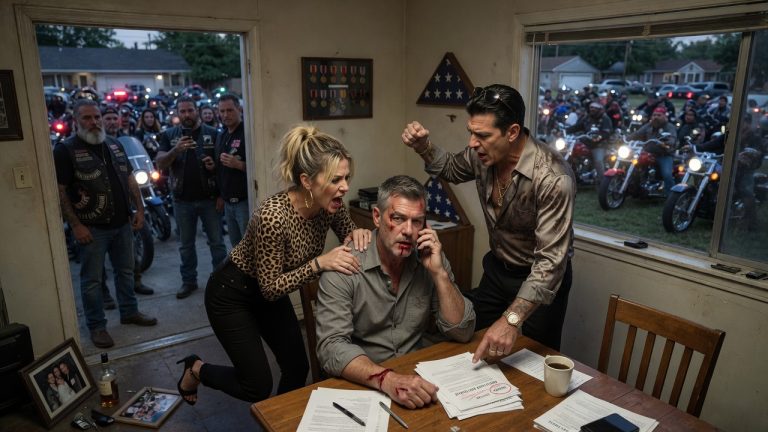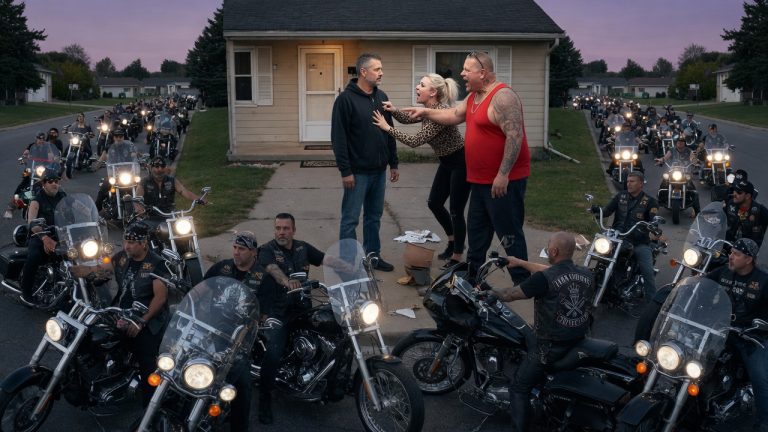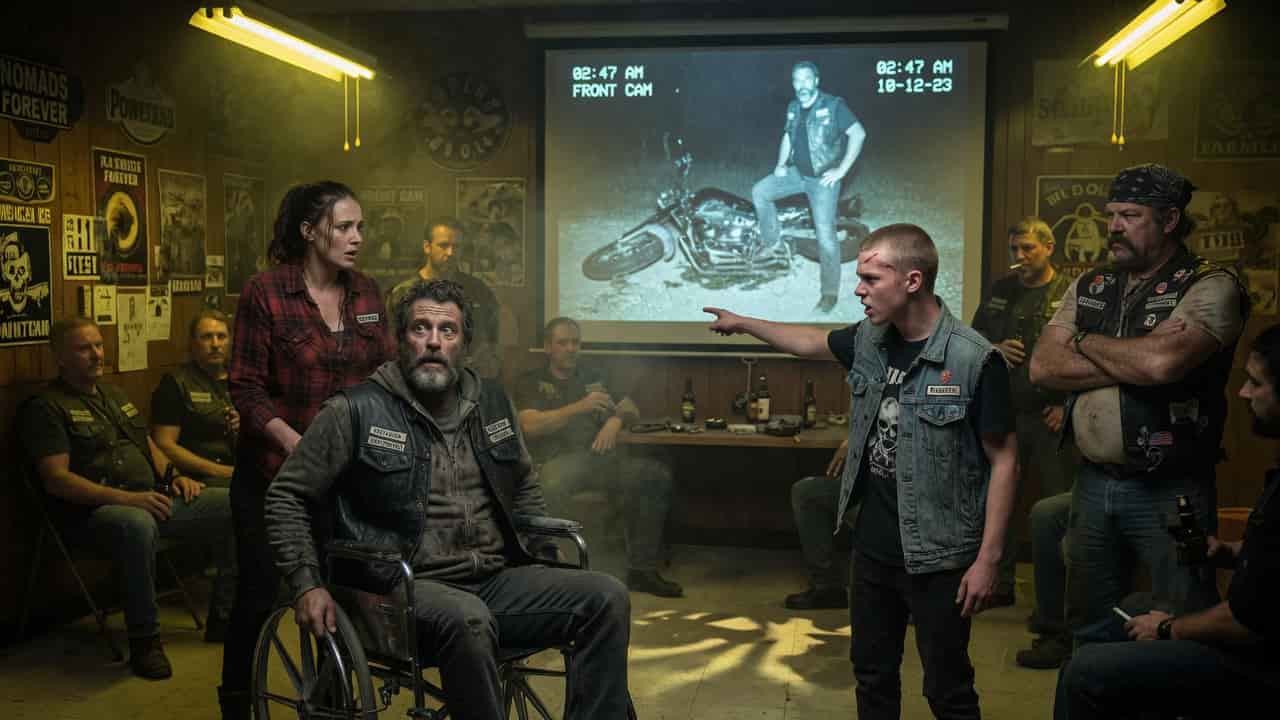
The room went so quiet you could hear the ice melting in the glasses at the back of the bar. Leo didn’t care that he was talking to a legend. He didn’t care that Elena was standing right there, her hands on the wheelchair handles, looking at him like he was a monster. He just stood there in his denim vest, a kid who had lost his father on that highway three years ago, and he stared down at the man who was supposed to be the club’s greatest tragedy.
“He can’t stand, Leo,” Elena whispered, her voice shaking with a mix of fury and exhaustion. “He hasn’t walked or spoken a word since the crash. You were there. You saw the wreckage. How can you be this cruel?”
Leo didn’t look at her. He kept his eyes locked on Vance, watching the way the older man’s throat hitched, the way his knuckles turned white against the chrome armrests. The grainy image on the projector screen behind them was blurry, but it was clear enough. It showed a man standing on two legs next to a burning wreck, walking away while ten of his brothers were left behind.
“The whole town calls you a saint,” Leo said, his voice dropping to a low, jagged edge that cut through the clubhouse. “They think you’re a ghost of the road. But I think you’re just a coward who found a way to hide from the truth. Open your mouth, Vance. Tell us why you’re really in that chair.”
Nobody moved. Not the road captains, not the old-timers, not even Elena. They all just watched as the man they had protected for three years began to tremble, his secret finally catching up to him in front of the only family he had left.
Chapter 1: The Weight of Silence
The Pacific fog didn’t just roll into Coos Bay; it claimed it, swallowing the jagged Oregon coastline and the rusted skeletons of the shipping docks until the world felt like it ended at the edge of the clubhouse parking lot. Inside the “Triple-Nine” headquarters, the air was a thick soup of stale Marlboros, primary-grade motor oil, and the kind of heavy, respectful silence that usually only belongs to cathedrals or morgues.
Silence Vance sat in his chrome-framed manual wheelchair at the head of the long pine table. He was forty-five, but in the low, amber light of the bar, he looked like a man who had been chiseled out of granite and then left to erode in the rain. His leather vest—the “Cut”—was stiff and dark, the “President” patch still visible above the “999” insignia, though he hadn’t ridden a bike in three years.
He didn’t speak. He hadn’t uttered a syllable since the night of the “Harvest Run,” the night the asphalt turned into a graveyard for ten of the club’s finest. The doctors called it a combination of traumatic brain injury and hysterical aphonia—a physical response to a psychic wound so deep the brain simply cut the wires to the vocal cords.
Elena stood behind him, her hands resting lightly on his shoulders. She was his sister-in-law, the widow of his younger brother, Gabe, who had died in that same pile-up. She was the only person Vance allowed into the small, cramped apartment above the garage where he spent his days staring at the rain-streaked windows. She was his hands, his voice, and his shield.
“He needs his water, Sparky,” Elena said, her voice quiet but firm.
Sparky, a man whose belly was a testament to thirty years of tavern food and whose hands were permanently stained with electrical tape residue, slid a glass of water across the scarred wood. He did it with a strange kind of reverence, the way a person might handle a relic.
“Sorry, Lanie,” Sparky grunted. “Just got caught up in the manifests. Port’s tight this week.”
Vance reached for the glass. His right hand trembled—a fine, rhythmic shutter that he couldn’t suppress no matter how hard he tensed his forearm. It was a detail he used to loathe, but now he leaned into it. The tremor was part of the performance, a physical shorthand for “broken man.” He took a sip, the cool water sliding down a throat that was perfectly capable of screaming if he ever let his guard down.
The truth was a cold, sharp stone sitting in the pit of his stomach. He wasn’t mute. He wasn’t paralyzed. His legs worked just fine when the door was locked and the curtains were drawn. He could speak; he just didn’t have anything left to say that wouldn’t end with a rope around his neck or a bullet in his spine.
He remembered every second of that night. He remembered the smell of the cheap bourbon he’d been swigging from a flask in his inner pocket. He remembered the way the taillights of the ten bikes ahead of him had blurred into a single red smear in the fog. Most of all, he remembered the moment he’d drifted over the center line, his front tire clipping Gabe’s rear fender, sending the whole formation into a chaotic, screaming tumble of chrome and flesh against the guardrail.
He had stood up that night. He had walked among the wreckage, smelling the spilled gasoline and the metallic tang of blood. He had looked into Gabe’s wide, vacant eyes and realized that he, the President, the “Vanguard of the Road,” had slaughtered his own family because he was too drunk to find the brake.
And so, he had crawled back into the ditch. He had waited for the sirens, and when the paramedics found him, he simply stopped responding. It was easier to be a victim than a murderer. It was safer to be a ghost than a monster.
“Meeting’s starting,” Sparky announced, rapping a heavy knuckle on the table.
The room filled up quickly. Men with thick necks and scarred knuckles filtered in from the bar, their voices dropping as they passed Vance. They treated him with a crushing, suffocating pity. He was their martyr, the man who had supposedly stayed with the wreckage until his own body gave out, the man who had watched ten brothers die and lost his soul in the process.
“The Memorial is in two days,” Sparky said, addressing the room. “Three-year mark. We’re doing the run down to the bridge. Vance is going to lead in the sidecar of the trike. Elena, you’re good with that?”
Elena nodded, her grip on Vance’s shoulders tightening slightly. “He’ll be there. He wants to be there.”
Vance looked down at the table. He didn’t want to be there. He wanted to vanish into the Oregon mist and never come back. Every time they honored him, every time they lowered their voices in his presence, it felt like a fresh coat of acid on his skin. They were building a temple out of his lies.
In the back of the room, near the door that led to the alley, a young man leaned against the wood-paneled wall. Leo. He was Gabe’s son, Elena’s boy, and he was the only person in the club who didn’t look at Vance with pity. He looked at Vance with a cold, searching intensity that made the hair on the back of Vance’s neck stand up.
Leo had been eighteen when the crash happened. Now he was a Prospect, wearing the unearned denim of a man trying to fill a dead father’s boots. He was thin, wired with a restless, angry energy, and he had his father’s eyes—the kind of eyes that looked through things rather than at them.
Vance shifted in his chair, the leather creaking. He hated the wheelchair. It was a prison of his own making, a theatrical prop that required constant vigilance. He had to remember not to shift his weight too naturally. He had to remember to let his legs hang limp, to let Elena move them for him when they grew stiff.
The meeting droned on—talk of dues, talk of the local police pressure, talk of the upcoming “Harvest Run” that had replaced the one that ended in blood. Through it all, Vance felt Leo’s gaze. It was a physical weight, a probe looking for a crack in the granite.
When the meeting broke, the brothers lined up to touch Vance’s shoulder, a silent ritual of respect. He endured it, his face a mask of practiced emptiness.
“Coming home, Vance?” Elena asked, her voice weary.
He nodded, the movement slow and deliberate.
As she turned the chair to wheel him toward the side exit, Leo stepped into their path. He didn’t move with the deference of the other brothers. He stood his ground, his hands shoved deep into the pockets of his denim vest.
“Hey, Ma,” Leo said, his voice flat.
“Leo,” Elena sighed. “You coming for dinner? I’m making that stew your dad liked.”
“Can’t,” Leo said. “Got things to do in the shop. Sparky’s got me on the night shift.” He turned his attention to Vance. “You okay, Uncle Vance? You look… tired. More than usual.”
Vance met the boy’s eyes. He saw the grief there, but underneath it, he saw a jagged, sharp-edged suspicion. Leo didn’t remember the crash, but he remembered the man Vance used to be—the loud, laughing, beer-swilling king of the road. He was looking for that man inside the shell, and Vance had to make sure he never found him.
Vance gave a small, jerky nod and looked away.
“He’s had a long day, Leo,” Elena said, her tone warning.
“Yeah,” Leo said, stepping aside. “I bet. Must be exhausting, sitting in that chair all day. Doing nothing but thinking.”
The walk back to the apartment was a gauntlet of humid air and the sound of the surf crashing against the cliffs a mile away. Elena pushed him in silence, her breathing heavy. She was thirty-eight, but she looked fifty. The grief had settled into the lines around her mouth, and the burden of caring for Vance had robbed her of whatever light she had left after Gabe died.
Vance felt a surge of genuine, agonizing guilt—not the kind he felt for the brothers, but a specific, domestic rot. He was stealing her life. He was letting her waste her youth on a man who was playing a part. He wanted to reach up, grab her hand, and tell her to go. To leave him in the garage and find a man who could actually hold her.
But he couldn’t. If he spoke, the lie collapsed. If the lie collapsed, the club would realize they had spent three years worshipping the man who murdered their brothers. They would kill him, but only after they made him watch what they did to his reputation. And Elena… Elena would realize she had spent three years serving the man who had put her husband in the ground.
She wouldn’t survive that truth. And neither would he.
In the garage, she parked the chair near the workbench. “I’ll bring your tray up in twenty minutes, Vance. Just… try to rest.”
She leaned down and kissed his forehead. Her skin was cool, smelling of laundry detergent and the faint tang of salt air. For a second, Vance wanted to pull her close, to bury his face in her neck and weep until the lie washed away. Instead, he sat motionless, his arms limp on the armrests, his eyes fixed on a rusted wrench on the floor.
When she left, closing the door to the stairs behind her, the silence changed. It wasn’t the heavy, respectful silence of the clubhouse. It was a hollow, echoing vacuum.
Vance waited. He counted to sixty, then to a hundred. He listened to the sound of Elena’s footsteps overhead, the muffled clatter of a pot on the stove.
Only then did he grip the armrests. He braced his core, his muscles tensing with a familiarity that felt like a betrayal. He stood up.
His knees popped, the sound loud in the quiet garage. He stretched his back, his spine clicking like a string of firecrackers. He walked four steps to the workbench, his gait steady and strong. He picked up the wrench, his hand no longer trembling.
He looked at his reflection in a cracked side-mirror leaning against the wall. He saw a liar. He saw a coward who was so afraid of the dark that he had invited it to live inside him.
He looked at the stairs. He could walk up there right now. He could walk into the kitchen, sit at the table, and tell Elena everything. He could tell her about the flask, about the center line, about the way he’d watched Gabe die and did nothing but think of his own skin.
He took a step toward the stairs, but then he heard a sound outside. A motorcycle. A soft, idling rumble that he recognized instantly.
Leo.
Vance froze. He didn’t have time to get back to the chair. The garage door had a small, high window, and he could see the flicker of a headlight.
He dropped to the floor, sliding under the workbench into the shadows just as the side door creaked open.
He held his breath, his heart hammering against his ribs like a trapped bird. Through the gaps in the workbench, he saw Leo’s boots—scuffed, black leather. The boy didn’t move. He stood in the center of the garage, looking at the empty wheelchair.
“I know you’re in here, Vance,” Leo whispered. The boy’s voice wasn’t filled with the pity of the others. it was filled with a cold, terrifying clarity. “I know you’re not what they say you are.”
Vance stayed perfectly still, his cheek pressed against the cold, oil-slicked concrete. He was the President of the 999. He was a legend. And he was hiding in the dirt like a rat, praying that a twenty-one-year-old kid wouldn’t look under the table.
Leo walked over to the wheelchair. He ran a hand over the chrome armrest. Then, with a sudden, violent motion, he kicked the chair, sending it spinning across the garage until it slammed into a stack of old tires.
“You’re a fake,” Leo hissed into the empty air. “And I’m going to prove it. I’m going to show them all exactly what you did to my father.”
The door slammed shut. The motorcycle roared to life and faded into the distance.
Vance crawled out from under the workbench. He was shaking now—not the practiced tremor of his hand, but a deep, systemic shudder. He looked at the overturned wheelchair.
The three years of peace were over. The debt was coming due, and it didn’t care if he was ready to pay it.
Chapter 2: The Prospect’s Shadow
The next morning arrived with a sky the color of a bruised lung. Vance was back in the chair, his posture slumped, his eyes fixed on the television that Elena had turned on to a local news station he wasn’t watching. The tremor in his hand was worse today, and for once, he didn’t have to fake it.
The memory of Leo’s voice in the garage was a jagged glass splinter in his mind. I’m going to prove it.
What could the boy have? The police investigation had been a joke. The 999 held a lot of sway in this county; the Sheriff was a man named Miller who had grown up riding with Vance’s older cousins. Miller had looked at the carnage, looked at the weeping, “broken” President, and decided it was a tragic accident caused by “unforeseen atmospheric conditions.” No blood tests were taken. No deep dives into the mechanics of the lead bike were performed.
But Leo had been digging. Vance could feel it. The boy had been spending his nights in the back of the clubhouse library, going through old ride logs and maintenance reports.
Elena came into the room, carrying a tray with oatmeal and a cup of black coffee. She looked like she hadn’t slept. The dark circles under her eyes were deep enough to hold shadows.
“Leo’s acting strange, Vance,” she said, setting the tray down on the small table beside him. She didn’t look at him as she spoke; she looked out the window at the rain. “He was out all night. When he came in this morning, he wouldn’t even look at me. He just went straight to his room and locked the door.”
Vance reached for the coffee, his hand shaking so violently he had to use both hands to steady the cup. He took a sip, the bitter heat grounding him. He wanted to tell her to be careful. He wanted to tell her that her son was playing a dangerous game.
“He misses his dad,” Elena continued, her voice breaking. “We both do. But he’s getting obsessed, Vance. He’s talking about the crash again. He’s asking questions about who was riding where, about who was holding the pace. I told him it doesn’t matter. I told him it won’t bring Gabe back.”
She finally looked at him, her eyes pleading. “Maybe if you… if you could just try to connect with him. I know you can’t talk, but he used to look up to you. He used to follow you around the garage like a shadow. He needs his uncle right now, not a monument.”
Vance felt a sick twist of irony. He was a shadow. He was the very thing that was haunting the boy. He gave Elena a slow, sad nod, the only answer he could offer. It was a lie, like everything else.
An hour later, Elena left for her shift at the diner. The apartment was silent, save for the hum of the refrigerator. Vance didn’t wait. He stood up, the wheelchair rolling back an inch. He moved to the window and watched her old Ford Taurus pull out of the gravel driveway.
He had to find out what Leo knew.
He walked to the door of the apartment, his movements cautious. He opened it a crack and listened. Nothing. He descended the stairs into the garage. The air was cool and smelled of gasoline and wet earth.
He went to the back of the garage, to a small, heavy wooden locker that had belonged to Gabe. It was locked with a rusted padlock. Vance knew where the key was—taped to the underside of the workbench. He retrieved it, his fingers nimble, and popped the lock.
Inside were Gabe’s old things: a leather wallet, a set of keys, a photo of Elena on their wedding day. And at the bottom, wrapped in an oily rag, was something Vance hadn’t seen in three years.
Gabe’s helmet.
It was a matte black full-face helmet, the visor cracked, the shell gouged with deep, white scars from the asphalt. Vance picked it up, his breath catching. He remembered the way Gabe had always kept it polished.
He looked at the back of the helmet. There was a small, circular mounting bracket. A GoPro mount.
Vance’s heart stopped.
On the night of the crash, Gabe had been the “Tail-Gunner” for the first half of the run, but then they’d swapped. Gabe had moved up to the second position, right behind Vance.
Vance remembered seeing the flash of a camera light in his rearview mirror during the ride. He’d forgotten about it in the chaos of the wreckage. In the aftermath, the police had bagged the gear, and the club had eventually reclaimed it.
If Gabe had been filming…
He searched the bottom of the locker. Nothing. No camera. No SD card.
He closed the locker and stood up, his mind racing. If the camera had survived the crash, it would have been in the evidence locker at the station. And if it was gone now, it meant someone had taken it.
Leo.
Vance felt a cold wave of panic. He looked around the garage, his eyes landing on the stack of tires where the wheelchair had hit. He felt exposed, even in his own home. He had to get to the clubhouse. He had to find Leo before the boy did something irreversible.
He forced himself back into the chair. He sat there for a long time, tensing and un-tensing his legs, practicing the “shuffe” he used when he had to move himself.
He rolled out of the garage and down the gravel path toward the clubhouse, which was only a few hundred yards away. The rain had turned to a fine, stinging mist. By the time he reached the side ramp, his grey hoodie was damp and clinging to his shoulders.
The clubhouse was mostly empty at this hour. Sparky was behind the bar, polishing glasses with a rag that looked like it had seen better decades.
“Vance? What are you doing here, brother? Lanie’s at work, ain’t she?”
Vance gestured vaguely toward the back of the room, where the library and the offices were.
“Looking for the kid?” Sparky asked, his brow furrowing. “He’s in the archives. Been in there for hours. Kid’s gonna give himself a migraine with all that reading.”
Vance nodded and began the slow, agonizing process of rolling himself toward the back. Every push of the wheels felt like a mile. His shoulders ached, and his heart was hammering a frantic rhythm against his ribs.
He reached the heavy oak door of the archives. It was slightly ajar. He pushed it open with the footrest of his chair.
The room was cramped, filled with filing cabinets and stacks of old motorcycle magazines. Leo was sitting at a small desk in the corner, a laptop open in front of him. He was wearing headphones, his face illuminated by the pale blue light of the screen.
He didn’t hear Vance enter.
Vance watched him for a moment. The boy’s face was a map of raw, unadulterated pain. His eyes were red-rimmed, his jaw set so tight the muscles were bulging. He was watching something on the screen, his hand hovering over the mouse.
Vance rolled closer. He could see the screen now.
It was a video. Grainy, shaky, and dark. It showed the back of a motorcycle—Vance’s motorcycle. The “999” patch on Vance’s back was clearly visible, swaying slightly as the bike leaned into a curve. The sound was a deafening roar of wind and engine.
In the video, Vance’s bike began to wobble. It drifted toward the center line. Then, a hand reached into the frame—Vance’s hand. He wasn’t gripping the handlebar. He was holding a silver flask. He took a long swig, then shoved the flask back into his vest.
A second later, the bike jerked to the right. There was a sickening crunch as the front tire clipped the bike filming the footage. The camera spun wildly. There was a scream—Gabe’s voice—and then the world turned into a chaotic blur of sparks and darkness.
The video didn’t end there.
The camera had landed in the grass, facing back toward the road. A minute passed. Then, a figure walked into the frame.
It was Vance. He was standing perfectly straight. He wasn’t limping. He wasn’t bleeding. He walked over to Gabe’s body, which was lying facedown in the light of a burning wreck.
Vance stood over his brother for a long, agonizing minute. He didn’t kneel. He didn’t try to flip him over. He just stood there, looking down, his face a mask of cold, calculating survival. Then, he looked at the road, looked at the other bodies, and walked away—back toward the ditch where he would later be found “paralyzed.”
Leo hit the spacebar. The frame froze on Vance’s face—the face of a man who had just decided to let his brother die so he wouldn’t have to go to prison.
Leo slowly took off the headphones. He didn’t turn around.
“I found it in the back of a drawer at the Sheriff’s office,” Leo said, his voice a low, jagged rasp. “Miller kept it. He thought he was protecting the club. He thought he was protecting the ‘Legend.’ He didn’t realize he was protecting a murderer.”
He finally turned the chair around. His eyes were dead. There was no anger left, only a vast, hollow vacuum.
“You weren’t even hurt, Vance,” Leo whispered. “You watched him die. You watched my dad take his last breath, and you were thinking about how to save your own skin.”
Vance sat in the wheelchair, his hands gripped so tight the chrome was biting into his palms. He wanted to speak. The words were right there, scratching at the back of his throat. I was scared. I was drunk. I didn’t know what to do.
But they were pathetic words. They were the words of the coward he had been for three years.
Leo stood up. He picked up the laptop and tucked it under his arm.
“Tomorrow is the Memorial,” Leo said. “The whole town is going to be there. The club, the families, the press. Everyone who thinks you’re a hero.”
He stepped toward Vance, looming over the chair. The power dynamic had shifted. The Prospect was the king now, and the President was just a man in a costume.
“I’m not going to kill you, Vance,” Leo said, leaning down until his breath smelled like the sour coffee from the bar. “That would be too easy. I’m going to make you watch. I’m going to make you watch while I burn your ‘Legend’ to the ground in front of everyone you lied to.”
He walked past the wheelchair, his shoulder brushing against Vance’s with a deliberate, insulting force. The door slammed shut, leaving Vance alone in the blue-tinted darkness of the archives.
Vance sat there for a long time. He looked at his legs. He looked at the wheelchair.
He could run. He had enough money stashed in the garage to get to Mexico. He could be gone before the sun went down.
But he looked at the door. He thought of Elena. He thought of the ten families who had brought him casseroles and mowed his lawn for three years. He thought of the way they looked at him—with a love that was built on a foundation of ash.
He didn’t run. He rolled himself out of the room, back through the quiet clubhouse, and into the rain. He had twenty-four hours left to decide who he was going to be: the ghost, or the man who finally stood up.
Chapter 3: The Ghost in the Garage
The night before the Memorial was a fever dream of cold sweat and the sound of the ocean. Vance didn’t go upstairs to the apartment. He stayed in the garage, sitting in the darkness, surrounded by the ghosts of the bikes he used to ride.
He had spent three years perfecting the art of being invisible while sitting in the center of the room. He had learned how to breathe so shallowly that people forgot he was there. He had learned how to use his “disability” as a shield, a way to avoid the hard questions and the even harder looks.
But now, the shield was gone. Leo had the truth on a hard drive, and the boy was a live wire, ready to snap.
At 2:00 AM, the garage door creaked. Vance didn’t move. He didn’t have to. He knew the gait.
Elena walked in, wearing an old robe over her pajamas. She didn’t turn on the light. She navigated the space by memory, her footsteps soft on the concrete. She came over to the wheelchair and sat on the floor beside him, leaning her head against his knee.
“I can’t sleep, Vance,” she whispered. “The wind is too loud tonight. It sounds like… it sounds like that night. The screaming of the metal.”
Vance felt a surge of nausea. He reached down and placed a hand on her hair. It was a simple gesture, the only comfort he could offer, but it felt like he was burning her with his touch.
“Leo’s gone,” she said, her voice muffled against his leg. “He took his bike and a bag of clothes. He didn’t say where he was going. He just looked at me and said, ‘I’m sorry, Mom.’ What did he mean, Vance? Why would he be sorry?”
Vance’s hand froze. He knew why. Leo was going to destroy the only stability Elena had left. He was going to take away her “hero” and leave her with a murderer. And he was doing it for justice, but justice was a blunt instrument that didn’t care who it crushed in the process.
He wanted to scream. He wanted to grab her by the shoulders and tell her to get out, to run, to find a life that wasn’t tied to this rotting dock of a town.
Instead, he stroked her hair. He played the part of the silent, grieving brother until the sun began to bleed through the fog, turning the garage into a grey, liminal space.
At 8:00 AM, Sparky and Wheels arrived. They were the “Guardians” today, tasked with getting Vance ready for the run. They moved with a practiced, somber efficiency. They helped him into his best leather vest, the one with the gold-flecked “999” patch. They polished the chrome on his wheelchair until it shone like a mirror.
“You ready, Boss?” Wheels asked. He was a younger man, a mechanic with a permanent smear of grease on his forehead. He looked at Vance with an adoring, wide-eyed loyalty that made Vance want to vomit. “It’s a big day. Ten brothers. Ten years of history.”
Vance gave a sharp, jerky nod.
They wheeled him out to the driveway. The “Trike” was waiting—a massive, black-and-chrome three-wheeled Harley with a custom sidecar. The sidecar was lined with velvet and had a specialized harness to keep Vance upright.
They lifted him. It was a humiliating process, being hoisted like a sack of grain by two men who used to follow his lead into bar fights. He kept his legs limp, his body heavy. He felt the eyes of the neighbors on him—the “broken hero” going to honor his fallen.
Elena followed in her car, her face a mask of grim determination.
The ride to the bridge was a funeral procession of five hundred bikes. The roar was deafening, a physical wall of sound that vibrated in Vance’s chest. He sat in the sidecar, the wind whipping his beard, his eyes fixed on the horizon.
Every mile felt like a countdown.
They reached the bridge—a towering, rusted span that jumped over a deep, rocky gorge. This was the spot. The place where the asphalt had failed.
A stage had been set up at the foot of the bridge, decorated with black bunting and the photos of the ten men who had died. A large projector screen stood to the left of the podium, flickering in the wind.
The crowd was massive. Hundreds of bikers, their families, local officials, and a few news crews from Portland. The air was thick with the smell of exhaust and the heavy, humid scent of the forest.
Sparky wheeled Vance to the front of the stage, positioning him in the “Place of Honor.” Elena stood beside him, her hand on his shoulder.
The ceremony began. There were prayers. There were speeches from the Mayor and the Sheriff. Miller, the Sheriff, stood at the podium and talked about “sacrifice” and “the brotherhood of the road.” He looked at Vance and gave a somber nod, a conspiratorial wink of the soul.
Then, it was time for the “Member’s Tribute.”
“Usually, our President would speak,” Sparky said, stepping to the microphone, his voice thick with emotion. “But as we all know, Vance gave his voice to the road that night. He gave everything he had to stay with his brothers. So, in his place, we’ve asked a representative of the next generation to say a few words. Leo, come on up.”
The crowd applauded—a low, rhythmic thumping of gloved hands.
Leo stepped onto the stage. He wasn’t wearing his denim vest. He was wearing a black suit that looked like it had been bought in a hurry. He looked older, sharper, his face a pale blade in the morning light.
He didn’t look at the crowd. He looked directly at Vance.
“My father died on this road,” Leo began, his voice amplified by the speakers, echoing off the rusted steel of the bridge. “Ten men died. We’ve spent three years calling it a tragedy. We’ve spent three years calling it an act of God.”
He paused, the silence stretching out, becoming uncomfortable.
“But it wasn’t an act of God,” Leo said, his voice dropping an octave. “It was an act of a man. A man who sat at the head of our table. A man who we called ‘Brother.'”
A murmur ran through the crowd. Elena’s grip on Vance’s shoulder tightened until it hurt.
“Leo, what are you doing?” she whispered, but her voice was lost in the wind.
Leo reached into his pocket and pulled out a small remote. He pointed it at the projector screen.
“We talk about the ‘Silence’ of the road,” Leo said, his eyes burning into Vance’s. “But today, the road is going to speak. I want you all to see the man you’ve been worshipping.”
He clicked the remote.
The screen flared to life. The dashcam footage began to play.
The crowd went silent. The only sound was the roar of the wind on the video and the mechanical thrum of the projector.
Vance watched himself on the screen. He watched the flask. He watched the wobble. He watched the crash.
The room—the entire bridge—felt like it was sucking the air out of the world. He felt Elena’s hand slip from his shoulder. He felt the physical weight of five hundred people realizing they had been betrayed.
The video reached the moment after the crash. The figure of Vance stood up. He walked among the bodies. He stood over Gabe.
A woman in the front row screamed—the widow of one of the other riders. Sparky moved toward the screen, his face a mask of disbelief. “What is this? What the hell is this, Leo?”
“It’s the truth!” Leo shouted, his voice cracking with three years of repressed rage. “Look at him! Look at your hero!”
The video froze on Vance’s face as he walked away from his dying brother.
The silence that followed was the most terrifying thing Vance had ever heard. It wasn’t the respectful silence of the clubhouse. It was the silence of a mob that had just found its target.
Leo stepped off the podium and walked toward Vance’s wheelchair. He stood over him, the remote still in his hand.
“Stand up, Vance,” Leo said, his voice carrying over the crowd. “The show’s over. Stand up and tell my mother why my dad is in a box while you’re sitting in a chrome throne.”
Vance looked up at the boy. He looked at Elena, who was backing away from him, her hands over her mouth, her eyes filled with a horror so pure it felt like a physical blow.
He looked at Sparky, at Wheels, at the men who had carried him for three years. Their faces were changing. The pity was curdling into a dark, violent loathing.
Vance felt the tremor in his hand. It wasn’t a fake tremor anymore. It was a systemic collapse.
He could stay in the chair. He could pretend it was a deep-fake, a lie, a trick. He could try to weather the storm.
But he looked at Elena’s face. He saw the woman he had loved, the woman whose life he had stolen, and he realized he couldn’t do it for one more second.
He gripped the armrests. His knuckles were white, the chrome cold against his skin.
The crowd gasped as the “paralyzed” man tensed his legs.
Vance stood up.
He didn’t do it slowly. He did it with a violent, jerky motion, his feet hitting the stage with a heavy thud. He stood at his full height, his back straight, his eyes fixed on Leo.
He reached up to his throat. He felt the phantom weight of the words he’d buried there.
“I’m sorry,” Vance said.
His voice was a rusted, croaking sound, like a door that hadn’t been opened in decades. It was small, but in the absolute silence of the bridge, it sounded like a thunderclap.
“I’m sorry, Elena,” he whispered, looking at her.
The rage broke. A wave of bikers surged toward the stage, their faces contorted. Sparky was the first one to reach him, his heavy hand grabbing Vance by the collar of his “President” vest.
“You son of a bitch,” Sparky hissed, his eyes wet with tears. “You murdered them. You let us carry you. You let us weep for you.”
He shoved Vance backward. Vance’s heels caught on the edge of the wheelchair, and he tumbled back onto the stage.
The “Legend” was dead. The man was finally exposed. And as the first fist connected with his jaw, Vance felt a strange, sickening sense of relief. The silence was finally over.
Chapter 4: The Memorial
The bridge didn’t feel like a monument anymore; it felt like a trap. The wind howled through the rusted girders, carrying the scent of salt and the metallic tang of the crowd’s sudden, sharp-edged fury.
Vance lay on the plywood stage, the rough grain scratching his cheek. Sparky was looming over him, a man he had known since they were both teenagers riding dirt bikes in the dunes. Sparky’s face was unrecognizable, a mask of veins and raw, weeping betrayal.
“Get up,” Sparky hissed, grabbing Vance by the front of his leather vest and hoisting him halfway off the floor. “Get up on those legs you’ve been hiding. Look at them. Look at the families!”
Vance didn’t fight back. He couldn’t. His body felt heavy, not with the fake paralysis he’d practiced, but with the crushing weight of three years of accumulated lies. He looked past Sparky’s shoulder.
Elena was still there, but she wasn’t the Elena he knew. She was standing ten feet away, her arms wrapped around herself as if she were freezing in the mid-morning sun. Her eyes weren’t filled with anger—not yet. They were filled with a hollow, echoing void. It was the look of someone whose entire reality had just dissolved into ash.
“Elena…” Vance tried to say her name again, but his voice was a broken instrument, a jagged rasp that barely made it past his teeth.
“Don’t,” she whispered. The word was small, but it cut through the shouting of the crowd like a razor. “Don’t you dare say my name.”
Leo stepped between them, his face pale and tight. He looked at the crowd, then back at Vance. He had won. He had exposed the monster. But there was no triumph in his expression, only a sickened sort of exhaustion.
“He’s been walking in the garage at night, Ma,” Leo said, his voice carrying over the sound of the wind. “I saw him. I saw him standing over Dad’s locker. He’s been playing us since the night they put the ten in the ground.”
The crowd surged forward again. A biker named Miller—no relation to the Sheriff, just a heavy-set man who had lost his younger brother in the crash—lunged onto the stage. He swung a heavy, gloved fist that caught Vance square in the ribs.
Vance gasped, the air leaving his lungs in a painful rush. He slumped back against the base of the podium.
“Stop!” the Sheriff shouted, stepping onto the stage, his hand on his holster. He didn’t look like he wanted to protect Vance; he looked like a man trying to stop a riot before it cost him his job. “Back off! All of you!”
“He’s a murderer, Miller!” Sparky shouted, pointing a trembling finger at Vance. “You saw the video! He was drunk! He caused it, and then he watched them die!”
The Sheriff looked at Vance. The conspiratorial wink was gone, replaced by a cold, calculating distance. Miller had been part of the cover-up, however passive, and now he was looking for a way to distance himself from the wreckage.
“Vance,” the Sheriff said, his voice flat. “Is that footage real?”
Vance looked at the screen. The frozen image of his own face, standing upright next to Gabe’s broken body, stared back at him. It was the ultimate witness.
“Yes,” Vance croaked.
The word hung in the air, a final, irreversible confession.
The roar of the crowd intensified. It was a physical force, a wall of noise fueled by years of misplaced sympathy. They had brought this man groceries. They had fixed his roof. They had stood guard at his door while he “recovered.” Every act of kindness they had performed for him was now a debt of rage he would have to pay.
“You’re done, Vance,” the Sheriff said, reaching for his handcuffs. “For the accident, for the fraud… all of it.”
“No,” Leo said, stepping forward. He looked at the Sheriff, then at the crowd. “The cops won’t do anything. They’ve been protecting him for years. This isn’t a police matter. This is a club matter.”
A low, dangerous murmur of agreement rippled through the bikers. The 999 lived by their own code, a set of rules that dated back to the post-war years. Betrayal of the brotherhood was the highest sin, and the punishment was never a jail cell.
Sparky looked at the Sheriff. “He’s right, Miller. This is Triple-Nine business. You want to stay in office? You walk off this bridge right now and let us handle our own.”
The Sheriff hesitated. He looked at the news crews, who were filming everything. He looked at the five hundred angry men with patches on their backs. He saw the way the wind was blowing.
“I can’t let you kill him here,” the Sheriff said, though his voice lacked conviction.
“We aren’t going to kill him,” Sparky said, his eyes fixed on Vance with a cold, terrifying clarity. “We’re going to give him the ‘Long Walk.’ The one we give to traitors.”
Vance knew what that meant. They would strip him of his vest. They would take his name, his history, and his pride. And then they would leave him with nothing but the truth.
Sparky reached down and grabbed the front of Vance’s leather vest. With a violent, ripping motion, he tore the “President” patch off the chest. The sound of the stitches snapping felt like the skin being peeled from Vance’s ribs.
He did the same with the “999” insignia, the “Vanguard” rocker, and the “Life Member” pin. One by one, the symbols of who Vance had been were cast onto the plywood floor.
Vance stood there, his legs shaking, his body exposed in the thin grey hoodie. He felt smaller, diminished, as if the leather had been the only thing holding his skeleton together.
“You’re nothing now,” Sparky said, leaning in close. “You’re a ghost. And ghosts don’t get to live in this town.”
Sparky turned to the crowd. “The Memorial is over! Clear the bridge! We’re taking this piece of trash back to the lot!”
The crowd began to disperse, but it wasn’t a peaceful exit. They moved with a dark, focused energy, heading for their bikes. The roar of five hundred engines starting at once was like a physical assault.
Vance was shoved off the stage. He stumbled, his feet catching on the gravel. He looked for Elena, but she was already walking toward her car, Leo’s hand on her shoulder. She didn’t look back. She didn’t offer a final glance of pity or even hatred. She just left him behind, exactly the way he had left Gabe.
Sparky and Wheels grabbed Vance by the arms. They didn’t put him back in the sidecar. They threw him into the bed of an old, rusted pickup truck parked at the edge of the bridge.
“Stay down,” Wheels spat, the adoring look in his eyes replaced by a jagged, sharp-edged contempt. “If you move, I’ll break those legs for real.”
The truck lurched forward, following the long line of motorcycles back toward Coos Bay. Vance lay in the bed of the truck, staring up at the grey sky. The metal was cold and smelled of rust and old mulch.
He watched the girders of the bridge pass overhead. He thought of the night of the crash. He thought of the way the fog had felt against his face as he stood over Gabe. He had thought he was being clever. He had thought he was being strong by choosing silence.
He realized now that the silence hadn’t been a shield. It had been a slow-acting poison. He had spent three years dying in that wheelchair, and now, finally, the process was complete.
They reached the clubhouse an hour later. The parking lot was full, the air thick with the smell of idling engines and the heavy, humid tension of a reckoning.
They dragged Vance out of the truck and threw him onto the gravel. He hit the ground hard, the small stones biting into his palms. He looked up and saw the entire club gathered in a semi-circle around the front door.
Sparky stood in the center, holding Vance’s stripped leather vest in one hand and a gallon of gasoline in the other.
“The 999 is built on trust,” Sparky said, his voice loud enough for the neighbors to hear. “It’s built on the idea that when you go down, the man behind you will pick you up. Vance didn’t just fail that trust. He mocked it. He turned our grief into his hiding spot.”
Sparky poured the gasoline over the vest. He pulled a Zippo from his pocket, flicked it open, and dropped the flame.
The leather caught instantly, the fire a bright, hungry orange in the grey afternoon. The smell of burning chemicals and animal hide filled the air.
Vance watched his life turn into black smoke. He felt the heat on his face, a searing reminder of the fire he had walked away from three years ago.
“You have one hour,” Sparky said, looking down at Vance. “One hour to get your things and get out of this county. If we see you after the sun goes down, we won’t be using words.”
The crowd parted. Vance stood up, his legs tensing with a sudden, sharp pain. He walked toward the garage, his gait unsteady. Every step felt like he was walking on broken glass.
He entered the garage. It was silent, the smell of oil and old rubber a mocking reminder of the “peace” he had tried to build here. He went to the stairs and climbed them, each step a mountain.
The apartment was empty. Elena’s things were gone—the photos on the mantel, the quilt on the bed, the small, ceramic bird she’d kept on the windowsill. She had moved with a surgical precision, removing every trace of herself from his life.
Vance sat on the edge of the bed. He looked at his hands. They were steady now. The tremor was gone.
He had what he wanted. He was no longer a ghost. He was a man, standing on his own two legs, in an empty room, in a town that hated him.
He reached under the bed and pulled out a small, canvas duffel bag. He packed a few shirts, a pair of boots, and the wad of cash he’d hidden in the lining. He didn’t take anything else. He didn’t take any photos. He didn’t take any memories.
He walked back down to the garage. He looked at the wheelchair, sitting in the corner like a discarded husk. He picked up a heavy sledgehammer from the workbench and swung it with all the strength he had left.
The chrome buckled. The wheels bent. He hit it again and again until it was nothing but a tangle of useless metal.
He walked out of the garage and toward the road. He didn’t look back at the clubhouse. He didn’t look back at the town.
He walked into the fog, his shadow lengthening behind him. He had paid his debt, but he knew the interest would keep coming for the rest of his life.
At the edge of the county line, a motorcycle idled in the shadows of a cedar tree. Leo.
The boy sat on his bike, his face unreadable. He watched Vance approach.
“She’s okay,” Leo said, his voice flat. “I took her to her sister’s in Florence. She doesn’t want to see you. Ever.”
Vance nodded. “I know.”
Leo looked at the road ahead, then back at his uncle. “Why did you do it, Vance? Why didn’t you just tell the truth that night?”
Vance looked at the boy—Gabe’s boy. He saw the man Leo was becoming, a man who wouldn’t hide in the shadows.
“Because I was a coward, Leo,” Vance said, his voice finally clear, finally his own. “And once you start lying to yourself, the rest of the world is easy to fool.”
Leo stared at him for a long beat. Then, without a word, he kicked the bike into gear and roared away, the red glow of his taillight vanishing into the mist.
Vance stood alone on the highway. He turned his face toward the wind and started walking.
Chapter 5: The Residue of the Road
The highway didn’t care about his confession. The U.S. 101 stretched out ahead of him, a grey ribbon of salt-crusted asphalt that cut through the towering Douglas firs like a surgical incision. Vance walked along the shoulder, his boots crunching on the gravel and discarded cigarette butts. His legs, the ones he had spent three years pretending were useless, felt like they were filled with hot lead. The muscles in his calves were screaming, a sharp, rhythmic cramping that reminded him of the price of atrophy. He hadn’t walked more than twenty paces at a time in a thousand days, and now the road was demanding interest on every mile he’d skipped.
The fog was thicker here, a damp, clinging shroud that smelled of rotting cedar and the distant, metallic tang of the Pacific. It settled into his grey hoodie, turning the fabric heavy and cold against his skin. He didn’t have a bike. He didn’t have a patch. He didn’t even have the wheelchair that had been his pulpit and his prison. He was just a man in his mid-forties, limping toward a horizon that didn’t want him.
He had walked about five miles when he saw the neon hum of a roadside tavern called The Rusty Anchor. It sat on a gravel lot overlooking a jagged cliff, its windows fogged over and its siding stained by decades of sea spray. A handful of pickup trucks and a lone, battered Sportster were parked out front.
Vance hesitated at the edge of the light. He knew this place. It was a neutral ground, a spot where loggers and crabbers drank beside bikers from three different counties. In the old days, he would have walked in through the front door, the “President” patch on his back acting as a master key to every room. Now, he felt like a trespasser in his own life.
He pushed through the heavy oak door. The bell above it gave a lonely, tinny chime. The air inside was a familiar cocktail of fried grease, stale beer, and the sweet, cloying scent of floor sawdust. The jukebox was low, playing some weary country ballad about a man who lost his dog and his dignity in the same week.
He slid onto a stool at the far end of the bar, as far from the television as he could get. The bartender was a woman named Dot, her face a topographical map of a hard life spent behind a counter. She didn’t recognize him at first—without the leather, without the chair, he was just another weary traveler.
“What’ll it be, honey?” she asked, wiping a glass with a rag that had seen better years.
“Coffee,” Vance said. His voice felt raw, like he was swallowing gravel. “Black.”
Dot paused, her eyes narrowing as she looked at him. She glanced at the television mounted above the rows of whiskey bottles. The local news was on, and the grainy image of the bridge—the Memorial—was looping. There was a shot of the “paralyzed” leader standing up, his face a mask of shame, followed by the burning of the vest.
The tavern went quiet. The two loggers at the end of the bar turned their heads. The man by the jukebox stopped mid-selection.
“You’re him,” Dot whispered, the rag stopping mid-motion. “You’re Vance. The one who… the one who lied.”
Vance didn’t look up. He stared at the scratched mahogany of the bar. “Coffee,” he repeated.
“I think you should leave,” Dot said. There was no anger in her voice, only a deep, unsettling disappointment. “My cousin was a Prospect for the 999. He wasn’t on that run, but he worshipped you. He spent his weekends mowing your lawn while you were sitting in that chair, laughing at us.”
“I wasn’t laughing,” Vance said, and for the first time in years, the words didn’t feel like they were part of a script. They felt like blood.
“Doesn’t matter,” Dot said, taking the coffee pot back to the warmer. “A lie like that… it doesn’t just go away because you said sorry. You took people’s hearts and you used them for a footstool. Get out.”
Vance stood up. His knees clicked, the sound echoing in the silent bar. He turned to leave, but a hand caught his shoulder.
It was the man from the jukebox. He was tall, thin, and moved with a predatory grace that Vance recognized instantly. He was wearing a faded army surplus jacket, his eyes hidden behind a pair of dark aviators despite the dim lighting.
“Going somewhere, Silence?” the man asked.
Vance looked at him. “Silas.”
“Shadow” Silas. He was a man who lived in the margins of the club’s history. He had been a member a decade ago, kicked out for stealing from the till and suspected of being a confidential informant, though nothing was ever proven. He had vanished into the woods of the Coast Range, living in a trailer and dealing in the kind of secrets that kept people awake at night.
“I prefer the old name,” Silas said, his voice a low, oily drawl. “It had more… gravitas. But I suppose ‘Vance the Coward’ is the new handle, isn’t it?”
“I don’t have time for you, Silas,” Vance said, trying to brush past him.
Silas didn’t move. He leaned in, his breath smelling of peppermint and cheap gin. “You have plenty of time. You’re a man with no home and a bag full of cash. I saw you leave the garage, Vance. I was watching from the tree line.”
Vance felt a cold prickle of dread. “What do you want?”
“I want the video,” Silas whispered. “The real video. The one Leo didn’t show.”
Vance frowned. “There is no other video. Leo found the camera. He showed the bridge.”
Silas chuckled, a dry, rattling sound. “Leo found a digital file that Miller had buried. But I know Gabe. Gabe didn’t just film the road. He was paranoid, Vance. He was recording the conversations in the clubhouse for months before the crash. He thought you were cutting a deal with the feds to save the club’s shipping contracts.”
Vance froze. The thought hadn’t occurred to him. He had been so focused on his own guilt that he hadn’t considered Gabe might have had his own secrets.
“There’s a second SD card, Vance,” Silas continued. “The one Gabe hid inside the lining of his helmet. The one I saw you taking out of the locker tonight before you smashed the chair.”
“I didn’t take a card,” Vance said. “I took a bag of clothes and some money.”
“Then you’re a fool,” Silas said, his grip on Vance’s shoulder tightening. “Because that card has the names. The names of the people who actually paid for that bourbon you were drinking. The ones who wanted the Vanguard out of the way so they could turn the 999 into a distribution hub for the cartels.”
Vance looked into Silas’s dark lenses. He saw a man who was desperate for a payday, but he also saw a terrifying possibility. Was the crash truly just a drunk mistake? Or had the bourbon been a catalyst for something someone else had set in motion?
He remembered the flask. It had been a gift from a “friend” in the Portland chapter. He’d never thought twice about it.
“I don’t have the card, Silas,” Vance said, his voice steady. “And even if I did, I wouldn’t give it to a rat like you.”
Silas’s expression shifted, the oily charm vanishing into a jagged, violent rage. He reached into his jacket, and the glint of a folding knife appeared in the dim light.
“You’re going to give me that bag,” Silas hissed. “And then you’re going to tell me where Gabe hid the rest of the files. Or I’m going to do what the 999 should have done on that bridge.”
The loggers at the bar didn’t move. They watched with a cold, detached curiosity. To them, this was just one monster eating another.
Vance looked at the knife. Three years ago, he would have handled this in seconds. He would have broken Silas’s wrist and sent him through the front window. But his body was a shell, and his spirit was a crater.
He looked at the bag on the floor. He looked at Silas.
Then, he did something that he hadn’t done in a long time. He smiled. It was a bleak, hollow thing.
“Do it,” Vance said.
Silas hesitated. “What?”
“Do it,” Vance repeated, stepping into the knife until the point was pressing against his sternum. “Kill the ‘Legend.’ Save the club the trouble. I’ve been dead since that night anyway. You’d be doing me a favor.”
The tavern went dead silent. The only sound was the wind rattling the windowpanes. Silas stared at Vance, his hand trembling. He was a predator, but he was a scavenger, not a killer. He wanted leverage, not a body.
“You’re crazy,” Silas whispered, backing away, the knife still held out but no longer threatening. “You’re actually out of your mind.”
“Maybe,” Vance said. He picked up his bag, his movements slow and deliberate. “But I’m done hiding. If you want the truth, go dig up Gabe. Otherwise, stay out of my way.”
Vance walked out of the bar. He didn’t look back. He stepped out into the fog, the cold air hitting him like a physical slap. He walked to the edge of the gravel lot, where the cliff dropped off into the churning darkness of the bay.
He sat on a large, moss-covered rock and opened his bag. He reached into the inner pocket, past the cash and the shirts. His fingers brushed against something small and hard.
He pulled it out. It was a small, black SD card.
He hadn’t realized he’d taken it. It must have been stuck to the rag he’d used to wrap the helmet. It was a piece of plastic no bigger than a fingernail, but it felt like a mountain in his palm.
He looked at the dark water below. He could throw it in. He could let the secrets of the 999 vanish into the Pacific. He could walk away and try to find a life where nobody knew his name.
But he thought of Elena. He thought of Leo. He thought of the ten men who were dead because of his “mistake.” If there was more to the story—if he had been a pawn in someone else’s game—didn’t he owe them the truth? Or would the truth just cause more blood to be spilled?
He closed his hand around the card. The residue of the road was sticky, a mixture of oil, salt, and old sins. He wasn’t a President anymore. He wasn’t a hero. He was just a man with a choice.
He stood up and began to walk again. He wasn’t walking away anymore. He was walking toward the only thing he had left. The end of the line.
The walk through the night was a slow-motion torture. By the time the sky began to turn a bruised, sickly purple, Vance had reached the outskirts of Florence. His feet were bleeding inside his boots, and his vision was swimming with exhaustion. He found a small, dilapidated motel called The Sea-Witch. It was the kind of place where people went to disappear, a cluster of peeling white cabins set back from the road.
He paid for a room in cash, using a false name that the clerk didn’t even bother to verify. He went into the room, which smelled of mildew and old cigarettes, and collapsed onto the bed.
He didn’t sleep. He lay there, staring at the water stains on the ceiling. He thought about the bourbon. He thought about the “friend” in Portland. He thought about the way his bike had wobbled before the crash.
He had blamed himself for three years. He had accepted the role of the murderer because it was the only thing that made sense. But what if he had been wrong? What if his “shame” was exactly what someone else had counted on?
The realization didn’t bring him comfort. It brought a new, sharper kind of horror. If he had been set up, then the last three years hadn’t been a tragedy—they had been a masterpiece of manipulation. And he had been the primary architect of his own destruction.
He reached for the remote on the nightstand and turned on the small, flickering television. The news was still talking about the bridge. They were showing a photo of Gabe.
“I’m coming, brother,” Vance whispered to the empty room. “One way or another, I’m going to finish this.”
He sat up and pulled a small, battered laptop from his bag—something he’d kept hidden in the garage for years, a relic from his time as a logistics manager for the club. He inserted the SD card.
The screen flickered. A list of audio files appeared.
He clicked on the first one.
“Vance is getting soft,” a voice said. It was Sparky. “He’s talking about shutting down the shipping lanes. He thinks we’re attracting too much heat. He’s gonna get us all killed.”
“We don’t kill the President,” another voice answered. It was the Sheriff, Miller. “Not in this town. But we can make sure he’s not the President anymore. Give him the gift I sent. He won’t be able to resist it on a long run in the fog. He’ll do the work for us.”
Vance closed the laptop. The silence of the motel room was absolute. He felt a strange, cold calm wash over him. The lie was deeper than he’d ever imagined. The “Long Walk” hadn’t been a punishment; it had been the final stage of the plan.
He looked out the window at the rising sun. He had one hour of sleep in him, maybe two. And then he was going back to Coos Bay. Not as a ghost, and not as a President.
He was going back as the debt collector. And he was going to make sure the 999 finally paid what they owed.
Chapter 6: The Final Mile
The fog had lifted by the time Vance reached the outskirts of Coos Bay, replaced by a cold, clinical sunlight that made everything look sharp and fragile. He had hitched a ride with a silent long-haul trucker who didn’t ask questions, and now he was standing on the gravel shoulder of the highway, three miles from the clubhouse.
He didn’t feel like a man on a mission. He felt like a man walking into his own funeral. His body ached with a deep, systemic fatigue, and his spirit was a frayed wire, sparking in the wind. But the weight of the SD card in his pocket was a grounding force. It was the only truth he had left.
He walked past the entrance to the bridge. The black bunting from the Memorial was still there, flapping disconsolately in the breeze. The stage had been dismantled, leaving only the scarred plywood behind. It looked like a graveyard after the mourners had gone home.
He didn’t go to the clubhouse. He went to the garage.
It was cordoned off with yellow police tape, but the Sheriff’s department had done a lazy job of it. Vance ducked under the tape and pushed open the side door. The air inside was still, smelling of the metal he’d smashed the day before. The broken wheelchair lay in the corner, a jagged pile of chrome that looked like the skeletal remains of a prehistoric beast.
He went to the workbench and sat on the stool. He didn’t have to wait long.
“I figured you’d come back here,” a voice said from the doorway.
Vance didn’t turn around. “Hello, Sparky.”
Sparky stepped into the light. He was wearing his vest, the “Road Captain” patch prominent on his chest. He was holding a heavy iron pry bar, his knuckles white around the grip. Behind him, Wheels stood in the shadows, his face twisted in a mixture of fear and bravado.
“You were supposed to be gone, Vance,” Sparky said, his voice a low, jagged rasp. “We gave you a chance. We gave you the Walk.”
“You gave me a setup,” Vance said, finally turning the stool to face them. He reached into his pocket and pulled out the SD card, holding it up between two fingers. “Gabe was a lot smarter than you gave him credit for, Sparky. He didn’t just record the road. He recorded the clubhouse.”
Sparky’s expression didn’t change, but his eyes flickered to the card. “Gabe’s dead. And whatever is on that card is just the ramblings of a dead man.”
“It’s your voice, Sparky,” Vance said. “Yours and Miller’s. Talking about the bourbon. Talking about how I’d ‘do the work’ for you. You didn’t just let me take the fall; you pushed me over the edge.”
“You were the one who drank it!” Wheels shouted from the shadows, his voice cracking. “You were the one who drove the bike into the ditch! We didn’t make you do that!”
“No,” Vance agreed. “I made the choice. But you made sure the choice was there. You turned a brotherhood into a business transaction, and you used ten men’s lives as the currency.”
Sparky stepped closer, the pry bar humming as he swung it slightly. “It doesn’t matter what’s on that card, Vance. Nobody’s going to believe you. You’re a liar. You’re the man who spent three years faking a broken back so he could hide from his own guilt. You have zero credibility in this town.”
“I’m not looking for credibility,” Vance said, standing up. He felt a sudden, sharp clarity. He wasn’t afraid of the pry bar. He wasn’t afraid of the pain. “I’m looking for the end of the line.”
“Well, you found it,” Sparky said, lunging forward.
The fight wasn’t like the movies. It was a slow, clumsy, brutal affair between three men who were past their prime. Sparky swung the pry bar, and Vance ducked, the metal whistling past his ear and slamming into the workbench. Vance landed a punch on Sparky’s jaw, a solid, jarring impact that sent a shockwave of pain up his arm.
Wheels jumped in, grabbing Vance from behind. Vance shoved back, his heels digging into the oil-slicked concrete. They tumbled to the floor, a chaotic mess of limbs and leather. Sparky came at him again, the pry bar coming down on Vance’s shoulder with a sickening thud.
Vance cried out, his arm going numb. He rolled away, gasping for air. He was on the floor, his face inches from the broken wheelchair. He reached out and grabbed a jagged piece of the chrome frame.
As Sparky leaned over him, his face contorted in a silent snarl, Vance swung the piece of metal. It caught Sparky in the side of the head, a sharp, glancing blow that sent him reeling back.
Vance scrambled to his feet, his shoulder screaming in pain. He backed toward the door, his breath coming in ragged, shallow gulps.
“You’re dead, Vance!” Sparky shouted, blood streaming down the side of his face. “You hear me? You’re never leaving this lot!”
Vance didn’t answer. He turned and ran out of the garage, his legs burning, his vision blurring. He didn’t run toward the highway. He ran toward the cliffs.
He reached the edge of the bluff, where the sea spray hit the air in a fine, salty mist. He could hear the roar of the Pacific below, a deep, rhythmic thrumming that felt like the heartbeat of the world.
He stopped at the very edge. He looked back and saw Sparky and Wheels emerging from the garage, their shadows long and jagged in the afternoon light. Further back, he saw the red and blue lights of a Sheriff’s cruiser pulling into the lot. Miller.
Vance reached into his pocket and pulled out the SD card. He also pulled out his phone. He hit a button on the screen—a pre-set command he’d programmed in the motel room.
“It’s uploaded, Sparky!” Vance shouted over the wind. “To the cloud. To the state police. To the Portland news bureau. The truth is out. It’s not just a card anymore. It’s the air you breathe.”
Sparky froze. The pry bar dropped from his hand, hitting the gravel with a dull clink. Miller stepped out of the cruiser, his face pale, his hand hovering over his holster.
“Vance,” Miller called out, his voice shaking. “Don’t do anything stupid. Come back from the edge. We can talk about this.”
“There’s nothing left to talk about,” Vance said. He looked at Miller—the man who had been his friend, the man who had helped him bury the truth. “The ‘Silence’ is over, Miller. For everyone.”
Vance looked out at the ocean. He thought of Elena. He thought of Leo. He thought of Gabe. He had spent three years trying to save his own skin, and all it had cost him was everything that mattered.
He felt a hand on his arm.
It wasn’t Sparky. It wasn’t the Sheriff.
It was Leo.
The boy had appeared from the shadows of the cedar trees, his face a map of raw, unadulterated conflict. He looked at Vance, his eyes searching.
“Uncle Vance,” Leo whispered. “Don’t.”
Vance looked at the boy—his brother’s son. He saw the grief, but he also saw the possibility of a future that wasn’t built on lies.
“I have to, Leo,” Vance said, his voice soft. “It’s the only way the debt gets paid.”
“No,” Leo said, his grip on Vance’s arm tightening. “That’s the easy way. That’s just another way of hiding. You stand here. You face them. You make them answer for what they did to my dad. And then you live with it.”
Vance looked into Leo’s eyes—Gabe’s eyes. He saw the strength there, the kind of strength he had lacked on that night three years ago. The boy wasn’t looking for a martyr. He was looking for a man.
Vance looked back at the cliff, then at the Sheriff and the club members. He felt the weight of the last three years—the fake wheelchair, the silence, the shame—begin to lift, replaced by a heavy, cold reality.
He stepped back from the edge.
“Alright,” Vance said, his voice a low, steady rasp. “Alright.”
The Sheriff moved in, the handcuffs clicking as they went around Vance’s wrists. Sparky and Wheels were taken into custody as well, their faces masks of defeated rage. The club members stood in the parking lot, their world collapsing around them.
As they led Vance toward the cruiser, he saw Elena. She was standing by the road, her arms wrapped around herself. She didn’t look away this time. She watched him, her expression a complex, unreadable mixture of pain and something that might have been the very beginning of forgiveness.
He didn’t say anything. He didn’t have to. The truth was between them now, raw and bleeding, but finally out in the light.
The ride to the station was silent. Vance sat in the back of the cruiser, looking out at the Oregon coast. He watched the fog begin to roll back in, swallowing the trees and the cliffs.
He was a prisoner now. He was a murderer. He was a man who had betrayed everything he loved. But as the iron bars of the holding cell slid shut, Vance felt a strange, terrifying sense of peace.
He wasn’t a ghost anymore. He was just a man. And for the first time in three years, he knew exactly where he was.
The final sentence of the story would not be written in leather or spoken in a clubhouse. It would be written in the quiet, mundane days of a prison cell, in the letters he would write to Leo, and in the long, slow process of earning a soul he had once thought was lost forever.
The road was long, and the debt was infinite. But Vance was finally, truly, moving forward.
He sat on the thin mattress of the bunk and looked at the grey stone walls. He closed his eyes and listened to the sound of the rain against the high, barred window.
“I’m here, Gabe,” he whispered.
The silence didn’t answer back. And for the first time, that was enough.