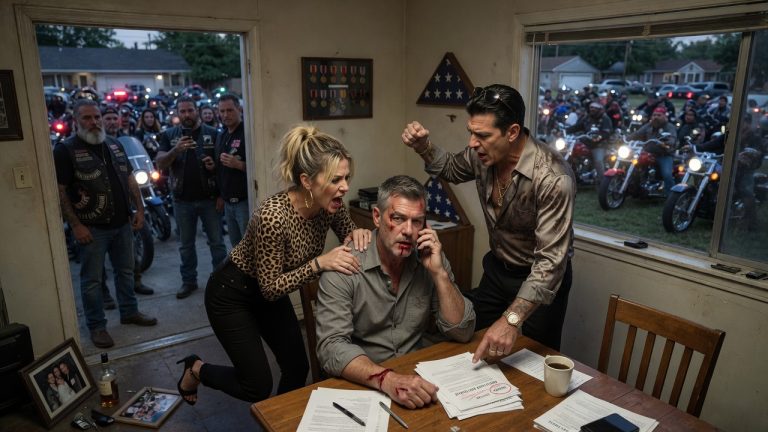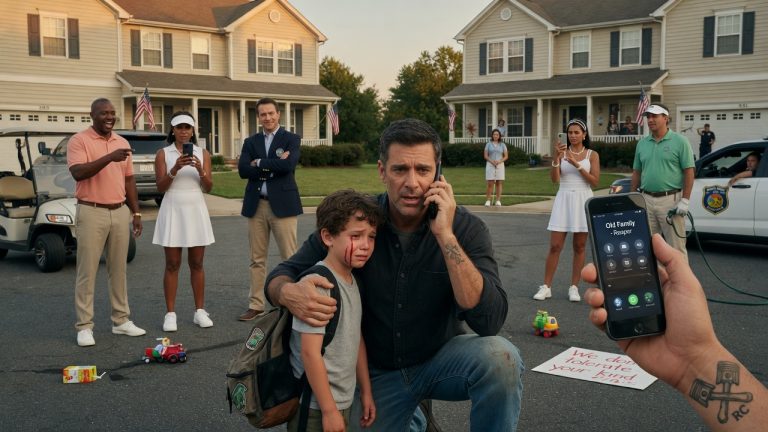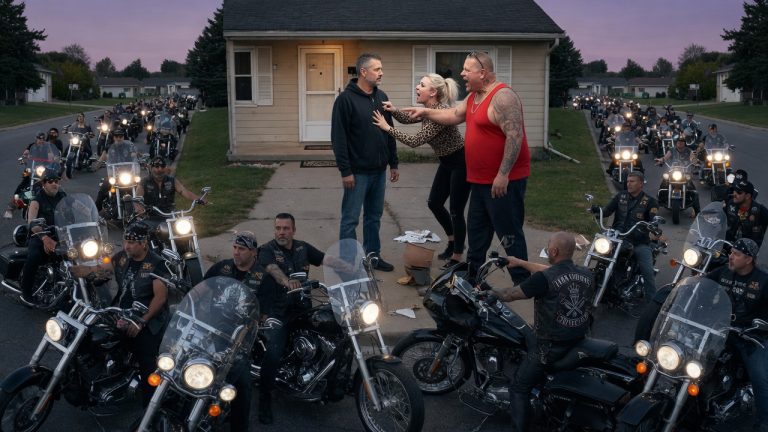
“Tell them what I just heard, Dad.”
The warehouse went so quiet I could hear the humidity dripping off the corrugated metal ceiling. I looked at Nails—my girl, the only thing I ever did right in this life—and I saw the world ending in her eyes. She wasn’t just holding a gun; she was holding the little silver earpiece I’d been using to talk to the feds for six months.
“Nails, honey,” I started, my voice sounding like gravel under a boot. “Put that down. You don’t understand what’s happening.”
“I understand that a voice just called you ‘Agent’ in my ear!” she screamed, her hand shaking so hard the barrel of the pistol danced against my chest. “I understand that Heavy and the boys are waiting for your signal, and you’re giving it to the people who want us gone!”
Behind her, the shadows moved. Heavy stepped into the light, his massive arms crossed, his face a mask of cold, hard stone. These were the men I’d bled with. The men I’d lied to so I could keep them from a life behind bars. To them, I wasn’t a savior. I was a ghost. I was a traitor.
I leaned on my iron cane, the one my father gave me with a bullet to the knee twenty years ago, and I realized I was finally out of places to run.
Chapter 1: The Weight of 999
The Baltimore humidity was a physical weight, a wet wool blanket that smelled of diesel, rotting fish, and the slow, grinding decay of the Inner Harbor. Cane Miller felt it in his marrow. Every step he took on the cracked asphalt of the shipyard felt like a debt being collected. His left leg, the one his father had shattered with a .38 Special on his eighteenth birthday, throbbed with a rhythmic, dull heat that no amount of ibuprofen could touch.
He leaned on the iron cane, a custom piece of work forged by Ink back when the 999 MC was still just a handful of guys in a basement. It was a solid inch of cold-rolled steel, topped with a heavy, polished ball that fit perfectly in Cane’s palm. It was his third leg, his weapon, and his badge of office. To the nine hundred and ninety-nine men who wore the patch, that cane was a symbol of resilience. To Cane, it was a reminder that you never truly escape where you came from.
“You’re limping worse today, Boss,” a voice rumbled from the shadows of the Loading Dock 4.
Cane didn’t turn his head. He knew the resonance of that voice. Heavy. Six-foot-four of muscle and scar tissue, the kind of man who looked like he’d been carved out of a granite quarry. Heavy was the club’s Enforcer, but more than that, he was the closest thing Cane had to a brother.
“The air’s thick, Heavy,” Cane said, his voice a low rasp. “Makes the metal in my leg feel like it’s trying to rust.”
“The shipment’s coming in at 0300,” Heavy said, stepping into the dim pool of light cast by a flickering security lamp. He spit a stream of tobacco juice onto the concrete. “The Russians are jumpy. They don’t like the way the port authority has been sniffing around the north end.”
Cane tightened his grip on the cane. “The Russians are always jumpy. That’s why we get paid the premium. We provide the muscle, they provide the hardware, and the 999 keeps the wheels turning. It’s a simple arrangement.”
But nothing was simple anymore. Not since the man from Europol had sat across from Cane in a windowless room in D.C. six months ago and showed him the files. Not since Cane realized that his “simple arrangement” was actually the primary artery for a global weapons network that was arming the kind of people who made bikers look like choirboys.
Cane looked out over the black water of the Patapsco River. Somewhere out there, a freighter was carrying enough high-grade ordnance to start a small war in the streets of Baltimore. And he was the one who was supposed to facilitate it.
“Where’s Nails?” Cane asked, shifting his weight.
“Working on Rider’s bike,” Heavy replied. “The kid’s got a knack for it. Better than her old man, if I’m being honest. She’s got those small hands, gets into the carburetor like she’s performing surgery.”
Cane felt a brief, sharp pang of pride mixed with an overwhelming sense of dread. Nails wasn’t his biological daughter—she was the kid of a brother who’d gone down in a high-speed chase ten years ago—but she was his soul. He’d raised her in the back of the clubhouse, taught her how to ride, how to fight, and how to spot a lie from a mile away. Which made his current life a waking nightmare.
“Tell her to go home,” Cane said. “It’s late. She doesn’t need to be around for the drop.”
“She’s nineteen, Cane. She knows the business. She wants to be part of the crew,” Heavy said, his tone suggesting he’d already had this argument with her.
“I don’t care what she wants. Tell her I said go home.”
Cane turned away, his cane clicking sharply against the ground. He headed toward his office, a cramped, grease-stained room at the back of the warehouse. Once inside, he locked the door and sat down in the creaking leather chair. He reached into the hidden pocket of his vest and pulled out a small, encrypted burner phone.
One message. Arrival confirmed. Trackers ready. Varga.
Cane stared at the screen until it went dark. Varga was his handler. A man who didn’t care about the 999, didn’t care about the brotherhood, and certainly didn’t care about Cane’s leg. He only cared about the “Big Fish”—the international dealers who used the MC as a shield.
Varga had promised Cane a way out. Full immunity for the club, a clean slate for the men who were just following orders, and a witness protection package for Nails. But to get it, Cane had to play the part of the traitor. He had to lead his brothers into a trap so the feds could snap the jaws shut on the Russians.
He looked at a framed photo on his desk. It was him and Nails, three years ago, standing next to her first rebuilt Harley. She was beaming, her face covered in oil, her arm thrown around his shoulders. He looked happy in the photo. He looked like a man who knew who he was.
Now, he felt like a hollowed-out shell. Every time he sat at the bar in the clubhouse and shared a beer with the men, he felt the weight of the silver earpiece hidden in the lining of his vest. He heard the voices of the men talking about loyalty, about “the patch over everything,” and he felt a physical sickness in his gut.
They called him the Loyal Traitor in his own mind. He was betraying their trust to save their lives. If the deal went through without interference, the MC would be tied to a series of high-profile hits across the East Coast. They’d be hunted down, one by one, and buried in federal holes. If he stopped it, they’d spend a few years in minimum security, maybe lose the club house, but they’d be alive.
And they would hate him for it.
The door to the warehouse creaked open, and the heavy thrum of a motorcycle engine echoed through the building. Cane recognized the sound—a Sportster with a modified exhaust. Nails.
He shoved the burner phone back into its hiding place just as a sharp knock sounded on his door.
“Dad? You in there?”
Cane took a breath, smoothing his expression. “Come in, Nails.”
She pushed the door open, her blonde hair escaping from her bandana in wild, greasy curls. She looked exactly like her father had—fierce, restless, and stubborn as a mule. She was holding a wrench in one hand and a smoldering cigarette in the other.
“Heavy says you’re kicking me out,” she said, leaning against the doorframe. “Since when do I miss a 0300 drop?”
“Since I decided it’s too hot tonight,” Cane said, not looking her in the eye. He started shuffling papers on his desk, pretending to be busy. “The docks are crawling with port security. I don’t need you getting caught in a sweep.”
“I’ve been evading sweeps since I was twelve, Cane. What’s the real reason?”
She stepped into the room, and he could feel her gaze on him. She was too smart. That was the problem. He’d raised her to be a predator, and now she was hunting for the truth in his own voice.
“The reason is I’m the President of this club and I told you to go home,” Cane snapped, the edge in his voice sharper than he intended.
Nails flinched, just a tiny flicker of her eyelids, but it was enough to make Cane regret the words instantly. She didn’t say anything for a long moment. She just looked at him, her blue eyes searching his face, looking for the man she knew.
“You’re hiding something,” she whispered. “You’ve been different for months. You don’t laugh. You don’t ride. You just sit in this office and stare at the walls.”
“I’m tired, Nails. My leg hurts. The world is getting smaller.”
“Then let me help you,” she said, her voice softening. She walked over and put her hand on his shoulder. “We’re 999, right? One heart, one spine. If you’re carrying something, let me take half of it.”
Cane felt the urge to tell her everything. To grab her and run. To tell her that the man she looked up to was a rat, a narc, a man who was about to destroy the only home she’d ever known.
But he couldn’t. If she knew, she became an accomplice. If she knew, Varga couldn’t protect her.
“Go home, Nails,” he said, his voice cold and flat. “That’s an order.”
She pulled her hand away like he’d burned her. The softness vanished, replaced by a wall of icy defiance. She didn’t argue. She didn’t yell. She just nodded once, turned on her heel, and walked out.
Cane listened to her bike roar to life and fade into the distance. The silence that followed was worse than the humidity. It was the silence of a man who had just pushed away the only person worth saving.
He stood up, grabbing his iron cane. He had work to do. He had trackers to plant. He had a family to betray. And as he limped toward the loading dock, the iron ball in his hand felt like it weighed a thousand pounds.
Chapter 2: The Humiliation of the Weak
The 999 MC clubhouse was a converted brewery on the edge of the industrial district, a sprawling brick fortress that smelled of stale beer, old leather, and the lingering scent of welding sparks. By midnight, the bar was crowded with the rank and file—men with thick necks and calloused hands who lived for the brotherhood because the rest of the world had no place for them.
Cane entered through the side door, his cane clicking rhythmically on the scarred wooden floor. The room usually went quiet out of respect when he walked in, but tonight there was a different energy. It was jagged, nervous. The upcoming shipment was the biggest the club had handled in a decade, and everyone felt the pressure.
He made his way toward the bar, his leg screaming for a place to rest. Before he could reach his usual stool, a man stepped into his path.
It was Rider. He was in his mid-twenties, a “new blood” who had patched in only a year ago. He was fast, reckless, and had a mouth that moved quicker than his brain. He was standing with a group of younger prospects, a beer in his hand and a sneer on his face.
“Hey, Boss,” Rider said, loud enough for the surrounding tables to hear. “You look like you’re dragging that leg pretty hard tonight. Sure you’re up for a dock run at 0300? Maybe you should stay here and let the men who can actually walk handle the heavy lifting.”
A few of the prospects snickered. The older members at the bar went still, their eyes sliding toward Cane. This was a direct challenge—not to his authority, but to his fitness. In a world built on strength, a limp was a target.
Cane stopped, leaning his weight onto the iron cane. He looked at Rider, his expression unreadable. “My leg has seen more miles than your bike, kid. It’ll be at the dock. Will you?”
Rider stepped closer, his chest puffed out. He was trying to impress the prospects, trying to carve out a name for himself by poking the old lion. “I’m just saying, Cane. We’re moving crates that weigh more than you do. If you trip and fall, you’re just a speed bump. Maybe it’s time to trade that patch for a rocking chair.”
As Rider spoke, he “accidentally” tilted his beer bottle. A stream of amber liquid splashed onto the toe of Cane’s worn leather boot. The room went deathly silent.
Cane looked down at his boot, then back up at Rider. The humiliation was intentional, a public display of disrespect designed to see if the old man still had teeth.
“You spilled your drink, Rider,” Cane said quietly.
“Oops,” Rider mocked, his friends laughing behind him. “My hand must have slipped. Just like your foot does every third step.”
Cane felt the rage simmering in his chest, a hot, bright coal. He could end this in three seconds. He could swing the iron cane and shatter Rider’s kneecap, show him exactly what a “half-man” could do. But he couldn’t. He was under a microscope. Varga had warned him—no incidents, no police attention, no hospital visits. He had to be the stable leader, the one who kept the peace until the trap was set.
He also knew that if he struck back now, it would only increase the tension within the club. He needed these men focused on the shipment, not on internal bloodletting.
“Clean it up,” Cane said, his voice flat.
Rider’s sneer widened. He felt the shift in power. He thought Cane was backing down because he was scared. “Clean it up? What are you gonna do if I don’t? Hit me with your stick? I’d have you on the floor before you could lift it.”
One of the older members, Ink, stood up from his stool, his tattooed hands clenched into fists. “That’s enough, Rider. Show some respect to the President.”
“Respect is earned, Ink,” Rider spat. “And all I see is a cripple holding onto a title because we’re too polite to take it from him.”
Cane looked around the room. He saw the doubt in the eyes of the younger men. He saw the pity in the eyes of the older ones. It was a poison, a residue of shame that would stick to him long after the floor was dry. He was the leader of 999, and he was being mocked by a kid who hadn’t even finished his first year of probation.
“I said clean it up,” Cane repeated, his voice dropping an octave.
Rider laughed, a harsh, braying sound. He took a long swig of his beer, then dropped the empty bottle. It shattered against the floor near Cane’s feet. “There. Now there’s more to clean. Since you’re already looking at the floor, why don’t you get down there and do it yourself?”
The humiliation was complete. Rider had turned the room against him. Cane felt the weight of his secret life—the earpiece, the feds, the betrayal—and it felt like it was crushing his spine. He was letting this happen because he had to save these men, and they were using his restraint as a reason to hate him.
Heavy stepped out from behind the bar, his massive frame looming over Rider. He didn’t say a word. He just placed a hand on Rider’s shoulder and squeezed. The kid’s face went pale, his knees buckling under the pressure.
“The Boss told you to clean it up,” Heavy rumbled. “I suggest you start before I use your vest to mop the floor.”
Rider looked at Heavy, then at Cane. The bravado vanished, replaced by a flickering fear. He reached for a rag on the bar, his movements jerky and embarrassed. He knelt down—right where he’d told Cane to kneel—and began picking up the glass.
The room began to move again, but the damage was done. The air was thick with the residue of the confrontation. Cane didn’t wait for Rider to finish. He turned and walked out of the clubhouse, the click of his cane sounding like a clock ticking down to zero.
Outside, the night air was slightly cooler, but the shame felt like a fever. He walked to the edge of the parking lot, leaning against his truck. His hands were shaking. He wasn’t afraid of Rider; he was afraid of what he was becoming. A man who couldn’t defend his own honor because he was too busy being a martyr for people who would eventually want him dead.
He reached into his vest and touched the burner phone. He wanted to call Varga. He wanted to tell him to hell with the plan. He wanted to be a biker again. He wanted to be the man who broke Rider’s jaw and stood over him with a bloody cane.
But then he thought of Nails. He thought of the life Varga had promised her. A life away from this, away from the violence, the grease, and the inevitable end that came for every man in the 999.
He pulled himself into the truck, the pain in his leg a sharp, biting reminder of his father’s “lesson.” Loyalty is a lie, boy, his father had told him as he stood over him with the smoking gun. There’s only power, and there’s only survival.
Cane shifted the truck into gear. He was going to survive. He was going to save Nails. And if he had to swallow his pride and let kids like Rider spit on his boots to do it, then that was the price.
But as he drove toward the harbor, he couldn’t shake the feeling that he was losing the very thing he was trying to protect. He wasn’t just a traitor to the club; he was becoming a traitor to himself.
The residue of the humiliation followed him like a ghost. He could still hear Rider’s laughter, still feel the cold beer on his boot. He was a king with an iron scepter, but his kingdom was made of ash, and the fire was already burning.
Chapter 3: The Cold Geometry of Betrayal
The Baltimore docks at 0200 were a labyrinth of steel and shadow. The giant cranes loomed over the water like prehistoric birds of prey, their yellow lights reflecting off the black, oily surface of the harbor. Cane parked his truck behind a stack of rusted containers, the iron cane heavy in his hand as he climbed out.
The physical toll of the night was catching up to him. His leg was a constant, throbbing scream, and the humidity felt like it was filling his lungs with liquid lead. He checked his watch. One hour until the freighter The Midnight Star was scheduled to dock.
He reached into the lining of his vest and pulled out a small, magnetic tracking device, no larger than a silver dollar. This was the “key” Varga had given him. He had to plant it on the main crate of the shipment—the one containing the specialized guidance systems the Russians were bringing in. Once the tracker was active, the feds would follow the shipment to the central distribution hub, and the raid would begin.
But first, he had to survive the meeting.
Heavy and four other members of the 999—including Rider, who was uncharacteristically quiet after the clubhouse incident—met him near the water’s edge. They were all armed, their leather vests bulging over handguns tucked into waistbands.
“The Russians are already here,” Heavy whispered, nodding toward a black SUV parked near the end of the pier. “Three of them. They brought the ‘Vulture.’”
Cane felt a chill that had nothing to do with the night air. The Vulture was a middleman for a Siberian syndicate, a man known for his clinical detachment and his habit of removing the fingers of anyone who moved too slowly.
“Stay back,” Cane ordered his men. “I’ll handle the talk. Heavy, keep your eyes on the perimeter. Rider, stay on the bike. If things go south, I want you out of here and heading for the secondary rally point.”
Rider gave a sullen nod, but didn’t meet Cane’s eyes. The residue of the humiliation was still there, a wall of resentment between them.
Cane limped toward the SUV, the iron cane clicking a steady, defiant beat against the concrete. The driver’s side window rolled down, revealing a man with a face like a hatchet and eyes that seemed to absorb the light. The Vulture.
“Mr. Miller,” the Vulture said, his English accented but perfect. “You are punctual. I appreciate that in a man of your… condition.”
He looked pointedly at Cane’s cane.
“The conditions are the same as they’ve always been,” Cane said, stopping five feet from the car. “We move the crates to the warehouse, we provide the escort to the state line, and we get paid. Where’s the manifest?”
The Vulture stepped out of the car. He was dressed in a sharp, dark suit that looked entirely out of place among the grease and grime of the docks. He handed Cane a tablet. “The shipment has been subdivided. Three main crates. If even one is tampered with, the contract is void. And the consequences, as you know, are final.”
Cane scrolled through the manifest. His heart was hammering against his ribs. The central crate—the one Varga wanted—was marked as ‘Industrial Tooling, Unit 09.’
“We have the trucks ready,” Cane said, handing the tablet back. “My men know the route.”
“Your men,” the Vulture said, his gaze drifting toward Heavy and the others. “They seem… restless. I hope they understand the importance of discretion. The cargo we are moving tonight is not for the eyes of the curious.”
“They’re 999,” Cane said firmly. “They don’t see anything they aren’t told to see.”
“Good. Because I would hate to have to burn the bridge we have built here, Mr. Miller.”
The freighter began its slow approach, a massive wall of black steel cutting through the water. As the ship docked and the cranes began to move, the atmosphere grew electric with tension. The 999 members moved into position, their bikes idling in a low, menacing growl.
Cane moved toward the unloading area, his mind racing. He had to find Unit 09 and plant the tracker before the crates were loaded onto the trucks. He waited until the first crate hit the pavement, the sound echoing like a gunshot through the warehouse.
The Russians were busy coordinating with the crane operators. Heavy was distracted, talking to the ship’s captain. This was his window.
Cane limped toward the stack of crates, his cane acting as a stabilizer. He found Unit 09, a heavy wooden box reinforced with steel bands. He moved to the blind side of the crate, shielded from the Vulture’s view by a stack of pallets.
He reached into his vest, pulling out the tracker. His hands were slick with sweat. He pressed the device against the underside of the crate, feeling the magnetic lock click into place.
“What are you doing, Cane?”
The voice was sharp, suspicious. Cane froze, his heart stopping for a beat. He slowly turned his head.
It was Rider. He was standing ten feet away, his arms crossed, watching Cane with narrowed eyes.
“Just checking the seals,” Cane said, his voice remarkably steady despite the panic surging through him. “The Vulture said these crates were sensitive. I don’t want any surprises.”
Rider stepped closer, his gaze dropping to Cane’s hand, which was still tucked under the edge of the crate. “You’ve been spending a lot of time ‘checking’ things lately. And you’re always alone when you do it.”
“I’m the President, Rider. I do the final check. If you have a problem with that, we can discuss it back at the clubhouse. With Heavy.”
The mention of Heavy made Rider flinch, but the suspicion didn’t leave his eyes. He looked at the crate, then back at Cane. “You’re hiding something. I can smell it on you. You’re acting like a man who’s waiting for the floor to drop.”
“The only thing I’m waiting for is to get this job done so I can go home and put some ice on my leg,” Cane said, stepping away from the crate. He used the iron cane to gesture toward the trucks. “Get back to your bike. The first load is moving.”
Rider hesitated, his mouth twisting as if he wanted to say more. But the roar of the trucks and the shouting of the crane operators drowned out the moment. He turned and walked away, but the look he gave Cane was one of pure, unadulterated distrust.
Cane leaned against the crate, his breath coming in ragged gasps. He had planted the tracker, but the cost was rising. Rider was onto him. It was only a matter of time before the kid’s suspicion turned into something more dangerous.
He looked up and saw Nails.
She wasn’t supposed to be here. She was standing on the far side of the dock, half-hidden behind a forklift. She was watching him, her expression a mix of hurt and confusion. She had followed him.
Cane felt a surge of pure terror. If the Russians saw her, she was dead. If Varga’s raid happened while she was on-site, she’d be caught in the crossfire.
“Nails!” he hissed, moving toward her as fast as his leg would allow.
She didn’t run. She stood her ground as he approached. “I knew you were lying,” she said, her voice trembling. “You didn’t want me here because you’re doing something for yourself. Something that doesn’t involve the club.”
“Nails, listen to me,” Cane said, grabbing her arm. “You have to leave. Right now. This is bigger than you think.”
“Then tell me!” she cried. “Stop treating me like a kid! I’m 999! I’ve earned my place!”
“You’re my daughter!” Cane roared, the frustration and fear finally boiling over. “And I’m trying to keep you from ending up in a hole!”
The Vulture looked over, his eyes sharp and cold. He began walking toward them.
“Is there a problem, Mr. Miller?” the Vulture asked, his hand drifting toward his jacket.
Cane felt the world narrowing down to a single point. He looked at Nails, then at the approaching killer. He had to make a choice.
“No problem,” Cane said, his voice shaking. “My daughter just brought me my medicine. She was leaving.”
He shoved Nails toward the exit. “Go. Now. Don’t look back.”
Nails looked at him, her eyes filling with tears. She didn’t say anything. She just turned and ran into the darkness.
Cane watched her go, his heart breaking in his chest. He turned back to the Vulture, his expression hardening into a mask of professional indifference.
“The shipment is moving,” Cane said, leaning on his iron cane. “Let’s get it done.”
But as he watched the trucks roll out of the shipyard, he knew the trap was already being sprung. And he knew that no matter what happened next, he had already lost the only thing that mattered.
The residue of the night—the sweat, the grease, the smell of the river—felt like it was staining his skin permanently. He was a man holding a detonator, waiting for the explosion that would destroy everything he loved.
Chapter 4: The Sound of the End
The 999 MC warehouse was a tomb of silence as the three trucks pulled in. The adrenaline of the docks had faded, replaced by a thick, suffocating tension. The shipment was secure, but the air felt like it was charged with static electricity.
Cane sat in his office, his iron cane leaning against the desk. He had the earpiece in now—the one Varga had given him. It was a tiny, high-tech device that sat deep in his ear canal, invisible to the naked eye.
“Positions confirmed,” Varga’s voice crackled in his ear. “The tactical teams are two minutes out. Give us the signal when the Vulture is inside the office with the manifest.”
Cane didn’t respond. He couldn’t. He just sat there, staring at the door.
He heard the heavy footsteps of his men in the warehouse. He heard the murmur of voices, the clinking of tools, the familiar sounds of the life he was about to end.
Then, he heard the fight.
It started as a shout, then the sound of something heavy hitting the floor. Cane grabbed his cane and limped to the door, throwing it open.
In the center of the warehouse, a chaotic struggle was unfolding. Rider and two other bikers had pinned a man against a stack of crates. It was the “Mirror”—the Interpol agent who had been tailing the shipment from the European side. He’d been caught trying to infiltrate the warehouse.
“We found a rat!” Rider screamed, his face twisted with a manic, vengeful joy. He was holding a jagged piece of glass, the remnants of a broken bottle. “He’s got a badge, Cane! He’s one of them!”
The warehouse erupted. The 999 members surged forward, a wall of leather and rage. Heavy moved to the center, his face a mask of grim determination. The Vulture and his men also drew their weapons, their eyes scanning the room for other intruders.
“Kill him!” someone shouted. “No one leaves this room!”
Cane pushed through the crowd, his iron cane slamming against the concrete. “Stop! Everyone stop!”
He reached the center of the circle. The agent was bleeding from a cut on his forehead, his eyes wide with the realization that he was about to be torn apart.
“Cane, what are we doing?” Heavy asked, his voice low and dangerous. “This guy is feds. He’s here for the shipment.”
“I’ll handle it,” Cane said, his heart pounding so hard he could feel it in his teeth. “He’s no good to us dead. We use him as leverage.”
“Leverage?” Rider spat. “He’s a narc! We gut him and we leave him for the crows! That’s the rule!”
Rider lunged forward, the glass shard aimed at the agent’s throat. Cane didn’t think. He swung the iron cane, the heavy steel head catching Rider in the shoulder and sending him sprawling across the floor.
The room went silent. The bikers looked at Cane, their expressions shifting from rage to confusion.
“You hit me?” Rider gasped, clutching his shoulder. “You hit one of your own… for a fed?”
“I said I’d handle it!” Cane roared, the sound echoing off the metal rafters.
In the chaos, the earpiece—the tiny, silver device Varga had given him—fell out of his ear. It hit the concrete with a tiny, metallic tink.
Cane didn’t see it. He was too busy looking at Rider, his hands shaking with the effort to maintain control.
But Nails saw it.
She had stayed. She hadn’t gone home. She was standing in the shadows near the loading dock, her face pale, her eyes fixed on the floor. She stepped forward, her movements slow and robotic. She reached down and picked up the silver earpiece.
She held it to her ear for a fraction of a second.
Cane saw the moment the light went out in her eyes. He saw the moment she heard Varga’s voice—the voice of the man who was about to lead the raid.
“Nails,” Cane whispered, his voice failing him.
She didn’t look at him. She looked at the earpiece, then at the room full of men who called him brother. She looked at the agent bleeding on the floor.
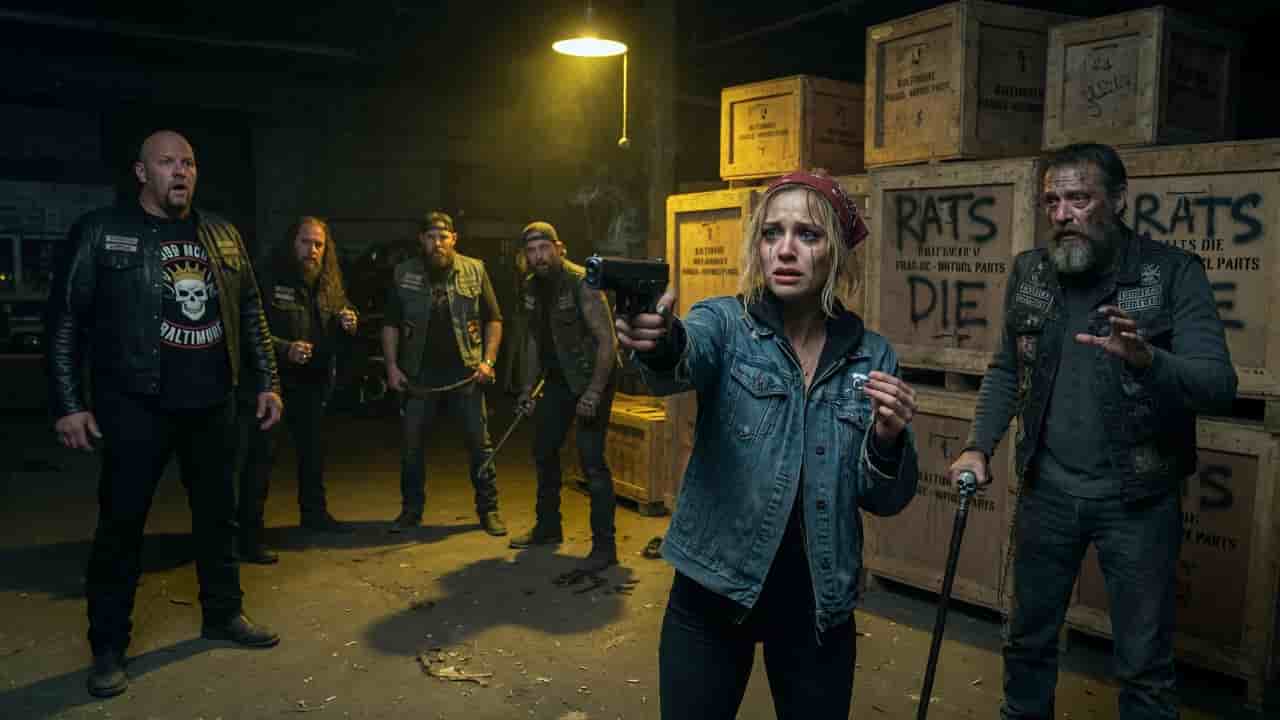
She reached into her denim jacket and pulled out the compact pistol he’d given her for her eighteenth birthday. She aimed it directly at his chest.
“Tell them what I just heard, Dad,” she said, her voice a jagged, broken thing.
The warehouse went so quiet the sound of the humidity seemed to roar. Every eye in the room turned to the earpiece in her hand, then to the gun in her hand, then to Cane.
“Nails, put it down,” Cane said, taking a shaky step toward her. His cane scraped the concrete, a lonely, pathetic sound. “Let me explain. You don’t understand.”
“I understand that a voice just called you ‘Agent’ in my ear!” she screamed, her hand shaking so hard the barrel of the pistol danced. “I understand that Heavy and the boys are waiting for your signal, and you’re giving it to the people who want us gone!”
Heavy stepped forward, his eyes narrowing, his massive frame radiating a cold, terrifying heat. “Cane? What is she talking about?”
Cane looked at Heavy—the man who had carried him home after his father shot him. He looked at Ink, who had forged his cane. He looked at the 999, the family he’d lied to so he could save them.
He was caught in the cold geometry of his own betrayal. He was a man holding a secret that had just become a death sentence.
“Say it!” Nails choked out, her thumb clicking the safety off. “Tell them who you’re talking to! Tell them why you’re killing us!”
Cane looked into the barrel of the gun. He looked at his daughter, the girl he’d tried to save, and he realized he was finally out of places to run.
The sound of sirens began to wail in the distance, a low, mournful howl that grew louder with every second. The trap was springing. The world was ending.
And as the 999 closed in on their leader, the iron cane in Cane’s hand felt like it was finally, mercifully, too heavy to carry.
Chapter 5: The Collapse of the Spine
The barrel of the pistol in Nails’s hand didn’t just point at Cane’s heart; it pointed at the last twenty years of his life. The warehouse felt like it was tilting on its axis. The humidity was gone, replaced by a dry, electric charge that made the hair on the back of Cane’s neck stand up. He could hear the sirens now, no longer a distant howl but a screaming chorus, the blue and red lights already beginning to pulse against the frosted high-windows of the Loading Dock.
“Nails,” Cane said, and his voice sounded like it was coming from the bottom of a well. He didn’t move his hands. He didn’t raise them in surrender, and he didn’t reach for the cane. He just stood there, braced on his one good leg, feeling the iron in his left hand tremble. “You have to listen. I did this for you. I did this for all of them.”
“For us?” Nails’s voice was a jagged, ugly thing. The tears were flowing freely now, carving white tracks through the grease and soot on her face. “You’re wearing a wire, Cane! You’ve got a fed in your ear telling you when to flip the switch! You’re not saving us—you’re the one who brought the wolves to the door!”
Heavy took a step toward Cane, his shadow stretching long and monstrous across the concrete floor. The massive Enforcer wasn’t looking at the sirens or the agent bleeding out near the crates. He was looking at Cane. It was a look of profound, terminal disappointment. It was the look of a man who had just realized his brother had been a stranger all along.
“Is it true?” Heavy asked. The words were low, vibrating with a tectonic pressure. “The earpiece. The trackers. Were you ever one of us, Cane? Or were you just the man they sent to manage the herd before the slaughter?”
“Heavy, I made a deal,” Cane said, his words coming faster now, desperate to bridge the widening chasm. “The Russians… the Vulture… they aren’t just bikers, man. They’re global. They were going to use the 999 as a meat shield. If this shipment went through, every man in this room would be looking at a life sentence or a pine box. I got us immunity. I got the club a way out.”
“By ratting?” Rider screamed from the floor, clutching his shattered shoulder. He spit a mouthful of blood toward Cane’s boots. “You’re a narc, old man! You’re the lowest thing on the planet! You’re worse than my father, and at least that bastard had the balls to leave!”
The first flashbang detonated at the north bay door.
The world turned white. The sound wasn’t a bang; it was a physical blow that compressed the air in Cane’s lungs and turned his vision into a smear of static. He felt himself falling, the iron cane slipping from his grip and clattering onto the concrete with a sound like a funeral bell. He hit the ground hard, his bad leg twisting, a lightning bolt of agony shooting from his ankle to his hip.
Then the screaming started.
“FEDERAL AGENTS! DROP THE WEAPONS! DOWN ON THE GROUND! NOW!”
The warehouse erupted into a choreographed nightmare. The tactical teams, clad in charcoal-grey ceramic plates and balaclavas, swarmed through the shattered doors like a flood of ink. The red dots of laser sights danced across the leather vests of the 999, hovering over hearts and foreheads.
Cane tried to push himself up, his ears ringing with a high-pitched whine that drowned out the chaos. Through the haze of smoke and flash-powder, he saw Heavy reach for his holster.
“Heavy, no!” Cane tried to yell, but his voice was a dry croak.
A volley of non-lethal beanbag rounds caught Heavy in the chest, the force of the impacts staggering the giant man. He groaned, a sound of pure animal frustration, before three agents tackled him, driving him into the concrete.
Cane’s eyes searched for Nails. He saw her backed against a stack of crates, the pistol still in her hand, her eyes wide with a panicked, blinding terror. She wasn’t an Enforcer. She wasn’t a soldier. She was just a nineteen-year-old girl who had been raised in a world that was currently being dismantled by men with submachine guns.
“Drop it, Nails!” Cane screamed, dragging himself across the floor on his stomach, his bad leg trailing behind him like a dead weight. “Please, honey, drop the gun!”
An agent turned his weapon toward her. “DROP THE WEAPON! DROP IT NOW!”
Nails looked at the agent, then at Cane. The betrayal in her eyes was so sharp it felt like a physical wound. She didn’t drop the gun. She didn’t fire it, either. She just stood there, frozen, the silver earpiece still clutched in her left hand like a piece of cursed jewelry.
Cane lunged, ignoring the fire in his hip, and tackled her legs just as the agent fired a Taser. The twin prongs hissed through the air where Nails’s chest had been a second before, thudding into the wooden crate behind her. They hit the ground together, the air leaving Nails in a sharp sob.
Cane shielded her with his body, his arms wrapped around her head as the boots of the tactical team thundered past them. He could smell the ozone of the Tasers, the acrid smoke of the flashbangs, and the metallic tang of fear.
“I’ve got her!” Cane shouted as an agent hovered over them, weapon leveled. “She’s mine! I’m Miller! I’m the asset!”
The agent paused, the laser dot lingering on Cane’s temple for a heartbeat before nodding to his partner. They moved on, moving toward the Vulture’s men, who were putting up a brief, violent resistance near the trucks.
Cane pulled back, looking at Nails. She was staring at him, her face inches from his. There was no gratitude in her expression. There was only a cold, hollowed-out silence.
“Don’t touch me,” she whispered.
“Nails, I had to—”
“You used me,” she said, her voice flat. “You used me to get close to the shipment. You used the fact that I loved you to hide what you were doing. You made me a part of your lie.”
“I made you part of the survival,” Cane hissed, grabbing her shoulders. “Look around you! They’re alive! Heavy is alive! They’re going to jail for a few years, but they aren’t going to be executed by a Russian hit squad! I bought their lives with my soul!”
“You bought them with their dignity,” she said, pushing him away. She stood up, her hands empty now, her pistol lying forgotten in the dust.
Two agents grabbed her arms, pulling her back. She didn’t fight them. She just kept her eyes on Cane as they zip-tied her wrists.
“You’re a ghost, Cane,” she said as they led her away. “My dad died years ago. I don’t know who the hell you are.”
Cane watched her go, the weight of the floor finally claiming him. He slumped against the crates, his breath coming in ragged, shallow gasps.
A pair of polished black boots appeared in his field of vision. Not tactical boots. Dress shoes.
Cane looked up. Varga stood there, his suit pristine, his face an unreadable mask of bureaucratic efficiency. He was looking at the warehouse, at the men being zip-tied and led out in a line, at the crates of weapons being tagged as evidence.
“A bit messier than we discussed, Miller,” Varga said, tapping a cigarette out of a silver case. “But the result is the same. The Vulture is in custody. The shipment is ours. The network is broken.”
“The club,” Cane rasped, reaching for his iron cane, which lay a few feet away. “The deal. Immunity for the 999.”
Varga took a long pull of his cigarette, the smoke curling around his head like a shroud. “The deal was for cooperation, Miller. And while you did your part, your men resisted. There will be charges. Conspiracy, weapons trafficking, resisting arrest. But,” he paused, looking at Cane with a thin, clinical smile, “I’ll make sure the sentencing is… manageable. They’ll get five years, maybe seven. In the grand scheme of things, you saved them.”
“Seven years,” Cane whispered. “They’ll be old men when they get out. They’ll have nothing.”
“They have their lives,” Varga said, turning to walk away. “Which is more than they would have had if the Russians had found that tracker. You did a good thing today, Agent Miller. Try to remember that when you’re sleeping in your new house in Arizona.”
Cane grabbed the iron cane, using it to haul himself to his feet. His leg was screaming, a white-hot agony that made his vision blur. He looked toward the exit, where the 999 were being loaded into a transport van.
He saw Heavy. The big man was being shoved into the back of the van, his head bowed. For a split second, Heavy looked back. He didn’t scream. He didn’t curse. He just looked at Cane, and then he looked at the iron cane in Cane’s hand.
In that look, Cane saw the death of the 999. He saw the end of the brotherhood, the end of the myth of the road, and the beginning of a long, cold silence.
He had saved them, and in doing so, he had destroyed the only reason they had to live.
As the van doors slammed shut, the sound echoed through the empty warehouse like a final, definitive heartbeat. Cane stood alone in the center of the wreckage, leaning on his father’s iron legacy, a king of nothing but ash and blue light.
The residue of the raid was everywhere—the smell of chemicals, the debris of the struggle, the lingering vibration of the sirens. But the heaviest residue was inside him. It was the feeling of being the only man left standing in a room full of ghosts.
He took a step toward the door, the click of his cane sounding smaller than it ever had before.
Chapter 6: The Long Shadow of the Harbor
Three months later, the Baltimore sun was a pale, anemic disk hanging over the Inner Harbor. It wasn’t the thick, wet heat of the summer; it was the beginning of the autumn chill, the kind of cold that found the cracks in your bones and stayed there.
Cane Miller sat on a weathered wooden bench near the pier, his iron cane resting against his thigh. He was wearing a plain canvas jacket now, the leather vest with the 999 patch buried in a dumpster outside a motel in Ohio weeks ago. He looked like any other middle-aged man watching the tide come in—grey at the temples, a bit weathered around the eyes, a man who had seen too much of the wrong kind of history.
He was supposed to be in Arizona. That was the plan. A new name, a small house, a pension from a government that preferred its assets quiet and out of sight. But the desert was too dry, and the silence there was too loud. He had come back to the water. He had come back to the place where he’d broken everything.
He pulled a crumpled envelope from his pocket. It was a letter from a lawyer, the one Varga had hired to “manage” the fallout.
Sentencing finalized, it read. Heavy: 6 years. Rider: 4 years. Ink: 5 years. All diverted to low-security facilities. The immunity for the daughter, Sarah ‘Nails’ Jenkins, has been processed. All charges dropped. Her whereabouts are currently unknown.
Cane folded the letter and tucked it back into his pocket. Sarah. He hadn’t called her that in ten years. To him, she would always be Nails, the girl with the grease on her nose and the fire in her heart. But Nails was gone. She’d disappeared the moment she walked out of that warehouse, refusing the protection, refusing the money, refusing to even look at the man who had raised her.
He looked out at the water, watching a tugboat pull a string of barges toward the open sea. He thought about his father. He thought about the day his father had shot him, the day he’d learned that loyalty was a luxury the poor couldn’t afford. He’d spent his whole life trying to prove his father wrong. He’d built a brotherhood. He’d created a family out of scrap metal and shared trauma.
And in the end, he’d used the very same logic his father had. He’d chosen survival over honor. He’d chosen the power of the secret over the truth of the bond.
A figure moved in his peripheral vision. A young woman, walking slowly along the pier. She was wearing a faded denim jacket, her blonde hair tied back with a black bandana.
Cane’s heart hammered against his ribs. He gripped the iron cane so hard his knuckles turned white.
“Nails?” he whispered.
The woman stopped. She turned her head, and for a second, the world seemed to freeze. It was her. But she looked older. The wildness in her eyes had been replaced by a weary, guarded stillness. She looked like someone who had spent the last three months learning how to be a ghost.
She walked toward him, stopping ten feet away. She didn’t sit down. She just stood there, the wind whipping her hair across her face.
“I heard you were back,” she said. Her voice was flat, devoid of the jagged rage that had defined their last encounter. It was worse this way. It was the voice of a stranger.
“I couldn’t stay away,” Cane said. “The desert didn’t suit me.”
“Nothing suits a traitor, Cane. You’re always looking for the next exit.”
Cane looked down at his boots. “The boys… they’re okay. The lawyer says the facilities are clean. They’ll be out before they’re too old to ride.”
“They won’t be riding together,” Nails said. “The club is gone. The clubhouse was auctioned off last week. Someone’s turning it into luxury lofts. The 999 is just a story now. A story about a man who sold his brothers to buy a clear conscience.”
“I didn’t buy a clear conscience, Nails. I bought them time. I bought them a chance to die in their beds instead of a warehouse floor.”
“Who asked you to?” she asked, her voice finally cracking, just a little. “Who gave you the right to decide what our lives were worth? We would have fought, Cane. We would have died for each other. That’s what being a brother means. It means you don’t make deals behind the family’s back.”
“It means you protect the family!” Cane roared, standing up, his leg buckling for a second before the iron cane caught him. “I protected you! I protected Heavy! If I hadn’t made that deal, you’d be a memory, Nails! You’d be a name on a headstone in a Potter’s Field!”
“I’d rather be a memory with my dignity than a survivor with your shame,” she said quietly.
She looked at the iron cane, the polished steel ball reflecting the grey sky. “You’re just like him, you know. Your father. He shot you to keep you from leaving. You shot us all to keep us from dying. You both think you own the people you love.”
Cane felt the words hit him like a physical blow. He looked at the cane, the object he’d carried as a badge of his survival, and he realized she was right. It wasn’t a scepter. It was a crutch for a man who didn’t know how to stand on his own truth.
Nails reached into her pocket and pulled something out. She walked forward and placed it on the bench next to him.
It was the silver earpiece. It was crushed, the delicate internal circuitry exposed and ruined.
“I kept it,” she said. “To remind myself why I don’t trust anyone. But I don’t need it anymore. I’ve learned the lesson.”
She turned to walk away.
“Nails!” Cane called out. “Where are you going? What are you going to do?”
She stopped, but didn’t look back. “I’m going to find a life that doesn’t involve patches or secrets. I’m going to be Sarah. And Sarah doesn’t have a father.”
She walked away, her figure growing smaller against the backdrop of the industrial cranes and the grey water. She didn’t look back.
Cane sat down on the bench, his hand resting on the crushed earpiece. He felt the cold of the iron cane seeping into his palm. He looked out at the harbor, at the city that had chewed him up and spit him out, and he realized that he had achieved exactly what he’d set out to do.
He had saved them.
The 999 were alive. Heavy was breathing. Rider was healing. Nails was free.
He was the only one who was dead.
He picked up the iron cane, feeling the familiar weight of it. He looked at the harbor one last time, then stood up. He limped toward his truck, the click-scrape of his movement the only sound in the quiet afternoon.
He was the Loyal Traitor. He had kept his word, and he had lost his world.
As he drove away from the water, heading toward a horizon that offered no comfort and no forgiveness, the residue of the past felt like a permanent stain on his soul. He was a man who had traded his heart for a set of keys, only to find that there were no doors left to open.
The final sentence of his story wasn’t written in blood or ink. It was written in the silence of a man who had finally escaped his father, only to become the ghost his father always wanted him to be.
He drove on, the iron cane on the seat beside him, a cold, silent passenger on a road that led nowhere.