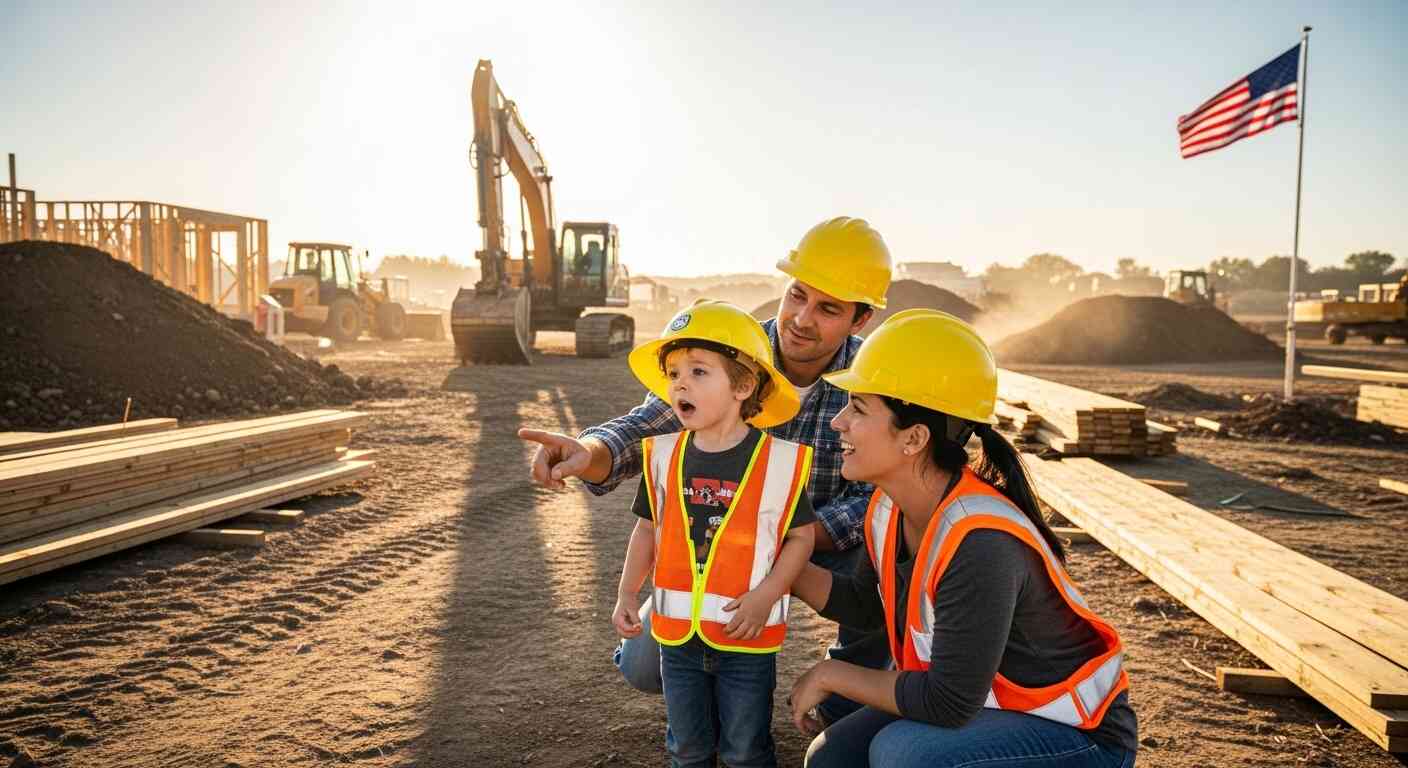
The dust in the Oakhaven Quarry doesn’t just settle on you; it buries you. It’s a fine, white powder that tastes like copper and ancient stone. My name is Silas Vane, and I’ve spent fifteen years digging holes in this earth, hoping to find enough silver to buy a life that didn’t involve a shovel.
But today, I wasn’t digging. I was running.
My seven-year-old son, Caleb, was limp in my arms. His skin was the color of wet chalk, and every breath he took sounded like a handful of gravel rattling in a tin can. He’d collapsed near the old ventilation shafts—the ones the company told us were sealed off fifty years ago.
“Stay with me, Caleb,” I choked out, my heavy boots skidding on the loose shale. “Just keep your eyes on me, buddy.”
I reached the main office, kicking the heavy steel door open. The air conditioning hit me like a block of ice. Miller, the site supervisor—a man who measured life in profit margins and safety violations—looked up from his monitors, annoyed.
“Vane? What the hell? You’re off-shift,” Miller barked.
“He can’t breathe, Miller! Scan his medical ID! I need the emergency transport triggered now!”
I laid Caleb on the desk, pushing aside piles of blueprints. Miller grumbled, reaching for the handheld scanner. He swiped the small, embedded chip in Caleb’s wristband—the standard-issue ID every citizen had to carry from birth.
The scanner chirped. A blue light bathed Caleb’s pale face. Miller’s eyes flicked to the screen, then back to the boy, then to me. The annoyance in his expression vanished, replaced by a raw, jagged terror I’d never seen on a grown man.
“Silas,” Miller whispered, his voice trembling. “Where did you get this boy?”
“What are you talking about? He’s my son! Call the medics!”
Miller turned the screen toward me. My heart stopped.
The photo on the screen was a perfect match for Caleb. Same messy hair, same small scar on his chin from a fall last summer. But the date of birth was 1972. The date of death was listed as July 14th, 1979.
“The system says this child died ten years before you were even born, Silas,” Miller said, backing away from the desk as if my son were a bomb. “And look at the father’s name on the record.”
I looked. The name on the 1979 death certificate wasn’t mine. It was my father’s.
I wasn’t holding my son. I was holding my own brother—the one my father told me had vanished in the quarry fifty years ago. And he hadn’t aged a single day.
FULL STORY
CHAPTER 1: THE DUST OF GHOSTS
The Oakhaven Quarry was a jagged tooth in the mouth of the Appalachian Mountains. It was a place of deep shadows and deeper secrets. My father, Elias Vane, had worked these pits until the dust turned his lungs into stone, leaving me with nothing but his debts and a tarnished name.
I didn’t mind the work. It was honest. It was quiet. And it allowed me to raise Caleb in the small cabin on the edge of the property. Caleb was everything to me. After my wife left us for the bright lights of Nashville, it was just the two of us against the world.
That morning, the air was heavy, pregnant with a coming storm. Caleb had insisted on bringing me my lunch pail, a small tradition he’d started over the summer. I saw him waving from the ridge of Section 4—the restricted zone.
“Caleb! Get back from the edge!” I shouted over the roar of the rock crusher.
He waved back, but then he stumbled. It wasn’t a trip. It was as if the strength had been sucked out of him all at once. He hit the ground, and a cloud of white dust rose around him.
By the time I reached him, he was convulsing. His eyes were rolled back, and a strange, metallic smell hung in the air—like ozone and old pennies. I scooped him up, his small body feeling impossibly light, and ran.
The encounter in Miller’s office felt like a fever dream. The screen, the dates, the impossible truth—it didn’t make sense.
“Miller, the system is glitched,” I said, my voice rising to a shout. “It’s a bug! Just call the ambulance!”
“It’s not a bug, Silas,” Miller said, his hand shaking as he reached for the desk phone. But he wasn’t calling an ambulance. He was dialing a four-digit internal code. The “Black Line.”
“What are you doing?” I demanded.
“The company… they told us if a ‘Type Zero’ ever appeared, we had to lock down the site. I thought it was a joke. A legend.” Miller looked at Caleb with a mixture of pity and horror. “That boy isn’t sick, Silas. He’s decaying. He was never meant to be in our air.”
Before Miller could finish the call, I grabbed the scanner and smashed it across his face. He crumpled, the phone danging from its cord.
I grabbed Caleb. I didn’t know what a ‘Type Zero’ was, and I didn’t care about 1979. I just knew that if I stayed here, the men who owned the quarry would take my son and turn him into a statistic.
I burst out of the office just as the site’s sirens began to moan—a low, mournful sound that signaled a “Containment Breach.”
I ran toward the old service road, the child’s shallow breaths hot against my neck. I needed a doctor, but not a company doctor. I needed Clara Mae.
Clara Mae lived in a trailer at the bottom of the valley. She was eighty years old, half-blind, and knew more about the history of Oakhaven than any computer system. She had been the head nurse at the quarry clinic back in the seventies.
As I threw Caleb into the back of my beat-up Ford, I saw the black SUVs of the “Safety Response Team” tearing across the quarry floor. They weren’t coming to help. They were coming to harvest.
“Hang on, Caleb,” I whispered, slamming the truck into gear. “Daddy’s got you.”
CHAPTER 2: THE CRYOGENIC SHADOW
Clara Mae’s trailer smelled of menthol and old newspapers. She didn’t seem surprised to see me, or the dying boy in my arms. She pointed to a worn velvet sofa.
“Lay him down, Silas. Put his head to the north,” she croaked.
I watched as she moved with surprising grace, her gnarled hands hovering over Caleb’s chest. She didn’t use a stethoscope. She used a piece of polished quartz.
“The dates, Clara,” I panted, pacing the small room. “Miller’s scanner said he died in ’79. It said he was my father’s son. My brother, Julian.”
Clara Mae stopped. She looked at the boy, then at me. “Your father didn’t lose your brother in a landslide, Silas. That was the lie the company paid him to tell. They needed a ‘clean’ subject. A child with no genetic defects to test the atmospheric stabilizers in the deep shafts.”
“What are you saying?”
“They found something down there, Silas. A pocket of air, or a fold in time—something that stopped the clock. They built the quarry to hide it. They put Julian in there to see if a human could survive the ‘Static.’ But something went wrong. The Static didn’t just preserve him; it bonded with him.”
I looked at Caleb—or Julian. He opened his eyes. They weren’t blue anymore. They were a swirling, milky white.
“Silas?” he whispered.
“I’m here, buddy.”
“It’s so loud,” he said. “The stone… it’s screaming.”
“He’s hearing the mountain,” Clara said, her voice dropping to a whisper. “The quarry owners—the Sterling Corporation—they’ve been trying to restart the project. They’ve been drilling deeper, breaking the Static. That’s why he’s sick. Every time they drill, they’re tearing his soul apart.”
The sound of a helicopter blade cut through the air. The hunt was getting closer.
“You have to take him back,” Clara said, grabbing my arm with surprising strength. “Not to the office. To the ‘Heart.’ The place where it started. If you don’t put him back into the Static, he’ll turn to dust in your arms by sunset.”
“I can’t put him in a hole in the ground!” I screamed.
“It’s not a hole, Silas. It’s a door. And it’s the only place where he’s truly alive.”
I looked at the window. The searchlights were sweeping the trees. I had two choices: let him die as my son in the world of men, or let him live as my brother in the world of ghosts.
“How do I find it?” I asked.
Clara Mae reached into her pocket and pulled out a heavy, rusted iron key. “Your father didn’t die of lung disease, Silas. He died of guilt. He gave me this thirty years ago. He said one day, the mountain would cough back what it swallowed. He wanted you to have the chance to say goodbye.”
I took the key. It was cold—colder than the ice in Miller’s office.
“Go, Silas. Before the sun finds him.”
FULL STORY
CHAPTER 3: THE HEART OF THE HOLLOW
The descent back into the quarry was a suicide mission. The Sterling Corporation had search teams every hundred yards, their high-powered flashlights cutting through the thick Appalachian fog.
I drove the truck as far as the tree line would allow, then shouldered Caleb. He was barely conscious now, his skin shimmering with a faint, bioluminescent glow. The limestone dust on his clothes seemed to be vibrating.
“Silas,” he murmured, his voice sounding like it was coming from the bottom of a well. “I remember the red truck.”
I froze. “What red truck, Caleb?”
“The one Daddy had. The one with the broken tail light. He told me to wait in the cave. He said he’d be right back.”
My father had a red truck. I remembered it from my earliest childhood—a 1974 Chevy. He’d sold it the year I was born. The realization hit me like a physical blow. This boy wasn’t just a “Type Zero.” He was my brother, Julian, and his memories were forty years old, yet fresh as a morning coat of paint.
“He’s coming back, Julian,” I lied, my heart breaking. “We’re going to see him.”
I found the entrance to the “Heart”—a narrow fissure behind the primary crusher. It was marked with a fading red ‘X.’ The iron key Clara gave me fit perfectly into a heavy padlock on a steel grate buried under a decade of silt.
The air inside was different. It was sweet, cool, and hummed with a low-frequency vibration that made my teeth ache. As we moved deeper, the flashlight beam hit the walls. They weren’t limestone. They were some kind of translucent crystal, pulsing with a soft, rhythmic light.
“Who’s there?” a voice barked from the darkness ahead.
I raised the gun I’d taken from Miller’s office. “Stay back!”
A man stepped into the light. It was Deputy Reed, a man I’d gone to high school with. He was wearing a Sterling Corporation security vest, but he looked terrified.
“Silas? Is that you? Man, you need to turn around. They’ve got orders to kill on sight.”
“Reed, look at him,” I said, gesturing to the boy. “You know what this is. You grew up on the same stories I did.”
Reed looked at Caleb. He lowered his weapon. “My grandfather was on the crew that ‘lost’ the Vane boy in ’79. He drank himself to death over it. He said they didn’t lose him. They traded him.”
“Traded him for what?”
“For the silver. For the wealth of this entire county. The Sterling family found a ‘Source’ down here—a node of energy that powers everything they do. But it needs a conduit. A human heart to regulate the flow. They chose a Vane because your bloodline is… compatible.”
“He’s seven years old, Reed!”
“And he’s the only reason this mountain hasn’t collapsed on the town,” Reed whispered. “If you take him out, we all die. If you put him back… he spends eternity in a dream.”
Suddenly, the tunnel behind us exploded in a shower of sparks. The Sterling “Safety” team had arrived.
CHAPTER 4: THE ARCHITECT OF AGONY
“Move! Behind the pillars!” I yelled.
Reed didn’t hesitate. He opened fire on his own employers, giving me a few precious seconds to drag Caleb toward the center of the chamber.
In the middle of the crystal cavern stood a machine that looked like it belonged in a nightmare. It was a brass-and-glass sphere, suspended by heavy cables over a shimmering pool of liquid light.
“The Cradle,” a voice boomed.
Arthur Sterling, the CEO himself, stepped out from a side tunnel. He was flanked by four men in full tactical gear. He didn’t look like a businessman; he looked like a priest at an altar.
“Mr. Vane. You’ve done what we couldn’t,” Sterling said, his eyes fixed on Caleb. “The boy escaped six months ago during a seismic shift. We’ve been searching every inch of the surface. We never thought he’d be hiding in plain sight as your son.”
“How is this possible?” I demanded, my arm around Caleb’s shaking shoulders. “How did he become my son?”
“The Static has a funny way of bending reality,” Sterling smiled. “When he escaped, he sought out the only familiar DNA in the area. Your father’s house. Your wife… she didn’t leave you, Silas. She saw him. She saw the ‘impossible’ and she lost her mind. She fled because she knew he wasn’t human.”
I thought of my wife’s sudden departure—the way she’d stared at Caleb with such profound fear in those last weeks. I’d thought it was postpartum depression. It was the truth.
“He’s not a battery, Sterling,” I said, raising my weapon.
“He’s a god,” Sterling countered. “Without him, the energy in this mountain will reach critical mass and vaporize the valley. You want to save your ‘son’? Put him in the Cradle. He’ll go back to sleep. He won’t feel pain. He’ll just be the heart of the world.”
Caleb looked at me. The white in his eyes was fading, replaced by the blue I loved. “Silas? Am I a monster?”
“No, Caleb. You’re the best thing that ever happened to me.”
“I don’t want to be in the dark anymore,” he whispered. “But I don’t want the people to die.”
The moral weight of it crushed me. Save the town and condemn my brother to an eternal, lonely prison? Or save the boy and let the mountain reclaim Oakhaven?
“There’s a third way,” Reed shouted from the shadows. “The fail-safe! If we overload the Cradle, it’ll vent the energy into the deep crust. The mountain stays, the energy goes, but the project is destroyed!”
“Kill them!” Sterling roared.
The chamber erupted into a chaotic firefight.
FULL STORY
CHAPTER 5: THE PRICE OF LIGHT
The sound of gunfire in the crystal cavern was deafening, the echoes bouncing off the walls until it felt like the mountain itself was screaming.
Reed went down first, a bullet catching him in the shoulder. I fired back, dropping two of Sterling’s guards, but I was out of ammo. I grabbed a heavy iron pry-bar from a tool crate and lunged for the Cradle’s control console.
“Don’t touch it!” Sterling screamed, his composure finally breaking. “That’s a billion dollars of infrastructure!”
“It’s my brother’s life!” I yelled back.
I slammed the bar into the glass interface. The liquid light inside the sphere began to churn, turning from gold to a violent, electric purple. The floor beneath us began to shake—a localized earthquake.
Caleb stood up. He wasn’t weak anymore. The proximity to the Source was feeding him, but it was also burning him. His skin was translucent, showing the glowing veins beneath.
“Silas!” he cried, reaching out.
I grabbed his hand. The moment our skin touched, I saw it. I saw 1979. I saw my father, weeping as he handed a terrified Julian to a man in a lab coat. I felt the forty years of silence, the cold of the crystal, and the desperate, aching love my father had tried to bury in a bottle.
“It’s okay, Julian,” I whispered. “I’ve got you now.”
I used the pry-bar to wedge the Cradle’s pressure valve open. The energy began to hiss out, a blinding spray of white sparks.
“No!” Sterling lunged for me, but he was too late.
The overload triggered a chain reaction. The crystal walls began to shatter, falling like giant diamonds. The “Static” was breaking. The forty-year-old debt was being settled.
“Silas, run!” Reed yelled, clutching his wound. “The whole chamber is going!”
I picked up Caleb. But he was heavier now. He was gaining mass. He was… aging. In my arms, the seven-year-old boy was stretching, his face maturing, his voice deepening.
By the time we reached the exit fissure, I wasn’t carrying a child. I was carrying a man.
We burst out into the cool night air just as the ground behind us collapsed into a massive sinkhole, swallowing the Cradle, the machines, and Arthur Sterling’s empire.
The silence that followed was absolute.
I laid the man down on the grass. He looked exactly like me, only his hair was shot through with white, and his eyes held a wisdom that no thirty-four-year-old should possess.
“Julian?” I whispered.
He looked up at the stars—the first stars he’d seen since 1979. He breathed in the air, deep and clear, free of limestone dust.
“It’s beautiful, Silas,” he rasped. “Thank you for coming back for me.”
CHAPTER 6: THE LONG ROAD HOME
The Oakhaven Quarry was permanently closed the following week. The Sterling Corporation filed for bankruptcy, and the feds moved in to investigate the “unusual seismic activity.”
The town survived, though the silver was gone. People returned to their lives, never knowing how close they’d come to being erased.
Julian didn’t stay long. He couldn’t. His body, suddenly thrust into forty years of time, was fragile. But he was happy. For three months, we sat on the porch of the cabin. I told him about the internet, about the man on the moon, and about the father who had loved him and hated himself in equal measure.
He died on a Tuesday, just like the day I found him. He went peacefully, his hand in mine, looking out at the mountains that had held him captive for so long.
I buried him next to our father. The headstone didn’t say 1979. It said: Julian Vane. Finally Home.
I still work the land, but not in the pits. I plant trees now. I’m reclaiming the scars the quarry left behind, one sapling at a time.
Sometimes, when the wind blows through the valley, I can still hear a faint hum—a remnant of the Static. And sometimes, I see a small boy in a dusty t-shirt waving from the ridge.
I’m not afraid of ghosts anymore. I realize now that they aren’t there to haunt us. They’re just waiting for someone to remember their name and lead them out of the dust.
I lost a son, and I found a brother. But more than that, I found a way to forgive the man who started it all.
Love doesn’t care about the dates on a scanner; it only cares about the weight of the person in your arms.