The dust in Blackwood, Nevada, doesn’t just settle; it buries. It gets into your lungs, your memories, and the cracks of your heart. I was just passing through, a woman with a broken car and a soul that felt like a hollowed-out tree, when I heard the sound.
It was a cry that didn’t belong to the wind.
I found him huddled behind a rusted furnace at the edge of the abandoned ironworks. He was maybe eight, wearing clothes that looked like they’d been pulled from a museum—thick denim and a flannel shirt that smelled of woodsmoke and old iron. His leg was mangled, a jagged cut that wept red onto the parched earth.
“I’ve got you,” I whispered, my heart hammering against my ribs. “I’ve got you, Sammy.”
I didn’t know why I called him Sammy. The name just felt right, like a song I’d forgotten I knew. I wrapped his leg in my scarf and carried him toward the only sign of life—the foreman’s shack at the new construction site.
The supervisor, a man named Miller who looked like he’d been carved out of granite, stopped us at the gate. He was ready to yell, ready to kick us out, until he saw the boy’s face.
“He needs a doctor!” I screamed over the roar of the machinery.
Miller didn’t move. He reached out with a trembling hand and pulled a small brass tag from the boy’s neck. He read the stamped numbers, his face turning a sickly shade of grey.
“Where did you get this?” Miller’s voice was a ghost’s rattle. “This tag… this ID… it belongs to Samuel Vane. He was eight years old when the foundry went up in ’76. He was the only one they never found.”
He looked at the boy, who was now staring at him with eyes that didn’t look like a child’s anymore.
“I saw him die,” Miller whispered, his voice breaking. “I was his older brother. I was the one who ran. How is he still warm?”
The wind picked up, howling through the rusted pipes, and for a second, the smell of smoke filled the air—smoke from a fire that had burned out half a century ago.
PART 2
Chapter 1: The Dust of Blackwood
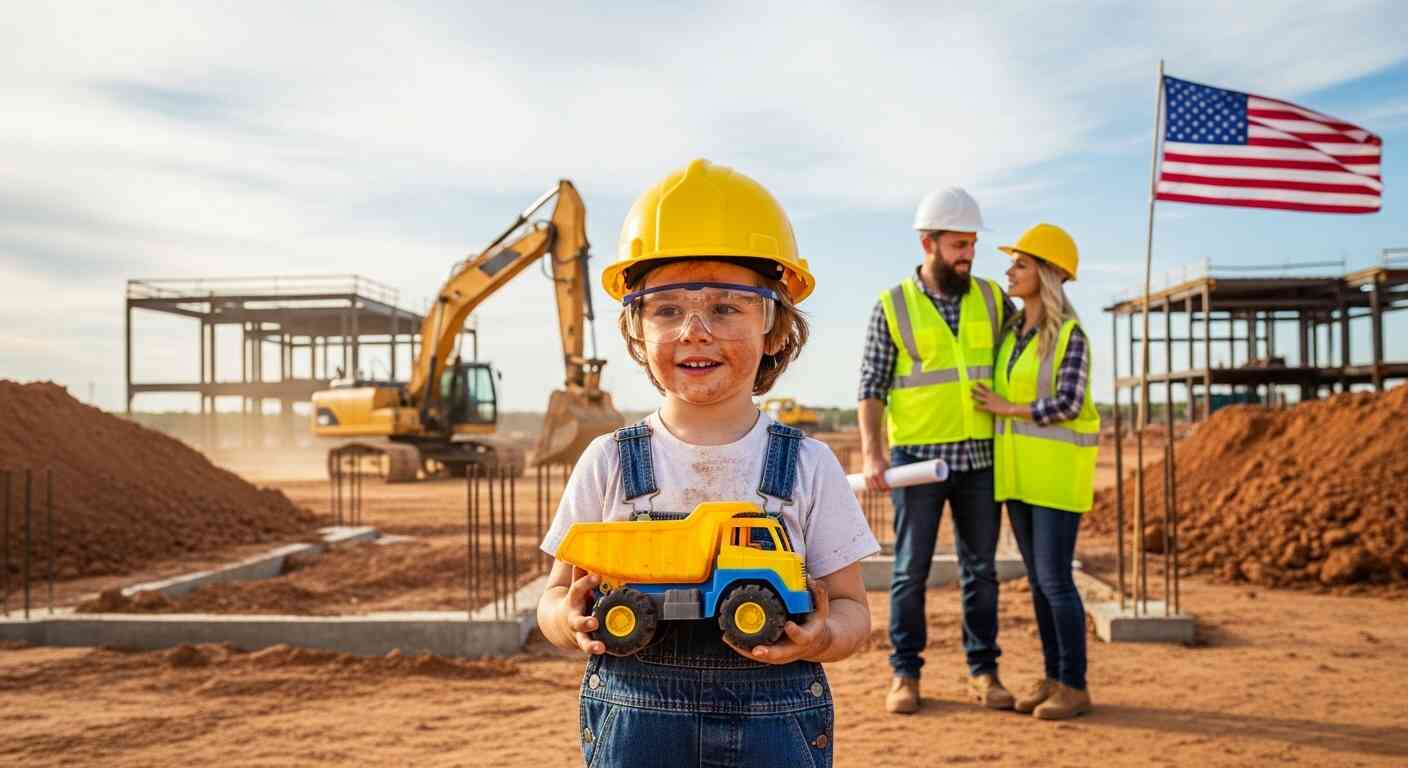
The Nevada heat was a physical weight, a shimmering curtain of gold and grit that draped over the skeletal remains of the Blackwood Foundry. Clara adjusted the weight of the boy in her arms, her boots crunching over decades of industrial waste. Her breath came in shallow, jagged hitches. She hadn’t been a mother in two years—not since the accident in Seattle that had taken her husband and her son, Leo—but the instinctual way she cradled the boy’s head felt like a phantom limb returning to life.
The boy—Sammy—wasn’t crying anymore. He was shivering, despite the hundred-degree heat. His skin felt like fine parchment, dry and unnaturally cool.
“Almost there, honey,” Clara murmured, though “there” was just a cluster of portable trailers and a half-finished steel structure that loomed over the desert like a ribcage.
She burst into the supervisor’s shaded perimeter, her appearance a jarring contrast to the sterile, high-tech construction environment. The supervisor, Miller, was a man built of hard angles and bitter memories. He was sixty, but he moved with the stiffness of a man who was eighty. When he saw Clara, he reached for his radio, his mouth open to bark a trespasser warning.
Then he saw the boy.
The radio slipped from Miller’s hand, thudding into the red dust. He didn’t speak. He didn’t breathe. His eyes were locked on the boy’s face—a face that was a mirror image of the faded Polaroid Miller kept in his wallet, tucked behind his driver’s license.
“Check his tag,” Clara gasped, leaning against the chain-link fence. “He needs… he needs help.”
Miller stepped forward, his boots dragging. He reached out, his thick, calloused fingers brushing against the boy’s neck to lift the brass ID tag. The metal was tarnished, green with age, but the stamped letters were unmistakable: SAMUEL VANE. ID #1976-B.
“This isn’t possible,” Miller whispered. The world around them—the hum of generators, the distant clank of cranes—seemed to fade into a vacuum of silence. “Sammy died. The furnace… the backdraft… the whole floor collapsed.”
“He was just there, Miller,” Clara said, her voice rising in panic. “Behind the old furnace. He was calling for his brother.”
Miller flinched as if he’d been struck. “He called for me?”
The boy looked up then. His eyes were a deep, haunting amber, the color of trapped sap. He reached out a small, soot-stained hand and touched Miller’s cheek.
“You didn’t come back, Arthur,” the boy whispered.
Miller collapsed to his knees, his sob a ragged, dry sound that tore through the stagnant air. Behind them, the sky began to bruise purple, the desert’s way of warning that the day was over and the shadows were taking charge. Clara felt a cold shiver go down her spine. She wasn’t just holding a lost boy. She was holding a piece of a tragedy that had refused to stay buried.
Chapter 2: The Ghost of Industry
The supervisor’s office was a cramped, air-conditioned box that smelled of stale coffee and blueprints. Miller sat in his swivel chair, his head in his hands, while Clara tended to Sammy’s leg. To her shock, when she unwrapped the bandage, the wound wasn’t bleeding. It was a deep, clean laceration, but the flesh inside looked like charred wood—black, dry, and motionless.
“He’s not… he’s not hurt like a normal person, Clara,” Miller said, his voice hollow. He looked at the boy, who was sitting on a stack of safety manuals, swinging his legs as if he were waiting for a school bus.
“He’s a child, Miller,” Clara snapped, though her own hands were shaking. “Look at him. He’s scared.”
“He’s a memory,” Miller countered. He stood up and walked to a filing cabinet, pulling out a heavy, dust-covered binder. It was the original fire report from 1976. He flipped to the back, where the casualty list was printed in faded ink.
Samuel Vane. Age 8. Declared deceased June 14, 1976. Remains unrecovered.
“I was fourteen,” Miller said, his eyes unfocused. “My dad was the foreman. He brought us to work because the babysitter cancelled. We were playing hide-and-seek in the basement near the cooling vents. I heard the boom. I saw the fire wall coming. I ran for the ladder. Sammy… Sammy was right behind me. I heard his hand hit the metal rung. And then… I heard him scream my name. I didn’t look back. I just kept climbing.”
The guilt in the room was palpable, a thick, suffocating thing.
Supporting characters began to filter in as word of the “incident” spread. Deputy Sarah Vance—Miller’s niece, a woman who carried the family name with a skeptical, modern pride—pushed through the door. Following her was Old Man Silas, a former worker who had lost an eye in that same fire.
“Arthur, what’s this I hear about a kid?” Sarah started, then stopped dead. She looked at Sammy, then at the old brass tag on the desk. “Is this a joke? Is this some kind of sick protest against the demolition?”
“It’s not a joke, Sarah,” Miller said.
“It’s him,” Old Man Silas whispered, his one good eye watering. “I recognize the shirt. His mother, Martha, she hand-stitched that collar. She died three years later of a broken heart.”
Sammy looked at Silas and smiled. It was a sweet, devastating smile. “Hi, Mr. Silas. Did you ever find your cat?”
Silas began to tremble. The cat had been dead for forty-five years.
“Clara,” Sarah said, her voice professional but tight. “Who are you? Where did you find this boy? I need to see some ID.”
“I’m a traveler,” Clara said, standing protectively in front of Sammy. “My car broke down five miles back. I was walking for help when I heard him. I don’t care about your fire or your history. This boy is here now, and he’s cold. He’s so cold.”
As she spoke, the lights in the trailer flickered. The temperature dropped twenty degrees in a second. Outside, the modern construction equipment—the digital monitors and the GPS-guided drills—began to whine, their screens filling with a date that shouldn’t have been there.
JUNE 14, 1976.
PART 3
Chapter 3: The Weight of Memory
The town of Blackwood didn’t have much—a diner, a gas station, and the lingering shadow of the foundry. By nightfall, the air in the trailer felt like an electrostatic charge was building. Deputy Sarah had tried to call the state authorities, but the phones were dead, emitting nothing but a low, rhythmic sound that Silas claimed was the sound of the old steam hammers.
“He’s a bridge,” Silas whispered, sitting in the corner of the office. “The boy. He’s not a ghost in the way you see in movies. He’s the town’s unfinished business. We’re tearing down the foundry to build a luxury resort, and the earth is pushing back.”
Clara sat on the floor next to Sammy. She had given him her sweater, and he had curled into it, his head resting on her lap. To anyone else, he looked like a tired child. To Clara, he felt like the weight of every grief she’d ever carried.
“Why are you here, Sammy?” Clara asked softly, stroking his hair. It felt like dry corn silk.
“The fire is still burning,” Sammy said. His voice was small, but it echoed in the tiny room. “It’s been burning for a long time. It’s hungry.”
“Arthur,” Sarah said, pulling her uncle aside. “We need to get this kid out of here. If the press hears about this, or the investors… it’ll be a circus. Let’s take him to the clinic in the city.”
“The city is two hours away, Sarah,” Miller said. He hadn’t stopped looking at Sammy. “And look at the horizon. The dust isn’t settling.”
He was right. A massive, unnatural dust storm had encircled the construction site, a wall of red grit that blocked out the stars. It wasn’t moving. It was waiting.
Clara felt a sudden, sharp pain in her chest—the memory of her own son, Leo. She remembered the hospital waiting room, the smell of antiseptic, the doctor’s face as he delivered the news. She had spent two years trying to outrun that pain, driving across the country with no destination. And now, she was trapped in a room with a boy who represented the ultimate ‘what if.’
“I lost my son,” Clara said, her voice cracking. “Two years ago. I thought… I thought if I just kept moving, I could leave the sadness behind. But it’s like the dust, isn’t it? It follows you.”
Miller looked at her, his hard expression softening. “I’ve been in this town my whole life, Clara. I’ve lived in the shadow of that chimney for fifty years. I thought if I tore it down, I’d finally be free. I thought I could build something new over the ashes.”
“You can’t build a future on a lie, Arthur,” Silas said. “You told the police Sammy was outside when the fire started. You told them you tried to grab him. You lied to your parents. You lied to the whole town.”
The silence that followed was deafening. Miller didn’t deny it. He couldn’t. The truth had walked through the dust and into his office.
Chapter 4: The Brother’s Burden
The revelation of Miller’s lie changed the air in the room. It became heavy, oppressive. Deputy Sarah looked at her uncle with a mix of betrayal and pity.
“You let them think it was an accident,” Sarah whispered. “You let Grandma go to her grave thinking Sammy just wandered off.”
“I was a kid!” Miller roared, his face turning a dark, bruised red. “I was terrified! I knew if I told them I heard him hit the ladder and didn’t stop… if I told them I looked him in the eye and then climbed into the light while he was swallowed by the dark… they’d hate me. I hated me!”
He turned to Sammy, tears streaming down his weathered face. “I’m sorry, Sammy. I’m so sorry. I’ve been running for fifty years.”
Sammy stood up. He walked over to Miller and gripped his large, shaking hand with his small, charred one. “The door is still locked, Arthur. The men in the basement… they’re still waiting.”
“What men?” Clara asked, a sense of dread pooling in her stomach.
“The night shift,” Silas said, his one eye wide with realization. “The fire didn’t start in the furnace. It started in the chemical storage. The safety doors were locked from the outside to prevent theft. We always said it was a malfunction. But if Sammy saw… if Sammy was there…”
“They didn’t die from the fire,” Sammy said. “They died from the smoke. They were banging on the door. I could hear them. I tried to turn the handle, but it was too hot.”
Miller’s face went white. “The safety doors. My father… he was the one who had the only key. He told me to never tell anyone he’d gone to the bar that night. He told me to say the doors were open.”
The central conflict of Blackwood wasn’t just a fire; it was a legacy of systemic negligence and familial silence. The foundry wasn’t just a place of work; it was a tomb built on a foundation of secrets.
Outside, the generators finally failed. The air conditioner sputtered and died. In the sudden quiet, they could hear it—a faint, rhythmic thudding from deep beneath the earth.
Thump. Thump. Thump.
It was the sound of hands hitting a steel door.
“They’re coming for the key,” Sammy said.
“I don’t have it,” Miller sobbed. “It’s gone. My father took it to his grave.”
“No,” Sammy said, looking at Miller’s neck. “You’ve been wearing it for fifty years.”
Miller reached into his shirt and pulled out a small, silver locket he always wore—a memento of his father. He pried it open with a pocketknife. Inside, hidden behind a photo of his mother, was a small, flat brass key.
“The ghost doesn’t want revenge, Arthur,” Clara said, realization dawning on her. “He wants you to finish the job. He wants you to open the door.”
PART 4
Chapter 5: The Flame Re-Kindled
The walk from the trailer to the ruins of the old foundry basement felt like a descent into another world. The dust storm had created a tunnel of static and wind, guiding them toward the jagged hole in the earth where the new foundation was being poured.
Miller led the way, the brass key clutched in his hand like a holy relic. Clara followed, holding Sammy’s hand, while Sarah and Silas brought up the rear with flashlights. The beams of light cut through the gloom, reflecting off twisted rebar and scorched brick.
“It’s here,” Sammy said, pointing to a section of wall that had been partially uncovered by the construction crews. “Behind the red brick.”
Miller began to dig with his bare hands, clawing at the loose dirt and debris. Sarah joined him, using a shovel from a nearby rack. They worked in a feverish silence, the only sound the clack-clack of the tools and the rising sound of the thudding behind the wall.
Finally, they hit metal. A heavy, industrial door, pitted with rust and warped by extreme heat. The lock was a massive, archaic thing.
“Arthur, don’t,” Sarah whispered. “We don’t know what’s behind there.”
“I know what’s behind there,” Miller said, his voice steady for the first time. “My brother. And my peace.”
He stepped up to the door. The heat radiating from the metal was impossible—it felt like a furnace was still raging on the other side. Miller’s skin began to blister, but he didn’t flinch. He inserted the brass key.
It turned with a scream of complaining metal.
The door didn’t swing open; it dissolved. In a blinding flash of white and orange light, the basement was filled with a roar of wind. Clara shielded Sammy with her body. She saw figures—dozens of them—made of smoke and light, rushing past them. They weren’t monsters. They were men in work clothes, their faces weary but relieved. They weren’t attacking; they were ascending.
And in the center of the light stood Sammy.
He wasn’t charred anymore. His denim was clean, his flannel bright. He looked at Miller and smiled. “Thanks, Artie. I can go play now.”
“Sammy, wait!” Miller cried, reaching out.
But the light was receding. Sammy turned to Clara. He walked over and touched her heart. “Leo says he likes the blue car you bought for the shelf. He says you can stop driving now. He’s not in the car anymore. He’s in the wind.”
Clara’s breath hitched. She hadn’t told anyone about the blue model car she’d bought for Leo’s memorial shelf. She hadn’t told anyone she was driving to outrun his ghost.
A sob erupted from her—a real, healing sob that felt like the first breath after being underwater for years.
“Tell him… tell him I love him,” Clara whispered.
“He knows,” Sammy said.
The light flared one last time, a brilliant, warm star in the heart of the desert, and then it was gone. The dust storm collapsed. The wind died. The silence that followed was peaceful, smelling of ozone and fresh rain.
Chapter 6: Ashes to Peace
The sun rose over Blackwood the next morning, but it didn’t feel like the same sun. It was soft, casting long, gentle shadows over the Nevada desert.
The construction site was silent. Miller had called off the demolition. He sat on the bumper of Clara’s car—which had miraculously started on the first try—watching the forensic teams from the city examine the basement. They had found the remains. Twenty-four men, finally recovered after fifty years of being “missing.”
“What are you going to do?” Clara asked, leaning against the door of her sedan.
“I’m going to build a park,” Miller said. “Not a resort. A park with a lot of trees. And a monument. For Sammy. And for the men.”
He looked at Clara. He looked younger, the deep lines of guilt around his eyes finally beginning to fade. “You headed back to Seattle?”
“No,” Clara said, looking at the road ahead. “I think I’m going to head East. I hear the mountains are beautiful this time of year. But I’m done running. I think I’ll stay in one place for a while.”
Sarah Vance walked over, handing Miller a cup of coffee. She looked at Clara and nodded—a silent sign of respect between two women who had looked into the eyes of the impossible.
“Take care of yourself, Clara,” Sarah said. “And if you ever need a place to stop… Blackwood isn’t so bad once the dust settles.”
Clara got into her car. She looked at the passenger seat. For two years, it had felt heavy with the weight of her grief, a constant reminder of the empty space. But today, the seat was just a seat. The air in the car felt light.
As she drove away, she looked in the rearview mirror. She saw Miller standing at the gates of the foundry, waving. Beside him, for just a fleeting second, she thought she saw the shimmering outline of a small boy in a flannel shirt, waving back.
She reached out and touched the dashboard, where a small, blue toy car sat. She smiled, a tear rolling down her cheek—not a tear of pain, but a tear of release.
She drove toward the horizon, the road stretching out like a promise. The foundry was behind her, its secrets finally at rest, its fires finally cold. She knew now that the past doesn’t have to be a prison; it can be a map, showing us exactly where we need to go to find ourselves again.
Grief is not a ghost that haunts you; it’s a love that’s waiting for you to find a place to put it down.