
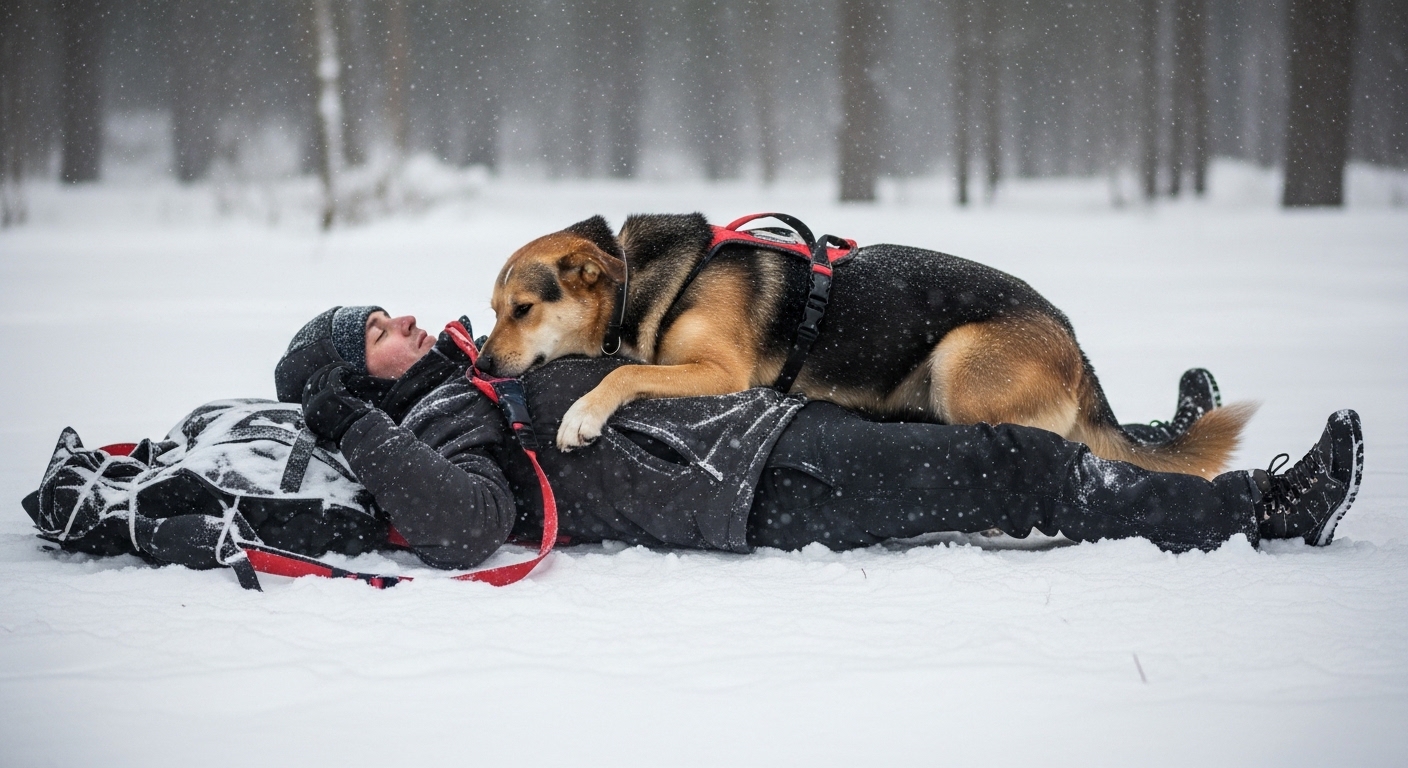
To my neighbor, Barnaby was just an “asset”—a senior dog whose years of loyalty were being traded for a few blood-stained bills from a research lab. But to me, Barnaby was the heart of our street, and I wasn’t going to let his final chapter be written in a cold, steel cage.
The night was thick with a silence that felt like a crime. I watched from my window as a black van pulled into Miller’s driveway, the driver exchanging a hushed conversation and a thick envelope with the man I’d lived next to for a decade.
I knew Miller was in debt, but I never thought he’d be this monstrous.
As soon as the van left, I grabbed my bolt cutters. My heart was a drum in my ears, every snap of a twig sounding like a gunshot. Miller was inside, probably counting his “blood money,” while Barnaby was locked in that windowless, suffocating shed at the edge of the property.
The padlock was heavy, cold, and stubborn. My hands were shaking so hard I nearly dropped the cutters, but then I heard it—a low, broken whine from behind the wood. It wasn’t a bark for help; it was the sound of a spirit that had already given up.
Snap.
The lock hit the dirt. I threw the door open, and the smell of rot and fear hit me. In the corner, huddled on a pile of oily rags, was the dog who had greeted me every morning for ten years. When he saw me, he didn’t run. He just rested his gray chin on my boot and let out a long, shaky breath.
I didn’t care about the sirens I heard in the distance. I didn’t care about the “No Trespassing” signs. I picked up all sixty pounds of him and started running. Because some things are worth more than the law—and a loyal soul is one of them.
Chapter 1: The Price of Loyalty
In the quiet suburb of Willow Creek, Mr. Miller was known as the man with the pristine lawn and the invisible dog. Barnaby, a senior Golden Retriever with a muzzle as white as a cloud, spent most of his life behind a chain-link fence, watching the world go by with soulful, tired eyes.
I lived next door for twelve years. I saw Barnaby age. I saw him go from a bouncing puppy to a slow, arthritic old man. And I saw the way Miller started looking at him—not with affection, but with annoyance. Barnaby was a “cost,” a “burden,” a “leftover” from a marriage that had ended in bitterness.
The change happened on a Friday. I saw a man in a clinical gray suit standing in Miller’s driveway. They were looking at Barnaby, who was sleeping in the shade. The man handed Miller a brochure with a logo I recognized—a private medical testing facility known for “humane” research.
“He’s old,” I heard Miller say, his voice devoid of any warmth. “He doesn’t have much left anyway. If the price is right, you can take him Monday.”
My blood turned to ice. Monday was forty-eight hours away. Barnaby wasn’t going to a retirement home; he was being sold as a disposable piece of equipment.
Chapter 2: The Midnight Heist
The weekend was a blur of agonizing indecision. I called the police, but they told me a dog was property. I called Animal Control, but they said as long as he was fed and sheltered, they couldn’t intervene.
“Property,” I whispered to the dark. “He’s not property. He’s Barnaby.”
At 1:00 AM on Sunday, the lights in Miller’s house finally went out. I moved through the shadows of our shared fence, the heavy bolt cutters tucked under my arm. The shed at the back of Miller’s lot was a dilapidated structure that smelled of gasoline and neglect.
The chain around the door handles was thick, a physical manifestation of Miller’s greed. My hands were trembling—not from the cold, but from the terrifying realization that I was committing a felony.
Snap.
The sound of the lock breaking felt like a thunderclap. I froze, waiting for a porch light to flick on, for Miller to come screaming out with a shotgun. But the house stayed dark.
I pulled the door open. The interior was pitch black. I flicked on my small penlight and saw him. Barnaby was tucked into a corner, his eyes wide and clouded with cataracts. He looked at me, and for a second, I thought he was going to bark. Instead, he just wagged his tail once—a slow, thumping sound against the plywood floor.
Chapter 3: The Supporting Cast
“Come on, boy,” I whispered, reaching for his collar.
But Barnaby couldn’t walk. His back legs were stiff, his muscles wasted from being locked in the cramped space. I realized then that Miller hadn’t just been selling him; he’d been breaking him.
I heard a floorboard creak in the house. A light flickered in the kitchen.
“Who’s out there?” Miller’s voice echoed across the yard.
I didn’t have time to be quiet. I scooped Barnaby up in my arms. He was lighter than he looked, mostly skin and bone. I sprinted toward the fence, but I wasn’t headed for my house. I was headed for the street, where a car was waiting with its lights off.
The driver was Marcus, a local vet tech I’d met at the park. He’d heard my frantic calls and had shown up with a crate and a heart full of fury.
“Get him in! Go!” Marcus hissed.
We sped away just as Miller reached the shed, his roar of rage muffled by the closing car door.
Chapter 4: The Legal Storm
We took Barnaby to a sanctuary three counties away—a place that specialized in “hospice” care for senior dogs. But the battle was just beginning.
The next morning, the police were at my door. Miller had reported the “theft” of his property. He wanted his “asset” back, and he wanted me in jail.
“I didn’t steal a dog,” I told the officer, my voice steady despite the fear. “I rescued a life from a black-market sale to a laboratory. And I have the footage to prove it.”
I had set up a trail cam on my fence the day I saw the man in the gray suit. It had captured the entire transaction—the exchange of money, the brochure, and Miller’s own words.
My lawyer, a fierce advocate for animal rights named Elena, stepped in. “Mr. Miller,” she said during the deposition, “you can sue for the cost of the padlock. But if you pursue the ‘theft’ of the dog, we will pursue a federal investigation into your unlicensed sale of animals to research facilities. Which would you prefer?”
Chapter 5: The Price of Peace
Miller blinked. He was a coward at heart, the kind of man who only picked on those who couldn’t fight back. He dropped the charges. He moved out of Willow Creek a month later, unable to handle the glares from the neighbors who had finally seen the monster behind the manicured lawn.
Barnaby spent the rest of his days at the sanctuary. He had a soft bed, unlimited treats, and a view of a pond where he could watch the ducks.
I visited him every weekend. He didn’t have much energy, but every time he saw me, he’d find the strength to lift his head and give me that one, slow, thumping wag of the tail. He knew he was safe. He knew the dark shed was gone forever.
Chapter 6: The Golden Sunset
Barnaby passed away on a sunny Tuesday afternoon, sleeping in a patch of clover. He didn’t die in a cold lab. He didn’t die under a scalpel. He died as he should have—surrounded by people who knew his name.
I sat on my porch that evening, looking at the empty shed next door. The sun was setting, painting the sky in shades of gold and amber, the exact color Barnaby used to be in his prime.
I realized then that some debts can’t be paid in cash. Miller had his money, but he had a hollow soul. I had a criminal record for trespassing, but I had the memory of those golden eyes finding mine in the dark.
I looked at the rusted padlock I’d kept in my pocket—the one I’d cut that night. It wasn’t a symbol of a crime. It was a trophy.
The final sentence of the letter I wrote to the sanctuary was the only truth that mattered: He spent ten years as a ghost in a backyard, but he spent his last year as a king in the sun.


