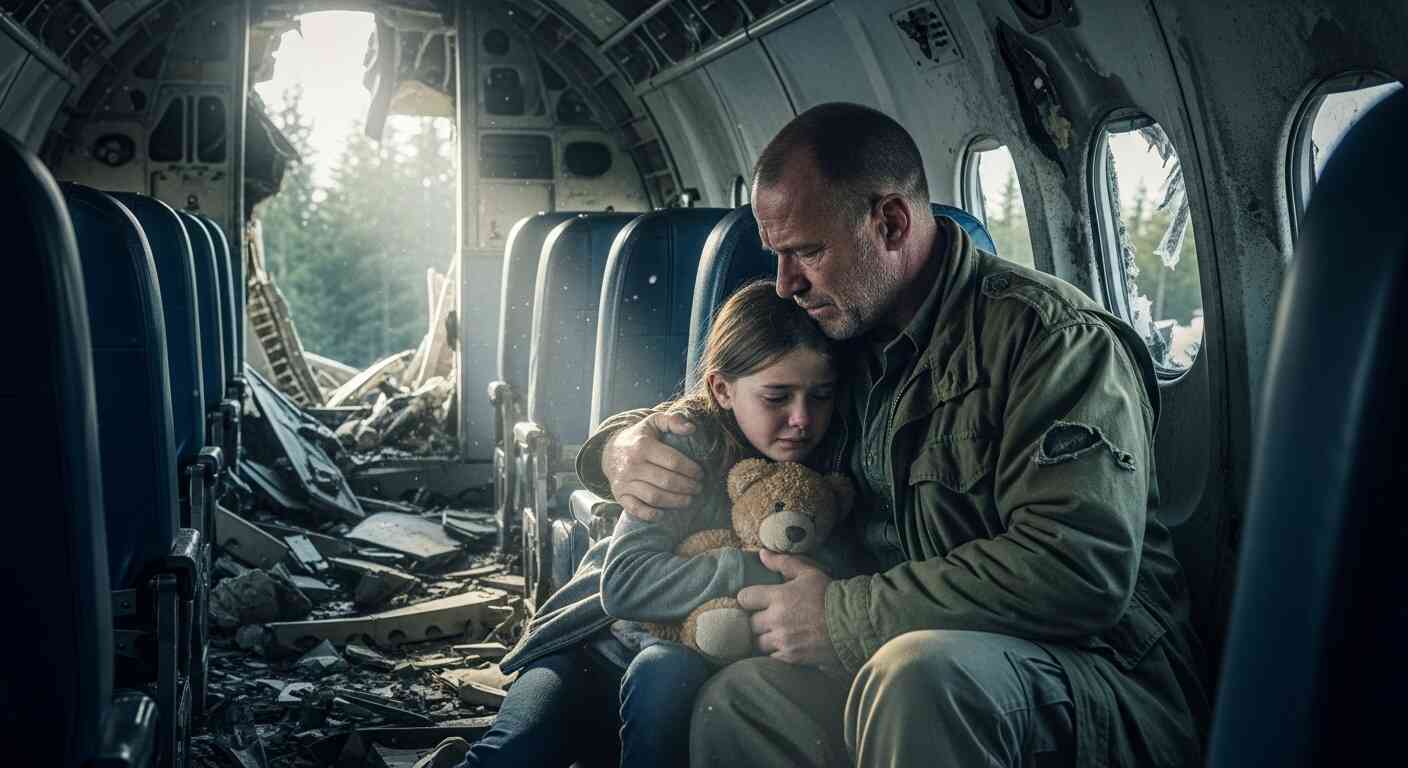
The air in First Class always tastes like expensive filtered oxygen and unearned confidence. I sat there, my hand resting on the shoulder of the skinny, trembling boy in the seat next to me. To the flight attendants, I was just a tired dad bringing a sick son home for a miracle surgery. They brought him extra blankets. They spoke in hushed, pitying tones.
They had no idea that the “kid” clenching my hand was the most dangerous locksmith in the Western Hemisphere. Or that in twenty minutes, we were going to disappear into the cargo hold to do the impossible.
“Just breathe, Leo,” I whispered, loud enough for the cabin crew to hear.
Leo didn’t look at me. He stared at the seatback in front of him, his knuckles white. To anyone else, it looked like a child’s fear of flying. To me, it was the sound of a man calculating the tumblers on a three-hundred-million-dollar vault hidden beneath the galley.
This wasn’t just a heist. It was the only way I could pay back the debt I owed to a man who died in a desert ten years ago. A man who left behind a widow and a daughter who didn’t know their mortgage was being paid by a ghost.
As the plane began its descent toward a private strip in the Nevada desert, the “veteran” in me took over. I looked at the boy—this grown man trapped in a body that hadn’t aged past ten—and realized that the baggage claim was where the lie would finally end.
For both of us.
PART 2
CHAPTER 1: THE WEIGHT OF THE BLANKET
The humming of the Boeing 787 was a low, vibrating drone that settled into my marrow. First Class was a sea of beige leather and the soft clinking of crystal. Across the aisle, a tech mogul was snoring under a cashmere throw. He didn’t have a care in the world. He didn’t know that three feet away, a spec-ops veteran with a shattered moral compass was orchestrating a crime that would make the evening news for the next decade.
I adjusted the blanket over Leo’s legs. He was small—painfully so. To the world, he was an eight-year-old boy suffering from a rare, wasting disease. He wore a Star Wars hoodie that was slightly too big, and his face was tucked into a surgical mask. It was the perfect camouflage. No one looks at a sick child’s eyes. If they did, they’d see the forty years of cynicism and the sharp, predatory intelligence of a master craftsman.
“You okay, kid?” I asked, my voice a practiced fatherly murmur.
Leo’s eyes flickered toward me. They were dark, rimmed with the exhaustion of a man who had spent his life being looked down upon, quite literally. “Don’t call me kid, Silas,” he whispered, the mask muffling his gravelly baritone. “The air is too thin up here. My hands are starting to cramp.”
“Five minutes,” I said, checking my watch. “The Marshall is going to take his bathroom break after the meal service. That’s our window.”
The Marshall was a man named Miller. He was two hundred pounds of muscle and ego, tasked with guarding the “Diplomatic Pouch” stored in the reinforced vault in the sub-floor of First Class. It wasn’t a pouch. It was a cold-storage unit containing three hundred pounds of untraceable gold bullion and a hard drive that could restart a civil war.
I felt the familiar surge of adrenaline—the “combat high” I hadn’t felt since my days in the sandbox. My heart rate stayed at a steady sixty. I’d killed for less than this. But today, I wasn’t killing. I was stealing.
“Why do you care so much about this widow, Silas?” Leo’s voice was a ghost of a sound. “You’re risking a federal prison cell for a woman who doesn’t even know your name.”
“I owe her husband,” I said, my jaw tightening. “He took a round that was meant for me. I’m just balancing the books.”
“Books are never balanced,” Leo replied, closing his eyes. “Someone always ends up in the red.”
The chime rang. The “Fasten Seatbelt” sign flickered off. Miller, the Marshall, stood up and stretched, his eyes scanning the cabin one last time before heading toward the lavatory.
It was time.
I stood up, lifting Leo into my arms. He weighed almost nothing. To the stewardess passing by, I was just a devoted father taking his sick boy to the restroom. She smiled, a sad, sympathetic curve of her lips.
“He’s such a brave little guy,” she whispered.
“The bravest,” I said, and for the first time in the whole flight, I wasn’t lying.
CHAPTER 2: THE HOLLOW FLOOR
The “handicapped” restroom in the forward cabin was larger than the others, designed for accessibility. Once the door locked with a heavy thunk, the father-son act dropped like a lead weight.
I set Leo down on the closed toilet lid. He immediately ripped off the surgical mask and began stretching his fingers, the joints popping like dry twigs. “If we hit turbulence while I’m in the tumblers, Silas, we’re both dead. This isn’t a pad-and-pencil job. This is a vibration-sensitive magnetic lock.”
“I’ll hold the floor steady,” I said, already kneeling to peel back the heavy floor mat.
Underneath was a maintenance hatch, disguised with the same high-grade carpet as the rest of the cabin. It required a specific sequence of pressure points to release. I’d spent six months studying the schematics of this specific airframe. I pressed my thumbs into the hidden indentations.
Click.
The hatch popped an inch. Below us, the roar of the engines was deafening, the cold air of the unpressurized maintenance crawlspace swirling up like a ghost.
“Go,” I said.
Leo didn’t hesitate. He was a creature of the dark. He slid into the hole with the grace of a cat, his small frame allowing him to navigate the maze of wires and hydraulic lines that would have trapped me in seconds. I followed him halfway, my torso blocking the hatch, my eyes on the restroom door.
We had twelve minutes before Miller finished his business and did his rounds.
Down in the dark, Leo pulled a set of tools from the lining of his “child-sized” backpack. They were custom-made—titanium picks no larger than sewing needles, a digital stethoscope, and a small vial of liquid nitrogen.
The vault sat there like a sleeping beast. A three-foot cube of reinforced tungsten, bolted directly to the airframe’s spine.
“Talk to me, Leo,” I whispered into the dark.
“It’s a 2024 Kessler-Vance,” Leo’s voice came back, strained. “Triple-redundant. If I trip the mercury switch, the pilot gets a silent alarm and the air marshals will be at the door in thirty seconds.”
“Don’t trip it,” I said.
“Funny,” he grunted. I heard the hiss of the nitrogen. “Silas… if this goes south, you leave me. You hear? You’re a war hero. You can talk your way out of a lot. I’m just a freak in a hoodie. They’ll bury me under the prison.”
“Nobody’s getting buried today,” I said, though my hand moved instinctively to the concealed ceramic blade in my waistband.
The plane tilted slightly—a course correction. I felt the vibration through the floorboards. In the cabin, I could hear the muffled sound of a cart rolling.
“Hurry,” I urged.
“Don’t rush the art, Silas,” Leo snapped. “I’m at the final gate. The magnetic seal is breaking… now.”
A sound like a deep, metallic sigh echoed from the hold. The vault door swung open.
“I’m in,” Leo whispered, his voice sounding younger, filled with a sudden, sharp awe. “My God, Silas… it’s not just gold. There’s a ledger here. Names. Dates. Your friend didn’t die for a country. He died for a payroll.”
My blood went cold. “Grab the drive and the bars. We move. Now!”
As Leo began handing up the heavy, velvet-wrapped bricks of gold, a shadow crossed the bottom of the restroom door. A heavy, rhythmic knocking followed.
“Everything alright in there?” It was Miller. The Marshall. “You’ve been in there a long time, sir.”
I looked at the hatch, then at the door. Leo was still halfway in the hold, clutching the hard drive that contained the truth about why my best friend was buried in an empty coffin.
“Just a moment!” I called out, my voice cracking with fake distress. “My son… he’s having a seizure!”
The silence on the other side of the door was terrifying.
FULL STORY
PART 3
CHAPTER 3: THE RAZOR’S EDGE
The silence lasted only three seconds, but in my world, three seconds is an eternity. It’s enough time to chamber a round, to check your six, or to realize you’re about to die.
“Open the door, sir,” Miller’s voice had lost its casual edge. It was now the voice of a man who had spent his life detecting bullshit. “I need to assist.”
“I’ve got him!” I yelled, putting a hand on the hatch cover. Leo was frantically shoving the last of the gold into his backpack. “He’s stabilizing! Just give us a second!”
“I’m opening the door from the outside,” Miller said. I heard the jingle of the master key.
“Leo, get up here!” I hissed.
Leo scrambled out of the hole just as I slammed the carpeted hatch back into place. He looked like a ghost—covered in dust, his eyes wide. I shoved him toward the sink, splashing water on his face.
“Cry,” I commanded. “Now!”
Leo didn’t need to be told twice. He was a master of his craft. He let out a high-pitched, ragged sob that sounded so gut-wrenching it made my own heart skip a beat. I grabbed him, pulling him against my chest, masking his dusty clothes with my own jacket.
The door swung open. Miller stood there, his hand on his hip, eyes narrow. He looked at the disheveled bathroom, the wet floor, and the “child” sobbing into my shoulder.
“What’s going on?” Miller asked, stepping into the small space. He was too close. He smelled of cheap coffee and gun oil.
“He’s sick, damn it!” I snapped, letting the “angry father” persona take the lead. “He has Focal Seizures. Look at him! You think I’m enjoying this?”
Miller’s eyes drifted to the floor. For a second, I thought he saw the seam of the hatch. My muscles coiled, ready to drive my palm into his chin and snap his head back against the bulkhead. I’d have to kill him. I didn’t want to, but Leo was holding enough evidence to hang us both.
Then, the plane hit a pocket of clear-air turbulence. We all stumbled. Miller reached out to steady himself against the wall, his hand landing inches from the hatch.
“Sorry,” Miller grunted, his suspicion wavering in the face of the boy’s genuine-sounding terror. Leo was shaking so hard his teeth were chattering. “I… I have a nephew. I didn’t mean to crowd you. Get him back to his seat. I’ll bring some orange juice.”
“Just leave us alone,” I said, pushing past him.
We walked back to our seats in 1A and 1B. I buckled Leo in. His backpack, heavy with the weight of gold and secrets, was shoved under the seat in front of him.
As we leveled out, Leo leaned his head against the window. The sun was setting, bleeding across the horizon in a bruised purple.
“Silas,” he whispered, his voice no longer shaking. “The ledger. I saw the name ‘Vanguard.’ That was your unit, wasn’t it?”
I felt a chill that had nothing to do with the cabin air. “Yeah. That was us.”
“The ledger says Vanguard wasn’t ambushed,” Leo said, his eyes reflecting the dying light. “They were sold. For twelve million dollars. The money is in that vault. Or it was.”
I looked out at the clouds. My best friend, Miller’s “nephew,” the widow—all of them were pawns in a game played by men in air-conditioned offices. I had spent ten years mourning a tragedy that was actually a transaction.
“We’re not just taking the money, Leo,” I said, my voice like iron. “We’re taking the truth.”
CHAPTER 4: THE DESCENT
The captain’s voice crackled over the intercom. “Ladies and gentlemen, we are beginning our final descent into North Las Vegas. Please ensure your seatbelts are fastened.”
The “private” strip wasn’t a commercial airport. It was a black site—a stretch of tarmac owned by a shell company. There would be no customs. No TSA. Just a team of “security contractors” waiting to receive the vault’s contents.
“We have to move fast once we hit the ground,” I whispered to Leo. “The ground crew will check the vault within five minutes of landing. Once they see it’s empty, the hangar goes into lockdown.”
Leo reached into his pocket and pulled out a small, rusted key. It looked like something from an old farmhouse, out of place in the high-tech world of private jets and bullion.
“What’s that?” I asked.
“My exit strategy,” Leo said. He looked at me, and for a moment, the mask of the child slipped entirely. I saw the man he was—lonely, brilliant, and tired of being a ghost. “You have the widow. You have your revenge. What do I have, Silas?”
“You have half the gold,” I said.
“Gold is heavy,” he replied. “It’s hard to run when you’re three-foot-six and the world sees you as a target. This key… it goes to a locker in the bus station. Inside is a new life. A real one.”
I looked at the key, then at him. “You’re not coming with me to the extraction?”
“Your extraction is a firefight waiting to happen, Silas. I’m a locksmith, not a soldier.”
The wheels hit the tarmac with a violent jar. The engines roared in reverse thrust. Outside the window, I saw the black SUVs lining the runway. Men in tactical gear stood by the hangar doors.
The Marshall, Miller, was already standing at the exit, looking impatient. He glanced back at us. Something in his expression had changed. He wasn’t looking at a sick kid anymore. He was looking at the backpack under Leo’s seat.
He’d put it together. The turbulence, the dust on Leo’s clothes, the length of time in the bathroom. He was a pro, just like me.
“Leo,” I said softly, unbuckling my seatbelt. “When the door opens, you run for the luggage cart. Don’t look back.”
“And you?”
I looked at Miller, who was reaching for his concealed holster. “I’m going to settle a ten-year-old debt.”
FULL STORY
PART 4
CHAPTER 5: THE BAGGAGE CLAIM
The cabin door hissed open, and the desert heat rushed in like a physical blow. Miller didn’t wait. He moved toward us, his hand reaching out to grab Leo’s collar.
“Sit down, sir!” Miller barked, his voice echoing in the nearly empty cabin. “I need to see that bag.”
I didn’t give him the chance. I lunged, my shoulder catching him in the solar plexus, driving him back against the galley wall. Leo bolted. He was a blur of a Star Wars hoodie, disappearing down the stairs and into the chaos of the ground crew.
“He’s just a kid!” the flight attendant screamed, but Miller was already swinging.
He was strong, but he was a brawler. I was a scalpel. I parried his punch, drove a knee into his thigh, and slammed him into the bulkhead. I didn’t want to kill him—he was just a man doing a job for the wrong people. I hit the pressure point at the base of his neck, and he slumped, his eyes rolling back.
I grabbed the backpack and ran.
The tarmac was a maze of jet fuel smells and screaming turbines. I saw Leo—or rather, I saw the Star Wars hoodie—weaving between the wheels of a luggage tug. The security contractors were yelling, radios crackling.
“Stop that man!” a voice boomed from the hangar.
I ignored them, my lungs burning as I sprinted toward the perimeter fence. I saw Leo reach the edge of the hangar, where a small service door stood. He stopped, looking back at me.
“Silas! This way!”
I reached him just as the first shots rang out. The bullets pinged off the metal hangar skin, showering us with sparks. We dove through the door into the cool, dark interior of the baggage sorting area.
It was empty. A ghost town of conveyor belts and silver trunks.
“The key, Leo!” I gasped. “Where’s the locker?”
“It’s not a locker, Silas,” Leo said, his voice calm. Too calm.
He stood by a massive, industrial-sized crate labeled REJECTED CARGO. He inserted the rusted key into a hole I hadn’t even noticed.
Click.
The side of the crate swung open. Inside wasn’t a locker. It was a tunnel—a maintenance crawlspace that led directly under the perimeter fence to the public road.
“This is where the lie ends,” Leo said. He handed me the rusted key. “The ledger is in the bag. The gold is yours. Use it to fix the world, Silas. I’m going to go find one of my own.”
I looked at him, truly looked at him, for the last time. “You had this planned from the start.”
“I’m a master locksmith,” he said with a faint, sad smile. “I never enter a room I can’t get out of.”
CHAPTER 6: THE HEART OF THE GHOST
Three days later.
I stood across the street from a small, suburban house in Ohio. The lawn was neatly mowed. A tricycle sat in the driveway. It was the kind of peace that I had spent my life destroying in other parts of the world.
I walked up to the door and left a heavy, waterproof duffel bag on the porch. Inside was four million dollars in gold, the hard drive that proved her husband was a hero, and a note that simply said: He never forgot you. Neither did we.
I didn’t wait for her to open the door. I couldn’t. I was a ghost, and ghosts don’t belong in the light.
As I drove away, my phone buzzed. It was a text from an unknown number. No words, just a picture.
It was a photo of a man—a real man, not a child—sitting on a beach in a country where the sun never seemed to set. He was holding a glass of wine, and for the first time, he wasn’t wearing a hoodie. He looked happy. He looked free.
I checked my pocket and felt the small, rusted key.
We had both spent our lives in cages of our own making. Leo was trapped in his body, and I was trapped in my guilt. But as the miles of highway stretched out before me, I realized that the hardest locks to pick aren’t made of steel or magnets. They’re the ones we put on our own hearts.
The weight of the world felt a little lighter as I tossed the key into the tall grass by the roadside.
Sometimes, the only way to save yourself is to lose everything you thought you were.
FULL STORY