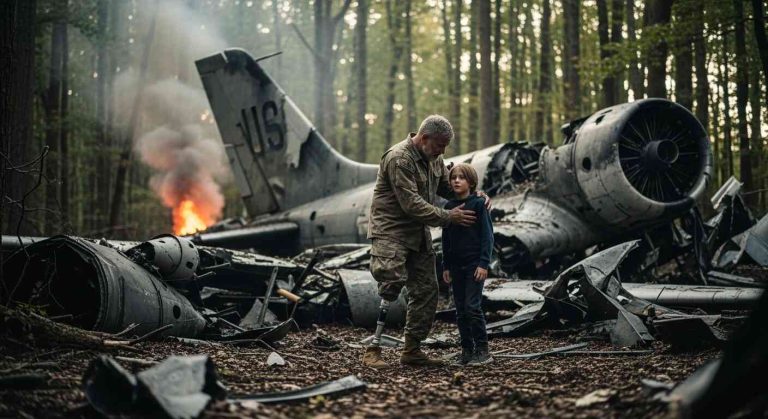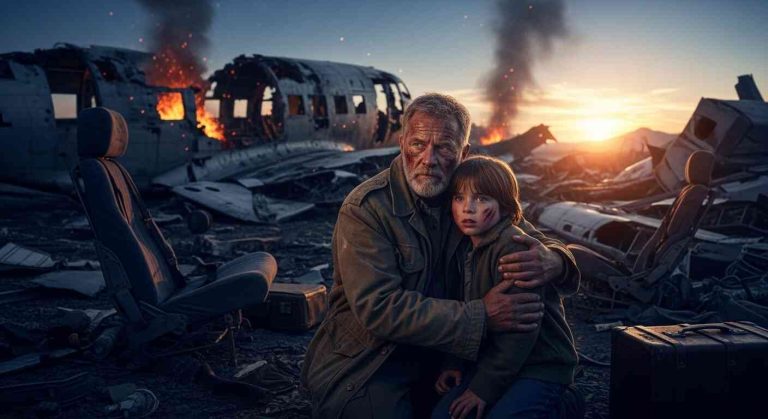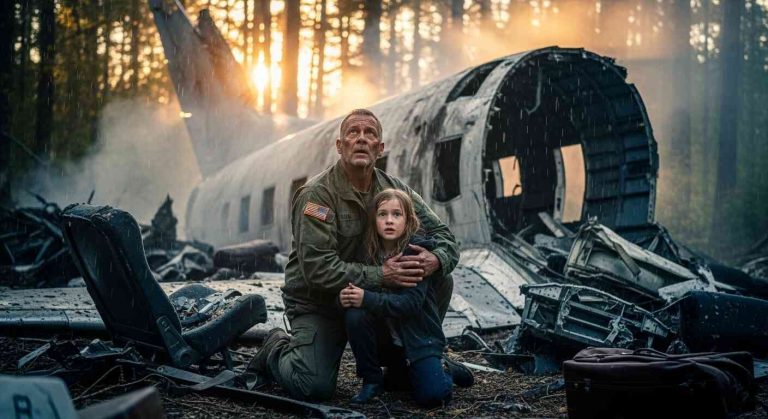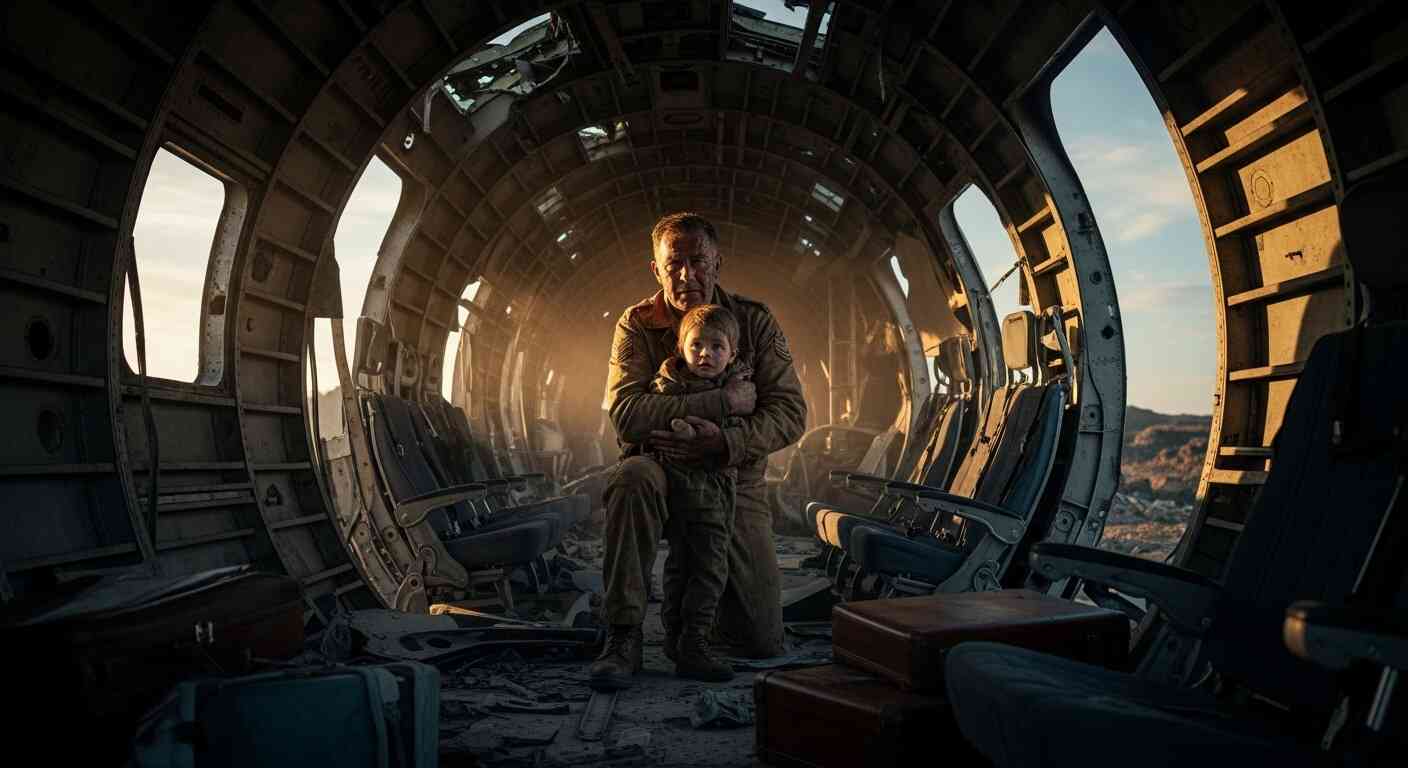
“Hold on tight, kid; we’re about to disappear from the world,” Elias growled, his voice barely audible over the mechanical scream of the 1946 Beechcraft.
Leo was ten, but in that moment, he looked a thousand years old. He didn’t ask why we were flying into a crack in the earth. He didn’t ask why the desert floor was close enough to touch. He just gripped his plastic dinosaur and prayed.
I checked the dial. 490 feet.
“Why can’t we go higher, Elias?” the boy whimpered. “It’s scary down here.”
I didn’t have the heart to tell him the truth. I didn’t want to tell him that if we hit 501 feet, a silent killer in the stratosphere—a drone programmed by men in suits thousands of miles away—would turn this plane into a fireball before we could even see the flash.
I wasn’t a hero. I was a man with a stolen plane, a terrified orphan, and a canyon that was running out of room.
“Just watch the rocks, Leo,” I whispered, banking the plane until the wingtip scraped the limestone. “As long as we stay in the shadows, they can’t see our souls.”
FULL STORY
CHAPTER 1: THE SHADOW CEILING
The air in the cockpit tasted like old pennies and high-octane fuel. It was a smell I had spent thirty years trying to wash out of my flight suits, yet here I was, drowning in it again.
“Elias! The wall!” Leo’s voice broke the trance.
I kicked the rudder, hard. The Beechcraft groaned, a metal beast protesting the laws of physics. We pivoted on a dime, the jagged red rock of the Mojave canyon shimmering past the canopy with less than a yard to spare. The vibration rattled my teeth. It rattled my bones.
“I see it, kid! I see it!” I shouted back. My hands were slick with sweat inside my gloves.
I glanced at the altimeter. It was a mechanical relic, the needle dancing nervously. 480 feet. We were flying in a trench, a literal grave dug into the earth. To anyone watching from the rim, we were a silver streak of suicide. But there was no one watching from the rim. Not humans, anyway.
“Check the screen,” I commanded, nodding toward the small, flickering tablet duct-taped to the dash.
Leo leaned forward, his small frame straining against the harness. His NASA hoodie was three sizes too big, a relic of a father who wasn’t coming back. “It’s… it’s still there. The red dot. It’s right above us.”
My stomach did a slow, nauseating roll. Aegis Systems. The “Silent Sky” initiative. They called it a security measures for the border, but it was really a net. An autonomous drone grid—the Scythes—programmed to loiter at twenty thousand feet and strike anything that didn’t broadcast a friendly transponder code.
But they had a blind spot. A hard-coded logic gate. To avoid interfering with ground traffic and low-level civilian infrastructure, the Scythes ignored everything below 500 feet.
The “Kill Zone” started at 501.
“Elias, I’m scared,” Leo whispered. He wasn’t crying. That was the worst part. He had run out of tears three days ago when the black SUVs pulled into his driveway. He was in a state of cold, crystalline terror.
“I know, Leo. But look at me.” I waited until he turned those big, hollow eyes toward mine. “I spent twenty years flying things faster than sound. This old bird? She’s a tractor with wings. She’s stable. She’s safe. I won’t let us clip a wall.”
That was a lie. A beautiful, necessary lie. The wind shears inside the canyon were unpredictable. A single gust could lift us ten feet, and that was all the Scythe needed. One ten-foot mistake, and a Hellfire missile would be through our engine block before the altimeter could even register the change.
“Why are they hunting us?” Leo asked. It was the question he’d been asking since I pulled him through the back window of his house in the middle of the night.
“Because you have something they want, Leo. That tablet your dad gave you? It’s not for games.”
“It’s just pictures of the stars,” he argued, clutching his backpack.
“It’s more than stars, kid. It’s the map to the back door of their entire system. Your dad was the smartest man I ever flew with. He knew they’d come for him. He just didn’t think they’d come for you, too.”
Suddenly, the plane bucked. A pocket of hot air rose from the canyon floor, shoving the Beechcraft upward.
“Elias!” Leo screamed.
The needle jumped. 490… 500… 510.
Beep. Beep. BEEEEEEEP.
The tablet on the dash turned bright crimson. A proximity warning. Somewhere, five miles above us, a computer brain had just woken up. It had seen a blip. It was calculating a solution. It was a god of math, and it had decided we were a variable that needed to be erased.
“Dive!” I yelled, more to myself than to the boy.
I shoved the yoke forward. The nose of the plane dropped toward the canyon floor, which was littered with boulders the size of houses. We were falling. The G-force lifted Leo out of his seat until his straps snapped him back.
The beep stopped. The screen faded back to a dull grey.
I pulled out of the dive, the belly of the plane screaming as it cleared a flat-topped rock by inches. My heart was a drum in my chest, threatening to burst.
“We’re okay,” I breathed, my voice cracking. “We’re back in the dark.”
But as I looked up through the glass, I saw it. A thin, white contrail cutting across the perfect blue of the Nevada sky. It was straight, cold, and purposeful.
The Scythe wasn’t gone. It was just waiting for us to blink.
CHAPTER 2: THE MECHANIC’S DEBT
We couldn’t stay in the air forever. The Beechcraft was thirsty, and my nerves were shredded. I needed a hole to crawl into, and I knew exactly where one was located.
“Where are we going?” Leo asked as I banked the plane toward a side-canyon so narrow I had to tilt the wings forty-five degrees to fit.
“A friend,” I said. “The only person left in this state who still knows how to fix things without an internet connection.”
Sarah Miller’s “Air-Strip” wasn’t on any map. It was a stretch of dry lake bed tucked behind a ridge of volcanic rock, shielded from satellite view by a rusted canopy of old camouflage netting.
I brought the plane in low—dangerously low. The wheels touched the sand with a violent jar, kicking up a plume of dust that I hoped would dissipate before the overhead eyes could log the thermal signature. I taxied the bird under the netting and killed the engine.
The silence that followed was heavy. It was the kind of silence that happens after a bomb goes off.
“Out, Leo. Now. Move like your life depends on it, because it does.”
We scrambled out of the cockpit. My legs felt like jelly. I grabbed Leo’s hand and ran for the small, corrugated metal shack at the edge of the clearing.
The door swung open before we reached it. A woman stood there, holding a short-barreled shotgun with the casual grace of someone who had used it before. Her hair was a mess of grey-streaked grease, and her eyes were hard as flint.
“Elias Thorne,” Sarah Miller said, not lowering the gun. “You’re three years late for a beer, and you’ve got a drone-target painted on your tail.”
“Good to see you too, Sarah,” I panted. “This is Leo. He’s David’s boy.”
The hardness in her eyes flickered. She looked at Leo, then back at me. She lowered the shotgun. “David? The guy who…?”
“Yeah. The guy who didn’t make it. The agency is scrubbed, Sarah. It’s all private now. Aegis took over the contract, and they’re cleaning house.”
“Come in,” she hissed, stepping aside. “And bring that plane’s transponder inside. If it so much as pings a satellite, we’re all charcoal.”
Inside, the shack smelled of soldering iron and stale coffee. Sarah had been a tech-sergeant in the same wing as me and David. When the military started outsourcing its soul to corporations, she was the first one to quit. She saw the writing on the wall before the rest of us even knew there was a wall.
“They killed my dad,” Leo said suddenly. He was standing in the middle of the room, looking at a wall of old photographs. “Didn’t they?”
Sarah paused, a wrench in her hand. She looked at me, an unspoken question in her eyes. I shook my head slightly.
“They tried to take his work, honey,” Sarah said softly, kneeling down to Leo’s level. “Your dad was trying to give the sky back to the people. The bad guys? They want to keep it in a cage.”
“I have the map,” Leo said, patting his backpack. “Elias says it’s important.”
“It’s the keys to the kingdom, kid,” I said, collapsing into a chair. “Sarah, I need fuel and a way to mask our heat signature. I’m taking him to the border. There’s a group in Mexico—remnants of the old signal-corps. If we can get this data to them, they can broadcast the kill-codes and shut the Scythes down.”
Sarah laughed, but there was no humor in it. “Elias, look at the monitor.”
She pointed to a bank of old CRT screens in the corner. They were hooked up to a localized radar array she’d built out of scrap.
“There aren’t just one or two Scythes anymore,” she said. “Aegis launched the ‘Swarm’ an hour ago. There are fifty of them over this sector alone. They’ve lowered the ceiling, Elias. They’re patrolling at four hundred feet now.”
My heart sank. “We can’t fly that low. Not through the pass. The turbulence will rip the wings off.”
“Then you don’t fly through the pass,” Sarah said, her voice dropping to a whisper. “You fly through the Needle.”
I felt the blood drain from my face. The Needle was a natural rock formation, a tunnel carved by ancient water. It was barely wide enough for a Cessna, let alone a Beechcraft. And it was less than fifty feet off the ground.
“That’s a death sentence,” I said.
“It’s the only way out of the net,” Sarah replied. “And you’re the only pilot crazy enough to try it.”
CHAPTER 3: THE HUNTER’S VOICE
We spent the night in the shadows of the hangar. Sarah worked like a woman possessed, coating the Beechcraft’s engine housing in a heat-reflective polymer she’d cooked up in a vat.
Leo fell asleep on a pile of old flight jackets. He looked so small, so innocent, clutching that plastic dinosaur. I sat nearby, cleaning my sidearm, the weight of the world pressing down on my shoulders.
“You love him,” Sarah said, appearing from beneath the wing, her face smeared with black goop.
“He’s David’s son. It’s a debt.”
“Don’t give me that ‘debt’ crap, Elias. I’ve known you since the Gulf. You don’t risk your life for a debt. You do it because you’ve finally found something worth saving.”
I didn’t answer. I couldn’t. If I admitted how much the kid meant to me, I’d lose my edge. And in the Needle, an edge was the only thing between us and a fiery grave.
Suddenly, the radio on Sarah’s workbench crackled to life. It wasn’t a standard frequency. It was an encrypted military channel I hadn’t heard in years.
“Elias? You there, buddy?”
The voice was smooth, cultured, and chillingly familiar.
“Vance,” I whispered, reaching for the dial.
“Don’t,” Sarah warned, grabbing my wrist. “They’ll triangulate.”
“He already knows where I am, Sarah. He’s just playing with his food.” I keyed the mic. “I’m here, Vance. You still working for the highest bidder, or did you finally sell your soul to the devil himself?”
“The devil pays better, Elias. And he has better toys.” A pause, punctuated by the sound of a jet engine in the background. “Give me the boy and the tablet. I can make the Scythes go dark. I can give you a pension and a quiet life in Florida. Think about it. You’re flying a museum piece against a trillion-dollar AI. How do you think this ends?”
“It ends with me spitting on your grave, Vance.”
“Emotional as always,” Vance sighed. “Look up, Elias. Not too high. Just enough to see the future.”
I ran to the edge of the netting and looked toward the horizon. The moon was out, casting a silver glow over the desert. And there, hovering like a vengeful ghost, was a shape I recognized.
The Reaper-X. It wasn’t a drone. It was a manned interceptor, the fastest thing in the sky, piloted by Vance himself. He wasn’t just letting the computers do the work. He wanted the kill for himself.
“He’s at three hundred feet,” I muttered. “He’s below the ceiling.”
“He is the ceiling,” Sarah said, her face pale.
“Get the kid up,” I commanded. “We’re leaving. Now.”
“Elias, the polymer isn’t dry!”
“It’ll dry in the wind. Move!”
I shook Leo awake. He didn’t complain. He just grabbed his bag and followed me to the plane. He saw the look on my face and didn’t ask a single question. He knew.
As we climbed into the cockpit, Sarah grabbed my hand. “Elias. If you make it to the other side… tell them I sent you. Tell them the sky belongs to the birds, not the suits.”
“I’ll tell them, Sarah. Thanks for the fuel.”
The engine roared to life, a defiant growl in the stillness of the desert. I didn’t wait for a warm-up. I throttled up and taxied out from under the net.
The moment our wheels left the sand, the world turned into a nightmare.
CHAPTER 4: THE NEEDLE’S EYE
“Elias! Behind us!” Leo screamed, pointing at the rearview mirror.
A pair of glowing red eyes was closing in. Vance’s interceptor. It looked like a shark made of shadows, slicing through the midnight air.
“Hold on, Leo! We’re going down!”
I pushed the nose down until we were skimming the sagebrush. The desert floor was a blur of grey and black. I could see the jackrabbits diving for cover as our shadow swept over them.
“Altimeter?” I barked.
“Eighty feet!” Leo yelled. “Sixty! Elias, we’re going to hit!”
“Not today!”
I saw the entrance to the Needle. It was a vertical crack in a wall of solid granite, barely wider than our wingspan. From this angle, it looked impossible. It looked like a needle’s eye, and we were the thread.
“Close your eyes, kid!”
I tilted the Beechcraft onto its side. The world went vertical. Leo’s scream was lost in the roar of the wind.
SCREECH.
The right wingtip clipped the canyon wall, throwing a shower of sparks into the cockpit. The plane shuddered, a horrific grinding sound echoing through the fuselage.
Then, suddenly, we were in the dark.
The Needle was a tunnel of wind and echoing engines. The walls were so close I could see the individual cracks in the stone. It was like flying through a straw.
Behind us, a massive explosion rocked the canyon.
“Did we get him?” Leo gasped, his eyes wide.
I checked the mirror. A fireball was blooming at the entrance of the tunnel. Vance’s interceptor was too fast, too wide. He’d tried to follow us and had paid the price.
“He’s gone,” I said, a grim satisfaction settling in my chest.
But the relief was short-lived.
“Elias,” Leo whispered. “The tablet.”
The screen was flashing again. Not red this time. Blue.
“What is it?”
“It’s… it’s sending something,” Leo said. “The map. It’s broadcasting.”
“To who?”
“To everyone,” Leo said, a small smile breaking through his terror. “My dad… he didn’t just make a map. He made a virus. He told me if I ever got close enough to an Aegis relay, the tablet would trigger.”
“The Needle,” I realized. “Sarah said it was a natural amplifier. The rock formations… they act like a giant antenna.”
Outside the cockpit, the sky was changing. The invisible net was breaking. Above us, the white contrails of the Scythes began to waver. One by one, the silent killers began to spiral out of control, their brains fried by the code David had hidden in a 10-year-old’s NASA tablet.
“We did it,” I breathed. “We actually did it.”
But the Beechcraft was dying. The collision with the wall had severed a fuel line. The engine began to sputter. The propeller slowed, its rhythmic beat turning into a death rattle.
“Elias? The engine stopped.”
“I know, kid. I know.”
We were out of the tunnel now, drifting over a wide, moonlit valley that led to the border. We had no power. We were just a heavy piece of metal falling gracefully through the air.
“Are we going to crash?”
I looked at the boy. He wasn’t scared anymore. He was looking at the sky—the real sky, clear and open and free of drones.
“No, Leo. We’re going to land.”
CHAPTER 5: THE PRICE OF THE SKY
The landing was anything but graceful. We pancaked into a dry wash, the landing gear snapping off like toothpicks. The Beechcraft slid for a hundred yards, plowing through sand and cacti until it came to a bone-jarring halt against a sand dune.
For a long time, there was only the sound of settling metal and the wind.
“Leo? You okay?”
I felt a small hand grab mine. “I’m okay, Elias. My dinosaur’s leg broke, though.”
I laughed. It was a ragged, sobbing sound. I unbuckled my harness and slumped forward, the adrenaline leaving my body in a cold rush.
We climbed out of the wreckage. The plane was a total loss, a crumpled heap of silver under the stars. We were twenty miles from the border, in the middle of nowhere, with nothing but a backpack and a broken plastic toy.
But as I looked up, I saw something I hadn’t seen in years.
The stars.
Thousands of them, bright and unblinking. The “Silent Sky” was gone. The grid was dark. Across the country, thousands of drones were falling like shooting stars, their sensors blinded by the truth.
“Your dad was a hell of a pilot, Leo,” I said, putting an arm around his shoulder. “But he was an even better father.”
“Elias?”
“Yeah, kid?”
“What do we do now?”
I looked toward the south, where the lights of a small town twinkled on the horizon.
“We walk,” I said. “And then? We find a place where nobody looks at the sky with fear.”
CHAPTER 6: THE FINAL HORIZON
Three months later.
The Mexican sun was warm on my back as I sat on the porch of the small villa outside Ensenada. The air smelled of salt and roasting corn.
In the yard, Leo was running with a group of local kids. He spoke a broken, laughing Spanish now, his face tanned and his eyes bright. The NASA hoodie had been replaced by a light linen shirt, but he still carried the backpack.
The data on the tablet had changed everything. The “Silent Sky” scandal had toppled Aegis Systems. The executives were in front of a grand jury, and the skies over America were open once again.
I took a sip of my coffee and looked at the horizon. A small Cessna was buzzing lazily through the blue, a flight instructor and a student, likely enjoying the view.
Sarah Miller had sent a postcard a week ago. She was back in business, legally this time, fixing old planes for people who just wanted to fly for the fun of it. She told me there was a seat waiting for me if I ever decided to come home.
But I was already home.
Leo ran up to the porch, panting, a dusty soccer ball under his arm.
“Elias! Did you see that? I scored!”
“I saw it, kid. Nice footwork.”
He sat down on the steps next to me, leaning his head against my knee. We sat there in silence for a while, watching the world go by. It was a simple life, a quiet life, the kind of life I thought I’d lost in the canyons.
“Elias?”
“Yeah?”
“Are we still hiding?”
I looked up at the vast, empty blue. There were no shadows. No red dots. No silent killers.
“No, Leo,” I said, ruffling his hair. “The world found us, and it turns out, it’s a pretty good place to be.”
I looked at the boy, the son of my best friend, the kid who had taught an old pilot how to breathe again. I realized then that the most important mission of my life hadn’t been the ones where I flew faster than sound. It was the one where I’d flown slow enough to catch a heart.
“Hold on tight, kid,” I whispered, pulling him close. “The best part of the story is just beginning.”
The sky is finally big enough for both of us.