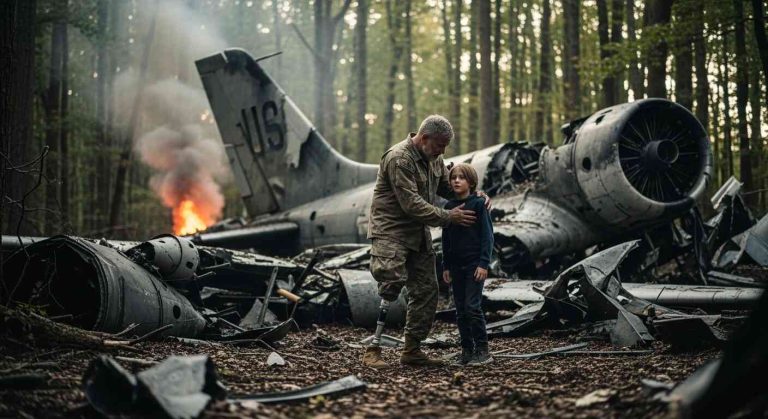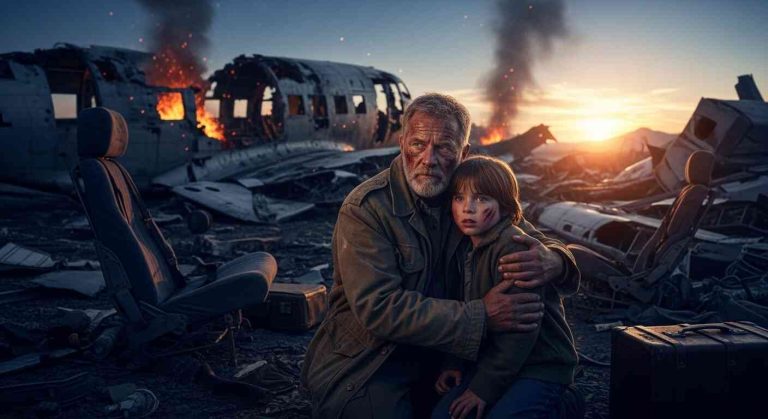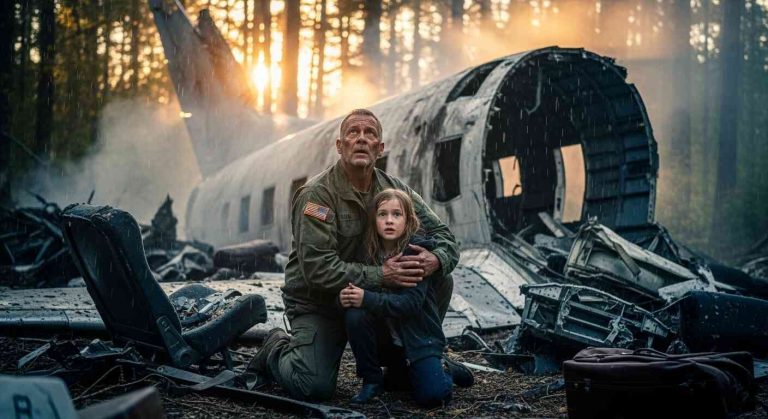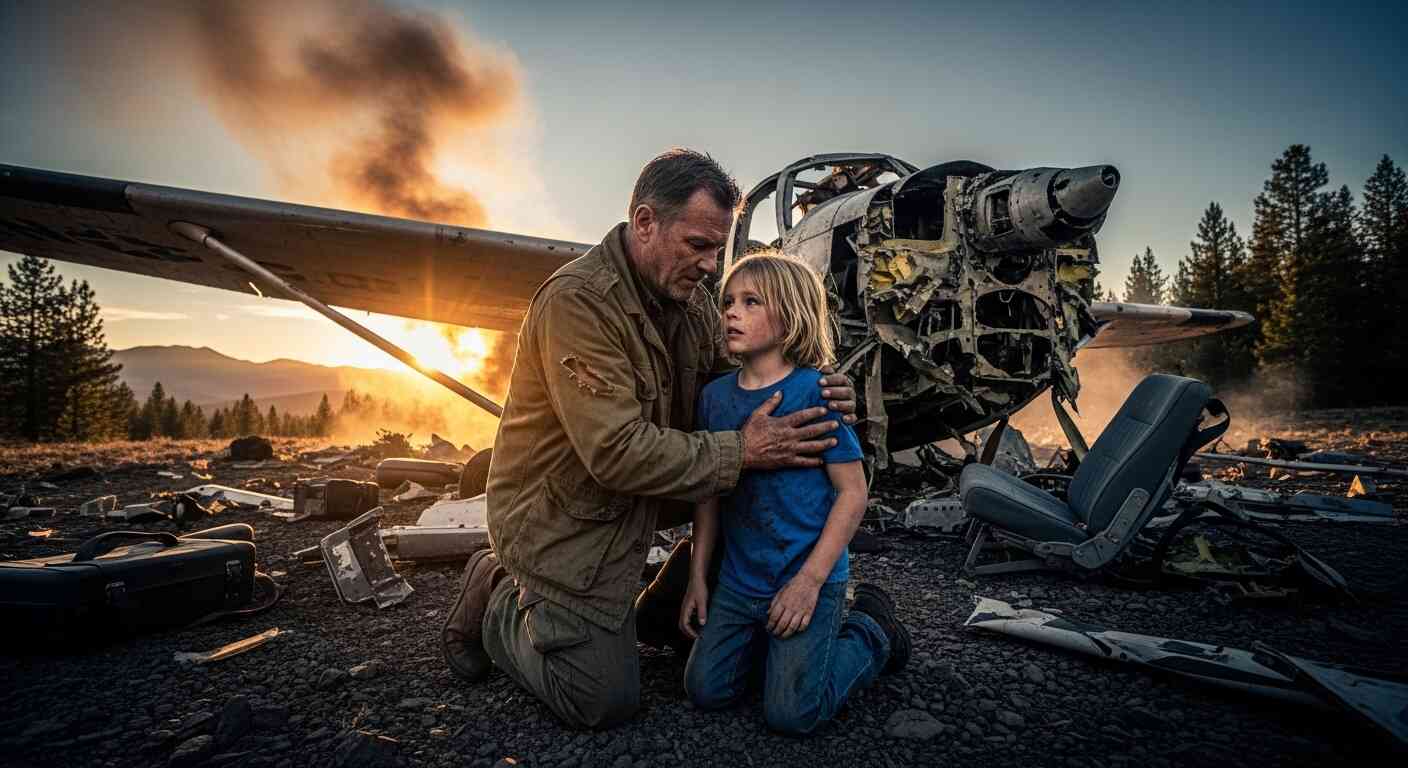
The sky didn’t just break; it screamed.
I felt the drop in my gut before the pilot even hit the intercom. Five hundred feet of dead air. Oxygen masks dropped like yellow ghosts from the ceiling. People were screaming, praying, clutching their loved ones.
I looked at the boy next to me. Leo. He wasn’t screaming. He was just… staring. His knuckles were white around that stuffed rabbit, his eyes wide and vacant. He’d seen worse things than a plane crash. I knew, because I’d pulled him out of the place where those things happen.
Then, they moved.
Four of them. Clean-cut, tactical posture, eyes like sharks. They weren’t looking for the exit. They were looking at us.
“Elias Thorne,” the one in the gray suit shouted over the roar of the wind. “Step away from the asset. Now!”
They thought the turbulence was their cover. They thought I was just an old soldier past his prime. They were wrong.
Nature does the heavy lifting; I just provide the timing.
While the plane bucked like a wild horse, I didn’t even stand up. My hands moved in a blur—muscle memory from a life I tried to bury.
Zip. Zip. Zip. Zip.
By the time the plane leveled out, four of the most dangerous men in the country were bound to their armrests. But when the leader looked at me, he didn’t see a criminal. He saw a ghost.
“Ash?” he whispered, his voice trembling. “What have you done?”
The real nightmare wasn’t the storm outside. It was the fact that the men sent to “rescue” this boy were the same ones who had turned him into a weapon.
FULL STORY
CHAPTER 1: THE VELOCITY OF BETRAYAL
The altitude alert was a rhythmic, piercing chirp that cut through the sound of crying babies and the low hum of the engines. Flight 412 from DC to San Francisco was a pressurized metal tube full of secrets, and I was sitting right in the middle of it.
I am Elias Thorne. To the Department of Defense, I am a “retired asset.” To the four men currently closing in on seat 14C, I am a traitor. But to the seven-year-old boy sitting next to me, I was the only thing standing between him and a laboratory floor.
Leo clutched his rabbit, Barnaby. The toy was missing an eye and smelled like the cheap detergent of a government holding cell.
“Stay low, Leo,” I whispered. My voice was a gravelly rasp, a gift from a shrapnel wound in Fallujah.
The plane suddenly lurched. A “mountain wave,” the pilots call it. To the passengers, it felt like the hand of God slamming us toward the earth. Coffee cups flew. A woman three rows up shrieked as her laptop hit the ceiling.
In the chaos, the four men moved. They didn’t stumble. They used the momentum, sliding down the aisle with the practiced ease of hunters.
The leader was Miller. I’d trained him. I knew the way he tilted his head when he was about to draw a sidearm. I knew the scar on his jaw from a training exercise in Georgia ten years ago. He was a good soldier. He was also a man who followed orders without asking why.
“Elias!” Miller yelled, bracing himself against an overhead bin. “Don’t make this a scene. Give us the boy, and you walk away. We can tell them you were compromised.”
“You know me better than that, Miller,” I said. I didn’t reach for a gun. I didn’t have one. TSA is good at finding steel; they aren’t so good at finding the intent in a man’s hands.
The plane dropped again. This time, it was violent. The lights flickered and died, leaving only the red glow of the emergency strips on the floor.
I moved.
I didn’t need to see. I knew exactly where Miller’s wrists would be as he reached for the seatback to steady himself. I had the heavy-duty industrial zip-ties looped through my belt.
Zip.
I felt him gasp. Before he could react, I lunged forward, catching the second man—a kid named Kael—around the throat, forcing him into the seat behind me.
Zip.
The third and fourth agents tried to converge, but the turbulence sent them staggering. I used the back-and-forth sway of the fuselage to whip the ties around their wrists, anchoring them to the steel frames of the chairs.
When the emergency lights finally kicked back over to a steady dim yellow, the cabin was silent except for the sobbing of a passenger and the groan of the airframe.
Miller sat in seat 12D, his hands bound tightly to the armrest in a double-loop tactical knot. He stared at his wrists, then up at me. His eyes weren’t full of anger. They were full of a terrifying, realization.
“That knot,” Miller whispered. “Only the Ghost Program uses that tie-down. You… you really are him.”
“I was,” I said, checking the seal on Leo’s seatbelt. “Now I’m just a guy who wants to get a kid to his grandmother’s house.”
“He doesn’t have a grandmother, Elias!” Miller hissed, leaning in as far as the ties would allow. “He’s property of the state. He’s a biological breakthrough. You’re stealing a billion dollars’ worth of research!”
Leo finally spoke. His voice was tiny, vibrating with the engine’s roar. “I’m not a billion dollars. I’m Leo.”
I looked at Miller. “See? That’s where you’re wrong. He’s not an asset. He’s a kid who’s scared of the dark.”
But as I looked toward the cockpit, I saw the “Fasten Seatbelt” sign flash three times. A code. The pilot wasn’t just flying the plane. He was talking to the people Miller worked for. We weren’t just in a storm. We were in a trap.
CHAPTER 2: GHOSTS IN THE FUSELAGE
The second chapter of our lives began when the air pressure stabilized, but the atmosphere inside the cabin grew ten times heavier.
I sat back down next to Leo. My heart was a hammer against my ribs, but I kept my face stone-still. In my line of work, if you show fear, you’re already dead.
“Ash?”
I turned. It was Miller. He used my old callsign.
“Shut up, Miller,” I said softly.
“We were a team,” he pleaded. His eyes were scanning the cabin, looking for a way out, but he knew those ties. They were rated for four hundred pounds of pressure. The more he struggled, the more they bit into his skin. “When you went dark after the Kabul extraction, we thought the Taliban got you. We mourned you, man. I drank a bottle of bourbon at your empty grave.”
“You should have saved the bourbon,” I said. “I wasn’t in a hole. I was in a hospital, watching what your ’employers’ did to kids like Leo.”
Beside us, a woman named Sarah—a nurse I’d chatted with during boarding—was staring at the bound agents with a mix of horror and confusion. She was our third supporting character in this tragedy, an innocent bystander caught in a shadow war.
“Are you… are you a sky marshal?” she stammered, her voice trembling.
“Something like that,” I lied. It was easier than the truth.
“He’s a kidnapper!” Kael, the younger agent, shouted from two rows back. “He took that boy from a secure medical facility. That child needs specialized care that only we can provide!”
Sarah looked at me, then at Leo. Leo didn’t look like a kidnap victim. He was leaning his head against my arm, his eyes closed. He looked like a son who had finally found his father.
“He’s lying,” Leo whispered, not opening his eyes. “The needles. They used the big needles when they thought I was sleeping.”
Sarah’s expression shifted. The fear turned into a sharp, maternal protective streak. She leaned over the aisle. “Is that true?” she asked me.
“They were testing his neuro-responses,” I said. “Trying to see if they could trigger a specific adrenaline spike that would allow him to process information at ten times the speed of a normal human. They call it ‘Project Chronos.’ To them, he’s a processor. To me, he’s a boy who likes blueberry pancakes.”
Suddenly, the plane tilted sharply to the left. Not turbulence. A maneuver.
I looked out the window. We were over the Rockies, but we were descending far too fast. We weren’t headed for San Francisco.
“Miller,” I said, my voice low and dangerous. “Where are we landing?”
Miller smiled, a grim, bloody expression. “There’s a private airstrip in Northern Nevada. Black site. The moment the wheels touch the tarmac, a strike team will breach the doors. They won’t care about collateral damage, Ash. They just want the boy.”
I looked at the hundred-plus passengers on the plane. Families. Business travelers. A grandmother in the back.
“You’re going to kill a hundred people for one child?” Sarah gasped.
“We won’t kill them,” Miller said, though he didn’t look her in the eye. “We’ll just… detain them. Indefinitely.”
I stood up. I had to get into the cockpit. But as I moved, the fourth agent—a man I hadn’t accounted for because he’d stayed silent—suddenly kicked out. He’d managed to slip his boots off and was using his feet to trip me.
I fell hard, the air leaving my lungs.
“Go!” Miller screamed to the cabin at large. “Someone help us! He’s a terrorist!”
A group of well-meaning passengers, fueled by panic and Miller’s lies, began to rise from their seats. They didn’t see the agents. They saw a man in a worn tactical jacket who had just “assaulted” four people.
I was surrounded. And the plane was screaming toward the desert.
CHAPTER 3: THE HIGH-ALTITUDE STANDOFF
The air in the cabin was thick with the scent of recycled oxygen and mounting hysteria.
“Stay back!” I shouted, holding my hands up. “I’m not trying to hurt anyone!”
“You tied them up!” a man in a business suit yelled, brandishing a heavy duty-free bottle of whiskey like a club. “We saw you!”
Sarah stood up, stepping between me and the crowd. “Listen to me! I’m a nurse. Look at the boy! Does he look like he’s being kidnapped?”
The crowd paused. Leo was standing now, his small hand gripping the hem of my jacket. He looked small, fragile, and utterly terrified—not of me, but of them.
“They’re the bad men,” Leo said, his voice cracking.
But Miller was a professional manipulator. “He’s brainwashed! Look at my wrists! Is this the work of a good man?”
The man with the whiskey bottle lunged. I didn’t want to hurt him, so I took the blow on my shoulder. The glass shattered, soaking my jacket in the smell of peat and smoke. I grabbed his arm, twisted, and guided him gently but firmly into an empty seat.
“I don’t have time for this!” I roared, and the sheer authority in my voice—the voice of a man who had commanded platoons in the dark—made the cabin go silent.
I turned to the cockpit door. It was reinforced steel. Post-9/11 security meant I wasn’t getting in without a blowtorch or an explosion.
“Vance!” I pounded on the door. “Captain Vance, I know you can hear me!”
The intercom crackled. “Sit down, Mr. Thorne. We are diverting for an emergency landing due to mechanical failure. Federal authorities are waiting.”
“Mechanical failure my ass,” I muttered.
I looked at Sarah. “I need your help. Do you have a medical kit? A real one?”
“In my carry-on,” she said, sensing the shift in my energy.
“Get it. And get the oxygen tank from the wall.”
I turned back to Miller. He was watching me, his eyes narrowing. “What are you doing, Ash? You can’t hijack a plane with a nurse and a kid.”
“I’m not hijacking it,” I said. “I’m liberating it.”
I looked at Leo. “Remember what we talked about? The ‘Quiet Game’?”
Leo nodded, his eyes wide.
“I need you to do it now. The loudest version.”
Project Chronos wasn’t just about processing speed. It was about frequency. When Leo got scared—truly, bone-deep scared—his brain emitted a high-frequency localized EM pulse. It was a side effect the government loved. It could fry electronics within a twenty-foot radius.
I knelt in front of him. “Leo, I need you to think about the white room. Think about the needles. Think about how much you hate them.”
“Elias, no,” Miller whispered, realizing the plan. “You’ll fry the flight controls! We’ll all go down!”
“Vance is flying on autopilot and slaved to a remote ground-control signal,” I said. “If I fry the receiver, he has to fly it manually. And I know Vance. He’s a coward. If he loses his guidance, he’ll head for the nearest civilian airport, not a black site in the desert.”
“Leo, do it now!”
Leo closed his eyes. His small frame began to shiver. The air around him seemed to hum, a low-frequency vibration that made my teeth ache.
The lights didn’t just flicker this time. They exploded.
The overhead panels popped open. The entertainment screens turned into static and then melted.
The plane groaned as the autopilot disconnected. I felt the nose dip, then pull up sharply as Vance scrambled to grab the yoke.
“We’re manual!” I yelled over the chaos.
But the pulse had a price. Leo collapsed into my arms, his nose bleeding, his skin cold as ice.
“Sarah! Now!”
The nurse scrambled forward, opening her kit. We had ten minutes before we hit the ground. Somewhere out there, F-22s were likely scrambling. I had to decide if I was going to save the boy, or the hundred people behind me.
CHAPTER 4: THE PRICE OF SILENCE
The cabin was a tomb of smoke and jagged shadows.
Sarah was working on Leo, her hands steady despite the fact that we were banking at a forty-degree angle. “His heart rate is bottoming out, Elias! Whatever he just did… it drained him.”
“Keep him breathing,” I said, my heart breaking as I watched the small boy struggle for air.
I walked back to Miller. He was slumped in his seat, the EMP having dazed him.
“Miller, look at me.”
He raised his head. He looked broken.
“You have a daughter, don’t you? Mia? She’d be six now?”
Miller flinched. “Don’t you bring her into this.”
“She’s exactly Leo’s age,” I said. “If the roles were reversed, if Mia was the one they were cutting open to see how her brain worked, would you be sitting there in those ties? Or would you be standing where I am?”
Miller looked away. The silence stretched between us, punctuated only by the wind whistling through a seal in the door.
“They told us he was a clone,” Miller whispered. “They said he didn’t have a soul. Just a biological construct.”
“He cries when he loses his toy, Miller. He likes the color blue. He’s more human than you or me.”
The plane leveled out. I could see the lights of a city through the clouds. Salt Lake City. Vance was playing it safe.
“The moment we land,” Miller said, his voice devoid of its earlier bravado, “the police will surround the plane. But the ‘Cleaners’ will be right behind them. They won’t let Leo leave that tarmac. And they won’t let you live to tell the story.”
“I know.”
“There’s a maintenance hatch,” Miller said suddenly.
I stared at him.
“In the galley, under the flooring. It leads to the cargo hold. If you can get down there before the stairs are attached, you can exit through the luggage belt. It’s a risk… but it’s the only one you’ve got.”
“Why are you telling me this?”
Miller looked at his bound wrists. “Because I don’t want to have to tell Mia that her daddy helped kill a little boy.”
I took a knife from my pocket—a ceramic blade they’d missed—and sliced the ties. Miller rubbed his wrists, the skin raw and red.
“Go,” he said. “Before I change my mind.”
I grabbed Leo from Sarah. She looked at me, tears in her eyes. “Where will you go?”
“Somewhere the sun doesn’t shine,” I said. “Thank you, Sarah. For believing us.”
“Elias!” Miller called out as I reached the galley.
I turned.
“You’re a dead man walking, Ash.”
“I’ve been dead since Kabul,” I said. “I’m just finally doing something useful with the corpse.”
CHAPTER 5: THE DESERT GHOST
The landing was a bone-jarring affair. Vance greased the wheels, but without the electronic dampeners, the 747 bounced like a basketball.
The moment the plane slowed, I was in the galley, ripping up the floorboards. Leo was semi-conscious, his head lolling on my shoulder.
“Almost there, buddy,” I whispered.
I dropped into the cargo hold just as I heard the sirens. The hold was freezing, filled with the smell of jet fuel and expensive suitcases. I found the belt system. It wasn’t moving yet.
I crawled through the darkness, pulling Leo with me. I could hear the muffled sounds of the passengers being evacuated above. Screams, confusion, the heavy stomp of boots.
“Clear the aisles! Feds! Move, move, move!”
I found the exit flap. I peeked through the rubber slats. The tarmac was a sea of blue and red lights. SWAT teams, black SUVs, and—just as Miller predicted—a nondescript white van with no plates. The Cleaners.
They weren’t looking at the passengers. They were looking at the belly of the plane.
“They’re waiting for us,” I whispered to Leo.
Leo opened his eyes. They were clear now, the pupils dilated. “I can help, Ash.”
“No, Leo. No more pulses. You’ll die.”
“Not a pulse,” Leo said. He reached out and touched the metal hull of the plane.
I felt a static charge jump to my skin.
“What are you doing?”
“I’m talking to the lights,” he said.
Suddenly, every emergency light on the runway—the guiding paths, the stadium floods, the police light bars—snapped off. Total, absolute darkness engulfed the Salt Lake City airport.
“Now!” Leo hissed.
I didn’t hesitate. I jumped from the cargo bay, hitting the concrete hard. I ran. Not toward the terminal, but toward the perimeter fence.
In the darkness, I was a ghost. I knew how to move in the shadows of a battlefield. I used the silhouettes of fuel trucks and baggage carts as cover.
We reached the fence. I threw my jacket over the barbed wire and hoisted Leo over. As I climbed after him, a spotlight cut through the dark.
“There! Over the fence!”
Bullets hissed through the air, snapping against the metal links. I felt a hot iron sear across my thigh. I didn’t stop. I tumbled onto the other side, grabbed Leo, and vanished into the high desert scrub.
We ran for three miles. My leg was screaming, my vision blurring. Finally, we reached a small, dusty gas station on a lonely stretch of highway.
I pulled out a burner phone. I had one contact left. One person who owed me a life.
“It’s Ash,” I said when the voice answered. “I have the package. I need a clean extraction. Now.”
CHAPTER 6: THE FINAL HORIZON
Three days later.
We were in a small cabin in the woods of British Columbia. The air was crisp, smelling of pine and freedom.
Leo was sitting on the porch, drawing in the dirt with a stick. He looked like a normal boy. For the first time, his eyes weren’t searching for an exit. They were watching a squirrel climb a cedar tree.
I sat on the steps, my leg bandaged, a cup of bitter coffee in my hand.
The news on the laptop was a flurry of “official” statements. Flight 412: A Hijacking Thwarted. They’d framed me as a lone wolf, a disgruntled veteran who had suffered a psychotic break. They said the boy had been “safely returned to a state facility.”
They had to lie. They couldn’t admit they’d lost the most expensive weapon ever created to a man with a zip-tie and a sense of decency.
Miller had been “reassigned.” I knew what that meant. He was probably in a basement somewhere, being grilled about why he let me go. But Miller was smart. He’d give them enough truth to survive, but not enough to find us.
Leo walked over and sat next to me. He leaned his head on my shoulder.
“Are we going back?” he asked.
“Never,” I said.
“Will they come looking?”
I looked out at the vast, impenetrable wilderness. I had booby-trapped the perimeter and set up a satellite warning system. But I knew the truth. Men like the ones we ran from don’t stop. They just wait.
“Let them come,” I said, ruffling his hair. “I’ve got plenty of zip-ties left.”
Leo smiled. It was the first real smile I’d seen on him. It was worth the treason. It was worth the wound in my leg and the bounty on my head.
I looked at the stuffed rabbit, Barnaby, sitting on the porch rail. The toy was a reminder of where he’d been, but the forest in front of us was where he was going.
I had been a soldier my whole life. I had fought for flags, for oil, and for men who didn’t know my name. But as I watched the sun set over the mountains, I realized this was the first time I had ever truly won a war.
The greatest missions aren’t the ones where you kill for your country; they’re the ones where you live for a child.
The world thinks he’s an asset, but to me, he’s just a boy who finally gets to see the stars.