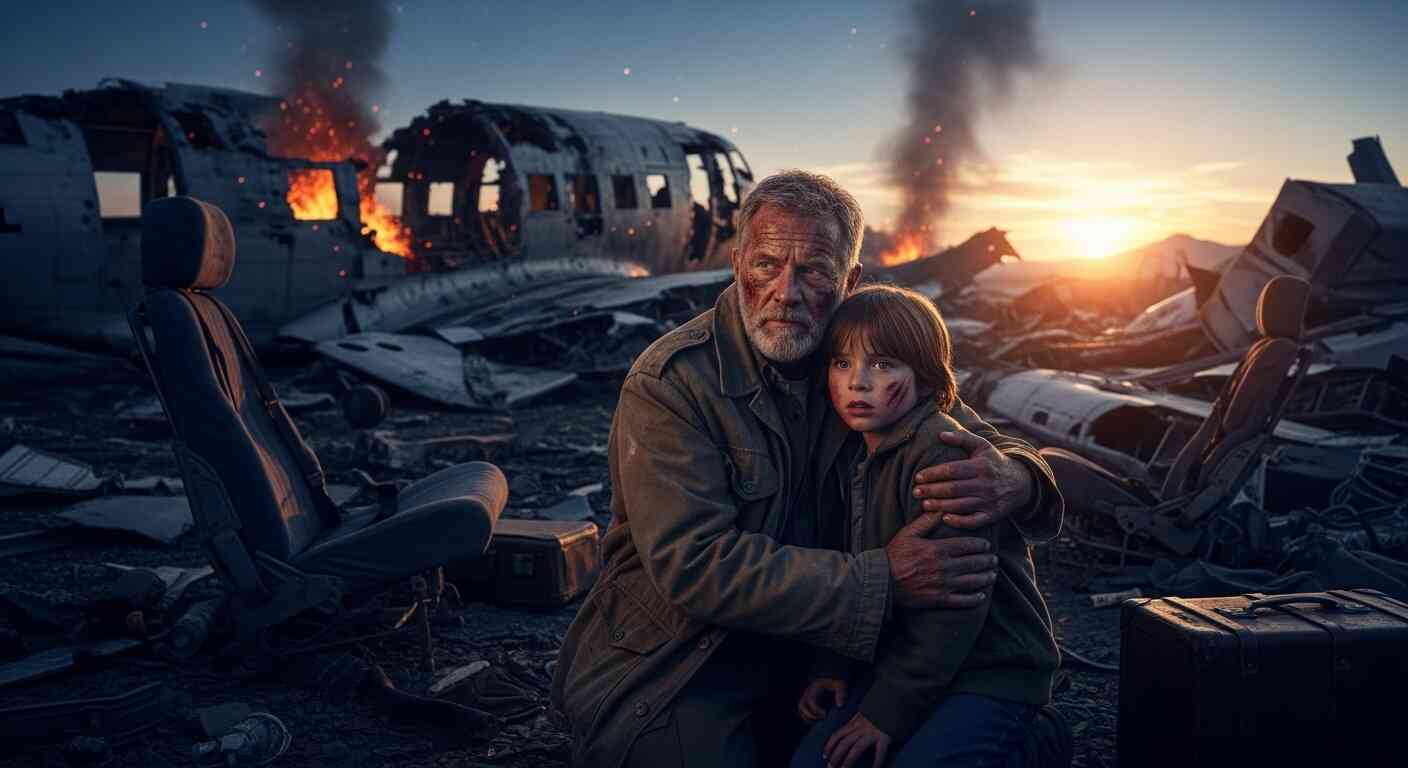
Chapter 1: The Leap of Faith
The wind at ten thousand feet doesn’t just blow; it screams. It’s a physical weight, a wall of ice and noise that tries to tear the breath right out of your lungs. I stood on the edge of the open cargo ramp of the C-130, my boots slipping on the oil-slicked metal, looking down at the jagged, mist-covered peaks of the Oregon Cascades.
Below me, the world was a blur of gray and green. In my arms, Maya was shivering so hard I could feel her teeth chattering against my chest. She wasn’t my biological daughter—not on paper, anyway—but in every way that mattered, she was the only thing I had left in this world.
She was eight years old, silent, and terrified. I had tied her to a stack of heavy, canvas mail bags using every bit of climbing grade paracord I had. To anyone else, it looked like I was preparing to toss trash into the abyss. To me, it was a life jacket.
“Elias, don’t do it!”
I didn’t need to turn around to know it was Miller. Sarah Miller had been hunting us for three states, a woman who had traded her badge for a paycheck from the highest bidder. I could hear her boots pounding against the vibrating floor of the plane, her voice barely carrying over the roar of the engines.
“There’s no parachute on those bags, Elias! You’re going to kill her!” Miller’s voice was high, panicked. She wasn’t a monster, just a woman doing a job, and she didn’t want a dead kid on her conscience.
I looked back over my shoulder. She was twenty feet away, her hand reaching out, her face pale under the flickering red jump-lights. Behind her, the “Shadow Men”—the mercenaries who really ran this operation—were closing in. They didn’t care about the girl. They wanted the drive she was carrying, the one hidden in the lining of her coat.
I looked down at Maya. Her eyes were huge, reflecting the dying orange light of the sunset. She didn’t scream. She didn’t cry. She just gripped the mail bags and looked at me with a trust that felt heavier than the mountain range below us.
“Trust me, kiddo,” I whispered, though the wind swallowed the words.
I grabbed the heavy mail bags and shoved.
For a second, there was a sickening silence as the weight left the plane. Maya disappeared into the gray void. Miller let out a strangled cry, her knees hitting the deck in horror.
I stood on the edge for one more heartbeat. I looked Miller dead in the eye.
“Physics is a law,” I shouted, my voice cracking with the strain of the altitude. “But I’ve always been a rebel.”
Then, I jumped.
No parachute. No backup. Just the cold, rushing air and the terrifying, beautiful certainty of the fall. I wasn’t falling to my death. I was falling toward the only play we had left.
PART 2
Chapter 1: (Included above)
Chapter 2: The Ghost in the Machine
The freefall was an eternity captured in seconds.
Most people think falling is like a roller coaster—that stomach-flipping drop. But when you’re doing it from two miles up, it feels like being pressed into a mattress by a giant hand. Gravity wants you, and it wants you fast.
As I tumbled through the air, trying to stabilize my body into a “box-man” position, I saw Maya and the mail bags. They were falling faster than I was, the weight of the bags acting like a lead sinker. I tucked my arms, angling my body into a steep dive, my eyes watering behind the goggles I’d stolen from the hangar.
Why were we here? The question flickered in my mind like a dying candle.
Six months ago, I was a broken-down veteran living in a cabin outside of Sisters, Oregon. My days were filled with the smell of cedar, the taste of cheap bourbon, and the silence of a man who had seen too much of the world’s ugliness. I had been an Air Force Pararescueman—a PJ. Our motto was “That Others May Live.” I had lived by that until the day I couldn’t.
I had lost my team in a valley in Kunar Province. I had lost my own daughter to a fever while I was halfway across the world. When I came home, there was nothing left but ghosts.
Then Maya showed up.
She was the daughter of my old tech-sergeant, Leo Vance. Leo had died in a “car accident” that smelled like a professional hit. Maya had been in the backseat. She hadn’t spoken a word since. She arrived at my door with a backpack, a stuffed rabbit, and a cryptic note from her father: “They’re coming for the data, Elias. Protect the Ghost.”
The “Ghost” wasn’t a person. It was a file. A file that proved a major defense contractor was sabotaging its own equipment to drive up repair contracts—sabotage that had caused the helicopter crash that killed my team.
The people Miller worked for were the ones who had sent Leo to his grave. And now, they were willing to drop an eight-year-old girl out of the sky to keep their secret buried.
I reached the mail bags. I grabbed the paracord tether I’d rigged, my fingers numbing in the sub-zero air. I pulled Maya close, her small body tucked into the center of the bags. She looked at me, and for the first time, I saw her lips move.
“Elias,” she mouthed.
I didn’t have time to answer. We were passing through five thousand feet. The ground was rushing up, a mosaic of sharp pines and unforgiving rock.
“Hold on!” I roared.
Suddenly, the tether I’d rigged to the floor of the C-130—a high-tensile, steel-core cable—snapped taut. It shouldn’t have worked. At this speed, the jerk should have snapped my spine. But I hadn’t just tied it to the plane. I’d tied it to a specialized deceleration drum I’d spent three days building in the hangar.
The cable hummed like a guitar string from hell. We didn’t stop, but we slowed.
Below us, a second plane—a smaller, faster Pilatus PC-12—screamed into view. This was Dutch. My old pilot. My brother. He was flying low, skimming the treetops, with a modified snatch-yoke mounted on his roof.
It was a maneuver we’d practiced in the special ops community for extracting personnel from hot zones. It was called the Fulton Recovery System. Only we were doing it in reverse, in the dark, with a child.
“Now, Dutch!” I screamed into my throat-mic.
The yoke on the second plane caught the cable. The jerk was violent. My vision went black for a split second as the G-force hammered my chest. Then, suddenly, we weren’t falling anymore. We were being towed.
FULL STORY
PART 3
Chapter 3: The Mid-Air Waltz
The transition from falling to being towed at two hundred miles per hour is like being hit by a freight train.
I felt my ribs groan under the pressure. Maya was buried in the canvas of the mail bags, protected by the padding I’d stuffed inside. The cable hummed, vibrating through my entire skeletal system. We were dangling five hundred feet behind Dutch’s plane, suspended over the Oregon wilderness like bait on a fishing line.
“Elias? You still with me, you crazy bastard?”
Dutch’s voice cracked through my earpiece. It was the most beautiful sound I’d ever heard.
“I’m here,” I gasped, my lungs burning. “Maya is secure. Reel us in, Dutch. Before Miller’s friends realize what happened.”
In the distance, the C-130 was banking hard. They had seen the snatch. Miller wasn’t stupid; she knew she’d been played. The mercenaries would have smaller, faster pursuit craft following them. We had maybe five minutes of airtime before they were on our tail.
Dutch’s plane had an internal winch. Slowly, agonizingly, the distance between us and the Pilatus began to close. I gripped the cable, my hands raw and bleeding through my gloves. I looked at Maya. She was staring at the tail of the plane ahead of us, her eyes wide with a strange, shimmering wonder.
She wasn’t afraid anymore. She was watching the world from a perspective no child should ever see.
“We’re okay, Maya,” I whispered. “We’re almost home.”
But “home” was a relative term. We were two fugitives on a wire, and the wind was picking up.
Chapter 4: The Shadow of the Hunter
While we were dangling in the sky, Sarah Miller was standing in the cargo bay of the C-130, staring at the empty air where we had been.
She wasn’t a villain in her own mind. She was a woman who had seen the system fail too many times. She had been a detective in Portland until she’d uncovered corruption that reached the mayor’s office. They’d stripped her badge and left her with nothing but a mountain of legal debt. When the private contractors offered her a job “recovering stolen property,” she took it.
She didn’t know the property was an eight-year-old girl.
“Ma’am, we have a lock on the second aircraft,” one of the mercenaries said, his voice cold. He was a man named Kael, a former Tier-1 operator who had lost his soul somewhere in the desert. “We’re launching the interceptors.”
Miller looked at the small monitor. Two black-painted helicopters were peeling off from a hidden landing strip in the valley below, heading straight for Dutch’s flight path.
“You don’t need to shoot them down,” Miller said, her voice trembling. “Just force them to land. There’s a child on that plane.”
Kael didn’t even look at her. He checked the magazine on his rifle. “The client wants the data. Dead or alive is optional. The girl is collateral.”
Miller felt a cold pit form in her stomach. She thought about her own niece. She thought about the way Elias had looked at her before he jumped—not with hatred, but with a weary, desperate hope.
She realized then that she was on the wrong side of the sky.
“I can’t let you do that,” she said softly.
Kael turned, his eyes narrowing. “You’re on the payroll, Miller. Sit down and shut up.”
Miller reached for her sidearm. She was fast, but Kael was a machine. He swiped her arm away and pinned her against the fuselage, the cold steel of his knife pressing against her throat.
“Try it again, and you’ll follow Thorne out that door,” he hissed. “Without the cable.”
He dropped her, and Miller slumped to the floor, watching the screen as the helicopters closed in on the little Pilatus. She had a choice to make. She could be a spectator to a murder, or she could find a way to break the machine she helped build.
FULL STORY
PART 4
Chapter 5: The Climax at the Edge of the World
We were fifty feet from the tail of Dutch’s plane when the first tracer rounds streaked past us.
“Elias! We’ve got company!” Dutch yelled.
I looked back. The two black helicopters were rising through the mist like prehistoric predators. Their door gunners were opening up, the muzzle flashes bright against the darkening sky.
“Reel us in faster!” I screamed.
The winch groaned. I grabbed the edge of the Pilatus’s cargo door as we reached the fuselage. I hauled the mail bags—and Maya—inside just as a round shattered the window of the cabin.
“Go, Dutch! Go!”
Dutch pushed the Pilatus into a terrifying dive, trying to use the terrain to mask our signature. We were weaving between the peaks, the wings of the plane nearly clipping the pine trees. Inside the cabin, I scrambled to untie Maya.
She was shaking, but she grabbed my hand. Her fingers were cold, but her grip was like iron.
“The rabbit,” she whispered. Her first words in months.
I looked down. Her stuffed rabbit had fallen out of the bags and was snagged on the edge of the open door.
“Forget the rabbit, Maya! We have to get to the back!”
“No,” she said, her voice stronger. “The Ghost. In the rabbit.”
My heart stopped. The data wasn’t in her coat. It was in the toy.
I looked at the rabbit, dangling over the abyss. Then I looked at the helicopters closing in. I reached out, my body half-out of the plane, and grabbed the toy just as a missile warning shrieked in the cockpit.
“Flare! Flare!” Dutch yelled.
The world turned white. The heat from the flares blinded me, but I felt the rabbit’s fur in my hand. I pulled myself back in and slammed the door shut.
Behind us, one of the helicopters caught a flare in its intake. It spun wildly, a fireball erupting in the twilight, and plummeted into the forest below. The second helicopter hesitated, and that was all the window Dutch needed. He pulled the nose up, climbing into a thick bank of thunderclouds.
We were in the gray. We were safe. For now.
Chapter 6: The Rebel’s Reward
We landed on a dirt strip in Northern California three hours later. The rain was pouring down, a cold, cleansing deluge that washed the smell of aviation fuel from my clothes.
Dutch taxied the plane into an old, rusted hangar. When the engines finally died, the silence was deafening.
I sat on the floor of the cabin, holding the stuffed rabbit. Maya was curled up next to me, her head on my shoulder. She was exhausted, but for the first time, she looked like a child again, not a victim.
“You really did it, Elias,” Dutch said, leaning over the back of his seat. He looked ten years older than he had that morning. “You defied physics. And the government. And common sense.”
“I’m a rebel, remember?” I said, a weak smile tugging at my lips.
I ripped open the seam of the rabbit. Inside, tucked into the stuffing, was a small, encrypted flash drive. Everything. The names, the dates, the proof of the sabotage. Leo had died for this. My team had died because of what was on this drive.
“What do we do with it?” Dutch asked.
“We give it to the only person who can actually use it,” I said.
I looked at the door of the hangar. A lone car had pulled up, its headlights cutting through the rain. A woman stepped out, holding an umbrella. It was Sarah Miller.
She had escaped the C-130 when it landed for refueling. She had contacted us through an old encrypted channel Dutch kept open. She had lost her job, her security, and her safety. But she had found her conscience.
I walked out into the rain and handed her the drive.
“This is the truth,” I said. “Make it loud.”
Miller looked at the drive, then at Maya, who was standing in the doorway of the plane.
“I’ll burn their world down with this,” Miller promised. “Go. Get her somewhere safe. I’ll buy you the time.”
I nodded. I turned back to the plane, where Maya was waiting.
We didn’t have a home anymore. We didn’t have a clear path forward. The people who wanted this drive would eventually come looking for us, but they wouldn’t find the man they expected. They would find a father.
I picked Maya up, and she wrapped her arms around my neck, squeezing tight.
“Where are we going, Elias?” she asked softly.
I looked out at the horizon, where the first hint of dawn was breaking through the storm.
“Somewhere where the only thing we have to worry about is the sunset,” I said.
I had jumped out of a plane without a parachute to save her life, but as we walked away from the hangar, I realized the truth. I hadn’t been the one doing the saving.
In the end, it wasn’t the cable that caught me; it was the girl who gave me a reason to stop falling.
FULL STORY