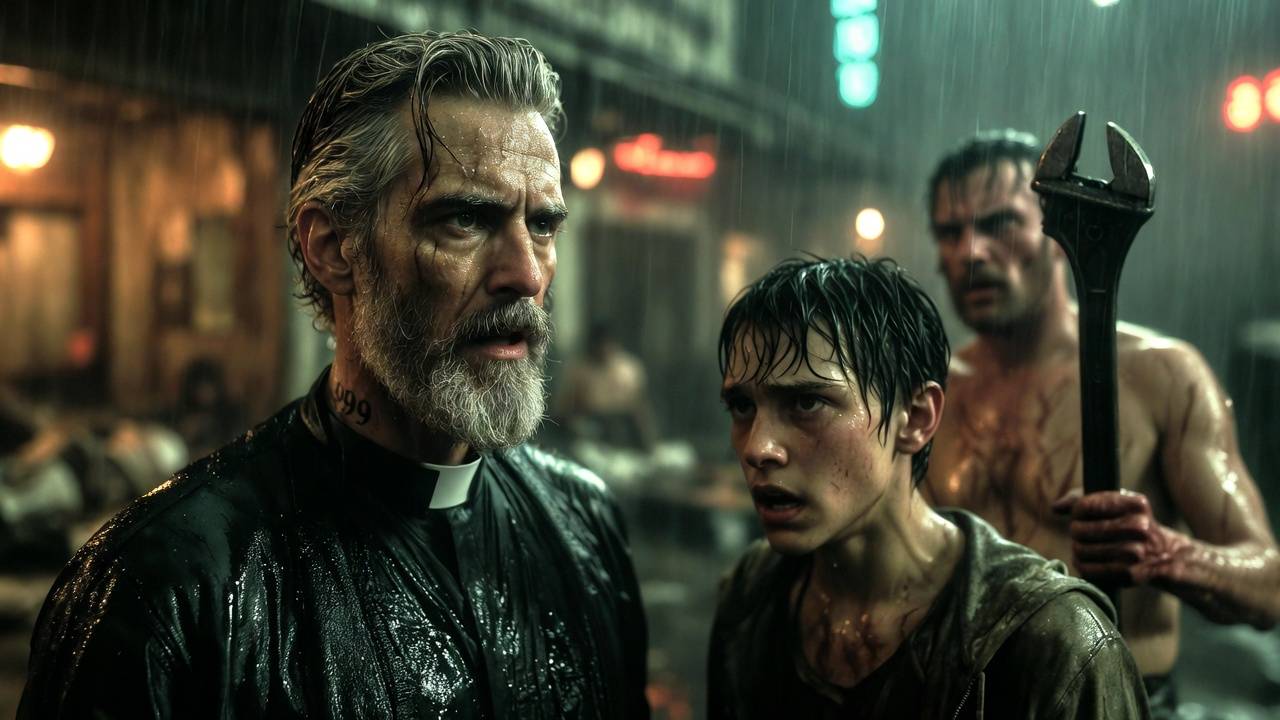
Chapter 5: Fire and Redemption
They drove me back to the mine, but we didn’t stop at the trailer. We drove further down, into the gut of the hollow, where an old ventilation shaft for the mine sat hidden behind a screen of weeping willows.
The air here was thick with the smell of ammonia and sulfur. The lab.
Silas was waiting outside, his calm demeanor replaced by a vibrating, terrifying rage. Next to him, Isaiah was tied to a chair, his face swollen, a strip of duct tape across his mouth.
“Do you have any idea what you’ve done?” Silas whispered as Deacon shoved me to my knees in the dirt. “That shipment was the lifeblood of this operation. You didn’t just steal from me, Stone. You burned my future.”
“Your future was built on the corpses of this town,” I said, coughing up a mouthful of blood. “I just gave it a head start on the cremation.”
Silas walked over to Isaiah. He pulled a small, silver lighter from his pocket and flicked it open. The flame danced in his eyes.
“You wanted to save his soul, didn’t you?” Silas asked. “You thought you could wash away your sins by playing hero. But here’s the truth, Elias: Some things don’t wash out. Some things have to be burned.”
He looked at the lab—a makeshift structure filled with pressurized tanks and volatile chemicals.
“Deacon,” Silas said. “Put them inside.”
“What?” Deacon blinked. “Silas, the whole place is a tinderbox. If we light it with them in there—”
“That’s the point,” Silas snapped. “I’m moving the operation to the next county. This place is compromised. We burn the evidence, we burn the traitor, and we burn the son of the man who dared to cross me. A clean slate.”
Isaiah’s eyes went wide. He started to thrash in the chair, a muffled scream vibrating against the tape.
They dragged us into the lab. The heat was already stifling. Vats of bubbling liquid hissed on hot plates. Tubes of blue and clear chemicals snaked across the floor like translucent intestines.
Deacon threw me into a corner, my hands zip-tied behind my back. They shoved Isaiah’s chair into the center of the room.
“See you in hell, Preacher,” Deacon said, a genuine sadness in his voice. He’d looked up to me once. In his own twisted way, I was the only father he’d ever had.
They stepped out, locking the heavy steel door from the outside.
Through the small, reinforced window, I saw Silas toss the lighter into a trail of gasoline they’d poured leading to the door.
Whoosh.
The fire raced toward us.
“Isaiah!” I screamed, struggling against the zip-ties. “Isaiah, look at me!”
The boy was panicked, his breath coming in jagged, terrifying gulps. The room was beginning to fill with a sweet, sickly smoke. In minutes, the heat would cause the tanks to rupture, and this whole hillside would become a crater.
I looked around the room. My ribs were screaming, and my vision was tunneling. I saw a jagged piece of metal—a discarded piece of a cooling rack—near the floor.
I threw myself toward it, the metal slicing into my wrists as I sawed at the plastic ties. The pain was secondary. The only thing that mattered was the boy in the chair.
Ten years ago, I walked away.
Today, I stay.
The zip-ties snapped. I didn’t wait to check the damage to my wrists. I lunged for Isaiah, ripping the tape from his mouth.
“Dad?” he gasped, the word finally coming out, fragile and broken.
“I’ve got you,” I said, fumbling with the ropes around his chest. “I’ve got you, son.”
“The door is locked,” Isaiah coughed, the smoke thickening. “We’re trapped.”
I looked at the back of the lab. There was a small ventilation fan built into the corrugated metal wall. It was too small for me. But it wasn’t too small for him.
“You’re going out through the fan,” I said, grabbing a heavy wrench from a workbench.
“What about you?”
“I’m right behind you,” I lied.
I smashed the fan housing, the metal screaming under the blows. I ripped the blades out, creating a jagged, narrow hole.
“Go! Now!”
I boosted him up. He scrambled into the opening, his thin frame barely squeezing through. He stopped, looking back at me, his face illuminated by the orange glow of the encroaching fire.
“You’re coming, right?”
I looked at the primary tank. The pressure gauge was in the red. The needle was vibrating.
“I love you, Isaiah,” I said. “I’m sorry it took me so long to say it.”
“Dad, no!”
I shoved him through. I heard him hit the ground on the other side.
I turned back to the room. The fire was at the door. I walked over to the main valve of the largest tank. I didn’t try to shut it. I opened it all the way.
If the lab was going to blow, I wanted to make sure it took Silas and his men with it.
I sat down on the floor, leaning against a cooling vat. I pulled the charred Bible from my waistband—I’d grabbed it from the SUV when they weren’t looking. I opened it to the middle, to the empty space where the gun had been.
I closed my eyes and began to pray. Not for my life. But for the boy on the other side of the wall.
The world turned white.
Chapter 6: The Last Sacrament
The explosion was felt all the way down in the valley. They say the sky over Blackwood Creek turned a brilliant, haunting green for a few seconds as the chemicals ignited.
Isaiah lay in the tall grass fifty yards away, the force of the blast having tossed him like a leaf. He watched as the ventilation shaft collapsed, the hillside folding in on itself in a roar of earth and flame. Silas’s trailer, the trucks, the men—everything was consumed in the inferno.
He sat there for hours, the rain returning to wash the soot from his face. He waited for a figure to emerge from the smoke. He waited for the man with the silver-flecked beard and the 999 tattoo to walk out, shaking off the ash like a resurrected saint.
But the mountain remained silent.
Three days later, a funeral was held at the Grace Church. It was a small affair. Sister Clara was there, her face a mask of grief. The congregation, the people who had seen their Preacher turn into a warrior, stood in the back, unsure of what to feel.
There was no body to bury. Just a wooden box filled with a few mementos Isaiah had found in the wreckage of the church office.
Isaiah stood at the pulpit. He was wearing a clean shirt, though his face was still mapped with bruises and scars. He looked older. The hollowed-out look in his eyes had been replaced by a quiet, heavy resolve.
He didn’t have a sermon. He didn’t have a scripture.
He reached into his pocket and pulled out a small, blackened object. It was the Bible. It had been found in the debris, miraculously unburnt at its core, though the edges were fused together by the heat.
“My father wasn’t a saint,” Isaiah said, his voice steady. “He was a man who broke things. He broke this town, he broke my mother, and he broke me.”
He looked down at the book in his hands.
“But in the end, he decided that the only thing left worth breaking was the chain he’d built. He gave me $500 and a prayer ten years ago. I thought they were worthless. But I realize now that the prayer wasn’t for me to be safe. It was a promise that one day, he’d come back to finish what he started.”
He opened the Bible. Inside the hollowed-out center, where the gun had once rested, there was now a single piece of paper. It was a bus ticket. To a city five hundred miles away. And a small, hand-written note.
The road to mercy is paved with the things we leave behind. Keep walking, son.
Isaiah stepped down from the pulpit. He didn’t say goodbye to anyone. He walked out of the church, past the spot where the clerical collar had been trampled into the mud, and headed toward the bus station.
He didn’t look back at the mountain. He didn’t look back at the ghosts.
He just kept walking, a broken boy carrying the weight of a father’s sacrifice, finally understanding that some debts can only be paid in blood, and some souls can only be saved by the fire.
He was the son of a cleaner, and for the first time in his life, he felt clean.