The scent of New York City theaters isn’t what people think. It’s not just rosewater and old mahogany; it’s the smell of dust, desperation, and the cold, metallic tang of hairspray.
I was standing in the wings of the Lyceum, my heart hammering against my ribs like a trapped bird. This was it. The senior showcase. The night that determined who got the Juilliard recommendations and who went home to a life of “what-ifs.”
I felt her before I saw her. Tiffany Vanderbilt. The name sounded like money, and she wore it like armor. She and her two shadows, Mia and Chloe, drifted toward me, smelling of expensive perfume and malice.
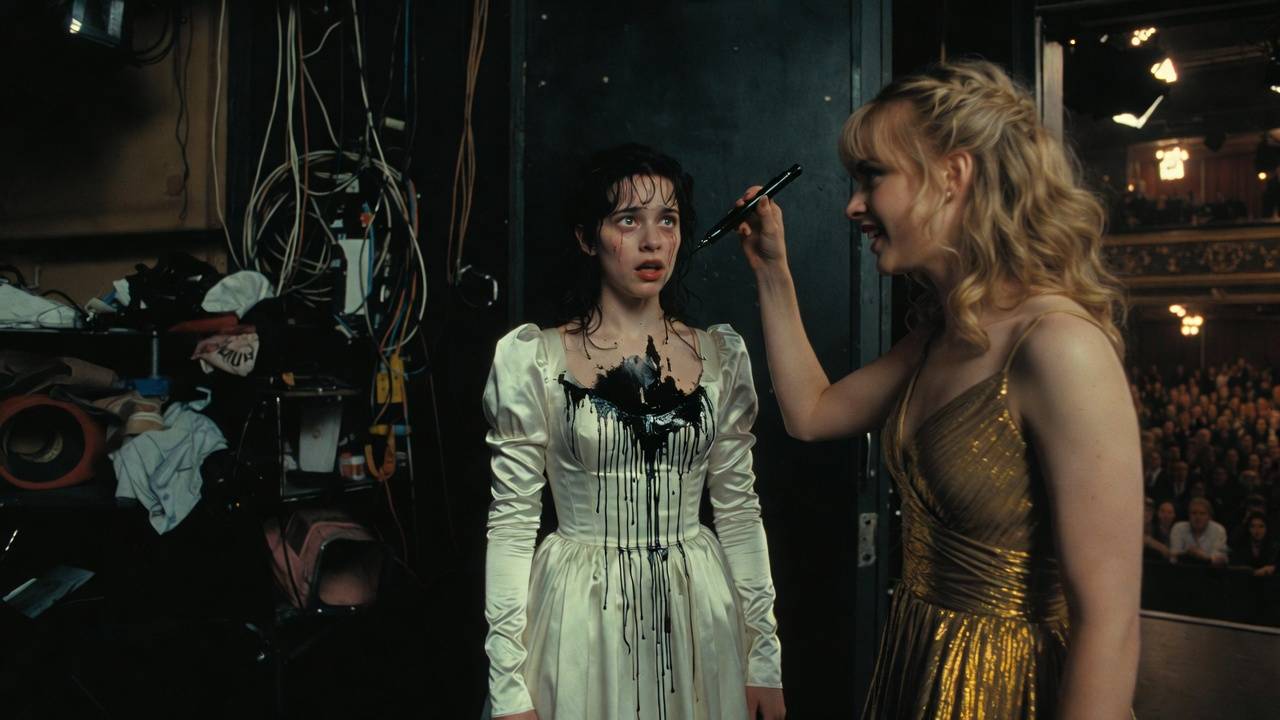
“Elara,” Tiffany purred, stepping into my personal space. She looked at my dress—a simple, elegant white silk gown my mother had spent three months’ wages on. “You look so… pure. It’s almost a shame.”
Before I could move, she lunged.
The fountain pen in her hand wasn’t just a pen; it was a weapon. She didn’t just splash me; she grabbed the bodice and dragged the nib across the silk, the thick, black permanent ink soaking through to my skin.
“There,” she whispered, her voice a poisonous needle in my ear. “You play Cinderella so well because you were born to be a slave to our spotlight. Don’t forget your place, charity case.”
They laughed—that high, tinkling sound that rich girls use to shatter souls—and vanished toward the stage.
I looked down. My mother’s sacrifice was a black, jagged mess. My hands started to shake. I wanted to crawl into the costume trunk and disappear. I wanted to die.
But then I saw my reflection in the vanity mirror. The ink wasn’t just a stain. It looked like a crack in a porcelain doll. It looked like the truth.
I heard the stage manager shout my name. “Elara! Thirty seconds! Where is your prop?”
I didn’t grab the glass slipper. I didn’t grab the wand. I grabbed the ink bottle Tiffany had left on the table and poured the rest of it over my hands, staining them charcoal black.
I wasn’t going to be their Cinderella anymore.
I walked out into the blinding white spotlight. I could see the front row. I saw Tiffany’s father, the Senator, and her mother, the “philanthropist,” sitting there with their perfect, plastic smiles.
I didn’t start the script. I looked directly at them, the ink dripping from my fingers onto the stage floor, and I began to speak.
Read the full story in the comments.
If you don’t see the new chapter, tap ‘All comments’.
FULL STORY
Chapter 2: The Sound of Silence
The silence in the Lyceum was unlike anything I had ever experienced. It wasn’t the respectful silence of an audience waiting to be entertained; it was the suffocating, heavy silence of a room full of people who had just seen a car crash and couldn’t look away.
I stood in the center of the stage, the white-hot spotlight turning the black ink on my dress into something that looked like rotting veins. I could feel the dampness of it against my chest, cold and mocking.
In the front row, Senator Vanderbilt shifted. His smile didn’t just fade; it disintegrated. Beside him, his wife, Diane, reached for her pearls, her knuckles turning as white as my dress used to be. They knew. They had to know that their daughter wasn’t just a “spirited young woman.” She was a monster they had fed with platinum spoons.
“The script says I’m supposed to tell you a story about a girl who loses her shoe and finds a kingdom,” I said, my voice projecting with a clarity that surprised even me. “But we all know that kingdoms aren’t found. They’re bought. And usually, they’re bought with the blood and the silence of people like me.”
I took a step forward, right to the edge of the apron. I saw Tiffany in the wings, her face a mask of panicked fury. She was gesturing wildly for the stage manager to cut the lights, to close the curtain, to do something. But the stage manager, a weary man named Marcus who had seen forty years of Vanderbilt “donations” buy lead roles for mediocre talent, didn’t move. He just watched me.
“My mother works two jobs,” I continued, my voice dropping to a jagged whisper that echoed in the rafters. “She’s a waitress at a diner in Queens by day and cleans the offices of Vanderbilt Enterprises by night. She bought this dress. She thought that if I looked like you, you might finally hear me.”
I raised my black-stained hands. “But Tiffany reminded me tonight that I’m just the help. And the help is supposed to keep things clean, isn’t it? We’re supposed to scrub away the stains so you can pretend the world is as perfect as your portraits.”
I saw a flash of movement. It was Chloe, Tiffany’s right hand, trying to sneak onto the side of the stage. I didn’t give her the chance.
“I have a different monologue tonight,” I said, abandoning the Shakespearean piece I had rehearsed for months. “It’s a story about a girl who watched her best friend get bullied out of this school last year. A girl who saw who pushed Sarah down those stairs. A girl who has the security footage because her mother was the one who found the thumb drive in the trash can of the Senator’s office.”
The air left the room. Senator Vanderbilt stood up, his face a deep, mottled purple. “That’s enough!” he barked, his voice booming through the theater. “Someone get this girl off the stage! She’s clearly had a breakdown!”
“Sit down, Arthur,” a voice rang out from the back of the house.
It was Mrs. Gable, the head of the Juilliard scholarship committee. She was standing, her arms crossed, her eyes narrowed behind thick spectacles. “I want to hear the rest of this performance. It’s the most honest thing I’ve seen on this stage in a decade.”
I looked at the Senator. He was trapped. If he left, he looked guilty. If he stayed, he had to listen to his world burn.
I took a deep breath, the scent of the ink filling my lungs. “Let’s talk about the price of a spotlight,” I whispered.
Chapter 3: The Ghost in the Wings
To understand how I got to that stage, you have to understand the three years of hell that preceded it. I wasn’t always the girl with the ink-stained dress. I was the girl who hid in the library, the girl who practiced her lines in the school’s boiler room because the rehearsal spaces were “reserved” for the girls who could afford private coaches.
When I first arrived at the St. Jude’s Academy for the Performing Arts on a full scholarship, I was naive enough to think that talent was the only currency that mattered. I met Sarah Jenkins on my first day. Sarah was a cellist with hands that seemed to create magic, but she had a stutter that made her an easy target.
Tiffany Vanderbilt saw Sarah as a threat—not because of her stutter, but because Sarah was better than her.
“She’s a charity case,” Tiffany would say, loud enough for the whole cafeteria to hear. “She’s only here so the school can get a tax break. Look at her shoes. I think my gardener wears the same pair.”
I stayed silent. I’m not proud of it. I watched as they put thumbtacks in Sarah’s chair. I watched as they poured salt into her instrument case. And then came the night of the Winter Gala.
Sarah was supposed to perform a solo. Ten minutes before she went on, someone pushed her down the marble staircase leading to the auditorium. She broke her wrist in three places. She never played the cello the same way again. The school called it an “unfortunate accident.” There were no witnesses. No cameras that “worked.”
Sarah left the school a week later, her dreams in tatters.
But what Tiffany didn’t know was that my mother, Maria, was cleaning the administrative wing that night. She had found a small, silver thumb drive lodged in the crevice of a sofa in Senator Vanderbilt’s private lounge—a lounge he used when he visited the school. On it was a backup of the “malfunctioning” security feed from the hallway.
My mother didn’t know what it was. She brought it home thinking it was mine. When we plugged it in, I saw it. I saw Tiffany Vanderbilt look around, smile, and shove Sarah Jenkins with both hands.
I held onto that secret for a year. I held onto it because I was afraid. I was afraid of losing my scholarship. I was afraid of the Senator’s reach. I was afraid of being Sarah.
But as I stood on that stage, looking at the black ink on my gown, I realized that I was already Sarah. I was already the girl they were trying to break.
“Tiffany Vanderbilt didn’t just ruin a dress tonight,” I said to the audience, my voice steady now. “She tried to erase a person. Just like she erased Sarah Jenkins. Just like this school erases anyone who doesn’t fit the ‘prestige’ brand.”
I saw Tiffany’s mother, Diane, start to sob into her silk handkerchief. It wasn’t a sob of guilt; it was a sob of social ruin. She knew the gossip columnists were in the balcony. She knew that by tomorrow, the Vanderbilt name would be synonymous with a hallway shove and a ruined girl.
“I used to think this theater was a temple,” I said, gesturing to the gold-leafed ceiling. “But it’s just a cage. And tonight, I’m breaking the locks.”
Chapter 4: The Unmasking
The climax of a play is usually where the hero wins. But in real life, the climax is where everyone loses something they can never get back.
As I finished my sentence, Tiffany finally snapped. She didn’t stay in the wings. She stormed onto the stage, her golden dress shimmering under the lights, making her look like a fallen angel.
“You’re a liar!” she screamed, her voice cracking. “You’re just a jealous, pathetic loser who wants what I have! My father pays for your books! My family keeps this school alive!”
The audience gasped. It was the one thing you never said out loud in the elite circles of New York—the transaction of power.
“Is that all I am, Tiffany?” I asked, turning to face her. “A line item in your father’s budget? A way for you to feel superior?”
“You’re nothing!” she shrieked. She lunged at me, her hands clawing for my face.
I didn’t move. I let her hit me. I let her fingers catch the collar of the ruined dress. The fabric tore—a sharp, violent sound that echoed through the sound system. She stood there, holding a piece of my white silk, her face contorted in a way that no amount of Botox or expensive skincare could hide.
She looked at her hands. They were covered in the black ink from my dress.
“Now you’re wearing it too,” I whispered.
The Senator was down in the aisle now, screaming for the guards. Two security men started toward the stage, but they were blocked by a group of students—the “other” kids. The scholarship kids, the tech crew, the kids who lived in the basement of the social hierarchy. They stood in the aisles, a wall of denim and flannel against the suits.
Marcus, the stage manager, finally spoke into his headset. “Leave them. Let her finish.”
I looked at Tiffany, who was now trembling. The reality of what she had done—on stage, in front of the board of directors, in front of the press—was sinking in.
“I have the footage, Tiffany,” I said, loud enough for the microphones to catch. “I have the video of what you did to Sarah. It’s already been sent to the New York Times. It was sent five minutes before I walked out here.”
That was the lie. I hadn’t sent it yet. I wanted to see her face when she thought the world was already gone.
She collapsed. Right there on the stage, in her thousand-dollar dress, she fell to her knees and began to howl. It wasn’t a pretty cry. It was the sound of a spoiled child realizing that for the first time in her life, daddy couldn’t fix it.
I looked out at the Senator. He looked old. For the first time, the power seemed to drain out of him, leaving behind just a man in an expensive suit who had raised a predator.
“This wasn’t about a dress,” I said to the silent, shocked crowd. “It was about the ink. We all have it on us. We just finally decided to stop pretending it’s not there.”