The air in the Sterling mansion always smelled like expensive lilies and bleach. It was a scent that made my lungs feel tight, a reminder that we were invited to be there, but never welcome to stay.
I was sitting in the corner of the “great room,” tucked behind a velvet armchair where I hoped I was invisible. I was twelve, and in a house that size, you learn quickly that being small is your only defense.
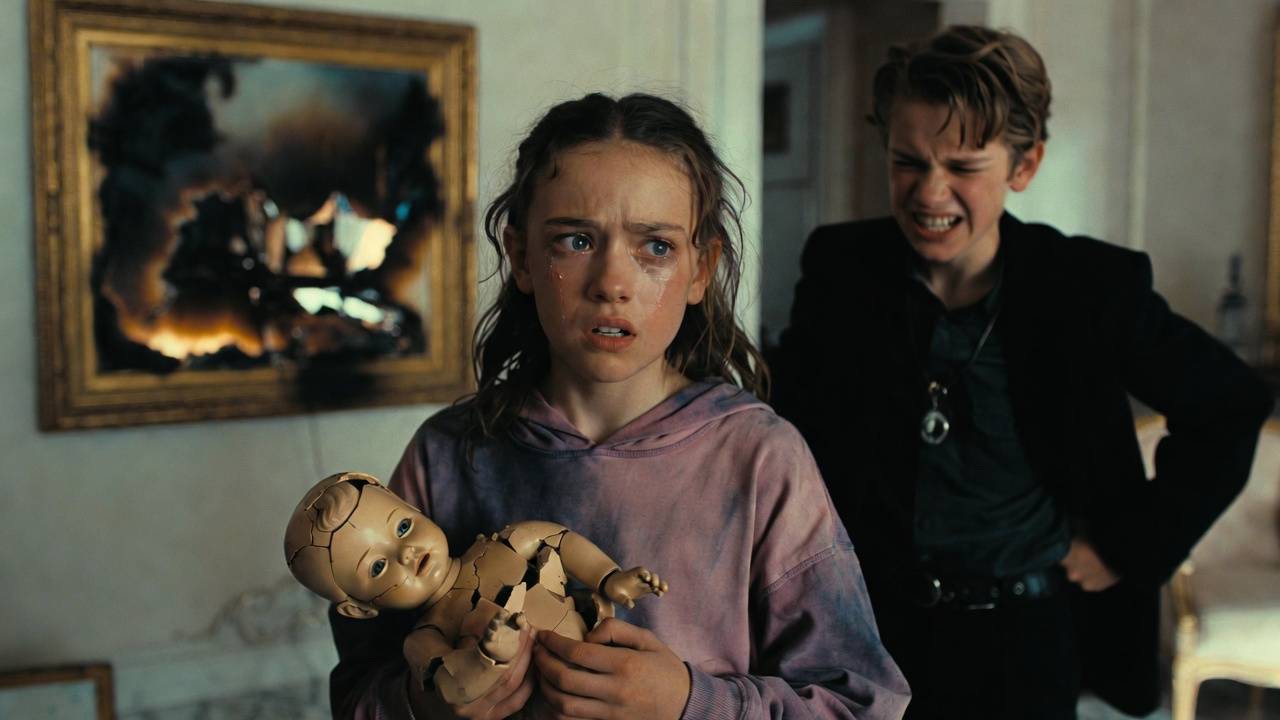
In my lap was Barnaby. He wasn’t a fancy doll. He was a patched-up ragdoll my mom had found at a Goodwill three years ago when she started this job. He had one button eye and a smell like lavender and home. He was my anchor.
Then I heard the floorboards creak. Not the heavy, confident step of Mr. Sterling, but the light, arrogant stride of Julian.
Julian was thirteen and born with a silver spoon that he used primarily to poke at people he thought were beneath him. Which, in his mind, was everyone.
“Still playing with garbage, Maya?”
I didn’t look up. I knew if I didn’t give him a reaction, he’d eventually get bored and go back to his Xbox. But today was different. Today, Julian had a frantic energy. His eyes were bloodshot, and he smelled faintly of something acrid—like smoke.
“Leave me alone, Julian,” I whispered.
“You don’t tell me what to do in my house,” he snapped. Before I could move, he reached down and snatched Barnaby out of my arms.
“Give him back!” I stood up, my heart hammering against my ribs.
He held the doll high above his head, laughing. “Look at this thing. It’s pathetic. Just like your mom, scrubbing the toilets while my dad pays for her life.”
He walked toward the marble staircase and held Barnaby over the railing. My breath hitched.
“Julian, please. Don’t.”
“Trash belongs with trash,” he sneered. “And you don’t deserve anything whole in this house.”
He didn’t just drop him. He threw him down with force. I watched in slow motion as Barnaby hit the marble floor fifteen feet below. There was a sickening crack—a sound a cloth doll shouldn’t make.
Julian leaned over the rail, looking down at the broken toy, his face twisted in a cruel grin. “Go pick up the pieces, maid-girl. It’s what you’re good at.”
I didn’t cry. Not yet. I walked down the stairs, every step feeling like I was moving through deep water. I reached the bottom and knelt beside Barnaby. His head was split open. The porcelain internal frame my mom had used to stiffen his neck was shattered.
But as I reached for him, I saw it.
A small, black metallic cylinder had rolled out of the stuffing. It was no bigger than a pea, nestled right where Barnaby’s missing button eye should have been.
I looked up. Julian was still at the top of the stairs, watching me, looking triumphant. He didn’t see the tiny red light blinking in my palm.
He also didn’t know that three hours ago, he had been in the East Wing gallery with a lighter and a bottle of turpentine, thinking he was alone when he set fire to his father’s prized 1920s original oil painting just to “see what would happen.”
He thought he could blame the “help.” He thought we were just background noise.
I gripped the tiny camera tight. My mother had put it there months ago because she was tired of being accused of stealing jewelry that Mrs. Sterling simply misplaced. She wanted protection.
What she got was a death sentence for Julian’s future.
I looked up at him and finally smiled. It wasn’t a nice smile. It was the smile of someone who had just found the match to start their own fire.
“You’re right, Julian,” I said, my voice steady for the first time. “Trash really does belong with trash. I can’t wait for your dad to see where you belong.”
Read the full story in the comments.
If you don’t see the new chapter, tap ‘All comments’.
FULL STORY
CHAPTER 2: THE WEIGHT OF SILENCE
To understand why my mother, Elena, had sewn a high-definition pinhole camera into a ragdoll, you have to understand what it’s like to live in a house where you are the first suspect for every lost earring.
The Sterlings lived in a world of “missing” things. Mrs. Sterling would leave a diamond tennis bracelet on the edge of a clawfoot tub, forget about it, and three hours later, the entire house would be under lockdown. My mother would be forced to turn out her pockets, her face burning with a shame that never quite washed off.
“It’s for our safety, Maya,” Mom had whispered two months ago as she carefully tucked the tech into Barnaby’s stuffing. “They see us, but they don’t look at us. This is our witness.”
I sat on the floor of the grand foyer now, the shattered remains of Barnaby in my lap. The house was unnervingly quiet. In the distance, I could hear the muffled sound of the industrial-grade air purifiers humming in the East Wing, trying to scrub the scent of charred canvas and oil paint from the air.
Julian had disappeared back into his room, likely convinced he had asserted his dominance. He had no idea the “maid-girl” was currently holding a microSD card that contained the destruction of his gilded life.
“Maya? What happened?”
It was Sarah, the nanny. She was sixty, with knees that clicked when she walked and eyes that had seen three generations of Sterling tantrums. she hurried over, her face softening when she saw the broken doll.
“Julian,” she sighed, kneeling beside me. “Oh, honey. I’ll try to sew him back together, okay?”
“He’s beyond sewing, Sarah,” I said, my voice sounding older than twelve.
“I’ll talk to his father. He shouldn’t be treating you this way.”
“Don’t,” I said, clutching the doll’s head. “Mr. Sterling is busy. The painting, remember?”
Sarah’s face went pale. The painting—a centerpiece of the Sterling collection—had been found scorched that morning. Mr. Sterling had spent the last four hours behind closed doors with the insurance adjusters and the private security team. The tension in the house was a physical weight. Everyone was waiting for the axe to fall.
And we all knew who the axe was aimed at.
My mother was currently in the kitchen, her hands trembling as she prepared a lunch no one would eat. She had been the one who “found” the fire, which in the eyes of a man like Alistair Sterling, was practically a confession.
I stood up, the microSD card hidden in the lining of my hoodie. “I’m going to see my mom.”
I walked through the labyrinthine hallways toward the kitchen. I passed Marcus, the security guard, who was standing near the gallery entrance. He looked at me with a pained expression. He liked my mom. He used to bring her coffee when the shifts were long.
“Maya,” he muttered. “Tell your mom to stay calm. They’re just asking questions.”
“Questions or accusations, Marcus?”
He didn’t answer. He just looked at the floor.
In the kitchen, my mother was staring at a cutting board. She wasn’t cutting anything. She just stood there, her shoulders hunched, looking smaller than I’d ever seen her.
“Mom,” I whispered.
She turned, and the look in her eyes broke me. It wasn’t fear of losing a job. It was the fear of losing her dignity.
“They’re saying I left a candle burning, Maya. They’re saying I was careless. Mr. Sterling… he told me the insurance might not cover it if it was gross negligence by staff. He said he’d sue us for everything we have.”
We had nothing. We had a ten-year-old Honda and a rented apartment in a neighborhood where the streetlights were usually shot out.
“He’s lying, Mom,” I said, stepping closer. “And Julian is the reason.”
I pulled the microSD card from my pocket and held it out. “Barnaby saw it. He saw everything.”
CHAPTER 3: THE MASTERPIECE ON FIRE
The footage was clearer than I expected.
I sat with my mother in the small, windowless “break room” tucked behind the pantry. We had my old, cracked-screen laptop open.
The video started at 10:15 AM. Barnaby had been sitting on the sideboard in the gallery—I’d left him there while I went to get a glass of water.
In the frame, the “Morning in the Orchard” painting glowed under the gallery lights. Then, Julian entered.
He didn’t look like a villain. He looked like a bored, angry kid. He was talking to someone on his phone, his voice loud and whiny.
“I don’t care about the gala, Dad! I’m not going!” he shouted into the phone. He paused, listening. “Fine! If you care about your stupid wall-trash more than me, then have the wall-trash!”
He hung up, his face red. He looked at the painting—the thing his father loved more than his own son. Julian grabbed a bottle of cleaning solvent from the supply cart my mother had left in the hall for a moment.
He didn’t hesitate. He sprayed the bottom of the canvas. He pulled a silver Zippo from his pocket—a gift he wasn’t supposed to have—and flicked it.
The “whump” of the flame catching was audible even through the doll’s stuffing. Julian watched it for exactly three seconds, his face illuminated by the orange glow. He looked terrified for a heartbeat, then his expression hardened into something cold. He turned and ran.
My mother gasped, her hand flying to her mouth. “Oh, Dios mío…”
“He did it on purpose, Mom. He framed you because he was mad at his dad.”
The door to the break room swung open. It was Marcus. He looked frantic.
“Elena, you need to come out. Now. Mr. Sterling has the police in the library. He’s making a formal statement about the ‘theft’ of the solvent and your ‘negligence’.”
My mother looked at the laptop, then at me. Her eyes were no longer filled with fear. They were filled with a cold, protective rage.
“Marcus,” she said, her voice like steel. “Tell Mr. Sterling we’ll be there in five minutes. And tell him to make sure the police have a way to play a video file.”
Marcus frowned. “What are you talking about?”
“Just tell him,” my mother said, closing the laptop.
She turned to me. “Maya, give me the card.”
“I’m coming with you,” I said.
“No, it’s going to be ugly.”
“He broke Barnaby,” I said, my voice trembling. “I want to be there when he breaks, too.”
My mother looked at me for a long beat, then nodded. She took my hand, her grip firm and calloused, and we walked out of the shadows of the kitchen and into the bright, suffocating light of the Sterling library.
CHAPTER 4: THE HUNT FOR A SCAPEGOAT
Alistair Sterling sat behind a desk made of wood that cost more than my mother’s lifetime earnings. Beside him stood two police officers, looking uncomfortable in the presence of so much wealth.
Julian was there, too, slumped in a leather chair, looking bored. He was playing with a loose thread on his cashmere sweater. When he saw me, he gave a tiny, mocking wink.
“Elena,” Mr. Sterling said, not looking up from a document. “I’ve been fair with you for ten years. But this… this is a loss of over 1.2 million dollars. The fire marshal says it started with a cleaning chemical. Your chemical.”
“I didn’t do it, Mr. Sterling,” my mother said.
“The evidence says otherwise,” he snapped, finally looking up. His eyes were cold blue ice. “You were the only one assigned to that wing. My son saw you leaving the area just before the smoke was detected.”
I looked at Julian. He didn’t blink. He was a professional liar.
“Is that true, Julian?” I asked.
The police officer cleared his throat. “Kid, let the adults talk.”
“No,” I said, stepping forward. “Julian, you told your dad you saw my mom? While you were throwing my doll off the balcony, or before that?”
“Maya, shut up,” Julian hissed.
“Enough,” Mr. Sterling roared. “Elena, I’m giving you one chance to sign this admission of liability. We won’t press criminal charges, but your wages will be garnished, and your bond will be forfeit. It’s the best you’re going to get.”
My mother didn’t reach for the pen. She reached for the laptop I was carrying.
“I have my own statement,” she said. She opened the screen and turned it toward the police officers and Mr. Sterling.
“This is from a security device we kept for our own protection,” she said. “Since the house cameras in the gallery were ‘mysteriously’ turned off for maintenance this morning.”
Mr. Sterling’s brow furrowed. Julian’s face went from pale to a sickly, translucent white.
“What is this?” Mr. Sterling asked.
“The truth,” I said.
I hit play.
The library went silent, save for the digital crackle of the flames on the screen. We watched as Julian sprayed the turpentine. We watched as he flicked the lighter. We watched the moment he decided to ruin my mother’s life to spite his father.
When the video ended, the silence was so heavy it felt like it was crushing the air out of the room.
One of the police officers turned his gaze toward Julian. “That’s a pretty distinctive hoodie the kid is wearing in the video. Looks like the one he’s wearing now.”
Mr. Sterling didn’t move. He looked at the screen, then at his son. His face didn’t show grief or disappointment. It showed a terrifying, cold realization. His “legacy” was a pyromaniac.
“Julian?” Mr. Sterling’s voice was a low growl.
“It… it was an accident,” Julian stammered, standing up. “I was just… she left the stuff out! It’s her fault for leaving it there!”
“You lit the match, Julian,” I said. “And then you smashed my doll because you thought I was too ‘trash’ to fight back.”