FULL STORY
CHAPTER 5: THE PRICE OF THE WIN
The media circus lasted for three days. My father, ever the strategist, pivoted. He stood in front of the cameras, smiling his million-dollar smile, and claimed that the “Community-Integrated Design” had been his idea all along—a “collaboration” with his son to show the heart of Vance Holdings.
He won the public’s favor. He won the contract.
But I lost a father.
He didn’t speak to me for weeks. I was moved out of my bedroom into a small apartment the company owned near the office. “If you want to be a man of the people,” he told me the day I moved out, “start by living like them.”
The court remained open during construction. It was a mess of scaffolding and dust, but the hoops stayed up.
One afternoon, I sat on the familiar bleachers, watching the progress. The library was rising—a sleek, glass structure that curved around the court like an embrace. It was exactly what I’d designed. It was beautiful. And it felt like a scar.
Jax walked over, tossing a ball from hand to hand. He looked different. He’d started taking night classes at the community college. Deon was with him, carrying a portfolio of drawings.
“The Ghost returns,” Jax said, a small, genuine smile tugging at his lips.
“Just checking the measurements,” I said.
“You look like hell, man. Heard your old man kicked you out.”
“He didn’t kick me out. He just… stopped being there. It’s a fair trade, I guess.”
Jax sat down next to me. “My mom always said, you can’t build something new without breaking some ground. Usually, that ground is your heart.”
He handed me the ball. “You ever gonna actually learn how to shoot, or are you just gonna keep drawing lines in the dirt?”
“I think I’m done drawing for a while.”
“Good. Because the neighborhood wants to throw a grand opening. They want you to give the speech.”
“I can’t do that, Jax. My dad… he’s the one on the plaque.”
“The plaque says Vance,” Jax said, looking at the building. “We know which Vance it’s talking about.”
I looked at the glass walls of the library. I could see the kids inside, sitting in the AC, reading books. And through the glass, they could see the court, where the ball was still bouncing.
I had saved the court, but I had broken my family. I had won the war, but I was a refugee in my own life.
As the sun began to set, casting that same golden Brooklyn glow over the asphalt, I realized that reality wasn’t something you hide from in books. It was something you wrote, one difficult choice at a time.
FULL STORY
CHAPTER 6: THE FINAL LINE
Two years later.
The Vance Community Library and Courts was the pride of the borough. It was the only place in the city where you could find a PhD student and a street-baller sharing the same bench.
I was finishing my final year of architecture school. I didn’t live in a brownstone anymore. I lived in a cramped studio in Bed-Stuy, paid for by a scholarship I’d earned on my own merit.
It was the day of the annual “Unity Tournament.” The court was packed. The smell of grilled hot dogs and the sound of hip-hop filled the air.
I stood at the edge of the fence, watching the game. Jax was coaching a team of teenagers, including Deon, who was now the starting point guard for his high school.
A shadow fell over me. I didn’t need to turn around to know who it was. I knew the smell of the cologne and the weight of the silence.
“It’s a good building, Leo,” my father said.
He looked older. The gray had moved from his temples to his entire head. He wasn’t wearing a suit; he was wearing a sweater and khakis. He looked… human.
“Thanks, Dad,” I said, my heart pounding. It was the first time we’d spoken in eighteen months.
“The board was happy with the final numbers. It’s the most successful project we’ve ever launched. High engagement, high public approval.” He paused, looking at the court. “I was wrong about the sentiment. It turns out, sentiment is a very stable foundation.”
I looked at him, searching for the anger, the resentment. But all I saw was a man trying to find a way back to his son.
“I’m sorry about the way I handled it,” he said, his voice low. “I forgot that I didn’t just build things. I was supposed to build a life for you.”
“You did, Dad. You just didn’t realize I needed to draw the plans myself.”
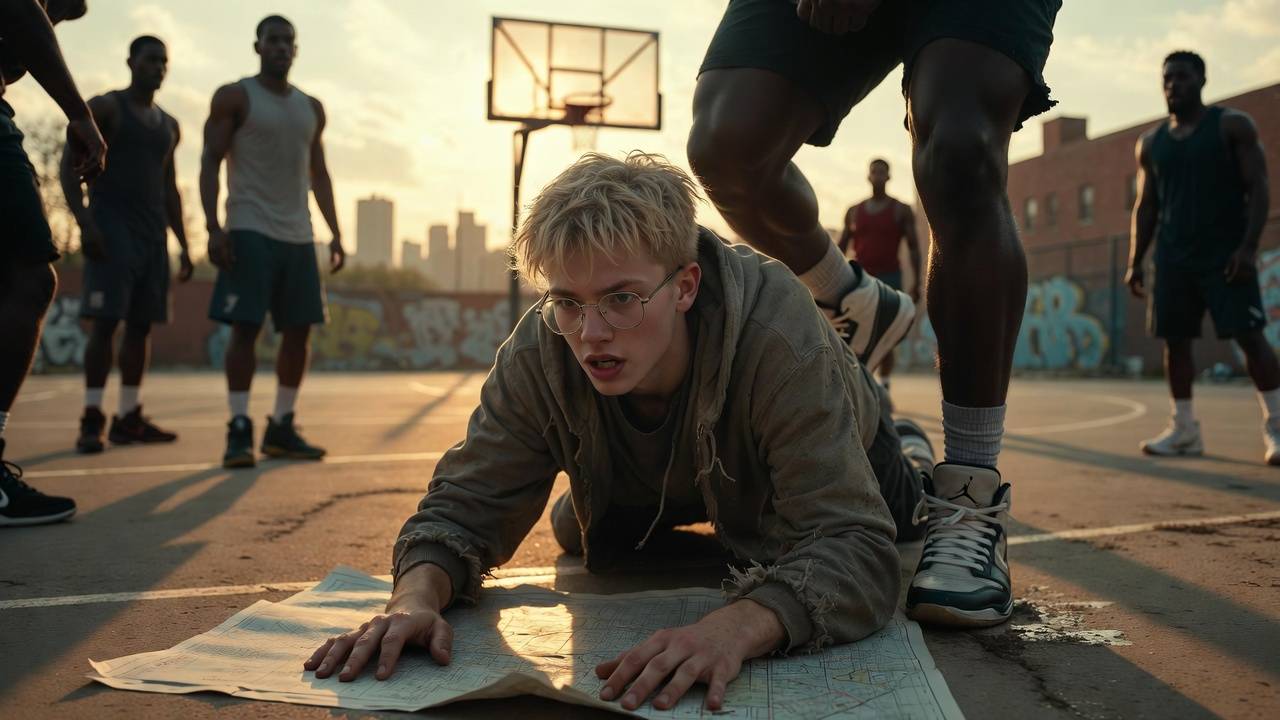
He reached into his pocket and pulled out a small, worn-out piece of paper. It was the map. The one I’d used to wipe Jax’s shoes. It was stained with dirt and blue ink, the edges frayed.
“I kept this,” he said. “To remind me that the most important lines aren’t the ones on the deed, but the ones we refuse to cross.”
He handed it to me.
“I’d like you to come home, Leo. Not to the firm. Not to the legacy. Just home. We have a lot of empty rooms, and your mother… she misses the ‘dramatic’ version of you.”
I took the map. I felt the grit of the court still embedded in the fibers.
Jax noticed us from across the court. He raised a hand in a silent salute. I raised mine back.
I looked at my father, and then at the neighborhood that had become my family when my own had fractured. The world was still loud, still messy, and still changing every second. But standing there, on the edge of the court I had bled for, I realized that I wasn’t lost anymore.
I wasn’t the “Ghost” hiding in books. I was the architect of my own heart.
I took my father’s hand, and as we walked away from the court, I heard the rhythmic thud-thud-thud of the ball behind us.
The heartbeat was still strong, and for the first time, I was perfectly in sync with the rhythm.
Home isn’t a place you buy; it’s the ground you’re willing to stand on when everyone else tells you to move.