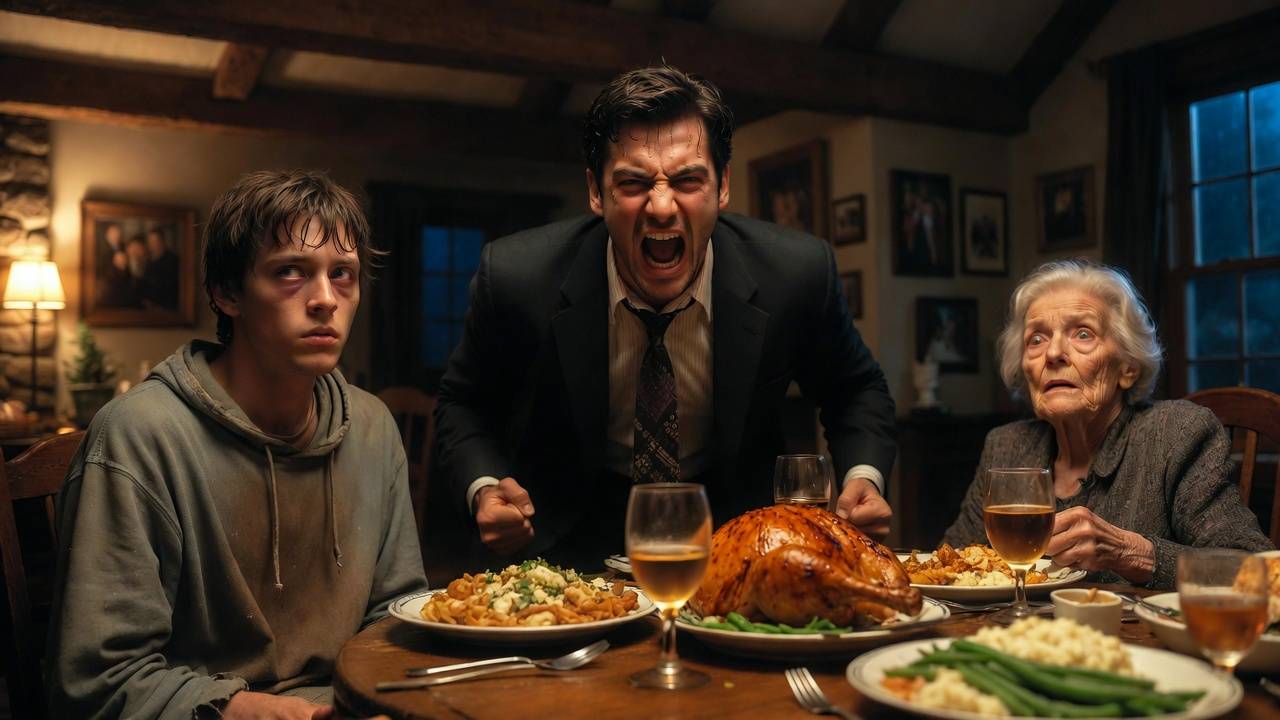
The steam rising from the turkey smelled like a lie. In our family, we don’t pass the salt; we pass judgment. But this year, the price of the meal was more than any of us could afford.
My cousin Marcus sat across from me, his $2,000 suit looking tight around his neck, his eyes darting like a man trapped in a burning building. He spent the last decade being the “Golden Boy” of the Vance family—the software architect, the high-flier, the one who “made it out” of our dusty corner of Georgia.
Then there was me. Leo. The “failure.” The one who dropped out of college to sit in a darkened room, fighting a depression that felt like drowning in dry land.
“Pass the stuffing, Leo,” Marcus said, his voice dripping with a casual cruelty he’d perfected over years of corporate ladder-climbing. “If you can manage that without having a breakdown, of course.”
The table went silent. Grandma Evelyn adjusted her glasses, her hands shaking. My sister, Sarah, reached out to touch my arm, but I pulled away. I wasn’t fragile today. I was just… done.
“Marcus, leave him be,” Sarah whispered. “It’s Thanksgiving.”
“No, Sarah, let’s be real for once,” Marcus snapped, standing up. He looked at the peeling wallpaper of the house we grew up in—the house Grandma was about to lose because of the unpaid taxes and a predatory mortgage. “We’re all sitting here pretending everything is fine while the ship is sinking. And why? Because we’re carrying dead weight.”
He pointed a finger at me, his face twisting into something ugly. “You’re the only debt this family can’t pay off, Leo. A total failure. You’ve lived off Grandma’s kindness for three years while I’ve been out there actually providing. And now, because of people like you, we’re all going to lose this roof over our heads.”
I looked at him. Really looked at him. I saw the fraying threads on his cuffs. I saw the way he hadn’t touched his expensive wine.
I didn’t say a word. I just reached into my pocket.
The silence in the room was so thick you could hear the pine trees groaning in the Georgia wind outside. I pulled out a single piece of paper, folded into thirds. I slid it across the table, over the gravy stains and the cranberry sauce.
“What is this?” Marcus sneered, grabbing it. “A suicide note? A bill for your therapy?”
He opened it. His face didn’t just go pale; it went gray. Like ash.
“That’s the mortgage receipt, Marcus,” I said, my voice sounding foreign even to me. “Paid in full. Every cent. The back taxes, too.”
“How?” Marcus stammered, his hands beginning to shake. “Where did you get—this is three hundred thousand dollars.”
I leaned forward, the shadows of the room finally feeling like home. “I sold the rights to the ‘Hydra’ encryption patch last week. The one your firm, Vanguard Tech, spent eighteen months trying to crack. The one they fired you for failing to secure two days ago.”
The room gasped. Marcus collapsed back into his chair, the “Golden Boy” finally losing his shine.
“You’re not the provider, Marcus,” I whispered. “You’re just the one who forgot that silence doesn’t mean empty. It means listening.”
Read the full story in the comments.
If you don’t see the new chapter, tap ‘All comments’.
FULL STORY
CHAPTER 2: THE GHOST IN THE ROOM
The aftermath of my revelation didn’t bring the immediate explosion I expected. Instead, it brought a silence so profound it felt like the house itself was holding its breath. The Vance family home, a sprawling, creaky Victorian in the heart of Oconee County, Georgia, had seen its share of tragedies—wars, droughts, and the slow, agonizing decline of the Southern middle class. But it had never seen Marcus Vance speechless.
Marcus stared at the paper. His eyes scanned the “PAID IN FULL” stamp over and over, as if looking for a typo, a forgery, or a way out. Beside him, his wife, Chloe, was frozen. Chloe was a woman who lived for the optics; her Instagram was a curated gallery of “blessed” moments and “boss babe” quotes. Seeing her husband publicly dismantled was like watching her brand go up in flames.
“Leo…” Grandma Evelyn’s voice broke the spell. She reached out, her thin, papery fingers touching the edge of the receipt. “Honey, what did you do?”
“I saved the house, Nana,” I said, and for the first time in three years, I felt the weight on my chest lighten just a fraction. “I couldn’t let them take it. Not after everything you did for me.”
“The Hydra patch?” Marcus finally spoke, his voice a ragged whisper. He looked up, his eyes bloodshot. “That was you? ‘Null_Pointer’? That was your handle on the forums?”
I nodded. To the world, I was the guy who couldn’t hold down a job at the local Best Buy. In the dark, hidden corners of the cybersecurity world, I was a legend. I had spent my “depressed” years not just staring at the wall, but building a recursive encryption algorithm that shouldn’t have been possible. I called it Hydra because every time a hacker tried to cut off a head, two more grew in its place.
Marcus’s firm, Vanguard Tech, had been the lead contractor for the Department of Defense. They had been tasked with creating the patch. Marcus had been the lead engineer. He had mocked me at every family gathering for years, calling me a “basement-dweller” while he was supposedly the architect of the future.
“They fired me because I told them the math was impossible,” Marcus said, his voice rising in pitch. “I told the board that no one could write that code. I told them the person who did it was probably a state-sponsored actor in Russia or China!”
“I’m not a state-sponsored actor, Marcus,” I said, taking a slow sip of water. “I’m just your cousin from Oconee. The one you said was a debt the family couldn’t pay off.”
The irony was a bitter pill, and Marcus was choking on it. He had spent the last decade building a persona based on being the smartest man in any room. He had used that status to bully Sarah, to patronize Uncle Ben, and to make me feel like a parasite.
Uncle Ben, Marcus’s father, sat at the end of the table. He was a man of few words, a retired mechanic with grease permanently etched into the lines of his palms. He looked at his son, then at me. There was a look of profound disappointment in his eyes—not in me, but in the monster he had raised.
“Sit down, Marcus,” Ben said firmly.
“Dad, you don’t understand—”
“I said sit down!” Ben roared, his voice echoing off the high ceilings. “You come into this house, you insult your kin, you brag about money you don’t even have anymore, and you mock a boy who was struggling? All while you were failing at the very thing you claimed made you better than us?”
Marcus sank into his chair. He looked small. The $2,000 suit didn’t look like armor anymore; it looked like a costume.
The tension in the room was shifting. It wasn’t just about the money anymore. It was about the decade of secrets and wounds that were finally being flayed open. Sarah, the nurse who had spent her weekends bringing me groceries and checking my pulse when I couldn’t get out of bed, was crying quietly.
“Leo, why didn’t you tell me?” she asked. “I thought… I thought you were dying.”
“I was, Sarah,” I said, and the honesty hurt. “But the code was the only thing that felt real. I didn’t do it for the money. I did it because it was the only problem I could solve when I couldn’t solve myself.”
I looked at Marcus. The “Golden Boy” was staring at his plate, but he wasn’t seeing the food. He was seeing the end of his career. If Vanguard Tech found out that the man who broke their “impossible” problem was the cousin of the man they just fired—the cousin Marcus had consistently belittled—the humiliation would be total.
But I wasn’t done. Because the mortgage wasn’t the only secret in this room.
CHAPTER 3: THE FOUNDATION OF LIES
As the meal continued in an agonizing, clinking silence, the atmosphere changed from a confrontation to a wake. Chloe tried to break the tension by talking about their upcoming trip to Aspen, but Marcus snapped at her to be quiet. He knew, even if she didn’t, that there would be no Aspen. There would be no bonus. There would likely be a lawsuit.
“So,” Marcus said, his voice regaining some of its venom as he tried to regain his footing. “You’re a millionaire now, Leo? Is that the story? You’ve been sitting in that room, watching us struggle, watching Nana worry herself sick about this house, just so you could have a ‘big reveal’ at dinner? That’s pretty sick, isn’t it?”
It was a classic Marcus move: projection. If he couldn’t be the hero, he would make me the villain.
“I didn’t get the payout until Tuesday, Marcus,” I said calmly. “And I didn’t spend three years ‘watching you struggle.’ I spent three years watching you pretend you were the one saving everyone.”
I turned to Grandma Evelyn. “Nana, did Marcus tell you about the ‘investment’ he made with your savings last year?”
The table went stiller, if that was even possible. Grandma Evelyn looked confused. “The college fund for the great-grandkids? Marcus said he put it in a high-yield tech fund.”
I looked at Marcus. He was white-knuckling his steak knife so hard his hand was shaking.
“It wasn’t a tech fund, Nana,” I said. “Marcus used your savings to cover his margin calls when his personal portfolio crashed in the spring. He didn’t ‘invest’ it. He gambled it to save his own skin so no one would know he was broke.”
“That’s a lie!” Chloe screamed, standing up. “Marcus is a Senior VP! He doesn’t need Nana’s money!”
“He was a Senior VP,” I corrected. “And yes, he did. I’ve been tracking the blockchain movements of the Vance Family Trust. I’m a coder, remember? Hiding a digital trail from me is like trying to hide a parade from a bird’s eye view.”
Uncle Ben looked at Marcus. “Son? Is this true?”
Marcus didn’t answer. He couldn’t. The truth was written in the way he wouldn’t meet his father’s eyes.
“You stole from your own grandmother?” Sarah’s voice was full of horror. “While you were standing here calling Leo a debt? You were the one stealing the foundation out from under us?”
“I was going to pay it back!” Marcus suddenly exploded, his chair flying backward as he stood. “I just needed the Hydra project to go through! If I had cracked that code, my options would have vested, and I would have tripled that money! I was doing it for the family!”
“No,” Ben said, standing up to face his son. “You were doing it for yourself. You were doing it so you could keep driving that German car and wearing those suits and looking down on everyone who actually puts in a day’s work.”
Ben walked over to the sideboard and picked up the mortgage receipt Leo had placed there. He looked at it for a long time, then looked at me.
“Leo,” Ben said, his voice thick with emotion. “I owe you an apology. I thought you were… I thought you’d given up. I didn’t see what was happening right under my nose.”
“It’s okay, Uncle Ben,” I said. “I didn’t want to be seen.”
“Well, we see you now,” Ben said. He turned back to Marcus. “As for you… you’re going to leave this house. Right now. You’re going to go home, you’re going to find a way to put every cent back into your grandmother’s account, or I will be the one calling the police. I don’t care if you’re my son.”
“Dad, you can’t be serious,” Marcus pleaded. “It’s Thanksgiving! Where are we supposed to go?”
“I hear there’s a nice Motel 6 by the interstate,” I said softly. “It’s cheap. Since you’re so worried about debt, it should suit you perfectly.”
Marcus looked around the room, searching for an ally. He found none. Not even Chloe, who was already busy checking her own bank balance on her phone, her face a mask of cold realization.
As Marcus and Chloe gathered their things in a whirlwind of hushed arguments and slammed doors, the rest of us stayed at the table. The “Golden Boy” was gone, leaving behind nothing but the cold smell of expensive cologne and the ruins of a reputation.
But the real climax wasn’t the expulsion of the villain. It was the moment I realized that even with the money and the house saved, the hole in my chest hadn’t quite filled up yet.
CHAPTER 4: THE WEIGHT OF SURVIVAL
The sound of Marcus’s car tires crunching over the gravel driveway faded into the Georgia night. Inside, the house felt strangely large, as if a localized storm system had finally passed.
Grandma Evelyn sat at the head of the table, her hands resting on the lace tablecloth. She looked older than she had an hour ago, but also more peaceful. The fear of the “For Sale” sign on the lawn had been a shadow over her life for months, a shadow she had tried to hide from us.
“Leo,” she whispered. “Come here, sugar.”
I got up and walked to her, kneeling beside her chair. She smelled like flour and lavender. She took my face in her hands, her skin feeling like silk.
“You’ve been carrying so much,” she said. “All that time in the dark… were you doing it for me?”
“I was doing it because I didn’t know how to be a person, Nana,” I admitted, the words catching in my throat. “I felt like a ghost. I thought if I could just solve one big thing, maybe I’d deserve to stay.”
“Oh, Leo,” Sarah said, coming over to join us. She put a hand on my shoulder. “You didn’t have to buy your way into this family. You were already the heart of it. We were just too busy listening to Marcus’s noise to hear you.”
This was the part the viral stories don’t usually tell you. The “hero” doesn’t just feel great after the revelation. The hero feels exhausted. The adrenaline that had sustained me through the confrontation was draining away, leaving behind the raw ache of three years of isolation.
Uncle Ben sat back down, picking up a drumstick. “Well,” he said, trying to inject some normalcy into the room. “The turkey’s cold, the gravy’s congealed, and my son is a crook. Anyone want some pie?”
We laughed, a brittle, shaky sound that slowly turned into real warmth. We moved to the living room, where a fire was crackling in the hearth. For the next few hours, we didn’t talk about software or mortgages or Marcus. We talked about the time Sarah tried to dye the cat blue, and the way Grandpa used to whistle when he was working in the garden.
But as the night wore on, I found myself wandering out onto the back porch. The Georgia air was crisp, the smell of damp earth and pine needles heavy in the breeze. I leaned against the railing, looking out at the woods I used to play in as a child.
I heard the screen door creak open. It was Uncle Ben. He joined me at the rail, lighting a cigarette—a habit he only indulged in during moments of extreme stress.
“You know,” Ben said, blowing a cloud of smoke into the dark. “Marcus wasn’t always like that. When he was a kid, he’d give you the shirt off his back. Somewhere along the way, he got it into his head that if he wasn’t the best, he was nothing. I blame myself for that. I pushed him too hard.”
“It wasn’t you, Ben,” I said. “The world tells men like Marcus that their value is equal to their net worth. He just believed the lie more than most.”
“And you?” Ben asked, looking at me. “What do you believe your value is?”
I looked at my hands. They were the hands of a man who spent his life behind a screen, but tonight, they had saved a home.
“I think I’m still figuring that out,” I said. “But for the first time, I think I’d like to do it out here. In the light.”
“Good,” Ben said, patting my back. “Because I’ve got a 1972 Chevy in the garage that needs a new wiring harness, and I’ve got a feeling your brain is just the one to figure it out.”
I smiled. It was the first real smile I’d had in years. Not a smirk, not a mask. Just a smile.
But the night had one last surprise for me. My phone buzzed in my pocket. It was an email from the CEO of Vanguard Tech.