CHAPTER 5
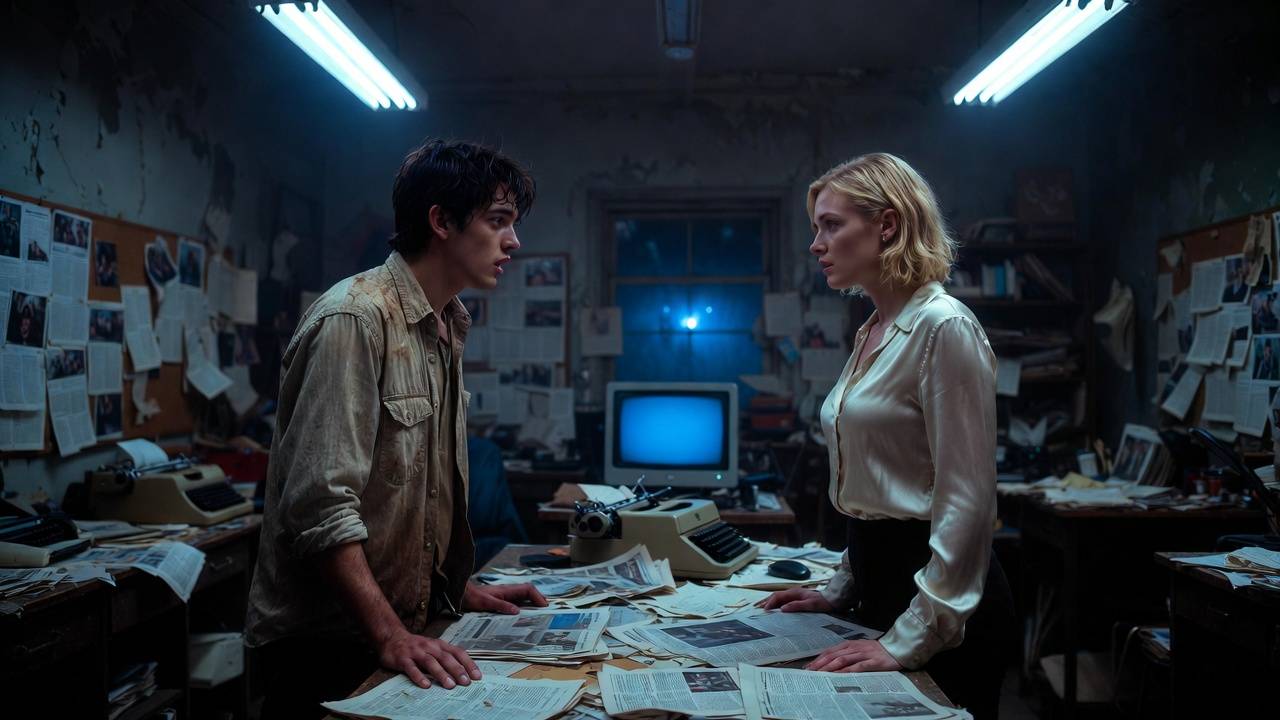
The final confrontation didn’t happen in a dark alley. It happened in the middle of the newsroom, right where it all started.
It was 4:30 PM. The school was mostly empty, save for the janitors and the late-stayers. Sarah was sitting at her desk, her head in her hands. Marcus and I stood by the door.
The door burst open. Principal Miller walked in, his face purple with rage. He didn’t even look at me. He went straight to Sarah.
“Did you get them?” he barked.
Sarah didn’t look up. “He’s got it all, Phil. He’s got the ledger. He’s got Marcus’s video of me confessing.”
Miller turned to me. He looked like he wanted to kill me. He stepped into my personal space, trying to use his size to crush my resolve.
“Give me those envelopes, Leo. Now. I’ll make you a deal. You walk away, I’ll personally fund your college. Anywhere you want to go. State, Ivy, doesn’t matter. I’ll make the ‘problems’ with your mother’s taxes go away. Just give me the paper.”
I looked at him. I looked at the man who had traded the integrity of an entire school for a bigger paycheck and a new stadium.
“You told me my truth wasn’t worth the peace, Principal Miller,” I said, my voice steady for the first time in my life. “You told me to go write about pets.”
I reached into the envelope and pulled out a single sheet of paper. It wasn’t the ledger. It was a mock-up of the front page I’d designed.
The headline read: THE COST OF SILENCE: HOW OAKRIDGE HIGH WAS BOUGHT AND SOLD.
“This is going to be on the front page of the Philadelphia Inquirer tomorrow morning,” I said. “And the digital version? It’s already live. I hit ‘publish’ on the way up the stairs.”
Miller lunged for me, but Marcus stepped in the way. Marcus was a linebacker’s size, even if he wasn’t allowed to play anymore. He didn’t move an inch.
“It’s over,” Marcus said.
Miller stopped. He looked at the computer on Sarah’s desk. He walked over and typed in the URL for the state’s largest newspaper.
There it was. His face. Sarah’s face. The photos of the stadium funds. The stories of the benched players.
The room went deathly silent. The only sound was the hum of the computers—the same computers Sarah had used to delete my work.
Sarah started to cry. Not a quiet, dignified cry, but a ragged, ugly sob. She realized that the “peace” she had fought so hard for was gone forever. Her “perfect” life was a wreckage.
Miller just sat down. He looked old. He looked small. He looked like exactly what he was: a thief who had been caught.
I walked over to Sarah’s desk. I picked up the printed hard copy of the corruption report—the physical evidence of their greed.
“You were right about one thing, Sarah,” I whispered, so only she could hear. “People do love a story about pets. But they love a story about a stray dog who bites back even more.”
I turned and walked out of the newsroom. I didn’t look back at the trophies, the blue monitors, or the girl who thought she could decide what the truth was.
I walked out of the school and into the cold Pennsylvania air. Marcus was beside me. We didn’t say anything. We didn’t need to.
The world was about to wake up to a very different Oakridge.
CHAPTER 6
The fallout was a hurricane.
By the time I got home that night, the police were at the school. By the next morning, Principal Miller had been placed on administrative leave, which lasted exactly six hours before he was arrested for embezzlement and fraud.
The Sterling family’s construction company was raided by the FBI two days later. The “Platinum Donor” wing of the hospital was quietly renamed.
Sarah didn’t show up for graduation. I heard she moved to her aunt’s house in Chicago. Her “Preferred Admission” to Columbia was rescinded within forty-eight hours of the Inquirer article hitting the stands.
But the real change happened in the West End.
A week after the story broke, the school board held an emergency meeting. Coach Miller was fired. Coach Higgins was promoted to head coach. And for the first time in the history of Oakridge High, the starting lineup was chosen on the field, not in a boardroom.
My mom sat me down the night the arrests were announced. She looked tired, her hands red from the laundry chemicals, but she was smiling.
“I was scared, Leo,” she said, holding my hand. “When Miller called me, I was so scared. But I’m proud of you. You didn’t let them turn you into one of them.”
“I couldn’t, Mom,” I said. “If I stayed quiet, I wouldn’t be your son.”
I went back to the newsroom one last time to pick up my things. The school was quiet. The “peace” was gone, replaced by a strange, buzzing energy. People were talking. People were angry. But for the first time, people were being honest.
I found Mrs. Gable in the office. She was packing up her desk. She’d resigned, citing a “sudden desire to travel.”
“You did a good thing, kid,” she said, handing me a small, leather-bound notebook. “Most people spend their whole lives waiting for someone else to tell the truth. You decided to be the one to say it.”
“It cost a lot of people a lot of things,” I said, looking at Sarah’s empty chair.
“The truth usually does,” she replied. “But lies cost even more. They just send the bill later.”
I walked out to the football field. Marcus was there, throwing a ball with some of the younger kids. He saw me and waved. He looked lighter. He looked like he could breathe again.
I looked up at the scoreboard. It was dark, but I knew what it represented now. It wasn’t just a game. It was a mirror. And if the mirror is dirty, you don’t break it—you clean it until you can see yourself clearly.
I realized then that I didn’t need a fancy office or a “Platinum” name to matter. I just needed my voice and the courage to use it when the world tried to drown it out.
I took a deep breath of the cool, evening air. The story was over, but the work was just beginning.
Because the truth isn’t something you find once; it’s something you have to fight for every single day.
Real peace isn’t the absence of conflict; it’s the presence of justice, and sometimes you have to break the silence to hear the heart of the world.