CHAPTER 5: THE CRACKED MIRROR
The night of the Winter Showcase, Lincoln Center was a sea of black ties and silk dresses. The air was thick with the scent of expensive perfume and the electric hum of anticipation. This was the night that careers were made.
Backstage, the tension was a physical weight. Marcus was pacing, his violin tucked under his arm, looking like a predator before a hunt. He didn’t even look at me. He didn’t need to. In his mind, I was already erased.
“Five minutes,” the stage manager whispered.
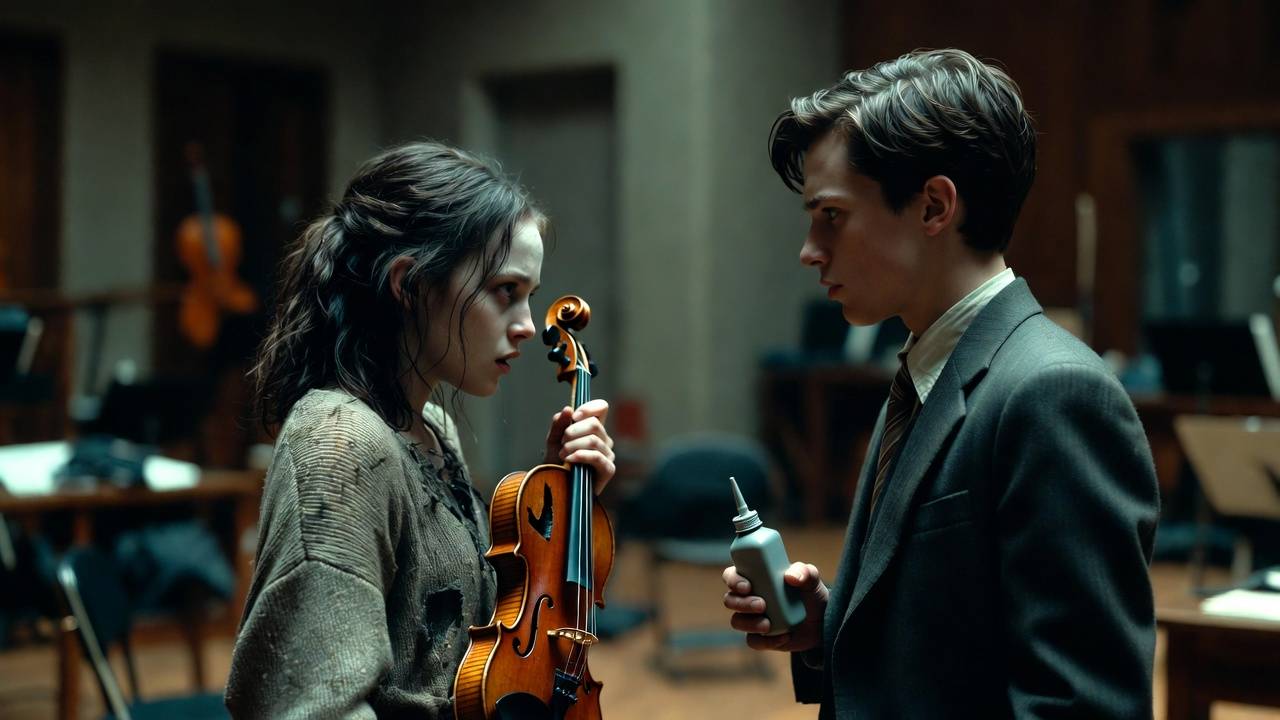
I looked at my violin. I had cleaned it as best I could, but the wood was stained, the finish stripped away in patches where the glue had been. It looked like a survivor.
We took the stage to thunderous applause. The lights were blinding, white-hot circles that turned the audience into a dark, breathing ocean. I took my seat in the second row, second chair. I was a “nobody” again.
Mrs. Gable raised her baton. The symphony began.
We played the opening movements with a hollow perfection. It was beautiful, but it felt like a museum piece—pretty to look at, but cold to the touch. Then, it was time for the solo.
Marcus stepped forward. He stood at the front of the stage, the light hitting him like a crown. He began to play. It was flawless. Every trill, every shift, every vibrato was exactly where the textbook said it should be. The audience was mesmerized by the technique.
But as he reached the climax of the piece, I saw it. A string on his violin—the E string—started to fray. He had tuned it too tight, his ego pushing the instrument further than the physics of the gut and steel could handle.
Snap.
The sound was like a gunshot in the silent hall.
Marcus froze. The orchestra faltered. Mrs. Gable’s baton wavered. The audience gasped. It was a performer’s worst nightmare, a moment of pure, unadulterated failure in front of the people who mattered most.
Marcus looked at his violin, his face turning a ghostly white. He looked at the audience, then at Mrs. Gable. He was a boy lost in the woods.
The silence that followed was heavy. It was the silence of a dream dying.
I stood up.
I didn’t grab my bow. I didn’t look at Marcus. I walked past him to the very edge of the stage, the ruined violin still in my left hand.
“Elena, what are you doing?” Mrs. Gable hissed from the podium.
I didn’t answer her. I looked out into the dark, into the eyes of a thousand strangers, and I saw my mother sitting in the tenth row, her hands pressed against her heart.
I closed my eyes. I didn’t think about the violin. I didn’t think about Marcus. I thought about the girl who wasn’t there to finish her song.
And then, I opened my mouth.
CHAPTER 6: THE VOICE OF THE STORM
The first note didn’t sound like a human voice. It sounded like a bell ringing in a deep canyon. It was a soprano note so pure, so high, and so fragile that it felt like it might shatter the chandeliers.
The auditorium went from silent to breathless.
I began to sing The Caged Nightingale. I sang the melody Clara had written, the one that sounded like summer mornings and shared secrets. I sang for the sister who was a better half of me, and for the girl I had been pretending to be for three years.
As I reached the part where the sheet music had gone blank—the part I had written in the middle of the night—the tone changed. It became darker, more powerful. It wasn’t an angel singing anymore; it was a woman claiming her soul.
I sang the betrayal of the glue. I sang the weight of the shadow. I sang the truth that Marcus Thorne would never understand: that music isn’t about being perfect. It’s about being honest.
I could feel the orchestra behind me beginning to follow. Mrs. Gable, a woman of iron, didn’t stop me. She raised her baton and, with a subtle movement of her wrist, signaled the cellos to join. Leo was the first. He played a deep, grounding rhythm that supported my voice like a foundation.
Then the violas. Then the woodwinds.
We weren’t playing the program anymore. We were playing the truth.
Marcus stood off to the side, his broken violin forgotten. He looked at me, and for the first time, I didn’t see a villain. I saw a boy who realized that all the money in the world couldn’t buy the thing I had just found for free.
I hit the final note—a crescendo that felt like it was tearing through the roof of the building, reaching for the stars over Manhattan. And then, I let it go.
The silence that followed wasn’t like the one after Marcus’s string snapped. This was a sacred silence. A silence of awe.
Then, the world exploded.
The standing ovation wasn’t just a polite gesture; it was a roar. People were crying. My mother was standing on her chair, tears streaming down her face. Mrs. Gable walked over to me, took my hand, and bowed with me.
Backstage, after the madness, Marcus was sitting on a equipment trunk, staring at the floor. Sarah was nowhere to be found.
“You’re not noise,” Marcus said, his voice barely a whisper. He didn’t look up. “I was wrong. You’re the only thing in this room that’s real.”
I looked at my ruined violin. I realized I didn’t need to play it anymore. I had found Clara’s voice, but in doing so, I had finally found my own. I wasn’t her shadow. I was her legacy.
Leo walked up to me and handed me a single white rose. “So,” he said, a rare smile breaking across his face. “I guess we’re looking for a vocal coach now?”
I laughed, and the sound felt light. It felt like the air after a fever breaks. I walked out of Lincoln Center, into the cold New York night, and for the first time in my life, I wasn’t afraid of the noise.
I am the song that survives the silence, and I will never be quiet again.