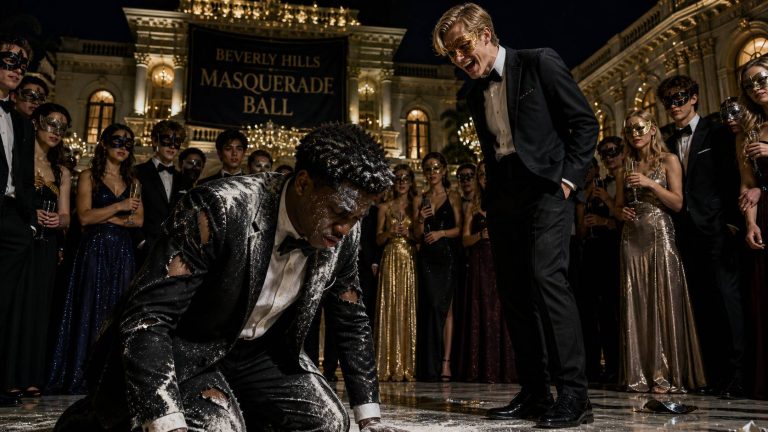
Chapter 1: The Cobalt Blue Baptism
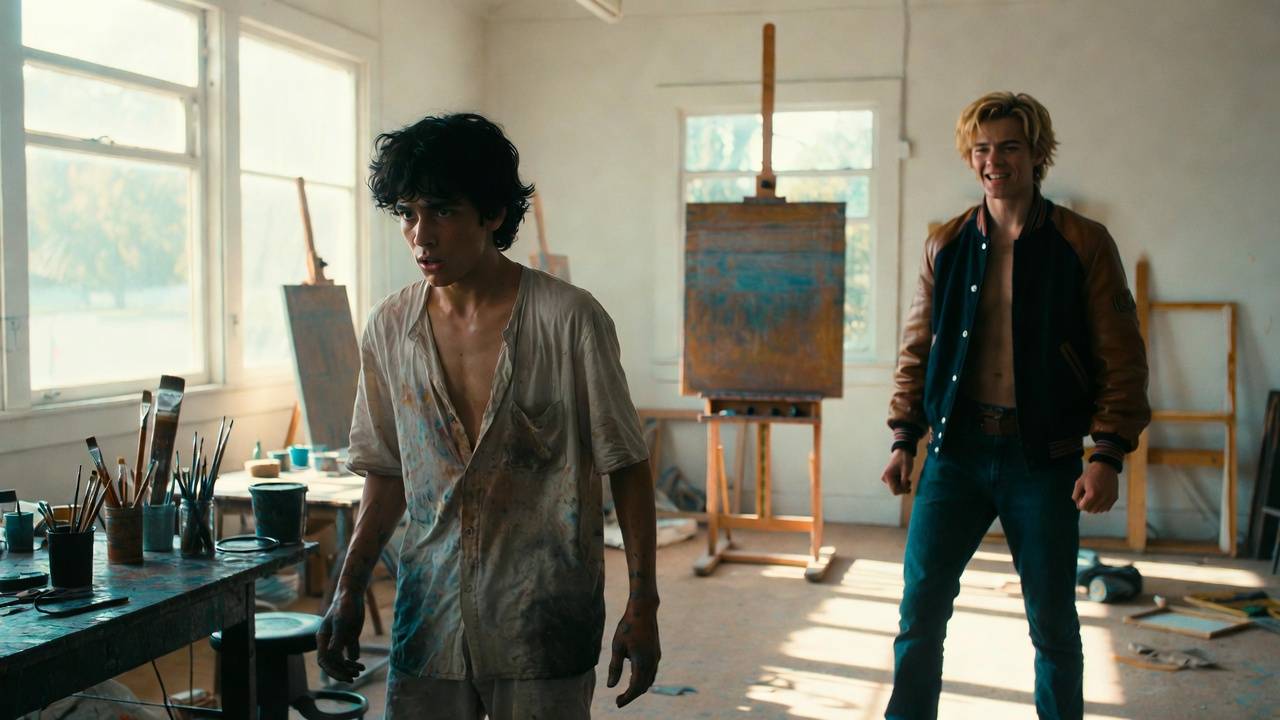
The air in the Oakridge High art studio always smelled like a cocktail of turpentine, floor wax, and the desperate, suffocating ambition of kids who were told they were “gifted” before they could even tie their shoes. It was 3:15 PM, that golden hour in California where the sun bleeds through the floor-to-ceiling windows, making everything look like a movie set. But for me, it felt like a cage.
I sat at Table 4, my back to the door, my fingers stained with the Ochre of the Oaxaca soil my father still talked about in his sleep. I was seventeen, a “scholarship kid,” which was the polite American way of saying I was the help’s son who happened to be able to paint like Caravaggio.
I was working on the final textures of my submission for the National Arts Merit. It was supposed to be a secret. Mr. Henderson, the only teacher who didn’t look through me like I was made of glass, had given me a corner and a tarp. “Keep it covered, Leo,” he’d whispered, his breath smelling of peppermint and stale coffee. “Talent like yours is a target.”
I didn’t listen. Not well enough.
The silence of the room didn’t break; it shattered. It started with the rhythmic thump-thump of a basketball being dribbled against the linoleum—a sound that, in this school, was the equivalent of a shark’s fin cutting the water.
“Hey, Picasso.”
I didn’t turn around. I knew that voice. It was deep, textured like expensive leather, and carried the weight of three generations of Sterling family money. Jackson Sterling. The Golden Boy. The quarterback who was supposedly the pride of the county, though I only ever saw a boy who looked like he was vibrating at a frequency of pure, unrefined rage.
“I’m busy, Jax,” I said, my voice steady. It was a lie. My heart was a trapped bird hitting its wings against my ribs.
“Busy doing what? Drawing more dirt? More ‘struggle’?” Jax was standing over me now. He was joined by his usual shadows—two offensive linemen whose names I never bothered to learn and a girl named Chloe who lived her entire life through a phone screen.
The “Third Party,” as I called them. The spectators. They weren’t the ones who hit you, but they were the ones who made sure your humiliation was archived in 4K.
Jax reached out and grabbed my jar of Cobalt Blue. It was the most expensive pigment I owned, bought with three weeks of my father’s overtime pay at the car wash.
“You know, Leo,” Jax said, his eyes scanning the room, making sure he had his audience. He looked at the phone cameras pointed our way and offered a predatory wink. “We really appreciate you coming here. Enriching our culture and all that. But you seem a little… dull. You don’t really represent the American spirit yet.”
“Give it back, Jax,” I said, finally standing up.
He was six inches taller than me, a wall of muscle and privilege. He looked down at the jar, then at me. Then, with a slow, deliberate motion, he dipped his entire palm into the thick, gooey paint.
“This is how we help you blend in with our flag,” he sneered.
He slammed his hand onto my face.
The coldness of the paint was a shock, a wet, suffocating mask that filled my nostrils and stung my eyes. I heard the collective gasp of the room, followed immediately by the “ohhhh” of twenty teenagers who had just witnessed a social execution.
“There,” Jax laughed, wiping his hand on my white t-shirt, leaving a smear of blue across my chest like a sash. “Now you’re one of the ‘Blue’ states. You like that, don’t you?”
The room erupted. Laughter. Shuffling feet. The clicking of shutters. No one stepped forward. Not the teacher—he had stepped out to the office. Not Maya, my only friend, who sat three tables away, her knuckles white as she gripped her sketchbook.
I stood there, blue paint dripping from my chin onto my shoes, the taste of chemicals on my tongue. I could have swung. I could have screamed. But instead, I looked at Jax.
For the first time, I didn’t look at the bully. I looked at the subject.
I saw the way his hand was shaking. I saw the faint, yellowish bruise peeking out from under the collar of his varsity jacket—a mark that didn’t come from a football field. I saw the hollow terror in his eyes that he was trying so hard to drown in Blue paint.
“You missed a spot,” I whispered.
Jax’s laugh died. “What?”
I reached back and grabbed the tarp covering my canvas. With one motion, I ripped it away.
“I’ve been watching you, Jax. Every day for six months. While you were watching me to make sure I knew my place, I was watching you to see who you really were.”
The circle of students pressed closer. The cameras zoomed in.
On the canvas wasn’t a landscape. It wasn’t “dirt.” It was a portrait.
It was Jax. But it wasn’t the Jax who stood in front of us. It was a Jax who was curled in a corner, his face a map of agony, his eyes leaking tears that looked more real than the paint on my own face. In the background of the painting, a shadow loomed—a shadow wearing a heavy gold ring, the exact same ring Jax’s father, the Honorable Judge Sterling, wore to every town hall meeting.
The silence that followed was so heavy it felt like it would crack the floor.
Jax didn’t move. He didn’t speak. The color drained from his face until he was the same shade as the canvas.
“You think this blue paint hides who I am?” I asked, stepping toward him, my face a mask of cobalt. “It doesn’t. But your jacket? Your money? Your father’s name? They don’t hide you either. I see you, Jackson. I see everything.”
Read the full story in the comments.
If you don’t see the new chapter, tap ‘All comments’.
FULL STORY
Chapter 2: The Boy from the Shadows
The aftermath of the “Art Room Reveal” wasn’t an explosion; it was a slow-motion car crash. Jax didn’t hit me. He didn’t even yell. He looked at the painting, then at the circle of his peers who were now looking at him with a new, hungry kind of curiosity. Then he turned and walked out of the studio, his gait stiff, his shoulders hunched as if he were trying to disappear inside his own skin.
I spent the next hour in the school bathroom, scrubbing the blue pigment from my pores. It didn’t want to leave. It clung to my hairline and under my fingernails, a permanent reminder of my “baptism.”
“Leo?”
I looked up to see Maya standing at the door of the boy’s room. She looked terrified.
“He’s going to kill you,” she whispered.
“He’s too scared to kill me,” I replied, splashing cold water on my face. “The painting is in Henderson’s office now. Locked up. He saw it when he came back.”
Maya stepped inside, leaning against the sinks. “My parents saw the video, Leo. It’s already on the community Facebook page. People are… they’re talking. Not about you. About the Judge.”
That was the problem. In Oakridge, Judge Sterling wasn’t just a man; he was an institution. He decided who went to jail, who got their zoning permits, and who got the local scholarships. My father, Eduardo, worked at the car wash three blocks from the courthouse. If the Judge was angry, my father didn’t just lose his job—we lost our lives.
“Why did you do it?” Maya asked, her voice trembling. “You could have just painted a flower, Leo. You could have gotten your A and moved on.”
“Because I’m tired of being the only one who’s honest,” I said, finally looking at her. My face was red from scrubbing, but the blue was mostly gone. “He thinks he can smear me because I’m easy to replace. He thinks because I have a different accent, I don’t have eyes. I wanted him to know that I’m the one who records the truth.”
That night, my father was late coming home. I sat in our small apartment, the air thick with the smell of fried onions and the sound of the neighbor’s TV through the thin walls. When he finally walked in, he didn’t look angry. He looked exhausted.
“The Judge came by the wash,” he said, not looking at me. He sat at the small kitchen table and began unlacing his boots.
My heart stopped. “What did he say?”
“Nothing to me,” Eduardo said. “He just sat in his black Mercedes and watched me scrub the tires. For twenty minutes. Then he drove away. Leo… what did you do at school today?”
I told him. I told him about the paint, about the flag comment, and about the portrait. I expected him to be afraid. I expected him to tell me to apologize.
Instead, he looked at his calloused, soapy hands.
“I came to this country so you could speak,” he said softly. “But I didn’t think you would speak so loud they’d hear you in the courthouse.”
“Are you mad?”
“I am worried,” he said. “The Sterling family doesn’t lose, Leo. They just find new ways to win.”
Chapter 3: The Rule of the Third Party
The next three days at Oakridge High were surreal. I was no longer the “invisible immigrant.” I was a local celebrity, but not the kind anyone wanted to sit with. In the cafeteria, a ten-foot radius of empty chairs followed me wherever I went.
The Third Party—the student body—was in a state of frantic observation. They didn’t support me, and they didn’t support Jax. They were waiting to see who would bleed first. It was the “Crowd Effect” I had studied in my concept sketches: when a tragedy happens, most people don’t help; they just adjust their lenses for a better angle.
Jax was absent. Rumors swirled like toxic dust. Some said he was at a private clinic. Others said he was locked in his room. The most persistent rumor was that Judge Sterling had “handled” the situation and that I was going to be expelled by Monday.
Mr. Henderson called me into his office during my free period. The portrait of Jax was propped up on a chair, covered by a black cloth.
“The school board wants me to destroy this, Leo,” Henderson said, his voice sounding older than usual. He was a man who had once dreamed of being in the MoMA but settled for teaching teenagers how to draw fruit.
“Will you?” I asked.
“I told them it was a ‘study of human emotion’ and that destroying it would be a violation of your First Amendment rights. But Leo… look at me.”
I looked.
“Art is a mirror. But if you show people a monster, they don’t blame the monster. They blame the person who held up the glass. The Judge has friends on the Board. They’re looking at your father’s immigration status. They’re looking at your scholarship application.”
“So I should have let him paint my face?” I snapped.
“No,” Henderson said. “But you should have known that in this town, the truth is a luxury you can’t afford.”
That afternoon, Maya found me by the lockers. She looked like she hadn’t slept.
“Jax is back,” she whispered. “He’s in the gym. He told me to tell you… he wants to talk. Alone.”
“It’s a trap,” I said.
“Probably,” Maya said, her eyes darting around. “But Leo, he looked… different. He didn’t look like the Golden Boy. He looked like the boy in your painting.”
Chapter 4: The Moral Choice
The gym smelled of sweat, stale popcorn, and the muffled echoes of a life I didn’t belong to. Jax was sitting on the bottom bleacher, his varsity jacket gone, wearing just a grey t-shirt. Even from the doorway, I could see the new marks. A dark, ugly purple bloom on his left temple.
“You’re a really good artist,” he said, his voice echoing in the empty space. He didn’t look up as I approached.
“I know,” I said, stopping ten feet away.
“My dad saw the video. Not the one of me putting paint on you. He saw the one where you showed the painting. The one where everyone was talking about the ‘bruises’ you drew.”
Jax finally looked up. His eye was swollen nearly shut.
“He said I disgraced the family name by letting a ‘nobody’ see through me. He said if I didn’t make it right, I wouldn’t have a family name anymore.”
Jax stood up, his legs shaking. He reached into his pocket and pulled out a thick envelope.
“There’s five thousand dollars in here,” he said, his voice cracking. “My dad wants you to sign a statement saying the painting was a ‘creative exercise.’ That I volunteered to be the subject. That the bruises were ‘artistic interpretation’ and not based on reality.”
I looked at the envelope. It was more money than my father made in four months. It was the ticket to the art supplies I needed, the application fees for the big schools, the security we had never had.
“And if I don’t?”
“Then he files a police report saying you stole the blue paint. He has the receipts. He says you’ve been harassing me, and he’ll use his influence to make sure your father’s work permit is ‘reviewed’.”
It was the classic American choice: the truth or the dream.
“You’re asking me to lie for the man who does that to you?” I gestured to his eye.
Jax’s face contorted. For a second, I thought he was going to cry. “He’s my father, Leo. In this world, you protect your own. Even if they’re monsters.”
I looked at Jax, really looked at him. I saw the weakness. I saw the fear. And I saw the perpetrator he was destined to become if I didn’t stop the cycle.
“Keep the money, Jax,” I said.
“You’re signing?” He looked relieved.
“No,” I said. “I’m going to the police. Not about the paint. About the painting.”