Chapter 5
The trial of The People vs. Tyler Sterling became a national obsession.
It wasn’t just about the detergent anymore. It was about the “Affluenza” defense. Tyler’s lawyers argued that he was a victim of “toxic high-pressure environments” and that the “prank” was a result of a brain not yet fully developed.
Julian had to take the stand. He had to watch the video again, projected on a 50-inch screen in a cold courtroom. He had to hear his own gagging sounds amplified through speakers. He saw Tyler sitting at the defense table, wearing a modest suit, looking like a choir boy.
“Mr. Sterling,” the defense attorney began, “isn’t it true that you had been drinking that night? That you weren’t in your right mind?”
Julian looked the lawyer in the eye. “I was sober. I remember every second. I remember the smell. I remember the laughter. Tyler wasn’t drunk; he was bored. He was so bored with his own perfection that he needed to break something just to see if he could.”
The courtroom went silent.
“He didn’t see me as a person,” Julian continued, his voice steadying. “He saw me as a prop. And when you treat people like props, you don’t get to act surprised when the stage collapses on you.”
The turning point came when Sarah took the stand. She testified about the months of racist “jokes” in their private group chats. She showed the court the messages where Tyler and his friends joked about “cleaning up the neighborhood” by making Julian “wash his insides.”
The “prank” defense disintegrated.
The jury didn’t take long. Guilty of felony assault with a hate crime enhancement.
As the verdict was read, Tyler finally broke. He didn’t look like a king anymore. He looked like a terrified child. He turned to his father, screaming, “You said you’d fix it! You said money fixes everything!”
Mr. Sterling didn’t look at his son. He was looking at his phone, watching his company’s stock price plummet in real-time. The “Sterling” name was officially radioactive.
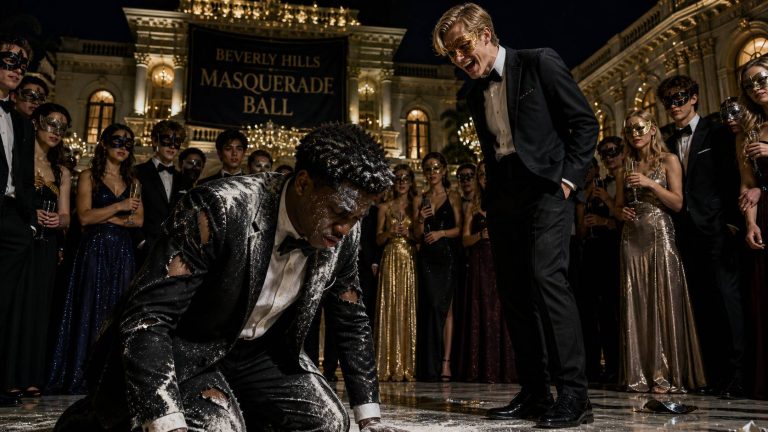
Tyler was sentenced to three years in a state facility. It wasn’t the life he’d planned. There would be no rowing team, no secret societies, no “legacy” to hide behind. Just a concrete cell and the memory of a blue bottle.
Chapter 6
Six months later, the dust had finally settled.
Julian was standing in his bedroom, packing a suitcase. His Stanford hoodie felt soft against his skin—not a gift of guilt, but a prize he had earned with his own mind.
The school district had been forced to implement a zero-tolerance policy for bullying, and three board members had resigned. Julian hadn’t taken the bribe, but his civil suit had eventually settled for an amount that allowed his mother to retire three years early.
There was a knock on the door. It was Marcus.
“Ready to go, man?” Marcus asked. He was going to a local state college, but he’d promised to drive Julian to the airport.
“Yeah,” Julian said. “Just one last thing.”
He walked into the kitchen. His mother was sitting at the table, drinking tea. She looked ten years younger. The lines of worry that had defined her face for a decade had softened.
“I’m proud of you,” she said, standing up to hug him. “Not because of where you’re going. But because of who you stayed.”
Julian stepped out onto the porch. The California air still smelled like salt, but the “money” smell was gone. It just smelled like the ocean. Like a fresh start.
He pulled out his phone. He hadn’t posted on social media since the night of the party. He took a photo of his packed bags and the morning sun hitting the driveway.
He didn’t mention Tyler. He didn’t mention the video. He didn’t mention the blue liquid.
He just wrote: “The weight of their hate was heavy, but the strength of my truth was heavier.”
He hit ‘Post’ and walked toward the car. He didn’t look back to see how many likes it got. He didn’t need the world to watch him anymore; he was finally busy living his own life.
Because in the end, the greatest revenge isn’t seeing your enemy fall—it’s realizing you no longer care enough to watch them hit the ground.