The air in the Lincoln Center rehearsal hall always smelled like expensive rosin and old, judgmental wood. I was used to the stares. I was used to the way the security guards followed me a little too closely until they saw the scholarship badge pinned to my jacket.
But tonight was supposed to be different. Tonight was the Soloist Showcase.
I stood in the wings, my heart thumping a rhythm against my ribs that only I could truly feel. I reached for my case, my fingers itching to touch the 1920s Italian violin that had been my only friend since I was six years old.
That’s when I saw them.
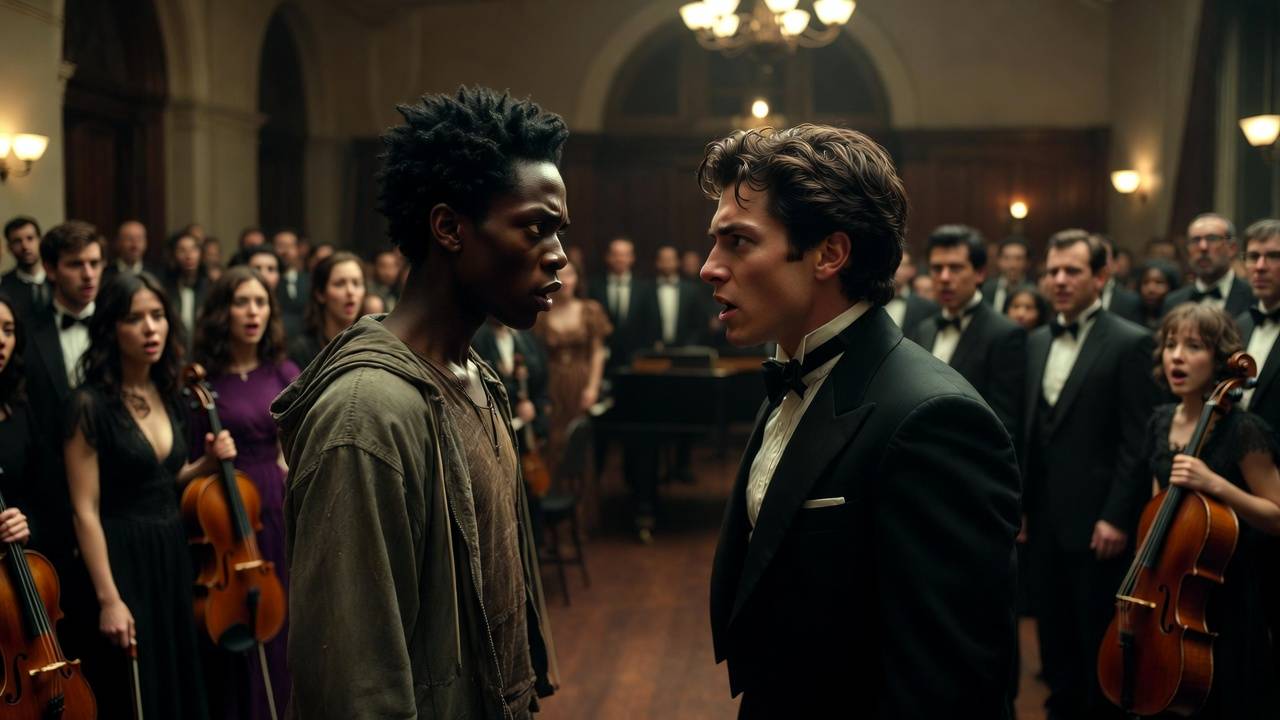
Julian stood there, flanked by his two shadows. Julian, whose father had donated a wing to the conservatory. Julian, whose technique was perfect but whose soul was as hollow as a plastic drum.
He held my violin in one hand. In the other, a pair of heavy industrial shears.
“What are you doing?” I didn’t say it. I couldn’t. I just stood there, my breath hitching in my throat.
Julian didn’t flinch. With a sickening, rhythmic snip-snip-snip, he sliced through the G, D, and A strings. They curled back like dying snakes, snapping against the polished spruce top.
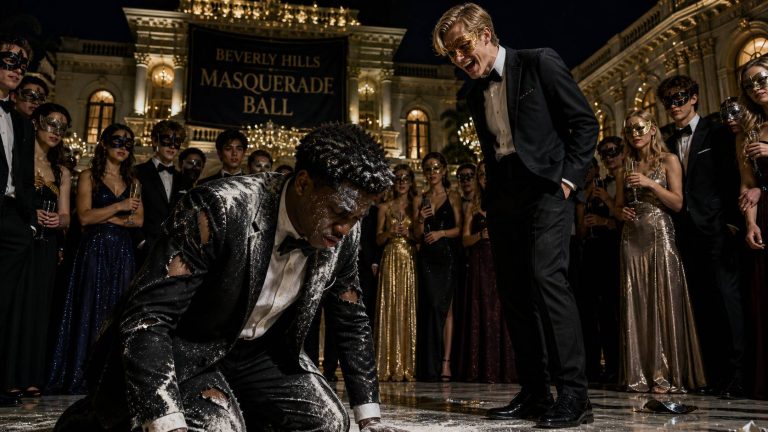
“You don’t belong on this stage, Liam,” Julian whispered, his voice dripping with a casual, inherited cruelty. “You’re a charity case. A diversity hire. No matter how well you play, the audience only sees that filthy skin color. We’re just saving them the discomfort of having to pretend you’re one of us.”
He dropped the violin back into the case. The wood groaned. He tossed the shears onto the floor—a heavy, metallic thud that vibrated through the soles of my shoes.
“Go home,” he said, brushing past me. “The silence suits you better.”
I looked down at my instrument. My father had worked three janitorial jobs to pay for the insurance on this violin. My mother had spent her last conscious days humming the Bach Partitas to me so I wouldn’t forget the shapes of the notes.
The stage manager hissed from the curtain. “Liam? You’re up. Five seconds.”
I didn’t have spare strings. I didn’t have time.
I looked at the broken instrument. Then, I looked at Julian, who was watching from the opposite wing with a smug, victorious grin.
I picked up the violin. I picked up the bow.
I didn’t feel fear anymore. I felt a cold, crystalline clarity.
As the lights hit me, blinding and white, I walked to the center of the stage. The murmur of the wealthy Manhattan crowd died down. They saw the Black boy in the thrifted suit. They saw the dangling, broken strings.
A few people gasped. Someone laughed—a short, sharp sound in the back.
I tucked the violin under my chin. I felt the vibration of the crowd’s confusion through the floorboards. I closed my eyes, positioned my fingers on the naked fingerboard, and drew the bow across the air.
I wasn’t playing for them. I was playing for the hum of the universe.
Read the full story in the comments.
If you don’t see the new chapter, tap ‘All comments’.
FULL STORY
Chapter 2: The Hum of the Earth
The audience didn’t understand why I was moving. To them, I was a madman or a performance artist trying too hard. I moved with a frantic, desperate energy, my bow arm sweeping in long, lyrical arcs, my left hand dancing over the strings that were no longer there.
They saw silence. I felt a symphony.
I was born in a world of muffled edges. When I was four, the doctors told my mother that the nerves in my ears were essentially “dead wires.” Congenital deafness, they called it. A tragedy, the neighbors said.
But my father, Marcus, didn’t believe in tragedies. He was a man who felt the world through his hands. He worked as a head custodian at the prestigious Manhattan Conservatory, and every Saturday, he’d sneak me into the empty concert halls.
“Put your hands on the wood, Liam,” he’d sign to me, his dark face illuminated by the ghost-lights of the stage. “Don’t listen with your ears. They lie to you. Listen with your skin.”
I grew up pressing my chest against grand pianos. I grew up standing barefoot on the floorboards while the orchestras practiced. I didn’t hear the high C of a soprano; I felt a sharp, needle-like prickle in my fingertips. I didn’t hear the low rumble of the timpani; I felt a warm, rolling wave in my stomach.
To me, music wasn’t sound. It was pressure. It was temperature. It was a physical map of the human soul.
When I started playing the violin, the teachers at the community center laughed. “A deaf violinist? You might as well ask a blind man to paint the Sistine Chapel.”
But they didn’t see the colors. Every vibration had a hue. The E-string was a piercing, electric blue. The G-string was a deep, earthy mahogany. When Julian cut my strings, he thought he was taking away my voice.
He didn’t realize he was just removing the filter.
On that stage at Lincoln Center, I played the “Chaconne” by Bach. I knew every vibration of that piece. I knew exactly how much pressure it took to make the wood of the violin groan in sympathy with the floorboards.
I played the silence. I leaned into the “ghost” notes, my body swaying with a grief that had no name. I was playing the sound of my father’s tired hands. I was playing the sound of the slur Julian had spat at me. I was playing the sound of every door that had ever been slammed in a face like mine.
The silence in the room began to change. It wasn’t the silence of boredom anymore. It was the silence of a vacuum—heavy, suffocating, and terrifyingly intense.
I saw a woman in the front row—pearls around her neck, a program in her hand. She wasn’t looking at my broken strings anymore. She was looking at my face. She was watching the tears track through the stage makeup, seeing the way my chest heaved with a music she couldn’t hear, but could suddenly feel.
Behind the curtain, Julian’s face had changed. The smugness was gone, replaced by a haunting, creeping realization. He had tried to humiliate me by making me silent.
Instead, he had given me the loudest stage I’d ever had.
Chapter 3: The Gilded Cage
Julian Vance didn’t hate me because I was Black. At least, that wasn’t the whole story. He hated me because I was free.
Julian lived in a world of “musts.” He must be the best. He must win the gold medal. He must uphold the Vance legacy that stretched back three generations at this conservatory. His father, a man who spoke in cold mandates and looked at Julian like a faulty investment, was sitting in the VIP box.
I had seen them in the hallway an hour before the show.
“If you lose to that… scholarship kid,” Julian’s father had said, his voice a low hiss, “don’t bother coming home for the summer. I’m not paying forty thousand a semester for you to be second best to a janitor’s son.”
Julian had stood there, his head bowed, his hands shaking inside his silk-lined pockets. He was a perpetrator, yes. He was a bully. But as I watched him from the shadows, I saw the invisible strings tied to his limbs, jerking him around.
He didn’t love music. He feared it.
To Julian, the violin was a weapon or a shield. To me, it was a lung.
The sabotage hadn’t been a spur-of-the-moment act of racism. It was a desperate, panicked attempt to survive his father’s judgment. If I couldn’t play, I couldn’t win. If I couldn’t win, Julian was safe.
But as I continued my silent performance, the logic of Julian’s world began to crumble.
I reached the climax of the piece—the part where the chords should have been soaring, triumphant, and agonizing. I slammed my bow across the space where the strings should have been, the wood of the bow striking the bridge of the violin with a sharp, percussive CRACK.
The sound echoed through the hall like a gunshot.
The audience jolted. It was the first “real” sound I had made. It was raw. It was broken. It was the sound of a heart snapping in half.
I saw Julian’s father lean forward in his box, his brow furrowed. He wasn’t looking at his son. He was looking at me with an expression I hadn’t expected: awe.
In that moment, Julian realized he had failed. He hadn’t just failed to stop me; he had accidentally highlighted the one thing he didn’t have.
He had the strings. He had the technique. He had the legacy.
But I had the music. And the music didn’t need strings to exist.
Chapter 4: The Sound of Shadows
The performance ended not with a note, but with a breath.
I pulled the bow away from the violin, my arm trembling, my lungs burning. I stood there in the center of the stage, the broken strings still swaying slightly, caught in the draft of the air conditioning.
I couldn’t hear the audience, but I felt the air pressure change. It was a massive, collective intake of breath.
For a long minute, nobody moved.
I looked up into the darkness of the theater. I couldn’t see my father, but I knew where he was. He’d be standing by the utility closet in the back, his hand pressed against the wall, feeling the last of the vibrations die out.
I took a bow. Not a graceful, practiced bow of a prodigy, but the heavy, exhausted slump of a survivor.
As I walked off stage, the silence was finally broken. It wasn’t applause—not at first. It was a low, rising murmur that turned into a roar. I felt the stage floor vibrate with the force of a thousand people standing up at once.
I ducked behind the curtain, and the world of shadows returned.
Sarah, the head of the string department, was waiting there. Her face was white. She looked at my violin, then at me. She didn’t sign—she knew I could lip-read—but her mouth moved slowly, deliberately.
“Liam… what happened to your instrument?”
I didn’t answer. I didn’t have to.
Julian was standing ten feet away, trapped between the stage door and the advancing stagehands. He looked like a cornered animal. The shears were still on the floor of the rehearsal room, probably with his fingerprints all over them.
“He did it,” a voice said.
It was Chloe. She was one of Julian’s “circle,” a girl who usually spent her time laughing at his jokes and ignoring my existence. She was standing there, her eyes red, holding her own violin case like a shield.
“I saw him, Sarah,” Chloe said, her voice shaking. “He said… he said the audience only sees his skin color. He cut them because he was scared.”
The hallway went deathly quiet.
Julian tried to laugh, but it came out as a strangled wheeze. “She’s lying. He’s a charity case, he probably broke it himself for the drama—”
SLAP.
The sound was louder than my violin bridge cracking. Sarah hadn’t moved, but Julian’s father had. He had come backstage, his face a mask of cold, aristocratic fury.
He didn’t look at Julian with anger. He looked at him with disgust.
“You didn’t just lose, Julian,” his father said, his voice a low, terrifying rumble. “You proved you don’t belong in this building. A Vance doesn’t sabotage. A Vance plays. And you… you couldn’t even do that.”
Julian looked at me then. For the first time, the mask of the bully was gone. Underneath was just a boy who had been broken long before he ever touched my violin.