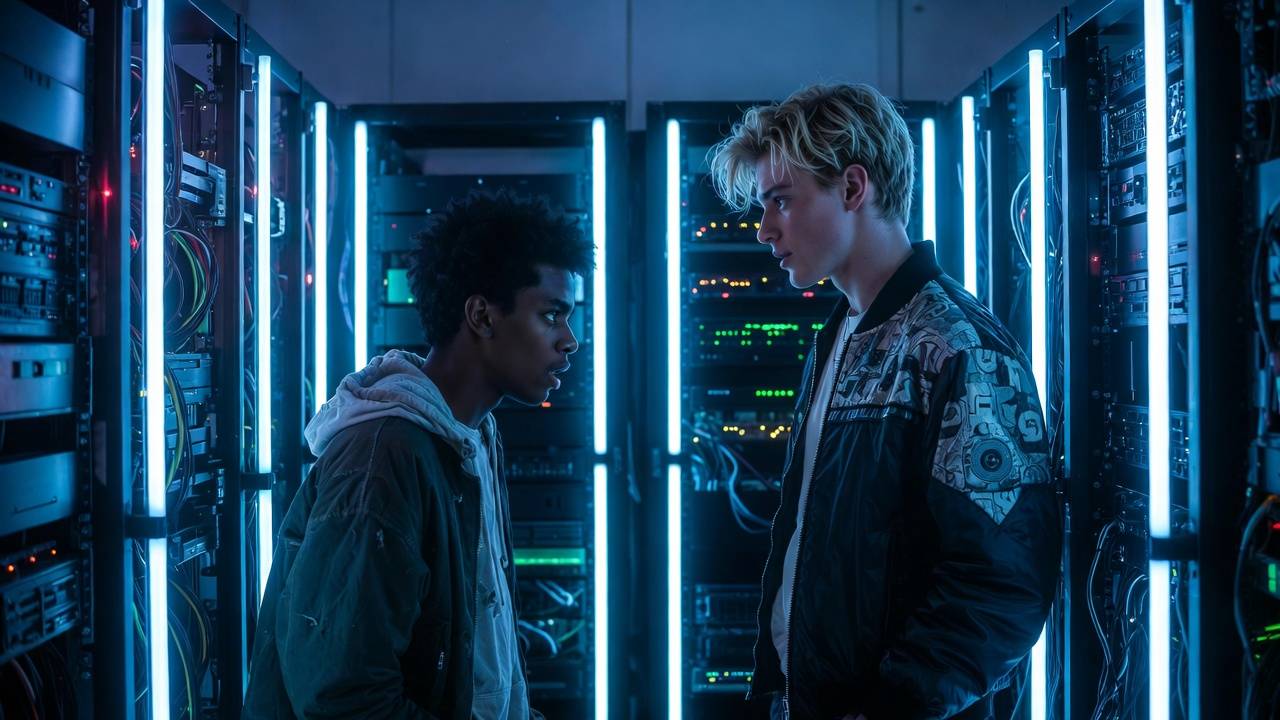
CHAPTER 1: THE SOUND OF VANISHING
The cursor blinked. Once. Twice. Then the screen went white.
In the high-stakes world of the “Apex Coding Club” in Palo Alto, silence is usually a sign of deep focus. But this silence was different. This was the sound of three months of my life—eighteen hours a day, thousands of lines of revolutionary neural-mapping code—being erased by a single, casual click.
“Oops,” Julian Sterling whispered. He didn’t sound sorry. He sounded like a man who had just stepped on an ant and was curious to see if it would still wiggle.
I stared at the monitor. My hands, still hovering over the keyboard, began to shake. I could feel the heat rising from my collar, a burning sensation that started at the base of my spine and ended in my throat.
“Julian, what did you do?” my voice was a ghost of itself.
Julian leaned back in his ergonomic chair, the kind that cost more than my mom’s monthly rent. He adjusted his designer hoodie and looked at me with eyes that had never known a day of genuine struggle.
“I did you a favor, Elias,” he said, loud enough for the other twelve students in the lab to hear. The room went cold. “I looked at your logic trees. They’re messy. Primitive. It’s clear your brain just isn’t wired for high-level architecture.”
He leaned in closer, his voice dropping to a jagged edge. “You’re a diversity hire, man. A charity case. My dad’s foundation paid for your scholarship because it looks good on a brochure, but let’s be real. You lack the logical thinking required for this world. Why don’t you do us both a favor? Drop out. Go back to manual labor. I hear there’s a construction site on 4th that needs someone to carry bricks.”
The “manual labor” comment hit like a physical blow. My father had died on a construction site when I was ten. My mother spent twelve hours a day cleaning the very offices we were sitting in. Julian knew that. He’d made sure to find out.
“That was my submission for the Gates Prize,” I said, my voice tightening. “The deadline is in two hours.”
Julian stood up, towering over me. “And now you have nothing to submit. Maybe you can code a shovel? Oh wait, you can’t.”
He laughed, a sharp, entitled sound that echoed off the glass walls. Around us, the other students—the sons and daughters of VCs and tech titans—either looked away or offered small, pitying smirks. No one moved. No one spoke. In this room, Julian was king.
I looked down at my hands. They had stopped shaking. A strange, icy calm was settling over me.
Julian didn’t know that I had spent the last week living in a state of constant paranoia. I knew he was tracking my progress. I knew he was jealous that a “charity case” was outperforming him.
And I knew that in Silicon Valley, the only thing more dangerous than a genius is a genius with nothing left to lose.
“You’re right, Julian,” I said, finally looking him in the eye. “My logic is different from yours.”
I grabbed my backpack and stood up. I didn’t look back at the empty screen. I didn’t look at the $20,000 servers. I just walked out of the room.
As the glass door swung shut, I pulled my phone from my pocket. I opened a simple terminal app.
I had planted a “Logic Bomb” inside my source code—a hidden script designed to execute only if the master file was deleted without the proper encryption key being entered first.
Julian thought he had wiped my work. He didn’t realize he had just pulled the pin on a grenade he was currently holding.
Read the full story in the comments.
If you don’t see the new chapter, tap ‘All comments’.
FULL STORY
CHAPTER 2: THE GHOST IN THE MACHINE
The bus ride back to East Palo Alto always felt like a journey between two different planets. On one side of the bridge, you had autonomous vehicles and lawns manicured by robots. On my side, the streetlights flickered with a tired rhythm, and the air smelled of exhaust and fried chicken from the corner spot.
I sat in the back of the 281 bus, my forehead pressed against the cold window. Julian’s words played on a loop in my head: Manual labor. Lack logical thinking. Charity case.
My mother was waiting for me when I got home. She was sitting at the small kitchen table, soaking her feet in a basin of warm water and Epsom salts. She looked up, her face lighting up despite the deep circles under her eyes.
“Elias! You’re home early. Is the project done? Did you win that prize?”
I felt a lump form in my throat. I couldn’t tell her. Not yet. She had pinned every hope on that Gates Prize. It was a $100,000 scholarship and a guaranteed internship at Google. It was our ticket out of this two-bedroom apartment where the heater broke every December.
“Just some last-minute bugs, Ma,” I lied, my heart heavy. “I’m going to work in my room.”
I closed my door and sat on my bed, pulling out my battered laptop. It was a refurbished ThinkPad I’d found in a dumpster and rebuilt myself. It wasn’t flashy like Julian’s MacBook Pro, but it was mine.
I opened the remote server logs.
When Julian “deleted” my code, he didn’t just erase it from the local machine. He used his admin privileges to purge it from the cloud. But he was sloppy. He was so convinced of his own brilliance that he didn’t check the background processes.
My Logic Bomb wasn’t just a prank. It was a “Mirror Script.”
The moment Julian initiated the mass-delete command, the script didn’t just disappear. It migrated. It looked for the nearest active, high-privilege account on the network to “host” itself.
And because Julian was logged in right next to me, the script had jumped into his private directory. It was now burrowed deep within his “Senior Capstone” folder like a digital parasite.
But it wasn’t just sitting there. It was scanning.
I watched the lines of text scroll across my screen. The script was designed to look for “Inconsistencies.” In Silicon Valley terms, that meant looking for stolen code, plagiarized algorithms, or hidden files.
What I found made my blood run cold.
Julian hadn’t just been bullying me; he was desperate. His own project—the one everyone thought was a work of genius—was a shell. He had been “borrowing” components from offshore developers and trying to stitch them together. But there was something else. A hidden folder labeled “Private_Logs_Encrypted.”
I shouldn’t have opened it. A “logical” person would have just reported the bullying and moved on. But Julian had insulted my father. He had mocked the very hands that built the city he lived in.
I hit Enter.
The encryption was weak—typical Julian, focusing on the exterior and ignoring the foundation. When the folder opened, I didn’t see code. I saw screenshots. Chat logs. Financial records.
Julian wasn’t just a bully. He was the middleman for a cheating ring that spanned three Ivy League preparatory schools. He was selling high-end AI scripts to the children of the elite so they could cruise into Stanford and MIT.
And there, at the bottom of the folder, was a video file.
I clicked play. My breath hitched. It was a recording of the Apex Club’s server room from three nights ago. It showed Julian entering a password—Mr. Halloway’s password—and altering the grades of several students.
He wasn’t just a cheat. He was a criminal.
I leaned back, the blue light of the laptop reflecting in my eyes. I had enough to ruin him. But I knew how Palo Alto worked. His father, Marcus Sterling, owned half the tech firms in the valley. If I just went to the principal, the evidence would “vanish,” and I’d be expelled for hacking.
I needed a bigger stage. I needed the detonation to be public.
I began to type. If Julian wanted to see “manual labor,” I was going to show him exactly how much work it took to tear down a kingdom.
CHAPTER 3: THE GOLDEN BOY’S SECRET
The next morning, the atmosphere at the Apex Coding Club was thick with a strange, performative grief. Mr. Halloway, the club director, stood at the front of the room with his arms crossed. He was a man who had made his millions in the 90s and now spent his days pretending to care about “the next generation of innovators.”
“I’ve heard there was an incident yesterday,” Halloway said, his eyes drifting toward me. “Elias, I’m told your project was lost due to a… technical glitch?”
Julian sat in the front row, spinning a pen between his fingers. He looked back at me, a look of mock sympathy on his face.
“It was tragic, sir,” Julian spoke up. “I tried to help him recover the sectors, but the corruption was too deep. It’s a shame. He worked so hard.”
“Is that true, Elias?” Halloway asked.
I stood up. My legs felt like lead, but my voice was steady. “The code is gone, Mr. Halloway. But I managed to salvage a small diagnostic tool I was working on. I’d like to present that today instead.”
Julian’s eyes narrowed. He hadn’t expected me to show up. He certainly hadn’t expected me to have anything to show.
“A diagnostic tool?” Halloway rubbed his chin. “The Gates Prize committee is arriving in four hours for the final showcase. If you have something to show, show it now. We need to vet it.”
I walked to the front of the room. My heart was a drum in my chest. As I passed Julian, he leaned out and whispered, “Give it up, brick-layer. You’re embarrassing yourself.”
I plugged my battered laptop into the 100-inch 4K digital bulletin board that dominated the front wall. This screen was usually used to display the club’s rankings, real-time stock market data, and school announcements.
“My project,” I began, looking at the room full of students who had watched me get humiliated the day before, “is about transparency in neural networks. It’s designed to find the ‘hidden layers’—the things the system tries to keep secret.”
I glanced at Julian. He was leaning back, looking bored. He didn’t realize that the moment I plugged into the school’s local area network (LAN), my Logic Bomb had found its signal.
The script in Julian’s folder was now “pinging” the presentation software.
“Show us the interface,” Halloway commanded.
I hit a key. A simple, clean dashboard appeared on the screen. It looked harmless.
“It works by scanning the nearest high-activity node,” I explained. “In this case, it’s Julian’s workstation, since he has the highest processing priority in the club.”
Julian sat up straight. “Wait, what? You’re using my machine as a demo? That’s a breach of privacy, Halloway!”
“Relax, Julian,” Halloway said, his interest piqued. “If it’s just a diagnostic scan, it won’t touch your files. Continue, Elias.”
I felt a surge of adrenaline. This was the moment of no return.
“The tool doesn’t just look at code,” I said. “It looks at the intent of the user. It mirrors the digital footprint.”
On the giant screen, a progress bar appeared.
SCANNING… 10%… 40%… 80%…
Suddenly, the screen flickered. A window popped up. It wasn’t my dashboard anymore. It was a browser history.
Julian’s private browser history.
The first few entries were mundane—Amazon, high-end sneaker sites, coding forums. But then, the list began to change.
How to bypass school admin passwords.
DarkWeb: AI Essay Generator – Premium.
PayPal Transaction: $5,000 to ‘GhostCode_Dev’.
The room went silent. I mean, truly silent. The kind of silence where you can hear the hum of the air conditioning.
“Elias, shut it down,” Halloway said, his voice dropping an octave.
“I can’t, sir,” I said, my voice cracking with feigned panic. “The logic is recursive. It’s… it’s pulling everything.”
The screen scrolled faster now. It wasn’t just history. It was the “Private_Logs” folder.
A series of screenshots filled the wall. They showed Julian’s chat logs with other students—the very students sitting in this room.
“Your dad’s check cleared. The algorithm for your Physics final is in the shared folder. Don’t get caught, you idiot.” — J. Sterling.
Another screenshot: A picture of Mr. Halloway’s private grade book, with a cursor hovering over Julian’s failing ‘C’ in Advanced Calculus, changing it to an ‘A+’.
Julian’s face went from pale to a ghostly, translucent white. He lunged for the screen, but his foot caught on a cable and he stumbled, crashing into a table.
“TURN IT OFF!” Julian screamed.
But the Logic Bomb was just getting started. The final phase of the script—the “Nuclear Option”—was about to trigger.
CHAPTER 4: THE PRESENTATION
The “Nuclear Option” wasn’t just about Julian. It was about the system that protected him.
As Julian scrambled to his feet, the digital bulletin board changed again. It wasn’t just showing his files anymore. It had accessed the school’s internal security feed.
The screen split into four quadrants. One showed Julian in the server room at 2:00 AM. Another showed him standing over my desk yesterday, his face twisted in a sneer as he deleted my project.
The audio from the security footage—audio Julian thought was never recorded—blasted through the room’s high-fidelity speakers.
“…You lack logical thinking, Elias. Go back to manual labor where you belong.”
The words echoed, louder and crueler than they had felt in person.
The students who had laughed yesterday were now staring at the floor. Sarah, a girl who usually sat in the back and never spoke, looked at Julian with pure disgust.
“You’re a monster, Julian,” she whispered.
At that moment, the back doors of the lab swung open. A group of men and women in dark suits entered. These were the representatives from the Gates Prize committee—the people who were supposed to judge our brilliance.
Among them was Marcus Sterling, Julian’s father. He was a tall, imposing man with silver hair and a suit that cost more than my house. He looked at the screen, then at his son, then at me.
The silence that followed was heavy enough to crush a man.
“What is the meaning of this?” Marcus Sterling’s voice was like rolling thunder.
Mr. Halloway was sweating. “Mr. Sterling… we were just… Elias was demonstrating a diagnostic tool…”
“That is my private data!” Julian shrieked, pointing a shaking finger at me. “He hacked me! He’s a criminal! He stole my files and manipulated them!”
I stood my ground. “I didn’t hack anything, Mr. Sterling. I wrote a program that mirrors the logic of the system it’s connected to. If the system is clean, the output is clean. If the system is corrupt…” I gestured to the screen, where a list of Julian’s “customers”—the children of the board members—was currently scrolling.
Marcus Sterling walked toward me. He was a foot taller than me, and he used every inch of it to try and intimidate me.
“You think you’re clever, boy?” he hissed, low enough that only I could hear. “You think you can come into our world and tear things down? I will have you in a juvenile detention center by sunset. I will ruin your mother’s life. You have no idea who you’re messing with.”
“I know exactly who I’m messing with,” I said, my voice barely a whisper. “The question is, do you know what’s happening on the other screens?”
Marcus frowned. “What other screens?”
“This bulletin board is networked to every monitor in the school,” I said. “And every monitor in the district. And because I used a public API to host the diagnostic tool… it’s currently being live-streamed to the Gates Prize official website as a ‘Student Innovation Demo’.”
Marcus Sterling’s eyes went wide. He lunged for my laptop, but I stepped back.
It was too late. The world was watching.