CHAPTER 1: THE SILENT ADHESIVE
The air in the San Francisco Academy of Ballet didn’t smell like art. It smelled like floor wax, expensive perfume, and the cold, metallic scent of ambition that was currently choking the life out of me. I sat on the cracked leather bench in Dressing Room 4—the one they relegated to the “scholarship kids”—and stared at my feet.
My feet were my inheritance. They were wide, scarred, and strong, a map of every double shift my father had worked at the Port of Oakland just to pay for my first pair of slippers. But today, they were a target.
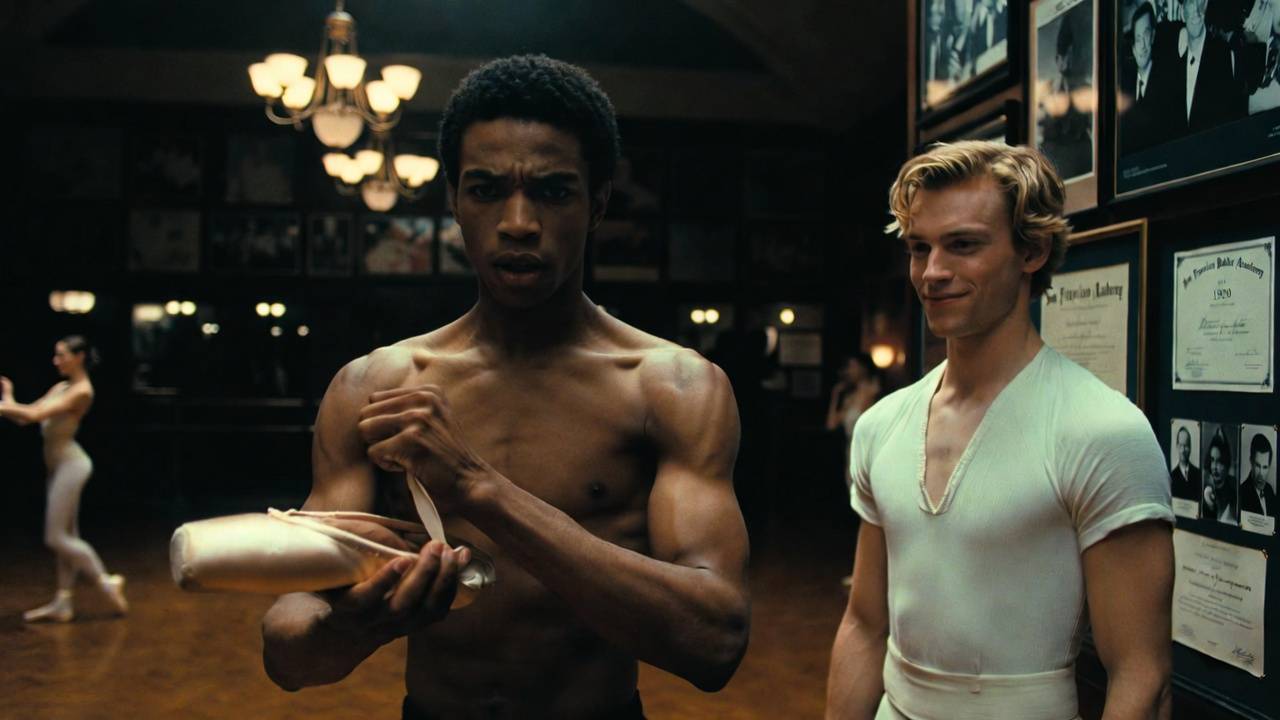
I reached for my custom pointe shoes. They were the only things I owned that felt like they belonged in this zip code. But as I slid my hand inside to check the padding, my skin didn’t meet the soft satin lining. It met something cold, viscous, and chemical.
Industrial-strength wood glue.
It had been poured deep into the toe box, half-dried into a jagged, cement-like mold.
“Looking for these, Porter?”
The voice was like silk dragged over gravel. I didn’t have to look up to know it was Julian Sterling. He was the Academy’s golden boy, a third-generation principal dancer whose last name was etched onto the wing of the building. He stood in the doorway, flanked by two other boys who looked like they’d been manufactured in the same factory of privilege.
“Your feet are too clumsy for this high art, Elias,” Julian said, his voice dropping to a conspiratorial whisper that echoed in the empty room. “You have the build of a dockworker. Go be a porter like your old man. Leave the stage to those of us who don’t have to try so hard to look like we belong.”
I looked at the glue. It was ruinous. If I put those shoes on, the adhesive would bond to my skin. Every jump, every turn, every landing would tear the flesh from my bones. And the final audition for the Lead in The Shadow Prince was in exactly twenty minutes.
The “Third Party”—the other dancers in the hall—stopped to watch. They didn’t say a word. They didn’t offer a clean pair of shoes. They just stood there with their water bottles and their foam rollers, their eyes wide with a mix of pity and relief. One less competitor to worry about. The crowd didn’t want a hero; they wanted a show.
“Twenty minutes, Elias,” Julian smirked, tapping his watch. “Don’t keep the judges waiting. Or do. The Port is always hiring.”
They walked away, their laughter trailing down the hall like a foul odor. I looked at my hands, then back at the shoes. My heart was a drum in a hollow chest.
I could quit. I could walk out, take the BART back to Oakland, and tell my father that Julian was right. That the world wasn’t ready for a Black boy from the streets to lead a classical company.
But then I thought about my father’s hands. His calloused, grease-stained, beautiful hands.
I didn’t reach for my phone to call for help. There was no help coming. I reached for the shoes.
I took a deep breath, gripped the satin ribbons, and forced my foot into the hardening, chemical trap. The pain was immediate—a searing, white-hot bite as the glue gripped my skin. I didn’t scream. I just pulled the ribbons tight, winding them around my ankles until the blood flow slowed.
If they wanted a porter, I’d give them one. I’d carry the weight of their hate until it broke them.
Read the full story in the comments.
If you don’t see the new chapter, tap ‘All comments’.
FULL STORY
CHAPTER 2: THE WEIGHT OF THE PORT
Elias Vance remembered the first time he realized he was “different” in the world of ballet. It wasn’t his skin color—at least, not at first. It was the way he moved. While the other boys in his beginner classes at age eight moved like feathers, Elias moved like a storm. He had a density to his muscles, a gravity to his jumps that made the floor groan.
His teacher in Oakland, Miss Arlene, had seen it differently. “You aren’t light, Elias,” she had told him, her voice thick with the wisdom of a woman who had seen too many dreams die. “You are powerful. You don’t defy gravity; you command it.”
But San Francisco wasn’t Oakland.
At the Academy, “power” was a dirty word unless it came from a trust fund. Elias worked three jobs to keep up with the “incidental” costs of the scholarship. He cleaned the studios at night, he tutored underclassmen in French, and on weekends, he helped his father, Marcus, at the docks.
“You don’t belong there, El,” Marcus had said just a week ago, his voice heavy with a father’s protective fear. They were sitting on the porch of their small home, the smell of salt and diesel hanging in the air. “Those people… they look at a man like you and they see a tool, not an artist. They’ll use you up and throw you away when you start to shine too bright.”
“I have to try, Pop,” Elias had replied. “If I don’t, then Julian Sterling is right. If I don’t, then the only thing Vance men ever do is move crates.”
Now, standing in the dressing room with his feet literally bonding to his shoes, Elias felt the truth of his father’s words. The pain was an ocean, and he was drowning in it. Every time he shifted his weight, he felt the glue tugging at the fine hairs and the delicate skin of his arches.
He stood up.
The room spun. A sickening squelch echoed in the small space as the glue settled. He took a step. It felt like walking on broken glass dipped in acid.
Supporting characters began to filter in for the final check. There was Sarah Jenkins, the Academy’s rehearsal director. She was a woman who had once been a star in London but had retired after a devastating hip injury. She walked with a slight limp and a permanent scowl. She saw Elias standing there, his face ashen, his hands trembling.
She paused. She looked at his feet. She was an expert; she knew the silhouette of a sabotaged shoe when she saw one. She saw the slight sheen of spilled glue on the floor.
“Vance,” she said, her voice sharp. “Are you ready?”
Elias looked her in the eye. He saw the recognition in hers. He saw the choice she was making. She could stop the audition. She could call for an investigation. She could disqualify Julian.
But Sarah Jenkins had seen a thousand talented kids come and go. She knew that the world didn’t care about fairness. It cared about who survived.
“I’m ready, Ma’am,” Elias said, his voice cracking only slightly.
“Then get to the wings,” she said, turning away. She didn’t help. She was the mirror of the world’s coldness—the third party that watched the tragedy and called it “training.”
Elias limped toward the stage, each step a prayer for numbness.
CHAPTER 3: THE CIRCLE OF SHARKS
The wings of the stage were crowded with the top twenty dancers in the country. The air was thick with the scent of rosin and anxiety.
Julian Sterling was center-stage, finishing his warm-up. He looked like a god. His extensions were perfect, his lines long and elegant. He caught Elias’s eye and did something truly cruel. He winked.
Beside Julian was Chloe, a girl Elias had once considered a friend. She was a brilliant technician, but she was terrified of Julian’s influence. Her father was a major donor to the Academy.
“Elias,” she whispered, stepping toward him as the music for the group warm-up began. “Your shoes… they look… are you okay? You’re bleeding through the satin.”
Elias looked down. A small, dark bloom of red was beginning to seep through the pinkish-beige fabric near his big toe. The glue had already started to cheese-grater his skin.
“I’m fine, Chloe,” Elias said, his teeth gritted.
“Julian said you were going to quit,” she said, her eyes darting toward the blonde boy. “He said you realized you weren’t cut out for the lead. Elias, if you’re hurt, don’t go out there. You’ll ruin your career.”
“He didn’t tell you what he did, did he?” Elias asked.
Chloe looked away. The silence was his answer. She knew. They all knew. The “Rule of the Crowd” was in full effect—the onlookers were paralyzed by the spectacle of his downfall.
The Central Conflict wasn’t just the glue. It was the choice. Elias could expose Julian right now. He could take off the shoes in front of the judges and show them the gore. But he knew the Academy. They would see him as a “problem.” They would see the drama, not the dance. Julian would get a slap on the wrist, and Elias would be the “disturbed scholarship kid” who caused a scene.
He had to choose: Be a victim and be forgotten, or be a martyr and be immortal.
“Everyone on stage!” the head judge, a legendary Russian choreograph named Volkov, barked from the darkened house.
Elias stepped out onto the marley floor. The lights hit him like a physical blow. The pain in his feet had transitioned from a sharp sting to a dull, throbbing roar that hummed in time with his pulse.
“The audition will consist of the Grand Pas de Deux variation,” Volkov announced. “Precision. Elegance. And above all… soul. Begin.”
The music started. A swelling, dramatic violin piece that felt like a funeral march for Elias’s feet.
CHAPTER 4: THE FRACTURED REALITY
The first five minutes were a blur of agony.
Elias danced. He did the basic combinations, the adagio, the turns. Every time he went into relevé, rising onto his toes, the glue acted like a thousand tiny fishhooks pulling at his flesh. He could feel the warmth of the blood pooling in the bottom of the shoe, making the surface slippery and even more dangerous.
Julian was dancing next to him, moving with an effortless, mocking grace. Julian was the “Standard.” He was what the world thought ballet should look like—clean, painless, and white.
Elias was the “Anomaly.”
Halfway through the variation, Elias felt a sickening pop in his left arch. The glue had hardened so much that it wasn’t allowing his foot to flex naturally. He was dancing on a stump of reinforced pain.
He caught his reflection in the wall-to-wall mirrors. He looked like a ghost. His skin was slick with sweat, his eyes wide and vacant. He was entering a state of shock.
The “Third Party”—the judges and the other dancers—started to whisper.
“Look at his feet,” one of the junior judges muttered. “He’s off his axis.”
“He looks like he’s dying,” another whispered.
But Elias wasn’t off his axis. He was finding a new one.
In the darkness of the house, Volkov leaned forward. He didn’t see a boy struggling with shoes. He saw a boy who looked like he was fighting a war.
“Stop,” Volkov suddenly shouted, cutting the music.
The room went deathly silent. Julian stopped mid-pirouette, landing perfectly. Elias stood trembling, his weight precariously balanced.
“Vance,” Volkov said, his voice echoing. “You are dancing like a man with a gun to his head. Why?”
Julian stepped forward, sensing the kill. “Sir, I think Elias is just overwhelmed. The technique might be a bit much for his… background.”
Elias looked at Julian. Then he looked at Volkov.
He didn’t reveal the secret. He didn’t cry for help.
“The Shadow Prince is a character who is trapped between two worlds, isn’t he?” Elias asked, his voice low and rasping. “He’s a man who has been cursed to dance in the dark while his heart is being torn out. I’m just trying to feel what he feels.”
Volkov stared at him for a long, agonizing minute.
“Again,” Volkov said. “From the Coda. And Vance? Show me the tearing.”