CHAPTER 1
The humidity in rural Alabama doesn’t just sit on you; it weighs you down like a wet wool blanket. It was 3:30 PM, the kind of afternoon where the air smells like scorched asphalt and pine needles. I was just trying to get home to my granddad. I was just trying to be invisible.
But invisibility is a luxury someone like me doesn’t get in this county.
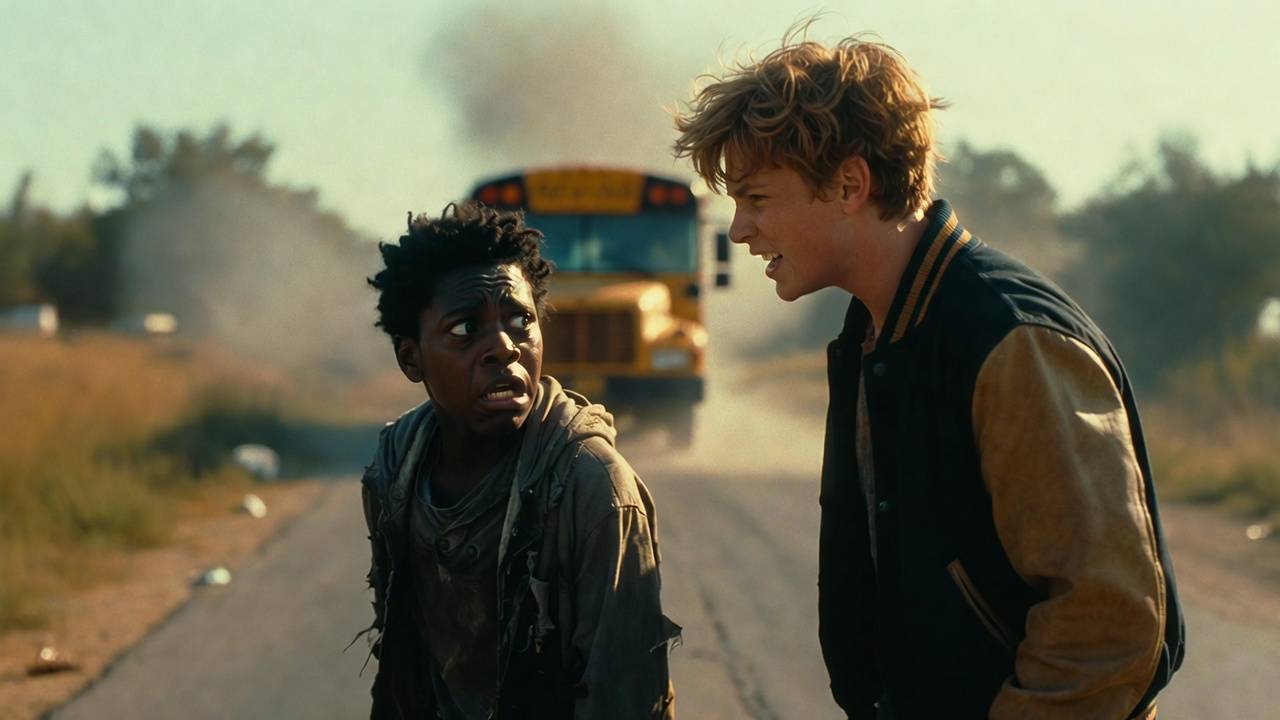
“Hey, Shadow,” Caleb’s voice cracked like a whip. He was fourteen, two years older than me, and lived in a house with a wraparound porch and a father who sat on the town council. He stepped into the aisle of the bus, blocking my path.
The bus driver, Ms. Hattie, stared straight ahead. She was sixty years old and had seen enough “boys being boys” to know that if she intervened, her tires would be slashed by morning. She just kept her foot on the brake, the diesel engine rumbling under our feet like a growling beast.
“I’m just trying to go home, Caleb,” I said, my voice small. I hated how small it sounded.
“Home?” Caleb laughed, and his buddies, Travis and Miller, joined in. “Nah. We think you need a special trip. We think you belong in the dark. That’s where things like you hide, right?”
They didn’t just push me. They hunted me. They dragged me off the high steps of the bus and threw me onto the gravel. The stones bit into my palms, drawing blood. Before I could scramble away, Caleb’s heavy work boot was on my shoulder, pinning me down next to the luggage compartment—the “belly of the beast,” as we called it.
“Open it, Miller,” Caleb commanded.
The rusted metal door screeched as it swung upward. It was a black maw, smelling of old grease and road salt. I fought. I kicked. I clawed at the dirt. But three against one isn’t a fight; it’s a harvest.
“Your place is where nobody can see you, just like your darkness,” Caleb hissed. He shoved me in. My head hit the metal ceiling, and for a second, the world turned into a kaleidoscope of red and black.
Then, the door slammed shut.
The click of the latch sounded like a coffin closing. I was buried alive in a tomb of yellow paint and diesel fumes. I screamed, hammering my fists against the door, but the engine roared to life, drowning out my terror.
I lay there, shaking, curled in a ball. It was pitch black. But as the bus began to bounce down the pothole-ridden backroads, my hand brushed against something that didn’t feel like a spare tire or a jack.
It was soft. Heavy. Leather.
It was a duffel bag that shouldn’t have been there. And as the bus hit a particularly deep rut, the bag shifted, and I heard the distinct clack of a burner phone hitting the metal floor.
I didn’t know it then, but Caleb hadn’t just locked me in a closet. He had locked me in the vault of his family’s darkest secrets.
Read the full story in the comments.
If you don’t see the new chapter, tap ‘All comments’.
FULL STORY
CHAPTER 2: THE VOICES THROUGH THE FLOOR
The darkness in the luggage compartment wasn’t empty. It was thick with the smell of something chemical—sharp and acrid, like bleach mixed with something sweet and rotting. I pulled my knees to my chest, my breath coming in jagged hitches. The bus swayed violently as it turned onto the old logging road, a route Ms. Hattie only took when she was dropping off the kids from the “Ridge”—the wealthy families who owned the town.
I reached out, my fingers trembling, and found the duffel bag again. I felt the zipper. It was slightly open. Inside, my fingers met something cold and plastic. Bricks. Dozens of them, wrapped tight in industrial tape.
Even at twelve, growing up in a town where the “war on drugs” was something you saw on the evening news and in the hollowed-out eyes of the men standing outside the gas station, I knew what this was.
Suddenly, the bus slowed. The vibration changed. We weren’t moving anymore. I held my breath, my heart drumming against my ribs.
Then, I heard voices. They weren’t coming from the outside; they were coming from directly above me, filtered through the thin metal floorboards and the gap in the wheel well.
“Is it there?” A voice asked. It wasn’t a kid’s voice. It was deeper, raspy. It was Beau, Caleb’s older brother. Beau was twenty, a former high school football star who everyone said was “going places,” though he never seemed to leave the county.
“Yeah,” Caleb’s voice replied, sounding uncharacteristically nervous. “I checked when I threw the kid in. It’s tucked in the back corner.”
“You did what?” Beau’s voice dropped to a lethal whisper. “You put a witness in the hold with half a million dollars of product?”
“He can’t see anything, Beau! It’s pitch black in there. Besides, he’s just the colored kid from the creek. Who’s he gonna tell? Nobody listens to them anyway. I just wanted to scare him. He was looking at me funny in the hall.”
My blood turned to ice. They weren’t just bullies. They were traffickers. And I wasn’t just a victim of a prank; I was a liability they couldn’t afford to let go.
“You’re an idiot, Caleb,” Beau hissed. “If Dad finds out you’re using the school bus routes to move the stash, he’ll kill us both. We move it tonight at the old quarry. And the kid? We’ll deal with him then. Make sure Hattie doesn’t open that door until we get to the house.”
The bus lurched forward again. I lay back against the cold metal, the realization sinking in. I wasn’t going home to Granddad tonight. Not unless I did something.
I felt around on the floor until my fingers closed over the burner phone I had heard earlier. It was an old flip phone, the kind you buy for twenty dollars at a pharmacy. I flipped it open. The screen glowed, a blinding blue light in the tomb of the luggage hold.
One bar of signal. 22% battery.
I didn’t call 911. Not yet. In this town, the police chief played poker with Caleb’s father every Saturday night. If I called the cops, I might as well be calling my own undertaker. I needed someone else. Someone who lived outside the reach of the Ridge.
I dialed the only number I knew by heart.
“Granddad?” I whispered into the phone, my voice shaking so hard the words barely came out. “Granddad, don’t speak. Just listen. I’m under the bus. And I found what they’re hiding.”
FULL STORY
CHAPTER 3: THE WEIGHT OF THE GHOSTS
On the other end of the line, there was a long, heavy silence. My grandfather, Silas, was a man of few words and long memories. He had grown up in the era of Jim Crow, had seen the freedom riders’ buses burned, and had taught me that for people like us, the law was often a fence designed to keep us out, not a shield to keep us safe.
“Elijah,” he said, his voice a low rumble that felt like a steady hand on my shoulder. “Where are you exactly?”
“We’re passing the old mill. Caleb and Beau… they’ve got something in here, Granddad. White bricks. Lots of them. They’re talking about the quarry tonight. They said they’re going to ‘deal’ with me.”
“Listen to me, boy,” Silas said, and I could hear the sound of him grabbing his keys. “You stay small. You stay quiet. Do you have your drawing charcoal in your pocket?”
“Yes,” I whispered. I always carried a small piece of willow charcoal and a scrap of paper. It was my escape.
“If that phone dies, you leave a mark. Every time that bus stops, you scratch a line on the inside of that door. I need to know every stop. I’m calling a man I know—a man in the city. A Federal Marshal. This town is rotten, Elijah, but the rot ends today. Do you hear me?”
“I’m scared, Granddad.”
“I know. But you come from people who survived the middle passage and the fields. You got the light of the truth in there with you. That’s more powerful than any gun Beau’s got. I’m coming for you.”
The call cut out. No signal.
I sat in the dark, the burner phone a dead weight in my hand. The bus stopped again. I heard the hiss of the air brakes. This was it. The Ridge. Caleb would be getting off here.
Above me, I heard the heavy thud of boots.
“See you tonight, Beau,” Caleb shouted. “Don’t forget to take out the trash.”
The bus door hissed shut, and the vehicle began to climb the steep, winding road toward the quarry. I felt the incline. My stomach did a slow roll. I took the charcoal from my pocket and pressed it against the yellow paint of the interior door.
1. Caleb’s House.
I didn’t know if I would live to show anyone these marks, but I was going to leave a record. I wasn’t going to disappear into the Alabama red clay without a fight.
Suddenly, the bus jerked to a violent stop. No air brakes this time. Just the screech of tires and the smell of burning rubber.
A loud thud hit the side of the luggage compartment. Then, the sound of a heavy chain being rattled against the latch.
“Open up, Hattie!” A voice screamed. It wasn’t Beau. It was someone else. Someone angry.
CHAPTER 4: THE THIEVES’ HONOR
The luggage door groaned as someone tried to pry it open from the outside. I scrambled to the very back of the compartment, wedging myself behind the heavy spare tire.
“I can’t open it, Miller! The lock is jammed!” Ms. Hattie’s voice was hysterical. “I told you boys I didn’t want any part of this! You said it was just a prank on the kid!”
“Shut up, old woman!” This was Miller, Caleb’s friend. I realized then that the “prank” had layers. Caleb and Beau were moving the drugs, but Miller and his older brother, a local grease monkey named Jax, had found out about the shipment.
They weren’t here to save me. They were here to hijack the stash.
“Beau’s right behind us in his truck,” Ms. Hattie cried. “If he catches you—”
“Beau’s a golden boy who’s never had to fight for anything,” Jax’s voice joined in, low and menacing. “He’s been skimming off our uncle’s business for months. We’re just taking what’s owed. Now, move!”
A heavy crowbar slammed into the seam of the luggage door. The metal shrieked and buckled. A sliver of late-afternoon sunlight pierced the darkness, hitting the duffel bag.
I watched, frozen, as the crowbar worked its way into the gap. The door was forced upward inch by inch. I saw Jax’s face—greasy hair, a jagged scar running down his cheek, and eyes that looked like they were made of glass.
He saw the bag first. His eyes lit up with a feverish greed.
Then, he saw me.
“Well, looky here,” Jax grinned, showing yellowed teeth. “Beau left us a little bonus. A witness and the loot.”
He reached in, grabbing the duffel bag and tossing it to Miller. Then, his hand shot out like a snake, grabbing my hoodie and dragging me out of the compartment.
I hit the gravel hard. The world spun. I looked up and saw three trucks parked in a circle in the middle of the woods. This wasn’t the quarry. This was a “dead zone”—a place where the trees grew so thick the sun barely touched the ground.
“What do we do with him, Jax?” Miller asked, clutching the bag. He looked terrified. Bullying a kid on a bus was one thing; kidnapping was another.
“We take him to the old shack,” Jax said, pulling a zip-tie from his pocket. “Once we get the money for the bricks, we’ll leave him there. Maybe someone finds him in a week. Maybe they don’t.”
He grabbed my wrists, pulling them behind my back. The plastic tie bit into my skin, cutting off the circulation.
Just as he was about to throw me into the back of his truck, a roar of an engine echoed through the trees. A black Chevy Silverado tore around the corner, fishtailing in the dirt.
Beau.
He didn’t slow down. He slammed his truck directly into the side of Jax’s vehicle, the sound of crunching metal echoing like a gunshot.
“My property!” Beau screamed, leaping out of the truck with a hunting rifle in his hand. “That bag is mine!”
The world dissolved into chaos.