FULL STORY
CHAPTER 5: THE HOLLOW TRUTH
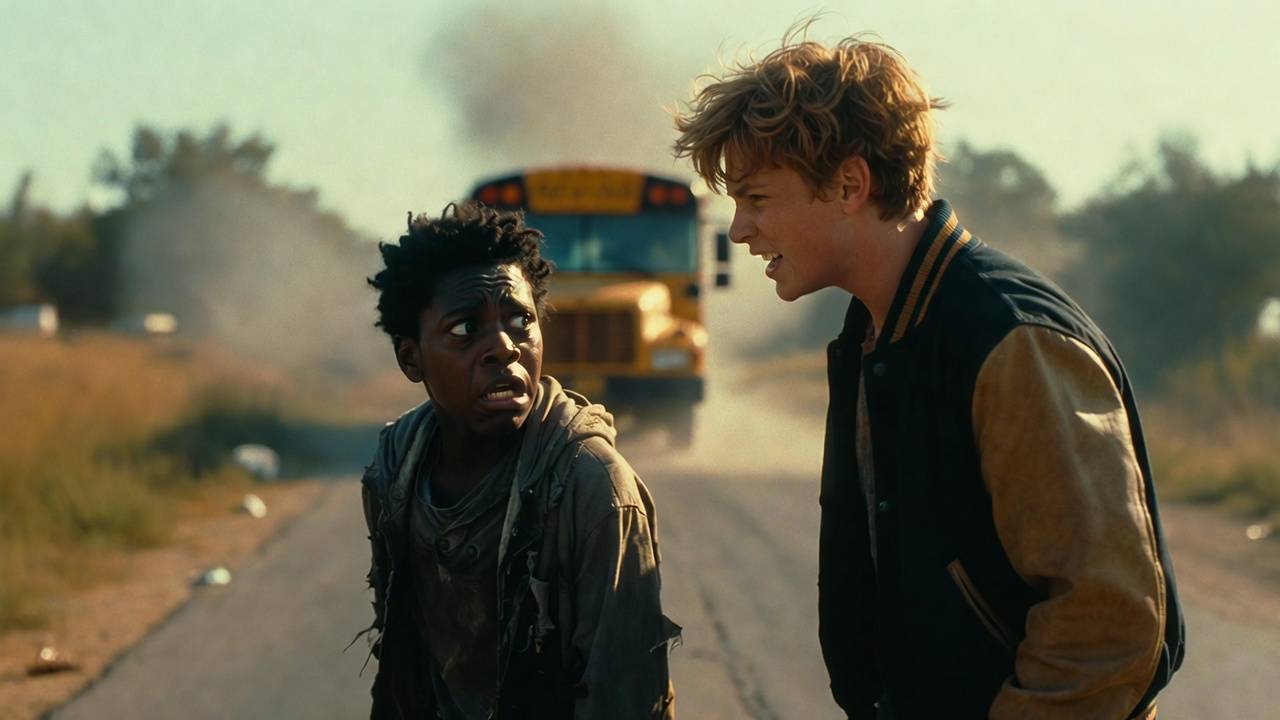
I scrambled under the chassis of the school bus, my hands tied, my heart hammering so hard I thought it would burst. Above me, the air was filled with the sounds of a war. Shouted curses, the metallic clack of a rifle being chambered, and the desperate pleas of Ms. Hattie, who had crawled under the bus seats, praying loudly.
“You think you can steal from my father?” Beau’s voice was a primal roar. “He owns this county! He owns the air you breathe!”
“Your father’s a fossil, Beau!” Jax yelled back from behind the cover of his wrecked truck. “He’s been using the town’s budget to fund his habits for years. We all know it! That stash isn’t yours—it belongs to the Cartel guys in Birmingham. You’re just the delivery boy!”
The revelation hit me harder than the shove into the bus. Caleb’s father—the man who shook hands at church, the man who gave speeches about “community values”—was the architect of the rot.
A gunshot rang out. A window on the bus shattered, raining glass down on the gravel. I squeezed my eyes shut, pressing my face into the dirt.
“Elijah!”
The voice was faint, coming from the woods behind the bus. I turned my head.
Through the trees, I saw him. My granddad, Silas. He wasn’t alone. Beside him was a tall man in a dark suit, holding a tactical radio. And behind them, moving like shadows through the pines, were a dozen men in “FEDERAL AGENT” vests.
Silas locked eyes with me. He didn’t shout. He didn’t run. He just nodded once—a silent command to stay down.
“THIS IS THE FBI!” A megaphone shattered the tension. “DROP YOUR WEAPONS! HANDS IN THE AIR!”
Beau spun around, his face pale, his rifle shaking. He looked like a cornered animal. For a second, I thought he was going to pull the trigger. He looked at the bus, then at the agents, then at me, huddled under the metal frame.
His eyes weren’t those of a “golden boy” anymore. They were full of the realization that his world—the world of privilege, of “Ridge” immunity, of bullying without consequence—was collapsing.
“Drop it, Beau,” Jax yelled, his voice cracking. He was already on his knees with his hands up.
Beau let the rifle slip from his fingers. It hit the dirt with a dull thud.
The agents swarmed. Within seconds, Beau and Jax were face-down in the dirt, their hands cuffed.
Silas ran to me. He crawled under the bus, his old knees popping, and pulled me out. He produced a pocket knife and sliced through the zip-ties. I fell into his arms, sobbing, the smell of his old flannel shirt—tobacco and laundry soap—the most beautiful thing in the world.
“I got you, boy,” he whispered, his own eyes wet. “I got you.”
As the agents processed the scene, one of them—the man in the suit—approached us. He was looking at the luggage compartment of the bus.
“Elijah?” he asked gently. “Your grandfather says you saw something. Can you show me?”
I led him to the compartment. I pointed to the charcoal marks I had made on the yellow paint.
“It’s not just the bags,” I said, my voice finally finding its strength. “They have a phone. And Caleb said his father would ‘deal’ with it. You need to look at the house on the Ridge.”
FULL STORY
CHAPTER 6: THE LIGHT OF DAY
The fallout was like a dam breaking.
By the next morning, the “Ridge” was no longer a symbol of prestige. It was a crime scene. Caleb’s father was arrested in his pajamas, led out of his mansion in front of the local news cameras. The “business” he had run for decades, a web of trafficking and corruption that had strangled the town, was laid bare for the world to see.
Caleb didn’t come to school the next day. Or the day after. I heard they moved to another state, or maybe they were just hiding in the wreckage of their reputation.
The school bus was different now. Ms. Hattie had retired, replaced by a younger woman who actually looked in the rearview mirror.
A week later, I stood at the bus stop. The morning sun was bright, burning off the mist from the creek. I felt a presence beside me.
It was Maya, a girl from my class who had always looked away when Caleb bullied me. She was holding a small box of high-quality drawing pencils.
“I… I wanted to give you these,” she said, her voice barely a whisper. “I’m sorry, Elijah. I should have said something. I should have helped.”
I looked at the pencils, then at her. I saw the same fear in her eyes I had felt in the dark, but it was mixed with something else now. Guilt. And a desire to be better.
“It’s okay,” I said, taking the pencils. “The dark is over now.”
I boarded the bus. I didn’t go to the back. I sat right in the middle, by the window. As we passed the spot where the bus had been hijacked, I looked down at the luggage compartment door.
It had been repainted. A fresh, bright yellow.
But I knew what was underneath. I knew that the marks I had made with my charcoal were still there, etched into the metal, a permanent reminder that even a child can bring down a giant if they aren’t afraid to see the truth.
I pulled out my sketchbook and the new pencils. I didn’t draw shadows. I didn’t draw monsters. I drew the sun rising over the Alabama pines, gold and fierce and unapologetic.
I was no longer the boy in the dark. I was the boy who had brought the light.
Granddad was waiting for me at the end of the line, standing by his mailbox with a smile that could bridge a thousand years of pain.
I stepped off the bus and didn’t look back, because I finally understood that the only way to truly leave the darkness behind is to make sure it has nowhere left to hide.