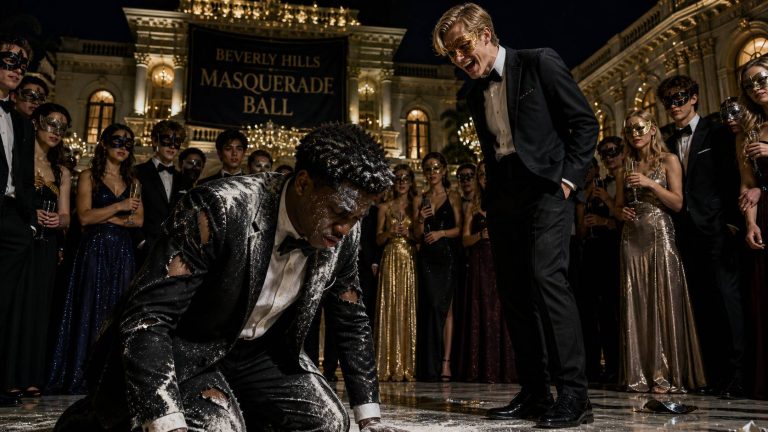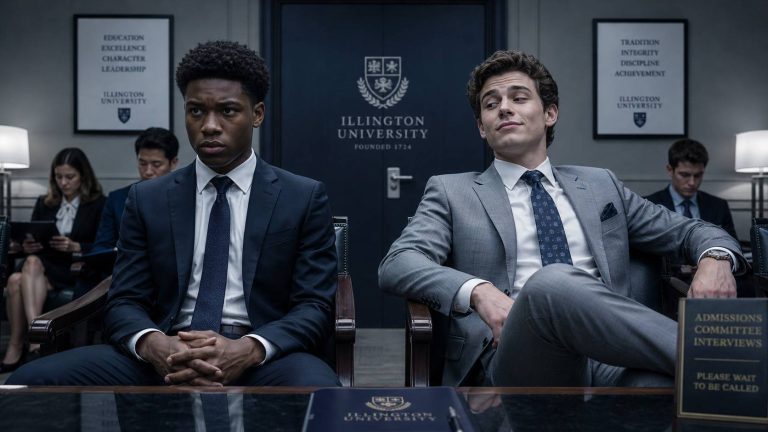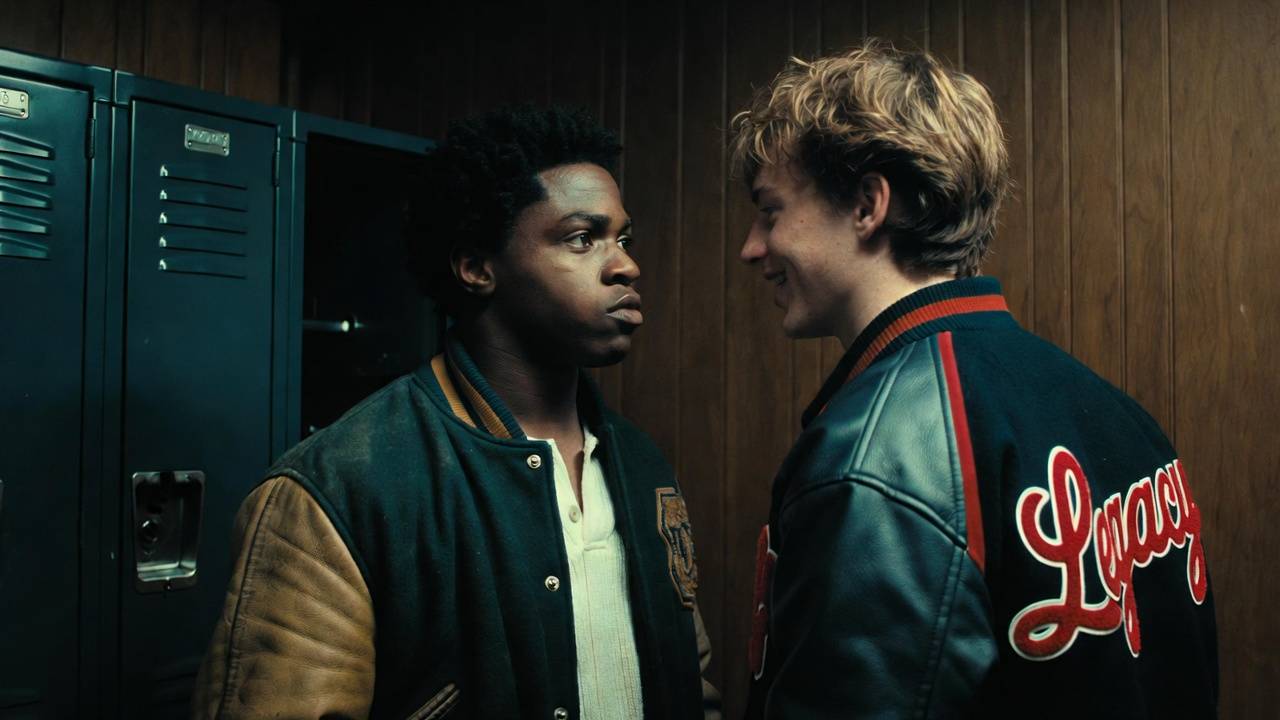
The air in the locker room at St. Jude’s Academy didn’t smell like sweat; it smelled like expensive cologne and the kind of arrogance that only comes from three generations of stolen wealth.
I stood there, my back against the cold steel of locker 402, feeling the weight of my grandfather’s jacket. It was a 1964 varsity original—faded maroon, smelling of cedar and old memories. To me, it was a suit of armor. To Julian Thorne, it was an insult to the “purity” of the school.
Julian stepped into my personal space, flanked by his usual shadows. He reached out, his manicured fingers stroking the frayed wool of my sleeve with mock pity.
“You know, Marcus,” he whispered, his voice dripping with a venom that felt centuries old. “You can study the books, you can win the track meets, and you can even wear the colors. But you’re just playing dress-up.”
I didn’t blink. “It’s just a jacket, Julian. Move.”
“Is it?” He suddenly gripped the collar, his face reddening. “My grandfather sat in this very room when your grandfather was probably out back sweeping the floors. This jacket is a lie. You think wearing this makes you royalty? A coat of paint can’t hide a slave’s blood.”
Then came the sound. The sickening rrrip of high-quality wool being forced apart.
The room went silent. The other guys stopped laughing. I felt the cold air hit my chest where the lining had been breached. But as the fabric gave way, something else happened.
Something Julian didn’t expect.
Yellowed, crisp slips of paper began to flutter out of the secret seams of the lining like autumn leaves. They hit the floor with a soft, heavy thud.
Julian looked down, a joke forming on his lips, but it died before it could reach the air. His face went from ivory to a sickly, translucent grey as he recognized the embossed gold seal of the Thorne family estate—and the legal bonds that shifted the world off its axis.
Read the full story in the comments.
If you don’t see the new chapter, tap ‘All comments’.
FULL STORY
Chapter 2: The Weight of Paper
The silence in the St. Jude’s locker room was no longer the silence of intimidation; it was the silence of a funeral. Julian Thorne remained frozen, a scrap of the 1964 wool still clutched in his hand like a trophy that had turned into a curse.
On the floor lay six government bonds, dated August 1968, each carrying the signature of Silas Thorne—Julian’s great-grandfather. But it wasn’t just the signatures that mattered. It was the “Transfer of Interest” clauses hand-stitched into the very structure of the documents.
“What is this?” Julian’s voice was a thin reed, stripped of its baritone authority.
I knelt, ignoring the throbbing heat in my chest, and began to collect the papers. My grandfather, Elijah, had been a quiet man. He had worked as a groundskeeper for the Thornes for forty years, a man of few words and calloused hands. When he died, he left me nothing but this jacket and a cryptic note: Keep the lining close to your heart, Marcus. It’s the only thing they can’t take back.
I looked at the top bond. It wasn’t just a savings certificate. It was a debt acknowledgment.
“It looks like my grandfather wasn’t just ‘sweeping the floors,’ Julian,” I said, my voice steady despite the adrenaline. “It looks like your great-grandfather used Elijah’s life savings to bail out the Thorne Textile Mill during the ’68 crash. And he put up the family estate as collateral.”
“That’s impossible,” Julian hissed, though his eyes were darting frantically across the room. The two “friends” who had been cheering him on were already backing away, sensing a shift in the social hierarchy that had governed this school for a century.
“Is it?” I stood up, the bonds safely tucked into my bag. “My grandfather was a Black man in 1960s Massachusetts. He knew if he tried to cash these then, he’d disappear. So he hid them. He waited. He knew one day, the paint would start to peel.”
I stepped toward Julian. For the first time in four years, he was the one who flinched. The “slave’s blood” he had mocked was now the only thing keeping his family from the street.
“Get out of my way,” I said.
This time, he moved.
Chapter 3: The Gathering Storm
Word travels at the speed of light in a school where everyone’s future is bought and paid for. By the time I reached my dorm, the “Scholarship Kid” wasn’t a ghost anymore. I was a lightning rod.
The legal reality was sinking in. My mother, a paralegal who had spent her life fighting for scraps, was on the phone within the hour. Her voice was shaking as she looked at the photos I’d sent.
“Marcus, if these are authentic… if the interest has compounded the way the clause suggests… the Thorne family doesn’t just owe us money. They owe us the deed to the North Shore property. The school’s main endowment fund is tied to that land.”
I sat on the edge of my narrow twin bed, looking at the torn jacket. The “Legacy” was a lie. The elite status of the Thornes wasn’t built on genius or grit; it was built on a predatory loan from a man they treated like furniture.
That evening, I was summoned to the Headmaster’s office. I expected a bribe. I expected a threat. What I found was Julian’s father, Arthur Thorne, sitting in the high-backed leather chair as if he owned the building.
“Marcus,” Arthur said, his voice smooth as aged bourbon. “My son tells me there was an… incident. A misunderstanding of property.”
He pushed a check across the desk. It had more zeros than I had ever seen in my life.
“Let’s call it a scholarship enhancement. In exchange for the return of the… vintage documents.”
I looked at the check, then at Arthur. He had the same cold, predatory eyes as his son. He didn’t see a human being; he saw a problem to be liquidated.
“My grandfather lived in a cottage with a leaking roof for forty years while he watched you build your empire,” I said quietly. “He wore this jacket every day to remind himself of what you owed him. You think you can buy that memory for the price of a mid-sized yacht?”
Arthur’s smile didn’t falter, but his eyes turned to ice. “Be careful, boy. Documents have a way of getting lost. And scholarship students have a way of being expelled.”
Chapter 4: The Moral Choice
The pressure became a physical weight. Over the next week, my locker was vandalized. My meal card was “deactivated” due to a technical error. The professors who used to praise my essays now found “structural flaws” in every paragraph.
Julian was the face of the harassment. He stood in the center of the courtyard, surrounded by his sycophants, loudly discussing how “trash belongs in the bin.”
But I had allies I didn’t know I had.
Sarah, a girl from Julian’s inner circle whose family had also been quietly crushed by Thorne’s business practices, cornered me in the library.
“They’re going to frame you, Marcus,” she whispered. “They’re planning to plant a stolen exam in your room tonight. Arthur Thorne has the board of directors in his pocket. You can’t win this in the school. You have to take it to the street.”
I had a choice. I could take the check Arthur had offered—a life-changing amount of money—and walk away. I could go to college, take care of my mother, and live a comfortable life. Or, I could burn the whole system down and risk everything.
If I kept the bonds and fought, there was a high chance the Thorne legal team would bury me in court for decades. I was a nineteen-year-old kid with a torn jacket. They were a dynasty.
That night, I sat with the bonds spread out on my desk. I thought about Elijah. I thought about the way he always bowed his head when Arthur Thorne walked by. He hadn’t been bowing in respect. He had been hiding the fire in his eyes.
I realized then that this wasn’t about the money. It was about the truth. If I took the bribe, I was just another person the Thornes had bought.
I picked up my phone and called the one person Arthur Thorne couldn’t buy: the investigative lead at the Boston Globe.