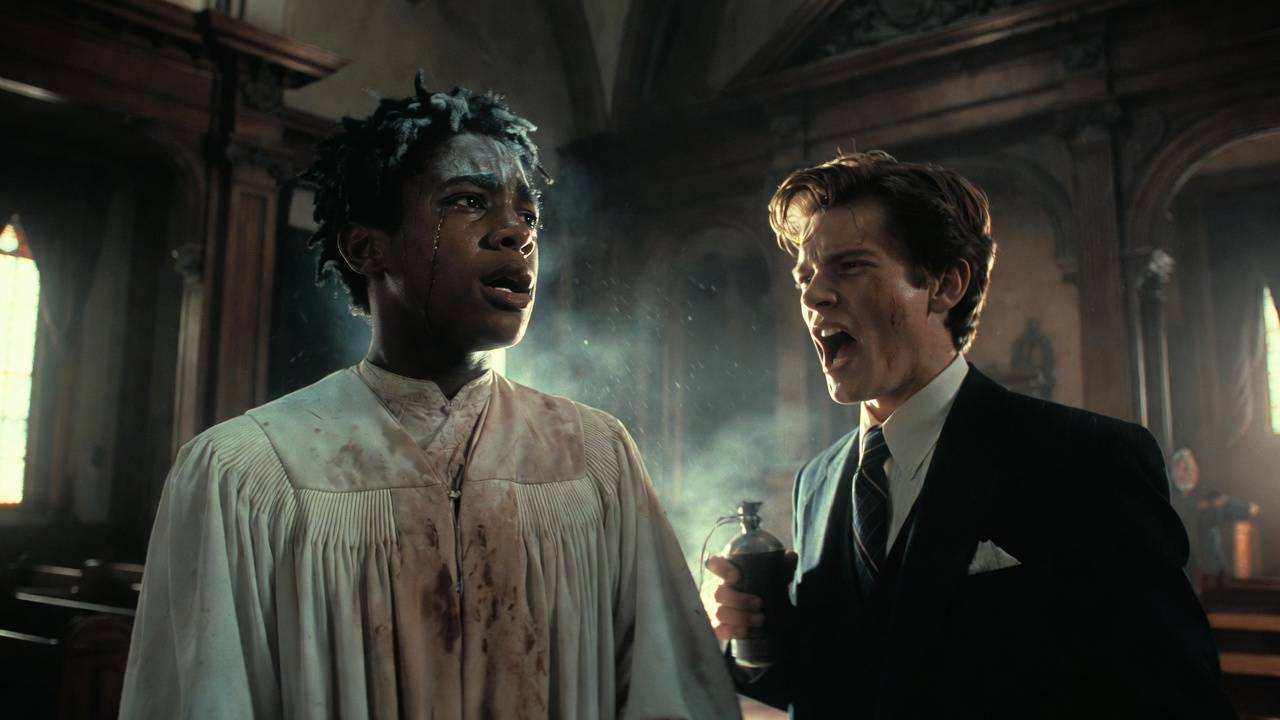
Chapter 5: The Reckoning
The next seventy-two hours felt like a fever dream.
Oakhaven wasn’t a quiet town anymore. The recording had been backed up to a cloud server I’d set up at the local library. By the time the sun came up the next morning, the “Confessions of Grace Community” was the top trending video in the state.
The Sheriff couldn’t bury it. The Deacon couldn’t buy it.
I sat on our small porch, my eyes still stinging, watching the blue and red lights of police cruisers as they pulled into the Sterling estate. They weren’t there for a social call. They were there for the ledger.
Caleb was charged with aggravated assault and a hate crime. His father was hauled away in handcuffs for grand larceny and racketeering. The “Golden Family” of Oakhaven was being stripped bare on the evening news.
But the real change happened in the streets.
People who had lived in the shadows for years—the families displaced by the land deal, the workers who had been mistreated by the church board—started coming forward. My mother didn’t go back to scrub the floors. She didn’t have to.
A group of lawyers from the city arrived, offering to represent the displaced families for free. They called it the “Elias Vance Initiative.”
On Sunday, the church was empty. For the first time in eighty years, the bells of Grace Community didn’t ring.
I walked up to the gates of the church one last time. The air felt different. The humidity had broken, replaced by a cool breeze that smelled of rain and fresh earth.
I saw Pastor Greg sitting on the steps, his head in his hands. He looked up at me, his eyes hollow.
“You destroyed this church, Elias,” he said.
I looked at the white pillars and the stained glass. I thought about the mace, the whispers, and the years of my mother’s sweat.
“No, Pastor,” I said softly. “I just turned on the lights. The rot was already there.”
Chapter 6: The Light Through the Scars
We moved away a month later.
Oakhaven was a place of ghosts for us, and my mother deserved to breathe air that didn’t taste like limestone dust. We moved to Savannah, where she opened a small catering business. She doesn’t scrub floors anymore; she creates things that bring people together.
I still have the scars—not physical ones, but the kind that itch when the air gets too quiet. I don’t go to church much these days. I find God in the way the sun hits the ocean and in the sound of people telling the truth even when their voices shake.
Caleb Sterling is in a juvenile detention center. I heard his father took a plea deal and gave up the names of three other Deacons involved in the land scheme. The “House of God” in Oakhaven is being converted into a community center for the very people they tried to push out.
Sometimes, I think about that night in the confessional. I think about the moment the mace hit my eyes and I thought I would never see again.
But in that darkness, I learned something that Caleb and his father never understood.
Power isn’t about who you can lock away; it’s about whose voice stays loud when the doors are shut. They tried to spray away the “dirt,” but they forgot that dirt is where things grow.
I look at my mother, sitting in the sun of our new kitchen, laughing with a neighbor. She looks younger. She looks free.
I realized then that the most powerful thing you can do in a world full of masks is to be the one who refuses to wear one.
Truth doesn’t just set you free; it clears the air so you can finally see the sky.
You don’t need a stained-glass window to find the light; you just need the courage to stop hiding in the shadows.