CHAPTER 1: THE WEIGHT OF THE BURLAP
The air in the Lincoln Heights Academy of Dramatic Arts smelled like expensive floor wax and old, inherited secrets. It was the kind of place where the silence didn’t mean peace—it meant you weren’t important enough to be spoken to.
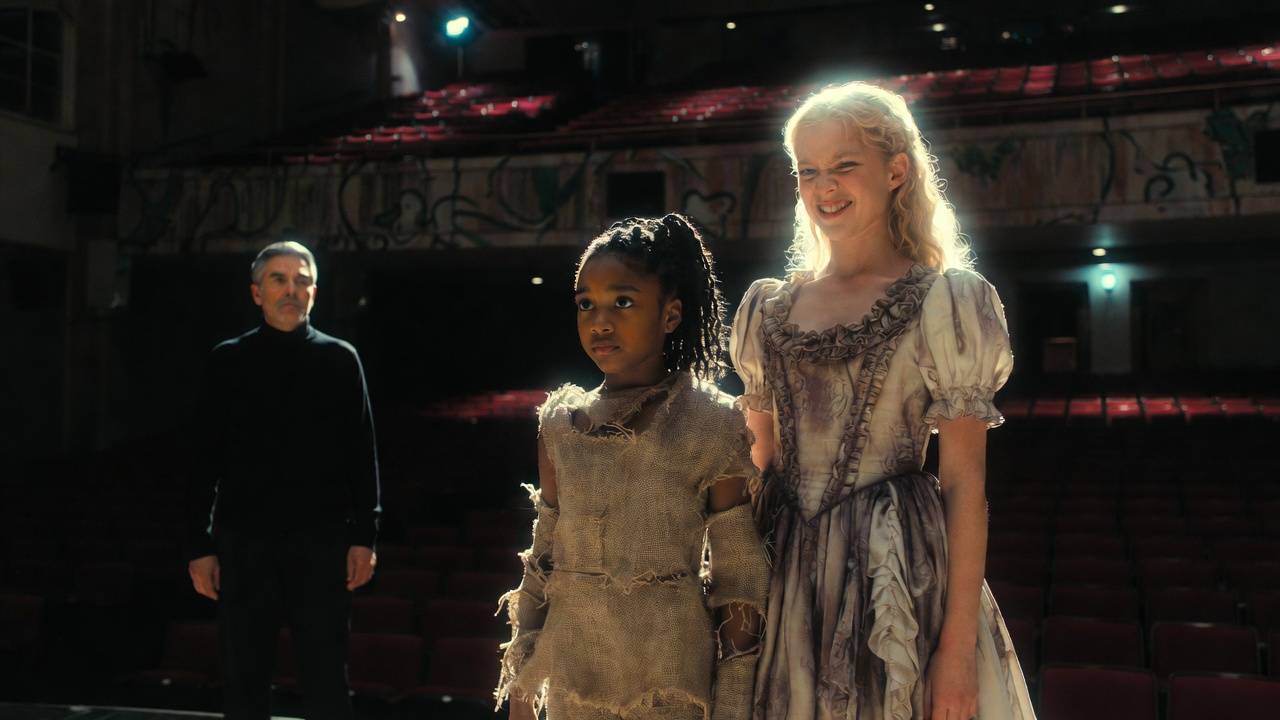
I stood in the center of the stage, the rough burlap of my costume scratching against my collarbone. It was a role specifically designed to erase me. I was “The Mute.” No lines. No name. Just a shadow to move through the background while the “real” actors—the ones with the right last names and the right skin tone—played out a tragedy they didn’t understand.
“Maya, you’re slouching again,” Mr. Sterling called out from the dark of the fifth row. His voice was like sandpaper. He was a man who had seen Broadway’s best and now spent his days trying to find a spark in the entitled children of Manhattan’s elite.
I straightened my spine. I didn’t look at him. I looked at Chloe Whitmore, who was currently standing three feet away, draped in a hand-stitched silk gown that cost more than my mother made in six months.
Chloe was the sun, and she knew it. She was the lead, the ingenue, the girl who always got the boy and the standing ovation. But today, the rehearsal wasn’t following the script.
“Mr. Sterling,” Chloe said, tossing her blonde hair back. “I feel like Maya isn’t giving me enough ‘desperation.’ How am I supposed to feel superior if she just looks… bored?”
A few of the other students in the wings snickered. Liam, a boy I’d shared a locker near for three years, looked down at his shoes. He knew what was coming. We all did.
“She’s a slave, Chloe,” Jackson, the male lead, chimed in with a smirk. “She doesn’t need to give you anything but silence. That’s her only job. To be a void.”
Then, it happened. It wasn’t in the lines. It wasn’t in the stage directions.
Chloe stepped closer, her perfume—something floral and cloying—filling my lungs. She leaned in, her voice a low hiss that didn’t carry to the back of the room, but cut through me like a razor.
“You don’t need lines, Maya,” she whispered. “Your voice is worthless in this world anyway. Just stand there, look dirty, and try not to remind us why you’re actually here on a scholarship.”
The word she used next wasn’t a whisper. It was a slur, spat like venom.
The room went cold. For a second, the only sound was the hum of the HVAC system. I waited for Mr. Sterling to stop it. I waited for him to demand an apology, to strip her of the role, to remind her that this was an institution of art, not a playground for bigots.
Instead, Sterling just sighed. “Let’s take it from the top of Act II. Maya, try to look a bit more… broken.”
I didn’t cry. My father, before he lost his voice to the cancer that eventually took the rest of him, told me that tears are for when you’re out of options.
I wasn’t out of options.
I looked at the back of the theater, at the heavy red curtains that hid the world from us. Behind those curtains, my secret was growing. Sterling knew. He was the one who had found me in the practice rooms at 2:00 AM, singing to the ghosts of the auditorium. He was the one who had seen the bruises on my spirit and offered me a different kind of script.
“Yes, Mr. Sterling,” I said, my voice barely a breath. “I’ll look broken.”
Chloe smirked, satisfied. She didn’t realize that the “void” she was so proud of creating was about to be filled with a sound that would tear her world apart.
Read the full story in the comments.
If you don’t see the new chapter, tap ‘All comments’.
FULL STORY
CHAPTER 2: THE ANATOMY OF SILENCE
Rehearsals became a gauntlet of calculated cruelty. For the next three weeks, Chloe and her circle turned the stage into a microcosm of the world outside, but louder. The unscripted insults became a regular feature. They called it “method acting.” They said they were “pushing boundaries” to make the play more authentic.
I endured it all. I stayed in character. I let them push me, belittle me, and treat me like the furniture.
My mother saw the toll it took, even if I didn’t say a word. She’d come home from her double shift at the hospital, her feet swollen, and find me sitting at the kitchen table, staring at my script—the one with no words for me.
“Maya, baby,” she’d say, placing a hand on my shoulder. “If that place is taking your light, you come home. We don’t need their fancy diploma if it costs you your soul.”
“It’s not taking it, Ma,” I’d tell her, leaning into her touch. “It’s just… compressing it. Like a spring.”
The supporting cast was a gallery of mirrors reflecting my own isolation. There was Liam, the boy from my neighborhood who had made it into the tech program. He avoided my eyes during the day, but at night, he’d leave a protein bar or a cold bottle of water on my prop crate. He was the silent witness, the one who was too afraid of losing his own spot to stand up for mine. His pain was a different kind—the pain of the coward.
Then there was Sarah, the stage manager, who kept a meticulous log of every “unscripted” slur Chloe hurled. She didn’t stop them, but she recorded them. She told me once, in the bathroom while we were both hiding, “They think the walls here are thick. They don’t realize how much the world is listening.”
But the most complex figure was Mr. Sterling. Every afternoon, after the main cast was dismissed to their Ubers and townhouses, he would lock the theater doors.
“Again,” he would say, sitting at the piano.
And I would sing.
Not the pop songs the other girls practiced. Not the musical theater standards. I sang Verdi. I sang Puccini. I sang with the rage of every ancestor who had been forced into silence.
Sterling didn’t offer praise. He offered corrections. “Your breath is shallow. You’re holding back because you’re still thinking about what Chloe said. Use the slur, Maya. Take that word and turn it into the high C. Make it work for you, or it will kill you.”
We were conspirators in a beautiful, dangerous game. He was a man whose career had been sidelined by “the way things are done,” and he was using me to burn the system down. I was the match, and he was the oxygen.
“The Broadway scouts will be in the front row on opening night,” he told me ten days before the show. “They’re coming to see Chloe. Her father paid for the reception. They expect a polite, predictable performance.”
He looked at me, his eyes sharp behind his glasses. “Give them a riot instead.”
CHAPTER 3: THE SECRET PACT
The week before opening night, the tension reached a fever pitch. Chloe had caught wind that Sterling was spending extra time in the theater. She didn’t know I was there—I hid in the catwalks whenever I heard her heels clicking in the hallway—but she was paranoid.
“I hear music at night,” she told Jackson during a break. “Opera. Real, heavy stuff. You think Sterling is bringing in a ringer for the pit?”
“Who cares?” Jackson laughed, checking his reflection in a hand mirror. “As long as the spotlight is on us, he can bring in the London Philharmonic.”
But Chloe wasn’t convinced. She began to watch me more closely. She looked for cracks in my “mute” facade. One afternoon, she cornered me in the costume shop.
“You’re very quiet, Maya,” she said, trailing a finger along the rough fabric of my burlap tunic. “Almost too quiet. It’s like you’re waiting for something.”
I didn’t answer. I just focused on the thread count of the fabric.
“My father is friends with the board of directors,” she continued, her voice dropping to a low, melodic threat. “If I find out you’re trying to upstage this production, or if you’re spreading lies about the ‘creative choices’ we’ve made in rehearsal… you won’t just be out of this school. You’ll be out of this city.”
I looked up then. I looked her right in the eye. For the first time, I didn’t look broken. I looked hungry.
“I’m just playing the part you gave me, Chloe,” I whispered. It was the first time I’d spoken to her in weeks. My voice was raspy, unused, but steady.
She recoiled as if I’d slapped her. “Don’t speak to me. You’re a mute. Remember?”
She stormed out, but I saw the flicker of fear in her eyes. She knew I had something she didn’t: a soul that wasn’t for sale.
That night, Sterling and I finalized the plan. We wouldn’t change the script. We wouldn’t alert the school. We would wait until the moment of greatest impact.
“In Act III,” Sterling said, his fingers ghosting over the piano keys, “there is a three-minute transition where the orchestra plays the ‘Lament of the Fallen.’ The stage is supposed to be dark, with just you center stage, kneeling. It’s meant to be a moment of quiet reflection before the finale.”
He looked at me. “That’s your window. I’ve spoken to the conductor. He knows. When the lights hit you, don’t kneel. Stand.”
“And the scouts?” I asked.
“They’ll be there. And they’ll be looking for something they haven’t seen in twenty years. They’ll be looking for the truth.”
CHAPTER 4: THE BREAKING POINT
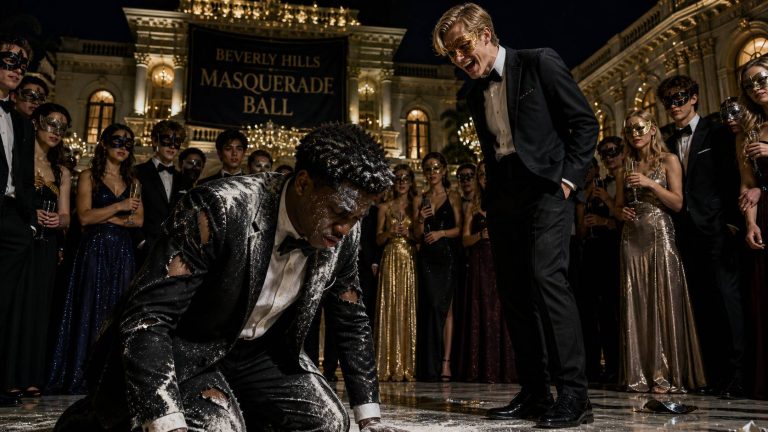
The day before opening night was a disaster. During the final dress rehearsal, Chloe went off-script entirely. She was frustrated, her movements erratic. During a scene where she was supposed to “scold” my character, she actually struck me.
It wasn’t a staged slap. It was a hard, stinging blow across my cheek that sent me sprawling to the floor.
The theater went silent. Even Jackson looked uncomfortable.
“Chloe!” Sterling yelled from the booth.
“She was out of position!” Chloe shrieked, her face flushed. “She’s ruining my rhythm! She’s doing it on purpose!”
I stayed on the floor. I felt the heat rising in my face, the copper taste of blood in my mouth where my tooth had cut my lip.
Liam stepped forward from the wings, a prop in his hand. He looked at me, then at Chloe, his chest heaving. For a second, I thought he would speak. I thought he would finally say something.
But he didn’t. He just gripped the prop tighter and looked at the floor. The “Third Party” remained silent. The crowd remained indifferent. The isolation was complete.
“Maya, are you okay?” Sterling’s voice was different now. There was a tremor in it.
I stood up slowly. I wiped the blood from my lip with the back of my hand. I didn’t look at Chloe. I looked at the empty seats in the front row where the scouts would be sitting in twenty-four hours.
“I’m fine,” I said. My voice was a ghost of a sound.
“Good,” Sterling said, though he didn’t sound like he meant it. “Take five, everyone.”
I went to the dressing room—the small, cramped one in the basement that I shared with the cleaning supplies. I sat in front of the cracked mirror and looked at my reflection. My face was bruised, my clothes were rags, and my spirit was under siege.
But as I sat there, I started to hum. A low, vibrating note that filled the small room.
I thought about my father. I thought about the way he used to close his eyes when he hit the high notes, as if he were looking at God. I thought about my mother’s tired hands. I thought about every “no” I had ever been told.
I wasn’t a victim. I was a weapon. And tomorrow, I was going to fire.