CHAPTER 5: THE IVY GATES
Moving into my dorm at Yale felt like entering another world. The stone arches, the ancient libraries—it was everything I had dreamed of, yet I felt like a ghost. I kept waiting for someone to splash ink on my papers, for someone to tell me I was a “diversity fluke.”
My roommate, a kid named Jackson from Los Angeles, was the opposite of Tyler. He was loud, messy, and brilliant.
“Hey, you’re the ‘Ink Guy’!” he shouted the first day. “That video was legendary, man. My dad’s a civil rights lawyer, and he uses it as an example of ‘digital justice’.”
I laughed, the tension in my shoulders finally beginning to melt.
But a week into the semester, I received a letter. No return address. Inside was a photo of my mother’s house back in New Jersey. On the back, someone had written: Stains don’t wash out. We’re still here.
My blood ran cold. The Vances hadn’t moved on.
I didn’t tell my mom. I didn’t want her to be afraid in her own home. Instead, I called the one person I knew could help. Not a lawyer. Not a cop.
I called Mr. Henderson.
“Marcus,” he said, his voice sounding older over the phone. “I was wondering when they’d try something. Richard Vance is losing his firm. He’s looking for someone to blame, and you’re the easiest target.”
“What do I do, Mr. Henderson? I’m hundreds of miles away.”
“You do what you’ve always done, son. You use your head. And you remember that the truth doesn’t just set you free—it’s a weapon.”
I realized then that I couldn’t just run away from my past. I had to finish what I started. I had to ensure that the “stain” was completely erased, not just hidden.
CHAPTER 6: THE FINAL REVELATION
I went back to New Jersey for Fall Break. I didn’t go to my house first. I went to the local courthouse.
With the help of Jackson’s father, the civil rights lawyer, we had filed a Freedom of Information Act request regarding the Vance family’s real estate development deals over the last decade.
The “stain” on the diploma hadn’t just been about a cheating scandal. It was about a culture of corruption.
I met Richard Vance in a small diner on the edge of town. He looked ten years older, his expensive suit replaced by a weary windbreaker.
“You should have stayed in New Haven,” he said, staring into his coffee.
“I couldn’t,” I said, placing a folder on the table. “Because I found the records for the East Side development. The one you built over the old chemical runoff site. The one where you falsified the soil samples to save ten million dollars.”
Vance’s hand began to shake.
“That land is where the new elementary school is, Richard. My cousin goes there. Your son’s old teammates go there.”
“You can’t prove it,” he whispered.
“I don’t have to,” I said. “The EPA is already on their way. I sent them the soil samples I took during my senior year chemistry project. You remember, the one where you thought I was just ‘cleaning the labs’?”
I stood up. I didn’t feel anger anymore. I just felt a profound sense of relief.
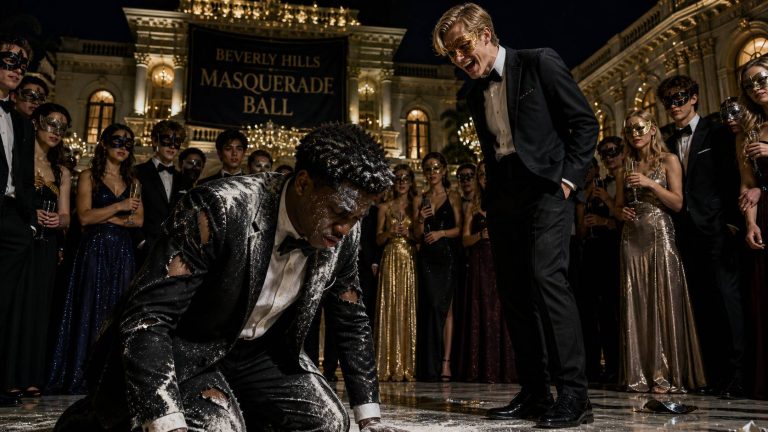
“The ink Tyler threw on me that day? It was the best thing that ever happened to me. It showed me that even the darkest mess can be turned into a map to the truth.”
I walked out of the diner and into the cool October air.
A year later, I stood on another stage—this time at a science symposium. My mother was there, wearing a new hat, her smile brighter than the sun. My gown was clean. My hands were steady.
I realized that the world will always try to throw ink on your story. They will try to tell you that you are defined by the marks they leave on you. But they’re wrong.
You aren’t the stain. You are the light that reveals it.
The hardest lessons aren’t learned in books, but in the moments when we choose to stand tall while the world tries to wash us away.
True character isn’t found in the absence of a struggle, but in the courage to remain clean when the world plays dirty.