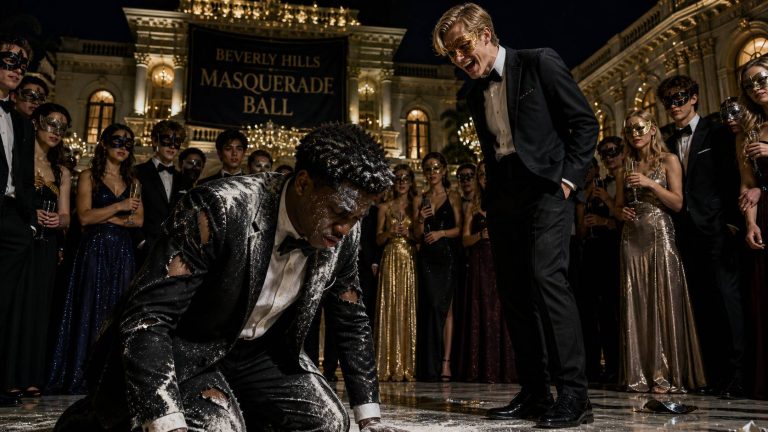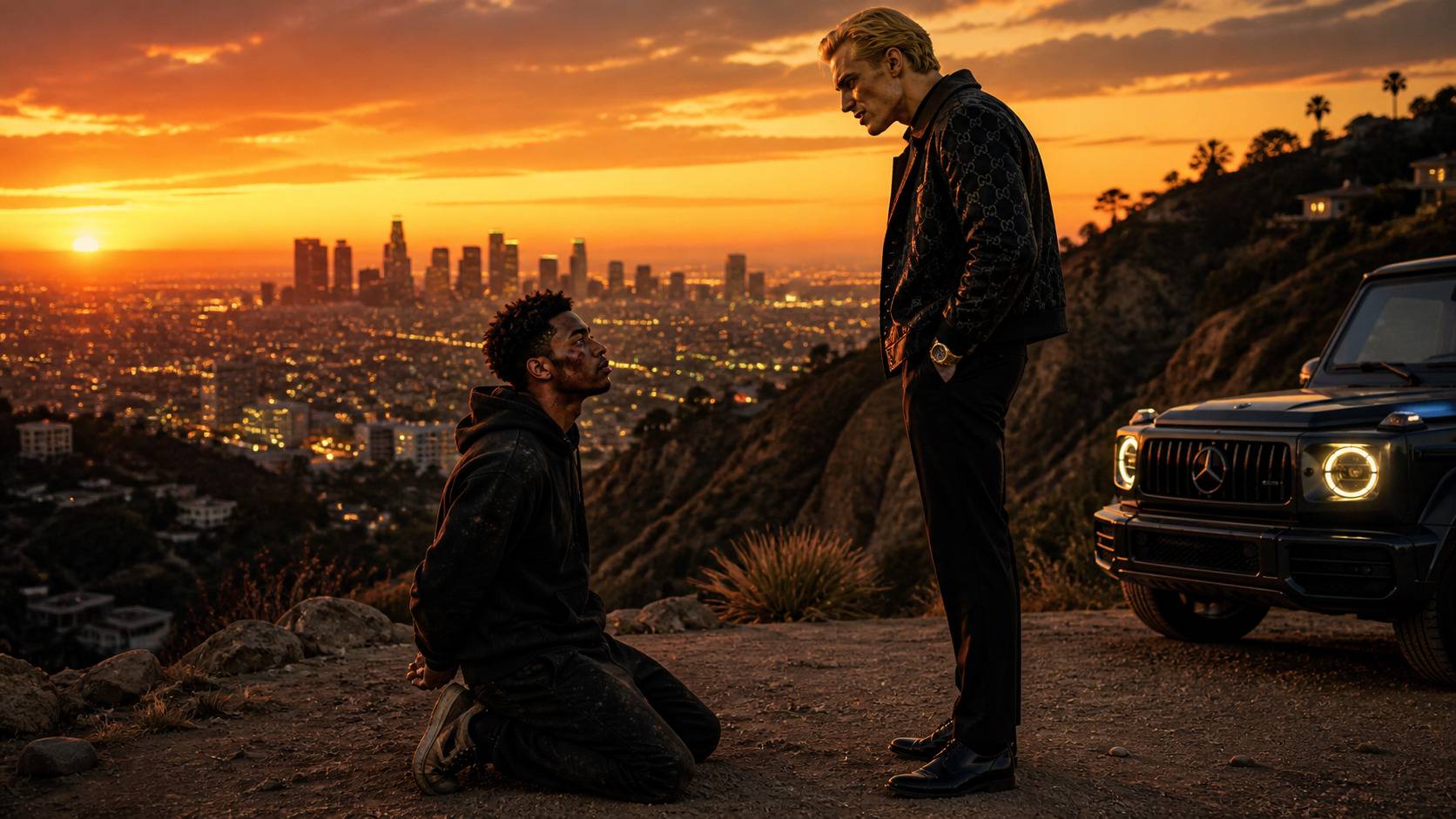
The sunset over the Hollywood Hills wasn’t beautiful tonight. It looked like a bruised kidney, purple and swollen, hanging over a city that thought it owned the sun.
I was on my knees. The gravel was biting into my skin, but I didn’t move. I couldn’t. Not yet.
“Kneel lower, Marcus,” Julian hissed. He was wearing a three-thousand-dollar jacket that smelled like his father’s gin and unearned confidence. “You’re just a speck of black dust in this golden aura. You don’t get to breathe the same air as us. You don’t get to look at the lights and think you’re part of them.”
Julian’s friends, Elias and Sarah, stood behind him. Elias looked bored, checking his Rolex every thirty seconds. Sarah looked away, her eyes fixed on the Los Angeles skyline as if she were searching for an escape route.
I looked down at the city. Millions of lights. A sea of electricity that powered the dreams, the crimes, and the egos of everyone in the valley.
“My dad owns three of those towers,” Julian bragged, pointing a shaky finger toward the glowing downtown core. “Your dad probably mows the lawn in front of them. You’re a glitch in the system, man. A shadow that shouldn’t be here.”
He stepped closer, his boot hovering over my fingers. “Apologize. Tell me you’re nothing. Tell me you’re the darkness that this city is trying to scrub away.”
I felt the weight of the remote in my pocket. It was cold. It was heavy. It was the only thing that felt real in a world made of plastic and glass.
I didn’t tell him that my father didn’t mow the lawns. I didn’t tell him that my mother spent eighteen hours a day in a bunker-like room beneath the city, managing the literal lifeblood of California.
I didn’t tell him that I had spent my summer coding the very failsafes that kept his “golden aura” from flickering out.
I just looked up at him, my face a mask of calm that I knew drove him insane.
“You really think the light is what makes you powerful, Julian?” I asked, my voice barely a whisper against the wind.
He laughed, a jagged, ugly sound. “It’s the only thing that matters. Without the light, you’re invisible. You’re gone.”
I reached into my pocket. My thumb found the toggle.
“Then let’s see how much you’re worth when the lights go out.”
Read the full story in the comments.
If you don’t see the new chapter, tap ‘All comments’.
FULL STORY
CHAPTER 2
The silence on the hill was different than the silence in the valley. Up here, silence felt like a luxury, something you bought with a zip code. But for me, Marcus Thorne, silence had always been a survival tactic.
I grew up in a house where the hum of the refrigerator was the loudest sound we heard. My father, David, was the Chief Grid Architect for the city’s Department of Power. He was a man of blueprints and load-balancing, a man who saw the city not as a collection of people, but as a series of interconnected circuits. My mother, Elena, was the one who kept the human side together. She was a nurse who worked the night shift, the one who saw the results when the power failed—the ventilators that stopped, the sirens that wailed in the dark.
They had worked themselves to the bone to get me into St. Jude’s Academy. It was a school for the children of the “Golden Aura,” as Julian called it.
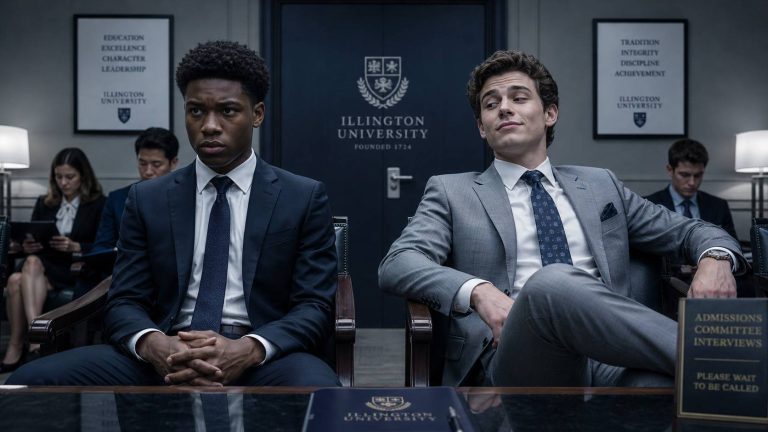
Julian Vane was the apex predator of the senior class. His father was a State Senator with a smile that looked like it was carved out of soap. Julian didn’t have his father’s charisma; he only had his father’s cruelty. To Julian, I was a statistical anomaly. I was the kid who got 100s on the coding exams but didn’t have a Tesla in the parking lot.
The bullying hadn’t started with the hills. It started with small things. The “accidental” spills of coffee on my laptop. The way the cafeteria table would empty the moment I sat down. The whispers in the hallway about “diversity hires” and “charity cases.”
But today was different. Today, Julian had found out about the internship.
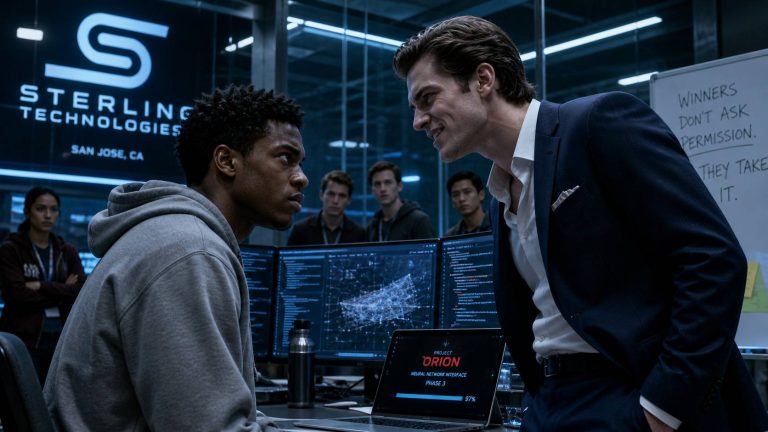
I had been selected for the High-Tier Infrastructure Shadow Program. It was a position usually reserved for the sons of donors, but I had won it through a blind coding competition. I had access to the mainframe. I had the keys to the kingdom.
“You think you’re going to sit in a room and watch my father’s business?” Julian had snarled at me behind the gym earlier that day. “You think you’re going to be the one holding the switch?”
He had dragged me up here, to the “Point,” a cliffside overlook where the rich kids went to drink and feel like gods.
Elias, Julian’s shadow, stood by the car. Elias was a kid who had everything but a backbone. His family had lost millions in the recent tech crash, and he was clinging to Julian’s status like a life raft. He didn’t hate me; he was just terrified of being me.
Sarah was the wild card. She was Julian’s girlfriend, or so the rumors went. She was a pianist, a girl whose hands were always moving, even when she wasn’t playing. She watched the confrontation with a hollow expression. She knew Julian was a monster, but she also knew that monsters provided the best protection.
“I’m waiting for the apology, Marcus,” Julian said, leaning in so close I could see the broken capillaries in his eyes. “Tell me you’re a speck of dust.”
I looked past him. The sun had finally dipped. The streetlights were beginning to flicker on, a billion golden honeycombs waking up.
“The grid is a delicate thing, Julian,” I said. “It requires balance. If one part takes too much, the whole thing collapses.”
“Is that a threat?” Julian laughed, turning to Elias. “The dust is threatening us with a physics lesson!”
“It’s not a threat,” I said, my thumb clicking the safety on the remote. “It’s a diagnosis.”
CHAPTER 3
The night before the “Point,” my father had sat me down in his study. The room was filled with monitors, each showing a different sector of the city’s power consumption.
“Marcus,” he had said, his voice heavy with the weight of twenty years of responsibility. “People think power is about the lines. It’s not. It’s about the trust. They trust that when they flip a switch, the world responds. If that trust breaks, the city breaks.”
He had been showing me the “Black Start” protocols—the system used to restart the grid if it ever suffered a total collapse. It was a masterpiece of engineering, a series of cascading commands that prioritized hospitals and emergency services before the residential neighborhoods.
“And what about the hills, Dad?” I had asked, pointing to Sector 4—Julian’s neighborhood.
My father had sighed. “Sector 4 has the highest consumption and the lowest tolerance for outages. They pay for the privilege of never knowing the dark. But Marcus, never forget—every light you see is a debt someone else is paying.”
I thought about the debt my mother paid with her tired eyes. I thought about the debt I paid every time I walked down the hallways of St. Jude’s.
I had spent that night creating my own “Black Start.” Or rather, a “Black End.”
I didn’t want to hurt anyone. I wasn’t a criminal. I was a concept creator. I wanted to show them a reality they couldn’t ignore. I created a localized override—a “ghost command” that would simulate a catastrophic failure in the Sector 4 substation, cascading through the affluent districts while leaving the hospitals and the low-income neighborhoods untouched.
It was a surgical strike. A demonstration of who really held the “Golden Aura.”
I sat in my room, the blue light of my monitor reflecting in my eyes. I wasn’t just Marcus Thorne, the scholarship kid. I was the architect of the coming shadow.
“You okay, honey?” my mother had asked, leaning against my doorframe. She was in her scrubs, ready for the graveyard shift.
“Yeah, Mom,” I said, closing my laptop. “Just finishing a project.”
“Don’t work too hard,” she said, kissing my forehead. “The world won’t end if you take a break.”
I watched her drive away, her old sedan a small red light disappearing into the distance. She was going to the hospital to save lives in the light.
I was going to the hills to change lives in the dark.
CHAPTER 4
The wind picked up on the cliffside, howling through the canyons like a hungry animal. Julian was getting impatient. The lack of fear in my eyes was wounding him more than any punch could.
“You know what happens to dust, Marcus?” Julian said, his voice dropping to a dangerous register. “It gets blown away.”
He grabbed the collar of my hoodie and jerked me toward the edge. The drop was hundreds of feet—a jagged descent of rock and scrub brush.
“Julian, stop!” Sarah finally spoke. Her voice was thin, trembling. “This is too much. Let him go.”
“Shut up, Sarah,” Julian snapped without looking at her. “He needs to learn his place. He thinks he’s special because he can fix a computer. He needs to realize that we own the computers. We own the grid. We own him.”
He shoved me again. My heels were inches from the void. I could feel the heat of the city rising up from below, a warm updraft that smelled of asphalt and ambition.
“Do you know why my dad calls this the ‘Golden Hour’?” Julian asked, his face inches from mine. “Because for one hour a day, the whole world looks like it’s made for us. And people like you? You’re just the dirt that makes the gold look brighter.”
I looked at Elias. He was looking at his shoes. I looked at Sarah. She was crying now, but she wasn’t moving to help.
They were the “Third Party.” The witnesses. The people who would watch a tragedy and call it an accident as long as their own lights stayed on.
“You’re wrong about one thing, Julian,” I said.
Julian grinned, a predatory flash of teeth. “Oh yeah? What’s that?”
“The gold isn’t yours,” I said. “It’s a loan. And the interest is due.”
I pulled the remote from my pocket. It didn’t look like much—just a black plastic box with a single toggle. Julian looked at it and laughed.
“What’s that? A garage door opener? You going to call your mom to come pick you up?”
“No,” I said, my voice steady, my heart a calm, rhythmic thrum. “I’m calling the dark.”
I clicked the toggle.