Chapter 5: The Cost of the Chord
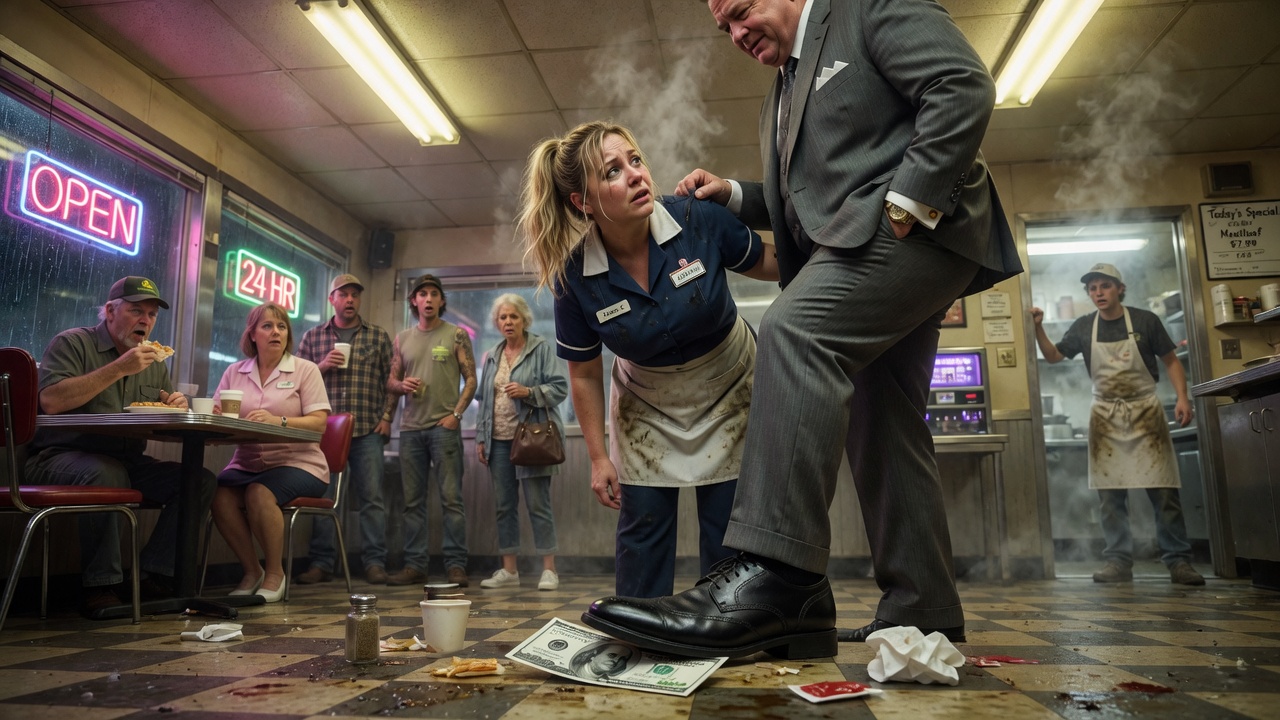
The silence that followed the sound of Rick Henderson’s expensive body hitting the linoleum was heavier than any symphony Jolene had ever played. For ten seconds, the only sound in the Midnight Rail was the overhead fan clicking and the ragged, wet gasps of a millionaire who had forgotten what it felt like to be touched by someone who didn’t fear him.
Rick’s associates moved first, their polished shoes clicking frantically as they swarmed him. “I’m calling the police!” the trophy wife shrieked, her voice a jagged glass edge in the quiet diner. “You’re dead, you hear me? You’re going to rot in a cell for this!”
Rick didn’t look like a king anymore. He looked like a wounded animal, clutching his chest where Jolene’s foot had left a dusty tread mark on his silk shirt. He didn’t look at his wife; he looked at Jolene, and for the first time, the mockery in his eyes was replaced by a cold, vibrating hatred.
“You’re done, Jolene,” he wheezed, his voice thin as he was hoisted up by his bodyguards. “I’m pulling the mortgage on this grease trap tonight. And your apartment? You’ve got until sunrise to get your trash out of my building. I’ll make sure there isn’t a diner within fifty miles that will let you wash a spoon.”
Pops stood behind the counter, his face ashen, his hands trembling as he held a coffee carafe. He didn’t defend her. He couldn’t. The terror of losing his life’s work was written in every wrinkle of his face. Jolene didn’t blame him. She just looked at Leo. Her son was standing by the kitchen door, the $100 bill clutched in his hand like a cursed relic. He wasn’t crying. He looked at his mother as if she were a stranger he was finally meeting for the first time.
The police arrived twenty minutes later. They didn’t handcuff her—half of them had grown up eating her blueberry pancakes—but the shame was a physical weight. They took statements while Rick was loaded into a private car, refusing an ambulance just to ensure he could give his orders to the bank.
By 8:00 PM, the “Midnight Rail” was dark for the first time in thirty years. Jolene sat on the edge of her bed in the cramped apartment above the pharmacy, her feet throbbing. She finally peeled back her wet socks. The scalding coffee Rick had spilled earlier had left angry, weeping blisters across the tops of her feet. She stared at them, the pain a dull thrumming rhythm, until the door creaked open.
Leo walked in, holding an old, yellowed envelope. Her heart stopped. It was the Juilliard letter, the one she’d supposedly burned. She’d hidden it in the lining of her piano stool, a secret piece of her soul she thought was buried forever.
“You stayed for her,” Leo said, his voice cracking. “And now you’re losing everything for me. Why didn’t you leave, Mom? Why did you stay in this graveyard?”
Chapter 6: The Final Movement
“Because a graveyard is where you protect the things that are still alive, Leo,” Jolene said, her voice raspy. She reached out and took the letter, the paper brittle against her calloused skin. “I didn’t stay to be a martyr. I stayed because I loved her. And I stay because I love you. A scholarship is just a piece of paper. You are the music.”
The “surrender” came at midnight. A black sedan idled outside the apartment, its headlights cutting through the rainy Ohio mist. Rick’s lawyer, a man with a face like a shark and a briefcase full of ruin, knocked on the door. He didn’t come to arrest her. Rick Henderson didn’t want justice; he wanted a different kind of victory.
“Mr. Henderson is prepared to drop the assault charges and reinstate the diner’s mortgage,” the lawyer said, placing a document on the small kitchen table. “On one condition. A public apology. Tomorrow morning, 8:00 AM, in front of the local news. You will admit you are an unstable, failed musician who bit the hand that fed her. You will sign over the rights to your family’s land on 4th Street for his new development. You do this, and your son gets his medicine, and your boss keeps his stove.”
Jolene looked at the paper. It was a contract for her soul. She looked at the $100 bill sitting on the counter, the money she’d used that afternoon to buy the insulin Leo needed to survive the week.
“Get out,” she said.
The lawyer blinked. “Excuse me?”
“I said get out,” Jolene stood up, ignoring the fire in her feet. “Tell Rick he can have the building. He can have the diner. But he doesn’t get to tell the story of who I am. I’m the Queen of 4th Street, and I’ve been playing a much longer game than he has.”
The next morning, the town gathered to watch the eviction. Rick stood on the sidewalk, his ego demanding a front-row seat to her destruction. But as the movers began to carry out the old upright piano from the diner, Jolene stopped them.
“Leave it right there,” she commanded.
In the middle of the rain-slicked sidewalk, with the sheriff watching and the town regulars huddled under umbrellas, Jolene Carter sat down at the out-of-tune piano. She didn’t look at the cameras or the man in the gray suit. She looked at Leo.
Then, her scarred, waitress hands began to move.
She didn’t play a scales exercise. She played Chopin’s Revolutionary Etude. The notes were sharp, defiant, and beautiful, even through the tinny, rusted strings of the diner piano. The music soared over the decaying buildings and the grey sky, a middle finger to every person who had ever treated her like a cautionary tale.
She played until her fingers bled, until the town was silent, until even Rick Henderson looked small against the backdrop of her talent. When the last chord echoed out, Jolene stood up. She didn’t look back at the diner. She walked to her beat-up car where Leo was waiting, his bags packed, his eyes bright with a new kind of fire.
“Where are we going?” Leo asked as she started the engine.
“Anywhere with a music school for you,” Jolene said, her sharp tongue finally softening into a smile. “I’ve got twenty years of tips, a piano I can play in the dark, and a son who knows exactly what his mother is capable of. Rick Henderson owns the dirt, Leo. But we own the air.”
As they drove out of Oakhaven, the “Midnight Rail” sign flickered once and died behind them. But the Queen of 4th Street was already gone, her melody finally rising above the noise of the town that tried to break her.