Dr. Arthur Vance used to lecture at the most prestigious Ivy League university in the country. Now, he’s fifty-five years old and digging a trench in the sweltering Atlanta heat for fifteen dollars an hour.
The men on the site call him “Professor” as a joke, led by a foreman named Bear who enjoys the power trip. Arthur takes the insults, the dirt kicked on his back, and the mockery without saying a word.
He can’t afford to lose this job because his wife, Diane, is in hospice. After the university canceled him and stripped his insurance, this manual labor is the only thing keeping her comfortable in her final days.
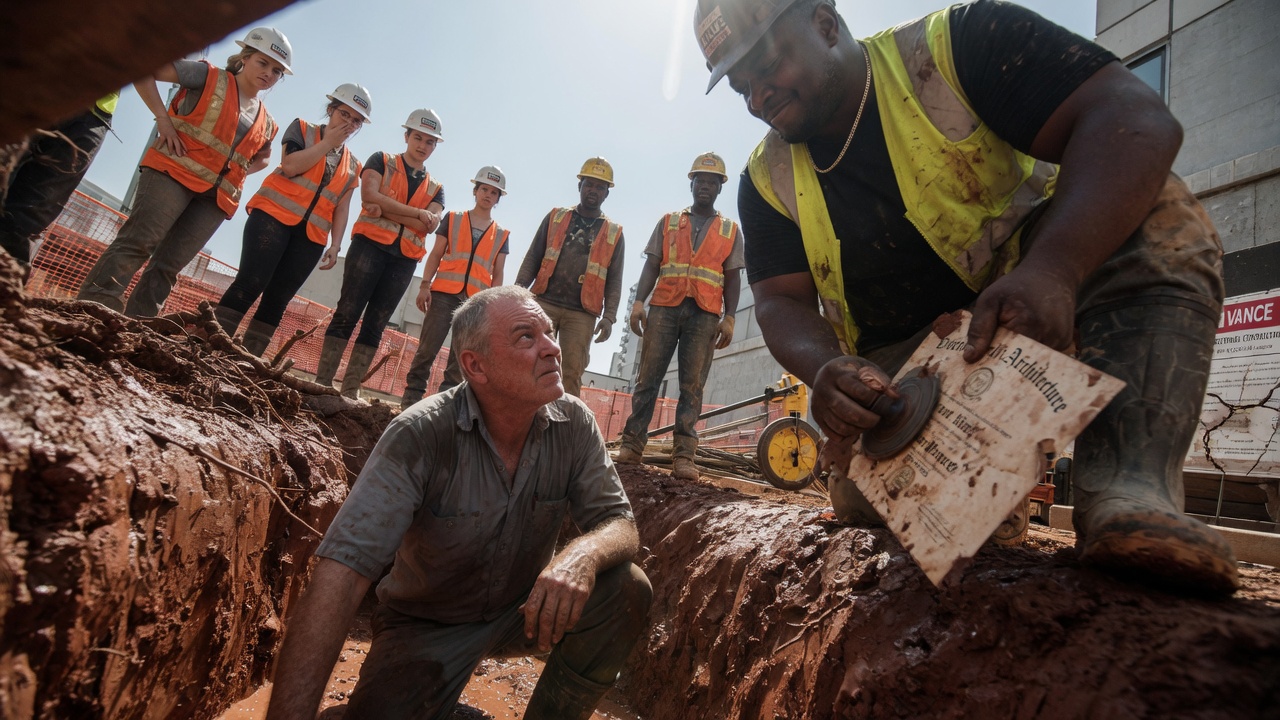
But today, Bear went too far. He found the one thing Arthur still carried from his old life—a tattered, mud-stained PhD diploma kept hidden in his lunchbox.
In front of a crowd of laborers and young interns, Bear dropped the diploma into the red clay and ground his boot into the paper. He wanted to see the “genius” break.
Arthur warned him once, his voice steady even as the humiliation reached a boiling point. When Bear laughed and escalated, the man they thought was a harmless academic moved with a terrifying, calculated precision.
The site went silent as the 250-pound foreman hit the mud, gasping for air and begging for mercy. The power dynamic on that construction site didn’t just shift; it shattered.
Arthur stood over him, not with rage, but with a quiet, dangerous dignity that proved you can take a man’s career, but you can’t take who he is.
Now the company is threatening legal action, and the video of the incident is spreading through the town. Arthur has a choice to make, and a secret to reveal that could burn the academic world to the ground.
The full story is in the comments.
Chapter 1
The humidity in Atlanta didn’t just sit on you; it owned you. It was a thick, wet blanket that smelled of diesel exhaust and turned the red clay of the construction site into a viscous, blood-colored soup. At fifty-five, Arthur Vance felt the weight of it in his marrow. His lower back was a screaming map of knots, and his hands, once used only for turning the pages of rare manuscripts and gesturing toward chalkboards, were now a landscape of cracked callouses and embedded grime.
He was currently at the bottom of a six-foot trench, the walls of damp earth pressing in on either side like the sides of a grave. He was digging a footer for what would eventually be a luxury condo complex, a place for people who would never know his name.
“How’s the view from down there, Professor?”
The voice came from above, accompanied by the sharp, rhythmic clink of a shovel hitting a stone. Arthur didn’t look up. He knew the voice. It belonged to Bear, a man twenty-five years his junior and twice his width, whose primary joy in life seemed to be the discovery that a man with a PhD in Philosophy could be forced to dig a hole for minimum wage.
“The soil composition is consistent, if that’s what you’re asking,” Arthur said, his voice raspy from the dust. He kept his rhythm, the spade biting into the clay.
“Listen to him,” Bear chuckled. Arthur could hear the others—Caleb and Jackson, two local kids who thought manual labor was a personality trait—joining in. “Soil composition. You hear that? He can’t just say it’s dirt. It’s gotta be ‘composition.’ Tell us, Doc, does the dirt feel bad about being moved? Is there a moral dilemma in the shovel?”
Arthur didn’t answer. Silence was his only armor. If he spoke, he risked the fragile peace he needed to finish the shift. He needed the eighty-eight dollars after taxes. He needed it for the morphine. He needed it for the nurse who came three times a week to sit with Diane while he was out here pretending he was still a man of consequence.
“Hey, I’m talking to you!” Bear’s shadow fell over the trench, blocking the brutal midday sun for a second.
Arthur stopped. He leaned on the handle of the spade, his chest heaving. He looked up, squinting. Bear was silhouetted against the white-hot sky, his neon yellow safety vest glowing like a warning sign.
“I heard you, Bear,” Arthur said quietly. “I’m working.”
“You’re lagging,” Bear said, his tone shifting from mockery to a low, jagged edge of authority. “The interns from the architecture firm are coming by at two. I want this footer cleared and level. I don’t want them seeing a ‘genius’ like you struggling with a simple trench. Makes me look bad for hiring a charity case.”
“I’m not a charity case,” Arthur said. The words felt heavy, like the clay.
“Then prove it. Dig faster.” Bear kicked a clod of red earth. It shattered against Arthur’s shoulder, the dust coating his grey work shirt. “And keep your mouth shut when the suits get here. Nobody wants a lecture on Hegel while they’re checking the grade.”
Bear walked away, his heavy boots thudding on the plywood walkways. Arthur stood in the trench for a long moment, the silence of the earth pressing against his ears. He reached into his pocket and felt the small, plastic bottle of ibuprofen. He took two without water, swallowing the bitter pills with a grimace.
He thought of Diane, lying in the darkened bedroom of their rented house, the one they’d moved into after the university had taken the faculty housing back. She would be awake now, staring at the ceiling, waiting for the sound of his truck. She didn’t know he was digging trenches. She thought he was doing “consulting work” for a local historical society. He couldn’t let her know the truth. He couldn’t let her final weeks be poisoned by the shame of his fall.
He went back to work. The spade went in. The spade came out. He moved the world, one heavy pound at a time. He was a man who had written three books on the ethics of power, and now he was being crushed by the simplest version of it: the power of a man who held a paycheck over his head.
The “cancellation,” as the newspapers had called it, had been surgical. A rival in the department, a man named Henderson whom Arthur had once mentored, had fabricated a series of emails. They suggested Arthur had traded grades for favors—a classic, ugly lie. By the time Arthur found the proof that Henderson had actually been the one plagiarizing his own graduate students to secure his tenure, the board had already voted. The university, terrified of a public relations nightmare, had cut him loose.
He could have burned it all down. He had the files. He had the evidence that would destroy Henderson and pull the rug out from under the university’s “prestige.” But the evidence also involved a student, a girl named Maya who had been Henderson’s victim. If Arthur released the proof, Maya’s reputation would be collateral damage. She was twenty-two, with a whole life ahead of her. Arthur was already a ghost.
So he had stayed silent. He had taken the fall. And now, he was at the bottom of a hole in Georgia, while the man who ruined him sat in an air-conditioned office in New Haven.
“Water break!” someone yelled.
Arthur climbed out of the trench, his knees popping like dry twigs. He walked over to the makeshift break area—a piece of plywood propped up on sawn-off barrels. His lunchbox sat there, a battered blue Igloo. Inside was a ham sandwich, a bruised apple, and tucked into the lid behind the thermos, the only thing he hadn’t been able to leave behind: his PhD diploma from Harvard.
It was a stupid thing to keep. It was a target. But on the days when the heat made him dizzy and Bear’s voice made him want to walk into traffic, he would touch the edge of the heavy paper. It was his proof that he existed before the dirt.
As he reached for the lunchbox, he saw Bear watching him from across the site. Bear wasn’t drinking water. He was talking to the young interns who had just arrived—clean-cut kids in crisp white hardhats. Bear gestured toward the trench, then toward Arthur. He was smiling. It wasn’t a friendly smile. It was the smile of a predator who had just spotted a limp.
Chapter 2
The interns were young enough to be Arthur’s students. They carried rolled-up blueprints like scepters and moved with a careful, tentative grace across the muddy site, trying to keep their expensive boots from getting ruined. Sarah, the lead intern, had a sharp, observant face. She looked at the blueprints, then at the trench Arthur had just climbed out of.
“The footer depth seems off on the southeast corner,” she said, her voice clear and professional.
Bear stepped closer to her, his posture widening. “We’re working on it. The soil here is tricky. A lot of red clay. My guy down there—Professor Vance—is supposed to be the expert on ‘composition.’ Right, Arthur?”
Arthur felt the eyes of the crew on him. Sarah turned, her gaze landing on Arthur. There was a flicker of something in her expression—a momentary pause, as if she were trying to place a face she’d seen in a dream.
“Vance?” she asked. “Arthur Vance?”
Arthur froze. He could feel the sweat cooling on his neck. “Just Arthur,” he said, reaching for his water bottle.
“You look like…” She trailed off, glancing at the other interns. “Never mind. It’s just a name.”
Bear’s eyes narrowed. He didn’t like the interruption of his dominance. He didn’t like that a girl in a white hardhat had looked at his laborer with anything other than indifference.
“He’s just an old guy who needs the work,” Bear said, his voice dropping an octave. “Don’t let the fancy talk fool you. He’s here to dig, not to design.”
“I was just checking the grade,” Arthur said to Sarah, ignoring Bear. “The clay holds more moisture toward the creek bed. If we go deeper than six feet without shoring, the walls will slump.”
Sarah nodded, impressed. “That’s exactly what the geotechnical report said. How did you know that?”
“I’ve spent a lot of time looking at dirt lately,” Arthur said.
Bear stepped between them, his chest inches from Arthur’s. “That’s enough. Sarah, why don’t you show the boys the specs for the rebar? Professor, get back in the hole. We’re losing light.”
Arthur didn’t move for a second. He looked Bear in the eye—not with aggression, but with the flat, tired recognition of what the man was. Bear’s jaw tightened. He wanted a reaction. He wanted Arthur to snap so he could have an excuse to break him.
Arthur turned and climbed back into the trench.
The afternoon dragged on. The heat became a physical enemy. Every time Arthur lifted a shovel, his vision pulsed with a dull, rhythmic throb. He could hear Bear talking to the interns above him, his voice booming with fake confidence.
“Yeah, we get all kinds out here,” Bear was saying. “Fringes of society. This one? He thinks he’s better than everyone because he read a few books. But out here, books don’t move dirt. Sweat moves dirt.”
Arthur concentrated on the rhythm. In. Lift. Throw. In. Lift. Throw. He thought about the logic of the Stoics. Marcus Aurelius had been an emperor, but he had understood that a man’s internal world was the only thing no one could touch. The soul is dyed by the color of its thoughts.
But the red clay was dying everything. It was under his fingernails, in his pores, in his lungs.
Around 3:00 PM, the interns moved toward the far end of the site. Bear stayed behind. He walked to the edge of Arthur’s trench and looked down.
“She recognized you, didn’t she?” Bear asked.
Arthur didn’t stop digging. “She recognized a name.”
“A famous name?” Bear kicked a small stone into the trench. It hit Arthur’s boot. “I looked you up, you know. Last night. I was wondering why a guy like you keeps a lunchbox like it’s a holy relic. You were some big shot. A ‘distinguished professor.’ Then you got caught with your hand in the cookie jar, didn’t you?”
Arthur stopped. He felt a coldness that had nothing to do with the weather. “You don’t know what you’re talking about.”
“I know what the internet says. Canceled. Fired. A moral failure. That’s the word they used. ‘Failure.'” Bear leaned down, his face split by a grin that was pure venom. “Must be hard. Going from a podium to a ditch. From being the guy with all the answers to the guy who takes orders from a ‘thug’ like me.”
“I don’t think you’re a thug, Bear,” Arthur said quietly. “I think you’re scared. I think you look at me and you see that life can be taken away in an afternoon. And that terrifies you.”
The grin vanished. Bear’s face went dark, the blood rushing to his cheeks. For a second, Arthur thought the man would jump into the trench. Instead, Bear stood up straight.
“You think you’re so smart,” Bear hissed. “But you’re just a man in a hole. And by the end of this week, I’m going to make sure you know exactly where you belong.”
Bear walked away. Arthur stayed in the trench, the spade heavy in his hands. He looked at his fingers. They were shaking. Not from fear, but from the sheer, exhausting effort of not fighting back. He had been a man of words his entire life. He had believed that reason could overcome anything.
But Bear didn’t care about reason. Bear cared about the weight of his boots.
That night, Arthur sat in his truck for twenty minutes before going inside the house. He used a gallon of water from a plastic jug to wash the worst of the clay off his arms and face. He changed into a clean shirt he kept in the cab. He checked his reflection in the rearview mirror. He looked old. He looked like a man who was losing a war.
He walked into the house. The smell of antiseptic and stale air hit him.
“Arthur?” Diane’s voice was weak, a silver thread in the dark hallway.
“I’m here, Dee,” he said, walking into the bedroom.
She was propped up on pillows, her skin the color of parchment. She smiled when she saw him, and for a moment, the weight of the trench lifted.
“How was the… the historical society?” she asked.
“Long,” he said, sitting on the edge of the bed and taking her hand. Her skin was so thin he could feel the pulse in her palm. “We’re cataloging some old land deeds. It’s tedious work, but it pays the bills.”
“You were always so good at the details,” she whispered. “I’m glad they have you, Arthur. They need someone who understands the value of the past.”
Arthur closed his eyes. He felt the lie like a physical weight in his chest. “I’m doing what I can, Dee. I’m doing what I can.”
He stayed with her until she fell asleep, then he went to the kitchen and ate his ham sandwich in the dark. He thought about the secret in his desk—the folder of evidence against Henderson. He could send it tomorrow. He could end the humiliation. But then he thought of Maya, the student. He thought of her face when she’d graduated, full of hope. If he burned Henderson, he burned her too.
He put his head in his hands. He was a man who had built his life on the idea of the “Good.” And now, the “Good” was demanding that he stay in the mud.
Chapter 3
The next morning, the site felt different. There was a buzz of anticipation among the crew. Bear was in a foul mood, barking orders and pacing the perimeter like a caged animal. Arthur went straight to his trench. He wanted to finish the footer and move to the other side of the site, away from Bear’s orbit.
He was four feet down when the architecture firm’s lead architect arrived—a man named Mr. Sterling, accompanied by Sarah and two other interns. Sterling was a man of immense self-importance, dressed in a tailored suit that cost more than Arthur’s truck.
“We need to check the structural integrity of the footer walls,” Sterling said, his voice echoing across the site. “Foreman, where is the man in charge of this section?”
Bear trotted over, his voice modulating into a subservient tone. “Right here, Mr. Sterling. My best man is on it. Professor Vance.”
Arthur stopped digging. He looked up. Bear was standing at the edge of the trench, and next to him, the architects were looking down.
“Vance?” Sterling asked, squinting. “The Arthur Vance? From the Ethics of Governance?”
Arthur felt the world tilt. He stood up straight, the spade at his side. “Yes.”
Sterling laughed, a dry, aristocratic sound. “I read your book in grad school. Brilliant stuff. A bit idealistic, perhaps, but brilliant. What on earth are you doing in a footer trench in north Georgia?”
Before Arthur could answer, Bear stepped in. “The Professor fell on some hard times, sir. Personal issues. Moral issues, I hear. I gave him a job because I believe in second chances.”
The humiliation was surgical. Bear wasn’t just insulting him; he was using Arthur’s past as a prop for his own “generosity.”
Sterling looked at Arthur with a mixture of pity and distaste. “I see. Well, the world is a fickle place, isn’t it? Sarah says you noticed the clay moisture levels. Good eye. But let’s stick to the specs, shall we?”
Sterling turned away, dismissing Arthur as if he were a piece of equipment. Sarah stayed for a second longer. She looked at Arthur, and he saw a flash of genuine horror in her eyes. She knew. She understood exactly what was happening. She opened her mouth to say something, but Bear stepped closer.
“Back to work, Professor,” Bear said, his voice dripping with satisfaction. “We have a schedule to keep.”
Arthur went back into the hole. The shame was a physical heat, worse than the sun. He could feel the eyes of the other laborers on him. Caleb and Jackson were snickering.
By noon, the heat was unbearable. The red clay had dried into a fine dust that coated everything. Arthur climbed out for his lunch break. He sat on a pile of lumber, his back to the crew. He opened his lunchbox.
He didn’t see Bear approaching until it was too late.
“What you got in there today, Doc?” Bear asked, his voice loud enough for everyone to hear. “A little caviar? A little chilled wine?”
Bear reached down and grabbed the lunchbox. Arthur stood up, his heart hammering against his ribs.
“Give it back, Bear,” Arthur said, his voice low and dangerous.
“What’s the matter? You hiding your secrets in here?” Bear flipped the lid open. He saw the sandwich, the apple, and then his eyes landed on the heavy, cream-colored paper tucked into the lid.
Bear pulled it out.
“Well, look at this,” Bear said, holding the diploma up. “Dr. Arthur Vance. Harvard University. Doctor of Philosophy. Summa Cum Laude.”
The crew drifted over, sensing blood in the water. The architects were still on the far side of the site, but they were watching now.
“It’s just a piece of paper, Bear,” Arthur said. He could feel the panic rising, the desperate need to protect the last shred of his dignity. “Put it back.”
“A piece of paper?” Bear laughed. “This is your life, isn’t it? This is the thing that makes you think you’re better than us. This fancy Latin and the gold seal. You carry it around like a lucky charm.”
Bear looked at the crew. “Hey, boys! The Professor brought his diploma to work! I guess he wants us to know he’s the smartest man in the ditch!”
“Put it back,” Arthur repeated. His hands were clenched at his sides.
“I think it needs a little local flavor,” Bear said. He dropped the diploma onto the ground. The heavy paper landed in a puddle of muddy water.
Arthur lunged forward, but Bear was faster. He stepped on the diploma, his heavy work boot grinding the cream-colored paper into the red clay.
“Oops,” Bear said. “My mistake. I guess a Harvard degree doesn’t hold up too well against Georgia mud.”
The crew erupted in laughter. Arthur stared at the boot, at the way the mud was seeping into the fibers of the paper, destroying the seal, erasing the name he had worked twenty years to earn.
“You missed a spot, Professor,” Bear said, kicking a pile of dirt onto Arthur’s shoulders. “Why don’t you give us a lecture on why a ‘genius’ like you is at the bottom of my hole? Or better yet, recite some Shakespeare for us while I cool you off.”
Bear reached for a five-gallon bucket of water that was sitting nearby—water used for mixing mortar, grey and gritty with silt.
“Recite something, Doc!” Bear yelled.
He swung the bucket.
The water hit Arthur with the force of a physical blow. It was cold and filthy, stinging his eyes and soaking his shirt. He stood there, dripping, the mud from the water mixing with the red clay on his skin.
He looked down at the diploma under Bear’s boot. It was ruined. A sodden, grey mess.
The world went quiet. The laughter of the crew seemed to recede, replaced by a high, ringing sound in Arthur’s ears. He felt something shift inside him—a fundamental break. The man who believed in words, the man who believed in the “Good,” the man who stayed silent to protect a girl he barely knew—that man was gone.
In his place was something older. Something colder.
Arthur looked up at Bear.
“Take your foot off that paper, Bear,” Arthur said. His voice wasn’t loud. It was a flat, dead calm that cut through the humidity like a blade. “This is your only warning.”
Chapter 4
Bear laughed, a harsh, barking sound that didn’t quite reach his eyes. He saw something in Arthur’s face that he hadn’t seen before—a stillness that made the hair on his arms stand up. But he had an audience. He couldn’t back down.
“Or what, Professor?” Bear sneered. He ground his boot harder into the mud, the paper tearing under the pressure. “You going to quote a poem at me? You going to tell me how this violates the social contract?”
Bear reached out and grabbed Arthur’s collar, his massive fist bunching the wet grey fabric. He pulled Arthur closer, his breath smelling of stale coffee and cigarettes.
“You’re nothing,” Bear hissed, loud enough for the interns and the crew to hear. “You’re a used-up old man in a wet shirt. Now, say ‘Thank you, Bear, for the bath,’ or I’m going to bury you in that trench.”
Arthur didn’t blink. He didn’t flinch. He looked at Bear’s hand on his collar, then back at Bear’s eyes.
“I told you,” Arthur said. “Take your foot off the paper.”
Bear shoved Arthur back, a hard, disrespectful jolt intended to humiliate. “Make me.”
Arthur didn’t wait. He didn’t hesitate. The years of quiet study, the decades of intellectual restraint—it all collapsed into a single, kinetic moment.
Bear moved to shove him again, his arm extending in a slow, arrogant arc.
Arthur planted his lead foot. As Bear’s hand reached his chest, Arthur snapped his left arm down in a sharp, violent arc, catching Bear’s forearm and slamming it off-line. The force of the strike was shocking. Bear’s shoulder turned off-axis, his massive frame lurching forward as his balance was stripped away.
Arthur didn’t give him time to recover. He stepped deep into Bear’s space, his entire body weight behind the movement. He drove his right palm—the heel of his hand, hardened by weeks of shovel work—directly into Bear’s sternum.
It wasn’t a punch. It was a structural collapse.
The sound was a dull, heavy thud that echoed in the silence of the site. Bear’s chest jolted, his lungs seizing as the air was forced out of him. His safety vest rippled from the impact. His eyes went wide, his mouth opening in a silent gasp. He stumbled back, his boots scrambling for purchase on the slippery plywood.
Arthur didn’t stop. He planted his standing foot, his hip driving forward with a precision that was terrifying to watch. He lifted his knee and drove a front push kick directly into the center of Bear’s chest.
It was a clean, brutal extension. Arthur’s heel made visible contact, pushing through Bear’s centerline.
Bear didn’t just fall. He was launched.
He hit the muddy trench wall behind him with a wet, heavy impact. He slid down the red clay, his arms flailing, and landed hard in the bottom of the trench he had forced Arthur to dig. A cloud of red dust and mud kicked up around him.
The silence that followed was absolute.
The crew stood frozen, shovels held halfway to the ground. The architects stood on the edge of the site, Sarah’s hand over her mouth, Sterling’s jaw literally hanging open.
Arthur stood at the edge of the trench. He wasn’t breathing hard. He looked down at Bear.
Bear was lying in the mud, gasping for air, his face pale and contorted with pain. He tried to sit up, but his hand went to his ribs, and he let out a thin, wheezing moan. He looked up at Arthur, and for the first time, the dominance was gone. There was only raw, unadulterated terror.
“Wait—stop!” Bear wheezed, his voice cracking. He raised one hand defensively, cowering in the red soup at the bottom of the hole. “My ribs… I think you broke something! Don’t… please!”
Arthur didn’t move. He looked at the man begging in the mud—the man who had spent weeks trying to erase him. He felt no triumph. He felt only a profound, echoing exhaustion.
He reached down and picked up his lunchbox. He looked at the ruined diploma, a grey, torn scrap of paper barely recognizable as an achievement. He let it drop back into the mud.
“I might be a ‘genius’ at the bottom of a hole, Bear,” Arthur said, his voice carrying clearly across the silent site. “But I’m still the man who just put you there.”
He turned and looked at the crew. Caleb and Jackson stepped back, their eyes wide. He looked at Sarah. She was staring at him, not with pity anymore, but with a strange, burgeoning respect.
“I’m done for the day,” Arthur said to the world at large.
He walked toward his truck. His boots felt heavy, the red clay clinging to them like the weight of a past he could no longer escape. He didn’t look back at the trench. He didn’t look back at the foreman begging for mercy.
He got into his truck and started the engine. He looked at his hands. They were steady.
He knew what was coming. The police would be called. The company would fire him. The video—he’d seen the phones out—would be everywhere by sunset. The secret he had kept, the quiet life he had tried to build for Diane, was over.
But as he pulled out of the muddy lot and onto the county road, Arthur felt a strange, cold clarity. He had spent his life teaching the theory of justice. Today, he had finally practiced it.
He drove toward home, the Atlanta sun setting behind him, casting long, bloody shadows over the red earth. He had a wife to hold, a secret to reveal, and a world to burn down. And for the first time in years, he wasn’t afraid of the fire.